Copyright © 2019 HashiCorp
LGPD e Desafios de Segurança
na Época de Transformação Digital
Stenio Ferreira– SE @ Hashicorp
Copyright © 2020 HashiCorp ∕
Agenda
 LGPD em 30 segundos
 Contexto “Transformação Digital” e visão Hashicorp
 Vault em 30 segundos
 Casos de Uso LGPD
- Privacy by Design
- Separação de Responsabilidades
- Transferência Internacional
Copyright © 2019 HashiCorp
LGPD
Lei Geral de Proteção de Dados
Copyright © 2020 HashiCorp ∕
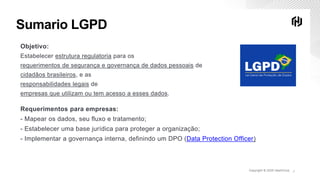
Sumario LGPD
Requerimentos para empresas:
- Mapear os dados, seu fluxo e tratamento;
- Estabelecer uma base jurídica para proteger a organização;
- Implementar a governança interna, definindo um DPO (Data Protection Officer)
Objetivo:
Estabelecer estrutura regulatoria para os
requerimentos de segurança e governança de dados pessoais de
cidadãos brasileiros, e as
responsabilidades legais de
empresas que utilizam ou tem acesso a esses dados.
Copyright © 2020 HashiCorp ∕
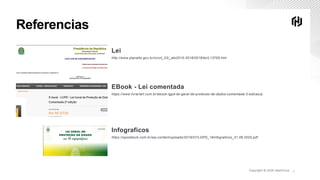
Referencias
Lei
http://www.planalto.gov.br/ccivil_03/_ato2015-2018/2018/lei/L13709.htm
EBook - Lei comentada
https://www.livrariart.com.br/ebook-lgpd-lei-geral-de-protecao-de-dados-comentada-2-edicao/p
Infograficos
https://opiceblum.com.br/wp-content/uploads/2019/07/LGPD_16infograficos_31.08.2020.pdf
Copyright © 2020 HashiCorp ∕
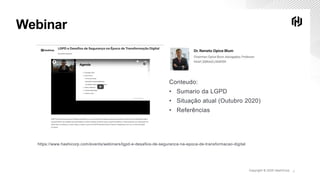
Webinar
https://www.hashicorp.com/events/webinars/lgpd-e-desafios-de-seguranca-na-epoca-de-transformacao-digital
Conteudo:
• Sumario da LGPD
• Situação atual (Outubro 2020)
• Referências
Copyright © 2019 HashiCorp
Transformação
Digital
Copyright © 2020 HashiCorp ∕
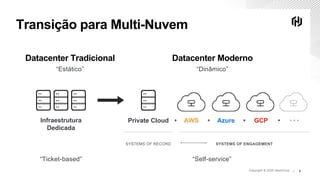
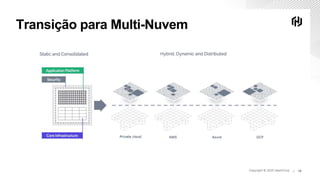
Transição para Multi-Nuvem
Copyright © 2020 HashiCorp ∕ 8
Datacenter Tradicional
“Estático”
Infraestrutura
Dedicada
Datacenter Moderno
“Dinâmico”
AWS Azure GCP+ + +Private Cloud +
SYSTEMS OF RECORD SYSTEMS OF ENGAGEMENT
“Ticket-based” “Self-service”
∕Copyright © 2019 HashiCorpCopyright © 2018 HashiCorp ∕ 9
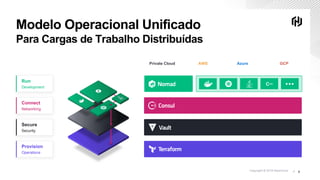
Modelo Operacional Unificado
Para Cargas de Trabalho Distribuídas
C++
Provision
Operations
Secure
Security
Run
Development
Connect
Networking
Private Cloud AWS Azure GCP
Copyright © 2020 HashiCorp ∕
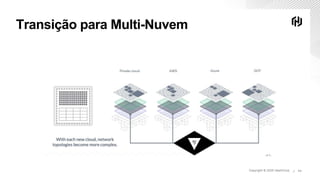
Transição para Multi-Nuvem
Copyright © 2020 HashiCorp ∕ 10
Copyright © 2020 HashiCorp ∕
Transição para Multi-Nuvem
Copyright © 2020 HashiCorp ∕ 11
Copyright © 2019 HashiCorp
Hashicorp Vault
Copyright © 2020 HashiCorp ∕
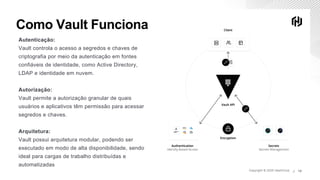
Como Vault Funciona
13∕
Autenticação:
Vault controla o acesso a segredos e chaves de
criptografia por meio da autenticação em fontes
confiáveis de identidade, como Active Directory,
LDAP e identidade em nuvem.
Autorização:
Vault permite a autorização granular de quais
usuários e aplicativos têm permissão para acessar
segredos e chaves.
Arquitetura:
Vault possui arquitetura modular, podendo ser
executado em modo de alta disponibilidade, sendo
ideal para cargas de trabalho distribuídas e
automatizadas
Copyright © 2019 HashiCorp
Casos de Uso LGPD
Copyright © 2020 HashiCorp ∕Copyright © 2020 HashiCorp ∕ 15
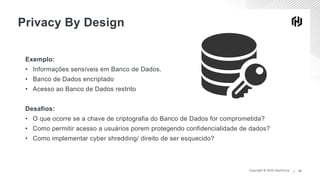
Privacy By Design
Exemplo:
• Informações sensíveis em Banco de Dados.
• Banco de Dados encriptado
• Acesso ao Banco de Dados restrito
Desafios:
• O que ocorre se a chave de criptografia do Banco de Dados for comprometida?
• Como permitir acesso a usuários porem protegendo confidencialidade de dados?
• Como implementar cyber shredding/ direito de ser esquecido?
Copyright © 2020 HashiCorp ∕Copyright © 2020 HashiCorp ∕ 16
Privacy By Design
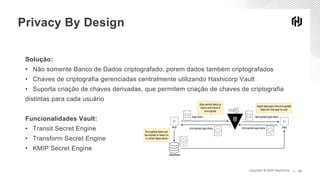
Solução:
• Não somente Banco de Dados criptografado, porem dados também criptografados
• Chaves de criptografia gerenciadas centralmente utilizando Hashicorp Vault
• Suporta criação de chaves derivadas, que permitem criação de chaves de criptografia
distintas para cada usuário
Funcionalidades Vault:
• Transit Secret Engine
• Transform Secret Engine
• KMIP Secret Engine
Copyright © 2020 HashiCorp ∕Copyright © 2020 HashiCorp ∕ 17
Privacy By Design
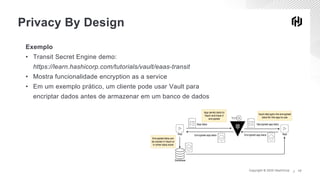
Exemplo
• Transit Secret Engine demo:
https://learn.hashicorp.com/tutorials/vault/eaas-transit
• Mostra funcionalidade encryption as a service
• Em um exemplo prático, um cliente pode usar Vault para
encriptar dados antes de armazenar em um banco de dados
Copyright © 2020 HashiCorp ∕Copyright © 2020 HashiCorp ∕ 18
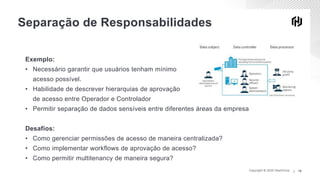
Separação de Responsabilidades
Exemplo:
• Necessário garantir que usuários tenham mínimo
acesso possível.
• Habilidade de descrever hierarquias de aprovação
de acesso entre Operador e Controlador
• Permitir separação de dados sensíveis entre diferentes áreas da empresa
Desafios:
• Como gerenciar permissões de acesso de maneira centralizada?
• Como implementar workflows de aprovação de acesso?
• Como permitir multitenancy de maneira segura?
Copyright © 2020 HashiCorp ∕Copyright © 2020 HashiCorp ∕ 19
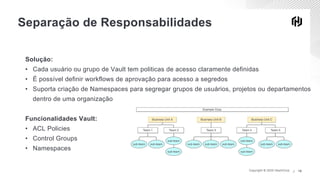
Solução:
• Cada usuário ou grupo de Vault tem politicas de acesso claramente definidas
• É possível definir workflows de aprovação para acesso a segredos
• Suporta criação de Namespaces para segregar grupos de usuários, projetos ou departamentos
dentro de uma organização
Funcionalidades Vault:
• ACL Policies
• Control Groups
• Namespaces
Separação de Responsabilidades
Copyright © 2020 HashiCorp ∕Copyright © 2020 HashiCorp ∕ 20
Exemplo 1
• ACL Policies demo:
https://learn.hashicorp.com/tutorials/vault/policies?in=vault/interactive
• Em um caso real, permite implementar politica de minimo acesso possivel
Exemplo 2
• Referencia Control Groups:
https://learn.hashicorp.com/tutorials/vault/control-groups?in=vault/policies
• Em um caso real, poderia ser utilizado para descrever fluxo de aprovação
para que um cliente tenha acesso a um segredo mais restrito
Separação de Responsabilidades
(Requer Vault Enterprise)
Copyright © 2020 HashiCorp ∕Copyright © 2020 HashiCorp ∕ 21
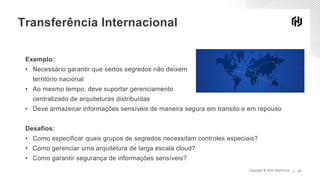
Transferência Internacional
Exemplo:
• Necessário garantir que certos segredos não deixem
território nacional
• Ao mesmo tempo, deve suportar gerenciamento
centralizado de arquiteturas distribuídas
• Deve armazenar informações sensíveis de maneira segura em transito e em repouso
Desafios:
• Como especificar quais grupos de segredos necessitam controles especiais?
• Como gerenciar uma arquitetura de larga escala cloud?
• Como garantir segurança de informações sensíveis?
Copyright © 2020 HashiCorp ∕Copyright © 2020 HashiCorp ∕ 22
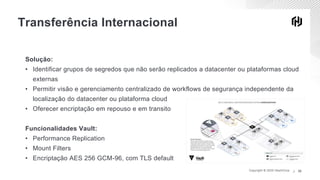
Solução:
• Identificar grupos de segredos que não serão replicados a datacenter ou plataformas cloud
externas
• Permitir visão e gerenciamento centralizado de workflows de segurança independente da
localização do datacenter ou plataforma cloud
• Oferecer encriptação em repouso e em transito
Funcionalidades Vault:
• Performance Replication
• Mount Filters
• Encriptação AES 256 GCM-96, com TLS default
Transferência Internacional
Copyright © 2020 HashiCorp ∕Copyright © 2020 HashiCorp ∕ 23
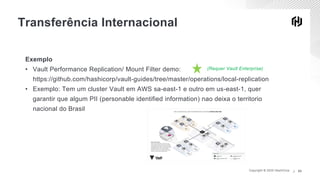
Exemplo
• Vault Performance Replication/ Mount Filter demo:
https://github.com/hashicorp/vault-guides/tree/master/operations/local-replication
• Exemplo: Tem um cluster Vault em AWS sa-east-1 e outro em us-east-1, quer
garantir que algum PII (personable identified information) nao deixa o territorio
nacional do Brasil
Transferência Internacional
(Requer Vault Enterprise)
Copyright © 2020 HashiCorp ∕Copyright © 2020 HashiCorp ∕ 24
• LPGPD é uma realidade, e somente formaliza boas praticas de mercado
• Eventuais custos de conformidade serão menores que custos com
incidentes de segurança
• Hashicorp Vault permite cumprir com requerimentos de segurança em
workflows de automação/devops
• Planejamento de adequação a LGPD posicionará empresas para se
tornarem mais competitivas no mercado moderno
Conclusão
∕Copyright © 2019 HashiCorp
25
www.hashicorp.com
stenio@hashicorp.com
Obrigado!

Lgpd webinar hashitalks brasil 2020

  • 1.
    Copyright © 2019HashiCorp LGPD e Desafios de Segurança na Época de Transformação Digital Stenio Ferreira– SE @ Hashicorp
  • 2.
    Copyright © 2020HashiCorp ∕ Agenda  LGPD em 30 segundos  Contexto “Transformação Digital” e visão Hashicorp  Vault em 30 segundos  Casos de Uso LGPD - Privacy by Design - Separação de Responsabilidades - Transferência Internacional
  • 3.
    Copyright © 2019HashiCorp LGPD Lei Geral de Proteção de Dados
  • 4.
    Copyright © 2020HashiCorp ∕ Sumario LGPD Requerimentos para empresas: - Mapear os dados, seu fluxo e tratamento; - Estabelecer uma base jurídica para proteger a organização; - Implementar a governança interna, definindo um DPO (Data Protection Officer) Objetivo: Estabelecer estrutura regulatoria para os requerimentos de segurança e governança de dados pessoais de cidadãos brasileiros, e as responsabilidades legais de empresas que utilizam ou tem acesso a esses dados.
  • 5.
    Copyright © 2020HashiCorp ∕ Referencias Lei http://www.planalto.gov.br/ccivil_03/_ato2015-2018/2018/lei/L13709.htm EBook - Lei comentada https://www.livrariart.com.br/ebook-lgpd-lei-geral-de-protecao-de-dados-comentada-2-edicao/p Infograficos https://opiceblum.com.br/wp-content/uploads/2019/07/LGPD_16infograficos_31.08.2020.pdf
  • 6.
    Copyright © 2020HashiCorp ∕ Webinar https://www.hashicorp.com/events/webinars/lgpd-e-desafios-de-seguranca-na-epoca-de-transformacao-digital Conteudo: • Sumario da LGPD • Situação atual (Outubro 2020) • Referências
  • 7.
    Copyright © 2019HashiCorp Transformação Digital
  • 8.
    Copyright © 2020HashiCorp ∕ Transição para Multi-Nuvem Copyright © 2020 HashiCorp ∕ 8 Datacenter Tradicional “Estático” Infraestrutura Dedicada Datacenter Moderno “Dinâmico” AWS Azure GCP+ + +Private Cloud + SYSTEMS OF RECORD SYSTEMS OF ENGAGEMENT “Ticket-based” “Self-service”
  • 9.
    ∕Copyright © 2019HashiCorpCopyright © 2018 HashiCorp ∕ 9 Modelo Operacional Unificado Para Cargas de Trabalho Distribuídas C++ Provision Operations Secure Security Run Development Connect Networking Private Cloud AWS Azure GCP
  • 10.
    Copyright © 2020HashiCorp ∕ Transição para Multi-Nuvem Copyright © 2020 HashiCorp ∕ 10
  • 11.
    Copyright © 2020HashiCorp ∕ Transição para Multi-Nuvem Copyright © 2020 HashiCorp ∕ 11
  • 12.
    Copyright © 2019HashiCorp Hashicorp Vault
  • 13.
    Copyright © 2020HashiCorp ∕ Como Vault Funciona 13∕ Autenticação: Vault controla o acesso a segredos e chaves de criptografia por meio da autenticação em fontes confiáveis de identidade, como Active Directory, LDAP e identidade em nuvem. Autorização: Vault permite a autorização granular de quais usuários e aplicativos têm permissão para acessar segredos e chaves. Arquitetura: Vault possui arquitetura modular, podendo ser executado em modo de alta disponibilidade, sendo ideal para cargas de trabalho distribuídas e automatizadas
  • 14.
    Copyright © 2019HashiCorp Casos de Uso LGPD
  • 15.
    Copyright © 2020HashiCorp ∕Copyright © 2020 HashiCorp ∕ 15 Privacy By Design Exemplo: • Informações sensíveis em Banco de Dados. • Banco de Dados encriptado • Acesso ao Banco de Dados restrito Desafios: • O que ocorre se a chave de criptografia do Banco de Dados for comprometida? • Como permitir acesso a usuários porem protegendo confidencialidade de dados? • Como implementar cyber shredding/ direito de ser esquecido?
  • 16.
    Copyright © 2020HashiCorp ∕Copyright © 2020 HashiCorp ∕ 16 Privacy By Design Solução: • Não somente Banco de Dados criptografado, porem dados também criptografados • Chaves de criptografia gerenciadas centralmente utilizando Hashicorp Vault • Suporta criação de chaves derivadas, que permitem criação de chaves de criptografia distintas para cada usuário Funcionalidades Vault: • Transit Secret Engine • Transform Secret Engine • KMIP Secret Engine
  • 17.
    Copyright © 2020HashiCorp ∕Copyright © 2020 HashiCorp ∕ 17 Privacy By Design Exemplo • Transit Secret Engine demo: https://learn.hashicorp.com/tutorials/vault/eaas-transit • Mostra funcionalidade encryption as a service • Em um exemplo prático, um cliente pode usar Vault para encriptar dados antes de armazenar em um banco de dados
  • 18.
    Copyright © 2020HashiCorp ∕Copyright © 2020 HashiCorp ∕ 18 Separação de Responsabilidades Exemplo: • Necessário garantir que usuários tenham mínimo acesso possível. • Habilidade de descrever hierarquias de aprovação de acesso entre Operador e Controlador • Permitir separação de dados sensíveis entre diferentes áreas da empresa Desafios: • Como gerenciar permissões de acesso de maneira centralizada? • Como implementar workflows de aprovação de acesso? • Como permitir multitenancy de maneira segura?
  • 19.
    Copyright © 2020HashiCorp ∕Copyright © 2020 HashiCorp ∕ 19 Solução: • Cada usuário ou grupo de Vault tem politicas de acesso claramente definidas • É possível definir workflows de aprovação para acesso a segredos • Suporta criação de Namespaces para segregar grupos de usuários, projetos ou departamentos dentro de uma organização Funcionalidades Vault: • ACL Policies • Control Groups • Namespaces Separação de Responsabilidades
  • 20.
    Copyright © 2020HashiCorp ∕Copyright © 2020 HashiCorp ∕ 20 Exemplo 1 • ACL Policies demo: https://learn.hashicorp.com/tutorials/vault/policies?in=vault/interactive • Em um caso real, permite implementar politica de minimo acesso possivel Exemplo 2 • Referencia Control Groups: https://learn.hashicorp.com/tutorials/vault/control-groups?in=vault/policies • Em um caso real, poderia ser utilizado para descrever fluxo de aprovação para que um cliente tenha acesso a um segredo mais restrito Separação de Responsabilidades (Requer Vault Enterprise)
  • 21.
    Copyright © 2020HashiCorp ∕Copyright © 2020 HashiCorp ∕ 21 Transferência Internacional Exemplo: • Necessário garantir que certos segredos não deixem território nacional • Ao mesmo tempo, deve suportar gerenciamento centralizado de arquiteturas distribuídas • Deve armazenar informações sensíveis de maneira segura em transito e em repouso Desafios: • Como especificar quais grupos de segredos necessitam controles especiais? • Como gerenciar uma arquitetura de larga escala cloud? • Como garantir segurança de informações sensíveis?
  • 22.
    Copyright © 2020HashiCorp ∕Copyright © 2020 HashiCorp ∕ 22 Solução: • Identificar grupos de segredos que não serão replicados a datacenter ou plataformas cloud externas • Permitir visão e gerenciamento centralizado de workflows de segurança independente da localização do datacenter ou plataforma cloud • Oferecer encriptação em repouso e em transito Funcionalidades Vault: • Performance Replication • Mount Filters • Encriptação AES 256 GCM-96, com TLS default Transferência Internacional
  • 23.
    Copyright © 2020HashiCorp ∕Copyright © 2020 HashiCorp ∕ 23 Exemplo • Vault Performance Replication/ Mount Filter demo: https://github.com/hashicorp/vault-guides/tree/master/operations/local-replication • Exemplo: Tem um cluster Vault em AWS sa-east-1 e outro em us-east-1, quer garantir que algum PII (personable identified information) nao deixa o territorio nacional do Brasil Transferência Internacional (Requer Vault Enterprise)
  • 24.
    Copyright © 2020HashiCorp ∕Copyright © 2020 HashiCorp ∕ 24 • LPGPD é uma realidade, e somente formaliza boas praticas de mercado • Eventuais custos de conformidade serão menores que custos com incidentes de segurança • Hashicorp Vault permite cumprir com requerimentos de segurança em workflows de automação/devops • Planejamento de adequação a LGPD posicionará empresas para se tornarem mais competitivas no mercado moderno Conclusão
  • 25.
    ∕Copyright © 2019HashiCorp 25 www.hashicorp.com stenio@hashicorp.com Obrigado!

Notas do Editor

  • #3 Talk about what’s happening in the world of infrastructure where we are going through a transition that happens in our industry every 20 years: this time from one which is largely dedicated servers in a private datacenter to a pool of compute capacity available on demand. In simple terms, this is a shift from “static” infrastructure to ‘dynamic infrastructure’ which is the reality of cloud. And while the first cloud provider was AWS, it is clear that it will be a multi-cloud world. Each of these platforms have their own key advantages and so it is inevitable that most G2K organizations will use more than one. This is not about moving applications around (since data gravity is a constraint) but rather creates a need for a common operating model across these distinct platforms that allows different teams to leverage the platform for their choice.
  • #5 Talk about what’s happening in the world of infrastructure where we are going through a transition that happens in our industry every 20 years: this time from one which is largely dedicated servers in a private datacenter to a pool of compute capacity available on demand. In simple terms, this is a shift from “static” infrastructure to ‘dynamic infrastructure’ which is the reality of cloud. And while the first cloud provider was AWS, it is clear that it will be a multi-cloud world. Each of these platforms have their own key advantages and so it is inevitable that most G2K organizations will use more than one. This is not about moving applications around (since data gravity is a constraint) but rather creates a need for a common operating model across these distinct platforms that allows different teams to leverage the platform for their choice.
  • #6 Talk about what’s happening in the world of infrastructure where we are going through a transition that happens in our industry every 20 years: this time from one which is largely dedicated servers in a private datacenter to a pool of compute capacity available on demand. In simple terms, this is a shift from “static” infrastructure to ‘dynamic infrastructure’ which is the reality of cloud. And while the first cloud provider was AWS, it is clear that it will be a multi-cloud world. Each of these platforms have their own key advantages and so it is inevitable that most G2K organizations will use more than one. This is not about moving applications around (since data gravity is a constraint) but rather creates a need for a common operating model across these distinct platforms that allows different teams to leverage the platform for their choice.
  • #7 Talk about what’s happening in the world of infrastructure where we are going through a transition that happens in our industry every 20 years: this time from one which is largely dedicated servers in a private datacenter to a pool of compute capacity available on demand. In simple terms, this is a shift from “static” infrastructure to ‘dynamic infrastructure’ which is the reality of cloud. And while the first cloud provider was AWS, it is clear that it will be a multi-cloud world. Each of these platforms have their own key advantages and so it is inevitable that most G2K organizations will use more than one. This is not about moving applications around (since data gravity is a constraint) but rather creates a need for a common operating model across these distinct platforms that allows different teams to leverage the platform for their choice.
  • #9 Talk about what’s happening in the world of infrastructure where we are going through a transition that happens in our industry every 20 years: this time from one which is largely dedicated servers in a private datacenter to a pool of compute capacity available on demand. In simple terms, this is a shift from “static” infrastructure to ‘dynamic infrastructure’ which is the reality of cloud. And while the first cloud provider was AWS, it is clear that it will be a multi-cloud world. Each of these platforms have their own key advantages and so it is inevitable that most G2K organizations will use more than one. This is not about moving applications around (since data gravity is a constraint) but rather creates a need for a common operating model across these distinct platforms that allows different teams to leverage the platform for their choice.
  • #11 Talk about what’s happening in the world of infrastructure where we are going through a transition that happens in our industry every 20 years: this time from one which is largely dedicated servers in a private datacenter to a pool of compute capacity available on demand. In simple terms, this is a shift from “static” infrastructure to ‘dynamic infrastructure’ which is the reality of cloud. And while the first cloud provider was AWS, it is clear that it will be a multi-cloud world. Each of these platforms have their own key advantages and so it is inevitable that most G2K organizations will use more than one. This is not about moving applications around (since data gravity is a constraint) but rather creates a need for a common operating model across these distinct platforms that allows different teams to leverage the platform for their choice.
  • #12 Talk about what’s happening in the world of infrastructure where we are going through a transition that happens in our industry every 20 years: this time from one which is largely dedicated servers in a private datacenter to a pool of compute capacity available on demand. In simple terms, this is a shift from “static” infrastructure to ‘dynamic infrastructure’ which is the reality of cloud. And while the first cloud provider was AWS, it is clear that it will be a multi-cloud world. Each of these platforms have their own key advantages and so it is inevitable that most G2K organizations will use more than one. This is not about moving applications around (since data gravity is a constraint) but rather creates a need for a common operating model across these distinct platforms that allows different teams to leverage the platform for their choice.
  • #14 Talk about what’s happening in the world of infrastructure where we are going through a transition that happens in our industry every 20 years: this time from one which is largely dedicated servers in a private datacenter to a pool of compute capacity available on demand. In simple terms, this is a shift from “static” infrastructure to ‘dynamic infrastructure’ which is the reality of cloud. And while the first cloud provider was AWS, it is clear that it will be a multi-cloud world. Each of these platforms have their own key advantages and so it is inevitable that most G2K organizations will use more than one. This is not about moving applications around (since data gravity is a constraint) but rather creates a need for a common operating model across these distinct platforms that allows different teams to leverage the platform for their choice.
  • #16 Talk about what’s happening in the world of infrastructure where we are going through a transition that happens in our industry every 20 years: this time from one which is largely dedicated servers in a private datacenter to a pool of compute capacity available on demand. In simple terms, this is a shift from “static” infrastructure to ‘dynamic infrastructure’ which is the reality of cloud. And while the first cloud provider was AWS, it is clear that it will be a multi-cloud world. Each of these platforms have their own key advantages and so it is inevitable that most G2K organizations will use more than one. This is not about moving applications around (since data gravity is a constraint) but rather creates a need for a common operating model across these distinct platforms that allows different teams to leverage the platform for their choice.
  • #17 Talk about what’s happening in the world of infrastructure where we are going through a transition that happens in our industry every 20 years: this time from one which is largely dedicated servers in a private datacenter to a pool of compute capacity available on demand. In simple terms, this is a shift from “static” infrastructure to ‘dynamic infrastructure’ which is the reality of cloud. And while the first cloud provider was AWS, it is clear that it will be a multi-cloud world. Each of these platforms have their own key advantages and so it is inevitable that most G2K organizations will use more than one. This is not about moving applications around (since data gravity is a constraint) but rather creates a need for a common operating model across these distinct platforms that allows different teams to leverage the platform for their choice.
  • #18 Talk about what’s happening in the world of infrastructure where we are going through a transition that happens in our industry every 20 years: this time from one which is largely dedicated servers in a private datacenter to a pool of compute capacity available on demand. In simple terms, this is a shift from “static” infrastructure to ‘dynamic infrastructure’ which is the reality of cloud. And while the first cloud provider was AWS, it is clear that it will be a multi-cloud world. Each of these platforms have their own key advantages and so it is inevitable that most G2K organizations will use more than one. This is not about moving applications around (since data gravity is a constraint) but rather creates a need for a common operating model across these distinct platforms that allows different teams to leverage the platform for their choice.
  • #19 Talk about what’s happening in the world of infrastructure where we are going through a transition that happens in our industry every 20 years: this time from one which is largely dedicated servers in a private datacenter to a pool of compute capacity available on demand. In simple terms, this is a shift from “static” infrastructure to ‘dynamic infrastructure’ which is the reality of cloud. And while the first cloud provider was AWS, it is clear that it will be a multi-cloud world. Each of these platforms have their own key advantages and so it is inevitable that most G2K organizations will use more than one. This is not about moving applications around (since data gravity is a constraint) but rather creates a need for a common operating model across these distinct platforms that allows different teams to leverage the platform for their choice.
  • #20 Talk about what’s happening in the world of infrastructure where we are going through a transition that happens in our industry every 20 years: this time from one which is largely dedicated servers in a private datacenter to a pool of compute capacity available on demand. In simple terms, this is a shift from “static” infrastructure to ‘dynamic infrastructure’ which is the reality of cloud. And while the first cloud provider was AWS, it is clear that it will be a multi-cloud world. Each of these platforms have their own key advantages and so it is inevitable that most G2K organizations will use more than one. This is not about moving applications around (since data gravity is a constraint) but rather creates a need for a common operating model across these distinct platforms that allows different teams to leverage the platform for their choice.
  • #21 Talk about what’s happening in the world of infrastructure where we are going through a transition that happens in our industry every 20 years: this time from one which is largely dedicated servers in a private datacenter to a pool of compute capacity available on demand. In simple terms, this is a shift from “static” infrastructure to ‘dynamic infrastructure’ which is the reality of cloud. And while the first cloud provider was AWS, it is clear that it will be a multi-cloud world. Each of these platforms have their own key advantages and so it is inevitable that most G2K organizations will use more than one. This is not about moving applications around (since data gravity is a constraint) but rather creates a need for a common operating model across these distinct platforms that allows different teams to leverage the platform for their choice.
  • #22 Talk about what’s happening in the world of infrastructure where we are going through a transition that happens in our industry every 20 years: this time from one which is largely dedicated servers in a private datacenter to a pool of compute capacity available on demand. In simple terms, this is a shift from “static” infrastructure to ‘dynamic infrastructure’ which is the reality of cloud. And while the first cloud provider was AWS, it is clear that it will be a multi-cloud world. Each of these platforms have their own key advantages and so it is inevitable that most G2K organizations will use more than one. This is not about moving applications around (since data gravity is a constraint) but rather creates a need for a common operating model across these distinct platforms that allows different teams to leverage the platform for their choice.
  • #23 Talk about what’s happening in the world of infrastructure where we are going through a transition that happens in our industry every 20 years: this time from one which is largely dedicated servers in a private datacenter to a pool of compute capacity available on demand. In simple terms, this is a shift from “static” infrastructure to ‘dynamic infrastructure’ which is the reality of cloud. And while the first cloud provider was AWS, it is clear that it will be a multi-cloud world. Each of these platforms have their own key advantages and so it is inevitable that most G2K organizations will use more than one. This is not about moving applications around (since data gravity is a constraint) but rather creates a need for a common operating model across these distinct platforms that allows different teams to leverage the platform for their choice.
  • #24 Talk about what’s happening in the world of infrastructure where we are going through a transition that happens in our industry every 20 years: this time from one which is largely dedicated servers in a private datacenter to a pool of compute capacity available on demand. In simple terms, this is a shift from “static” infrastructure to ‘dynamic infrastructure’ which is the reality of cloud. And while the first cloud provider was AWS, it is clear that it will be a multi-cloud world. Each of these platforms have their own key advantages and so it is inevitable that most G2K organizations will use more than one. This is not about moving applications around (since data gravity is a constraint) but rather creates a need for a common operating model across these distinct platforms that allows different teams to leverage the platform for their choice.
  • #25 Talk about what’s happening in the world of infrastructure where we are going through a transition that happens in our industry every 20 years: this time from one which is largely dedicated servers in a private datacenter to a pool of compute capacity available on demand. In simple terms, this is a shift from “static” infrastructure to ‘dynamic infrastructure’ which is the reality of cloud. And while the first cloud provider was AWS, it is clear that it will be a multi-cloud world. Each of these platforms have their own key advantages and so it is inevitable that most G2K organizations will use more than one. This is not about moving applications around (since data gravity is a constraint) but rather creates a need for a common operating model across these distinct platforms that allows different teams to leverage the platform for their choice.