Utilização do Telescópio
em Observações
Astronômicas
Eder Martioli
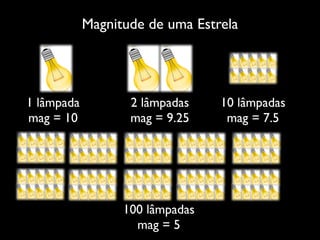
Magnitude de uma Estrela
1 lâmpada
mag = 10
2 lâmpadas
mag = 9.25
10 lâmpadas
mag = 7.5
100 lâmpadas
mag = 5
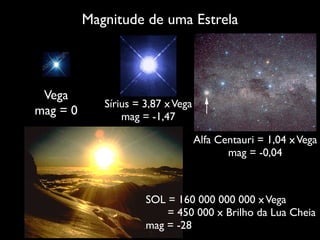
Magnitude de uma Estrela
Vega
mag = 0
Sírius = 3,87 xVega
mag = -1,47
SOL = 160 000 000 000 xVega
= 450 000 x Brilho da Lua Cheia
mag = -28
Alfa Centauri = 1,04 xVega
mag = -0,04
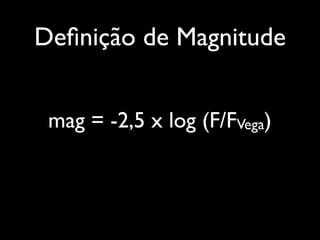
Definição de Magnitude
mag = -2,5 x log (F/FVega)
As 10 estrelas mais brilhantes do céu:
Sol -28
Sirius -1,47
Canopus -0,63
Alfa Centauro -0,04
Arcturus -0,07
Vega 0,00
Capella 0,06
Rigel 0,15
Procyon 0,37
Achernar 0,43
−29.30 
Sun as seen from Mercury at perihelion
−26.73 
Sun (449,000 times brighter than full moon)
−19.3 
 Sun as seen from Neptune
−12.6 
 Full Moon
−9.0 
 Maximum brightness of an Iridium (satellite) flare
−6.0 
 The Crab Supernova (SN 1054) of AD 1054 (6500 light years away)
−4.6 
 Maximum brightness of Venus when illuminated as a crescent and the International Space Station (when the ISS is at its
perigee and fully lit by the sun)[3]
−4 
Faintest objects observable during the day with naked eye when Sun high in the sky
−3.8 
 Minimum brightness of Venus when it is on the far side of the Sun
−2.9 
 Maximum brightness of Mars
−2.9 
 Maximum brightness of Jupiter
−2.5 
 Faintest objects observable during the day with naked eye when Sun less than 10° above horizon
−1.9 
 Maximum brightness of Mercury at superior conjunction
−1.47 
 Brightest star (except for the sun) at visible wavelengths: Sirius
−0.7 
 Second-brightest star: Canopus
−0.4 
 Maximum brightness of Saturn at opposition and when the rings are full open (2003, 2018)
0 
 The zero point by definition: This used to be Vega
3 ... 4 
 Faintest stars visible in an urban neighborhood with naked eye
4.6 
Maximum brightness of Ganymede
5.1 
Maximum brightness of brightest asteroid Vesta
5.5 
Maximum brightness of Uranus
6.4 
Maximum brightness of asteroid Pallas
6.5 
Faintest stars observable with naked eye under perfect conditions
6.7 
Maximum brightness of Ceres
7.7 
Maximum brightness of Neptune
9.1 
Maximum brightness of 10 Hygiea
9.5 
Faintest objects visible using common 7x50 binoculars
10.2 
 Maximum brightness of Iapetus
12.9 
 Brightest quasar 3C 273 (2.4 Giga-light years away)
13.65 
 Maximum brightness of Pluto (1,148 times fainter than naked-eye visibility)
15.6 
 Maximum brightness of centaur Chiron
18.7 
 Current opposition brightness of Eris
20.7 
 Callirrhoe (small ~8km satellite of Jupiter)
23 
Maximum brightness of Pluto's smallest moons Hydra and Nix
25 
Fenrir (small ~4km satellite of Saturn)
27 
Faintest objects observable in visible light with 8m ground-based telescopes
30 
Faintest objects observable in visible light with Hubble Space Telescope
35 
Sedna at aphelion (900 AU)
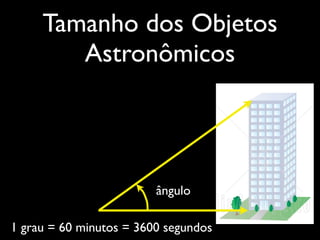
Tamanho dos Objetos
Astronômicos
ângulo
1 grau = 60 minutos = 3600 segundos
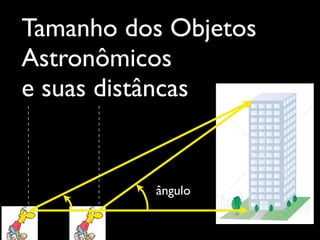
Tamanho dos Objetos
Astronômicos
e suas distâncas
ângulo
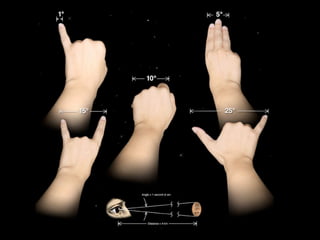
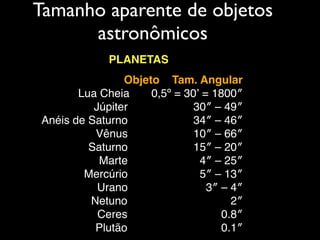
Tamanho aparente de objetos
astronômicos
PLANETAS
Objeto Tam. Angular
Lua Cheia 0,5º = 30’ = 1800″
Júpiter 30″ – 49″
Anéis de Saturno 34″ – 46″
Vênus 10″ – 66″
Saturno 15″ – 20″
Marte 4″ – 25″
Mercúrio 5″ – 13″
Urano 3″ – 4″
Netuno 2″
Ceres 0.8″
Plutão 0.1″
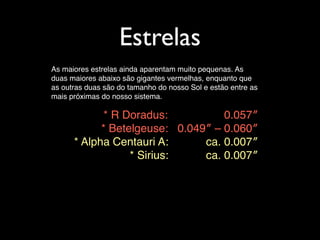
Estrelas
As maiores estrelas ainda aparentam muito pequenas. As
duas maiores abaixo são gigantes vermelhas, enquanto que
as outras duas são do tamanho do nosso Sol e estão entre as
mais próximas do nosso sistema.
* R Doradus: 0.057″
* Betelgeuse: 0.049″ – 0.060″
* Alpha Centauri A: ca. 0.007″
* Sirius: ca. 0.007″
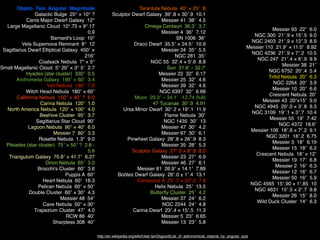
Objeto Tam. Angular Magnitude
Galactic Bulge 25° × 10° ?
Canis Major Dwarf Galaxy 12°
Large Magellanic Cloud 10°.75 × 9°.17
0.9
Barnard's Loop 10°
Vela Supernova Remnant 8° 12
Sagittarius Dwarf Elliptical Galaxy 450′ ×
216′
Coalsack Nebula 7° × 5°
Small Magellanic Cloud 5° 20′ × 3° 5′ 2.7
Hyades (star cluster) 330′ 0.5
Andromeda Galaxy 190′ × 60′ 3.4
Veil Nebula 180′ 7.0
Witch Head Nebula 180′ × 60′
California Nebula 150′ × 40′ ? 6.0
Carina Nebula 120′ 1.0
North America Nebula 120′ × 100′ 4.0
Beehive Cluster 95′ 3.7
Sagittarius Star Cloud 90′
Lagoon Nebula 90′ × 40′ 6.0
Messier 7 80′ 3.3
Rosette Nebula 1.3° 9.0
Pleiades (star cluster) 75′ × 50′ ? 2.8 -
5.6
Triangulum Galaxy 70.8′ × 41.7′ 6.27
Orion Nebula 65′ 3.0
Brocchi's Cluster 60′ 3.6
Puppis A 60′
Heart Nebula 60′ 18.3
Pelican Nebula 60′ × 50′
Double Cluster 60′ × 30′ 4.3
Messier 48 54′
Cave Nebula 50′ × 30′
Trapezium Cluster 47′ 4.0
RCW 86 40′
Sharpless 308 40′
Tarantula Nebula 40′ × 25′ 8
Sculptor Dwarf Galaxy 39′.8 × 30′.9 10.1
Messier 41 38′ 4.5
Omega Centauri 36.3′ 3.7
Messier 4 36′ 7.12
SN 1006 36′
Draco Dwarf 35.5′ × 24.5′ 10.9
Messier 34 35′ 5.5
NGC 281 35′
NGC 55 32'.4 × 5'.6 8.8
Sun 31.6' – 32.7'
Messier 22 32′ 6.17
Messier 25 32′ 4.6
Messier 39 32′ 4.6
NGC 6397 32′ 6.68
Moon 29.3′ – 34.1' -12.74 (full)
47 Tucanae 30′.9 4.91
Ursa Minor Dwarf 30′.2 × 19′.1 11.9
Flame Nebula 30′
NGC 1435 30′ 13
Messier 47 30′ 4.2
Messier 67 30′ 6.1
Pinwheel Galaxy 28′.8 × 26′.9 8.3
Messier 35 28′ 5.3
Sculptor Galaxy 27′.5 × 6′.8 8.0
Messier 23 27′ 6.9
Messier 46 27′ 6.1
Messier 81 26.9′ × 14.1′ 7.89
Boötes Dwarf Galaxy 26′.0 ± 1′.4 13.1
Centaurus A 25′.7 × 20′.0 7.8
Helix Nebula 25′ 13.5
Butterfly Cluster 25′ 4.2
Messier 37 24′ 6.2
NGC 2244 24′ 4.8
Carina Dwarf 23′.4 × 15′.5 11.3
Messier 5 23′ 6.65
Messier 13 23′ 5.8
Messier 93 22′ 6.0
NGC 300 21′.9 × 15′.5 9.0
NGC 2403 21′.9 × 12′.3 8.9
Messier 110 21.9′ × 11.0′ 8.92
NGC 4236 21′.9 × 7′.2 10.5
NGC 247 21′.4 × 6′.9 9.9
Messier 38 21′
NGC 6752 20′.4 5.4
Trifid Nebula 20′ 6.3
NGC 2264 20′ 3.9
Messier 10 20′ 6.6
Crescent Nebula 20′
Messier 43 20′x15′ 9.0
NGC 4945 20′.0 × 3′.8 9.3
NGC 3109 19′.1 × 3′.7 10.4
Messier 55 19′ 7.42
NGC 4372 18.6′
Messier 106 18′.6 × 7′.2 9.1
NGC 3201 18′.2 6.75
Messier 3 18′ 6.19
Messier 15 18′ 6.2
Crescent Nebula 18′ × 12′
Messier 19 17′ 6.8
Messier 2 16′ 6.3
Messier 12 16′ 6.7
Messier 50 16′ 5.9
NGC 4565 15′.90 × 1′.85 10
NGC 4631 15′.5 × 2′.7 9.8
Messier 26 15′ 8.0
Wild Duck Cluster 14′ 6.3
http://en.wikipedia.org/wiki/User:IanOsgood/List_of_astronomical_objects_by_angular_size
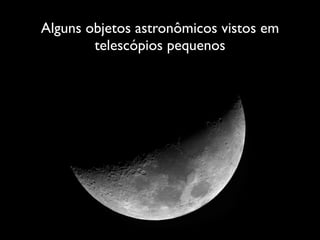
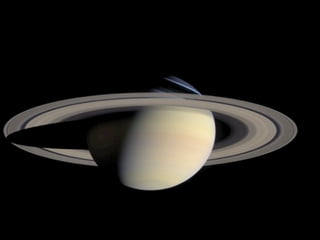
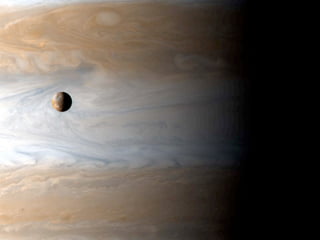
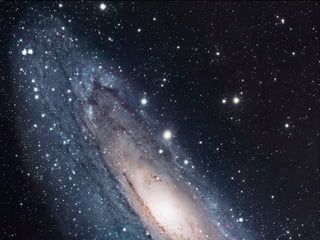
Alguns objetos astronômicos vistos em
telescópios pequenos
Dicas para saber o que
observar
• www.skymaps.com
• Programa Stellarium
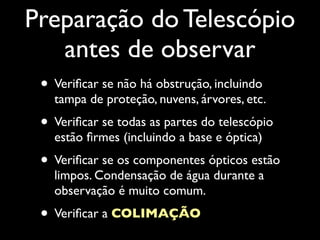
Preparação do Telescópio
antes de observar
• Verificar se não há obstrução, incluindo
tampa de proteção, nuvens, árvores, etc.
• Verificar se todas as partes do telescópio
estão firmes (incluindo a base e óptica)
• Verificar se os componentes ópticos estão
limpos. Condensação de água durante a
observação é muito comum.
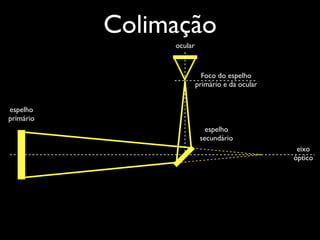
• Verificar a COLIMAÇÃO
Foco do espelho
primário e da ocular
eixo
óptico
espelho
secundário
espelho
primário
ocular
Colimação
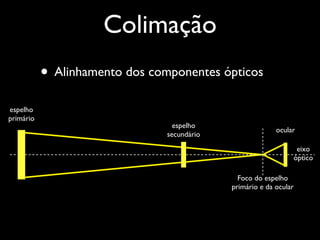
• Alinhamento dos componentes ópticos
Foco do espelho
primário e da ocular
eixo
óptico
espelho
secundário
espelho
primário
ocular
Colimação
Foco do espelho
primário e da ocular
eixo
ópticoeixo óptico do
esp. primário
espelho
secundário
espelho
primário
ocular
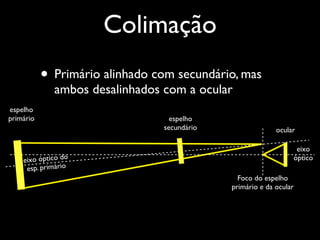
• Primário alinhado com secundário, mas
ambos desalinhados com a ocular
Colimação
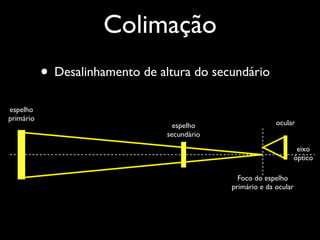
• Desalinhamento de altura do secundário
Foco do espelho
primário e da ocular
eixo
óptico
espelho
secundário
espelho
primário
ocular
Colimação
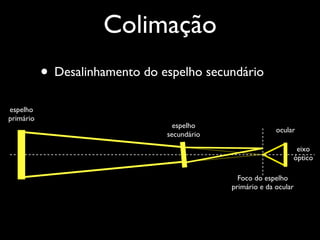
• Desalinhamento do espelho secundário
Foco do espelho
primário e da ocular
eixo
óptico
espelho
secundário
espelho
primário
ocular
Colimação
Passo I
• Olhe através do focalizador sem a ocular
• Posicione os espelhos de forma que:
- O secundário fique centralizado com o
orifício da ocular
-Você enxergue o primário inteiramente a
partir do secundário
- O secudário esteja centralizado com o
primário
Dica
• Você pode utilizar uma massinha, ou
qualquer outra coisa para marcar o centro
do espelho primário. Isso ajudará no
alinhamento.
Outra dica
• O alinhamento deve ser feito de fora pra
dentro, ou de cima pra baixo.
Ou seja, sempre termine o alinhamento
com o espelho primário!!!
Passo II
• Olhe através da entrada principal do tubo.
Faça isso com bastante luz, suficiente pra
ver todos os espelhos.Alinhe os espelhos
utilizando os parafusos de ajuste. Comece
sempre pelo espelho secundário.
Passo III
• Alinhamento do Espelho primário com a
ocular
• Utilize para isso uma ocular com um
pequeno orifício no centro. Esse orifício
deve estar centrado no encaixe da ocular.
• Olhe através desse orifício e alinhe o
centro do espelho primário com o centro
da ocular.
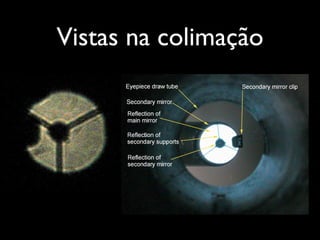
Vistas na colimação

Curso Telescópio Aula 4

  • 1.
    Utilização do Telescópio emObservações Astronômicas Eder Martioli
  • 2.
    Magnitude de umaEstrela 1 lâmpada mag = 10 2 lâmpadas mag = 9.25 10 lâmpadas mag = 7.5 100 lâmpadas mag = 5
  • 3.
    Magnitude de umaEstrela Vega mag = 0 Sírius = 3,87 xVega mag = -1,47 SOL = 160 000 000 000 xVega = 450 000 x Brilho da Lua Cheia mag = -28 Alfa Centauri = 1,04 xVega mag = -0,04
  • 4.
    Definição de Magnitude mag= -2,5 x log (F/FVega)
  • 5.
    As 10 estrelasmais brilhantes do céu: Sol -28 Sirius -1,47 Canopus -0,63 Alfa Centauro -0,04 Arcturus -0,07 Vega 0,00 Capella 0,06 Rigel 0,15 Procyon 0,37 Achernar 0,43
  • 6.
    −29.30 Sun asseen from Mercury at perihelion −26.73 Sun (449,000 times brighter than full moon) −19.3 Sun as seen from Neptune −12.6 Full Moon −9.0 Maximum brightness of an Iridium (satellite) flare −6.0 The Crab Supernova (SN 1054) of AD 1054 (6500 light years away) −4.6 Maximum brightness of Venus when illuminated as a crescent and the International Space Station (when the ISS is at its perigee and fully lit by the sun)[3] −4 Faintest objects observable during the day with naked eye when Sun high in the sky −3.8 Minimum brightness of Venus when it is on the far side of the Sun −2.9 Maximum brightness of Mars −2.9 Maximum brightness of Jupiter −2.5 Faintest objects observable during the day with naked eye when Sun less than 10° above horizon −1.9 Maximum brightness of Mercury at superior conjunction −1.47 Brightest star (except for the sun) at visible wavelengths: Sirius −0.7 Second-brightest star: Canopus −0.4 Maximum brightness of Saturn at opposition and when the rings are full open (2003, 2018) 0 The zero point by definition: This used to be Vega 3 ... 4 Faintest stars visible in an urban neighborhood with naked eye 4.6 Maximum brightness of Ganymede 5.1 Maximum brightness of brightest asteroid Vesta 5.5 Maximum brightness of Uranus 6.4 Maximum brightness of asteroid Pallas 6.5 Faintest stars observable with naked eye under perfect conditions 6.7 Maximum brightness of Ceres 7.7 Maximum brightness of Neptune 9.1 Maximum brightness of 10 Hygiea 9.5 Faintest objects visible using common 7x50 binoculars 10.2 Maximum brightness of Iapetus 12.9 Brightest quasar 3C 273 (2.4 Giga-light years away) 13.65 Maximum brightness of Pluto (1,148 times fainter than naked-eye visibility) 15.6 Maximum brightness of centaur Chiron 18.7 Current opposition brightness of Eris 20.7 Callirrhoe (small ~8km satellite of Jupiter) 23 Maximum brightness of Pluto's smallest moons Hydra and Nix 25 Fenrir (small ~4km satellite of Saturn) 27 Faintest objects observable in visible light with 8m ground-based telescopes 30 Faintest objects observable in visible light with Hubble Space Telescope 35 Sedna at aphelion (900 AU)
  • 7.
    Tamanho dos Objetos Astronômicos ângulo 1grau = 60 minutos = 3600 segundos
  • 8.
    Tamanho dos Objetos Astronômicos esuas distâncas ângulo
  • 10.
    Tamanho aparente deobjetos astronômicos PLANETAS Objeto Tam. Angular Lua Cheia 0,5º = 30’ = 1800″ Júpiter 30″ – 49″ Anéis de Saturno 34″ – 46″ Vênus 10″ – 66″ Saturno 15″ – 20″ Marte 4″ – 25″ Mercúrio 5″ – 13″ Urano 3″ – 4″ Netuno 2″ Ceres 0.8″ Plutão 0.1″
  • 11.
    Estrelas As maiores estrelasainda aparentam muito pequenas. As duas maiores abaixo são gigantes vermelhas, enquanto que as outras duas são do tamanho do nosso Sol e estão entre as mais próximas do nosso sistema. * R Doradus: 0.057″ * Betelgeuse: 0.049″ – 0.060″ * Alpha Centauri A: ca. 0.007″ * Sirius: ca. 0.007″
  • 12.
    Objeto Tam. AngularMagnitude Galactic Bulge 25° × 10° ? Canis Major Dwarf Galaxy 12° Large Magellanic Cloud 10°.75 × 9°.17 0.9 Barnard's Loop 10° Vela Supernova Remnant 8° 12 Sagittarius Dwarf Elliptical Galaxy 450′ × 216′ Coalsack Nebula 7° × 5° Small Magellanic Cloud 5° 20′ × 3° 5′ 2.7 Hyades (star cluster) 330′ 0.5 Andromeda Galaxy 190′ × 60′ 3.4 Veil Nebula 180′ 7.0 Witch Head Nebula 180′ × 60′ California Nebula 150′ × 40′ ? 6.0 Carina Nebula 120′ 1.0 North America Nebula 120′ × 100′ 4.0 Beehive Cluster 95′ 3.7 Sagittarius Star Cloud 90′ Lagoon Nebula 90′ × 40′ 6.0 Messier 7 80′ 3.3 Rosette Nebula 1.3° 9.0 Pleiades (star cluster) 75′ × 50′ ? 2.8 - 5.6 Triangulum Galaxy 70.8′ × 41.7′ 6.27 Orion Nebula 65′ 3.0 Brocchi's Cluster 60′ 3.6 Puppis A 60′ Heart Nebula 60′ 18.3 Pelican Nebula 60′ × 50′ Double Cluster 60′ × 30′ 4.3 Messier 48 54′ Cave Nebula 50′ × 30′ Trapezium Cluster 47′ 4.0 RCW 86 40′ Sharpless 308 40′ Tarantula Nebula 40′ × 25′ 8 Sculptor Dwarf Galaxy 39′.8 × 30′.9 10.1 Messier 41 38′ 4.5 Omega Centauri 36.3′ 3.7 Messier 4 36′ 7.12 SN 1006 36′ Draco Dwarf 35.5′ × 24.5′ 10.9 Messier 34 35′ 5.5 NGC 281 35′ NGC 55 32'.4 × 5'.6 8.8 Sun 31.6' – 32.7' Messier 22 32′ 6.17 Messier 25 32′ 4.6 Messier 39 32′ 4.6 NGC 6397 32′ 6.68 Moon 29.3′ – 34.1' -12.74 (full) 47 Tucanae 30′.9 4.91 Ursa Minor Dwarf 30′.2 × 19′.1 11.9 Flame Nebula 30′ NGC 1435 30′ 13 Messier 47 30′ 4.2 Messier 67 30′ 6.1 Pinwheel Galaxy 28′.8 × 26′.9 8.3 Messier 35 28′ 5.3 Sculptor Galaxy 27′.5 × 6′.8 8.0 Messier 23 27′ 6.9 Messier 46 27′ 6.1 Messier 81 26.9′ × 14.1′ 7.89 Boötes Dwarf Galaxy 26′.0 ± 1′.4 13.1 Centaurus A 25′.7 × 20′.0 7.8 Helix Nebula 25′ 13.5 Butterfly Cluster 25′ 4.2 Messier 37 24′ 6.2 NGC 2244 24′ 4.8 Carina Dwarf 23′.4 × 15′.5 11.3 Messier 5 23′ 6.65 Messier 13 23′ 5.8 Messier 93 22′ 6.0 NGC 300 21′.9 × 15′.5 9.0 NGC 2403 21′.9 × 12′.3 8.9 Messier 110 21.9′ × 11.0′ 8.92 NGC 4236 21′.9 × 7′.2 10.5 NGC 247 21′.4 × 6′.9 9.9 Messier 38 21′ NGC 6752 20′.4 5.4 Trifid Nebula 20′ 6.3 NGC 2264 20′ 3.9 Messier 10 20′ 6.6 Crescent Nebula 20′ Messier 43 20′x15′ 9.0 NGC 4945 20′.0 × 3′.8 9.3 NGC 3109 19′.1 × 3′.7 10.4 Messier 55 19′ 7.42 NGC 4372 18.6′ Messier 106 18′.6 × 7′.2 9.1 NGC 3201 18′.2 6.75 Messier 3 18′ 6.19 Messier 15 18′ 6.2 Crescent Nebula 18′ × 12′ Messier 19 17′ 6.8 Messier 2 16′ 6.3 Messier 12 16′ 6.7 Messier 50 16′ 5.9 NGC 4565 15′.90 × 1′.85 10 NGC 4631 15′.5 × 2′.7 9.8 Messier 26 15′ 8.0 Wild Duck Cluster 14′ 6.3 http://en.wikipedia.org/wiki/User:IanOsgood/List_of_astronomical_objects_by_angular_size
  • 13.
    Alguns objetos astronômicosvistos em telescópios pequenos
  • 28.
    Dicas para sabero que observar • www.skymaps.com • Programa Stellarium
  • 29.
    Preparação do Telescópio antesde observar • Verificar se não há obstrução, incluindo tampa de proteção, nuvens, árvores, etc. • Verificar se todas as partes do telescópio estão firmes (incluindo a base e óptica) • Verificar se os componentes ópticos estão limpos. Condensação de água durante a observação é muito comum. • Verificar a COLIMAÇÃO
  • 30.
    Foco do espelho primárioe da ocular eixo óptico espelho secundário espelho primário ocular Colimação
  • 31.
    • Alinhamento doscomponentes ópticos Foco do espelho primário e da ocular eixo óptico espelho secundário espelho primário ocular Colimação
  • 32.
    Foco do espelho primárioe da ocular eixo ópticoeixo óptico do esp. primário espelho secundário espelho primário ocular • Primário alinhado com secundário, mas ambos desalinhados com a ocular Colimação
  • 33.
    • Desalinhamento dealtura do secundário Foco do espelho primário e da ocular eixo óptico espelho secundário espelho primário ocular Colimação
  • 34.
    • Desalinhamento doespelho secundário Foco do espelho primário e da ocular eixo óptico espelho secundário espelho primário ocular Colimação
  • 35.
    Passo I • Olheatravés do focalizador sem a ocular • Posicione os espelhos de forma que: - O secundário fique centralizado com o orifício da ocular -Você enxergue o primário inteiramente a partir do secundário - O secudário esteja centralizado com o primário
  • 36.
    Dica • Você podeutilizar uma massinha, ou qualquer outra coisa para marcar o centro do espelho primário. Isso ajudará no alinhamento.
  • 37.
    Outra dica • Oalinhamento deve ser feito de fora pra dentro, ou de cima pra baixo. Ou seja, sempre termine o alinhamento com o espelho primário!!!
  • 38.
    Passo II • Olheatravés da entrada principal do tubo. Faça isso com bastante luz, suficiente pra ver todos os espelhos.Alinhe os espelhos utilizando os parafusos de ajuste. Comece sempre pelo espelho secundário.
  • 39.
    Passo III • Alinhamentodo Espelho primário com a ocular • Utilize para isso uma ocular com um pequeno orifício no centro. Esse orifício deve estar centrado no encaixe da ocular. • Olhe através desse orifício e alinhe o centro do espelho primário com o centro da ocular.
  • 40.