Guimarães – The cradle city of Portugal
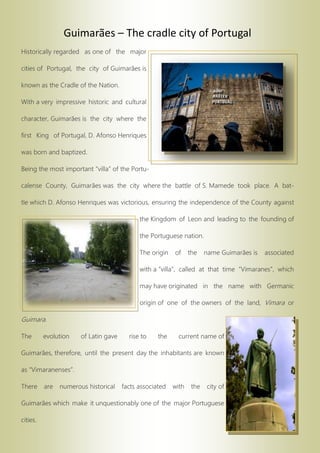
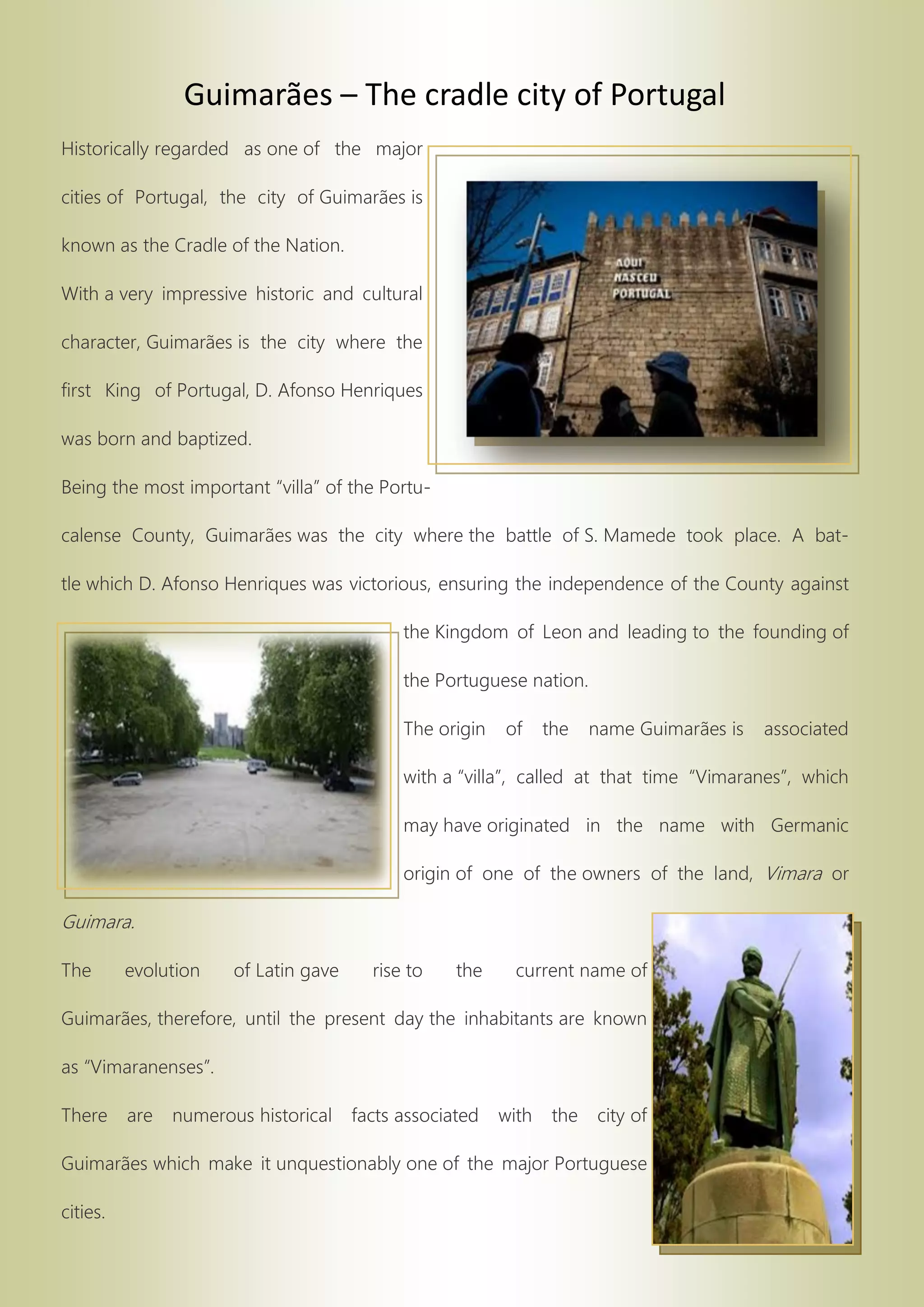
Historically regarded as one of the major
cities of Portugal, the city of Guimarães is
known as the Cradle of the Nation.
With a very impressive historic and cultural
character, Guimarães is the city where the
first King of Portugal, D. Afonso Henriques
was born and baptized.
Being the most important “villa” of the Portu-
calense County, Guimarães was the city where the battle of S. Mamede took place. A bat-
tle which D. Afonso Henriques was victorious, ensuring the independence of the County against
the Kingdom of Leon and leading to the founding of
the Portuguese nation.
The origin of the name Guimarães is associated
with a “villa”, called at that time “Vimaranes”, which
may have originated in the name with Germanic
origin of one of the owners of the land, Vimara or
Guimara.
The evolution of Latin gave rise to the current name of
Guimarães, therefore, until the present day the inhabitants are known
as “Vimaranenses”.
There are numerous historical facts associated with the city of
Guimarães which make it unquestionably one of the major Portuguese
cities.
Guimarães – a cidade berço de Portugal
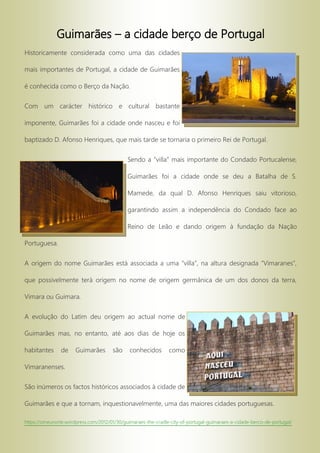
Historicamente considerada como uma das cidades
mais importantes de Portugal, a cidade de Guimarães
é conhecida como o Berço da Nação.
Com um carácter histórico e cultural bastante
imponente, Guimarães foi a cidade onde nasceu e foi
baptizado D. Afonso Henriques, que mais tarde se tornaria o primeiro Rei de Portugal.
Sendo a “villa” mais importante do Condado Portucalense,
Guimarães foi a cidade onde se deu a Batalha de S.
Mamede, da qual D. Afonso Henriques saiu vitorioso,
garantindo assim a independência do Condado face ao
Reino de Leão e dando origem à fundação da Nação
Portuguesa.
A origem do nome Guimarães está associada a uma “villa”, na altura designada “Vimaranes”,
que possivelmente terá origem no nome de origem germânica de um dos donos da terra,
Vimara ou Guimara.
A evolução do Latim deu origem ao actual nome de
Guimarães mas, no entanto, até aos dias de hoje os
habitantes de Guimarães são conhecidos como
Vimaranenses.
São inúmeros os factos históricos associados à cidade de
Guimarães e que a tornam, inquestionavelmente, uma das maiores cidades portuguesas.
https://omeunorte.wordpress.com/2012/01/30/guimaraes-the-cradle-city-of-portugal-guimaraes-a-cidade-berco-de-portugal/
Oliveira Square and the Battle of Salado Memorial
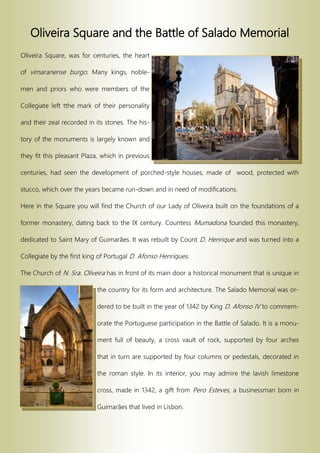
Oliveira Square, was for centuries, the heart
of vimaranense burgo. Many kings, noble-
men and priors who were members of the
Collegiate left tthe mark of their personality
and their zeal recorded in its stones. The his-
tory of the monuments is largely known and
they fit this pleasant Plaza, which in previous
centuries, had seen the development of porched-style houses, made of wood, protected with
stucco, which over the years became run-down and in need of modifications.
Here in the Square you will find the Church of our Lady of Oliveira built on the foundations of a
former monastery, dating back to the IX century. Countess Mumadona founded this monastery,
dedicated to Saint Mary of Guimarães. It was rebuilt by Count D. Henrique and was turned into a
Collegiate by the first king of Portugal D. Afonso Henriques.
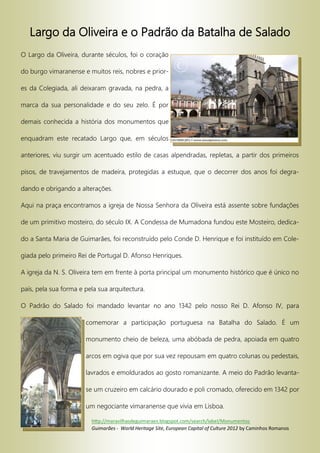
The Church of N. Sra. Oliveira has in front of its main door a historical monument that is unique in
the country for its form and architecture. The Salado Memorial was or-
dered to be built in the year of 1342 by King D. Afonso IV to commem-
orate the Portuguese participation in the Battle of Salado. It is a monu-
ment full of beauty, a cross vault of rock, supported by four arches
that in turn are supported by four columns or pedestals, decorated in
the roman style. In its interior, you may admire the lavish limestone
cross, made in 1342, a gift from Pero Esteves, a businessman born in
Guimarães that lived in Lisbon.
Largo da Oliveira e o Padrão da Batalha de Salado
O Largo da Oliveira, durante séculos, foi o coração
do burgo vimaranense e muitos reis, nobres e prior-
es da Colegiada, ali deixaram gravada, na pedra, a
marca da sua personalidade e do seu zelo. É por
demais conhecida a história dos monumentos que
enquadram este recatado Largo que, em séculos
anteriores, viu surgir um acentuado estilo de casas alpendradas, repletas, a partir dos primeiros
pisos, de travejamentos de madeira, protegidas a estuque, que o decorrer dos anos foi degra-
dando e obrigando a alterações.
Aqui na praça encontramos a igreja de Nossa Senhora da Oliveira está assente sobre fundações
de um primitivo mosteiro, do século IX. A Condessa de Mumadona fundou este Mosteiro, dedica-
do a Santa Maria de Guimarães, foi reconstruído pelo Conde D. Henrique e foi instituído em Cole-
giada pelo primeiro Rei de Portugal D. Afonso Henriques.
A igreja da N. S. Oliveira tem em frente à porta principal um monumento histórico que é único no
país, pela sua forma e pela sua arquitectura.
O Padrão do Salado foi mandado levantar no ano 1342 pelo nosso Rei D. Afonso IV, para
comemorar a participação portuguesa na Batalha do Salado. É um
monumento cheio de beleza, uma abóbada de pedra, apoiada em quatro
arcos em ogiva que por sua vez repousam em quatro colunas ou pedestais,
lavrados e emoldurados ao gosto romanizante. A meio do Padrão levanta-
se um cruzeiro em calcário dourado e poli cromado, oferecido em 1342 por
um negociante vimaranense que vivia em Lisboa.
http://maravilhasdeguimaraes.blogspot.com/search/label/Monumentos
Guimarães - World Heritage Site, European Capital of Culture 2012 by Caminhos Romanos

Cradle of-the nation

  • 1.
    Guimarães – Thecradle city of Portugal Historically regarded as one of the major cities of Portugal, the city of Guimarães is known as the Cradle of the Nation. With a very impressive historic and cultural character, Guimarães is the city where the first King of Portugal, D. Afonso Henriques was born and baptized. Being the most important “villa” of the Portu- calense County, Guimarães was the city where the battle of S. Mamede took place. A bat- tle which D. Afonso Henriques was victorious, ensuring the independence of the County against the Kingdom of Leon and leading to the founding of the Portuguese nation. The origin of the name Guimarães is associated with a “villa”, called at that time “Vimaranes”, which may have originated in the name with Germanic origin of one of the owners of the land, Vimara or Guimara. The evolution of Latin gave rise to the current name of Guimarães, therefore, until the present day the inhabitants are known as “Vimaranenses”. There are numerous historical facts associated with the city of Guimarães which make it unquestionably one of the major Portuguese cities.
  • 2.
    Guimarães – acidade berço de Portugal Historicamente considerada como uma das cidades mais importantes de Portugal, a cidade de Guimarães é conhecida como o Berço da Nação. Com um carácter histórico e cultural bastante imponente, Guimarães foi a cidade onde nasceu e foi baptizado D. Afonso Henriques, que mais tarde se tornaria o primeiro Rei de Portugal. Sendo a “villa” mais importante do Condado Portucalense, Guimarães foi a cidade onde se deu a Batalha de S. Mamede, da qual D. Afonso Henriques saiu vitorioso, garantindo assim a independência do Condado face ao Reino de Leão e dando origem à fundação da Nação Portuguesa. A origem do nome Guimarães está associada a uma “villa”, na altura designada “Vimaranes”, que possivelmente terá origem no nome de origem germânica de um dos donos da terra, Vimara ou Guimara. A evolução do Latim deu origem ao actual nome de Guimarães mas, no entanto, até aos dias de hoje os habitantes de Guimarães são conhecidos como Vimaranenses. São inúmeros os factos históricos associados à cidade de Guimarães e que a tornam, inquestionavelmente, uma das maiores cidades portuguesas. https://omeunorte.wordpress.com/2012/01/30/guimaraes-the-cradle-city-of-portugal-guimaraes-a-cidade-berco-de-portugal/
  • 3.
    Oliveira Square andthe Battle of Salado Memorial Oliveira Square, was for centuries, the heart of vimaranense burgo. Many kings, noble- men and priors who were members of the Collegiate left tthe mark of their personality and their zeal recorded in its stones. The his- tory of the monuments is largely known and they fit this pleasant Plaza, which in previous centuries, had seen the development of porched-style houses, made of wood, protected with stucco, which over the years became run-down and in need of modifications. Here in the Square you will find the Church of our Lady of Oliveira built on the foundations of a former monastery, dating back to the IX century. Countess Mumadona founded this monastery, dedicated to Saint Mary of Guimarães. It was rebuilt by Count D. Henrique and was turned into a Collegiate by the first king of Portugal D. Afonso Henriques. The Church of N. Sra. Oliveira has in front of its main door a historical monument that is unique in the country for its form and architecture. The Salado Memorial was or- dered to be built in the year of 1342 by King D. Afonso IV to commem- orate the Portuguese participation in the Battle of Salado. It is a monu- ment full of beauty, a cross vault of rock, supported by four arches that in turn are supported by four columns or pedestals, decorated in the roman style. In its interior, you may admire the lavish limestone cross, made in 1342, a gift from Pero Esteves, a businessman born in Guimarães that lived in Lisbon.
  • 4.
    Largo da Oliveirae o Padrão da Batalha de Salado O Largo da Oliveira, durante séculos, foi o coração do burgo vimaranense e muitos reis, nobres e prior- es da Colegiada, ali deixaram gravada, na pedra, a marca da sua personalidade e do seu zelo. É por demais conhecida a história dos monumentos que enquadram este recatado Largo que, em séculos anteriores, viu surgir um acentuado estilo de casas alpendradas, repletas, a partir dos primeiros pisos, de travejamentos de madeira, protegidas a estuque, que o decorrer dos anos foi degra- dando e obrigando a alterações. Aqui na praça encontramos a igreja de Nossa Senhora da Oliveira está assente sobre fundações de um primitivo mosteiro, do século IX. A Condessa de Mumadona fundou este Mosteiro, dedica- do a Santa Maria de Guimarães, foi reconstruído pelo Conde D. Henrique e foi instituído em Cole- giada pelo primeiro Rei de Portugal D. Afonso Henriques. A igreja da N. S. Oliveira tem em frente à porta principal um monumento histórico que é único no país, pela sua forma e pela sua arquitectura. O Padrão do Salado foi mandado levantar no ano 1342 pelo nosso Rei D. Afonso IV, para comemorar a participação portuguesa na Batalha do Salado. É um monumento cheio de beleza, uma abóbada de pedra, apoiada em quatro arcos em ogiva que por sua vez repousam em quatro colunas ou pedestais, lavrados e emoldurados ao gosto romanizante. A meio do Padrão levanta- se um cruzeiro em calcário dourado e poli cromado, oferecido em 1342 por um negociante vimaranense que vivia em Lisboa. http://maravilhasdeguimaraes.blogspot.com/search/label/Monumentos Guimarães - World Heritage Site, European Capital of Culture 2012 by Caminhos Romanos