Modal Verbs –May, Must & Should
• Nesta aula, vamos aprender sobre três verbos
modais: may, must e should.
• Eles expressam possibilidade, permissão,
obrigação e conselho.
2.
O que sãoModal Verbs?
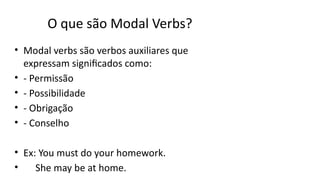
• Modal verbs são verbos auxiliares que
expressam significados como:
• - Permissão
• - Possibilidade
• - Obrigação
• - Conselho
• Ex: You must do your homework.
• She may be at home.
3.
May – Permissãoou Possibilidade
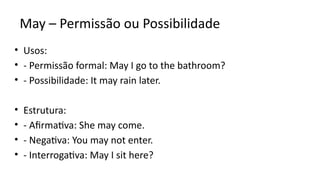
• Usos:
• - Permissão formal: May I go to the bathroom?
• - Possibilidade: It may rain later.
• Estrutura:
• - Afirmativa: She may come.
• - Negativa: You may not enter.
• - Interrogativa: May I sit here?
4.
Should – Conselhoe
Recomendação
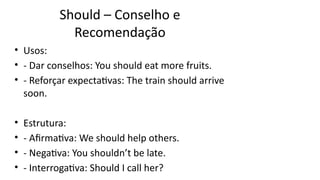
• Usos:
• - Dar conselhos: You should eat more fruits.
• - Reforçar expectativas: The train should arrive
soon.
• Estrutura:
• - Afirmativa: We should help others.
• - Negativa: You shouldn’t be late.
• - Interrogativa: Should I call her?
5.
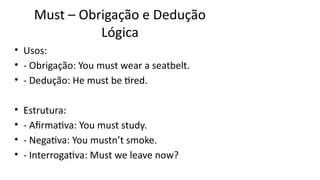
Must – Obrigaçãoe Dedução
Lógica
• Usos:
• - Obrigação: You must wear a seatbelt.
• - Dedução: He must be tired.
• Estrutura:
• - Afirmativa: You must study.
• - Negativa: You mustn’t smoke.
• - Interrogativa: Must we leave now?
6.
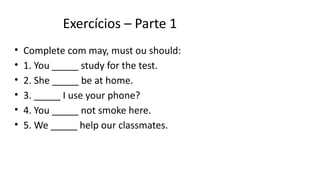
Exercícios – Parte1
• Complete com may, must ou should:
• 1. You _____ study for the test.
• 2. She _____ be at home.
• 3. _____ I use your phone?
• 4. You _____ not smoke here.
• 5. We _____ help our classmates.
7.
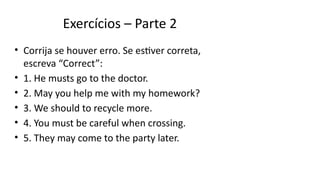
Exercícios – Parte2
• Corrija se houver erro. Se estiver correta,
escreva “Correct”:
• 1. He musts go to the doctor.
• 2. May you help me with my homework?
• 3. We should to recycle more.
• 4. You must be careful when crossing.
• 5. They may come to the party later.
8.
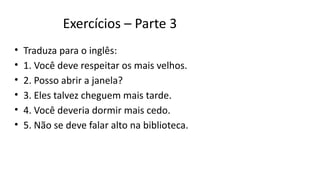
Exercícios – Parte3
• Traduza para o inglês:
• 1. Você deve respeitar os mais velhos.
• 2. Posso abrir a janela?
• 3. Eles talvez cheguem mais tarde.
• 4. Você deveria dormir mais cedo.
• 5. Não se deve falar alto na biblioteca.
9.
Finalização
• Parabéns! Agoravocê conhece o uso dos
modais:
• - May (possibilidade/permissão)
• - Must (obrigação/dedução)
• - Should (conselho/expectativa)
• Revise os exercícios e pratique!