VERBTO BE
1
O que é o verbo to be?
Antes de tudo, assim como falamos ali em cima, você
precisa saber que o to be significa “ser” e “estar”, e tem três
variações, de acordo com o pronome usado. Você se lembra
dos pronomes, certo?
I - eu
You – você
He - ele
She - ela
It – ele, ela (para coisas e animais)
We - nós
You – vocês
They – eles, elas
2
3
Verbo to be no presente
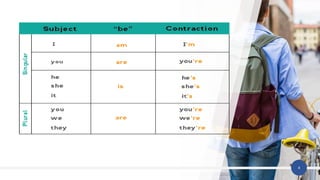
Em inglês, teremos am, is e are para indicar o to be nesses pronomes. Mas como
sabemos como usar cada um? Para começar, o mais fácil: am somente será
utilizadoa companhando a primeira pessoa do singular, ou seja, “eu”.
• I am – eu sou/estou
• He is – ele é/está
• She is – ela é/está
• It is – ele é/está, ela é/está (para coisas e animais)
• Já are estará junto da segunda pessoa do singular “tu” ou “você”, e da primeira,
segunda e terceira pessoas do plural, “nós”, “vós” e “eles, elas”.
• You are – tu (você) é/está
• We are – nós somos/estamos
• You are – vocês são/estão
• They are – eles, elas são/estão
4
5
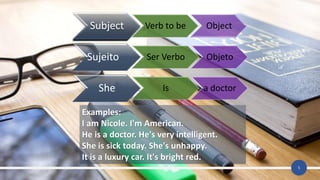
Subject Verb to be Object
Sujeito Ser Verbo Objeto
She Is a doctor
Examples:
I am Nicole. I'm American.
He is a doctor. He's very intelligent.
She is sick today. She's unhappy.
It is a luxury car. It's bright red.
6
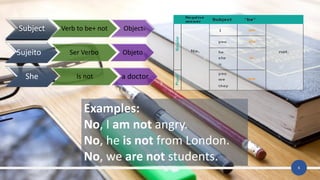
Subject Verb to be+ not Object
Sujeito Ser Verbo Objeto
She Is not a doctor
Examples:
No, I am not angry.
No, he is not from London.
No, we are not students.
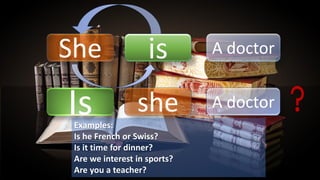
She is A doctor
Is she A doctor
Examples:
Is he French or Swiss?
Is it time for dinner?
Are we interest in sports?
Are you a teacher?
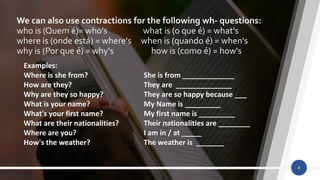
We can also use contractions for the following wh- questions:
who is (Quem é)= who's what is (o que é) = what's
where is (onde está) = where's when is (quando é) = when's
why is (Por que é) = why's how is (como é) = how's
8
Examples:
Where is she from? She is from _____________
How are they? They are ______________
Why are they so happy? They are so happy because ___
What is your name? My Name is _________
What's your first name? My first name is _________
What are their nationalities? Their nationalities are ________
Where are you? I am in / at _____
How's the weather? The weather is _______
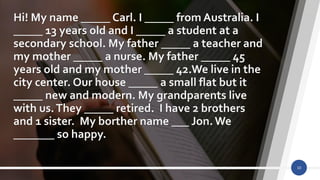
Hi! My name _____ Carl. I _____ from Australia. I
_____ 13 years old and I _____ a student at a
secondary school. My father _____ a teacher and
my mother _____ a nurse. My father _____ 45
years old and my mother _____ 42.We live in the
city center. Our house _____ a small flat but it
_____ new and modern. My grandparents live
with us.They _____ retired. I have 2 brothers
and 1 sister. My borther name ___ Jon.We
_______ so happy.
10
11
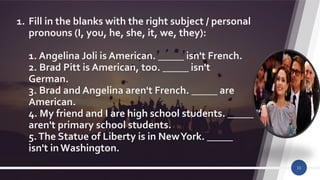
1. Fill in the blanks with the right subject / personal
pronouns (I, you, he, she, it, we, they):
1. Angelina Joli is American. _____ isn't French.
2. Brad Pitt is American, too. _____ isn't
German.
3. Brad and Angelina aren't French. _____ are
American.
4. My friend and I are high school students. _____
aren't primary school students.
5.The Statue of Liberty is in NewYork. _____
isn't in Washington.
Thanks you so
much….
12

Verb TOBe Presentation.pdf

  • 1.
  • 2.
    O que éo verbo to be? Antes de tudo, assim como falamos ali em cima, você precisa saber que o to be significa “ser” e “estar”, e tem três variações, de acordo com o pronome usado. Você se lembra dos pronomes, certo? I - eu You – você He - ele She - ela It – ele, ela (para coisas e animais) We - nós You – vocês They – eles, elas 2
  • 3.
    3 Verbo to beno presente Em inglês, teremos am, is e are para indicar o to be nesses pronomes. Mas como sabemos como usar cada um? Para começar, o mais fácil: am somente será utilizadoa companhando a primeira pessoa do singular, ou seja, “eu”. • I am – eu sou/estou • He is – ele é/está • She is – ela é/está • It is – ele é/está, ela é/está (para coisas e animais) • Já are estará junto da segunda pessoa do singular “tu” ou “você”, e da primeira, segunda e terceira pessoas do plural, “nós”, “vós” e “eles, elas”. • You are – tu (você) é/está • We are – nós somos/estamos • You are – vocês são/estão • They are – eles, elas são/estão
  • 4.
  • 5.
    5 Subject Verb tobe Object Sujeito Ser Verbo Objeto She Is a doctor Examples: I am Nicole. I'm American. He is a doctor. He's very intelligent. She is sick today. She's unhappy. It is a luxury car. It's bright red.
  • 6.
    6 Subject Verb tobe+ not Object Sujeito Ser Verbo Objeto She Is not a doctor Examples: No, I am not angry. No, he is not from London. No, we are not students.
  • 7.
    She is Adoctor Is she A doctor Examples: Is he French or Swiss? Is it time for dinner? Are we interest in sports? Are you a teacher?
  • 8.
    We can alsouse contractions for the following wh- questions: who is (Quem é)= who's what is (o que é) = what's where is (onde está) = where's when is (quando é) = when's why is (Por que é) = why's how is (como é) = how's 8 Examples: Where is she from? She is from _____________ How are they? They are ______________ Why are they so happy? They are so happy because ___ What is your name? My Name is _________ What's your first name? My first name is _________ What are their nationalities? Their nationalities are ________ Where are you? I am in / at _____ How's the weather? The weather is _______
  • 10.
    Hi! My name_____ Carl. I _____ from Australia. I _____ 13 years old and I _____ a student at a secondary school. My father _____ a teacher and my mother _____ a nurse. My father _____ 45 years old and my mother _____ 42.We live in the city center. Our house _____ a small flat but it _____ new and modern. My grandparents live with us.They _____ retired. I have 2 brothers and 1 sister. My borther name ___ Jon.We _______ so happy. 10
  • 11.
    11 1. Fill inthe blanks with the right subject / personal pronouns (I, you, he, she, it, we, they): 1. Angelina Joli is American. _____ isn't French. 2. Brad Pitt is American, too. _____ isn't German. 3. Brad and Angelina aren't French. _____ are American. 4. My friend and I are high school students. _____ aren't primary school students. 5.The Statue of Liberty is in NewYork. _____ isn't in Washington.
  • 12.