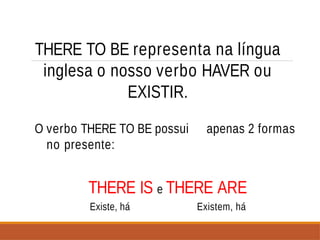
THERE TO BE representa na língua
inglesa o nosso verbo HAVER ou
EXISTIR.
O verbo THERE TO BE possui apenas 2 formas
no presente:
THERE IS e THERE ARE
Existe, há Existem, há
Attention
1. No dia a dia é comum usarmos o verbo TER
em vez de HAVER ou EXISTIR.
EX: TEM um cachorro na calçada.
HÁ , EXISTE um cachorro na calçada.
There is a dog on the sidewalk.
Attention
2. BE CAREFUL: não confunda o verbo THERE TO
BE(haver, existir) com o verbo TO HAVE (TER).
Em inglês o verbo TER tem o sentido de posse. Veja a
diferença:
EX: Eu TENHO um cachorro. (POSSE)
I HAVE a dog. (POSSE) Mary HAS
a house
EX: TEM um cachorro na calçada.
(EXISTÊNCIA)
HÁ , EXISTE um cachorro na calçada.(EXISTÊNCIA)
There is a dog on the sidewalk. .(EXISTÊNCIA)
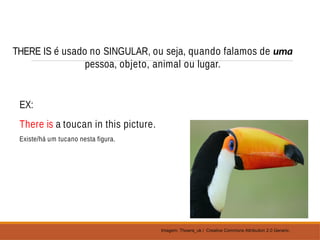
THERE IS é usado no SINGULAR, ou seja, quando falamos de uma
pessoa, objeto, animal ou lugar.
EX:
There is a toucan in this picture.
Existe/há um tucano nesta figura.
Imagem: Thowra_uk / Creative Commons Attribution 2.0 Generic.
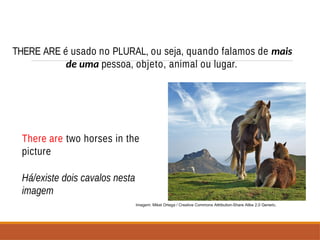
THERE ARE é usado no PLURAL, ou seja, quando falamos de mais
de uma pessoa, objeto, animal ou lugar.
There are two horses in the
picture
Há/existe dois cavalos nesta
imagem
Imagem: Mikel Ortega / Creative Commons Attribution-Share Alike 2.0 Generic.
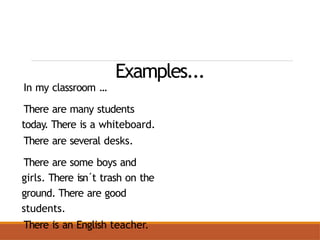
Examples...
In my classroom ...
There are many students
today. There is a whiteboard.
There are several desks.
There are some boys and
girls. There isn´t trash on the
ground. There are good
students.
There is an English teacher.
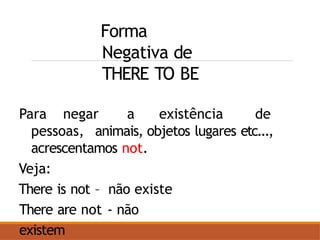
Forma
Negativa de
THERE TO BE
Para negar a existência de
pessoas, animais, objetos lugares etc...,
acrescentamos not.
Veja:
There is not – não existe
There are not - não
existem
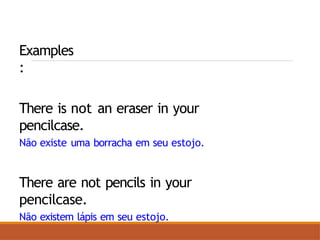
Examples
:
There is not an eraser in your
pencilcase.
Não existe uma borracha em seu estojo.
There are not pencils in your
pencilcase.
Não existem lápis em seu estojo.
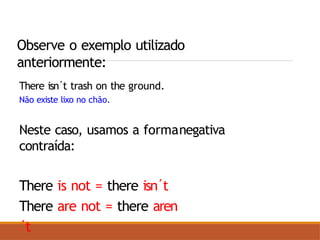
Observe o exemplo utilizado
anteriormente:
There isn´t trash on the ground.
Não existe lixo no chão.
Neste caso, usamos a formanegativa
contraída:
There is not = there isn´t
There are not = there aren
´t
É bastante comum utilizar o verbo there to be:
• em descrições de ambientes;
• para localizar pontos de referência.
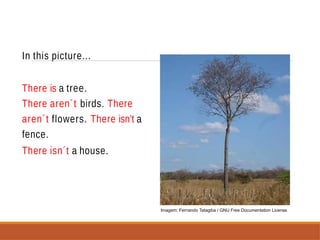
In this picture...
There is a tree.
There aren´t birds. There
aren´t flowers. There isn’t a
fence.
There isn´t a house.
Imagem: Fernando Tatagiba / GNU Free Documentation License.
Forma interrogativa
Para formar perguntas, é preciso apenas
inverter a posição do verbo to be:
There is = Is there?
There are = Are there?
Examples
Is there an eraser in your pencilcase?
Existe uma borracha em seu estojo?
Are there pencils in your pencilcase?
Existem lápis em seu estojo?
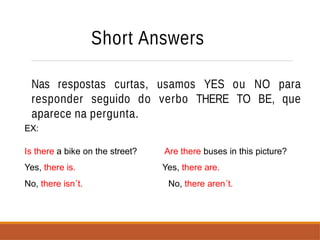
Short Answers
Nas respostas curtas, usamos YES ou NO para
responder seguido do verbo THERE TO BE, que
aparece na pergunta.
EX:
Is there a bike on the street?
Yes, there is.
No, there isn´t.
Are there buses in this picture?
Yes, there are.
No, there aren´t.
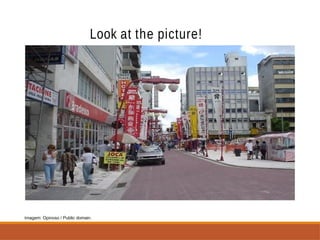
Look at the picture!
Imagem: Opinoso / Public domain.
VIDEOS PARAASSISTIR
https://youtu.be/Aq8bI-6zga4?feature=shared
https://youtu.be/6NHZ9lMzKnE?feature=shared

thereis-thereare-.pptx thereis-thereare ingles

  • 2.
    THERE TO BErepresenta na língua inglesa o nosso verbo HAVER ou EXISTIR. O verbo THERE TO BE possui apenas 2 formas no presente: THERE IS e THERE ARE Existe, há Existem, há
  • 3.
    Attention 1. No diaa dia é comum usarmos o verbo TER em vez de HAVER ou EXISTIR. EX: TEM um cachorro na calçada. HÁ , EXISTE um cachorro na calçada. There is a dog on the sidewalk.
  • 4.
    Attention 2. BE CAREFUL:não confunda o verbo THERE TO BE(haver, existir) com o verbo TO HAVE (TER). Em inglês o verbo TER tem o sentido de posse. Veja a diferença: EX: Eu TENHO um cachorro. (POSSE) I HAVE a dog. (POSSE) Mary HAS a house EX: TEM um cachorro na calçada. (EXISTÊNCIA) HÁ , EXISTE um cachorro na calçada.(EXISTÊNCIA) There is a dog on the sidewalk. .(EXISTÊNCIA)
  • 5.
    THERE IS éusado no SINGULAR, ou seja, quando falamos de uma pessoa, objeto, animal ou lugar. EX: There is a toucan in this picture. Existe/há um tucano nesta figura. Imagem: Thowra_uk / Creative Commons Attribution 2.0 Generic.
  • 6.
    THERE ARE éusado no PLURAL, ou seja, quando falamos de mais de uma pessoa, objeto, animal ou lugar. There are two horses in the picture Há/existe dois cavalos nesta imagem Imagem: Mikel Ortega / Creative Commons Attribution-Share Alike 2.0 Generic.
  • 7.
    Examples... In my classroom... There are many students today. There is a whiteboard. There are several desks. There are some boys and girls. There isn´t trash on the ground. There are good students. There is an English teacher.
  • 8.
    Forma Negativa de THERE TOBE Para negar a existência de pessoas, animais, objetos lugares etc..., acrescentamos not. Veja: There is not – não existe There are not - não existem
  • 9.
    Examples : There is notan eraser in your pencilcase. Não existe uma borracha em seu estojo. There are not pencils in your pencilcase. Não existem lápis em seu estojo.
  • 10.
    Observe o exemploutilizado anteriormente: There isn´t trash on the ground. Não existe lixo no chão. Neste caso, usamos a formanegativa contraída: There is not = there isn´t There are not = there aren ´t
  • 11.
    É bastante comumutilizar o verbo there to be: • em descrições de ambientes; • para localizar pontos de referência.
  • 12.
    In this picture... Thereis a tree. There aren´t birds. There aren´t flowers. There isn’t a fence. There isn´t a house. Imagem: Fernando Tatagiba / GNU Free Documentation License.
  • 13.
    Forma interrogativa Para formarperguntas, é preciso apenas inverter a posição do verbo to be: There is = Is there? There are = Are there?
  • 14.
    Examples Is there aneraser in your pencilcase? Existe uma borracha em seu estojo? Are there pencils in your pencilcase? Existem lápis em seu estojo?
  • 15.
    Short Answers Nas respostascurtas, usamos YES ou NO para responder seguido do verbo THERE TO BE, que aparece na pergunta. EX: Is there a bike on the street? Yes, there is. No, there isn´t. Are there buses in this picture? Yes, there are. No, there aren´t.
  • 16.
    Look at thepicture! Imagem: Opinoso / Public domain.
  • 17.