Inglês Técnico
Aula 2 – Elementos básicos I
Professora :Eline Ferreira de Araújo.
OBJETIVOS
• Conhecer a estrutura gramatical inglesa.
• Empregar corretamente os pronomes e o
verbo to be nas frases em inglês.
• Compreender as diferenças idiomáticas
entre português e inglês.
Subject Pronoun
O estudo dos pronomes é algo simples
e comum. Em inglês existe apenas uma
especificidade, que pode causar um pouco de
estranheza, que é o pronome “it”, o qual não
utilizamos na língua portuguesa; mas, com a
prática, você vai conseguir entender e aprender
bem rápido.
•O pronome pessoal (subject pronoun) é usado
apenas no lugar do sujeito (subject).
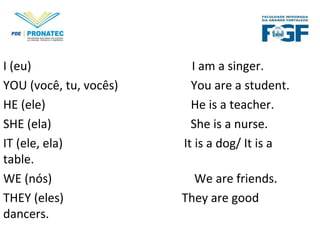
I (eu) I am a singer.
YOU (você, tu, vocês) You are a student.
HE (ele) He is a teacher.
SHE (ela) She is a nurse.
IT (ele, ela) It is a dog/ It is a
table.
WE (nós) We are friends.
THEY (eles) They are good
dancers.
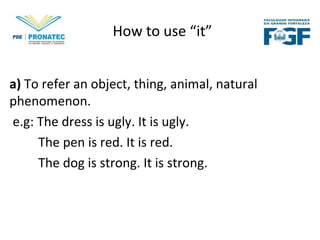
How to use “it”
a) To refer an object, thing, animal, natural
phenomenon.
e.g: The dress is ugly. It is ugly.
The pen is red. It is red.
The dog is strong. It is strong.
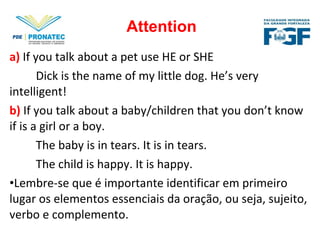
a) If you talk about a pet use HE or SHE
Dick is the name of my little dog. He’s very
intelligent!
b) If you talk about a baby/children that you don’t know
if is a girl or a boy.
The baby is in tears. It is in tears.
The child is happy. It is happy.
•Lembre-se que é importante identificar em primeiro
lugar os elementos essenciais da oração, ou seja, sujeito,
verbo e complemento.
Attention
Verb to be – simple
present
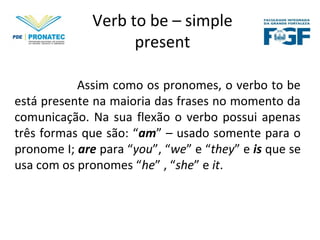
Assim como os pronomes, o verbo to be
está presente na maioria das frases no momento da
comunicação. Na sua flexão o verbo possui apenas
três formas que são: “am” – usado somente para o
pronome I; are para “you”, “we” e “they” e is que se
usa com os pronomes “he” , “she” e it.
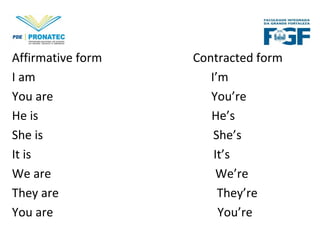
Affirmative form Contracted form
I am I’m
You are You’re
He is He’s
She is She’s
It is It’s
We are We’re
They are They’re
You are You’re
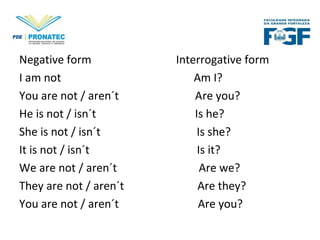
Negative form Interrogative form
I am not Am I?
You are not / aren´t Are you?
He is not / isn´t Is he?
She is not / isn´t Is she?
It is not / isn´t Is it?
We are not / aren´t Are we?
They are not / aren´t Are they?
You are not / aren´t Are you?
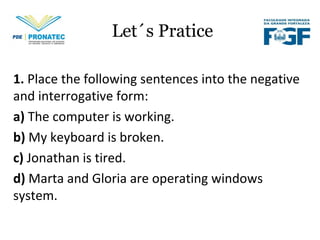
Let´s Pratice
1. Place the following sentences into the negative
and interrogative form:
a) The computer is working.
b) My keyboard is broken.
c) Jonathan is tired.
d) Marta and Gloria are operating windows
system.
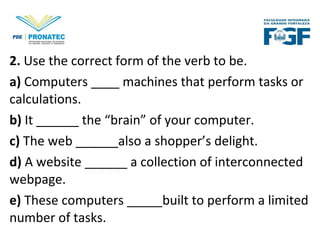
2. Use the correct form of the verb to be.
a) Computers ____ machines that perform tasks or
calculations.
b) It ______ the “brain” of your computer.
c) The web ______also a shopper’s delight.
d) A website ______ a collection of interconnected
webpage.
e) These computers _____built to perform a limited
number of tasks.
BIBLIOGRAFIA
• http://www.google.com.br/imgres?q=ementa+de+ingl
%C3%AAs+instrumental&um=1&hl=pt-
• Apostila_de_INGLES_informatica_PRONATEC_IFPA
• BOECKNER, Keith; BROWN, Charles. Oxford English for
computing. Oxford: Oxford University Press, 1994.
• CENTRO DE EDUCAÇÃO TECNOLÓGICA DO AMAZONAS. Inglês
Técnico para o Curso de Secretariado. Manaus, 2006.
• MICROSOFT. Parts of a Computer. Disponível em:
http://windows.microsoft.com/en- US/windows-vista/Parts-
of-a-computer>. Acesso em: 25 fev. 2010.
• MARTINEZ, Ron. Como dizer tudo em inglês. 27. Ed. Rio de
Janeiro: Editora Campus, 2002.

Aula2 elementos básicos i

  • 1.
    Inglês Técnico Aula 2– Elementos básicos I Professora :Eline Ferreira de Araújo.
  • 2.
    OBJETIVOS • Conhecer aestrutura gramatical inglesa. • Empregar corretamente os pronomes e o verbo to be nas frases em inglês. • Compreender as diferenças idiomáticas entre português e inglês.
  • 3.
    Subject Pronoun O estudodos pronomes é algo simples e comum. Em inglês existe apenas uma especificidade, que pode causar um pouco de estranheza, que é o pronome “it”, o qual não utilizamos na língua portuguesa; mas, com a prática, você vai conseguir entender e aprender bem rápido. •O pronome pessoal (subject pronoun) é usado apenas no lugar do sujeito (subject).
  • 4.
    I (eu) Iam a singer. YOU (você, tu, vocês) You are a student. HE (ele) He is a teacher. SHE (ela) She is a nurse. IT (ele, ela) It is a dog/ It is a table. WE (nós) We are friends. THEY (eles) They are good dancers.
  • 5.
    How to use“it” a) To refer an object, thing, animal, natural phenomenon. e.g: The dress is ugly. It is ugly. The pen is red. It is red. The dog is strong. It is strong.
  • 6.
    a) If youtalk about a pet use HE or SHE Dick is the name of my little dog. He’s very intelligent! b) If you talk about a baby/children that you don’t know if is a girl or a boy. The baby is in tears. It is in tears. The child is happy. It is happy. •Lembre-se que é importante identificar em primeiro lugar os elementos essenciais da oração, ou seja, sujeito, verbo e complemento. Attention
  • 7.
    Verb to be– simple present Assim como os pronomes, o verbo to be está presente na maioria das frases no momento da comunicação. Na sua flexão o verbo possui apenas três formas que são: “am” – usado somente para o pronome I; are para “you”, “we” e “they” e is que se usa com os pronomes “he” , “she” e it.
  • 8.
    Affirmative form Contractedform I am I’m You are You’re He is He’s She is She’s It is It’s We are We’re They are They’re You are You’re
  • 9.
    Negative form Interrogativeform I am not Am I? You are not / aren´t Are you? He is not / isn´t Is he? She is not / isn´t Is she? It is not / isn´t Is it? We are not / aren´t Are we? They are not / aren´t Are they? You are not / aren´t Are you?
  • 10.
    Let´s Pratice 1. Placethe following sentences into the negative and interrogative form: a) The computer is working. b) My keyboard is broken. c) Jonathan is tired. d) Marta and Gloria are operating windows system.
  • 11.
    2. Use thecorrect form of the verb to be. a) Computers ____ machines that perform tasks or calculations. b) It ______ the “brain” of your computer. c) The web ______also a shopper’s delight. d) A website ______ a collection of interconnected webpage. e) These computers _____built to perform a limited number of tasks.
  • 12.
    BIBLIOGRAFIA • http://www.google.com.br/imgres?q=ementa+de+ingl %C3%AAs+instrumental&um=1&hl=pt- • Apostila_de_INGLES_informatica_PRONATEC_IFPA •BOECKNER, Keith; BROWN, Charles. Oxford English for computing. Oxford: Oxford University Press, 1994. • CENTRO DE EDUCAÇÃO TECNOLÓGICA DO AMAZONAS. Inglês Técnico para o Curso de Secretariado. Manaus, 2006. • MICROSOFT. Parts of a Computer. Disponível em: http://windows.microsoft.com/en- US/windows-vista/Parts- of-a-computer>. Acesso em: 25 fev. 2010. • MARTINEZ, Ron. Como dizer tudo em inglês. 27. Ed. Rio de Janeiro: Editora Campus, 2002.