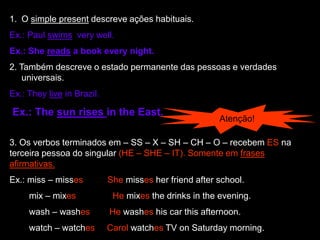
1. O simple present descreve ações habituais.
Ex.: Paul swims very well.
Ex.: She reads a book every night.
2. Também descreve o estado permanente das pessoas e verdades
universais.
Ex.: They live in Brazil.
Ex.: The sun rises in the East.
Atenção!
3. Os verbos terminados em – SS – X – SH – CH – O – recebem ES na
terceira pessoa do singular (HE – SHE – IT). Somente em frases
afirmativas.
Ex.: miss – misses She misses her friend after school.
mix – mixes He mixes the drinks in the evening.
wash – washes He washes his car this afternoon.
watch – watches Carol watches TV on Saturday morning.
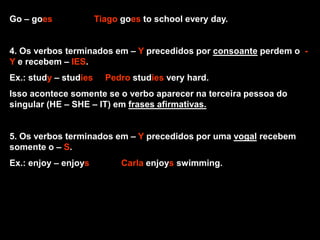
Go – goes Tiago goes to school every day.
4. Os verbos terminados em – Y precedidos por consoante perdem o -
Y e recebem – IES.
Ex.: study – studies Pedro studies very hard.
Isso acontece somente se o verbo aparecer na terceira pessoa do
singular (HE – SHE – IT) em frases afirmativas.
5. Os verbos terminados em – Y precedidos por uma vogal recebem
somente o – S.
Ex.: enjoy – enjoys Carla enjoys swimming.
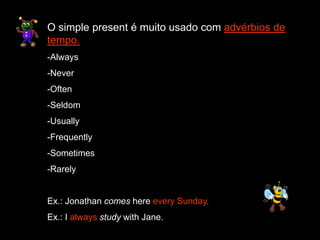
O simple present é muito usado com advérbios de
tempo.
-Always
-Never
-Often
-Seldom
-Usually
-Frequently
-Sometimes
-Rarely
Ex.: Jonathan comes here every Sunday.
Ex.: I always study with Jane.
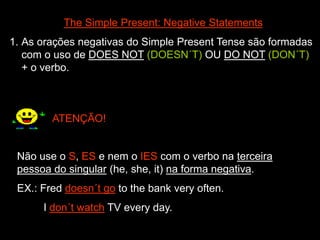
The Simple Present: Negative Statements
1. As orações negativas do Simple Present Tense são formadas
com o uso de DOES NOT (DOESN´T) OU DO NOT (DON´T)
+ o verbo.
ATENÇÃO!
Não use o S, ES e nem o IES com o verbo na terceira
pessoa do singular (he, she, it) na forma negativa.
EX.: Fred doesn´t go to the bank very often.
I don´t watch TV every day.
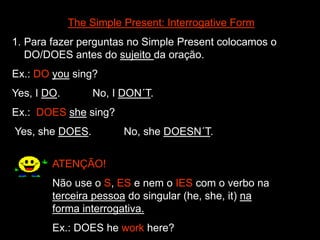
The Simple Present: Interrogative Form
1. Para fazer perguntas no Simple Present colocamos o
DO/DOES antes do sujeito da oração.
Ex.: DO you sing?
Yes, I DO. No, I DON´T.
Ex.: DOES she sing?
Yes, she DOES. No, she DOESN´T.
ATENÇÃO!
Não use o S, ES e nem o IES com o verbo na
terceira pessoa do singular (he, she, it) na
forma interrogativa.
Ex.: DOES he work here?
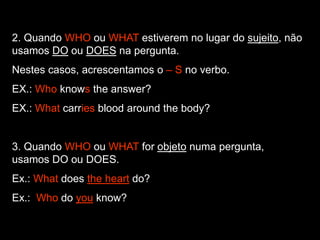
2. Quando WHO ou WHAT estiverem no lugar do sujeito, não
usamos DO ou DOES na pergunta.
Nestes casos, acrescentamos o – S no verbo.
EX.: Who knows the answer?
EX.: What carries blood around the body?
3. Quando WHO ou WHAT for objeto numa pergunta,
usamos DO ou DOES.
Ex.: What does the heart do?
Ex.: Who do you know?

The Simple Present Tense.pptx

  • 2.
    1. O simplepresent descreve ações habituais. Ex.: Paul swims very well. Ex.: She reads a book every night. 2. Também descreve o estado permanente das pessoas e verdades universais. Ex.: They live in Brazil. Ex.: The sun rises in the East. Atenção! 3. Os verbos terminados em – SS – X – SH – CH – O – recebem ES na terceira pessoa do singular (HE – SHE – IT). Somente em frases afirmativas. Ex.: miss – misses She misses her friend after school. mix – mixes He mixes the drinks in the evening. wash – washes He washes his car this afternoon. watch – watches Carol watches TV on Saturday morning.
  • 3.
    Go – goesTiago goes to school every day. 4. Os verbos terminados em – Y precedidos por consoante perdem o - Y e recebem – IES. Ex.: study – studies Pedro studies very hard. Isso acontece somente se o verbo aparecer na terceira pessoa do singular (HE – SHE – IT) em frases afirmativas. 5. Os verbos terminados em – Y precedidos por uma vogal recebem somente o – S. Ex.: enjoy – enjoys Carla enjoys swimming.
  • 4.
    O simple presenté muito usado com advérbios de tempo. -Always -Never -Often -Seldom -Usually -Frequently -Sometimes -Rarely Ex.: Jonathan comes here every Sunday. Ex.: I always study with Jane.
  • 5.
    The Simple Present:Negative Statements 1. As orações negativas do Simple Present Tense são formadas com o uso de DOES NOT (DOESN´T) OU DO NOT (DON´T) + o verbo. ATENÇÃO! Não use o S, ES e nem o IES com o verbo na terceira pessoa do singular (he, she, it) na forma negativa. EX.: Fred doesn´t go to the bank very often. I don´t watch TV every day.
  • 6.
    The Simple Present:Interrogative Form 1. Para fazer perguntas no Simple Present colocamos o DO/DOES antes do sujeito da oração. Ex.: DO you sing? Yes, I DO. No, I DON´T. Ex.: DOES she sing? Yes, she DOES. No, she DOESN´T. ATENÇÃO! Não use o S, ES e nem o IES com o verbo na terceira pessoa do singular (he, she, it) na forma interrogativa. Ex.: DOES he work here?
  • 7.
    2. Quando WHOou WHAT estiverem no lugar do sujeito, não usamos DO ou DOES na pergunta. Nestes casos, acrescentamos o – S no verbo. EX.: Who knows the answer? EX.: What carries blood around the body? 3. Quando WHO ou WHAT for objeto numa pergunta, usamos DO ou DOES. Ex.: What does the heart do? Ex.: Who do you know?