The 5th International Symposium on Smart Graphics 
(SG-2005) - Frauenwoerth Cloister, Germany, August 22-24, 2005 
Visualization TTrreeee,, mmuullttiippllee 
lliinnkkeedd aannaallyyttiiccaall ddeecciissiioonnss 
Rodrigues Jr., José Fernando 
Traina, Agma J. M. 
Traina Jr., Caetano 
University of São Paulo 
Computer Science Department 
ICMC-USP 
Brazil
(SG-05) 
2/30 
• Introduction 
• Developed System 
• Interaction Systematization 
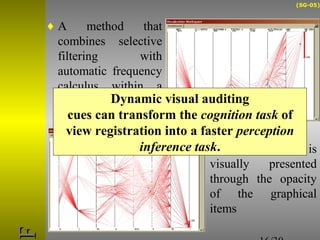
• Summarization Features 
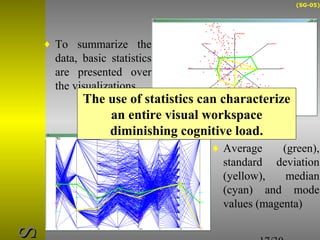
• Conclusions and Ending 
uuOO
(SG-05) 
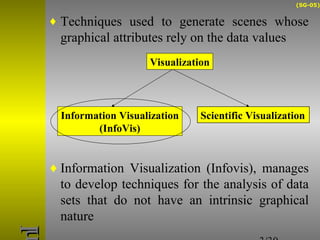
¨ Techniques used to generate scenes whose 
graphical attributes rely on the data values 
Scientific Visualization 
3/30 
vvooffnnII 
Visualization 
Information Visualization 
(InfoVis) 
¨Information Visualization (Infovis), manages 
to develop techniques for the analysis of data 
sets that do not have an intrinsic graphical 
nature
(SG-05) 
¨ Increasing volume of data that cannot be well 
utilized to produce useful knowledge 
¨ Raw visualization techniques are limited in the 
task of data analysis, while datasets are 
unlimited both in size and complexity 
There is a need for visualization 
mechanisms that reduce the 
drawback of massive datasets. 
¨ The efficient analysis of multivariate data can 
provide assistance in decision making 
4/30 
MM
(SG-05) 
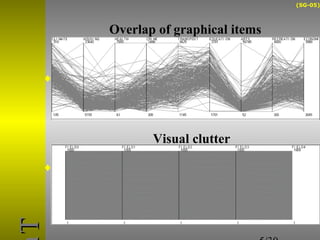
¨ Due to overlap of graphical items, some regions 
of the visualization seam like blots in the display 
¨ Massively populated datasets tend to result in a 
visualization scene with an unacceptable level of 
clutter 
5/30 
eehhTT 
Overlap of graphical items 
Visual clutter
(SG-05) 
6/30 
• Introduction 
• Developed System 
• Interaction Systematization 
• Summarization Features 
• Conclusions and Ending 
uuOO
(SG-05) 
7/30 
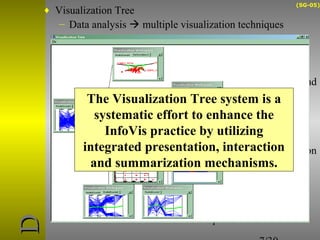
¨ Visualization Tree 
DD 
– Data analysis  multiple visualization techniques 
– Graphical overlap  Visual pipeline 
– Cognitive flow  Workspaces refinement and 
composition 
The Visualization Tree system is a 
– systematic effort to enhance the 
Visual clutter InfoVis  Tree practice scheme 
by utilizing 
– Enhance integrated exploration presentation,  New interaction interaction 
systematization 
based and on the summarization tree metaphor 
mechanisms. 
– Overpopulated data sets  Frequency plot 
– Data summarization  Statistics presentation 
–
(SG-05) 
8/30 
• Introduction 
• Developed System 
• Interaction Systematization 
• Summarization Features 
• Conclusions and Ending 
uuOO 
Developed System
(SG-05) 
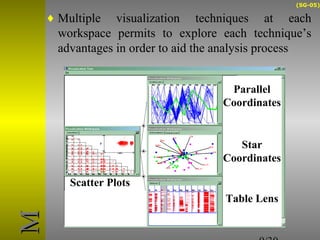
¨Multiple visualization techniques at each 
workspace permits to explore each technique’s 
advantages in order to aid the analysis process 
9/30 
MM 
Scatter Plots 
Parallel 
Coordinates 
Star 
Coordinates 
Table Lens
(SG-05) 
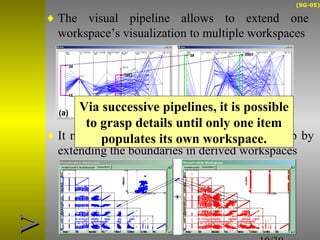
¨ The visual pipeline allows to extend one 
workspace’s visualization to multiple workspaces 
¨ It naturally diminishes graphical items overlap by 
extending the boundaries in derived workspaces 
10/30 
VV 
Via successive pipelines, it is possible 
to grasp details until only one item 
populates its own workspace.
(SG-05) 
11/30 
eeeerr TT 
¨The tree scheme allows to build multiple 
views in a decision-tree style 
Cars 
European 
Japanese 
American 
4 cylinders 
3 cyliners 
1976 - 1982 
1970 - 1976
(SG-05) 
12/30 
eeeerr TT 
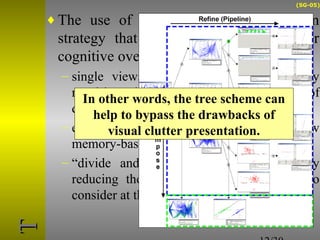
¨The use of multiple views is a known 
strategy that can help to diminish user 
cognitive overhead: 
– single views create cognitive overhead by 
requiring In other simultaneously words, the tree comprehension scheme can 
of 
diverse help data 
to bypass the drawbacks of 
– easier visual to accomplish clutter presentation. 
than single view 
memory-based comparison 
– “divide and conquer,” aiding memory by 
reducing the amount of data they need to 
consider at the same time
(SG-05) 
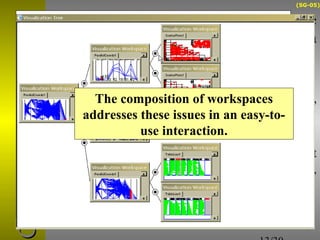
The composition of workspaces 
addresses these issues in an easy-to-use 
13/30 
CC 
¨ Besides refining the views, it may be 
interesting to merge views for extra 
analytical possibilities: 
– when two or more views have similar, 
correlated or worthy-comparing semantics 
interaction. 
– for easy comparison, it may be worthy to put 
together branches of the tree in side-by-side, 
rather than node-like, positioning 
Cars 
European 
Japanese 
American 
4 cylinders 
3 cyliners 
1976 - 1982 
1970 - 1975 
(European 4 cylinder moels) OR 
(Older American models)
(SG-05) 
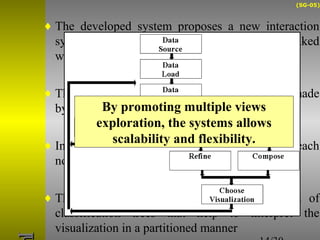
By promoting multiple views 
exploration, the systems allows 
scalability and flexibility. 
14/30 
nnII 
¨ The developed system proposes a new interaction 
systematization to explore multiple linked 
workspaces 
¨ The tree structure keeps track of the decisions made 
by the analyst 
¨ Interaction tasks can be performed either in each 
node or in the whole tree 
¨ The system interaction promotes the creation of 
classification trees that help to interpret the 
visualization in a partitioned manner
(SG-05) 
15/30 
• Introduction 
• Developed System 
• Interaction Systematization 
• Summarization Features 
• Conclusions and Ending 
uuOO 
Developed System
(SG-05) 
cues can transform the cognition task of 
view registration into a faster perception 
16/30 
FF 
¨ A method that 
combines selective 
filtering with 
automatic frequency 
calculus within a 
given selection 
Dynamic visual auditing 
inference task. 
¨ The frequency is 
visually presented 
through the opacity 
of the graphical 
items
(SG-05) 
The use of statistics can characterize 
an entire visual workspace 
diminishing cognitive load. 
17/30 
SS 
¨ To summarize the 
data, basic statistics 
are presented over 
the visualizations 
¨ Average (green), 
standard deviation 
(yellow), median 
(cyan) and mode 
values (magenta)
(SG-05) 
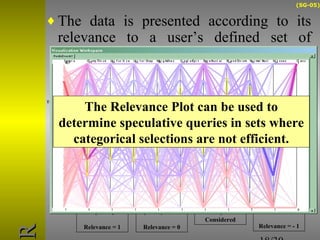
¨The data is presented according to its 
relevance to a user’s defined set of 
interesting points 
18/30 
X1 
X1 = RP1 + MRD 
Relevance = 0 
X0 
X0 = RP0 
Relevance = 1 
X2 
X3 
Null RP2  Not 
Considered 
Dist = 1 
Relevance = - 1 
The relevance point is over 
the attribute value 
The distance is equal the 
Maximum relevance 
distance The distance is the 
Relevance = 1 + 0 + (-1) = maximum possible 
0/3 = 0 
RR 
The Relevance Plot can be used to 
determine speculative queries in sets where 
categorical selections are not efficient.
(SG-05) 
19/30 
• Introduction 
• Developed System 
• Interaction Systematization 
• Summarization Features 
• Conclusions and Ending 
uuOO 
Developed System
(SG-05) 
20/30 
ccnnooCC 
¨ The Visualization Tree systematization can help 
to diminish InfoVis techniques limitations 
¨ The interaction, exploration and summarization 
functionalities, together, can be considered a 
step further in multivariate visual analysis 
¨ The future of InfoVis do not rely on 
revolutionary new techniques but on integrated 
systematizations presenting interaction and 
summarization capabilities
(SG-05) 
¨All this information did not fit in the paper, 
so the tool (MSWindows) can be 
downloaded at 
http://www.gbdi.icmc.usp.br/~junio/vistree 
or at 
http://vistree.got.to (alias) 
¨We have validated most of the system’s 
features based on literature knowledge. 
However… 
¨To do: perform a systematic evaluation of 
the tool usability 
21/30 
eehhTT ¨Thanks for coming

Visualization tree multiple linked analytical decisions

  • 1.
    The 5th InternationalSymposium on Smart Graphics (SG-2005) - Frauenwoerth Cloister, Germany, August 22-24, 2005 Visualization TTrreeee,, mmuullttiippllee lliinnkkeedd aannaallyyttiiccaall ddeecciissiioonnss Rodrigues Jr., José Fernando Traina, Agma J. M. Traina Jr., Caetano University of São Paulo Computer Science Department ICMC-USP Brazil
  • 2.
    (SG-05) 2/30 •Introduction • Developed System • Interaction Systematization • Summarization Features • Conclusions and Ending uuOO
  • 3.
    (SG-05) ¨ Techniquesused to generate scenes whose graphical attributes rely on the data values Scientific Visualization 3/30 vvooffnnII Visualization Information Visualization (InfoVis) ¨Information Visualization (Infovis), manages to develop techniques for the analysis of data sets that do not have an intrinsic graphical nature
  • 4.
    (SG-05) ¨ Increasingvolume of data that cannot be well utilized to produce useful knowledge ¨ Raw visualization techniques are limited in the task of data analysis, while datasets are unlimited both in size and complexity There is a need for visualization mechanisms that reduce the drawback of massive datasets. ¨ The efficient analysis of multivariate data can provide assistance in decision making 4/30 MM
  • 5.
    (SG-05) ¨ Dueto overlap of graphical items, some regions of the visualization seam like blots in the display ¨ Massively populated datasets tend to result in a visualization scene with an unacceptable level of clutter 5/30 eehhTT Overlap of graphical items Visual clutter
  • 6.
    (SG-05) 6/30 •Introduction • Developed System • Interaction Systematization • Summarization Features • Conclusions and Ending uuOO
  • 7.
    (SG-05) 7/30 ¨Visualization Tree DD – Data analysis  multiple visualization techniques – Graphical overlap  Visual pipeline – Cognitive flow  Workspaces refinement and composition The Visualization Tree system is a – systematic effort to enhance the Visual clutter InfoVis  Tree practice scheme by utilizing – Enhance integrated exploration presentation,  New interaction interaction systematization based and on the summarization tree metaphor mechanisms. – Overpopulated data sets  Frequency plot – Data summarization  Statistics presentation –
  • 8.
    (SG-05) 8/30 •Introduction • Developed System • Interaction Systematization • Summarization Features • Conclusions and Ending uuOO Developed System
  • 9.
    (SG-05) ¨Multiple visualizationtechniques at each workspace permits to explore each technique’s advantages in order to aid the analysis process 9/30 MM Scatter Plots Parallel Coordinates Star Coordinates Table Lens
  • 10.
    (SG-05) ¨ Thevisual pipeline allows to extend one workspace’s visualization to multiple workspaces ¨ It naturally diminishes graphical items overlap by extending the boundaries in derived workspaces 10/30 VV Via successive pipelines, it is possible to grasp details until only one item populates its own workspace.
  • 11.
    (SG-05) 11/30 eeeerrTT ¨The tree scheme allows to build multiple views in a decision-tree style Cars European Japanese American 4 cylinders 3 cyliners 1976 - 1982 1970 - 1976
  • 12.
    (SG-05) 12/30 eeeerrTT ¨The use of multiple views is a known strategy that can help to diminish user cognitive overhead: – single views create cognitive overhead by requiring In other simultaneously words, the tree comprehension scheme can of diverse help data to bypass the drawbacks of – easier visual to accomplish clutter presentation. than single view memory-based comparison – “divide and conquer,” aiding memory by reducing the amount of data they need to consider at the same time
  • 13.
    (SG-05) The compositionof workspaces addresses these issues in an easy-to-use 13/30 CC ¨ Besides refining the views, it may be interesting to merge views for extra analytical possibilities: – when two or more views have similar, correlated or worthy-comparing semantics interaction. – for easy comparison, it may be worthy to put together branches of the tree in side-by-side, rather than node-like, positioning Cars European Japanese American 4 cylinders 3 cyliners 1976 - 1982 1970 - 1975 (European 4 cylinder moels) OR (Older American models)
  • 14.
    (SG-05) By promotingmultiple views exploration, the systems allows scalability and flexibility. 14/30 nnII ¨ The developed system proposes a new interaction systematization to explore multiple linked workspaces ¨ The tree structure keeps track of the decisions made by the analyst ¨ Interaction tasks can be performed either in each node or in the whole tree ¨ The system interaction promotes the creation of classification trees that help to interpret the visualization in a partitioned manner
  • 15.
    (SG-05) 15/30 •Introduction • Developed System • Interaction Systematization • Summarization Features • Conclusions and Ending uuOO Developed System
  • 16.
    (SG-05) cues cantransform the cognition task of view registration into a faster perception 16/30 FF ¨ A method that combines selective filtering with automatic frequency calculus within a given selection Dynamic visual auditing inference task. ¨ The frequency is visually presented through the opacity of the graphical items
  • 17.
    (SG-05) The useof statistics can characterize an entire visual workspace diminishing cognitive load. 17/30 SS ¨ To summarize the data, basic statistics are presented over the visualizations ¨ Average (green), standard deviation (yellow), median (cyan) and mode values (magenta)
  • 18.
    (SG-05) ¨The datais presented according to its relevance to a user’s defined set of interesting points 18/30 X1 X1 = RP1 + MRD Relevance = 0 X0 X0 = RP0 Relevance = 1 X2 X3 Null RP2  Not Considered Dist = 1 Relevance = - 1 The relevance point is over the attribute value The distance is equal the Maximum relevance distance The distance is the Relevance = 1 + 0 + (-1) = maximum possible 0/3 = 0 RR The Relevance Plot can be used to determine speculative queries in sets where categorical selections are not efficient.
  • 19.
    (SG-05) 19/30 •Introduction • Developed System • Interaction Systematization • Summarization Features • Conclusions and Ending uuOO Developed System
  • 20.
    (SG-05) 20/30 ccnnooCC ¨ The Visualization Tree systematization can help to diminish InfoVis techniques limitations ¨ The interaction, exploration and summarization functionalities, together, can be considered a step further in multivariate visual analysis ¨ The future of InfoVis do not rely on revolutionary new techniques but on integrated systematizations presenting interaction and summarization capabilities
  • 21.
    (SG-05) ¨All thisinformation did not fit in the paper, so the tool (MSWindows) can be downloaded at http://www.gbdi.icmc.usp.br/~junio/vistree or at http://vistree.got.to (alias) ¨We have validated most of the system’s features based on literature knowledge. However… ¨To do: perform a systematic evaluation of the tool usability 21/30 eehhTT ¨Thanks for coming