GREENWASHING ON GOOGLE 1
GREENWASHING
ON GOOGLE
How Google Profits by
Cleaning Big Oil’s Reputation.
GREENWASHING ON GOOGLE 2
The Center for Countering Digital Hate is a US-headquartered international non-
profit NGO that disrupts the architecture of online hate and misinformation.
Digital technology has changed forever the way we communicate, build relationships,
share knowledge, set social standards, and negotiate and assert our societies’ values.
Digital spaces have been colonized and their unique dynamics exploited by
malignant actors that instrumentalize hate and misinformation. These movements
are opportunistic, agile, and confident in exerting influence and persuading people.
Over time these malignant actors, advocating diverse causes - from hatred of
women to racial and religious intolerance to science-denial - have formed a digital
Counter- Enlightenment. The disinformation they spread to bolster their causes has
socialized the offline world for the worse.
The Center’s work combines both analysis and active disruption of these networks.
CCDH’s solutions seek to increase the economic, political, and social costs of all
parts of the infrastructure - the actors, systems, and culture - that support and profit
from hate and misinformation.
If you appreciate this report, you can donate to CCDH at counterhate.com/donate.
In the United States, Center for Countering Digital Hate Inc is a 501(c)(3) charity.
In the United Kingdom, Center for Countering Digital Hate Ltd is a non-profit
company limited by guarantee.
GREENWASHING ON GOOGLE 3
Content
1. Introduction
2. Executive Summary
3. Why greenwashing ads on Google Search matter
4. Google accepted $23.7m from Big Oil over two years
5. Google accepted $10.9m for oil and gas greenwashing ads over two years
a. Google accepted over $5.3m from BP’s greenwashing ads over two years
b. Google accepted $4m for ExxonMobil greenwashing ads over two years
c. Google accepted $1.2m from Shell for greenwashing ads over two years
d. Google accepted $317,710 from Aramco’s greenwashing ads over two years
e. Google accepted $112,854 from Chevron’s greenwashing ads over two years
6. Internal documents expose gap between greenwashing ads and reality
7. Google accepted $421,000 to run ads from a climate denial organization
8. Recommendations
9. Appendix A: Methodology
10. Appendix B: STAR Framework
Published 3 November 2022
© Center for Countering Digital Hate Inc
GREENWASHING ON GOOGLE 4
1 Introduction
As I write, an energy crisis is hurting households around the world and contributing to crippling
inflation. Meanwhile, Big Oil is enjoying record profits by jacking up their prices and margins.
This shameless act of profiteering took place despite the scrutiny they are deservedly under.
The mass burning of hydrocarbons by humanity has led to rapid shifts in the composition of
our atmosphere and ecosystems. Unprecedented global action is being demanded by people,
scientists and politicians. The clamor for greening our economies is an existential crisis for
those companies and we know from experience they will do anything and everything to stave
off the moment when humanity makes the investments, policy changes and decisions to cut
off the flow of hydrocarbons from Big Oil companies and the torrent of money that flows back
to them.
An entire industry of enablers has helped Big Oil profiteer and deny, deflect and delay the
moment that meaningful change happens. The UN Secretary General, António Guterres,
criticized PR agencies “raking in billions” for gaslighting the world about Big Oil’s detrimental
impact on the climate.61
But among those enablers, CCDH has discovered that social media
firms are the newest weapon of choice. And chief among them is Google, a firm that has made
its reputation by providing a curated lens on the world, providing useful results for every query
we put to its search engine, but has since sold the right to distort that lens to Big Oil. This may
come as a surprise. Google, after all, has touted its “commitment to sustainability”.62
But that
appears to be as hollow as their oft-repeated mantra “do no evil”.
In this report, for the first time, the Center for Countering Digital Hate comprehensively
details how Google enables Big Oil’s greenwashing. Greenwashing is an advertising and public
relations strategy companies use to appear more climate friendly than they are in reality.
When oil and gas companies greenwash, they seek to distract and deceive the public about
their role in the climate crisis, particularly when their business models and activities are
undeniably key drivers of climate change.
Using the data analytics tool Semrush, we reveal that nearly half of the $23.7 million spent on
Google search ads by oil and gas companies in the last two years have targeted search terms
on environmental sustainability. The five companies studied in this report, ExxonMobil, British
Petroleum (BP), Chevron, Shell, and Aramco, have polluted our search results while Google
raked in their dirty money.
Big Oil’s deception is by design. It is a tried and true business plan for the world’s largest
GREENWASHING ON GOOGLE 5
polluters to make public promises about sustainability, whilst lining their pockets with the
largest profits in decades.63
In September 2022, the House Committee on Oversight and
Reform’s Subcommittee on the Environment released initial findings of their investigation into
Big Oil’s latest deceptive PR tactics. The Committee found that Big Oil, in their own words
admitted through internal documents, is “gaslighting” the public.64
Our report has discovered much of the same: their ads are not supported by their actions.
The internal memos obtained by the Oversight Committee underscore just how intentionally
misleading Big Oil designs their ads to be. Ads placed by Shell promote a commitment to
“net-zero emissions”, while the company privately instructs employees that net-zero is “not a
Shell business plan”.65
Ads placed by BP claim “carbon capture… can cut CO2 emissions”, while
the company privately plans to use carbon capture to “enable the full use of fossil fuels across
the energy transition and beyond”.66
By allowing fossil fuel giants to advertise on searches like
“How to reduce greenhouse gas emissions?”, “eco-friendly companies”, and “net zero”, Google
is not only complicit in the latest disinformation campaign of the fossil fuel industry, but
actively profiting from this deception.
This report proves what many of us know to be true: when fossil fuel companies come under
fire for their role in exacerbating the climate crisis, they ramp up spending on ads that
greenwash their environmental credentials. Greenwashing is key to Big Oil’s strategy to delay
the transition to renewable energy. Climate campaigners and consumer protection advocates
alike have long warned that greenwashing is the latest PR frontier for companies that refuse to
reconcile their reputations and their actions on the climate emergency we face. When users
query the “pros and cons of the paris climate agreement” or “what are greenhouse gases”,
Google sells ads to the US’s largest oil company, ExxonMobil, at the top of the page. We know
that 68% of users are unable to spot the difference between ads and organic search results.67
Moreover, studies show that only 0.63% of Google searchers will click on links shown in the
second page of results.68
Google is allowing fossil fuel companies to dominate the information
ecosystem to peddle their deception.
Google’s lack of transparency and corporate irresponsibility is a wider problem – they sell
search terms to the highest bidder, no matter the consequences. They don’t even act on their
own specific promises. For example, contrary to its promises to no longer run ads containing
climate denial, we reveal that Google continues to accept hundreds of thousands for outright
climate denial. Ads that claim “fossil fuels make the planet safer” have no right to appear on a
search engine that claims to care about the climate crisis.
GREENWASHING ON GOOGLE 6
Google has therefore exploited the lack of compulsory transparency from regulators and
governments, allowing the company to operate with opacity and without an ad library for the
public and researchers to know where ads are placed. The choice for Google is clear: keep
your promises to stop profiting from climate denial and stop pushing Big Oil ads designed to
distort their environmental records. The public, regulators, and officials should not be kept
in the dark about Google’s role in greenwashing the records of fossil fuel giants. Following
the principles laid out in CCDH’s framework for tech reform and legislative change, the STAR
Framework, we demand the following:
• Google must keep its promise not to profit from climate change denial ads.
• Google must stop profiting from Google ads that distort search results about climate
change.
• Google must create a public and transparent ad library.
It’s time for Google to come clean about its own gaslighting. The planet can’t wait for
corporations to decide to act responsibly.
Imran Ahmed
CEO, Center for Countering Digital Hate
GREENWASHING ON GOOGLE 7
2 Executive Summary
Google accepted $23.7m for ads from Big Oil in the last two years
• Analysis of Big Oil ads placed on Google Search by five of the world’s biggest oil
companies and carbon emitters show they spent $23.7m since September 2020.
• Researchers used the enterprise analytics tool Semrush to analyze US Google Search
ad spending by British Petroleum (BP), ExxonMobil, Chevron, Shell and Aramco which
are together accountable for 14% of global carbon emissions since 1965.
Big Oil devoted $10.9m of this ad spend to misleading greenwashing ads viewed 58.6m times
• Greenwashing is when companies use green messaging to appear more climate friendly
and environmentally sustainable than they really are.
• Big Oil spent $10.9m to target US Google Search users with greenwashing ads in the last
two years, which were viewed an estimated 58.6m times, including:
• $1.8m to target users searching for information on greenhouse gasses
• $1.7m to target queries about renewables
• $1.2m to target queries about carbon offsets
• $5.2m to target users searching for information about Big Oil companies
• All five Big Oil companies targeted users searching for “eco friendly” companies
• Internal oil company documents published by the US Committee on Oversight and
Reform show Big Oil is deliberately misleading Google Search users.
Google accepted a further $421,000 for ads from a climate denial organization
• Competitive Enterprise Institute ads claimed “climate campaigners hype the risks of
global warming” and “fossil fuels make the planet safer”.
Google should come clean and stop profiting from greenwashing
• Google must keep its promise not to profit from climate denial content, which means
halting denial ads from the Competitive Enterprise Institute.
• Google must stop distorting search results with greenwashing ads, extending its existing
commitments to bar Big Oil from using its technologies to prolong the climate crisis.
• Google should introduce a transparent ad library, so the public can examine how
corporations like Big Oil use ads to systematically distort search results.
• Legislators should adopt CCDH’s STAR Framework for regulation of Big Tech that
delivers Safety by Design, Transparency, Accountability and Responsibility.
• The FTC should update its guidance on deceptive ads in light of Big Oil greenwashing.
GREENWASHING ON GOOGLE 8
3 Why greenwashing ads on Google Search matter
The vast majority of Americans use Google Search to find information on topics they care
about, and consider that information to be trustworthy.
Google dominates the search market in the United States, commanding a market share of
87%.1
Users also have a high degree of trust in search engines: 73% believe that most or all of
the information they find in search is accurate and trustworthy.2
Users have a particularly high level of trust in the top-ranked results provided by search
engines, even where they are less relevant or less credible than lower-ranked results.3
This is important because ads placed on Google Search appear at the top of the page when
people use Google to search the web, deliberately resembling organic search results. Studies
have shown that 68% of users are unable to distinguish these ads from organic search results.4
Accordingly, many of the users who turn to Google Search to find information will encounter
Google ads at the top of search results and consider the information they contain to be
credible.
It is for all of these reasons that Big Oil companies are placing ads on Google Search in a bid to
target and influence users searching for information about climate change and the role that oil
and gas companies play in the climate crisis.
These attempts to influence public perceptions of the role of polluting industries in causing
climate change are known as greenwashing. Throughout our report we use the following
definition of greenwashing produced by ClientEarth, an international environmental law charity.
Greenwashing is where a company uses advertising and public messaging to appear
more climate friendly and environmentally sustainable than it really is. It’s also a
technique used by certain companies to distract consumers from the fact that their
business model and activities actually do a lot of environmental harm and damage.5
We know that greenwashing is a key part of Big Oil’s strategy to delay a transition to
renewables and continue profiting from polluting oil and gas. Internal documents recently
published by the US House Committee on Oversight and Reform show that some of the
companies studied by this report privately follow a strategy of prolonging oil and gas use while
GREENWASHING ON GOOGLE 9
publicly stating a commitment to renewables.6
This deliberate attempt to mislead the public is
greenwashing.
Examples of greenwashing identified by our research include ads targeting people using
Google to search for information on “eco friendly companies”, “how to reduce greenhouse gas
emissions” and “pros and cons of paris climate agreement”. These ads distort search results,
presenting users with Big Oil’s preferred answers to key questions about climate change.
This report reveals the full extent to which Google has profited from Big Oil ad campaigns that
aim to influence users searching for information about their contributions to climate change.
GREENWASHING ON GOOGLE 10
4 Google accepted $23.7m from Big Oil over two years
Five of the world’s largest oil and gas companies, ExxonMobil, BP, Chevron, Shell and Aramco,
have spent a combined total of $23.7 million over two years on US Google Search ads.
It shows that Google is content for oil and gas giants to influence the information served to
users of Google Search in exchange for millions of dollars despite having barred those same
companies from accessing its AI tools to exploit fossil fuels.7
Big Oil companies studied by this report account for 14% of global emissions
The five Big Oil companies studied by this report - ExxonMobil, BP, Chevron, Shell and
Aramco - account for 14.38% of the world’s carbon emissions since 1965 according to
research carried out by the Climate Accountability Institute.8
Saudi Arabia’s Aramco
is the leading state-owned polluter accounting for 4.38% of the global total, while the
other four are leading investor-owned oil and gas corporations accounting for 10%.
Using estimates from Semrush, an enterprise analytics tool for Google Search, researchers
found the total amount spent on such ads targeting US search queries by the world’s largest
oil and gas companies between 1 September 2020 and 31 August 2022. Our report focuses on
the five companies that spend most on Google Search ads in the US according to Semrush.
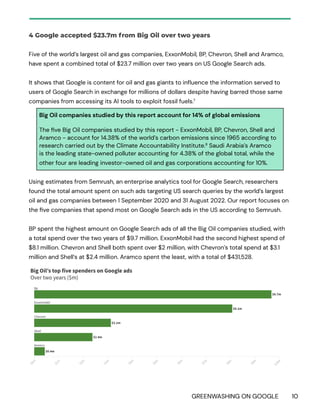
BP spent the highest amount on Google Search ads of all the Big Oil companies studied, with
a total spend over the two years of $9.7 million. ExxonMobil had the second highest spend of
$8.1 million. Chevron and Shell both spent over $2 million, with Chevron’s total spend at $3.1
million and Shell’s at $2.4 million. Aramco spent the least, with a total of $431,528.
GREENWASHING ON GOOGLE 11
5 Google accepted $10.9m for oil and gas greenwashing ads over two years
Using the data analytics tool Semrush, researchers compiled a dataset of 32,816 US Google
Search ads placed by the Big Oil companies on 61,216 separate search queries between 1
September 2020 and 31 August 2022, and the amount they spent on each one.
In total, the five Big Oil companies studied by this report spent $10.9 million on US Google
Search ads that constitute greenwashing, nearly half of their total Google Search ad spend.
This total includes $5.7 million that the companies spent on ads targeting search queries
related to environmental sustainability. The companies spent a further $5.2 million on ads
targeting search queries about the companies themselves, such as company names, that
contained language about environmental sustainability.
Big Oil companies are using these ads to distort search results, promoting the narrative that
their activities are environmentally sustainable. These ads also have the effect of distracting
people from the environmental damage caused by their activities. As such, all ads that employ
one of these two messaging tactics are described as “greenwashing” in this report.
In 2021, Google announced a new policy banning ads with “content that contradicts well-
established scientific consensus around the existence and causes of climate change”.9
However, Google continues to profit from greenwashing, enabling Big Oil to distort search
results with misleading ads about their role in the climate crisis.
Greenwashing ads were viewed over 58 million times
Greenwashing ads placed by the Big Oil companies were viewed over 58 million times
by US users, according to estimates using ad traffic figures from Semrush and the
average click-through-rate for Google Search ads.
Semrush estimates that the Big Oil greenwashing ads identified by this report were
clicked 1,857,588 times, a metric that Semrush refers to as “traffic”.
According to estimates from digital marketing agency LOCALiQ, the average click-
through-rate for Google Search ads is 3.17%, meaning for every person who clicks on a
Google ad, there are an average of 31 others who view the ad but don’t click it.10
Combining this figure with Semrush traffic estimates shows that the greenwashing ads
detailed in this report received an estimated 58.6 million views over two years.
GREENWASHING ON GOOGLE 12
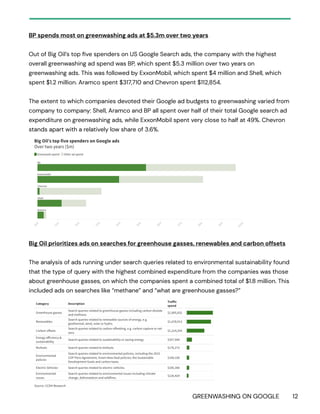
BP spends most on greenwashing ads at $5.3m over two years
Out of Big Oil’s top five spenders on US Google Search ads, the company with the highest
overall greenwashing ad spend was BP, which spent $5.3 million over two years on
greenwashing ads. This was followed by ExxonMobil, which spent $4 million and Shell, which
spent $1.2 million. Aramco spent $317,710 and Chevron spent $112,854.
The extent to which companies devoted their Google ad budgets to greenwashing varied from
company to company: Shell, Aramco and BP all spent over half of their total Google search ad
expenditure on greenwashing ads, while ExxonMobil spent very close to half at 49%. Chevron
stands apart with a relatively low share of 3.6%.
Big Oil prioritizes ads on searches for greenhouse gasses, renewables and carbon offsets
The analysis of ads running under search queries related to environmental sustainability found
that the type of query with the highest combined expenditure from the companies was those
about greenhouse gasses, on which the companies spent a combined total of $1.8 million. This
included ads on searches like “methane” and “what are greenhouse gasses?”
GREENWASHING ON GOOGLE 13
In addition, the companies spent a combined total of $1.7 million on ads on queries about
renewables, such as Google searches about “renewable energy sources” or “hydroelectricity”.
A further $1.2 million was spent on ads on queries about carbon offsets, such as Google
searches for “carbon capture technology” or “net zero company”.
Ads running on these search queries often claimed that oil companies are committed to net-
zero, suggesting that the goal could be reached through using carbon capture technology and
investment in renewables.
Big Oil companies targeted users searching for “eco friendly” companies
All five of the Big Oil companies advertised under searches about being “eco friendly”.
BP placed ads on searches for “small eco friendly companies”, “eco friendly stock
companies”, “eco friendly companies”, as well as just “eco friendly”. Similarly, Aramco
placed ads on search queries including “eco friendly companys” and “eco friendly
companies near me”, while Chevron also advertised under queries for “eco friendly”.
ExxonMobil and Shell both targeted more specific queries using the term, with Exxon
placing ads on the searches “eco friendly energy sources” and “eco friendly energy”,
and Shell advertising under searches for “eco friendly products”.
In addition, four of the five companies – Shell, BP, ExxonMobil and Aramco – advertised
under the single search term “low carbon footprint”, despite being some of the world’s
biggest carbon emitters.
GREENWASHING ON GOOGLE 14
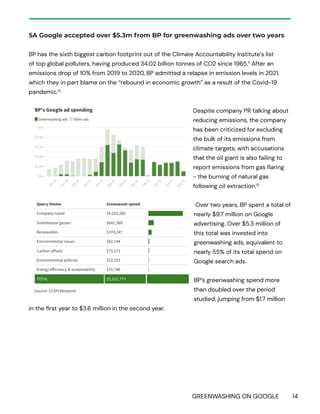
5A Google accepted over $5.3m from BP for greenwashing ads over two years
BP has the sixth biggest carbon footprint out of the Climate Accountability Institute’s list
of top global polluters, having produced 34.02 billion tonnes of CO2 since 1965.11
After an
emissions drop of 10% from 2019 to 2020, BP admitted a relapse in emission levels in 2021,
which they in part blame on the “rebound in economic growth” as a result of the Covid-19
pandemic.12
Despite company PR talking about
reducing emissions, the company
has been criticized for excluding
the bulk of its emissions from
climate targets, with accusations
that the oil giant is also failing to
report emissions from gas flaring
- the burning of natural gas
following oil extraction.13
Over two years, BP spent a total of
nearly $9.7 million on Google
advertising. Over $5.3 million of
this total was invested into
greenwashing ads, equivalent to
nearly 55% of its total spend on
Google search ads.
BP’s greenwashing spend more
than doubled over the period
studied, jumping from $1.7 million
in the first year to $3.6 million in the second year.
GREENWASHING ON GOOGLE 15
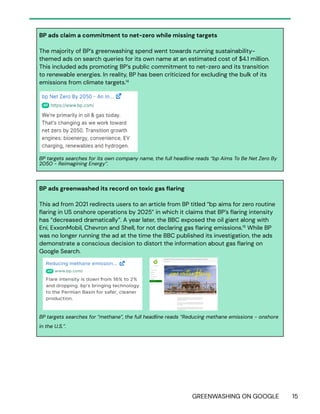
BP ads claim a commitment to net-zero while missing targets
The majority of BP’s greenwashing spend went towards running sustainability-
themed ads on search queries for its own name at an estimated cost of $4.1 million.
This included ads promoting BP’s public commitment to net-zero and its transition
to renewable energies. In reality, BP has been criticized for excluding the bulk of its
emissions from climate targets.14
BP targets searches for its own company name, the full headline reads “bp Aims To Be Net Zero By
2050 - Reimagining Energy”.
BP ads greenwashed its record on toxic gas flaring
This ad from 2021 redirects users to an article from BP titled “bp aims for zero routine
flaring in US onshore operations by 2025” in which it claims that BP’s flaring intensity
has “decreased dramatically”. A year later, the BBC exposed the oil giant along with
Eni, ExxonMobil, Chevron and Shell, for not declaring gas flaring emissions.15
While BP
was no longer running the ad at the time the BBC published its investigation, the ads
demonstrate a conscious decision to distort the information about gas flaring on
Google Search.
BP targets searches for “methane”, the full headline reads “Reducing methane emissions - onshore
in the U.S.”.
GREENWASHING ON GOOGLE 16
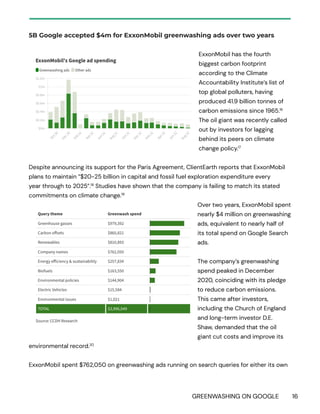
5B Google accepted $4m for ExxonMobil greenwashing ads over two years
ExxonMobil has the fourth
biggest carbon footprint
according to the Climate
Accountability Institute’s list of
top global polluters, having
produced 41.9 billion tonnes of
carbon emissions since 1965.16
The oil giant was recently called
out by investors for lagging
behind its peers on climate
change policy.17
Despite announcing its support for the Paris Agreement, ClientEarth reports that ExxonMobil
plans to maintain “$20-25 billion in capital and fossil fuel exploration expenditure every
year through to 2025”.18
Studies have shown that the company is failing to match its stated
commitments on climate change.19
Over two years, ExxonMobil spent
nearly $4 million on greenwashing
ads, equivalent to nearly half of
its total spend on Google Search
ads.
The company’s greenwashing
spend peaked in December
2020, coinciding with its pledge
to reduce carbon emissions.
This came after investors,
including the Church of England
and long-term investor D.E.
Shaw, demanded that the oil
giant cut costs and improve its
environmental record.20
ExxonMobil spent $762,050 on greenwashing ads running on search queries for either its own
GREENWASHING ON GOOGLE 17
name or that of one of its Big Oil competitors. The oil giant invested another $3.2 million into
ads that targeted sustainability-themed search queries.
In total, ExxonMobil’s ads appeared on 1,788 separate
queries relating to sustainability. Nearly $1 million of its
spend on greenwashing ads targeted queries related to
greenhouse gasses, including searches for “greenhouse
gas emissions” and “carbon emissions”.
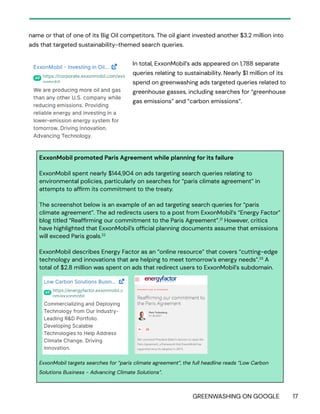
ExxonMobil promoted Paris Agreement while planning for its failure
ExxonMobil spent nearly $144,904 on ads targeting search queries relating to
environmental policies, particularly on searches for “paris climate agreement” in
attempts to affirm its commitment to the treaty.
The screenshot below is an example of an ad targeting search queries for “paris
climate agreement”. The ad redirects users to a post from ExxonMobil’s “Energy Factor”
blog titled “Reaffirming our commitment to the Paris Agreement”.21
However, critics
have highlighted that ExxonMobil’s official planning documents assume that emissions
will exceed Paris goals.22
ExxonMobil describes Energy Factor as an “online resource” that covers “cutting-edge
technology and innovations that are helping to meet tomorrow’s energy needs”.23
A
total of $2.8 million was spent on ads that redirect users to ExxonMobil’s subdomain.
ExxonMobil targets searches for “paris climate agreement”, the full headline reads “Low Carbon
Solutions Business - Advancing Climate Solutions”.
GREENWASHING ON GOOGLE 18
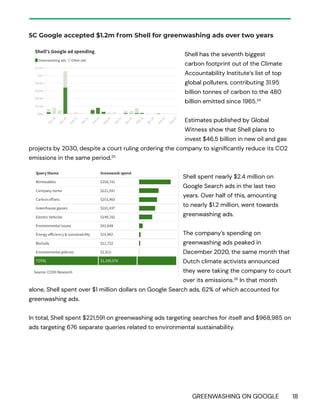
5C Google accepted $1.2m from Shell for greenwashing ads over two years
Shell has the seventh biggest
carbon footprint out of the Climate
Accountability Institute’s list of top
global polluters, contributing 31.95
billion tonnes of carbon to the 480
billion emitted since 1965.24
Estimates published by Global
Witness show that Shell plans to
invest $46.5 billion in new oil and gas
projects by 2030, despite a court ruling ordering the company to significantly reduce its CO2
emissions in the same period.25
Shell spent nearly $2.4 million on
Google Search ads in the last two
years. Over half of this, amounting
to nearly $1.2 million, went towards
greenwashing ads.
The company’s spending on
greenwashing ads peaked in
December 2020, the same month that
Dutch climate activists announced
they were taking the company to court
over its emissions.26
In that month
alone, Shell spent over $1 million dollars on Google Search ads, 62% of which accounted for
greenwashing ads.
In total, Shell spent $221,591 on greenwashing ads targeting searches for itself and $968,985 on
ads targeting 676 separate queries related to environmental sustainability.
GREENWASHING ON GOOGLE 19
Shell’s ads emphasize commitment to net-zero despite plans for new oil and gas
fields
Shell spent $181,784 on the single search query “net zero company”, accounting for
7.6% of its total Google ad spend over the last two years. Ads running on search queries
concerning net zero promoted claims that “we can achieve a net-zero emissions world”
but linked to a page on Shell’s website with no explicit commitment to net zero.27
Documents circulated internally at Shell and published by the US House COmmittee
on Oversight and Reform reveal that the company’s official position is that net-zero
emissions is “not a Shell business plan”.28
Shell targets searches for “net zero”, the full headline reads “Shell - Net Zero Target - shell.us”.
GREENWASHING ON GOOGLE 20
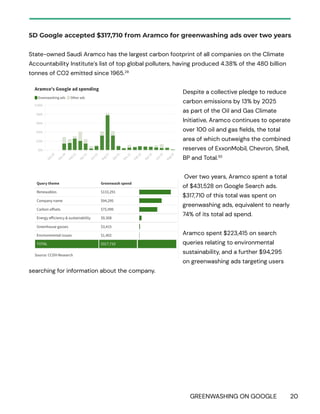
5D Google accepted $317,710 from Aramco for greenwashing ads over two years
State-owned Saudi Aramco has the largest carbon footprint of all companies on the Climate
Accountability Institute’s list of top global polluters, having produced 4.38% of the 480 billion
tonnes of CO2 emitted since 1965.29
Despite a collective pledge to reduce
carbon emissions by 13% by 2025
as part of the Oil and Gas Climate
Initiative, Aramco continues to operate
over 100 oil and gas fields, the total
area of which outweighs the combined
reserves of ExxonMobil, Chevron, Shell,
BP and Total.30
Over two years, Aramco spent a total
of $431,528 on Google Search ads.
$317,710 of this total was spent on
greenwashing ads, equivalent to nearly
74% of its total ad spend.
Aramco spent $223,415 on search
queries relating to environmental
sustainability, and a further $94,295
on greenwashing ads targeting users
searching for information about the company.
GREENWASHING ON GOOGLE 21
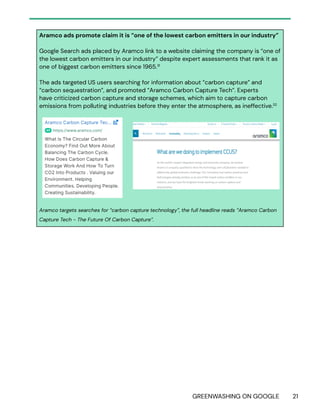
Aramco ads promote claim it is “one of the lowest carbon emitters in our industry”
Google Search ads placed by Aramco link to a website claiming the company is “one of
the lowest carbon emitters in our industry” despite expert assessments that rank it as
one of biggest carbon emitters since 1965.31
The ads targeted US users searching for information about “carbon capture” and
“carbon sequestration”, and promoted “Aramco Carbon Capture Tech”. Experts
have criticized carbon capture and storage schemes, which aim to capture carbon
emissions from polluting industries before they enter the atmosphere, as ineffective.32
Aramco targets searches for “carbon capture technology”, the full headline reads “Aramco Carbon
Capture Tech - The Future Of Carbon Capture”.
GREENWASHING ON GOOGLE 22
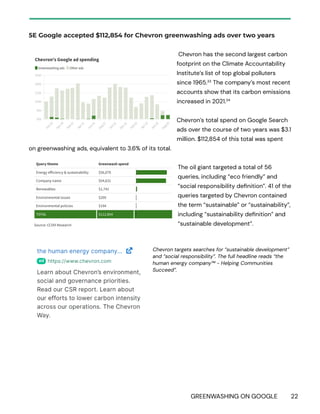
5E Google accepted $112,854 for Chevron greenwashing ads over two years
Chevron has the second largest carbon
footprint on the Climate Accountability
Institute’s list of top global polluters
since 1965.33
The company’s most recent
accounts show that its carbon emissions
increased in 2021.34
Chevron’s total spend on Google Search
ads over the course of two years was $3.1
million. $112,854 of this total was spent
on greenwashing ads, equivalent to 3.6% of its total.
The oil giant targeted a total of 56
queries, including “eco friendly” and
“social responsibility definition”. 41 of the
queries targeted by Chevron contained
the term “sustainable” or “sustainability”,
including “sustainability definition” and
“sustainable development”.
Chevron targets searches for “sustainable development”
and “social responsibility”. The full headline reads “the
human energy company™ - Helping Communities
Succeed”.
GREENWASHING ON GOOGLE 23
6 Internal documents expose gap between greenwashing ads and reality
Internal documents from four companies investigated by this report reveal the extent to which
greenwashing ads misrepresent the reality of Big Oil’s continued pursuit of fossil fuel profits.
On 16 September 2021, the US House Committee on Oversight and Reform launched an
investigation into the fossil fuel industry’s climate disinformation and greenwashing campaign.
Following a year-long investigation, the committee released internal documents from BP,
ExxonMobil, Shell and Chevron detailing what it describes as “the fossil fuel industry’s
campaign to mislead the American people about the industry’s role in climate change.”35
Based on these internal documents, the following section lays out how the greenwashing
Google Search ads placed by these Big Oil companies contrasts with their real positions
on climate action. Google Search ad expenditures are estimated based on analysis of ad
descriptions, titles and targeted keywords.
GREENWASHING ON GOOGLE 24
Greenwash Reality
On net-zero targets
Shell ads claim that it “aims to become a
net-zero emissions energy business by
2050, in step with society.” In total, Shell
spent a total of $1.2 million on Google Search
ads containing the phrase “net zero”.
Shell’s internal messaging guidance instructs
employees that net-zero emissions is “a
collective ambition for the world” rather than
a “Shell goal or target.”
On the Paris Agreement
ExxonMobil ads claim “we’re reaffirming
support for the Paris Agreement”, spending
$307,019 in total on Google Search ads
affirming a commitment to the agreement.
ExxonMobil has sought to water down its
commitment to climate targets, with a memo
revealing the company’s desire to “remove
reference to [the] Paris Agreement” from
an agreement with the Oil and Gas Climate
Initiative (OGCI).
Chevron ads have promoted a page stating
“Chevron supports the Paris Agreement.”36
Chevron spent $23,706 on such ads.
Chevron supported efforts to water down
climate targets, according to an internal
memo written by employees at ExxonMobil.
That included attempts to “remove reference
to [the] Paris Agreement” from an agreement
with the Oil and Gas Climate Initiative (OGCI).
On carbon capture
BP ads claim that “carbon capture… is
a proven technology that can cut CO2
emissions.” The company spent $62,813
on Google Search ads mentioning carbon
capture or sequestration.
BP privately views carbon capture as a way
to “enable the full use of fossil fuels across
the energy transition and beyond”, according
to internal documents.
On the transition to cleaner energy
Chevron ads claim “we believe the future
of energy is lower carbon… Learn about our
energy transition strategy and actions.” The
company spent $22,502 on ads mentioning
the term “transition”.
Chevron documents providing talking points
to an executive assert that “[o]il and gas” are
the “lower carbon solutions that ensures a
just transition.”
On biofuels
ExxonMobil ads boast of the company’s
“successes in developing algae-based
biodiesel.” The company spent $237,654 on
ads mentioning algae-based biofuels in total.
ExxonMobil notes detailing an investor
presentation state that the technology for
algae-based biofuels is “[s]till decades away
from the scale we need.”
GREENWASHING ON GOOGLE 25
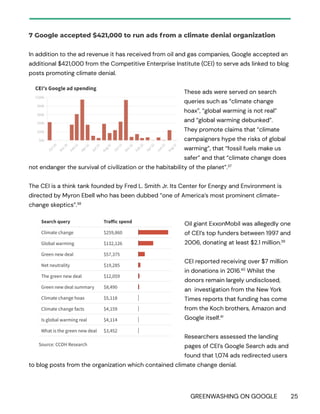
7 Google accepted $421,000 to run ads from a climate denial organization
In addition to the ad revenue it has received from oil and gas companies, Google accepted an
additional $421,000 from the Competitive Enterprise Institute (CEI) to serve ads linked to blog
posts promoting climate denial.
These ads were served on search
queries such as “climate change
hoax”, “global warming is not real”
and “global warming debunked”.
They promote claims that “climate
campaigners hype the risks of global
warming”, that “fossil fuels make us
safer” and that “climate change does
not endanger the survival of civilization or the habitability of the planet”.37
The CEI is a think tank founded by Fred L. Smith Jr. Its Center for Energy and Environment is
directed by Myron Ebell who has been dubbed “one of America’s most prominent climate-
change skeptics”.38
Oil giant ExxonMobil was allegedly one
of CEI’s top funders between 1997 and
2006, donating at least $2.1 million.39
CEI reported receiving over $7 million
in donations in 2016.40
Whilst the
donors remain largely undisclosed,
an investigation from the New York
Times reports that funding has come
from the Koch brothers, Amazon and
Google itself.41
Researchers assessed the landing
pages of CEI’s Google Search ads and
found that 1,074 ads redirected users
to blog posts from the organization which contained climate change denial.
GREENWASHING ON GOOGLE 26
Google allowed CEI to target users searching for Australia’s wildfires
Google allowed CEI to place ads targeting users searching for information about
Australia’s deadly wildfires, promoting claims that “alarmists have been quick to blame
climate change”. CEI’s overall Google ad spend peaked in March 2021 at $95,056,
followed by another spike in November 2021 at $94,152 which coincided with COP26.
During this time, CEI ran ads on search queries including “australias wild fires”, “how are
australian fires doing” and “natural causes for wildfires”.
Left, CEI promoting climate denial in Google Search ads. Right, CEI targets searches for “australia
wild fires” [sic], “how are australian fires doing” and “natural causes for wildfires”.
Google broke its promise not to profit from ads promoting climate denial
Despite Google’s announcement in October 2021 to demonetize and prohibit ads that
promote climate denial, data from Semrush suggests that the platform has failed to
enforce its own policy and has continued to serve ads from CEI until September 2022.
The ad below redirects users to the blog post titled “Our Latest Global Warming Scare”,
in which the author claims that “the risks of fire today remain great but for reasons that
are unrelated to climate change [sic]”.42
Ad running on the search query “climate [sic] change facts”, last seen on 29 September 2022.
GREENWASHING ON GOOGLE 27
8 Recommendations: Google should come clean and stop profiting from
greenwashing
The vast majority of Americans who want to see action taken to tackle climate change
would be forgiven for thinking that Google was playing its part.43
After all, Google publicly
acknowledges that climate change poses a threat.44
Last year, the tech giant even made a
commitment on climate change denial, saying it would no longer run ads containing climate
denial or allow the monetization of content that promotes denial.45
The year before that, it
barred oil and gas giants from using its AI tools to aid in further fossil fuel exploration.46
But this report reveals that in all this time Google was effectively gaslighting the public. In the
last two years alone, Big Oil paid Google at least $10.9 million to pollute users’ search results
with greenwashing ads that distort the facts about the climate crisis and our way out of it.
Internal memos published by the House Committee on Oversight and Reform show that
many of those ads were deliberately constructed to mislead the public.47
Ads placed by
Shell promote a commitment to “net-zero emissions”, while the company privately instructs
employees that net-zero is “not a Shell business plan”.48
Ads placed by BP claim “carbon
capture… can cut CO2 emissions”, while the company privately plans to use carbon capture to
“enable the full use of fossil fuels across the energy transition and beyond”.49
That is to say nothing of the hundreds of thousands of dollars Google made from ads
promoting outright climate change denial, including claims that “climate campaigners hype the
risks of global warming” and “fossil fuels make the planet safer”.
The immediate challenge to Google is clear: stop profiting from Big Oil ads designed to mislead
the public and keep your promises to stop profiting from climate denial.
That leads on to a deeper, long-term problem that Google needs to address. It starts with
acknowledging that Google got away with gaslighting us on its climate change policies
because it keeps the public in the dark over the ads it runs.
Google’s offer to advertisers is simple. For a price, it will replace the top ranked results of
a search query - the results that users most often notice and trust - with content of the
advertiser’s choice.50
But despite the importance of Google Search as a source of trusted
information, Google tells the public virtually nothing about how its search results are distorted
by advertisers.
GREENWASHING ON GOOGLE 28
The end result is inevitable: Google ads that distort search results with misleading claims or
outright disinformation can run for years until a report like this one drags them into the public
eye. That has to change with a radical new commitment to ad transparency from Google.
We are making three demands of Google. Regardless, regulators and legislators must act to
tackle misleading climate ads and force transparency on Google.
1 Google must keep its promise not to profit from climate denial content
Last year, Google bowed to pressure from the Climate Action Against Disinformation (CAAD)
coalition and promised not to run ads promoting climate change denial.51
In the wake of that announcement, we published research showing that ten “superpolluter”
publishers of climate disinformation, the Toxic Ten, were making up to $3.6 million a year from
Google Search ads.52
Our subsequent checks on Google’s enforcement showed the tech giant
was breaking its promise: 95% of climate denial ads were still monetised with Google ads.53
Despite calls from leading Senators to keep its promise not to profit from climate denial
content, our report shows that Google is continuing to run climate denial ads from the
Competitive Enterprise Institute that made it an estimated $421,000 in the last two years.54
Google must halt any live climate denial ads placed by the Competitive Enterprise Institute. To
prevent climate denial ads running in future, it should introduce robust checks on climate ads
before placing them in users’ search results, and introduce new transparency tools so that the
public and civil society organizations can identify problems with Google’s systems.
GREENWASHING ON GOOGLE 29
Our STAR Framework for social media regulation can hold Google accountable
CCDH has developed the STAR Framework - a global standard for legislative design -
to assist with the development of consistent and effective legislation for Big Tech. The
STAR Framework has four components: Safety by Design, Transparency, Accountability
and Responsibility which are outlined in the table in Appendix B. The findings in this
report support the need for greater transparency and accountability of Google,
particularly public transparency of rules enforcement and economics, including
advertising information.
Trust needs to be verified, and there should be consequences for violating public
trust. Google has betrayed that public trust by continuing to profit from climate
disinformation, despite promises made.
Self-regulation has failed. Given their record of facilitating and profiting from harm,
technology companies, like Google, cannot be trusted to oversee and enforce
their own rules. An accountability system, truly independent from the technology
companies, provides appropriate checks and balances on corporate power and the
perverse incentives that currently exist for taking a negligent approach to safety by
design, transparency and rules enforcement.
We recommend that Congress adopts the STAR Framework in future legislative efforts.
2 Google must stop profiting from Big Oil ads that distort climate change search results
Google has already accepted the principle that its technologies should not be used by Big
Oil companies in ways that could worsen or prolong the climate crisis. It must now apply that
same principle to the ad services that Big Oil exploits to distort users’ search results.
Thanks to internal oil and gas company documents obtained by the House Committee on
Oversight and Reform, we know that ads placed by Big Oil grossly misrepresent their real
commitments to action on climate change and form part of a strategy to delay that action.
Google made $149 billion from search advertising in 2021.55
It can afford to make a principled
decision and reject Big Oil advertising that prolongs the climate crisis.
The FTC can help hold Big Tech and Big Oil accountable for greenwashing
The report reveals Big Oil’s effective use of advertising targeting users searching for
information about the environment and the record of Big Oil on climate change.
GREENWASHING ON GOOGLE 30
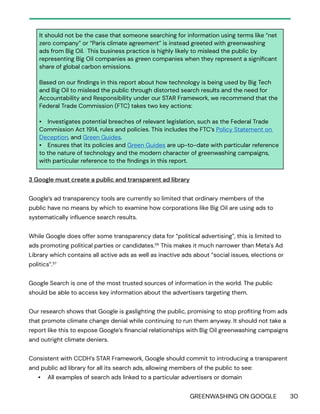
It should not be the case that someone searching for information using terms like “net
zero company” or “Paris climate agreement” is instead greeted with greenwashing
ads from Big Oil. This business practice is highly likely to mislead the public by
representing Big Oil companies as green companies when they represent a significant
share of global carbon emissions.
Based on our findings in this report about how technology is being used by Big Tech
and Big Oil to mislead the public through distorted search results and the need for
Accountability and Responsibility under our STAR Framework, we recommend that the
Federal Trade Commission (FTC) takes two key actions:
• Investigates potential breaches of relevant legislation, such as the Federal Trade
Commission Act 1914, rules and policies. This includes the FTC’s Policy Statement on
Deception, and Green Guides.
• Ensures that its policies and Green Guides are up-to-date with particular reference
to the nature of technology and the modern character of greenwashing campaigns,
with particular reference to the findings in this report.
3 Google must create a public and transparent ad library
Google’s ad transparency tools are currently so limited that ordinary members of the
public have no means by which to examine how corporations like Big Oil are using ads to
systematically influence search results.
While Google does offer some transparency data for “political advertising”, this is limited to
ads promoting political parties or candidates.56
This makes it much narrower than Meta’s Ad
Library which contains all active ads as well as inactive ads about “social issues, elections or
politics”.57
Google Search is one of the most trusted sources of information in the world. The public
should be able to access key information about the advertisers targeting them.
Our research shows that Google is gaslighting the public, promising to stop profiting from ads
that promote climate change denial while continuing to run them anyway. It should not take a
report like this to expose Google’s financial relationships with Big Oil greenwashing campaigns
and outright climate deniers.
Consistent with CCDH’s STAR Framework, Google should commit to introducing a transparent
and public ad library for all its search ads, allowing members of the public to see:
• All examples of search ads linked to a particular advertisers or domain
GREENWASHING ON GOOGLE 31
• The search queries and other criteria advertisers used to target the ads
• How many times an ad was seen or clicked
• How much was spent on each ad
• The dates that an ad started and finished running
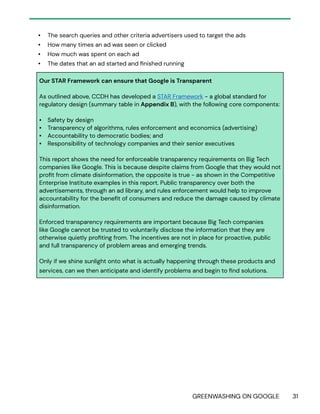
Our STAR Framework can ensure that Google is Transparent
As outlined above, CCDH has developed a STAR Framework - a global standard for
regulatory design (summary table in Appendix B), with the following core components:
• Safety by design
• Transparency of algorithms, rules enforcement and economics (advertising)
• Accountability to democratic bodies; and
• Responsibility of technology companies and their senior executives
This report shows the need for enforceable transparency requirements on Big Tech
companies like Google. This is because despite claims from Google that they would not
profit from climate disinformation, the opposite is true - as shown in the Competitive
Enterprise Institute examples in this report. Public transparency over both the
advertisements, through an ad library, and rules enforcement would help to improve
accountability for the benefit of consumers and reduce the damage caused by climate
disinformation.
Enforced transparency requirements are important because Big Tech companies
like Google cannot be trusted to voluntarily disclose the information that they are
otherwise quietly profiting from. The incentives are not in place for proactive, public
and full transparency of problem areas and emerging trends.
Only if we shine sunlight onto what is actually happening through these products and
services, can we then anticipate and identify problems and begin to find solutions.
GREENWASHING ON GOOGLE 32
Appendix A: Methodology
As Google does not provide a transparent and detailed ad library, researchers utilized
Semrush, an enterprise analytics tool for Google Search, to collect the data for this report.
Semrush collects its data from its partnerships with clickstream data providers and third party
data providers, before examining live and historical data in order to create reports tracking
insights, such as a keyword’s search volume and cost-per-click.58
Semrush provides its estimates for the amount spent on ads running under queries in a
monthly format, so keyword query data was combined across 24 months for each company in
order to calculate totals over the two years.
Our analysis was restricted to figures for paid traffic from Google users based in the US
only, although Semrush also provides data on advertising in other countries where available.
Similarly, company domains from outside the US were excluded from analysis, such as
“exxonmobil.eu” and “shellenergy.co.uk”.
Defining Big Oil
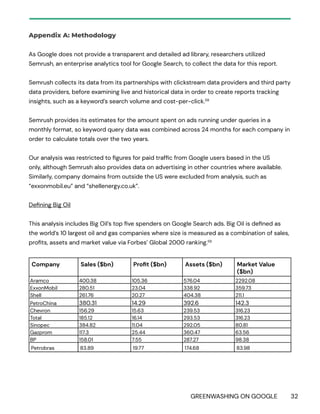
This analysis includes Big Oil’s top five spenders on Google Search ads. Big Oil is defined as
the world’s 10 largest oil and gas companies where size is measured as a combination of sales,
profits, assets and market value via Forbes’ Global 2000 ranking.59
Company Sales ($bn) Profit ($bn) Assets ($bn) Market Value
($bn)
Aramco 400.38 105.36 576.04 2292.08
ExxonMobil 280.51 23.04 338.92 359.73
Shell 261.76 20.27 404.38 211.1
PetroChina 380.31 14.29 392.6 142.3
Chevron 156.29 15.63 239.53 316.23
Total 185.12 16.14 293.53 316.23
Sinopec 384.82 11.04 292.05 80.81
Gazprom 117.3 25.44 360.47 63.56
BP 158.01 7.55 287.27 98.38
Petrobras 83.89 19.77 174.68 83.98
GREENWASHING ON GOOGLE 33
Emissions since 1965
The five Big Oil companies studied by this report - ExxonMobil, BP, Chevron, Shell and Aramco
- account for 14.38% of the world’s carbon emissions since 1965 according to research
carried out by the Climate Accountability Institute.60 Saudi Arabia’s Aramco is the leading
state-owned polluter accounting for 4.38% of the global total, while the other four are leading
investor-owned oil and gas corporations accounting for 10%.
Most recent emission levels
According to CCDH calculations, the five companies studied in this report emitted 8%
of 2021’s total energy-related emissions, equivalent to just over 2.9 billion tonnes of CO2
equivalents.
To calculate these figures, researchers obtained the most recently reported figures for each
company from GlobalData, a data analytics and consulting company. With the exception of
Aramco which did not disclose its Scope 3 emissions, the total emissions for each company
were calculated using their most recent Scope 1, 2 and 3 emission figures.
Each company’s total emissions were added together to give a sum of 2.9 billion tonnes of
carbon emissions for all five companies. This was then divided by the total energy-related
emissions in 2021 taken from the International Energy Agency to give 8%.
Company
Scope 1
(MtCO2eq)
Scope 2
(MtCO2eq)
Scope 3
(MtCO2eq) TOTAL (MtCO2eq)
Aramco 60,600,000 18,700,000 N/A 79,300,000
Chevron 57,000,000 4,000,000 408,000,000 469,000,000
BP 33,200,000 2,400,000 304,000,000 339,600,000
Shell 60,000,000 8,000,000 1,299,000,000 1,367,000,000
ExxonMobil 107,000,000 7,000,000 540,000,000 654,000,000
TOTAL 2,908,900,000
Total energy-related
emissions (2021) 36,300,000,000
% (Total energy-related
emissions) 8.01%
GREENWASHING ON GOOGLE 34
Calculating Google Ad Spend
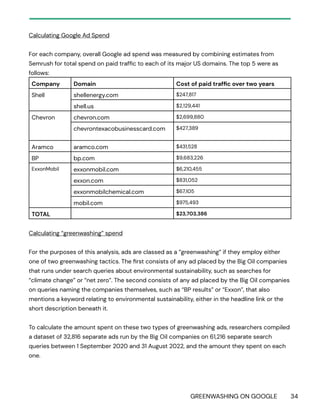
For each company, overall Google ad spend was measured by combining estimates from
Semrush for total spend on paid traffic to each of its major US domains. The top 5 were as
follows:
Company Domain Cost of paid traffic over two years
Shell shellenergy.com $247,817
shell.us $2,129,441
Chevron chevron.com $2,699,880
chevrontexacobusinesscard.com $427,389
Aramco aramco.com $431,528
BP bp.com $9,683,226
ExxonMobil exxonmobil.com $6,210,455
exxon.com $831,052
exxonmobilchemical.com $67,105
mobil.com $975,493
TOTAL $23,703,386
Calculating “greenwashing” spend
For the purposes of this analysis, ads are classed as a “greenwashing” if they employ either
one of two greenwashing tactics. The first consists of any ad placed by the Big Oil companies
that runs under search queries about environmental sustainability, such as searches for
“climate change” or “net zero”. The second consists of any ad placed by the Big Oil companies
on queries naming the companies themselves, such as “BP results” or “Exxon”, that also
mentions a keyword relating to environmental sustainability, either in the headline link or the
short description beneath it.
To calculate the amount spent on these two types of greenwashing ads, researchers compiled
a dataset of 32,816 separate ads run by the Big Oil companies on 61,216 separate search
queries between 1 September 2020 and 31 August 2022, and the amount they spent on each
one.
GREENWASHING ON GOOGLE 35
To identify ads employing the first of the two greenwashing tactics, researchers categorized
all queries on which the companies spent at least $50 to determine whether or not the ads
running on them constituted greenwashing. A total of 6,084 of the total 32,816 search queries
reached this threshold, accounting for 99% of the total amount spent. All spending for ads
running on query categories relating to the broad theme of environmental sustainability were
classed as “greenwashing”.
For example, queries like “carbon capture” and “carbon sequestration” were categorized
under “carbon offset”, and therefore the ads on them were classed as greenwashing. Searches
for “coal” or “natural gas” were categorized under “fossil fuels”, and therefore not classed as
greenwashing. The following table details the categories used in the analysis and indicates
which ones were classed as greenwashing.
GREENWASHING ON GOOGLE 36
Category Description
Traffic
spend Greenwashing?
Greenhouse
gasses
Search queries related to greenhouse gasses, e.g. carbon
dioxide and methane. $1,805,832 Yes
Renewables
Search queries related to renewable sources of energy,
e.g. geothermal, wind, solar or hydro. $1,678,913 Yes
Carbon offsets
Search queries related to carbon offsetting, e.g. carbon
capture or net-zero. $1,214,254 Yes
Energy efficiency
& sustainability Search queries related to sustainability or saving energy. $357,949 Yes
Biofuels Search queries related to biofuels. $176,272 Yes
Environmental
policies
Search queries related to environmental policies, e.g. the
2015 COP Paris Agreement, Green New Deal policies, the
Sustainable Development Goals and carbon taxes. $169,100 Yes
Electric Vehicles Search queries related to electric vehicles. $165,366 Yes
Environmental
issues
Search queries related to environmental issues, including
climate change, deforestation and wildfires. $126,424 Yes
Company names
Search queries containing keywords related to our
identified oil and gas companies, including their
subsidiaries, e.g. ‘Chevron’ and ‘Texaco’. $16,183,986 No
Irrelevant
Search queries not at all relevant to climate or do not
contain names of oil and companies, e.g. ‘senior financial
analyst jobs’. $934,790 No
Energy
General search queries for energy, e.g. energy sources,
pipelines. $368,944 No
Fossil fuels
Search queries related to fossil fuels, e.g. crude oil, or their
derived products, e.g. plastics or engine oil. $259,421 No
Nuclear Search queries related to nuclear energy. $76,486 No
Vehicle engines Search queries related to vehicle engines. $5,348 No
To identify ads employing the second of the two greenwashing tactics, researchers analyzed
the text of all ads running under searches for the Big Oil companies themselves. A total of
$16,183,986 was spent running under such queries, including those consisting of abbreviations
of company names such as “Exxon” and “Mobil”, as well as those including the company
names alongside another search term, such as “Exxon results”. All ads running under these
queries were counted as greenwashing if they included one of the following keywords relating
to environmental sustainability: “Net zero”, “Green”, “Environment”, “Carbon”, “Emissions”,
“Climate”, “Sustainable”, “Sustainability”, “Greenhouse gas”, “Solar”, “Renewable”, “Wind”,
“Hydro”, “Paris”, “Electric vehicle” or “Biofuel”.
GREENWASHING ON GOOGLE 37
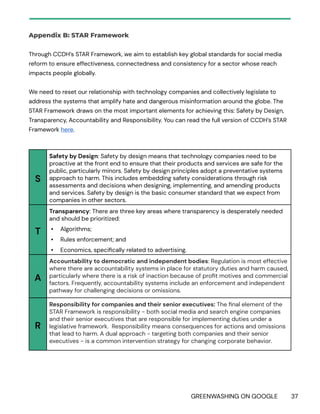
Appendix B: STAR Framework
Through CCDH’s STAR Framework, we aim to establish key global standards for social media
reform to ensure effectiveness, connectedness and consistency for a sector whose reach
impacts people globally.
We need to reset our relationship with technology companies and collectively legislate to
address the systems that amplify hate and dangerous misinformation around the globe. The
STAR Framework draws on the most important elements for achieving this: Safety by Design,
Transparency, Accountability and Responsibility. You can read the full version of CCDH’s STAR
Framework here.
S
Safety by Design: Safety by design means that technology companies need to be
proactive at the front end to ensure that their products and services are safe for the
public, particularly minors. Safety by design principles adopt a preventative systems
approach to harm. This includes embedding safety considerations through risk
assessments and decisions when designing, implementing, and amending products
and services. Safety by design is the basic consumer standard that we expect from
companies in other sectors.
T
Transparency: There are three key areas where transparency is desperately needed
and should be prioritized:
• Algorithms;
• Rules enforcement; and
• Economics, specifically related to advertising.
A
Accountability to democratic and independent bodies: Regulation is most effective
where there are accountability systems in place for statutory duties and harm caused,
particularly where there is a risk of inaction because of profit motives and commercial
factors. Frequently, accountability systems include an enforcement and independent
pathway for challenging decisions or omissions.
R
Responsibility for companies and their senior executives: The final element of the
STAR Framework is responsibility - both social media and search engine companies
and their senior executives that are responsible for implementing duties under a
legislative framework. Responsibility means consequences for actions and omissions
that lead to harm. A dual approach - targeting both companies and their senior
executives - is a common intervention strategy for changing corporate behavior.
GREENWASHING ON GOOGLE 38
Endnotes
1 Schultheiß, S., & Lewandowski, D. (2021). Misplaced trust? The relationship between trust,
ability to identify commercially influenced results and search engine preference. Journal of
Information Science, 0(0). https://doi.org/10.1177/01655515211014157
2 Purcell K, Brenner J, Rainie L. Search engine use 2012. Washington, DC, https://www.eff.org/
files/pew_2012_0.pdf
3 Schultheiß, S., & Lewandowski, D. (2021). Misplaced trust? The relationship between trust,
ability to identify commercially influenced results and search engine preference. Journal of
Information Science, 0(0). https://doi.org/10.1177/01655515211014157
4 “The latest Google Ads Research from Varn 2022”, Varn, 22 September 2022, https://varn.
co.uk/09/22/latest-google-ads-research-2022-varn
5 “Greenwashing”, ClientEarth, Accessed 10 October 2022, https://www.clientearth.org/what-
we-do/priorities/greenwashing/
6 “Ahead of Hearing, Committee Releases Memo Showing Fossil Fuel Industry is Misleading
the Public About Commitment to Reduce Emissions”, US House Committee on Oversight and
Reform, 14 September 2022, https://oversight.house.gov/news/press-releases/ahead-of-hearing-
committee-releases-memo-showing-fossil-fuel-industry-is
7 “Google plans to stop making A.I. tools for oil and gas firms”, CNBC, 20 May 2020, https://
www.cnbc.com/2020/05/20/google-ai-greenpeace-oil-gas.html
8 “Revealed: the 20 firms behind a third of all carbon emissions”, The Guardian, 9 October
2019, https://www.theguardian.com/environment/2019/oct/09/revealed-20-firms-third-carbon-
emissions
9 “Updating our ads and monetization policies on climate change”, Google Ads Help, 7
October 2021, https://support.google.com/google-ads/answer/11221321?hl=en
10 “Google Ads Benchmarks for YOUR Industry [Updated!]”, WordStream by LOCALiQ, 8
October 2022, https://www.wordstream.com/blog/ws/2016/02/29/google-adwords-industry-
benchmarks?_ga=2.89239704.2099466390.1665401618-2051396563.1665401618
11 “Revealed: the 20 firms behind a third of all carbon emissions”, The Guardian, 9 October
2019, https://www.theguardian.com/environment/2019/oct/09/revealed-20-firms-third-carbon-
emissions
12 “BP reports 10% drop in overall emissions in 2020”, Reuters, 22 March 2022, https://
www.reuters.com/article/us-bp-emissions/bp-reports-10-drop-in-overall-emissions-in-2020-
idUSKBN2BE2DN
“CO2 emissions”, British Petroleum, accessed 30 September 2022, https://www.bp.com/en/global/
corporate/energy-economics/statistical-review-of-world-energy/co2-emissions.html
13 “BP’s Climate Targets Missing Bulk of Emissions, Report Says”, Bloomberg, 28 March 2022,
https://www.bloomberg.com/news/articles/2022-03-27/bp-s-climate-targets-missing-bulk-of-
emissions-report-says/
“Revealed: Huge gas flaring emissions never reported”, BBC News, 29 September 2022, https://
www.bbc.co.uk/news/science-environment-62917498
“Gas Flaring Explained”, The World Bank, accessed 10 October 2022, https://www.worldbank.org/en/
programs/gasflaringreduction/gas-flaring-explained
14 “BP’s Climate Targets Missing Bulk of Emissions, Report Says”, Bloomberg, 28 March 2022,
https://www.bloomberg.com/news/articles/2022-03-27/bp-s-climate-targets-missing-bulk-of-
emissions-report-says/
15 “Revealed: Huge gas flaring emissions never reported”, BBC News, 29 September 2022,
https://www.bbc.co.uk/news/science-environment-62917498
“Gas Flaring Explained”, The World Bank, accessed 10 October 2022, https://www.worldbank.org/en/
programs/gasflaringreduction/gas-flaring-explained
GREENWASHING ON GOOGLE 39
16 “Revealed: the 20 firms behind a third of all carbon emissions”, The Guardian, 9 October
2019, https://www.theguardian.com/environment/2019/oct/09/revealed-20-firms-third-carbon-
emissions
17 “Exxon Sets a 2050 Goal for Net-Zero Greenhouse Gas Emissions”, The New York Times, 18
January 2022, https://www.nytimes.com/2022/01/18/business/exxon-net-zero-emissions.html
18 “Greenwashing Files: ExxonMobil”, ClientEarth, accessed 3 October 2022, https://www.
clientearth.org/projects/the-greenwashing-files/exxonmobil
19 “Oil firms’ climate claims are greenwashing, study concludes”, The Guardian, 16 February
2022, https://www.theguardian.com/environment/2022/feb/16/oil-firms-climate-claims-are-
greenwashing-study-concludes
20 “‘Is Exxon a Survivor?’ The Oil Giant Is at a Crossroads”, The New York Times, 10 December
2020, https://www.nytimes.com/2020/12/10/business/energy-environment/exxon-mobil-
pandemic-energy-transition.html
“Concern over Church of England pension board fossil fuel industry links”, The Guardian, 21
February 2022, https://www.theguardian.com/environment/2022/feb/21/concern-over-church-of-
england-pension-board-fossil-fuel-industry-links
21 “Reaffirming our commitment to the Paris Agreement”, Energy Factor, 20 January 2022,
https://energyfactor.exxonmobil.com/insights/partners/commitment-paris-agreement/
22 “ExxonMobil is planning on climate failure despite ‘Advancing Climate Solutions’”, Carbon
Tracker Initiative, 8 February 2022, https://carbontracker.org/exxonmobil-is-planning-on-climate-
failure-despite-advancing-climate-solutions/
23 “About us”, Energy Factor, accessed 7 October 2022, https://energyfactor.exxonmobil.com/
about-us/
24 “Revealed: the 20 firms behind a third of all carbon emissions”, The Guardian, 9 October
2019, https://www.theguardian.com/environment/2019/oct/09/revealed-20-firms-third-carbon-
emissions
25 “IPCC clarion call puts spotlight on fossil fuel industry’s hypocrisy”, Global Witness, 12 April
2022, https://www.globalwitness.org/en/campaigns/fossil-gas/ipcc-clarion-call-puts-spotlight-
on-fossil-fuel-industrys-hypocrisy/
“Greenwashing Files: Shell”, ClientEarth, accessed 3 October 2022, https://www.clientearth.org/
projects/the-greenwashing-files/shell/#:~:text=About%20Shell&text=In%202020%2C%20Shell%20
disclosed%20emissions,1.5%C2%B0C%20carbon%20budget
“Shell: Netherlands court orders oil giant to cut emissions”, BBC News, 26 May 2021, https://www.
bbc.co.uk/news/world-europe-57257982
26 “Dutch climate activists take Shell to court over emissions”, AP, 1 December 2020,
https://apnews.com/article/technology-climate-netherlands-climate-change-environment-
c256f3be23815e494a1b6f1c037c1fa8
27 “Our climate target”, Shell, accessed 13 October 2022, https://www.
shell.com/energy-and-innovation/the-energy-future/our-climate-target.
html#iframe=L3dlYmFwcHMvY2xpbWF0ZV9hbWJpdGlvbi8
28 “Ahead of Hearing, Committee Releases Memo Showing Fossil Fuel Industry is Misleading
the Public About Commitment to Reduce Emissions”, US House Committee on Oversight and
Reform, 14 September 2022, https://oversight.house.gov/news/press-releases/ahead-of-hearing-
committee-releases-memo-showing-fossil-fuel-industry-is
29 “Saudi oil giant Aramco reports 82% rise in quarterly profits”, The Guardian, 15 May 2022,
https://www.theguardian.com/business/2022/may/15/saudi-oil-giant-aramco-reports-82-rise-in-
quarterly-profits-to-record-395bn
“Revealed: the 20 firms behind a third of all carbon emissions”, The Guardian, 9 October 2019,
https://www.theguardian.com/environment/2019/oct/09/revealed-20-firms-third-carbon-
emissions
30 “Greenwashing Files: Aramco”, ClientEarth, accessed 30 September 2022, https://www.
GREENWASHING ON GOOGLE 40
clientearth.org/projects/the-greenwashing-files/aramco/
“Factbox: Saudi Aramco - the oil colossus”, Reuters, 17 November 2019, https://www.reuters.com/
article/us-saudi-aramco-ipo-factbox-idUSKBN1XR0AR
31 “Carbon capture, utilization & storage”, Saudi Aramco, accessed 30 September 2022,
https://www.aramco.com/en/sustainability/climate-change/managing-our-footprint/carbon-
capture-utilization-and-storage
“Revealed: the 20 firms behind a third of all carbon emissions”, The Guardian, 9 October 2019,
https://www.theguardian.com/environment/2019/oct/09/revealed-20-firms-third-carbon-
emissions
32 “Carbon capture is not a solution to net zero emissions plans, report says”, The Guardian, 1
September 2022, https://www.theguardian.com/environment/2022/sep/01/carbon-capture-is-not-
a-solution-to-net-zero-emissions-plans-report-says
33 “Revealed: the 20 firms behind a third of all carbon emissions”, The Guardian, 9 October
2019, https://www.theguardian.com/environment/2019/oct/09/revealed-20-firms-third-carbon-
emissions
34 “2021 Performance Data”, Chevron,14 June 2021, https://www.chevron.com/-/media/shared-
media/documents/2021-sustainabilty-performance-data.pdf
35 “Ahead of Hearing, Committee Releases Memo Showing Fossil Fuel Industry is Misleading
the Public About Commitment to Reduce Emissions”, US House Committee on Oversight and
Reform, 14 September 2022, https://oversight.house.gov/news/press-releases/ahead-of-hearing-
committee-releases-memo-showing-fossil-fuel-industry-is
36 “Advancing a lower carbon future”, Chevron, retrieved 17 October 2022, https://www.
chevron.com/sustainability/environment/energy-transition
37 “Climate Change, Fossil Fuels, and Human Well Being”, Competitive Enterprise Institute, 11
July 2018, https://cei.org/blog/climate-change-fossil-fuels-and-human-well-being/
“A Citizen’s Guide to Climate Change”, Competitive Enterprise Institute, 11 June 2019, https://cei.
org/studies/a-citizens-guide-to-climate-change/
38 “Competitive Enterprise Institute (CEI)”, DeSmog, accessed 6 October 2022, https://www.
desmog.com/competitive-enterprise-institute/
“Myron Ebell: Director, Center for Energy and Environment,” Competitive Enterprise Institute.
Archived 29 September 2012. Archive URL: https://archive.ph/wpXxG
39 “Competitive Enterprise Institute (CEI)”, DeSmog, accessed 6 October 2022, https://www.
desmog.com/competitive-enterprise-institute/
40 “2016 Tax Form 990”, Competitive Enterprise Institute, accessed 11 October 2022, https://
www.documentcloud.org/documents/6172441-Competitive-Enterprise-Institute-2016.html
41 “Following the Money That Undermines Climate Science”, The New York Times, 10 July 2019,
https://www.nytimes.com/2019/07/10/climate/nyt-climate-newsletter-cei.html
42 “Our Latest Global Warming Scare”, Competitive Enterprise Institute, 17 October 2018,
https://cei.org/citations/our-latest-global-warming-scare/
43 “Two-Thirds of Americans Think Government Should Do More on Climate”, Pew Research
Center, 23 June 2020, https://www.pewresearch.org/science/2020/06/23/two-thirds-of-
americans-think-government-should-do-more-on-climate/
44 “Building an energy-efficient, low-carbon supply chain”, Google, October 2019, https://
sustainability.google/progress/projects/supply-chain-energy-emissions/
45 “Updating our ads and monetisation policies on climate change”, Google, 7 October 2021,
https://support.google.com/google-ads/answer/11221321
46 “Google plans to stop making A.I. tools for oil and gas firms”, CNBC, 20 May 2020, https://
www.cnbc.com/2020/05/20/google-ai-greenpeace-oil-gas.html
47 “Ahead of Hearing, Committee Releases Memo Showing Fossil Fuel Industry is Misleading
the Public About Commitment to Reduce Emissions”, US House Committee on Oversight and
Reform, 14 September 2022, https://oversight.house.gov/news/press-releases/ahead-of-hearing-
GREENWASHING ON GOOGLE 41
committee-releases-memo-showing-fossil-fuel-industry-is
48 ibid.
49 ibid.
50 See Section 3 of this report.
51 “Updating our ads and monetisation policies on climate change”, Google, 7 October 2021,
https://support.google.com/google-ads/answer/11221321
52 “Toxic Ten”, CCDH, 2 November 2021, https://counterhate.com/research/the-toxic-ten/
53 “Google Pledged to Remove Ads From Climate Denial Sites, but Many Still Run”, New York
Times, 16 December 2021, https://www.nytimes.com/2021/12/16/climate/google-climate-denial-ads.
html
54 “Whitehouse, Warren, & Schatz call on tech giants to follow through on pledges to stop
facilitating climate denial”, Sen. Sheldon Whitehouse, 21 December 2021, https://www.whitehouse.
senate.gov/news/release/whitehouse-warren-and-schatz-call-on-tech-giants-to-follow-through-
on-pledges-to-stop-facilitating-climate-denial
55 “Annual Report 2021”, Alphabet, 1 February 2022, https://abc.xyz/investor/static/pdf/2021_
alphabet_annual_report.pdf?cache=3a96f54
56 “Political advertising on Google”, Google, retrieved 12 October 2022, https://
adstransparency.google.com/political?political&region=US
57 “Ads about social issues, elections or politics”, Meta, retrieved 12 October 2022, https://
www.facebook.com/business/help/1838453822893854
58 “Where does Semrush data come from?”, Semrush, accessed 7 October 2022, https://www.
semrush.com/kb/998-where-does-semrush-data-come-from
59 “2022: The Global 2000”, Forbes, 12 May 2022, https://www.forbes.com/lists/
global2000/?sh=72b0c3115ac0
60 “Revealed: the 20 firms behind a third of all carbon emissions”, The Guardian, 9 October
2019, https://www.theguardian.com/environment/2019/oct/09/revealed-20-firms-third-carbon-
emissions
61 United Nations, 20 September 2022 https://www.un.org/sg/en/content/sg/
statement/2022-09-20/secretary-generals-address-the-general-assembly-trilingual-delivered-
follows-scroll-further-down-for-all-english-and-all-french
62 Google Sustainability, accessed 21 October 2022, https://sustainability.google/
commitments/
63 “Big oil’s quarterly profits hit record $50 billion, with BP yet to come” Reuters, 29 July 2022,
https://www.reuters.com/business/energy/big-oils-q2-profits-hit-record-50-bln-with-bp-yet-
come-2022-07-29/#:~:text=3%20months%20ago-,Big%20oil’s%20quarterly%20profits%20hit%20
record%20%2450,with%20BP%20yet%20to%20come
64 House Committee on Oversight and Reform, 14 September 2022, https://oversight.house.
gov/news/press-releases/ahead-of-hearing-committee-releases-memo-showing-fossil-fuel-
industry-is
65 ibid.
66 ibid.
67 “The latest Google Ads Research from Varn 2022”, Varn, 22 September 2022, https://varn.
co.uk/09/22/latest-google-ads-research-2022-varn
68 “Here’s What We Learned About Organic Click Through Rate”, BackLinko, 14 October 2022,
https://backlinko.com/google-ctr-stats
GREENWASHING ON GOOGLE 42
Greenwashing on Google
Published 3 November 2022
© Center for Countering Digital Hate Inc

How Google enables Big Oil’s greenwashing-Final Report

  • 1.
    GREENWASHING ON GOOGLE1 GREENWASHING ON GOOGLE How Google Profits by Cleaning Big Oil’s Reputation.
  • 2.
    GREENWASHING ON GOOGLE2 The Center for Countering Digital Hate is a US-headquartered international non- profit NGO that disrupts the architecture of online hate and misinformation. Digital technology has changed forever the way we communicate, build relationships, share knowledge, set social standards, and negotiate and assert our societies’ values. Digital spaces have been colonized and their unique dynamics exploited by malignant actors that instrumentalize hate and misinformation. These movements are opportunistic, agile, and confident in exerting influence and persuading people. Over time these malignant actors, advocating diverse causes - from hatred of women to racial and religious intolerance to science-denial - have formed a digital Counter- Enlightenment. The disinformation they spread to bolster their causes has socialized the offline world for the worse. The Center’s work combines both analysis and active disruption of these networks. CCDH’s solutions seek to increase the economic, political, and social costs of all parts of the infrastructure - the actors, systems, and culture - that support and profit from hate and misinformation. If you appreciate this report, you can donate to CCDH at counterhate.com/donate. In the United States, Center for Countering Digital Hate Inc is a 501(c)(3) charity. In the United Kingdom, Center for Countering Digital Hate Ltd is a non-profit company limited by guarantee.
  • 3.
    GREENWASHING ON GOOGLE3 Content 1. Introduction 2. Executive Summary 3. Why greenwashing ads on Google Search matter 4. Google accepted $23.7m from Big Oil over two years 5. Google accepted $10.9m for oil and gas greenwashing ads over two years a. Google accepted over $5.3m from BP’s greenwashing ads over two years b. Google accepted $4m for ExxonMobil greenwashing ads over two years c. Google accepted $1.2m from Shell for greenwashing ads over two years d. Google accepted $317,710 from Aramco’s greenwashing ads over two years e. Google accepted $112,854 from Chevron’s greenwashing ads over two years 6. Internal documents expose gap between greenwashing ads and reality 7. Google accepted $421,000 to run ads from a climate denial organization 8. Recommendations 9. Appendix A: Methodology 10. Appendix B: STAR Framework Published 3 November 2022 © Center for Countering Digital Hate Inc
  • 4.
    GREENWASHING ON GOOGLE4 1 Introduction As I write, an energy crisis is hurting households around the world and contributing to crippling inflation. Meanwhile, Big Oil is enjoying record profits by jacking up their prices and margins. This shameless act of profiteering took place despite the scrutiny they are deservedly under. The mass burning of hydrocarbons by humanity has led to rapid shifts in the composition of our atmosphere and ecosystems. Unprecedented global action is being demanded by people, scientists and politicians. The clamor for greening our economies is an existential crisis for those companies and we know from experience they will do anything and everything to stave off the moment when humanity makes the investments, policy changes and decisions to cut off the flow of hydrocarbons from Big Oil companies and the torrent of money that flows back to them. An entire industry of enablers has helped Big Oil profiteer and deny, deflect and delay the moment that meaningful change happens. The UN Secretary General, António Guterres, criticized PR agencies “raking in billions” for gaslighting the world about Big Oil’s detrimental impact on the climate.61 But among those enablers, CCDH has discovered that social media firms are the newest weapon of choice. And chief among them is Google, a firm that has made its reputation by providing a curated lens on the world, providing useful results for every query we put to its search engine, but has since sold the right to distort that lens to Big Oil. This may come as a surprise. Google, after all, has touted its “commitment to sustainability”.62 But that appears to be as hollow as their oft-repeated mantra “do no evil”. In this report, for the first time, the Center for Countering Digital Hate comprehensively details how Google enables Big Oil’s greenwashing. Greenwashing is an advertising and public relations strategy companies use to appear more climate friendly than they are in reality. When oil and gas companies greenwash, they seek to distract and deceive the public about their role in the climate crisis, particularly when their business models and activities are undeniably key drivers of climate change. Using the data analytics tool Semrush, we reveal that nearly half of the $23.7 million spent on Google search ads by oil and gas companies in the last two years have targeted search terms on environmental sustainability. The five companies studied in this report, ExxonMobil, British Petroleum (BP), Chevron, Shell, and Aramco, have polluted our search results while Google raked in their dirty money. Big Oil’s deception is by design. It is a tried and true business plan for the world’s largest
  • 5.
    GREENWASHING ON GOOGLE5 polluters to make public promises about sustainability, whilst lining their pockets with the largest profits in decades.63 In September 2022, the House Committee on Oversight and Reform’s Subcommittee on the Environment released initial findings of their investigation into Big Oil’s latest deceptive PR tactics. The Committee found that Big Oil, in their own words admitted through internal documents, is “gaslighting” the public.64 Our report has discovered much of the same: their ads are not supported by their actions. The internal memos obtained by the Oversight Committee underscore just how intentionally misleading Big Oil designs their ads to be. Ads placed by Shell promote a commitment to “net-zero emissions”, while the company privately instructs employees that net-zero is “not a Shell business plan”.65 Ads placed by BP claim “carbon capture… can cut CO2 emissions”, while the company privately plans to use carbon capture to “enable the full use of fossil fuels across the energy transition and beyond”.66 By allowing fossil fuel giants to advertise on searches like “How to reduce greenhouse gas emissions?”, “eco-friendly companies”, and “net zero”, Google is not only complicit in the latest disinformation campaign of the fossil fuel industry, but actively profiting from this deception. This report proves what many of us know to be true: when fossil fuel companies come under fire for their role in exacerbating the climate crisis, they ramp up spending on ads that greenwash their environmental credentials. Greenwashing is key to Big Oil’s strategy to delay the transition to renewable energy. Climate campaigners and consumer protection advocates alike have long warned that greenwashing is the latest PR frontier for companies that refuse to reconcile their reputations and their actions on the climate emergency we face. When users query the “pros and cons of the paris climate agreement” or “what are greenhouse gases”, Google sells ads to the US’s largest oil company, ExxonMobil, at the top of the page. We know that 68% of users are unable to spot the difference between ads and organic search results.67 Moreover, studies show that only 0.63% of Google searchers will click on links shown in the second page of results.68 Google is allowing fossil fuel companies to dominate the information ecosystem to peddle their deception. Google’s lack of transparency and corporate irresponsibility is a wider problem – they sell search terms to the highest bidder, no matter the consequences. They don’t even act on their own specific promises. For example, contrary to its promises to no longer run ads containing climate denial, we reveal that Google continues to accept hundreds of thousands for outright climate denial. Ads that claim “fossil fuels make the planet safer” have no right to appear on a search engine that claims to care about the climate crisis.
  • 6.
    GREENWASHING ON GOOGLE6 Google has therefore exploited the lack of compulsory transparency from regulators and governments, allowing the company to operate with opacity and without an ad library for the public and researchers to know where ads are placed. The choice for Google is clear: keep your promises to stop profiting from climate denial and stop pushing Big Oil ads designed to distort their environmental records. The public, regulators, and officials should not be kept in the dark about Google’s role in greenwashing the records of fossil fuel giants. Following the principles laid out in CCDH’s framework for tech reform and legislative change, the STAR Framework, we demand the following: • Google must keep its promise not to profit from climate change denial ads. • Google must stop profiting from Google ads that distort search results about climate change. • Google must create a public and transparent ad library. It’s time for Google to come clean about its own gaslighting. The planet can’t wait for corporations to decide to act responsibly. Imran Ahmed CEO, Center for Countering Digital Hate
  • 7.
    GREENWASHING ON GOOGLE7 2 Executive Summary Google accepted $23.7m for ads from Big Oil in the last two years • Analysis of Big Oil ads placed on Google Search by five of the world’s biggest oil companies and carbon emitters show they spent $23.7m since September 2020. • Researchers used the enterprise analytics tool Semrush to analyze US Google Search ad spending by British Petroleum (BP), ExxonMobil, Chevron, Shell and Aramco which are together accountable for 14% of global carbon emissions since 1965. Big Oil devoted $10.9m of this ad spend to misleading greenwashing ads viewed 58.6m times • Greenwashing is when companies use green messaging to appear more climate friendly and environmentally sustainable than they really are. • Big Oil spent $10.9m to target US Google Search users with greenwashing ads in the last two years, which were viewed an estimated 58.6m times, including: • $1.8m to target users searching for information on greenhouse gasses • $1.7m to target queries about renewables • $1.2m to target queries about carbon offsets • $5.2m to target users searching for information about Big Oil companies • All five Big Oil companies targeted users searching for “eco friendly” companies • Internal oil company documents published by the US Committee on Oversight and Reform show Big Oil is deliberately misleading Google Search users. Google accepted a further $421,000 for ads from a climate denial organization • Competitive Enterprise Institute ads claimed “climate campaigners hype the risks of global warming” and “fossil fuels make the planet safer”. Google should come clean and stop profiting from greenwashing • Google must keep its promise not to profit from climate denial content, which means halting denial ads from the Competitive Enterprise Institute. • Google must stop distorting search results with greenwashing ads, extending its existing commitments to bar Big Oil from using its technologies to prolong the climate crisis. • Google should introduce a transparent ad library, so the public can examine how corporations like Big Oil use ads to systematically distort search results. • Legislators should adopt CCDH’s STAR Framework for regulation of Big Tech that delivers Safety by Design, Transparency, Accountability and Responsibility. • The FTC should update its guidance on deceptive ads in light of Big Oil greenwashing.
  • 8.
    GREENWASHING ON GOOGLE8 3 Why greenwashing ads on Google Search matter The vast majority of Americans use Google Search to find information on topics they care about, and consider that information to be trustworthy. Google dominates the search market in the United States, commanding a market share of 87%.1 Users also have a high degree of trust in search engines: 73% believe that most or all of the information they find in search is accurate and trustworthy.2 Users have a particularly high level of trust in the top-ranked results provided by search engines, even where they are less relevant or less credible than lower-ranked results.3 This is important because ads placed on Google Search appear at the top of the page when people use Google to search the web, deliberately resembling organic search results. Studies have shown that 68% of users are unable to distinguish these ads from organic search results.4 Accordingly, many of the users who turn to Google Search to find information will encounter Google ads at the top of search results and consider the information they contain to be credible. It is for all of these reasons that Big Oil companies are placing ads on Google Search in a bid to target and influence users searching for information about climate change and the role that oil and gas companies play in the climate crisis. These attempts to influence public perceptions of the role of polluting industries in causing climate change are known as greenwashing. Throughout our report we use the following definition of greenwashing produced by ClientEarth, an international environmental law charity. Greenwashing is where a company uses advertising and public messaging to appear more climate friendly and environmentally sustainable than it really is. It’s also a technique used by certain companies to distract consumers from the fact that their business model and activities actually do a lot of environmental harm and damage.5 We know that greenwashing is a key part of Big Oil’s strategy to delay a transition to renewables and continue profiting from polluting oil and gas. Internal documents recently published by the US House Committee on Oversight and Reform show that some of the companies studied by this report privately follow a strategy of prolonging oil and gas use while
  • 9.
    GREENWASHING ON GOOGLE9 publicly stating a commitment to renewables.6 This deliberate attempt to mislead the public is greenwashing. Examples of greenwashing identified by our research include ads targeting people using Google to search for information on “eco friendly companies”, “how to reduce greenhouse gas emissions” and “pros and cons of paris climate agreement”. These ads distort search results, presenting users with Big Oil’s preferred answers to key questions about climate change. This report reveals the full extent to which Google has profited from Big Oil ad campaigns that aim to influence users searching for information about their contributions to climate change.
  • 10.
    GREENWASHING ON GOOGLE10 4 Google accepted $23.7m from Big Oil over two years Five of the world’s largest oil and gas companies, ExxonMobil, BP, Chevron, Shell and Aramco, have spent a combined total of $23.7 million over two years on US Google Search ads. It shows that Google is content for oil and gas giants to influence the information served to users of Google Search in exchange for millions of dollars despite having barred those same companies from accessing its AI tools to exploit fossil fuels.7 Big Oil companies studied by this report account for 14% of global emissions The five Big Oil companies studied by this report - ExxonMobil, BP, Chevron, Shell and Aramco - account for 14.38% of the world’s carbon emissions since 1965 according to research carried out by the Climate Accountability Institute.8 Saudi Arabia’s Aramco is the leading state-owned polluter accounting for 4.38% of the global total, while the other four are leading investor-owned oil and gas corporations accounting for 10%. Using estimates from Semrush, an enterprise analytics tool for Google Search, researchers found the total amount spent on such ads targeting US search queries by the world’s largest oil and gas companies between 1 September 2020 and 31 August 2022. Our report focuses on the five companies that spend most on Google Search ads in the US according to Semrush. BP spent the highest amount on Google Search ads of all the Big Oil companies studied, with a total spend over the two years of $9.7 million. ExxonMobil had the second highest spend of $8.1 million. Chevron and Shell both spent over $2 million, with Chevron’s total spend at $3.1 million and Shell’s at $2.4 million. Aramco spent the least, with a total of $431,528.
  • 11.
    GREENWASHING ON GOOGLE11 5 Google accepted $10.9m for oil and gas greenwashing ads over two years Using the data analytics tool Semrush, researchers compiled a dataset of 32,816 US Google Search ads placed by the Big Oil companies on 61,216 separate search queries between 1 September 2020 and 31 August 2022, and the amount they spent on each one. In total, the five Big Oil companies studied by this report spent $10.9 million on US Google Search ads that constitute greenwashing, nearly half of their total Google Search ad spend. This total includes $5.7 million that the companies spent on ads targeting search queries related to environmental sustainability. The companies spent a further $5.2 million on ads targeting search queries about the companies themselves, such as company names, that contained language about environmental sustainability. Big Oil companies are using these ads to distort search results, promoting the narrative that their activities are environmentally sustainable. These ads also have the effect of distracting people from the environmental damage caused by their activities. As such, all ads that employ one of these two messaging tactics are described as “greenwashing” in this report. In 2021, Google announced a new policy banning ads with “content that contradicts well- established scientific consensus around the existence and causes of climate change”.9 However, Google continues to profit from greenwashing, enabling Big Oil to distort search results with misleading ads about their role in the climate crisis. Greenwashing ads were viewed over 58 million times Greenwashing ads placed by the Big Oil companies were viewed over 58 million times by US users, according to estimates using ad traffic figures from Semrush and the average click-through-rate for Google Search ads. Semrush estimates that the Big Oil greenwashing ads identified by this report were clicked 1,857,588 times, a metric that Semrush refers to as “traffic”. According to estimates from digital marketing agency LOCALiQ, the average click- through-rate for Google Search ads is 3.17%, meaning for every person who clicks on a Google ad, there are an average of 31 others who view the ad but don’t click it.10 Combining this figure with Semrush traffic estimates shows that the greenwashing ads detailed in this report received an estimated 58.6 million views over two years.
  • 12.
    GREENWASHING ON GOOGLE12 BP spends most on greenwashing ads at $5.3m over two years Out of Big Oil’s top five spenders on US Google Search ads, the company with the highest overall greenwashing ad spend was BP, which spent $5.3 million over two years on greenwashing ads. This was followed by ExxonMobil, which spent $4 million and Shell, which spent $1.2 million. Aramco spent $317,710 and Chevron spent $112,854. The extent to which companies devoted their Google ad budgets to greenwashing varied from company to company: Shell, Aramco and BP all spent over half of their total Google search ad expenditure on greenwashing ads, while ExxonMobil spent very close to half at 49%. Chevron stands apart with a relatively low share of 3.6%. Big Oil prioritizes ads on searches for greenhouse gasses, renewables and carbon offsets The analysis of ads running under search queries related to environmental sustainability found that the type of query with the highest combined expenditure from the companies was those about greenhouse gasses, on which the companies spent a combined total of $1.8 million. This included ads on searches like “methane” and “what are greenhouse gasses?”
  • 13.
    GREENWASHING ON GOOGLE13 In addition, the companies spent a combined total of $1.7 million on ads on queries about renewables, such as Google searches about “renewable energy sources” or “hydroelectricity”. A further $1.2 million was spent on ads on queries about carbon offsets, such as Google searches for “carbon capture technology” or “net zero company”. Ads running on these search queries often claimed that oil companies are committed to net- zero, suggesting that the goal could be reached through using carbon capture technology and investment in renewables. Big Oil companies targeted users searching for “eco friendly” companies All five of the Big Oil companies advertised under searches about being “eco friendly”. BP placed ads on searches for “small eco friendly companies”, “eco friendly stock companies”, “eco friendly companies”, as well as just “eco friendly”. Similarly, Aramco placed ads on search queries including “eco friendly companys” and “eco friendly companies near me”, while Chevron also advertised under queries for “eco friendly”. ExxonMobil and Shell both targeted more specific queries using the term, with Exxon placing ads on the searches “eco friendly energy sources” and “eco friendly energy”, and Shell advertising under searches for “eco friendly products”. In addition, four of the five companies – Shell, BP, ExxonMobil and Aramco – advertised under the single search term “low carbon footprint”, despite being some of the world’s biggest carbon emitters.
  • 14.
    GREENWASHING ON GOOGLE14 5A Google accepted over $5.3m from BP for greenwashing ads over two years BP has the sixth biggest carbon footprint out of the Climate Accountability Institute’s list of top global polluters, having produced 34.02 billion tonnes of CO2 since 1965.11 After an emissions drop of 10% from 2019 to 2020, BP admitted a relapse in emission levels in 2021, which they in part blame on the “rebound in economic growth” as a result of the Covid-19 pandemic.12 Despite company PR talking about reducing emissions, the company has been criticized for excluding the bulk of its emissions from climate targets, with accusations that the oil giant is also failing to report emissions from gas flaring - the burning of natural gas following oil extraction.13 Over two years, BP spent a total of nearly $9.7 million on Google advertising. Over $5.3 million of this total was invested into greenwashing ads, equivalent to nearly 55% of its total spend on Google search ads. BP’s greenwashing spend more than doubled over the period studied, jumping from $1.7 million in the first year to $3.6 million in the second year.
  • 15.
    GREENWASHING ON GOOGLE15 BP ads claim a commitment to net-zero while missing targets The majority of BP’s greenwashing spend went towards running sustainability- themed ads on search queries for its own name at an estimated cost of $4.1 million. This included ads promoting BP’s public commitment to net-zero and its transition to renewable energies. In reality, BP has been criticized for excluding the bulk of its emissions from climate targets.14 BP targets searches for its own company name, the full headline reads “bp Aims To Be Net Zero By 2050 - Reimagining Energy”. BP ads greenwashed its record on toxic gas flaring This ad from 2021 redirects users to an article from BP titled “bp aims for zero routine flaring in US onshore operations by 2025” in which it claims that BP’s flaring intensity has “decreased dramatically”. A year later, the BBC exposed the oil giant along with Eni, ExxonMobil, Chevron and Shell, for not declaring gas flaring emissions.15 While BP was no longer running the ad at the time the BBC published its investigation, the ads demonstrate a conscious decision to distort the information about gas flaring on Google Search. BP targets searches for “methane”, the full headline reads “Reducing methane emissions - onshore in the U.S.”.
  • 16.
    GREENWASHING ON GOOGLE16 5B Google accepted $4m for ExxonMobil greenwashing ads over two years ExxonMobil has the fourth biggest carbon footprint according to the Climate Accountability Institute’s list of top global polluters, having produced 41.9 billion tonnes of carbon emissions since 1965.16 The oil giant was recently called out by investors for lagging behind its peers on climate change policy.17 Despite announcing its support for the Paris Agreement, ClientEarth reports that ExxonMobil plans to maintain “$20-25 billion in capital and fossil fuel exploration expenditure every year through to 2025”.18 Studies have shown that the company is failing to match its stated commitments on climate change.19 Over two years, ExxonMobil spent nearly $4 million on greenwashing ads, equivalent to nearly half of its total spend on Google Search ads. The company’s greenwashing spend peaked in December 2020, coinciding with its pledge to reduce carbon emissions. This came after investors, including the Church of England and long-term investor D.E. Shaw, demanded that the oil giant cut costs and improve its environmental record.20 ExxonMobil spent $762,050 on greenwashing ads running on search queries for either its own
  • 17.
    GREENWASHING ON GOOGLE17 name or that of one of its Big Oil competitors. The oil giant invested another $3.2 million into ads that targeted sustainability-themed search queries. In total, ExxonMobil’s ads appeared on 1,788 separate queries relating to sustainability. Nearly $1 million of its spend on greenwashing ads targeted queries related to greenhouse gasses, including searches for “greenhouse gas emissions” and “carbon emissions”. ExxonMobil promoted Paris Agreement while planning for its failure ExxonMobil spent nearly $144,904 on ads targeting search queries relating to environmental policies, particularly on searches for “paris climate agreement” in attempts to affirm its commitment to the treaty. The screenshot below is an example of an ad targeting search queries for “paris climate agreement”. The ad redirects users to a post from ExxonMobil’s “Energy Factor” blog titled “Reaffirming our commitment to the Paris Agreement”.21 However, critics have highlighted that ExxonMobil’s official planning documents assume that emissions will exceed Paris goals.22 ExxonMobil describes Energy Factor as an “online resource” that covers “cutting-edge technology and innovations that are helping to meet tomorrow’s energy needs”.23 A total of $2.8 million was spent on ads that redirect users to ExxonMobil’s subdomain. ExxonMobil targets searches for “paris climate agreement”, the full headline reads “Low Carbon Solutions Business - Advancing Climate Solutions”.
  • 18.
    GREENWASHING ON GOOGLE18 5C Google accepted $1.2m from Shell for greenwashing ads over two years Shell has the seventh biggest carbon footprint out of the Climate Accountability Institute’s list of top global polluters, contributing 31.95 billion tonnes of carbon to the 480 billion emitted since 1965.24 Estimates published by Global Witness show that Shell plans to invest $46.5 billion in new oil and gas projects by 2030, despite a court ruling ordering the company to significantly reduce its CO2 emissions in the same period.25 Shell spent nearly $2.4 million on Google Search ads in the last two years. Over half of this, amounting to nearly $1.2 million, went towards greenwashing ads. The company’s spending on greenwashing ads peaked in December 2020, the same month that Dutch climate activists announced they were taking the company to court over its emissions.26 In that month alone, Shell spent over $1 million dollars on Google Search ads, 62% of which accounted for greenwashing ads. In total, Shell spent $221,591 on greenwashing ads targeting searches for itself and $968,985 on ads targeting 676 separate queries related to environmental sustainability.
  • 19.
    GREENWASHING ON GOOGLE19 Shell’s ads emphasize commitment to net-zero despite plans for new oil and gas fields Shell spent $181,784 on the single search query “net zero company”, accounting for 7.6% of its total Google ad spend over the last two years. Ads running on search queries concerning net zero promoted claims that “we can achieve a net-zero emissions world” but linked to a page on Shell’s website with no explicit commitment to net zero.27 Documents circulated internally at Shell and published by the US House COmmittee on Oversight and Reform reveal that the company’s official position is that net-zero emissions is “not a Shell business plan”.28 Shell targets searches for “net zero”, the full headline reads “Shell - Net Zero Target - shell.us”.
  • 20.
    GREENWASHING ON GOOGLE20 5D Google accepted $317,710 from Aramco for greenwashing ads over two years State-owned Saudi Aramco has the largest carbon footprint of all companies on the Climate Accountability Institute’s list of top global polluters, having produced 4.38% of the 480 billion tonnes of CO2 emitted since 1965.29 Despite a collective pledge to reduce carbon emissions by 13% by 2025 as part of the Oil and Gas Climate Initiative, Aramco continues to operate over 100 oil and gas fields, the total area of which outweighs the combined reserves of ExxonMobil, Chevron, Shell, BP and Total.30 Over two years, Aramco spent a total of $431,528 on Google Search ads. $317,710 of this total was spent on greenwashing ads, equivalent to nearly 74% of its total ad spend. Aramco spent $223,415 on search queries relating to environmental sustainability, and a further $94,295 on greenwashing ads targeting users searching for information about the company.
  • 21.
    GREENWASHING ON GOOGLE21 Aramco ads promote claim it is “one of the lowest carbon emitters in our industry” Google Search ads placed by Aramco link to a website claiming the company is “one of the lowest carbon emitters in our industry” despite expert assessments that rank it as one of biggest carbon emitters since 1965.31 The ads targeted US users searching for information about “carbon capture” and “carbon sequestration”, and promoted “Aramco Carbon Capture Tech”. Experts have criticized carbon capture and storage schemes, which aim to capture carbon emissions from polluting industries before they enter the atmosphere, as ineffective.32 Aramco targets searches for “carbon capture technology”, the full headline reads “Aramco Carbon Capture Tech - The Future Of Carbon Capture”.
  • 22.
    GREENWASHING ON GOOGLE22 5E Google accepted $112,854 for Chevron greenwashing ads over two years Chevron has the second largest carbon footprint on the Climate Accountability Institute’s list of top global polluters since 1965.33 The company’s most recent accounts show that its carbon emissions increased in 2021.34 Chevron’s total spend on Google Search ads over the course of two years was $3.1 million. $112,854 of this total was spent on greenwashing ads, equivalent to 3.6% of its total. The oil giant targeted a total of 56 queries, including “eco friendly” and “social responsibility definition”. 41 of the queries targeted by Chevron contained the term “sustainable” or “sustainability”, including “sustainability definition” and “sustainable development”. Chevron targets searches for “sustainable development” and “social responsibility”. The full headline reads “the human energy company™ - Helping Communities Succeed”.
  • 23.
    GREENWASHING ON GOOGLE23 6 Internal documents expose gap between greenwashing ads and reality Internal documents from four companies investigated by this report reveal the extent to which greenwashing ads misrepresent the reality of Big Oil’s continued pursuit of fossil fuel profits. On 16 September 2021, the US House Committee on Oversight and Reform launched an investigation into the fossil fuel industry’s climate disinformation and greenwashing campaign. Following a year-long investigation, the committee released internal documents from BP, ExxonMobil, Shell and Chevron detailing what it describes as “the fossil fuel industry’s campaign to mislead the American people about the industry’s role in climate change.”35 Based on these internal documents, the following section lays out how the greenwashing Google Search ads placed by these Big Oil companies contrasts with their real positions on climate action. Google Search ad expenditures are estimated based on analysis of ad descriptions, titles and targeted keywords.
  • 24.
    GREENWASHING ON GOOGLE24 Greenwash Reality On net-zero targets Shell ads claim that it “aims to become a net-zero emissions energy business by 2050, in step with society.” In total, Shell spent a total of $1.2 million on Google Search ads containing the phrase “net zero”. Shell’s internal messaging guidance instructs employees that net-zero emissions is “a collective ambition for the world” rather than a “Shell goal or target.” On the Paris Agreement ExxonMobil ads claim “we’re reaffirming support for the Paris Agreement”, spending $307,019 in total on Google Search ads affirming a commitment to the agreement. ExxonMobil has sought to water down its commitment to climate targets, with a memo revealing the company’s desire to “remove reference to [the] Paris Agreement” from an agreement with the Oil and Gas Climate Initiative (OGCI). Chevron ads have promoted a page stating “Chevron supports the Paris Agreement.”36 Chevron spent $23,706 on such ads. Chevron supported efforts to water down climate targets, according to an internal memo written by employees at ExxonMobil. That included attempts to “remove reference to [the] Paris Agreement” from an agreement with the Oil and Gas Climate Initiative (OGCI). On carbon capture BP ads claim that “carbon capture… is a proven technology that can cut CO2 emissions.” The company spent $62,813 on Google Search ads mentioning carbon capture or sequestration. BP privately views carbon capture as a way to “enable the full use of fossil fuels across the energy transition and beyond”, according to internal documents. On the transition to cleaner energy Chevron ads claim “we believe the future of energy is lower carbon… Learn about our energy transition strategy and actions.” The company spent $22,502 on ads mentioning the term “transition”. Chevron documents providing talking points to an executive assert that “[o]il and gas” are the “lower carbon solutions that ensures a just transition.” On biofuels ExxonMobil ads boast of the company’s “successes in developing algae-based biodiesel.” The company spent $237,654 on ads mentioning algae-based biofuels in total. ExxonMobil notes detailing an investor presentation state that the technology for algae-based biofuels is “[s]till decades away from the scale we need.”
  • 25.
    GREENWASHING ON GOOGLE25 7 Google accepted $421,000 to run ads from a climate denial organization In addition to the ad revenue it has received from oil and gas companies, Google accepted an additional $421,000 from the Competitive Enterprise Institute (CEI) to serve ads linked to blog posts promoting climate denial. These ads were served on search queries such as “climate change hoax”, “global warming is not real” and “global warming debunked”. They promote claims that “climate campaigners hype the risks of global warming”, that “fossil fuels make us safer” and that “climate change does not endanger the survival of civilization or the habitability of the planet”.37 The CEI is a think tank founded by Fred L. Smith Jr. Its Center for Energy and Environment is directed by Myron Ebell who has been dubbed “one of America’s most prominent climate- change skeptics”.38 Oil giant ExxonMobil was allegedly one of CEI’s top funders between 1997 and 2006, donating at least $2.1 million.39 CEI reported receiving over $7 million in donations in 2016.40 Whilst the donors remain largely undisclosed, an investigation from the New York Times reports that funding has come from the Koch brothers, Amazon and Google itself.41 Researchers assessed the landing pages of CEI’s Google Search ads and found that 1,074 ads redirected users to blog posts from the organization which contained climate change denial.
  • 26.
    GREENWASHING ON GOOGLE26 Google allowed CEI to target users searching for Australia’s wildfires Google allowed CEI to place ads targeting users searching for information about Australia’s deadly wildfires, promoting claims that “alarmists have been quick to blame climate change”. CEI’s overall Google ad spend peaked in March 2021 at $95,056, followed by another spike in November 2021 at $94,152 which coincided with COP26. During this time, CEI ran ads on search queries including “australias wild fires”, “how are australian fires doing” and “natural causes for wildfires”. Left, CEI promoting climate denial in Google Search ads. Right, CEI targets searches for “australia wild fires” [sic], “how are australian fires doing” and “natural causes for wildfires”. Google broke its promise not to profit from ads promoting climate denial Despite Google’s announcement in October 2021 to demonetize and prohibit ads that promote climate denial, data from Semrush suggests that the platform has failed to enforce its own policy and has continued to serve ads from CEI until September 2022. The ad below redirects users to the blog post titled “Our Latest Global Warming Scare”, in which the author claims that “the risks of fire today remain great but for reasons that are unrelated to climate change [sic]”.42 Ad running on the search query “climate [sic] change facts”, last seen on 29 September 2022.
  • 27.
    GREENWASHING ON GOOGLE27 8 Recommendations: Google should come clean and stop profiting from greenwashing The vast majority of Americans who want to see action taken to tackle climate change would be forgiven for thinking that Google was playing its part.43 After all, Google publicly acknowledges that climate change poses a threat.44 Last year, the tech giant even made a commitment on climate change denial, saying it would no longer run ads containing climate denial or allow the monetization of content that promotes denial.45 The year before that, it barred oil and gas giants from using its AI tools to aid in further fossil fuel exploration.46 But this report reveals that in all this time Google was effectively gaslighting the public. In the last two years alone, Big Oil paid Google at least $10.9 million to pollute users’ search results with greenwashing ads that distort the facts about the climate crisis and our way out of it. Internal memos published by the House Committee on Oversight and Reform show that many of those ads were deliberately constructed to mislead the public.47 Ads placed by Shell promote a commitment to “net-zero emissions”, while the company privately instructs employees that net-zero is “not a Shell business plan”.48 Ads placed by BP claim “carbon capture… can cut CO2 emissions”, while the company privately plans to use carbon capture to “enable the full use of fossil fuels across the energy transition and beyond”.49 That is to say nothing of the hundreds of thousands of dollars Google made from ads promoting outright climate change denial, including claims that “climate campaigners hype the risks of global warming” and “fossil fuels make the planet safer”. The immediate challenge to Google is clear: stop profiting from Big Oil ads designed to mislead the public and keep your promises to stop profiting from climate denial. That leads on to a deeper, long-term problem that Google needs to address. It starts with acknowledging that Google got away with gaslighting us on its climate change policies because it keeps the public in the dark over the ads it runs. Google’s offer to advertisers is simple. For a price, it will replace the top ranked results of a search query - the results that users most often notice and trust - with content of the advertiser’s choice.50 But despite the importance of Google Search as a source of trusted information, Google tells the public virtually nothing about how its search results are distorted by advertisers.
  • 28.
    GREENWASHING ON GOOGLE28 The end result is inevitable: Google ads that distort search results with misleading claims or outright disinformation can run for years until a report like this one drags them into the public eye. That has to change with a radical new commitment to ad transparency from Google. We are making three demands of Google. Regardless, regulators and legislators must act to tackle misleading climate ads and force transparency on Google. 1 Google must keep its promise not to profit from climate denial content Last year, Google bowed to pressure from the Climate Action Against Disinformation (CAAD) coalition and promised not to run ads promoting climate change denial.51 In the wake of that announcement, we published research showing that ten “superpolluter” publishers of climate disinformation, the Toxic Ten, were making up to $3.6 million a year from Google Search ads.52 Our subsequent checks on Google’s enforcement showed the tech giant was breaking its promise: 95% of climate denial ads were still monetised with Google ads.53 Despite calls from leading Senators to keep its promise not to profit from climate denial content, our report shows that Google is continuing to run climate denial ads from the Competitive Enterprise Institute that made it an estimated $421,000 in the last two years.54 Google must halt any live climate denial ads placed by the Competitive Enterprise Institute. To prevent climate denial ads running in future, it should introduce robust checks on climate ads before placing them in users’ search results, and introduce new transparency tools so that the public and civil society organizations can identify problems with Google’s systems.
  • 29.
    GREENWASHING ON GOOGLE29 Our STAR Framework for social media regulation can hold Google accountable CCDH has developed the STAR Framework - a global standard for legislative design - to assist with the development of consistent and effective legislation for Big Tech. The STAR Framework has four components: Safety by Design, Transparency, Accountability and Responsibility which are outlined in the table in Appendix B. The findings in this report support the need for greater transparency and accountability of Google, particularly public transparency of rules enforcement and economics, including advertising information. Trust needs to be verified, and there should be consequences for violating public trust. Google has betrayed that public trust by continuing to profit from climate disinformation, despite promises made. Self-regulation has failed. Given their record of facilitating and profiting from harm, technology companies, like Google, cannot be trusted to oversee and enforce their own rules. An accountability system, truly independent from the technology companies, provides appropriate checks and balances on corporate power and the perverse incentives that currently exist for taking a negligent approach to safety by design, transparency and rules enforcement. We recommend that Congress adopts the STAR Framework in future legislative efforts. 2 Google must stop profiting from Big Oil ads that distort climate change search results Google has already accepted the principle that its technologies should not be used by Big Oil companies in ways that could worsen or prolong the climate crisis. It must now apply that same principle to the ad services that Big Oil exploits to distort users’ search results. Thanks to internal oil and gas company documents obtained by the House Committee on Oversight and Reform, we know that ads placed by Big Oil grossly misrepresent their real commitments to action on climate change and form part of a strategy to delay that action. Google made $149 billion from search advertising in 2021.55 It can afford to make a principled decision and reject Big Oil advertising that prolongs the climate crisis. The FTC can help hold Big Tech and Big Oil accountable for greenwashing The report reveals Big Oil’s effective use of advertising targeting users searching for information about the environment and the record of Big Oil on climate change.
  • 30.
    GREENWASHING ON GOOGLE30 It should not be the case that someone searching for information using terms like “net zero company” or “Paris climate agreement” is instead greeted with greenwashing ads from Big Oil. This business practice is highly likely to mislead the public by representing Big Oil companies as green companies when they represent a significant share of global carbon emissions. Based on our findings in this report about how technology is being used by Big Tech and Big Oil to mislead the public through distorted search results and the need for Accountability and Responsibility under our STAR Framework, we recommend that the Federal Trade Commission (FTC) takes two key actions: • Investigates potential breaches of relevant legislation, such as the Federal Trade Commission Act 1914, rules and policies. This includes the FTC’s Policy Statement on Deception, and Green Guides. • Ensures that its policies and Green Guides are up-to-date with particular reference to the nature of technology and the modern character of greenwashing campaigns, with particular reference to the findings in this report. 3 Google must create a public and transparent ad library Google’s ad transparency tools are currently so limited that ordinary members of the public have no means by which to examine how corporations like Big Oil are using ads to systematically influence search results. While Google does offer some transparency data for “political advertising”, this is limited to ads promoting political parties or candidates.56 This makes it much narrower than Meta’s Ad Library which contains all active ads as well as inactive ads about “social issues, elections or politics”.57 Google Search is one of the most trusted sources of information in the world. The public should be able to access key information about the advertisers targeting them. Our research shows that Google is gaslighting the public, promising to stop profiting from ads that promote climate change denial while continuing to run them anyway. It should not take a report like this to expose Google’s financial relationships with Big Oil greenwashing campaigns and outright climate deniers. Consistent with CCDH’s STAR Framework, Google should commit to introducing a transparent and public ad library for all its search ads, allowing members of the public to see: • All examples of search ads linked to a particular advertisers or domain
  • 31.
    GREENWASHING ON GOOGLE31 • The search queries and other criteria advertisers used to target the ads • How many times an ad was seen or clicked • How much was spent on each ad • The dates that an ad started and finished running Our STAR Framework can ensure that Google is Transparent As outlined above, CCDH has developed a STAR Framework - a global standard for regulatory design (summary table in Appendix B), with the following core components: • Safety by design • Transparency of algorithms, rules enforcement and economics (advertising) • Accountability to democratic bodies; and • Responsibility of technology companies and their senior executives This report shows the need for enforceable transparency requirements on Big Tech companies like Google. This is because despite claims from Google that they would not profit from climate disinformation, the opposite is true - as shown in the Competitive Enterprise Institute examples in this report. Public transparency over both the advertisements, through an ad library, and rules enforcement would help to improve accountability for the benefit of consumers and reduce the damage caused by climate disinformation. Enforced transparency requirements are important because Big Tech companies like Google cannot be trusted to voluntarily disclose the information that they are otherwise quietly profiting from. The incentives are not in place for proactive, public and full transparency of problem areas and emerging trends. Only if we shine sunlight onto what is actually happening through these products and services, can we then anticipate and identify problems and begin to find solutions.
  • 32.
    GREENWASHING ON GOOGLE32 Appendix A: Methodology As Google does not provide a transparent and detailed ad library, researchers utilized Semrush, an enterprise analytics tool for Google Search, to collect the data for this report. Semrush collects its data from its partnerships with clickstream data providers and third party data providers, before examining live and historical data in order to create reports tracking insights, such as a keyword’s search volume and cost-per-click.58 Semrush provides its estimates for the amount spent on ads running under queries in a monthly format, so keyword query data was combined across 24 months for each company in order to calculate totals over the two years. Our analysis was restricted to figures for paid traffic from Google users based in the US only, although Semrush also provides data on advertising in other countries where available. Similarly, company domains from outside the US were excluded from analysis, such as “exxonmobil.eu” and “shellenergy.co.uk”. Defining Big Oil This analysis includes Big Oil’s top five spenders on Google Search ads. Big Oil is defined as the world’s 10 largest oil and gas companies where size is measured as a combination of sales, profits, assets and market value via Forbes’ Global 2000 ranking.59 Company Sales ($bn) Profit ($bn) Assets ($bn) Market Value ($bn) Aramco 400.38 105.36 576.04 2292.08 ExxonMobil 280.51 23.04 338.92 359.73 Shell 261.76 20.27 404.38 211.1 PetroChina 380.31 14.29 392.6 142.3 Chevron 156.29 15.63 239.53 316.23 Total 185.12 16.14 293.53 316.23 Sinopec 384.82 11.04 292.05 80.81 Gazprom 117.3 25.44 360.47 63.56 BP 158.01 7.55 287.27 98.38 Petrobras 83.89 19.77 174.68 83.98
  • 33.
    GREENWASHING ON GOOGLE33 Emissions since 1965 The five Big Oil companies studied by this report - ExxonMobil, BP, Chevron, Shell and Aramco - account for 14.38% of the world’s carbon emissions since 1965 according to research carried out by the Climate Accountability Institute.60 Saudi Arabia’s Aramco is the leading state-owned polluter accounting for 4.38% of the global total, while the other four are leading investor-owned oil and gas corporations accounting for 10%. Most recent emission levels According to CCDH calculations, the five companies studied in this report emitted 8% of 2021’s total energy-related emissions, equivalent to just over 2.9 billion tonnes of CO2 equivalents. To calculate these figures, researchers obtained the most recently reported figures for each company from GlobalData, a data analytics and consulting company. With the exception of Aramco which did not disclose its Scope 3 emissions, the total emissions for each company were calculated using their most recent Scope 1, 2 and 3 emission figures. Each company’s total emissions were added together to give a sum of 2.9 billion tonnes of carbon emissions for all five companies. This was then divided by the total energy-related emissions in 2021 taken from the International Energy Agency to give 8%. Company Scope 1 (MtCO2eq) Scope 2 (MtCO2eq) Scope 3 (MtCO2eq) TOTAL (MtCO2eq) Aramco 60,600,000 18,700,000 N/A 79,300,000 Chevron 57,000,000 4,000,000 408,000,000 469,000,000 BP 33,200,000 2,400,000 304,000,000 339,600,000 Shell 60,000,000 8,000,000 1,299,000,000 1,367,000,000 ExxonMobil 107,000,000 7,000,000 540,000,000 654,000,000 TOTAL 2,908,900,000 Total energy-related emissions (2021) 36,300,000,000 % (Total energy-related emissions) 8.01%
  • 34.
    GREENWASHING ON GOOGLE34 Calculating Google Ad Spend For each company, overall Google ad spend was measured by combining estimates from Semrush for total spend on paid traffic to each of its major US domains. The top 5 were as follows: Company Domain Cost of paid traffic over two years Shell shellenergy.com $247,817 shell.us $2,129,441 Chevron chevron.com $2,699,880 chevrontexacobusinesscard.com $427,389 Aramco aramco.com $431,528 BP bp.com $9,683,226 ExxonMobil exxonmobil.com $6,210,455 exxon.com $831,052 exxonmobilchemical.com $67,105 mobil.com $975,493 TOTAL $23,703,386 Calculating “greenwashing” spend For the purposes of this analysis, ads are classed as a “greenwashing” if they employ either one of two greenwashing tactics. The first consists of any ad placed by the Big Oil companies that runs under search queries about environmental sustainability, such as searches for “climate change” or “net zero”. The second consists of any ad placed by the Big Oil companies on queries naming the companies themselves, such as “BP results” or “Exxon”, that also mentions a keyword relating to environmental sustainability, either in the headline link or the short description beneath it. To calculate the amount spent on these two types of greenwashing ads, researchers compiled a dataset of 32,816 separate ads run by the Big Oil companies on 61,216 separate search queries between 1 September 2020 and 31 August 2022, and the amount they spent on each one.
  • 35.
    GREENWASHING ON GOOGLE35 To identify ads employing the first of the two greenwashing tactics, researchers categorized all queries on which the companies spent at least $50 to determine whether or not the ads running on them constituted greenwashing. A total of 6,084 of the total 32,816 search queries reached this threshold, accounting for 99% of the total amount spent. All spending for ads running on query categories relating to the broad theme of environmental sustainability were classed as “greenwashing”. For example, queries like “carbon capture” and “carbon sequestration” were categorized under “carbon offset”, and therefore the ads on them were classed as greenwashing. Searches for “coal” or “natural gas” were categorized under “fossil fuels”, and therefore not classed as greenwashing. The following table details the categories used in the analysis and indicates which ones were classed as greenwashing.
  • 36.
    GREENWASHING ON GOOGLE36 Category Description Traffic spend Greenwashing? Greenhouse gasses Search queries related to greenhouse gasses, e.g. carbon dioxide and methane. $1,805,832 Yes Renewables Search queries related to renewable sources of energy, e.g. geothermal, wind, solar or hydro. $1,678,913 Yes Carbon offsets Search queries related to carbon offsetting, e.g. carbon capture or net-zero. $1,214,254 Yes Energy efficiency & sustainability Search queries related to sustainability or saving energy. $357,949 Yes Biofuels Search queries related to biofuels. $176,272 Yes Environmental policies Search queries related to environmental policies, e.g. the 2015 COP Paris Agreement, Green New Deal policies, the Sustainable Development Goals and carbon taxes. $169,100 Yes Electric Vehicles Search queries related to electric vehicles. $165,366 Yes Environmental issues Search queries related to environmental issues, including climate change, deforestation and wildfires. $126,424 Yes Company names Search queries containing keywords related to our identified oil and gas companies, including their subsidiaries, e.g. ‘Chevron’ and ‘Texaco’. $16,183,986 No Irrelevant Search queries not at all relevant to climate or do not contain names of oil and companies, e.g. ‘senior financial analyst jobs’. $934,790 No Energy General search queries for energy, e.g. energy sources, pipelines. $368,944 No Fossil fuels Search queries related to fossil fuels, e.g. crude oil, or their derived products, e.g. plastics or engine oil. $259,421 No Nuclear Search queries related to nuclear energy. $76,486 No Vehicle engines Search queries related to vehicle engines. $5,348 No To identify ads employing the second of the two greenwashing tactics, researchers analyzed the text of all ads running under searches for the Big Oil companies themselves. A total of $16,183,986 was spent running under such queries, including those consisting of abbreviations of company names such as “Exxon” and “Mobil”, as well as those including the company names alongside another search term, such as “Exxon results”. All ads running under these queries were counted as greenwashing if they included one of the following keywords relating to environmental sustainability: “Net zero”, “Green”, “Environment”, “Carbon”, “Emissions”, “Climate”, “Sustainable”, “Sustainability”, “Greenhouse gas”, “Solar”, “Renewable”, “Wind”, “Hydro”, “Paris”, “Electric vehicle” or “Biofuel”.
  • 37.
    GREENWASHING ON GOOGLE37 Appendix B: STAR Framework Through CCDH’s STAR Framework, we aim to establish key global standards for social media reform to ensure effectiveness, connectedness and consistency for a sector whose reach impacts people globally. We need to reset our relationship with technology companies and collectively legislate to address the systems that amplify hate and dangerous misinformation around the globe. The STAR Framework draws on the most important elements for achieving this: Safety by Design, Transparency, Accountability and Responsibility. You can read the full version of CCDH’s STAR Framework here. S Safety by Design: Safety by design means that technology companies need to be proactive at the front end to ensure that their products and services are safe for the public, particularly minors. Safety by design principles adopt a preventative systems approach to harm. This includes embedding safety considerations through risk assessments and decisions when designing, implementing, and amending products and services. Safety by design is the basic consumer standard that we expect from companies in other sectors. T Transparency: There are three key areas where transparency is desperately needed and should be prioritized: • Algorithms; • Rules enforcement; and • Economics, specifically related to advertising. A Accountability to democratic and independent bodies: Regulation is most effective where there are accountability systems in place for statutory duties and harm caused, particularly where there is a risk of inaction because of profit motives and commercial factors. Frequently, accountability systems include an enforcement and independent pathway for challenging decisions or omissions. R Responsibility for companies and their senior executives: The final element of the STAR Framework is responsibility - both social media and search engine companies and their senior executives that are responsible for implementing duties under a legislative framework. Responsibility means consequences for actions and omissions that lead to harm. A dual approach - targeting both companies and their senior executives - is a common intervention strategy for changing corporate behavior.
  • 38.
    GREENWASHING ON GOOGLE38 Endnotes 1 Schultheiß, S., & Lewandowski, D. (2021). Misplaced trust? The relationship between trust, ability to identify commercially influenced results and search engine preference. Journal of Information Science, 0(0). https://doi.org/10.1177/01655515211014157 2 Purcell K, Brenner J, Rainie L. Search engine use 2012. Washington, DC, https://www.eff.org/ files/pew_2012_0.pdf 3 Schultheiß, S., & Lewandowski, D. (2021). Misplaced trust? The relationship between trust, ability to identify commercially influenced results and search engine preference. Journal of Information Science, 0(0). https://doi.org/10.1177/01655515211014157 4 “The latest Google Ads Research from Varn 2022”, Varn, 22 September 2022, https://varn. co.uk/09/22/latest-google-ads-research-2022-varn 5 “Greenwashing”, ClientEarth, Accessed 10 October 2022, https://www.clientearth.org/what- we-do/priorities/greenwashing/ 6 “Ahead of Hearing, Committee Releases Memo Showing Fossil Fuel Industry is Misleading the Public About Commitment to Reduce Emissions”, US House Committee on Oversight and Reform, 14 September 2022, https://oversight.house.gov/news/press-releases/ahead-of-hearing- committee-releases-memo-showing-fossil-fuel-industry-is 7 “Google plans to stop making A.I. tools for oil and gas firms”, CNBC, 20 May 2020, https:// www.cnbc.com/2020/05/20/google-ai-greenpeace-oil-gas.html 8 “Revealed: the 20 firms behind a third of all carbon emissions”, The Guardian, 9 October 2019, https://www.theguardian.com/environment/2019/oct/09/revealed-20-firms-third-carbon- emissions 9 “Updating our ads and monetization policies on climate change”, Google Ads Help, 7 October 2021, https://support.google.com/google-ads/answer/11221321?hl=en 10 “Google Ads Benchmarks for YOUR Industry [Updated!]”, WordStream by LOCALiQ, 8 October 2022, https://www.wordstream.com/blog/ws/2016/02/29/google-adwords-industry- benchmarks?_ga=2.89239704.2099466390.1665401618-2051396563.1665401618 11 “Revealed: the 20 firms behind a third of all carbon emissions”, The Guardian, 9 October 2019, https://www.theguardian.com/environment/2019/oct/09/revealed-20-firms-third-carbon- emissions 12 “BP reports 10% drop in overall emissions in 2020”, Reuters, 22 March 2022, https:// www.reuters.com/article/us-bp-emissions/bp-reports-10-drop-in-overall-emissions-in-2020- idUSKBN2BE2DN “CO2 emissions”, British Petroleum, accessed 30 September 2022, https://www.bp.com/en/global/ corporate/energy-economics/statistical-review-of-world-energy/co2-emissions.html 13 “BP’s Climate Targets Missing Bulk of Emissions, Report Says”, Bloomberg, 28 March 2022, https://www.bloomberg.com/news/articles/2022-03-27/bp-s-climate-targets-missing-bulk-of- emissions-report-says/ “Revealed: Huge gas flaring emissions never reported”, BBC News, 29 September 2022, https:// www.bbc.co.uk/news/science-environment-62917498 “Gas Flaring Explained”, The World Bank, accessed 10 October 2022, https://www.worldbank.org/en/ programs/gasflaringreduction/gas-flaring-explained 14 “BP’s Climate Targets Missing Bulk of Emissions, Report Says”, Bloomberg, 28 March 2022, https://www.bloomberg.com/news/articles/2022-03-27/bp-s-climate-targets-missing-bulk-of- emissions-report-says/ 15 “Revealed: Huge gas flaring emissions never reported”, BBC News, 29 September 2022, https://www.bbc.co.uk/news/science-environment-62917498 “Gas Flaring Explained”, The World Bank, accessed 10 October 2022, https://www.worldbank.org/en/ programs/gasflaringreduction/gas-flaring-explained
  • 39.
    GREENWASHING ON GOOGLE39 16 “Revealed: the 20 firms behind a third of all carbon emissions”, The Guardian, 9 October 2019, https://www.theguardian.com/environment/2019/oct/09/revealed-20-firms-third-carbon- emissions 17 “Exxon Sets a 2050 Goal for Net-Zero Greenhouse Gas Emissions”, The New York Times, 18 January 2022, https://www.nytimes.com/2022/01/18/business/exxon-net-zero-emissions.html 18 “Greenwashing Files: ExxonMobil”, ClientEarth, accessed 3 October 2022, https://www. clientearth.org/projects/the-greenwashing-files/exxonmobil 19 “Oil firms’ climate claims are greenwashing, study concludes”, The Guardian, 16 February 2022, https://www.theguardian.com/environment/2022/feb/16/oil-firms-climate-claims-are- greenwashing-study-concludes 20 “‘Is Exxon a Survivor?’ The Oil Giant Is at a Crossroads”, The New York Times, 10 December 2020, https://www.nytimes.com/2020/12/10/business/energy-environment/exxon-mobil- pandemic-energy-transition.html “Concern over Church of England pension board fossil fuel industry links”, The Guardian, 21 February 2022, https://www.theguardian.com/environment/2022/feb/21/concern-over-church-of- england-pension-board-fossil-fuel-industry-links 21 “Reaffirming our commitment to the Paris Agreement”, Energy Factor, 20 January 2022, https://energyfactor.exxonmobil.com/insights/partners/commitment-paris-agreement/ 22 “ExxonMobil is planning on climate failure despite ‘Advancing Climate Solutions’”, Carbon Tracker Initiative, 8 February 2022, https://carbontracker.org/exxonmobil-is-planning-on-climate- failure-despite-advancing-climate-solutions/ 23 “About us”, Energy Factor, accessed 7 October 2022, https://energyfactor.exxonmobil.com/ about-us/ 24 “Revealed: the 20 firms behind a third of all carbon emissions”, The Guardian, 9 October 2019, https://www.theguardian.com/environment/2019/oct/09/revealed-20-firms-third-carbon- emissions 25 “IPCC clarion call puts spotlight on fossil fuel industry’s hypocrisy”, Global Witness, 12 April 2022, https://www.globalwitness.org/en/campaigns/fossil-gas/ipcc-clarion-call-puts-spotlight- on-fossil-fuel-industrys-hypocrisy/ “Greenwashing Files: Shell”, ClientEarth, accessed 3 October 2022, https://www.clientearth.org/ projects/the-greenwashing-files/shell/#:~:text=About%20Shell&text=In%202020%2C%20Shell%20 disclosed%20emissions,1.5%C2%B0C%20carbon%20budget “Shell: Netherlands court orders oil giant to cut emissions”, BBC News, 26 May 2021, https://www. bbc.co.uk/news/world-europe-57257982 26 “Dutch climate activists take Shell to court over emissions”, AP, 1 December 2020, https://apnews.com/article/technology-climate-netherlands-climate-change-environment- c256f3be23815e494a1b6f1c037c1fa8 27 “Our climate target”, Shell, accessed 13 October 2022, https://www. shell.com/energy-and-innovation/the-energy-future/our-climate-target. html#iframe=L3dlYmFwcHMvY2xpbWF0ZV9hbWJpdGlvbi8 28 “Ahead of Hearing, Committee Releases Memo Showing Fossil Fuel Industry is Misleading the Public About Commitment to Reduce Emissions”, US House Committee on Oversight and Reform, 14 September 2022, https://oversight.house.gov/news/press-releases/ahead-of-hearing- committee-releases-memo-showing-fossil-fuel-industry-is 29 “Saudi oil giant Aramco reports 82% rise in quarterly profits”, The Guardian, 15 May 2022, https://www.theguardian.com/business/2022/may/15/saudi-oil-giant-aramco-reports-82-rise-in- quarterly-profits-to-record-395bn “Revealed: the 20 firms behind a third of all carbon emissions”, The Guardian, 9 October 2019, https://www.theguardian.com/environment/2019/oct/09/revealed-20-firms-third-carbon- emissions 30 “Greenwashing Files: Aramco”, ClientEarth, accessed 30 September 2022, https://www.
  • 40.
    GREENWASHING ON GOOGLE40 clientearth.org/projects/the-greenwashing-files/aramco/ “Factbox: Saudi Aramco - the oil colossus”, Reuters, 17 November 2019, https://www.reuters.com/ article/us-saudi-aramco-ipo-factbox-idUSKBN1XR0AR 31 “Carbon capture, utilization & storage”, Saudi Aramco, accessed 30 September 2022, https://www.aramco.com/en/sustainability/climate-change/managing-our-footprint/carbon- capture-utilization-and-storage “Revealed: the 20 firms behind a third of all carbon emissions”, The Guardian, 9 October 2019, https://www.theguardian.com/environment/2019/oct/09/revealed-20-firms-third-carbon- emissions 32 “Carbon capture is not a solution to net zero emissions plans, report says”, The Guardian, 1 September 2022, https://www.theguardian.com/environment/2022/sep/01/carbon-capture-is-not- a-solution-to-net-zero-emissions-plans-report-says 33 “Revealed: the 20 firms behind a third of all carbon emissions”, The Guardian, 9 October 2019, https://www.theguardian.com/environment/2019/oct/09/revealed-20-firms-third-carbon- emissions 34 “2021 Performance Data”, Chevron,14 June 2021, https://www.chevron.com/-/media/shared- media/documents/2021-sustainabilty-performance-data.pdf 35 “Ahead of Hearing, Committee Releases Memo Showing Fossil Fuel Industry is Misleading the Public About Commitment to Reduce Emissions”, US House Committee on Oversight and Reform, 14 September 2022, https://oversight.house.gov/news/press-releases/ahead-of-hearing- committee-releases-memo-showing-fossil-fuel-industry-is 36 “Advancing a lower carbon future”, Chevron, retrieved 17 October 2022, https://www. chevron.com/sustainability/environment/energy-transition 37 “Climate Change, Fossil Fuels, and Human Well Being”, Competitive Enterprise Institute, 11 July 2018, https://cei.org/blog/climate-change-fossil-fuels-and-human-well-being/ “A Citizen’s Guide to Climate Change”, Competitive Enterprise Institute, 11 June 2019, https://cei. org/studies/a-citizens-guide-to-climate-change/ 38 “Competitive Enterprise Institute (CEI)”, DeSmog, accessed 6 October 2022, https://www. desmog.com/competitive-enterprise-institute/ “Myron Ebell: Director, Center for Energy and Environment,” Competitive Enterprise Institute. Archived 29 September 2012. Archive URL: https://archive.ph/wpXxG 39 “Competitive Enterprise Institute (CEI)”, DeSmog, accessed 6 October 2022, https://www. desmog.com/competitive-enterprise-institute/ 40 “2016 Tax Form 990”, Competitive Enterprise Institute, accessed 11 October 2022, https:// www.documentcloud.org/documents/6172441-Competitive-Enterprise-Institute-2016.html 41 “Following the Money That Undermines Climate Science”, The New York Times, 10 July 2019, https://www.nytimes.com/2019/07/10/climate/nyt-climate-newsletter-cei.html 42 “Our Latest Global Warming Scare”, Competitive Enterprise Institute, 17 October 2018, https://cei.org/citations/our-latest-global-warming-scare/ 43 “Two-Thirds of Americans Think Government Should Do More on Climate”, Pew Research Center, 23 June 2020, https://www.pewresearch.org/science/2020/06/23/two-thirds-of- americans-think-government-should-do-more-on-climate/ 44 “Building an energy-efficient, low-carbon supply chain”, Google, October 2019, https:// sustainability.google/progress/projects/supply-chain-energy-emissions/ 45 “Updating our ads and monetisation policies on climate change”, Google, 7 October 2021, https://support.google.com/google-ads/answer/11221321 46 “Google plans to stop making A.I. tools for oil and gas firms”, CNBC, 20 May 2020, https:// www.cnbc.com/2020/05/20/google-ai-greenpeace-oil-gas.html 47 “Ahead of Hearing, Committee Releases Memo Showing Fossil Fuel Industry is Misleading the Public About Commitment to Reduce Emissions”, US House Committee on Oversight and Reform, 14 September 2022, https://oversight.house.gov/news/press-releases/ahead-of-hearing-
  • 41.
    GREENWASHING ON GOOGLE41 committee-releases-memo-showing-fossil-fuel-industry-is 48 ibid. 49 ibid. 50 See Section 3 of this report. 51 “Updating our ads and monetisation policies on climate change”, Google, 7 October 2021, https://support.google.com/google-ads/answer/11221321 52 “Toxic Ten”, CCDH, 2 November 2021, https://counterhate.com/research/the-toxic-ten/ 53 “Google Pledged to Remove Ads From Climate Denial Sites, but Many Still Run”, New York Times, 16 December 2021, https://www.nytimes.com/2021/12/16/climate/google-climate-denial-ads. html 54 “Whitehouse, Warren, & Schatz call on tech giants to follow through on pledges to stop facilitating climate denial”, Sen. Sheldon Whitehouse, 21 December 2021, https://www.whitehouse. senate.gov/news/release/whitehouse-warren-and-schatz-call-on-tech-giants-to-follow-through- on-pledges-to-stop-facilitating-climate-denial 55 “Annual Report 2021”, Alphabet, 1 February 2022, https://abc.xyz/investor/static/pdf/2021_ alphabet_annual_report.pdf?cache=3a96f54 56 “Political advertising on Google”, Google, retrieved 12 October 2022, https:// adstransparency.google.com/political?political&region=US 57 “Ads about social issues, elections or politics”, Meta, retrieved 12 October 2022, https:// www.facebook.com/business/help/1838453822893854 58 “Where does Semrush data come from?”, Semrush, accessed 7 October 2022, https://www. semrush.com/kb/998-where-does-semrush-data-come-from 59 “2022: The Global 2000”, Forbes, 12 May 2022, https://www.forbes.com/lists/ global2000/?sh=72b0c3115ac0 60 “Revealed: the 20 firms behind a third of all carbon emissions”, The Guardian, 9 October 2019, https://www.theguardian.com/environment/2019/oct/09/revealed-20-firms-third-carbon- emissions 61 United Nations, 20 September 2022 https://www.un.org/sg/en/content/sg/ statement/2022-09-20/secretary-generals-address-the-general-assembly-trilingual-delivered- follows-scroll-further-down-for-all-english-and-all-french 62 Google Sustainability, accessed 21 October 2022, https://sustainability.google/ commitments/ 63 “Big oil’s quarterly profits hit record $50 billion, with BP yet to come” Reuters, 29 July 2022, https://www.reuters.com/business/energy/big-oils-q2-profits-hit-record-50-bln-with-bp-yet- come-2022-07-29/#:~:text=3%20months%20ago-,Big%20oil’s%20quarterly%20profits%20hit%20 record%20%2450,with%20BP%20yet%20to%20come 64 House Committee on Oversight and Reform, 14 September 2022, https://oversight.house. gov/news/press-releases/ahead-of-hearing-committee-releases-memo-showing-fossil-fuel- industry-is 65 ibid. 66 ibid. 67 “The latest Google Ads Research from Varn 2022”, Varn, 22 September 2022, https://varn. co.uk/09/22/latest-google-ads-research-2022-varn 68 “Here’s What We Learned About Organic Click Through Rate”, BackLinko, 14 October 2022, https://backlinko.com/google-ctr-stats
  • 42.
    GREENWASHING ON GOOGLE42 Greenwashing on Google Published 3 November 2022 © Center for Countering Digital Hate Inc