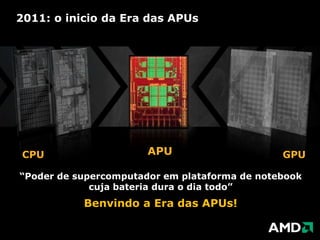
CPUGPUAMD Vision e a primeira APURoberto BrandãoAMD Brasil
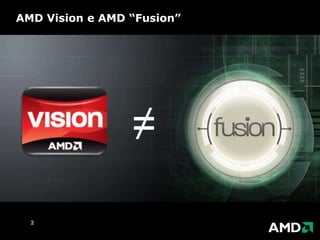
AMD Vision e AMD “Fusion”2≠
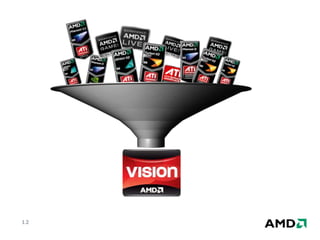
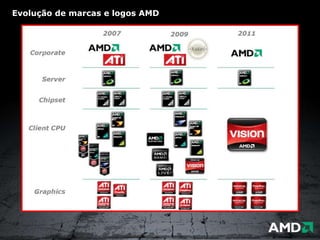
AMD Vision3
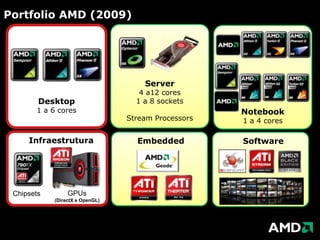
 Portfolio AMD (2009) Server4 a12 cores1 a 8 socketsStream ProcessorsDesktop1 a 6 coresNotebook1 a 4 cores   Infraestrutura   Embedded    SoftwareGPUs(DirectX e OpenGL)Chipsets
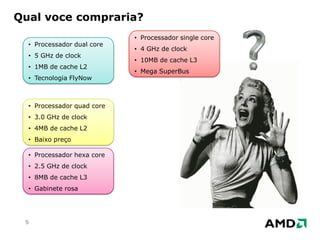
Qual voce compraria?Processador single core
4 GHz de clock
10MB de cache L3
Mega SuperBus
Processador dual core
5 GHz de clock
1MB de cache L2
Tecnologia FlyNow
Processador quad core
3.0 GHz de clock
4MB de cache L2
Baixo preço
Processador hexa core
2.5 GHz de clock
8MB de cache L3
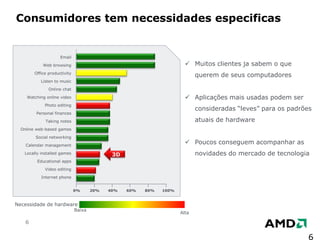
Gabinete rosaConsumidores tem necessidadesespecificasMuitosclientesjasabem o quequerem de seuscomputadores
Aplicaçõesmaisusadaspodemserconsideradas “leves” paraospadrõesatuais de hardware
Poucosconseguemacompanhar as novidades do mercado de tecnologiaEmailWeb browsingOffice productivityListen to musicOnline chatWatching online videoPhoto editingPersonal financesTaking notesOnline web-based gamesSocial networkingCalendar managementLocally installed gamesEducational appsVideo editingInternet phone3D80%100%20%40%60%0%Necessidade de hardwareBaixaAlta6
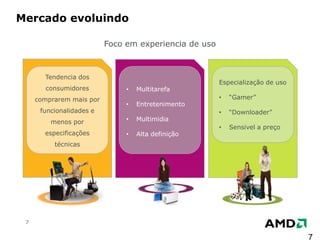
Mercado evoluindoFocoemexperiencia de usoTendencia dos consumidorescompraremmaisporfuncionalidades e menosporespecificaçõestécnicasEspecialização de uso“Gamer”
“Downloader”
Sensivel a preço
Multitarefa
Entretenimento
Multimidia
Alta definição7
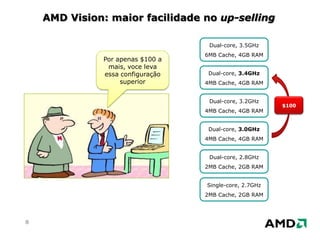
AMD Vision: maiorfacilidade no up-sellingDual-core, 3.5GHz6MB Cache, 4GB RAMPor apenas $100 a mais, voce leva essa configuração superiorDual-core, 3.4GHz4MB Cache, 4GB RAMDual-core, 3.2GHz4MB Cache, 4GB RAM$100Dual-core, 3.0GHz4MB Cache, 4GB RAMDual-core, 2.8GHz2MB Cache, 2GB RAMSingle-core, 2.7GHz2MB Cache, 2GB RAM
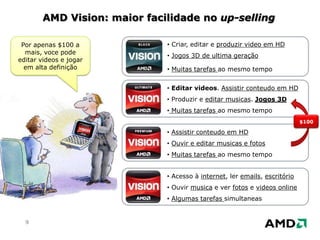
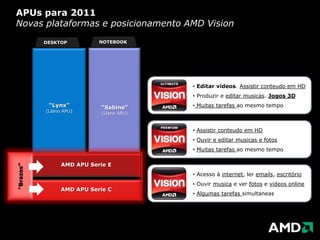
AMD Vision: maiorfacilidade no up-sellingPor apenas $100 a mais, voce pode editar videos e jogar em alta definiçãoCriar, editar e produzir video em HD
Jogos 3D de ultimageração
Muitastarefasaomesmo tempo
Editar videos. Assistirconteudoem HD
Produzir e editarmusicas. Jogos 3D
Muitastarefasaomesmo tempo$100Assistirconteudoem HD
Ouvir e editarmusicas e fotos
Muitastarefasaomesmo tempo
Acesso à internet, leremails, escritório
Ouvirmusica e verfotos e videos online
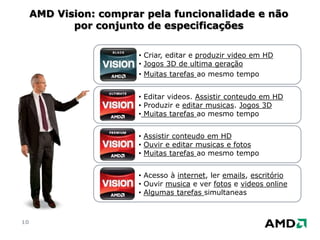
AlgumastarefassimultaneasAMD Vision: comprarpelafuncionalidade e nãoporconjunto de especificaçõesCriar, editar e produzir video em HD
Jogos 3D de ultimageração
Muitastarefasaomesmo tempo
Editar videos. Assistirconteudoem HD
Apresentacao + Demo Brazos

Notas do Editor

  • #2 [08/19/2009, Simon] Great job!
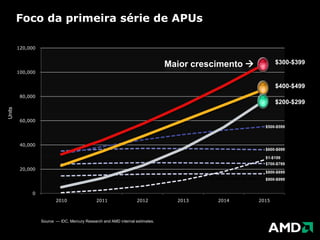
  • #7 These compelling experiences also happen to be the ones that consumers really care about. Take a look at this graph, published late last year by IDC. It shows what consumers are doing on their PCs. The areas in red are the use cases that Fusion can impact. Not coincidentally, these areas are the ones you’ve heard me repeat over and over during this track. AMD, in partnership with customers and software developers, is focused on driving the optimizations for HD and 3D video and digital content management. We’re also committed to optimize for an immersive gaming experience.
  • #12 AMD is a technology leader with many features not offered by our competitorPlatform Power Gate feature highlights AMD’s platform focus which brings together AMD Software & platform hardware to provide end user benefit.
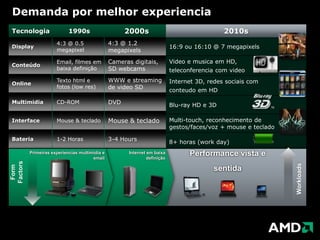
  • #16 In the 1990s, personal computing was still in its infancy. Think back to your first laptop and its limitations: rudimentary communications such as email and slow modems, limited graphics capabilities and displays, and very limited battery life. Things began to improve in the 2000s as improved imaging technologies came to market, more content permeated the Internet and battery life slowly climbed. Today, we are entering the third era of x86 computing. Parallel computing that fully utilizes the GPU is required to take advantage of the vast amount of video content, dynamic display technologies and increasingly mobile products. Computing is no longer passive – it is now fully immersive and our Fusion technology promises an end user experience that is seen and felt.
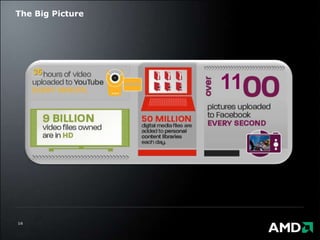
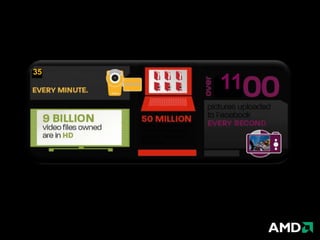
  • #17 The fact that people are visual beings is evident in how we experience technology today.Over 20 hours of video are uploaded to YouTube every minute!In October of last year, YouTube reached over 1 billion video views per day!And more and more of those videos are in HD – in fact, 9 billion video files in consumers’ personal libraries today are HD. We’re adding 50 million digital media files to our personal content libraries every DAY and we’re uploading over 1000 pictures to Facebook every second. In short, we’re experiencing an explosion in multimedia and navigating a sea of digital content chaos.
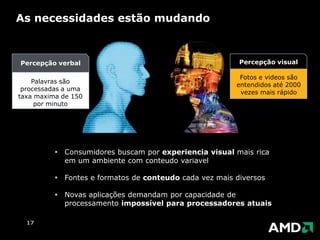
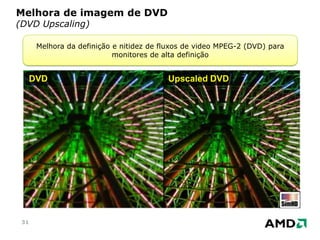
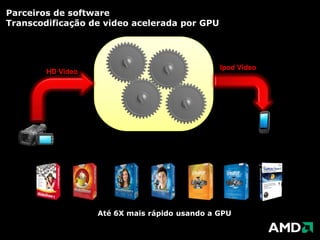
  • #18 So, EVERYONE seems to be creating, consuming, and sharing content. This explosion in multimedia requires new applications and new ways to manage and manipulate the data. Files and content must be organized, stored, or transcoded to match the destination device. Low resolution video needs to be up-scaled for larger screens, high definition video must be shrunk for smart phones, and home movies need to be stabilized and cleaned up for more enjoyable viewing. This new class of usage models and applications are pushing the limits of traditional PC architecture. The GPU, with its massively parallel computing architecture is increasingly being leveraged by applications to assist in these tasks. A new wave of software innovation is happening and consumers are hungry for applications that run faster, make all things digital media easier, and are affordable. AMD’s software partners are taking advantage of the GPU to deliver better experiences to their customers across an ever-wider set of content.
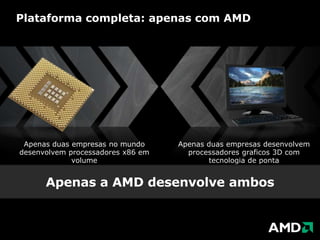
  • #19 Only two companies in the world design and produce industry-standard x86 microprocessors in volume.And only two companies in the world develop and deliver leading-edge graphics technology.But - only one company does both – and that’s AMD. A number of years ago, we saw that … with the remarkable innovation trajectory of silicon and microprocessor designs … we were soon going to be able to combine the distinct capabilities of the CPU and GPU into a single piece of silicon. That day is rapidly approaching … and AMD has had more engineers working on this integration for longer than any other company in the business.As the world is shifting to more complex and graphics-intensive applications – things like video and virtualization – the best mix of capability is actually a balanced platform of CPU, GPU and chipset … finely tuned through application performance optimization.We actively work with a wide variety of partners, including leading hardware and software vendors in both the commercial and consumer spaces, to optimize AMD technologies. AMD’s continued collaboration with industry leaders like Adobe, Autodesk, Broadcom, Novell, Microsoft and VMWare remain essential to our balanced platform approach. For partners a balanced platform means being able to deliver a better experience to their customers. For businesses it means increased reliability, greater performance-per-watt and greater performance-per dollar. And for consumers it means a more affordable, powerful and visually stunning experience.These are exciting times and with our balanced platform approach, AMD is well-equipped to give users want they want today and in the future.
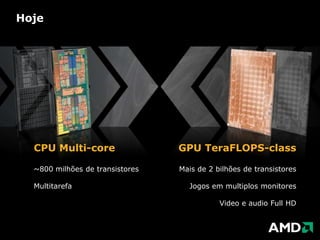
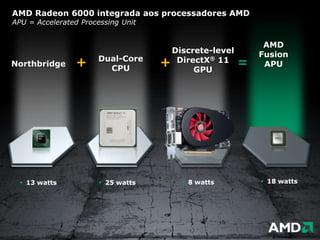
  • #20 Let’s look at today’s compute platforms:You have a Phenom II with 758 million transistors on 45nm process technology on the left On the right you see a 5870 DX11 GPU with 2.15 billion transistors on 40nm process technology. Today, with the emergence of visual computing, you see more work than ever before for the GPU. Especially with, arguably for consumers, the most important workload: video.The explosion of HD video and now HD gaming, means the GPU matters more than ever in the PC platform. More user-generated content puts more of the work onto the GPU such as video processing and rendering and 3D user interface.The era of visual computing is already becoming more about mobility and being able to do more of what I’ve just described on the go. However, users do not want more compute capabilities at the expense of battery life or smaller form factors.Favoring one component over the other or taking a niche approach to balanced visual computing platforms does not meet the needs of the mass market. Usage scenarios favor a combination of GPU/CPU balance and low power..
  • #21 The need for this optimal energy-efficient balance of CPU and GPU represents the beginning of a new era of computing in 2011.The Fusion of CPU and GPU compute power is what the next chapter in visual computing requires – a powerful visual computing experience at home or on the go without compromise. Our AMD Fusion™ design is driven by mobility and is based on a low-power visual compute architecture that will enhance active and resting battery life while increasing both CPU and GPU performance. This is the culmination of the vision of ‘One AMD’ and only AMD can deliver the GPU and CPU combination that will be the future of computing
  • #26 [08/19/2009, Simon] Great job!
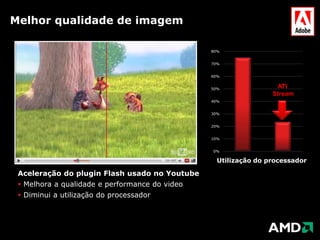
  • #37 Using ATI Stream technology, enjoy better visual quality when you watch streaming video online (YouTube/Hulu) with new video enhancement features.*
  • #43 The industry leaders in all of the key visual computing facets are actively engaged in optimizing their applications to take full advantage that parallel processing offers. From HD Internet through digital content creation and gaming, our open/industry standards partner ecosystem continues to expand ensuring that consumers experience all that Fusion has to offer.
  • #44 11 of the world’s top 12 notebook OEMs shipping AMD platformsEmbedded platforms opening new market opportunities for AMDWith the arrival of Llano, AMD will have the only top-to-bottom solution stack
  • #50 The fact that people are visual beings is evident in how we experience technology today.Over 20 hours of video are uploaded to YouTube every minute!In October of last year, YouTube reached over 1 billion video views per day!And more and more of those videos are in HD – in fact, 9 billion video files in consumers’ personal libraries today are HD. We’re adding 50 million digital media files to our personal content libraries every DAY and we’re uploading over 1000 pictures to Facebook every second. In short, we’re experiencing an explosion in multimedia and navigating a sea of digital content chaos.