SEMINAR
    ON
ULTRASOUND

                 Tharanath PP
             India Ultrasound
Ultrasound
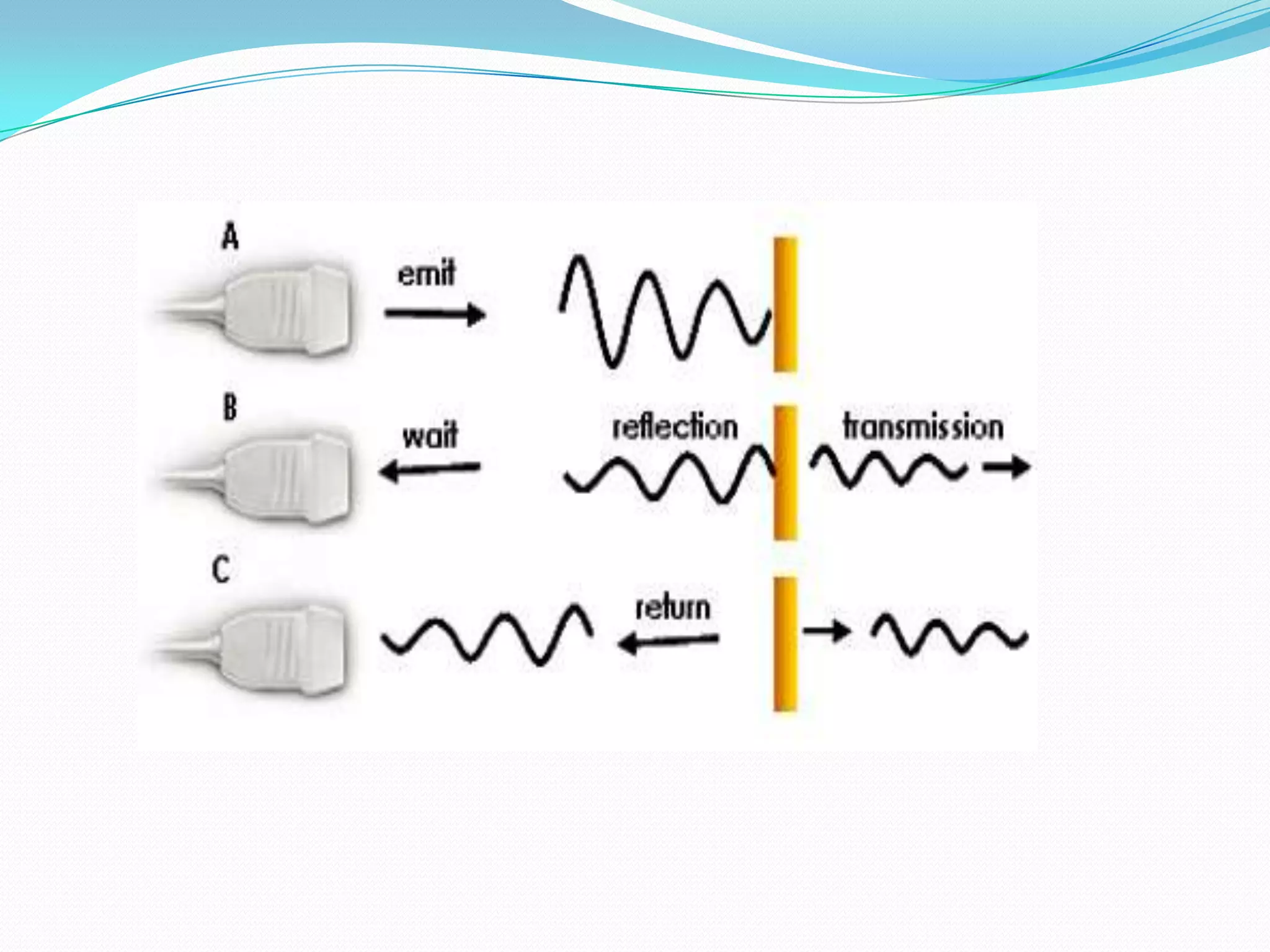
 Basic Idea
 – Send waves into body which are reflected at the interfaces
  between tissue
 – Return time of the waves tells us of the depth of the
  reflecting surface
 History
 – First practical application, 1912 unsuccessful search for Titanic
 – WW II brought massive military research - SONAR (SOund
    Navigation And Ranging)
   – Mid-century used for non-destructive testing of materials
   – First used as diagnostic tool in 1942 for localizing brain tumors
   – 1950’s 2D gray scale images
   – 1965 or so real-time imaging
Ultrasound ranges?


Human sensitivity: 20 - 20,000Hz
 Ultrasound: > 20,000Hz
 Diagnostic Ultrasound: 2.5 - 14 MHz
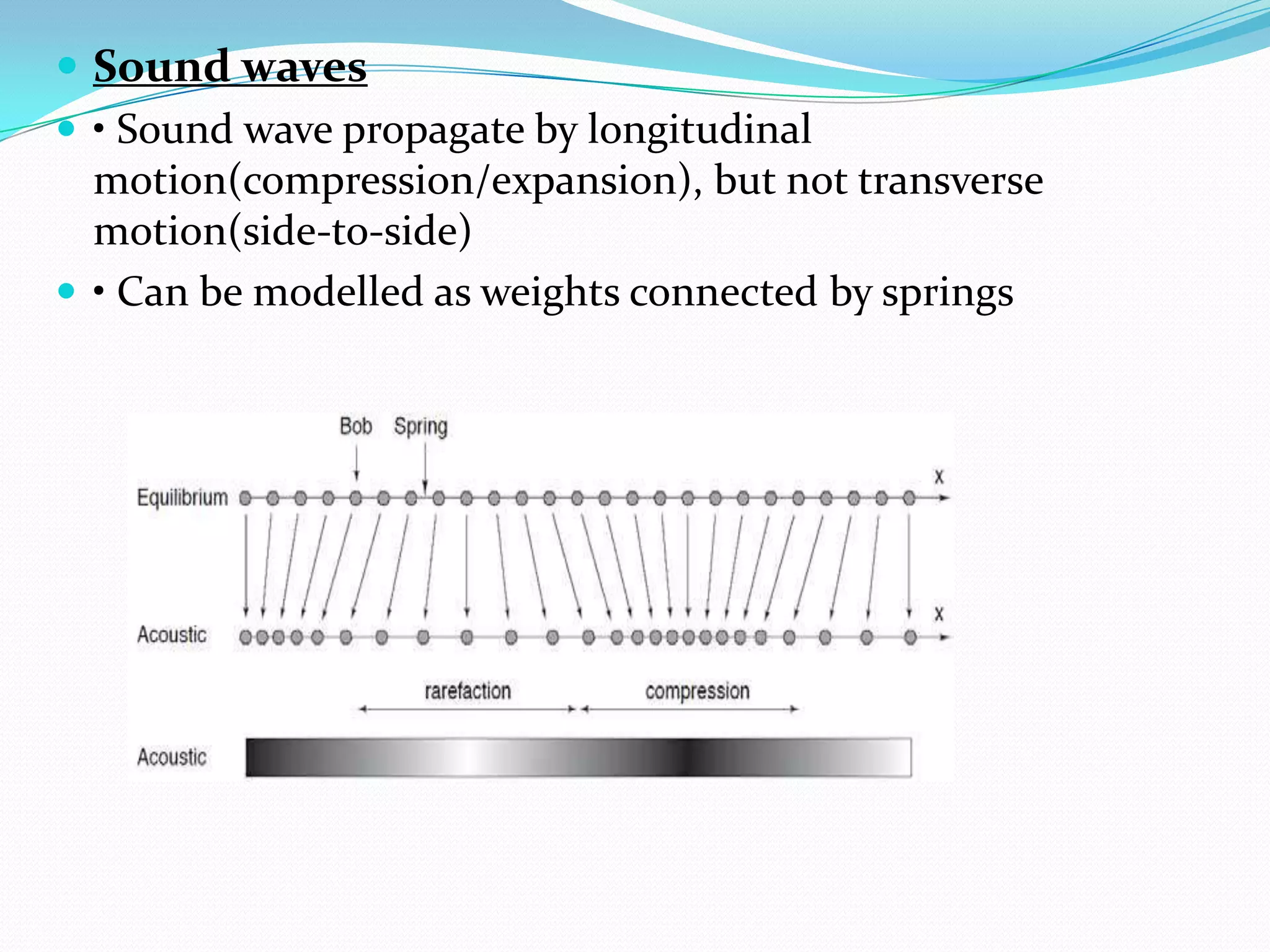
 Sound waves
 • Sound wave propagate by longitudinal
  motion(compression/expansion), but not transverse
  motion(side-to-side)
 • Can be modelled as weights connected by springs
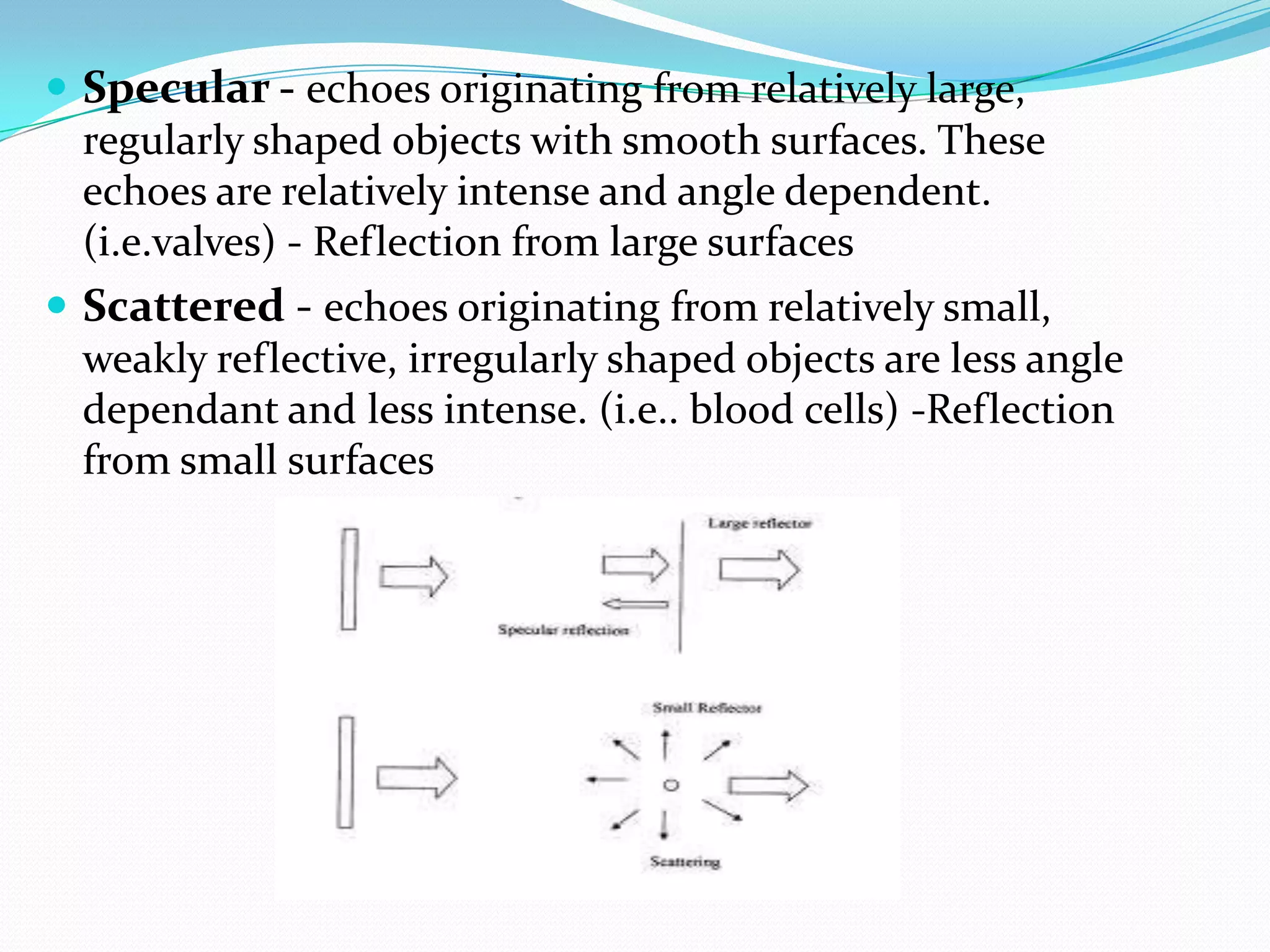
 Specular - echoes originating from relatively large,
  regularly shaped objects with smooth surfaces. These
  echoes are relatively intense and angle dependent.
  (i.e.valves) - Reflection from large surfaces
 Scattered - echoes originating from relatively small,
  weakly reflective, irregularly shaped objects are less angle
  dependant and less intense. (i.e.. blood cells) -Reflection
  from small surfaces
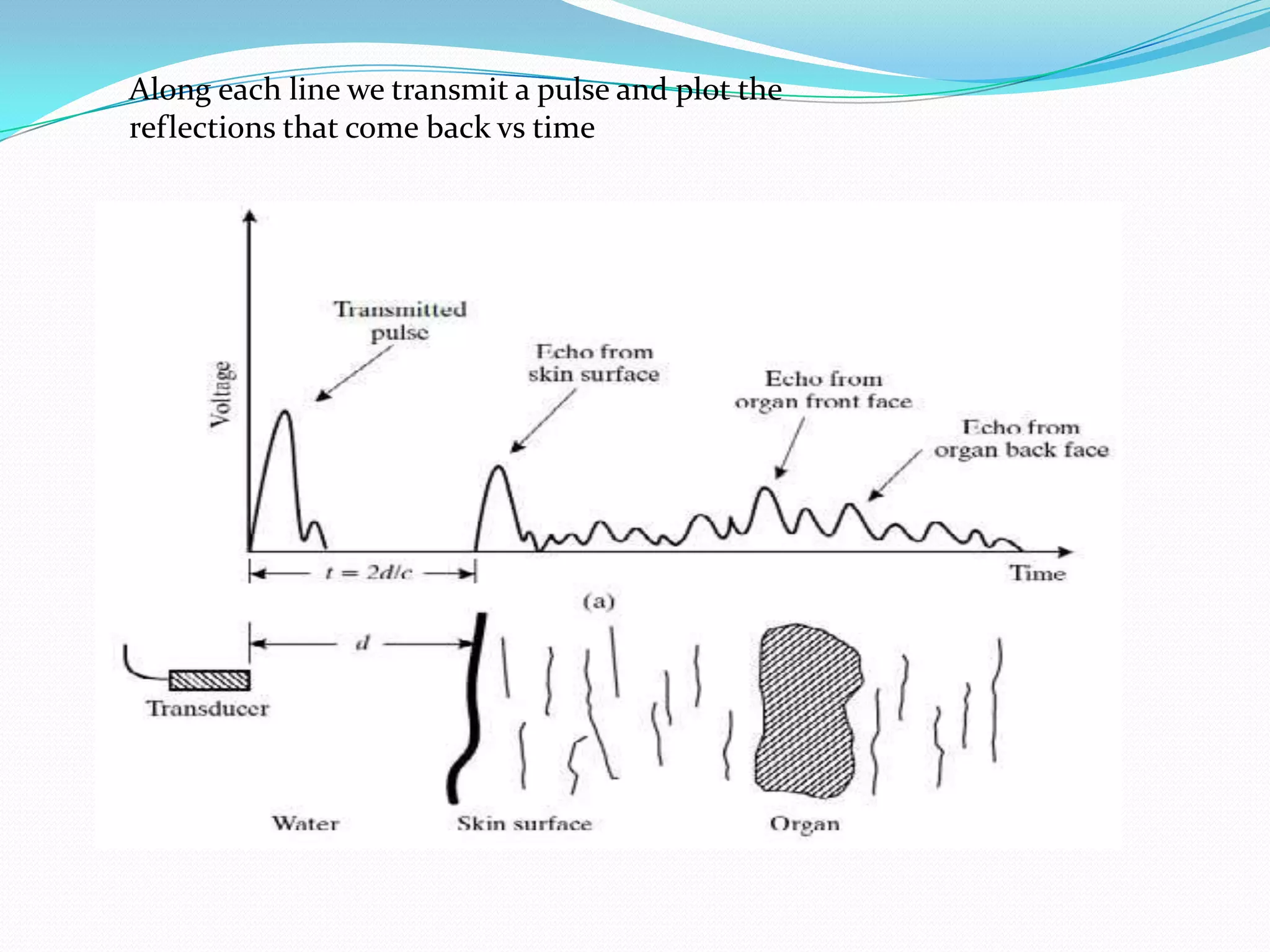
Along each line we transmit a pulse and plot the
reflections that come back vs time
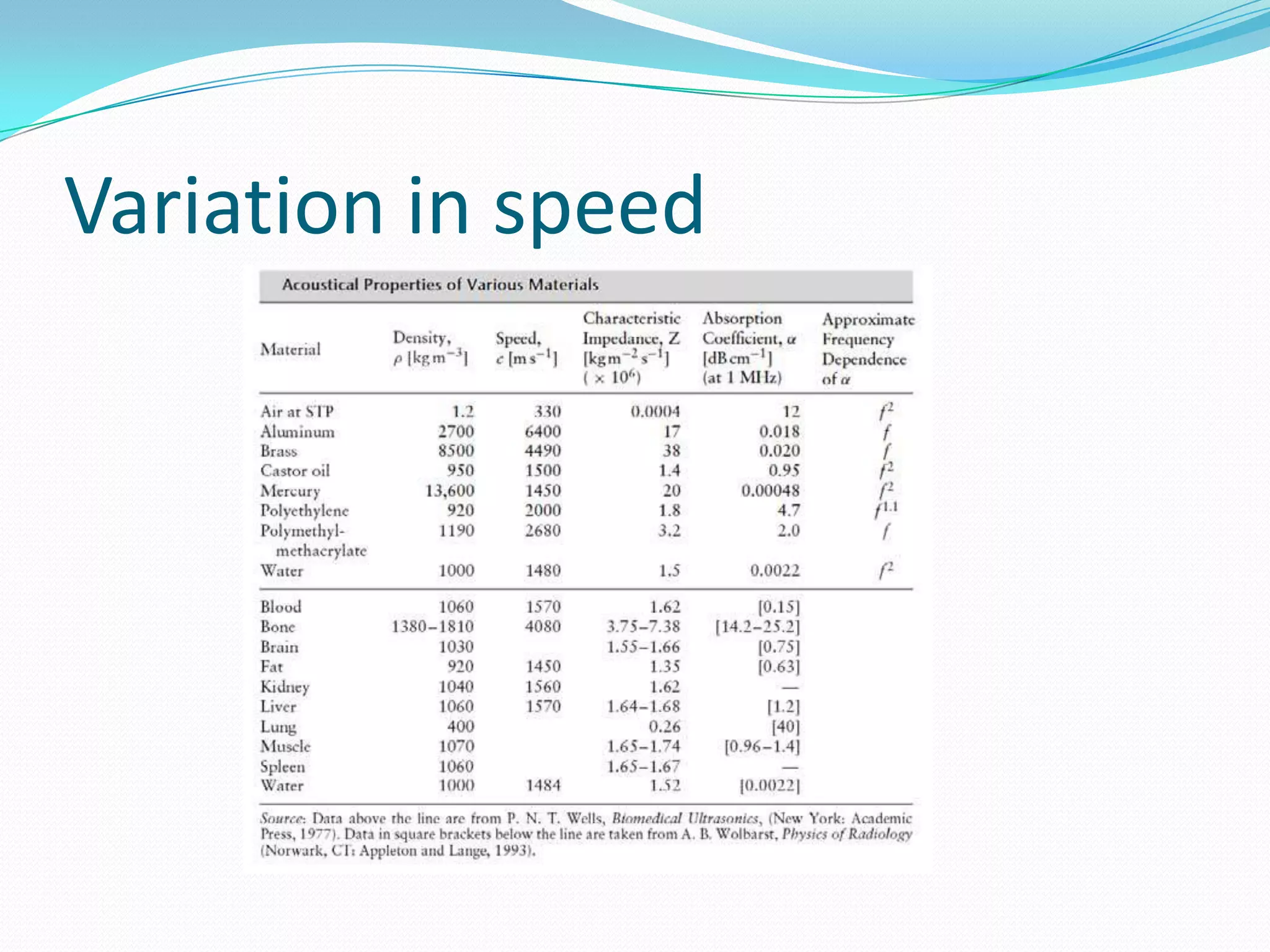
Variation in speed
Propagation of ultrasound waves in
tissue
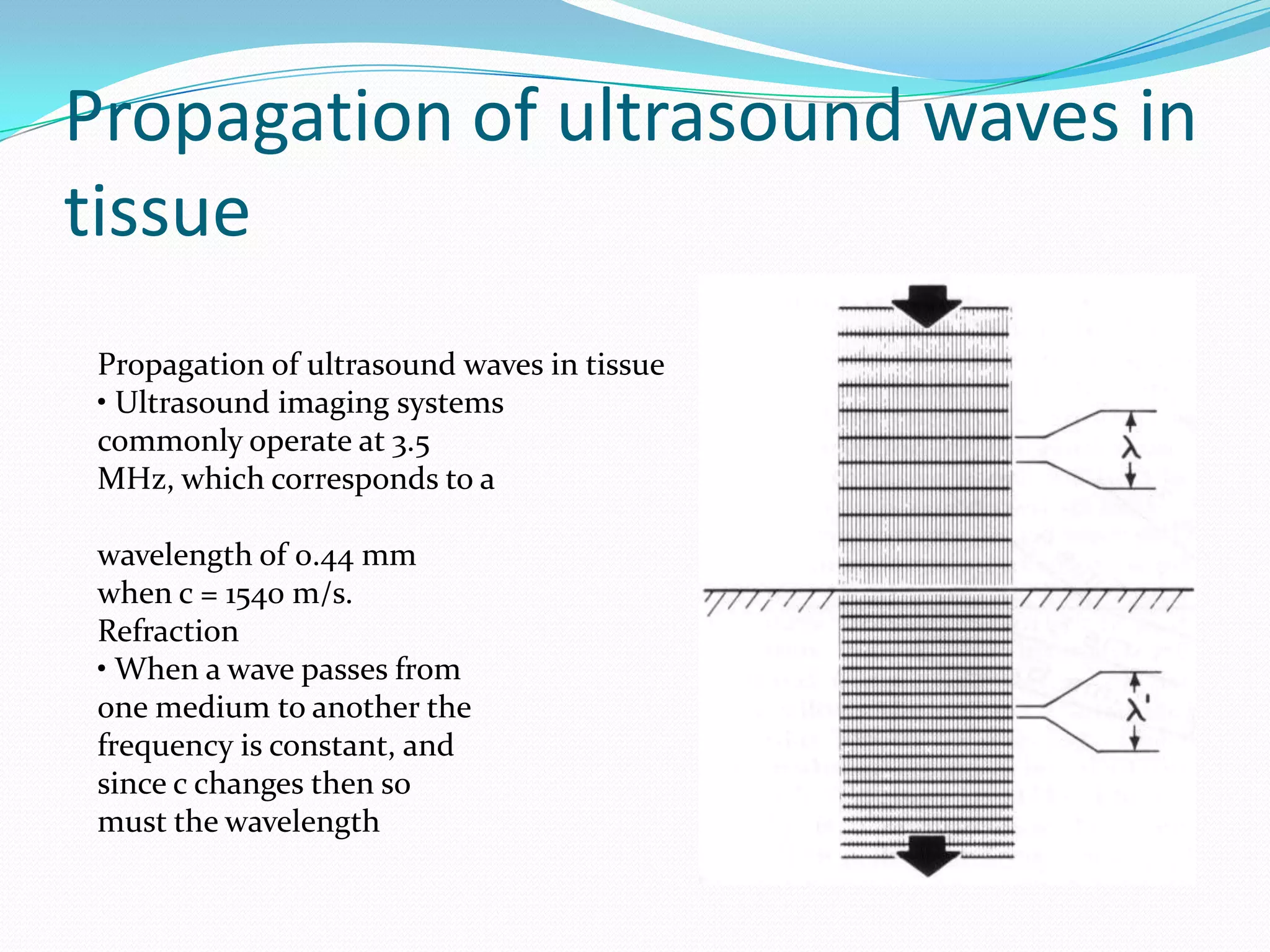
 Propagation of ultrasound waves in tissue
 • Ultrasound imaging systems
 commonly operate at 3.5
 MHz, which corresponds to a

 wavelength of 0.44 mm
 when c = 1540 m/s.
 Refraction
 • When a wave passes from
 one medium to another the
 frequency is constant, and
 since c changes then so
 must the wavelength
Propagation of ultrasound waves in tissue

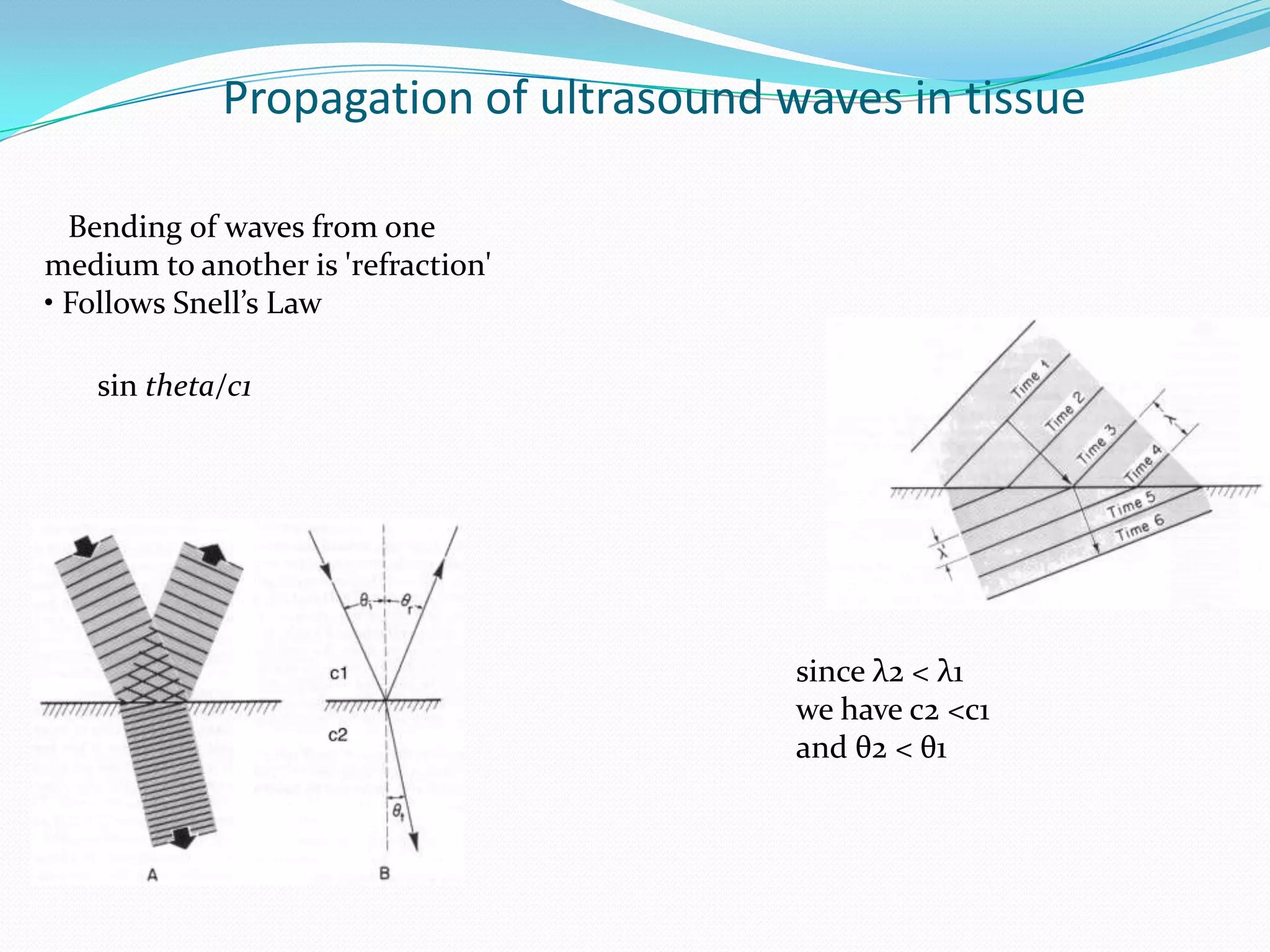
  Bending of waves from one
medium to another is 'refraction'
• Follows Snell’s Law

   sin theta/c1


                                        since λ2 < λ1
                                        we have c2 <c1
                                        and θ2 < θ1
Definition/ Terminology

 Cycle
 Frequency: cycles per second
 Wave length
 Period
 Amplitude
 Compression - area of high density
 Rarefication - area of low density
 velocity = l x ƒ= constant for a given medium
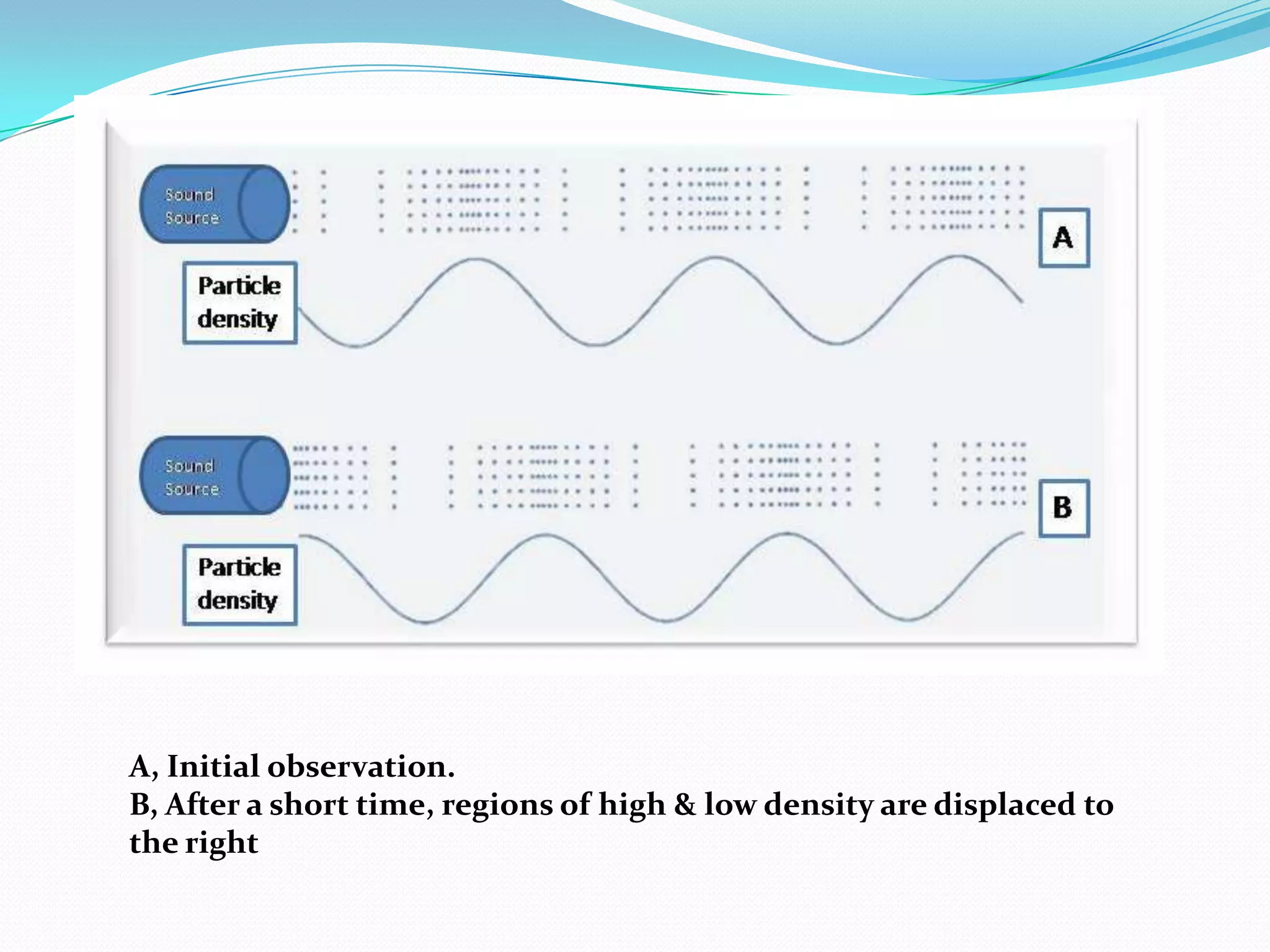
A, Initial observation.
B, After a short time, regions of high & low density are displaced to
the right
Ultrasound Production

 Piezoelectric effect:
  – Crystals vibrate at given frequency when an
  alternating current is applied
 – Crystal acts as speaker and microphone
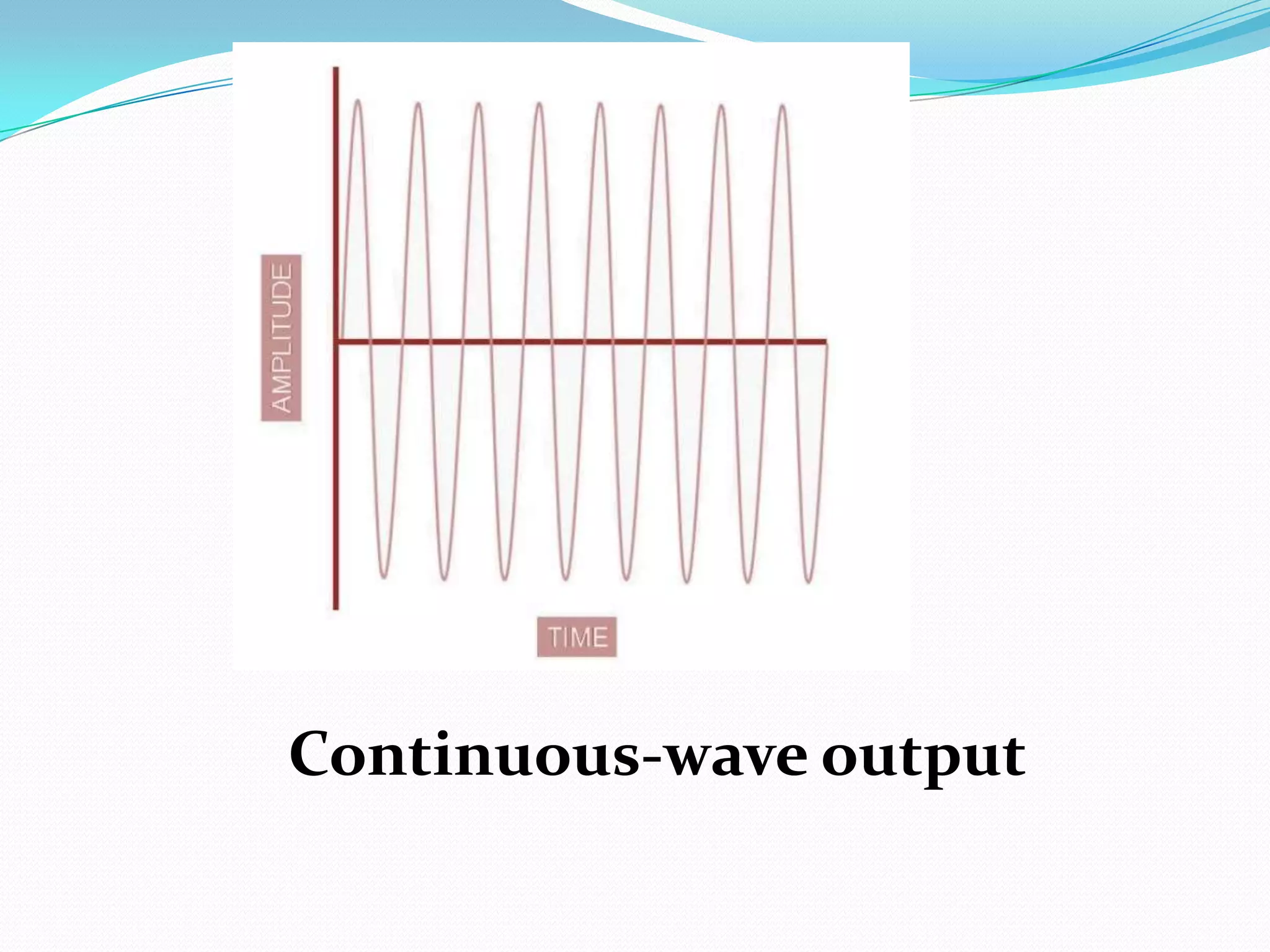
 Continuous mode:


  – continuous-wave Doppler (CW)
 Pulsed-echo mode:
Continuous-wave output
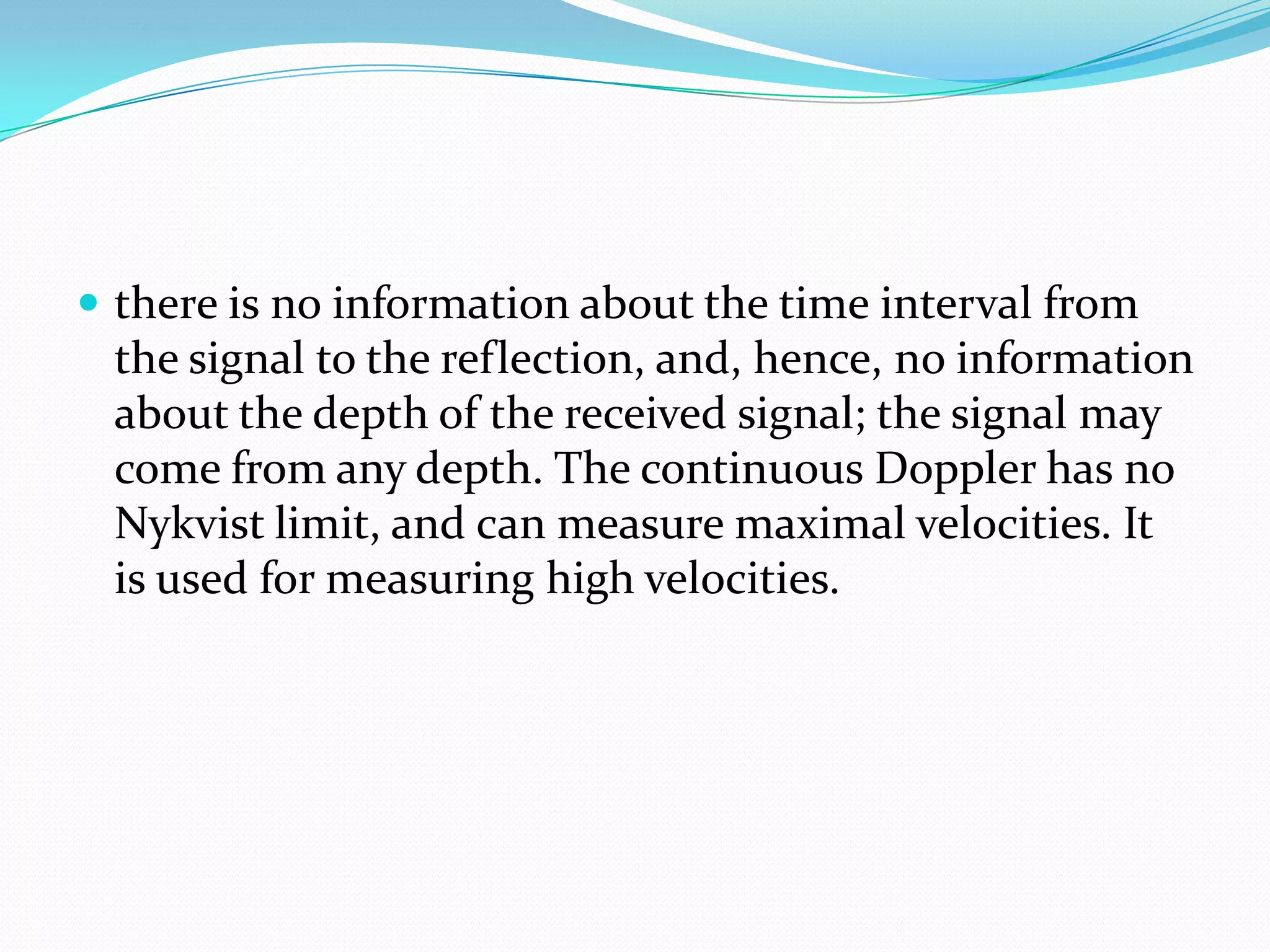
 there is no information about the time interval from
 the signal to the reflection, and, hence, no information
 about the depth of the received signal; the signal may
 come from any depth. The continuous Doppler has no
 Nykvist limit, and can measure maximal velocities. It
 is used for measuring high velocities.
Pulsed Echo


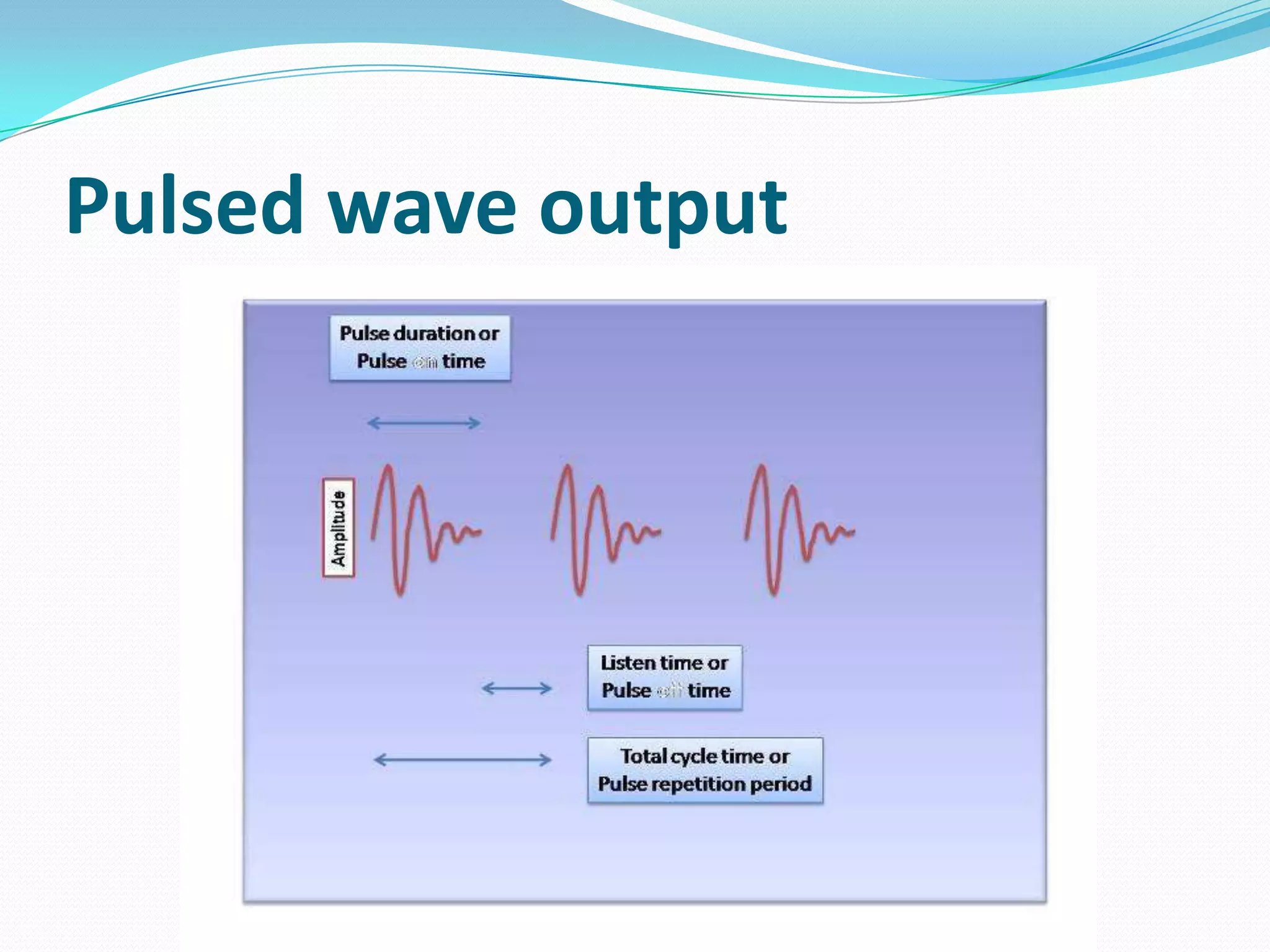
 Signal generation = only ~1% of the entire
  pulse cycle
 On times; off times
 Time of signal return proportional to distance
  travelled
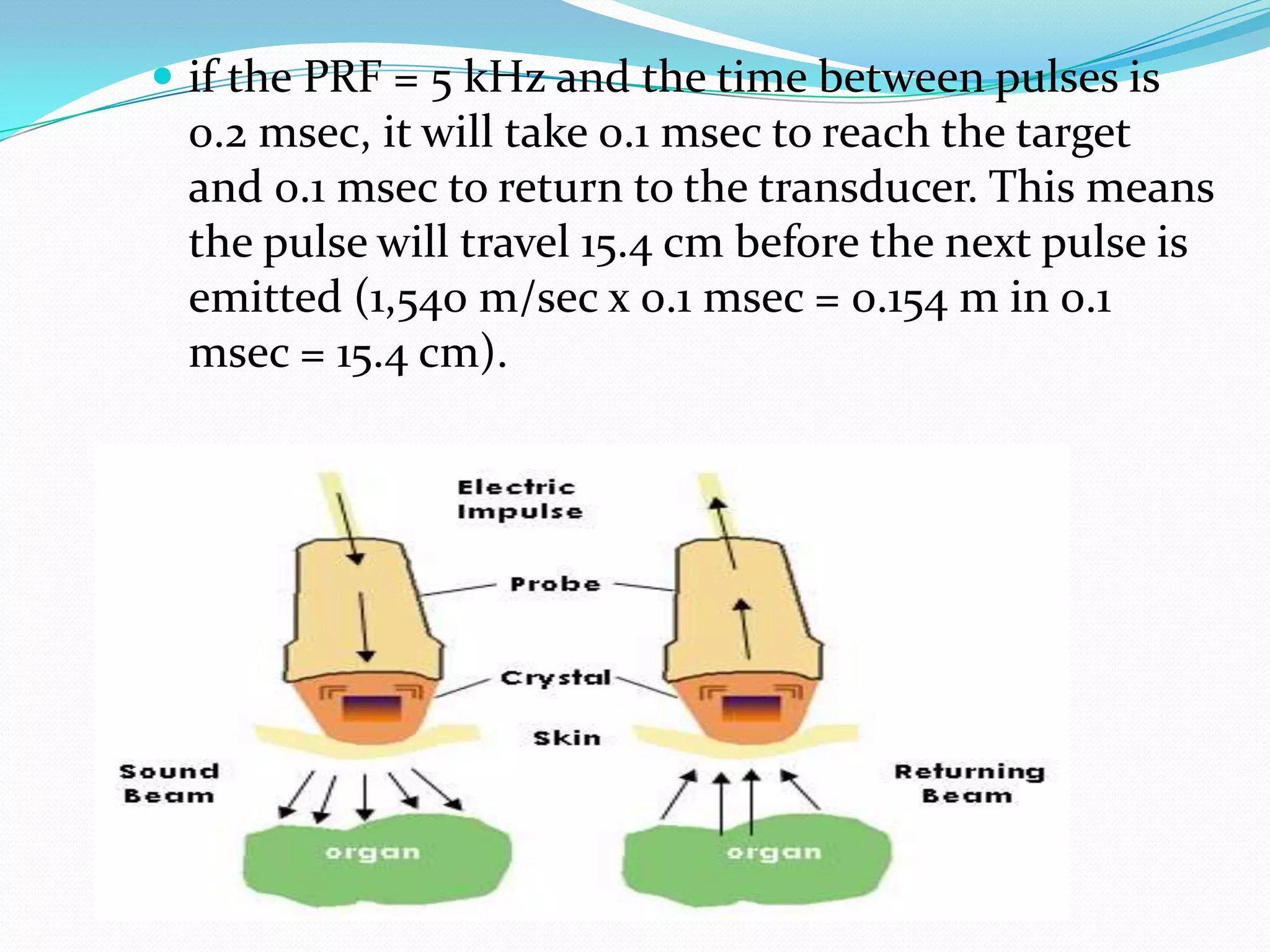
 if the PRF = 5 kHz and the time between pulses is
 0.2 msec, it will take 0.1 msec to reach the target
 and 0.1 msec to return to the transducer. This means
 the pulse will travel 15.4 cm before the next pulse is
 emitted (1,540 m/sec x 0.1 msec = 0.154 m in 0.1
 msec = 15.4 cm).
Pulsed wave output
Pulsed Echo

 PRF: pulse repetition frequency
  – Very important in Color Doppler
 SPL: spatial pulse length
  = wavelength x no. of cycles
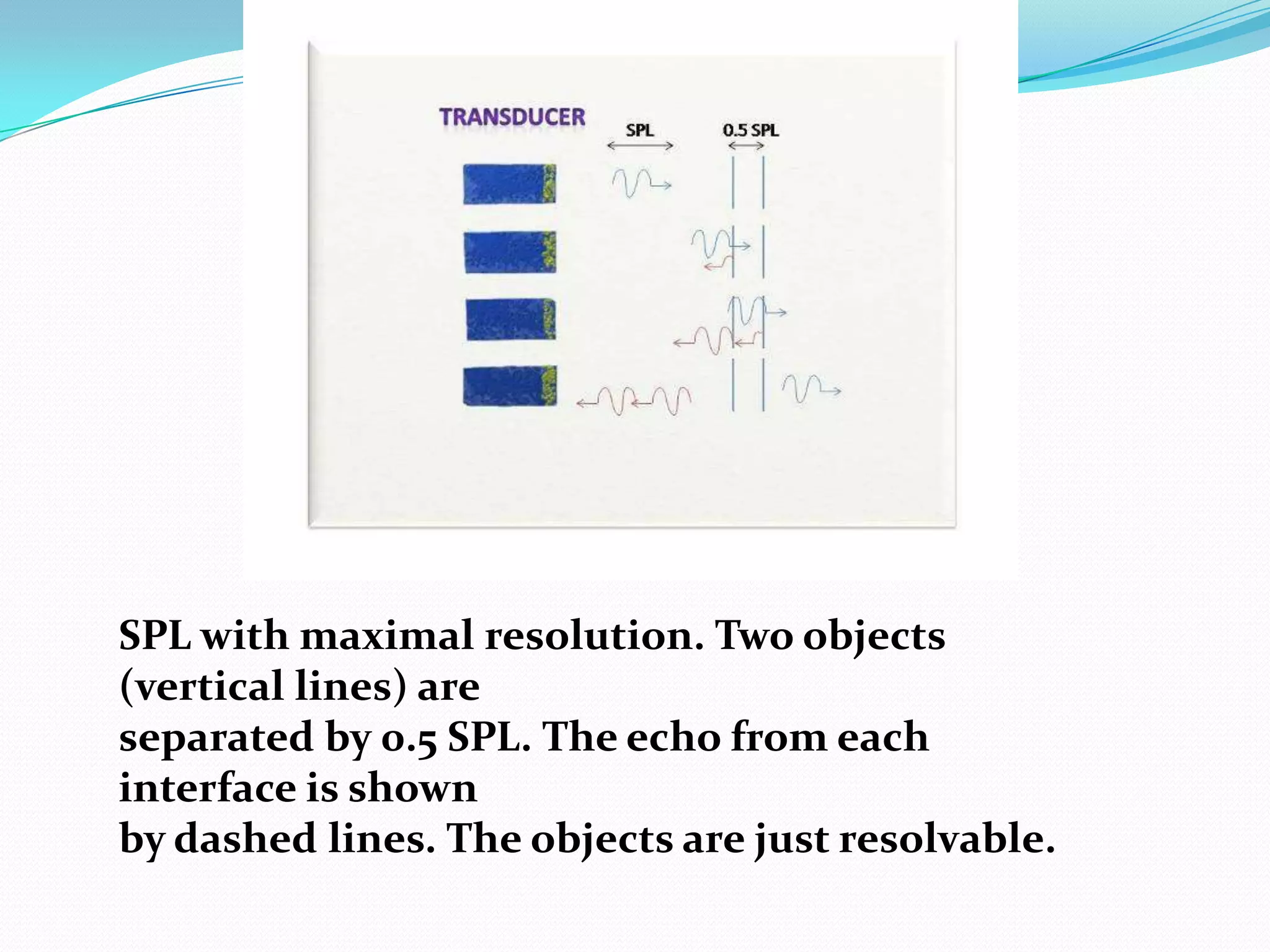
 Maximal resolution = 0.5 SPL
  – The smallest distance between 2 points that
  USG can delineate
SPL with maximal resolution. Two objects
(vertical lines) are
separated by 0.5 SPL. The echo from each
interface is shown
by dashed lines. The objects are just resolvable.
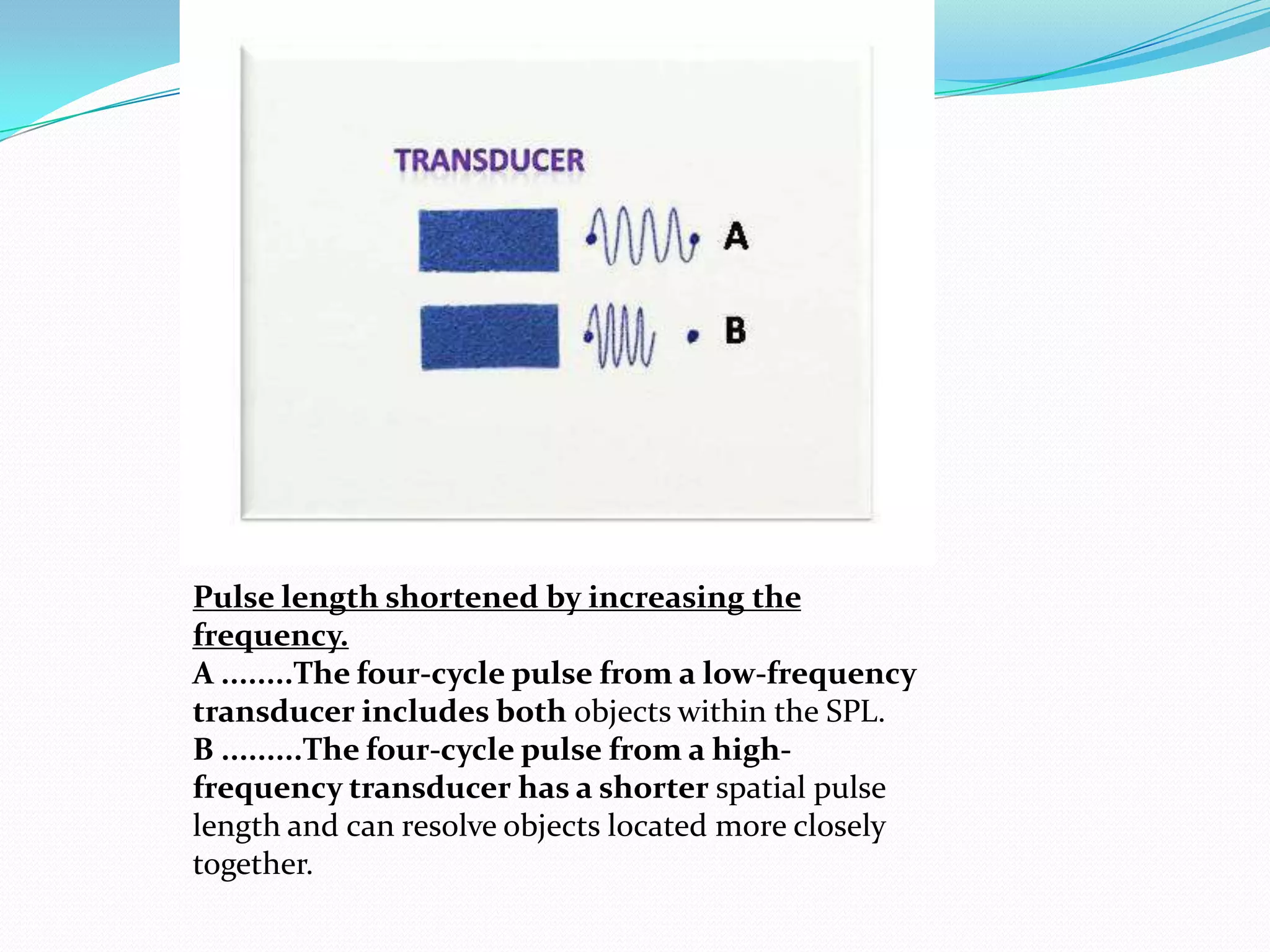
Pulse length shortened by increasing the
frequency.
A ........The four-cycle pulse from a low-frequency
transducer includes both objects within the SPL.
B .........The four-cycle pulse from a high-
frequency transducer has a shorter spatial pulse
length and can resolve objects located more closely
together.
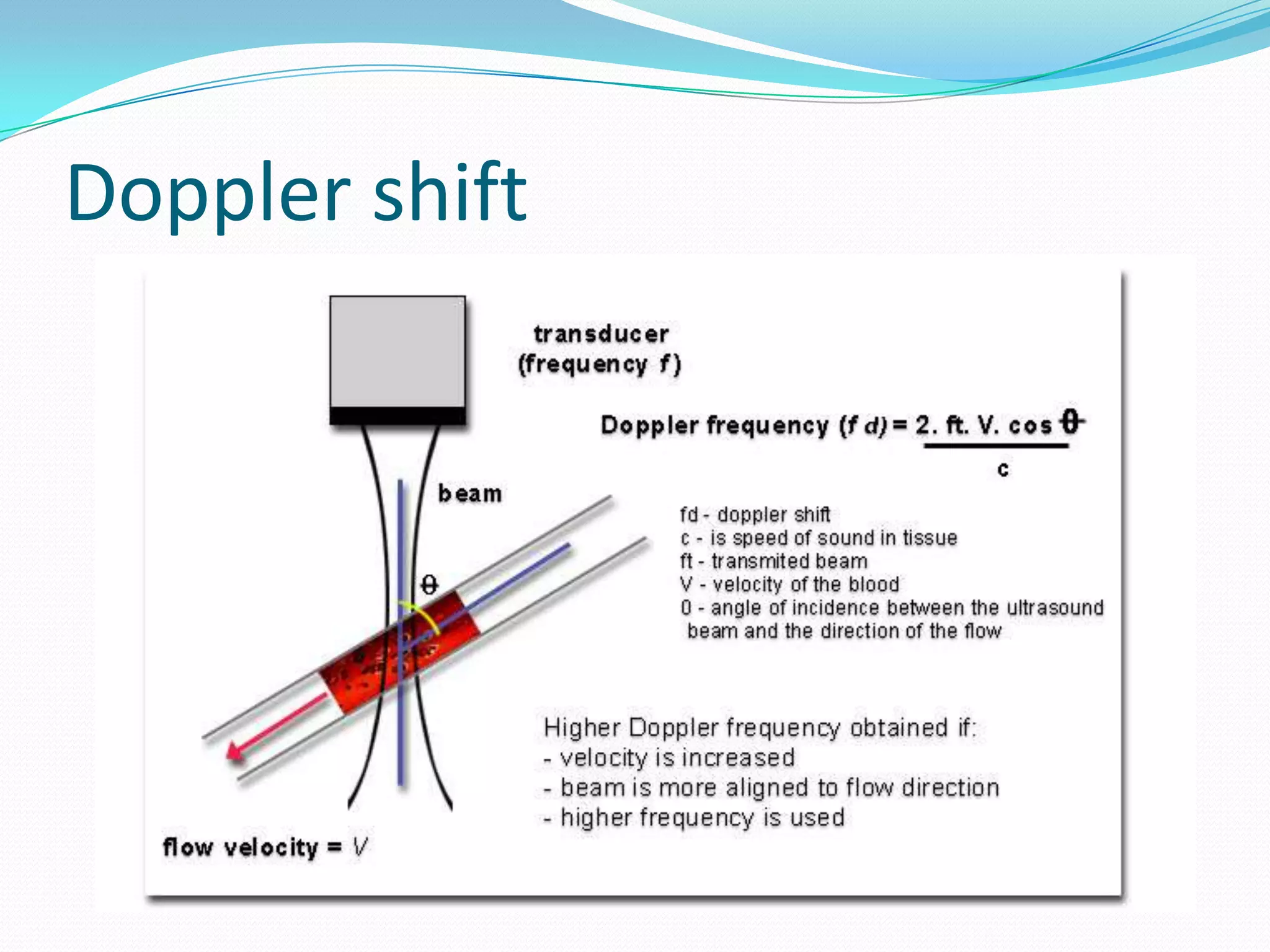
Doppler shift
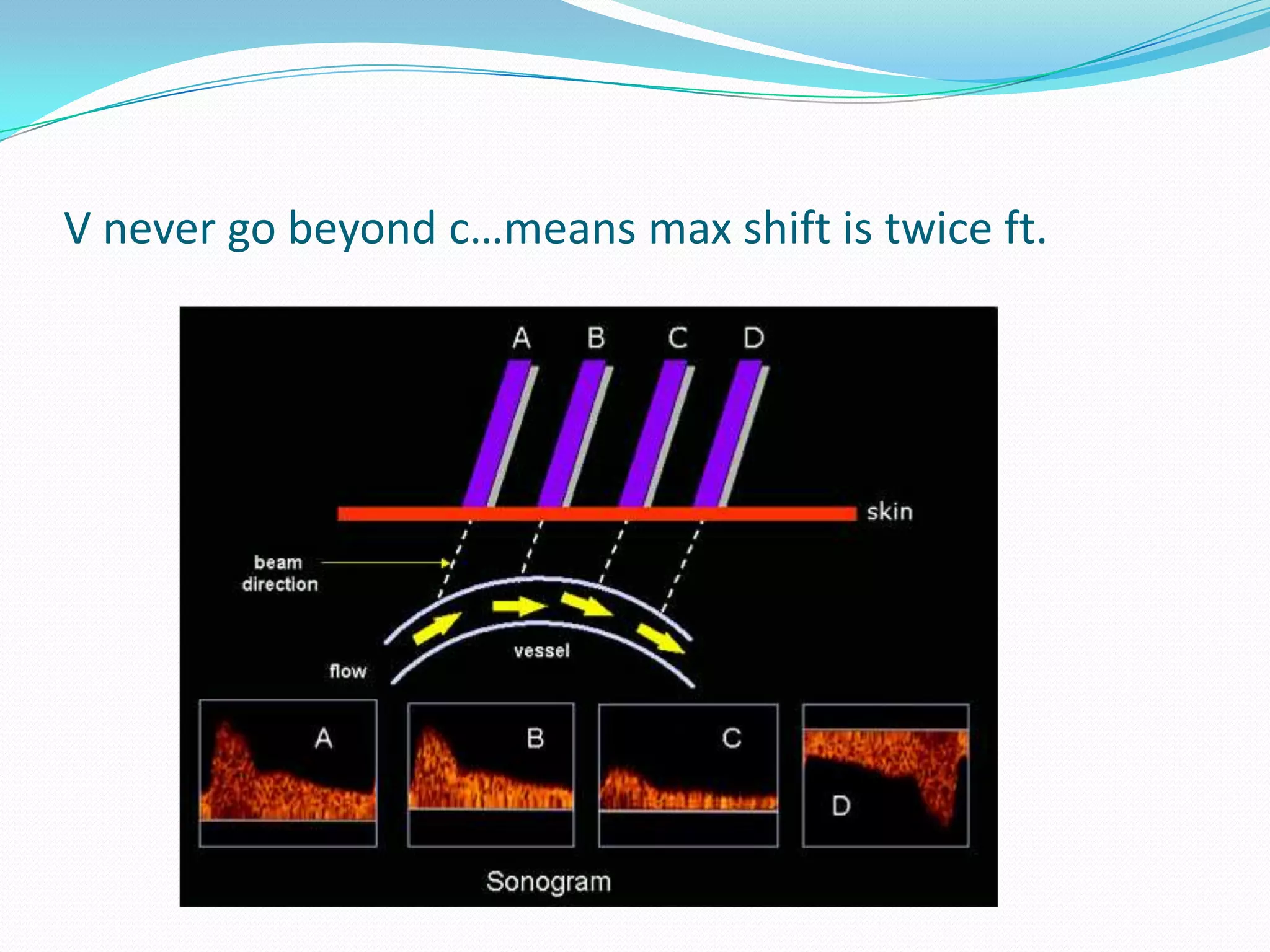
V never go beyond c…means max shift is twice ft.
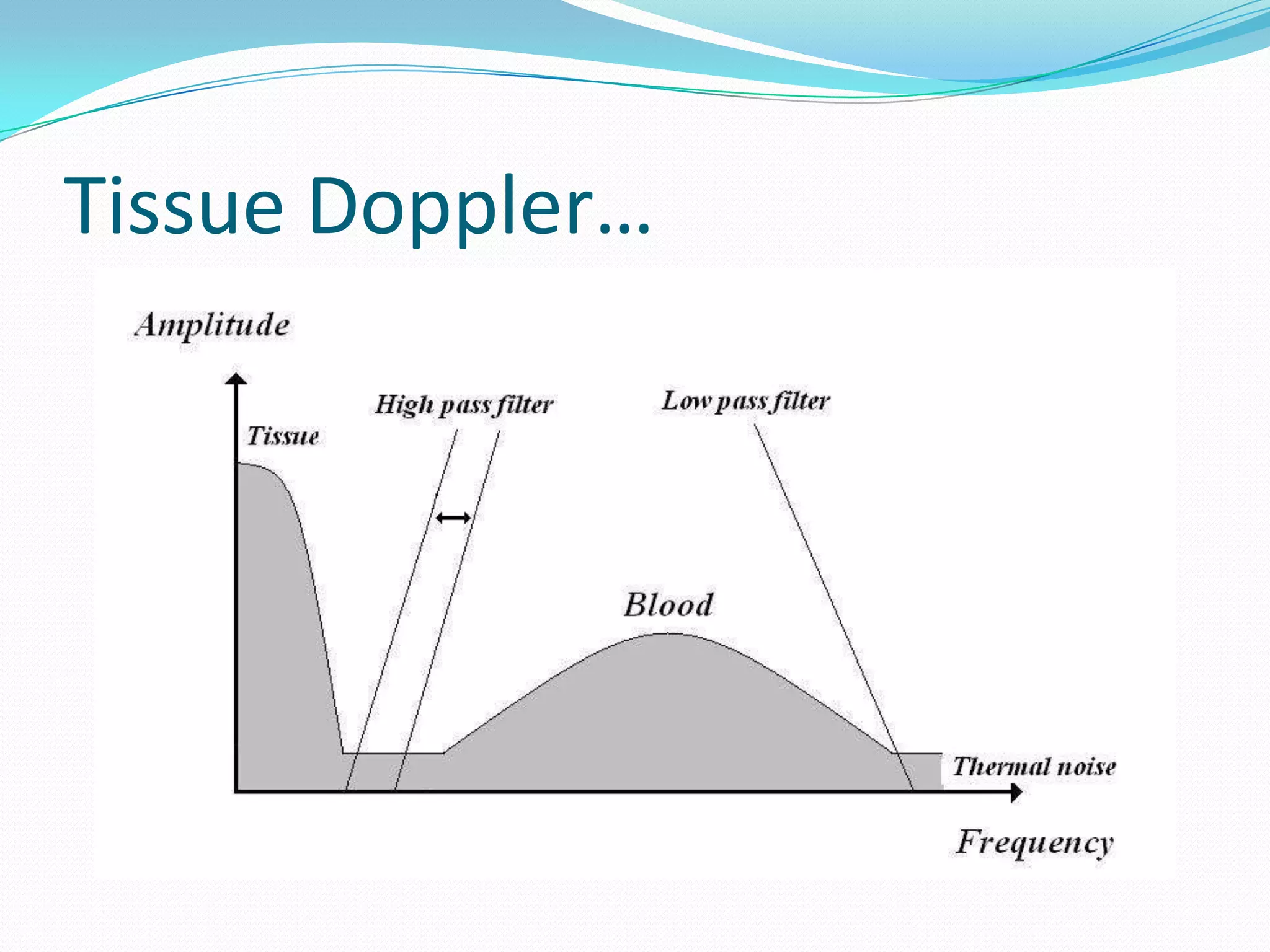
Tissue Doppler…
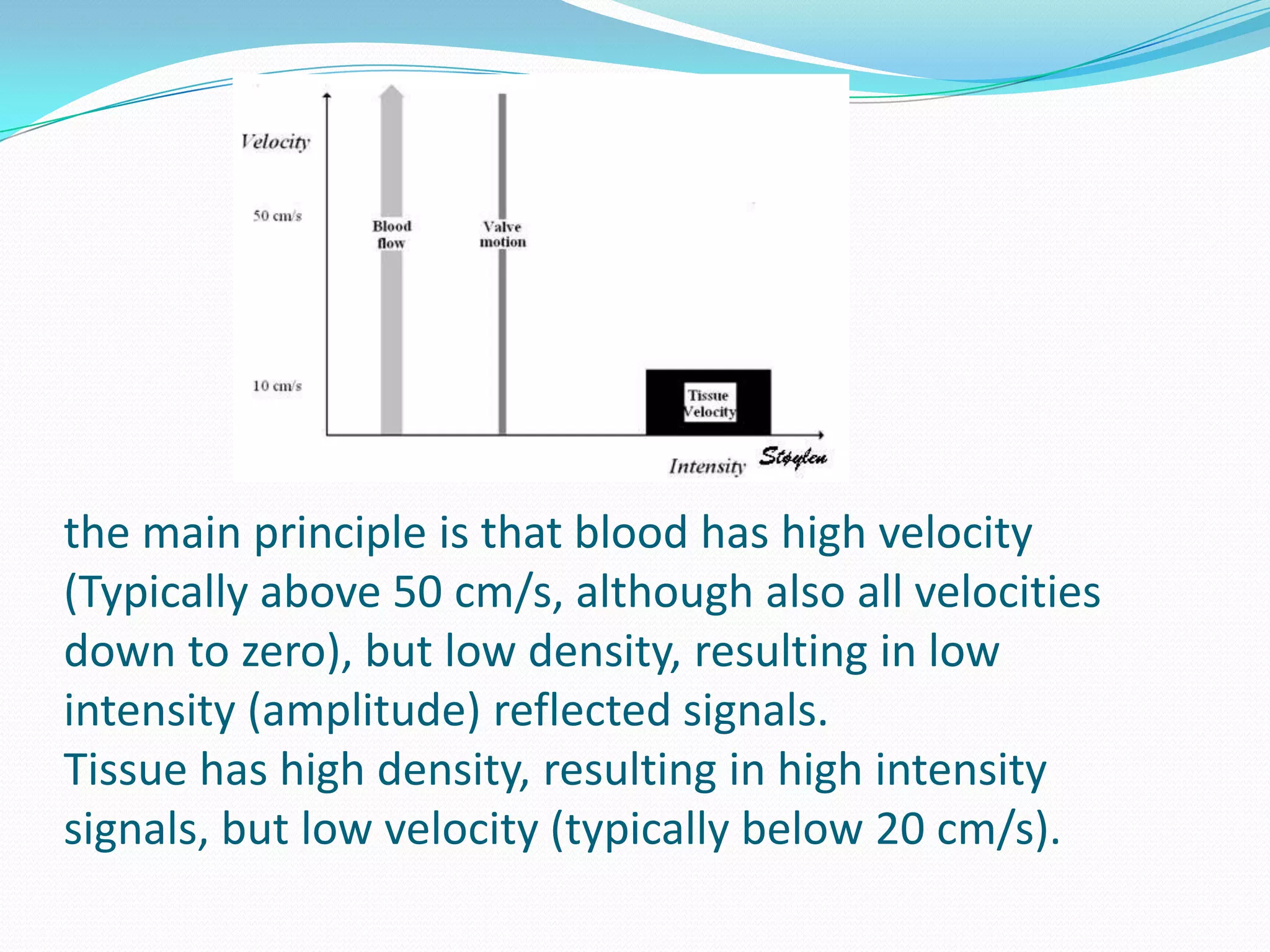
the main principle is that blood has high velocity
(Typically above 50 cm/s, although also all velocities
down to zero), but low density, resulting in low
intensity (amplitude) reflected signals.
Tissue has high density, resulting in high intensity
signals, but low velocity (typically below 20 cm/s).
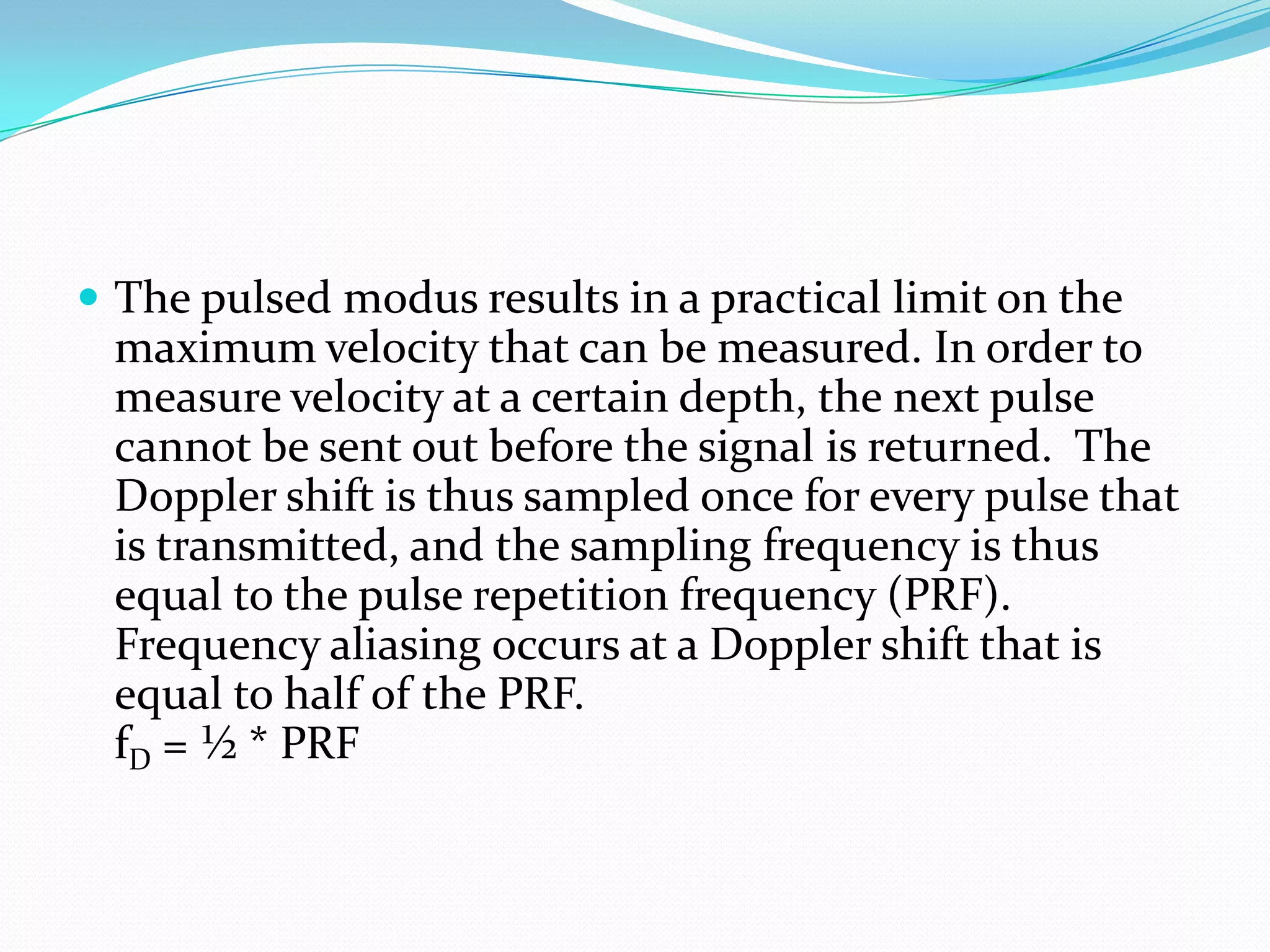
 The pulsed modus results in a practical limit on the
 maximum velocity that can be measured. In order to
 measure velocity at a certain depth, the next pulse
 cannot be sent out before the signal is returned. The
 Doppler shift is thus sampled once for every pulse that
 is transmitted, and the sampling frequency is thus
 equal to the pulse repetition frequency (PRF).
 Frequency aliasing occurs at a Doppler shift that is
 equal to half of the PRF.
 fD = ½ * PRF
 Sampling from increasing depth will increase the time
 for the pulse returning, thus increasing the sampling
 interval and decrease the sampling frequency. The
 Nykvist limit thus decreases with depth. This means
 that pulsed Doppler has depth resolution, but this
 leads to a limit to the velocities that can be measured.
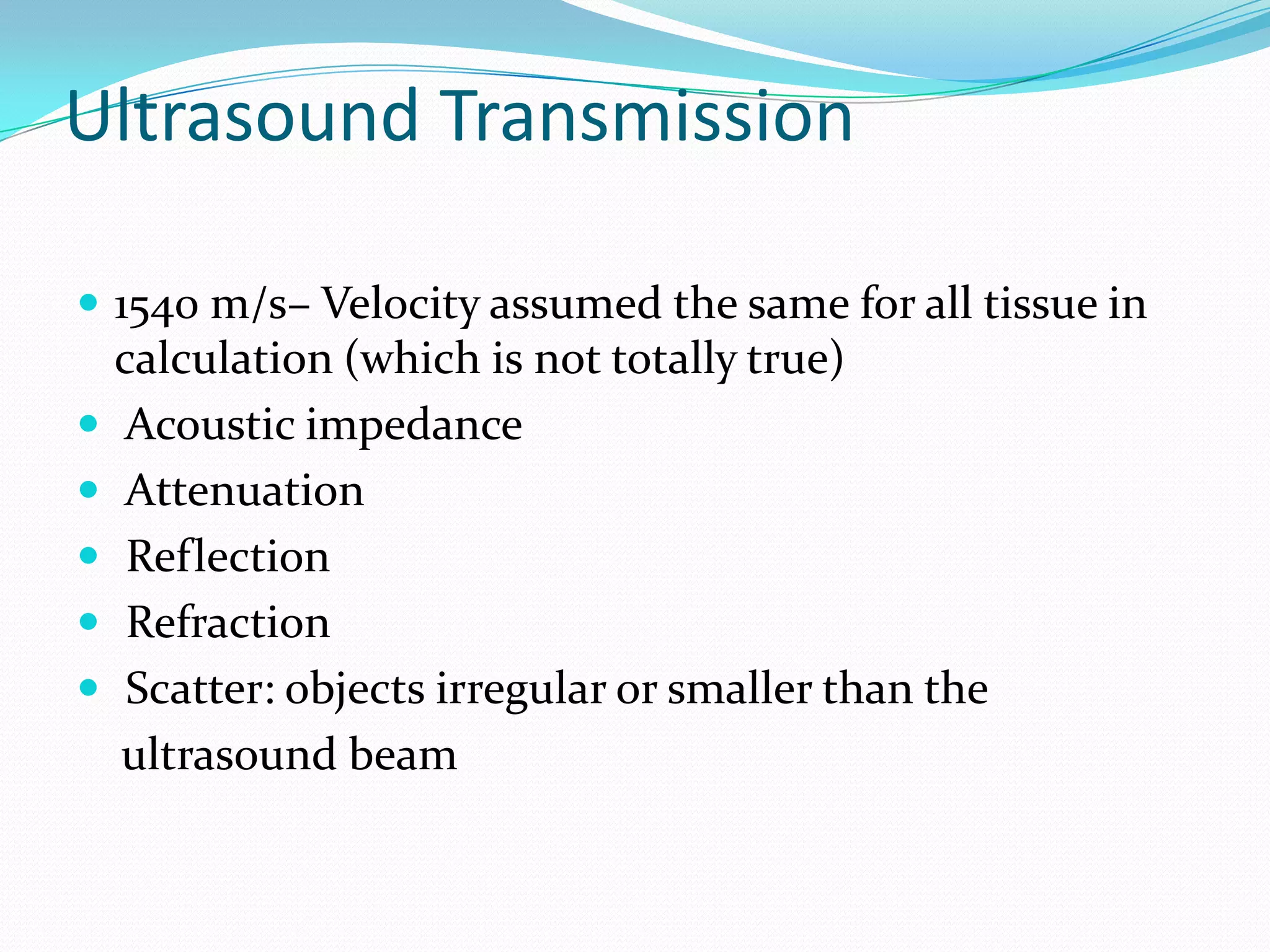
Ultrasound Transmission

 1540 m/s– Velocity assumed the same for all tissue in
    calculation (which is not totally true)
   Acoustic impedance
   Attenuation
    Reflection
    Refraction
    Scatter: objects irregular or smaller than the
    ultrasound beam
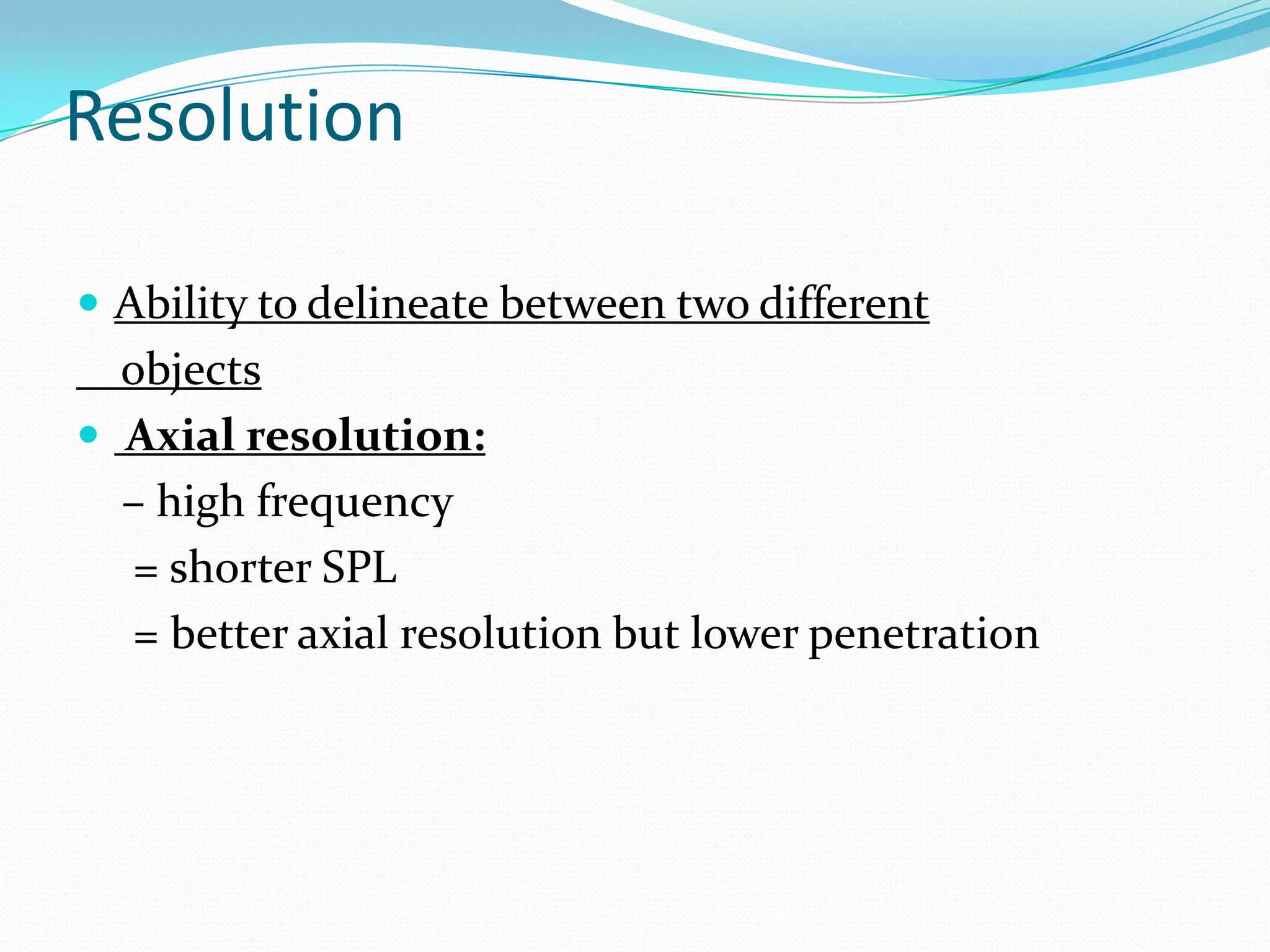
Resolution

 Ability to delineate between two different
  objects
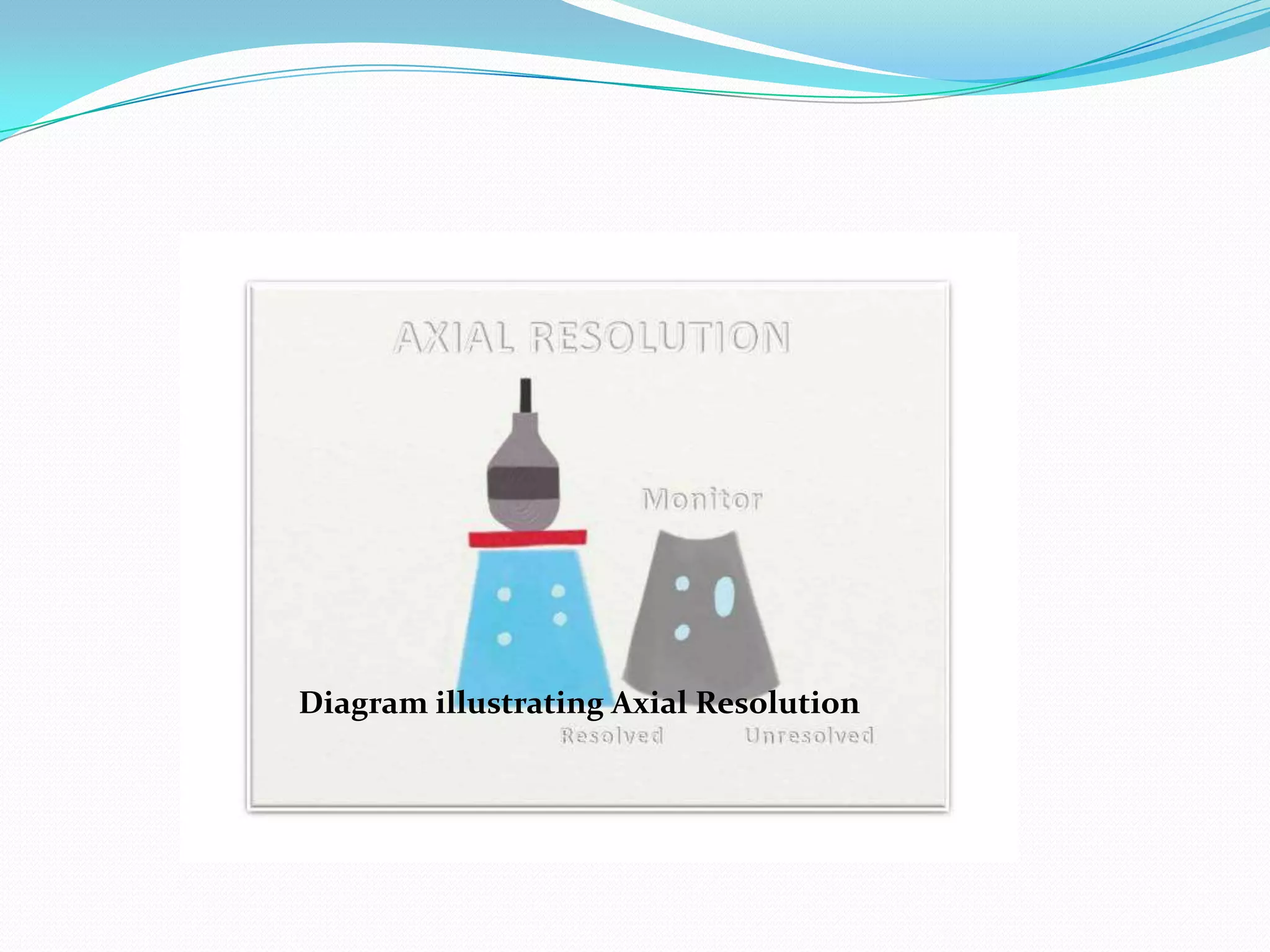
 Axial resolution:
  – high frequency
   = shorter SPL
   = better axial resolution but lower penetration
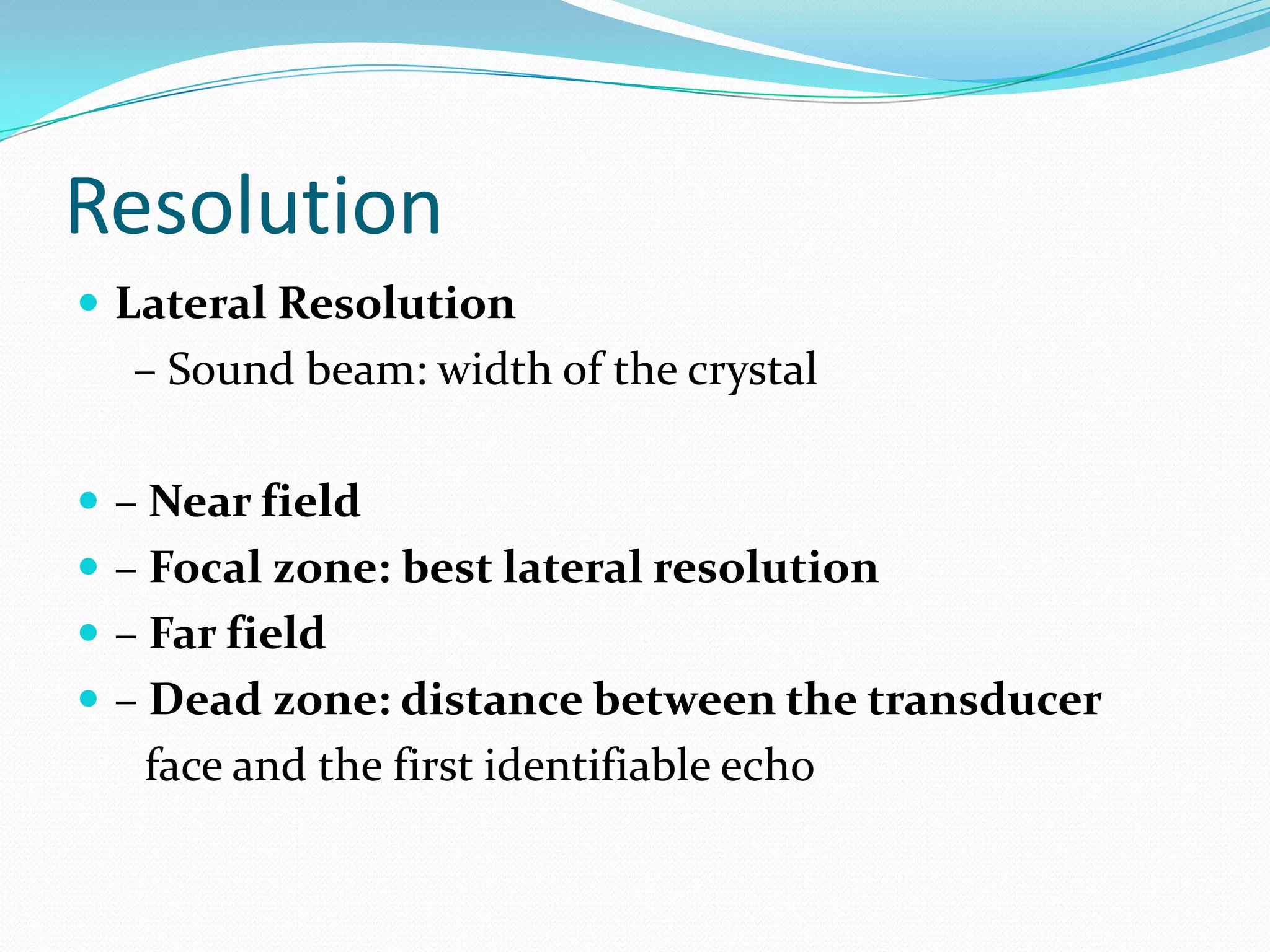
Resolution
 Lateral Resolution
  – Sound beam: width of the crystal

 – Near field
 – Focal zone: best lateral resolution
 – Far field
 – Dead zone: distance between the transducer
   face and the first identifiable echo
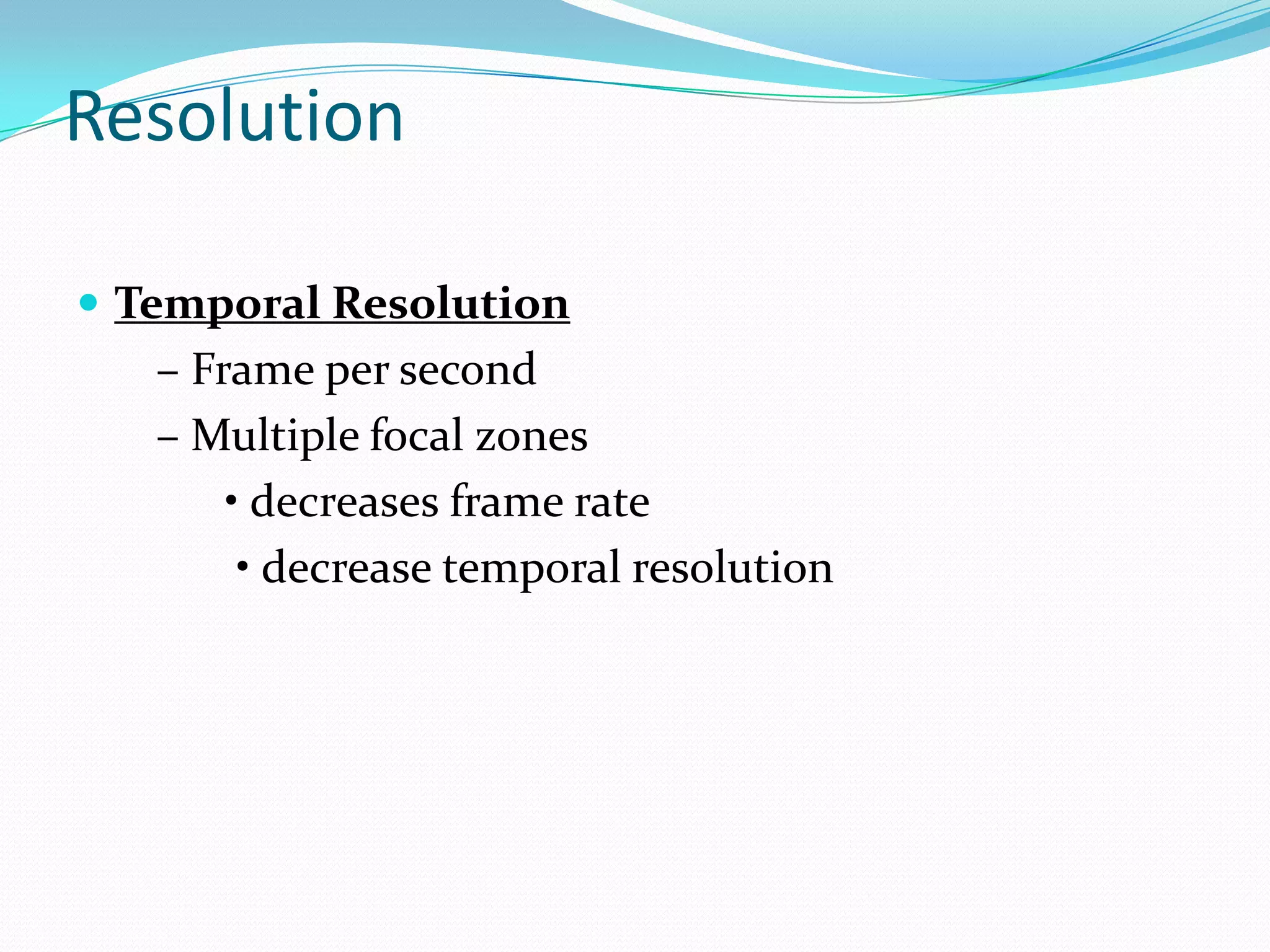
Resolution

 Temporal Resolution
   – Frame per second
   – Multiple focal zones
       • decreases frame rate
        • decrease temporal resolution
Diagram illustrating Axial Resolution
Modes

 A mode: amplitude
 B mode: brightness
 Real time (frames/sec)
 M mode: motion
A-Scan Presentation.

 The A-scan presentation displays the amount of
  received ultrasonic energy as a
 function of time. The relative amount of received
  energy is plotted along the
 vertical axis and the elapsed time (which may be
  related to the sound energy
 travel time within the material) is displayed along the
  horizontal axis
B-Scan Presentation.

 The B-scan presentation is a profile (cross-sectional)
  view of the test specimen.
 In the B-scan, the time-of-flight (travel time) of the
  sound energy is displayed
 along the vertical axis and the linear position of the
  transducer is displayed along
 the horizontal axis
Doppler Ultrasound

 Continuous wave (CW)
  – Seldom used, not a/v in most AED machines
 Pulsed wave (PW)
    Color Doppler
    Duplex Doppler:– Putting Color Doppler on
  top of Grey-scale Bmode
    Power Doppler
Transducers

 Formats
 – linear - rectangular field of view
 – sector - pie-shaped field of view
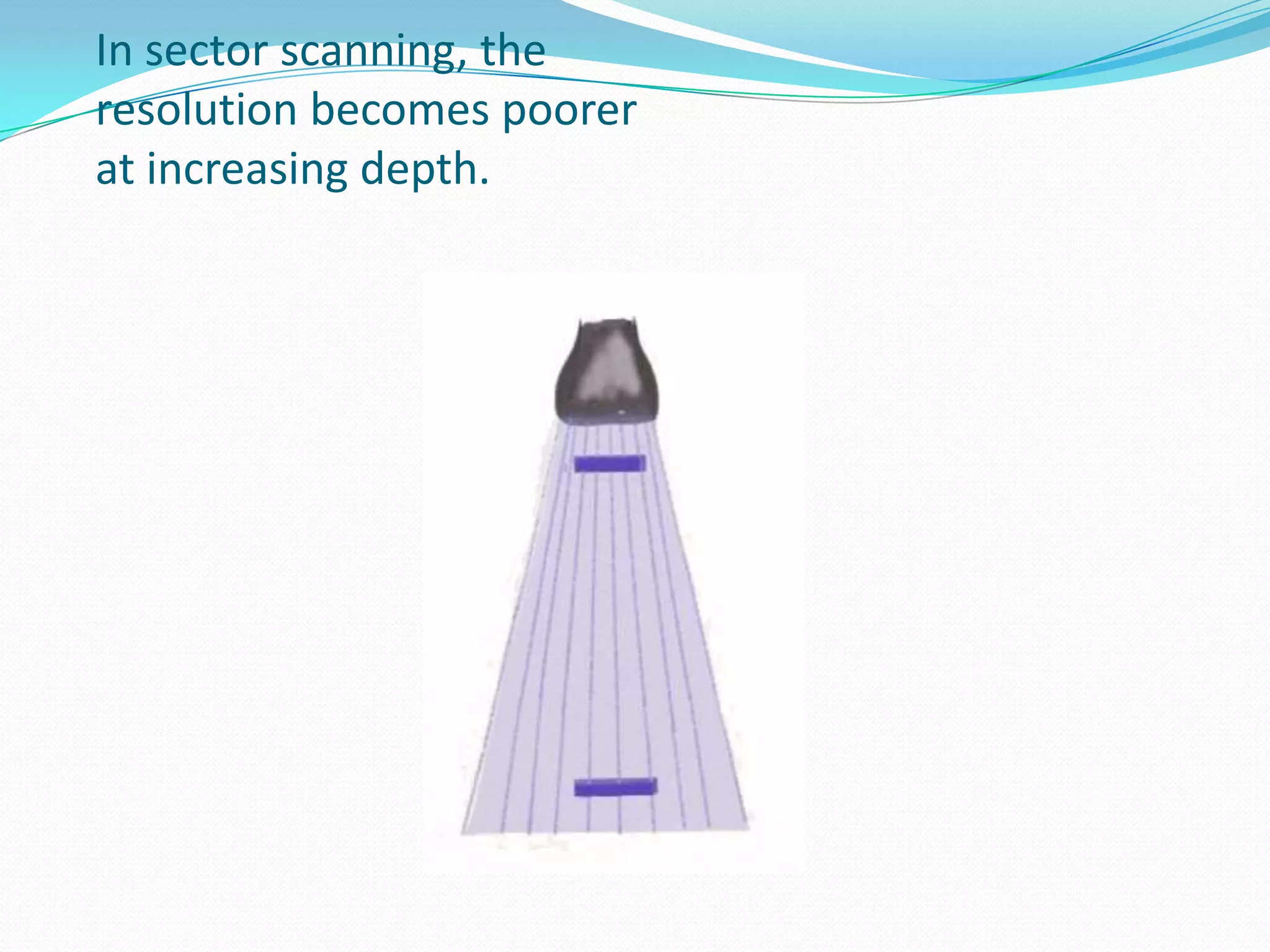
In sector scanning, the
resolution becomes poorer
at increasing depth.
Transducers

 Mechanical Probe: seldom used now
 Electronic Probe:
    – Linear array transducers
         • piezoelectric elements linearly arranged
         • sequentially activated to produce an image
    – Phased array transducers
        • smaller scanning surface (foot print)
        • good for echocardiography
        • more expensive
        • elements are activated with phase differences to
 allow steering of the ultrasound signal
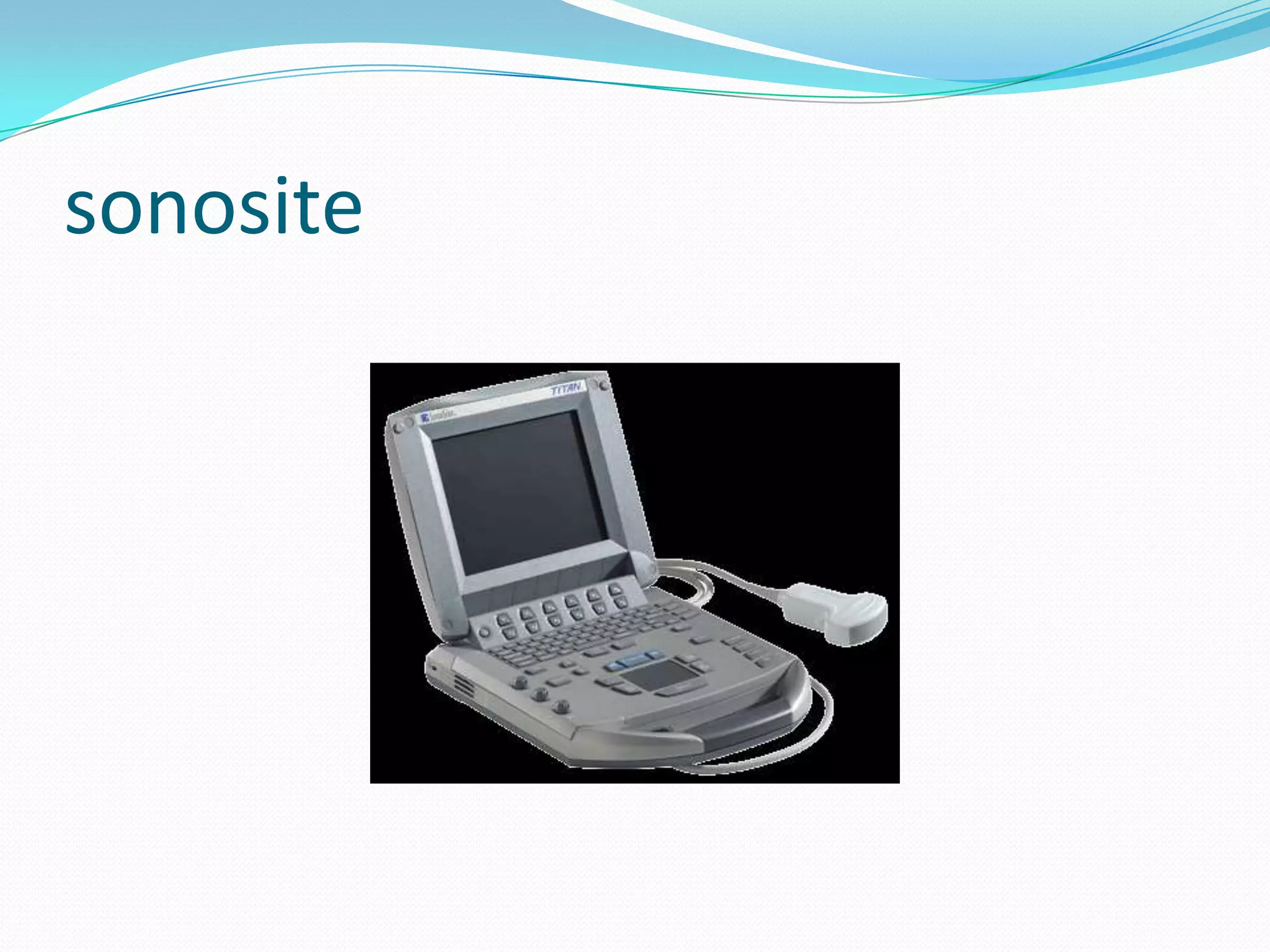
sonosite
Available transducers
 C60/5-2 Convex Array Abdominal
 C11/7-4 Microconvex Array
 L38/10-5 Linear Array Vascular
 C15e/2-4 Microconvex Array Cardiac
 ICT/7-4 Endocavity
Imaging Modes on the Titan
   2D
   Split screen
   Zoom
   Color power Doppler
   M-Mode: 3 sweep speeds 1/2:1/2, 1/3:2/3 or full screen
    options
   Pulsed wave (PW) Doppler
   Continuous wave (CW) Doppler
   Velocity based color flow Doppler
   Duplex imaging
   3 sweep speeds 1/2:1/2, 1/3:2/3 or full screen options
   Tissue Harmonic Imaging (THI)
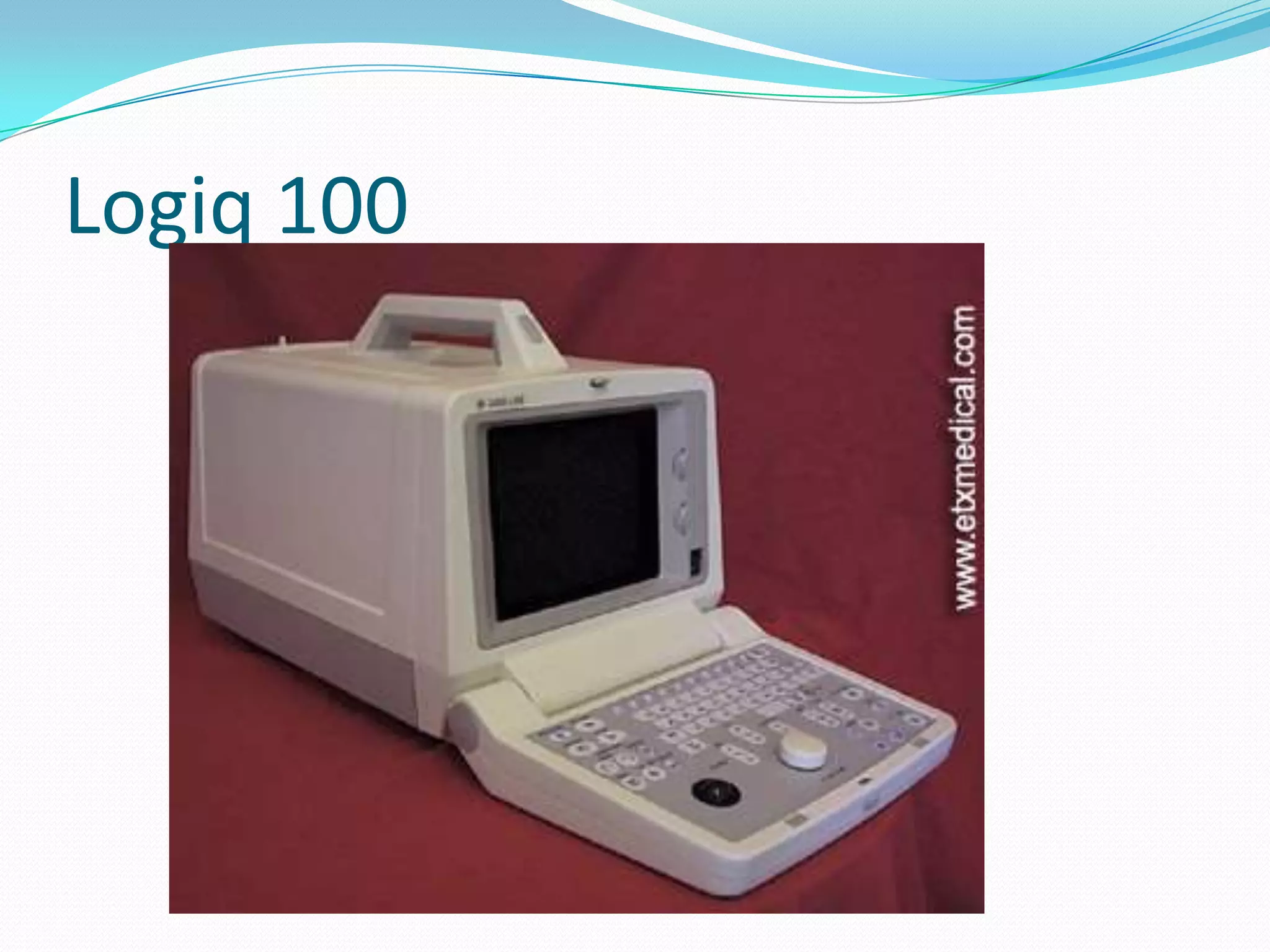
Logiq 100
 The Logiq 100 PRO's five main probes:
 5.0 MHz Convex-Array probe, 40 mm radius, 68°
  field of view
 3.5 MHz Convex-Array probe, 50 mm radius, 68°
  field of view
 7.5 MHz Linear-Array probe, 60 mm field of view
 3.5 MHz Micro convex Cardiac probe, 13 mm
  radius, 82° field of view
 6.5 MHz Endocavity probe, 10 mm radius, 120° field
  of view
probes
 C36
 C55
 L76
 E72
Contd..
 Operating modes: B-Mode, Dual B-Image (B/B-
 Mode), B/M Mode, M-Mode

 Dimensions: 276 mm x 244 mm x 405 mm, Weight:
 9.8 kg (without probes)
reference
 http://www.prioritymedical.com/ultrasoundtrans
  ducers.html
 www.gehealthcare.com/euen/ultrasound/.../logiq-
  100-pro/index.html#ge-probes
 www.medwow.com/...probes.../logiq-
  100.../1541_9_15853.med?...
ULTRASOUND IMAGING PRINCIPLES

ULTRASOUND IMAGING PRINCIPLES

  • 2.
    SEMINAR ON ULTRASOUND Tharanath PP India Ultrasound
  • 3.
    Ultrasound  Basic Idea – Send waves into body which are reflected at the interfaces between tissue  – Return time of the waves tells us of the depth of the reflecting surface  History  – First practical application, 1912 unsuccessful search for Titanic  – WW II brought massive military research - SONAR (SOund Navigation And Ranging)  – Mid-century used for non-destructive testing of materials  – First used as diagnostic tool in 1942 for localizing brain tumors  – 1950’s 2D gray scale images  – 1965 or so real-time imaging
  • 4.
    Ultrasound ranges? Human sensitivity:20 - 20,000Hz  Ultrasound: > 20,000Hz  Diagnostic Ultrasound: 2.5 - 14 MHz
  • 5.
     Sound waves • Sound wave propagate by longitudinal motion(compression/expansion), but not transverse motion(side-to-side)  • Can be modelled as weights connected by springs
  • 6.
     Specular -echoes originating from relatively large, regularly shaped objects with smooth surfaces. These echoes are relatively intense and angle dependent. (i.e.valves) - Reflection from large surfaces  Scattered - echoes originating from relatively small, weakly reflective, irregularly shaped objects are less angle dependant and less intense. (i.e.. blood cells) -Reflection from small surfaces
  • 7.
    Along each linewe transmit a pulse and plot the reflections that come back vs time
  • 8.
  • 9.
    Propagation of ultrasoundwaves in tissue Propagation of ultrasound waves in tissue • Ultrasound imaging systems commonly operate at 3.5 MHz, which corresponds to a wavelength of 0.44 mm when c = 1540 m/s. Refraction • When a wave passes from one medium to another the frequency is constant, and since c changes then so must the wavelength
  • 10.
    Propagation of ultrasoundwaves in tissue Bending of waves from one medium to another is 'refraction' • Follows Snell’s Law sin theta/c1 since λ2 < λ1 we have c2 <c1 and θ2 < θ1
  • 11.
    Definition/ Terminology  Cycle Frequency: cycles per second  Wave length  Period  Amplitude  Compression - area of high density  Rarefication - area of low density  velocity = l x ƒ= constant for a given medium
  • 12.
    A, Initial observation. B,After a short time, regions of high & low density are displaced to the right
  • 13.
    Ultrasound Production  Piezoelectriceffect: – Crystals vibrate at given frequency when an alternating current is applied – Crystal acts as speaker and microphone  Continuous mode: – continuous-wave Doppler (CW)  Pulsed-echo mode:
  • 14.
  • 15.
     there isno information about the time interval from the signal to the reflection, and, hence, no information about the depth of the received signal; the signal may come from any depth. The continuous Doppler has no Nykvist limit, and can measure maximal velocities. It is used for measuring high velocities.
  • 16.
    Pulsed Echo  Signalgeneration = only ~1% of the entire pulse cycle  On times; off times  Time of signal return proportional to distance travelled
  • 17.
     if thePRF = 5 kHz and the time between pulses is 0.2 msec, it will take 0.1 msec to reach the target and 0.1 msec to return to the transducer. This means the pulse will travel 15.4 cm before the next pulse is emitted (1,540 m/sec x 0.1 msec = 0.154 m in 0.1 msec = 15.4 cm).
  • 19.
  • 20.
    Pulsed Echo  PRF:pulse repetition frequency – Very important in Color Doppler  SPL: spatial pulse length = wavelength x no. of cycles  Maximal resolution = 0.5 SPL – The smallest distance between 2 points that USG can delineate
  • 21.
    SPL with maximalresolution. Two objects (vertical lines) are separated by 0.5 SPL. The echo from each interface is shown by dashed lines. The objects are just resolvable.
  • 22.
    Pulse length shortenedby increasing the frequency. A ........The four-cycle pulse from a low-frequency transducer includes both objects within the SPL. B .........The four-cycle pulse from a high- frequency transducer has a shorter spatial pulse length and can resolve objects located more closely together.
  • 23.
  • 24.
    V never gobeyond c…means max shift is twice ft.
  • 26.
  • 27.
    the main principleis that blood has high velocity (Typically above 50 cm/s, although also all velocities down to zero), but low density, resulting in low intensity (amplitude) reflected signals. Tissue has high density, resulting in high intensity signals, but low velocity (typically below 20 cm/s).
  • 28.
     The pulsedmodus results in a practical limit on the maximum velocity that can be measured. In order to measure velocity at a certain depth, the next pulse cannot be sent out before the signal is returned. The Doppler shift is thus sampled once for every pulse that is transmitted, and the sampling frequency is thus equal to the pulse repetition frequency (PRF). Frequency aliasing occurs at a Doppler shift that is equal to half of the PRF. fD = ½ * PRF
  • 29.
     Sampling fromincreasing depth will increase the time for the pulse returning, thus increasing the sampling interval and decrease the sampling frequency. The Nykvist limit thus decreases with depth. This means that pulsed Doppler has depth resolution, but this leads to a limit to the velocities that can be measured.
  • 30.
    Ultrasound Transmission  1540m/s– Velocity assumed the same for all tissue in calculation (which is not totally true)  Acoustic impedance  Attenuation  Reflection  Refraction  Scatter: objects irregular or smaller than the ultrasound beam
  • 31.
    Resolution  Ability todelineate between two different objects  Axial resolution: – high frequency = shorter SPL = better axial resolution but lower penetration
  • 32.
    Resolution  Lateral Resolution – Sound beam: width of the crystal  – Near field  – Focal zone: best lateral resolution  – Far field  – Dead zone: distance between the transducer face and the first identifiable echo
  • 33.
    Resolution  Temporal Resolution – Frame per second – Multiple focal zones • decreases frame rate • decrease temporal resolution
  • 34.
  • 35.
    Modes  A mode:amplitude  B mode: brightness  Real time (frames/sec)  M mode: motion
  • 36.
    A-Scan Presentation.  TheA-scan presentation displays the amount of received ultrasonic energy as a  function of time. The relative amount of received energy is plotted along the  vertical axis and the elapsed time (which may be related to the sound energy  travel time within the material) is displayed along the horizontal axis
  • 37.
    B-Scan Presentation.  TheB-scan presentation is a profile (cross-sectional) view of the test specimen.  In the B-scan, the time-of-flight (travel time) of the sound energy is displayed  along the vertical axis and the linear position of the transducer is displayed along  the horizontal axis
  • 38.
    Doppler Ultrasound  Continuouswave (CW) – Seldom used, not a/v in most AED machines  Pulsed wave (PW) Color Doppler Duplex Doppler:– Putting Color Doppler on top of Grey-scale Bmode Power Doppler
  • 39.
    Transducers  Formats  –linear - rectangular field of view  – sector - pie-shaped field of view
  • 40.
    In sector scanning,the resolution becomes poorer at increasing depth.
  • 41.
    Transducers  Mechanical Probe:seldom used now  Electronic Probe: – Linear array transducers • piezoelectric elements linearly arranged • sequentially activated to produce an image – Phased array transducers • smaller scanning surface (foot print) • good for echocardiography • more expensive • elements are activated with phase differences to allow steering of the ultrasound signal
  • 42.
  • 43.
    Available transducers  C60/5-2Convex Array Abdominal  C11/7-4 Microconvex Array  L38/10-5 Linear Array Vascular  C15e/2-4 Microconvex Array Cardiac  ICT/7-4 Endocavity
  • 44.
    Imaging Modes onthe Titan  2D  Split screen  Zoom  Color power Doppler  M-Mode: 3 sweep speeds 1/2:1/2, 1/3:2/3 or full screen options  Pulsed wave (PW) Doppler  Continuous wave (CW) Doppler  Velocity based color flow Doppler  Duplex imaging  3 sweep speeds 1/2:1/2, 1/3:2/3 or full screen options  Tissue Harmonic Imaging (THI)
  • 45.
  • 46.
     The Logiq100 PRO's five main probes:  5.0 MHz Convex-Array probe, 40 mm radius, 68° field of view  3.5 MHz Convex-Array probe, 50 mm radius, 68° field of view  7.5 MHz Linear-Array probe, 60 mm field of view  3.5 MHz Micro convex Cardiac probe, 13 mm radius, 82° field of view  6.5 MHz Endocavity probe, 10 mm radius, 120° field of view
  • 47.
  • 48.
    Contd..  Operating modes:B-Mode, Dual B-Image (B/B- Mode), B/M Mode, M-Mode  Dimensions: 276 mm x 244 mm x 405 mm, Weight: 9.8 kg (without probes)
  • 50.
    reference  http://www.prioritymedical.com/ultrasoundtrans ducers.html  www.gehealthcare.com/euen/ultrasound/.../logiq- 100-pro/index.html#ge-probes  www.medwow.com/...probes.../logiq- 100.../1541_9_15853.med?...