Completable

Future
THREADSCONCORRÊNCIAE
PARALELISMOEMJAVA
Helder da Rocha (helder@summa.com.br)
10
1. Criação e controle de threads
2. Acesso exclusivo e comunicação entre threads
3. Ciclo de vida, aplicações e boas práticas
4. Variáveis atômicas
5. Travas
6. Coleções
7. Sincronizadores
8. Executores e Futures
9. Paralelismo
10. CompletableFuture
THREADSCONCORRÊNCIAE
PARALELISMOEMJAVA
APICompletableFuture
• API de execução assíncrona, funcional, baseada em fluxos de dados reativos
introduzida no Java 8
• Consiste da interface CompletionStage e sua implementação: a classe
CompletableFuture.
• Possui mais de 70 métodos.
• Métodos recebem interfaces funcionais e retornam CompletionStage
(podem ser concatenados)
• Programação similar a API de streams (mas usa push, em vez de pull)
CompletionStage
CompletableFuture<V>
CompletionStage<V>Future<V>
• Um CompletableFuture é um Future e também um CompletionStage:
interface que representa uma computação possivelmente assíncrona
• Um CompletableFuture é corrente de CompletionStages concatenados.
• Cada CompletionStage executa uma etapa da tarefa. Cada etapa é executada
quando a anterior termina, podendo usar seu resultado como entrada.
CompletionStage CompletionStage CompletionStage
CompletionStage
• O primeiro elemento da corrente deve ser uma tarefa descrita pela
interface funcional Runnable ou Supplier<T>.
• Os estágios seguintes podem conter tarefas descritas pelas seguintes
interfaces funcionais:
• Consumer<T> (se não retornam valor)
• Function<T,R> (se recebem valor e retornam outro)
• Runnable (se não recebem nem passam valor adiante)
Concatenaçãodeestágios
CompletableFuture
supplyAsync
() -> event.get()
CompletionStage
thenApply
x -> x * x
CompletionStage
thenAccept
x -> System.out.println(x)
CompletionStage
thenRun
() -> System.out.println("Done!")
triggers
triggers
triggers
• A execução de um estágio é
disparada pela conclusão de
um estágio anterior
• Também pode esperar dois
estágios ou um dentre dois
estágios anteriores
• Também é possível combinar
resultados.
Um evento pode completar um
CompletableFuture chamando
complete(valor)
ComocriarumCompletableFuture
• Usando o construtor default
CompletableFuture<Integer> trigger = new CompletableFuture<>();
• CompletableFuture pode ser completado explicitamente usando
complete(valor) ou completeAsync(Supplier)
trigger.complete(5);
• Um callback (esperando no get()) que executará depois do complete()
new Thread(() -> {
try {
System.out.println("Resultado da tarefa: " + trigger.get());
} catch (InterruptedException | ExecutionException e) { ... }
}).start();
ComocriarumCompletableFuture
• Usando métodos de fábrica e uma tarefa Runnable ou Supplier<V>
• CompletableFuture.runAsync( Runnable tarefa)

• CompletableFuture.supplyAsync( Supplier<T> tarefa)
CompletableFuture<Void> cf1 = CompletableFuture.runAsync(() -> {
for (int i = 0; i < 1_000_000_000; i++)
if (i % 100_000_000 == 0)
System.out.print("2");
});
CompletableFuture<String> cf2 = CompletableFuture.supplyAsync(() -> {
StringBuilder builder = new StringBuilder();
for (int i = 0; i < 1_000_000_000; i++)
if (i % 100_000_000 == 0)
builder.append((char)(new Random().nextInt(26) + 'A'));
return builder.toString();
});
Estágiosiniciais
()
void R res
Runnable
«interface»
void run()
Supplier<R>
«interface»
R get()
CompletionStage
runAsync
() -> void
CompletionStage
supplyAsync
() -> r
()
thenRun
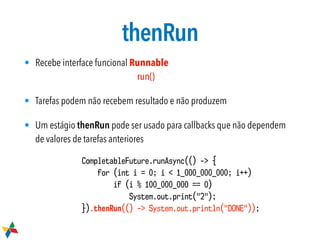
• Recebe interface funcional Runnable

run()
• Tarefas podem não recebem resultado e não produzem
• Um estágio thenRun pode ser usado para callbacks que não dependem
de valores de tarefas anteriores
CompletableFuture.runAsync(() -> {
for (int i = 0; i < 1_000_000_000; i++)
if (i % 100_000_000 == 0)
System.out.print("2");
}).thenRun(() -> System.out.println("DONE"));
thenAccept
• Recebe interface funcional Consumer<T>

accept(T valor)
• Tarefas podem receber um resultado (mas não produzem)
• Um estágio thenAccept pode ser usado no final de uma cadeia
CompletableFuture.supplyAsync(() -> {
StringBuilder builder = new StringBuilder();
for (int i = 0; i < 1_000_000_000; i++)
if (i % 100_000_000 == 0)
builder.append((char)(new Random().nextInt(26) + 'A'));
return builder.toString();
}).thenAccept(result -> System.out.println("Result is: " + result));
thenApply
TagOperations to = new TagOperations();
CompletableFuture.supplyAsync(() -> "text")
.thenApply(s -> to.tag("p", s))
.thenApply(s -> s.concat("n"))
.thenApply(s -> "n".concat(s))
.thenApply(s -> to.tag("div", s))
.thenAccept(s -> 

System.out.println("Result:n" + s));
class TagOperations {
String tag(String tagName, 

String contents) {...}
String unTag(String taggedText) {...}
}
• Recebe interface funcional
Function<T,R>

R apply(T valor)
• Tarefas podem receber um
resultado e produzir outro.
• Vários estágios thenApply
podem ser concatenados
Estágiosintermediários
()
void
T val
void R res
T val
Runnable
«interface»
void run()
Consumer<T>
«interface»
void accept(T val)
Function<T,R>
«interface»
R apply(T val)
CompletionStage
thenRun
() -> void
CompletionStage
thenAccept
t -> void
CompletionStage
thenApply
t -> r
Estágiossíncronos
• Cada estágio é executado no mesmo
thread do estágio anterior, exceto se o
método terminar em Async
• Um estágio inicia apenas quando o
estágio anterior termina (isto vale para
estágios comuns e Async).
• Se o estágio anterior produzir um
resultado, o valor poderá ser usado pelo
estágio seguinte
main
future
future.join()
forkjoin-pool

thread-1
complete()
complete()
complete()
complete()
complete()
thenAccept
supplyAsync
thenApply
thenApply
thenApply
main
future
future.join()
forkjoin-pool

thread-1
forkjoin-pool

thread-2
forkjoin-pool

thread-3
complete()
complete()
complete()
complete()
complete()
thenAccept
supplyAsync
thenApply
thenApplyAsync
thenApplyAsync
Estágios
Async
• Se o método terminar em
Async, o a tarefa é
executada em novo thread
• Mesmo em threads
diferentes, um estágio
seguinte só inicia quando o
anterior é completado
Execuçãosimultânea
main
future
forkjoin-pool

thread-1
forkjoin-pool

thread-2
supplyAsync
thenApply
thenApplyAsync
future
thenApply
future
complete()
complete()
complete()
main
future
forkjoin-pool

thread-1
supplyAsync
thenApply
future
future
complete()
complete()
complete()
• É possível em estágios Async que fazem parte de correntes diferentes
EscolhadoExecutorService
• Os métodos Async permitem a escolha do serviço de execução
(ExecutorService) que será usado pela tarefa
ExecutorService executor = Executors.newSingleThreadExecutor();
CompletableFuture.supplyAsync(() -> loadFile("dictionary.csv"))
.thenApply(data -> csvParser.parse(data))
.thenApply(data -> dataVizGenerator.lineChart(data))
.thenAcceptAsync(chart -> workspace.display(chart), executor);
main thread
fork-join-pool thread
executor thread
Exceções
• Se um CompletionStage provocar uma exceção, ela será encapsulada
dentro de uma CompletionException
• A exceção é propagada pelos CompletionStages que vierem depois.
• isCompletedExceptionally() retornará true
• Se get() for chamado será lançada uma ExecutionException
exceptionally
• Funciona como bloco catch
• Recebe Function<Throwable,T>
• Pode substituir exceção por um valor válido
CompletableFuture.supplyAsync(()->1/0)
.exceptionally(e->0)
.thenAccept(n->System.out::println));
handle
• Recebe BiFunction<T,Throwable, R>
• Etapa completa normalmente e repassa resultado adiante.
• Se houver exceção, resultado é null, mas exceção poderá ser utilizada.
• Se a operação completar normalmente, a exceção será null.
CompletableFuture.supplyAsync(()->1/0)
.handle((data, error) -> {
if(error != null) {
return 0;
} else return data;
})
.thenAcceptAsync(s -> System.out.println("Result:" + s));
whenComplete
• Recebe um BiConsumer<T,Throwable>
• Não tem como tratar a exceção (alterar o valor que é passado adiante)
CompletableFuture.supplyAsync(()->1/0)
.whenComplete((data, error) -> {
if(error != null) {
System.out.println("Error: " + error);
}
})
.exceptionally(e -> 0)
.thenAccept(n->System.out::println));
Estágiosquecapturamexceções
void R r
BiConsumer<T,U>
«interface»
void accept(T val,Throwable e)
BiFunction<T,Throwable,R>
«interface»
R apply(T val,Throwable e)
CompletionStage
exceptionally
e -> r
CompletionStage
whenComplete
(t, e) -> void
CompletionStage
handle
(t, e) -> r
T val Throwable eThrowable e
Function<Throwable,R>
«interface»
R apply(Throwable e)
R r
T val Throwable e
CompletionException
• Exceções são encapsuladas em CompletionException (podem ser
extraídas usando getCause())
• Nas expressões dos métodos exceptionally() e handle() a exceção é
automaticamente desempacotada
java.util.concurrent.CompletionException
getCause()java.io.IOException
Desempacotamentoautomático
java.io.IOException
CompletionStage
thenApply
out -> out.println("text")
CompletionStage
exceptionally
e -> System.out.println(e)
CompletionStage
thenApply
out -> out.println("text")
CompletionStage
handle
(d,e) -> System.out.println(e)
java.io.IOException
java.io.IOException
java.io.IOException
CompletionStage
thenApply
out -> out.println("text")
CompletionStage
whenComplete
(d,e) -> System.out.println(e)
java.io.IOException
j.u.c.CompletionException
• IOException provocada em um estágio e automaticamente desempacotada
em exceptionally() e handle(), mas não em whenComplete()
CombinaçãoAND
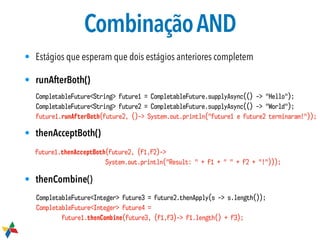
• Estágios que esperam que dois estágios anteriores completem
• runAfterBoth()
• thenAcceptBoth()
• thenCombine()
CompletableFuture<String> future1 = CompletableFuture.supplyAsync(() -> "Hello");
CompletableFuture<String> future2 = CompletableFuture.supplyAsync(() -> "World");
future1.runAfterBoth(future2, ()-> System.out.println("future1 e future2 terminaram!"));
future1.thenAcceptBoth(future2, (f1,f2)->
System.out.println("Result: " + f1 + " " + f2 + "!")));
CompletableFuture<Integer> future3 = future2.thenApply(s -> s.length());
CompletableFuture<Integer> future4 =
future1.thenCombine(future3, (f1,f3)-> f1.length() + f3);
CombinaçãoAND
()
void void R res
Runnable
«interface»
void run()
BiConsumer<T,U>
«interface»
void accept(T val1, U val2)
BiFunction<T,U,R>
«interface»
R apply(T val1, U val2)
CompletionStage
runAfterBoth
() -> void
CompletionStage
thenAcceptBoth
(t, u) -> void
CompletionStage
thenCombine
(t, u) -> r
T val1 U val2 T val1 U val2
CombinaçãoOR
• Estágios que esperam que um, dentre dois estágios anteriores, complete
• runAfterEither()
• acceptEither()

• applyToEither()
future1.runAfterEither(future2,
() -> System.out.println("Terminou future1 ou future2"));
future1.acceptEither(future2,
s -> System.out.println(s)); // imprime “Hello” ou “World”
future1.applyToEither(future2, s -> s.toUpperCase())
.thenAccept(s -> System.out.println(s)); // imprime “HELLO” ou “WORLD”
CombinaçãoOR
()
void void R res
T val
CompletionStage
runEither
() -> void
CompletionStage
acceptEither
t -> void
CompletionStage
applyToEither
t -> r
T val
Runnable
«interface»
void run()
Consumer<T>
«interface»
void accept(T val)
Function<T,R>
«interface»
R apply(T val)
Composiçaodeestágios
• thenCompose()

• Análogo ao método flatMap() de Stream
CompletionStage
thenCompose
t -> stage
CompletionStage stage
T val
Function<T,CompletionStage>
«interface»
CompletionStage apply(T val)
CompletableFuture<String> stage1 =
new CompletableFuture<>();
CompletableFuture<String> stage2 =
CompletableFuture.supplyAsync(() -> "World");
CompletableFuture<CompletableFuture<String>> stage3 =
stage1.thenApply(s1 ->
stage2.thenApply(s2 -> s1 + s2.toUpperCase()));
stage3.thenAccept(cf -> System.out.println("S3: " + cf.join()));
CompletableFuture<String> stage4 =
stage1.thenCompose(s1 ->
stage2.thenApply(s2 -> s1 + s2.toUpperCase()));
stage4.thenAccept(s -> System.out.println("S4: " + s));
stage1.complete("Hello, ");
stage1.join();
CombinaçãoeseleçãodeCompletableFutures
• anyOf() retorna CompletableFuture que é completado assim que um dos
CompletableFutures da lista completar
• allOf() retorna CompletableFuture que é completado quando todos os
CompletableFutures da lista completarem.
List<CompletableFuture<?>> fs = List.of(f1, f2, f3, f4);
CompletableFuture<?>[] array = fs.toArray(new CompletableFuture[fs.size()]);
CompletableFuture<List<?>>> resultados = CompletableFuture.allOf(array)
.thenApply(v -> fs.stream().map(f -> f.join())
.collect(Collectors.toList()));
CompletableFuture<?> anyFuture = CompletableFuture.anyOf(array));
Outrosmétodos
• completedFuture(valor) 

• Retorna um CompletableFuture já completo e com o valor passado
como argumento. Útil para a construção de testes.
• completeExceptionally(throwable) 

• Chamadas a get(), join() e similares lançam exceção passada como
argumento, se CompletableFuture ainda não tiver completado a tarefa
• obtrudeValue(valor) e obtrudeException(throwable)
• Forçam retorno de valor diferente para get(), join() ou lançamento de
exceção diferente, independente da tarefa ter sido completada ou não
THREADSCONCORRÊNCIAE
PARALELISMOEMJAVA
Helder da Rocha (helder@summa.com.br)
github.com/helderdarocha/java8-course/
/java/concurrency/
Maio 2015

Threads 10: CompletableFuture

  • 1.
  • 2.
    1. Criação econtrole de threads 2. Acesso exclusivo e comunicação entre threads 3. Ciclo de vida, aplicações e boas práticas 4. Variáveis atômicas 5. Travas 6. Coleções 7. Sincronizadores 8. Executores e Futures 9. Paralelismo 10. CompletableFuture THREADSCONCORRÊNCIAE PARALELISMOEMJAVA
  • 3.
    APICompletableFuture • API deexecução assíncrona, funcional, baseada em fluxos de dados reativos introduzida no Java 8 • Consiste da interface CompletionStage e sua implementação: a classe CompletableFuture. • Possui mais de 70 métodos. • Métodos recebem interfaces funcionais e retornam CompletionStage (podem ser concatenados) • Programação similar a API de streams (mas usa push, em vez de pull)
  • 4.
    CompletionStage CompletableFuture<V> CompletionStage<V>Future<V> • Um CompletableFutureé um Future e também um CompletionStage: interface que representa uma computação possivelmente assíncrona • Um CompletableFuture é corrente de CompletionStages concatenados. • Cada CompletionStage executa uma etapa da tarefa. Cada etapa é executada quando a anterior termina, podendo usar seu resultado como entrada. CompletionStage CompletionStage CompletionStage
  • 5.
    CompletionStage • O primeiroelemento da corrente deve ser uma tarefa descrita pela interface funcional Runnable ou Supplier<T>. • Os estágios seguintes podem conter tarefas descritas pelas seguintes interfaces funcionais: • Consumer<T> (se não retornam valor) • Function<T,R> (se recebem valor e retornam outro) • Runnable (se não recebem nem passam valor adiante)
  • 6.
    Concatenaçãodeestágios CompletableFuture supplyAsync () -> event.get() CompletionStage thenApply x-> x * x CompletionStage thenAccept x -> System.out.println(x) CompletionStage thenRun () -> System.out.println("Done!") triggers triggers triggers • A execução de um estágio é disparada pela conclusão de um estágio anterior • Também pode esperar dois estágios ou um dentre dois estágios anteriores • Também é possível combinar resultados. Um evento pode completar um CompletableFuture chamando complete(valor)
  • 7.
    ComocriarumCompletableFuture • Usando oconstrutor default CompletableFuture<Integer> trigger = new CompletableFuture<>(); • CompletableFuture pode ser completado explicitamente usando complete(valor) ou completeAsync(Supplier) trigger.complete(5); • Um callback (esperando no get()) que executará depois do complete() new Thread(() -> { try { System.out.println("Resultado da tarefa: " + trigger.get()); } catch (InterruptedException | ExecutionException e) { ... } }).start();
  • 8.
    ComocriarumCompletableFuture • Usando métodosde fábrica e uma tarefa Runnable ou Supplier<V> • CompletableFuture.runAsync( Runnable tarefa) • CompletableFuture.supplyAsync( Supplier<T> tarefa) CompletableFuture<Void> cf1 = CompletableFuture.runAsync(() -> { for (int i = 0; i < 1_000_000_000; i++) if (i % 100_000_000 == 0) System.out.print("2"); }); CompletableFuture<String> cf2 = CompletableFuture.supplyAsync(() -> { StringBuilder builder = new StringBuilder(); for (int i = 0; i < 1_000_000_000; i++) if (i % 100_000_000 == 0) builder.append((char)(new Random().nextInt(26) + 'A')); return builder.toString(); });
  • 9.
    Estágiosiniciais () void R res Runnable «interface» voidrun() Supplier<R> «interface» R get() CompletionStage runAsync () -> void CompletionStage supplyAsync () -> r ()
  • 10.
    thenRun • Recebe interfacefuncional Runnable
 run() • Tarefas podem não recebem resultado e não produzem • Um estágio thenRun pode ser usado para callbacks que não dependem de valores de tarefas anteriores CompletableFuture.runAsync(() -> { for (int i = 0; i < 1_000_000_000; i++) if (i % 100_000_000 == 0) System.out.print("2"); }).thenRun(() -> System.out.println("DONE"));
  • 11.
    thenAccept • Recebe interfacefuncional Consumer<T>
 accept(T valor) • Tarefas podem receber um resultado (mas não produzem) • Um estágio thenAccept pode ser usado no final de uma cadeia CompletableFuture.supplyAsync(() -> { StringBuilder builder = new StringBuilder(); for (int i = 0; i < 1_000_000_000; i++) if (i % 100_000_000 == 0) builder.append((char)(new Random().nextInt(26) + 'A')); return builder.toString(); }).thenAccept(result -> System.out.println("Result is: " + result));
  • 12.
    thenApply TagOperations to =new TagOperations(); CompletableFuture.supplyAsync(() -> "text") .thenApply(s -> to.tag("p", s)) .thenApply(s -> s.concat("n")) .thenApply(s -> "n".concat(s)) .thenApply(s -> to.tag("div", s)) .thenAccept(s -> 
 System.out.println("Result:n" + s)); class TagOperations { String tag(String tagName, 
 String contents) {...} String unTag(String taggedText) {...} } • Recebe interface funcional Function<T,R>
 R apply(T valor) • Tarefas podem receber um resultado e produzir outro. • Vários estágios thenApply podem ser concatenados
  • 13.
    Estágiosintermediários () void T val void Rres T val Runnable «interface» void run() Consumer<T> «interface» void accept(T val) Function<T,R> «interface» R apply(T val) CompletionStage thenRun () -> void CompletionStage thenAccept t -> void CompletionStage thenApply t -> r
  • 14.
    Estágiossíncronos • Cada estágioé executado no mesmo thread do estágio anterior, exceto se o método terminar em Async • Um estágio inicia apenas quando o estágio anterior termina (isto vale para estágios comuns e Async). • Se o estágio anterior produzir um resultado, o valor poderá ser usado pelo estágio seguinte main future future.join() forkjoin-pool thread-1 complete() complete() complete() complete() complete() thenAccept supplyAsync thenApply thenApply thenApply
  • 15.
    main future future.join() forkjoin-pool thread-1 forkjoin-pool thread-2 forkjoin-pool thread-3 complete() complete() complete() complete() complete() thenAccept supplyAsync thenApply thenApplyAsync thenApplyAsync Estágios Async • Se ométodo terminar em Async, o a tarefa é executada em novo thread • Mesmo em threads diferentes, um estágio seguinte só inicia quando o anterior é completado
  • 16.
  • 17.
    EscolhadoExecutorService • Os métodosAsync permitem a escolha do serviço de execução (ExecutorService) que será usado pela tarefa ExecutorService executor = Executors.newSingleThreadExecutor(); CompletableFuture.supplyAsync(() -> loadFile("dictionary.csv")) .thenApply(data -> csvParser.parse(data)) .thenApply(data -> dataVizGenerator.lineChart(data)) .thenAcceptAsync(chart -> workspace.display(chart), executor); main thread fork-join-pool thread executor thread
  • 18.
    Exceções • Se umCompletionStage provocar uma exceção, ela será encapsulada dentro de uma CompletionException • A exceção é propagada pelos CompletionStages que vierem depois. • isCompletedExceptionally() retornará true • Se get() for chamado será lançada uma ExecutionException
  • 19.
    exceptionally • Funciona comobloco catch • Recebe Function<Throwable,T> • Pode substituir exceção por um valor válido CompletableFuture.supplyAsync(()->1/0) .exceptionally(e->0) .thenAccept(n->System.out::println));
  • 20.
    handle • Recebe BiFunction<T,Throwable,R> • Etapa completa normalmente e repassa resultado adiante. • Se houver exceção, resultado é null, mas exceção poderá ser utilizada. • Se a operação completar normalmente, a exceção será null. CompletableFuture.supplyAsync(()->1/0) .handle((data, error) -> { if(error != null) { return 0; } else return data; }) .thenAcceptAsync(s -> System.out.println("Result:" + s));
  • 21.
    whenComplete • Recebe umBiConsumer<T,Throwable> • Não tem como tratar a exceção (alterar o valor que é passado adiante) CompletableFuture.supplyAsync(()->1/0) .whenComplete((data, error) -> { if(error != null) { System.out.println("Error: " + error); } }) .exceptionally(e -> 0) .thenAccept(n->System.out::println));
  • 22.
    Estágiosquecapturamexceções void R r BiConsumer<T,U> «interface» voidaccept(T val,Throwable e) BiFunction<T,Throwable,R> «interface» R apply(T val,Throwable e) CompletionStage exceptionally e -> r CompletionStage whenComplete (t, e) -> void CompletionStage handle (t, e) -> r T val Throwable eThrowable e Function<Throwable,R> «interface» R apply(Throwable e) R r T val Throwable e
  • 23.
    CompletionException • Exceções sãoencapsuladas em CompletionException (podem ser extraídas usando getCause()) • Nas expressões dos métodos exceptionally() e handle() a exceção é automaticamente desempacotada java.util.concurrent.CompletionException getCause()java.io.IOException
  • 24.
    Desempacotamentoautomático java.io.IOException CompletionStage thenApply out -> out.println("text") CompletionStage exceptionally e-> System.out.println(e) CompletionStage thenApply out -> out.println("text") CompletionStage handle (d,e) -> System.out.println(e) java.io.IOException java.io.IOException java.io.IOException CompletionStage thenApply out -> out.println("text") CompletionStage whenComplete (d,e) -> System.out.println(e) java.io.IOException j.u.c.CompletionException • IOException provocada em um estágio e automaticamente desempacotada em exceptionally() e handle(), mas não em whenComplete()
  • 25.
    CombinaçãoAND • Estágios queesperam que dois estágios anteriores completem • runAfterBoth() • thenAcceptBoth() • thenCombine() CompletableFuture<String> future1 = CompletableFuture.supplyAsync(() -> "Hello"); CompletableFuture<String> future2 = CompletableFuture.supplyAsync(() -> "World"); future1.runAfterBoth(future2, ()-> System.out.println("future1 e future2 terminaram!")); future1.thenAcceptBoth(future2, (f1,f2)-> System.out.println("Result: " + f1 + " " + f2 + "!"))); CompletableFuture<Integer> future3 = future2.thenApply(s -> s.length()); CompletableFuture<Integer> future4 = future1.thenCombine(future3, (f1,f3)-> f1.length() + f3);
  • 26.
    CombinaçãoAND () void void Rres Runnable «interface» void run() BiConsumer<T,U> «interface» void accept(T val1, U val2) BiFunction<T,U,R> «interface» R apply(T val1, U val2) CompletionStage runAfterBoth () -> void CompletionStage thenAcceptBoth (t, u) -> void CompletionStage thenCombine (t, u) -> r T val1 U val2 T val1 U val2
  • 27.
    CombinaçãoOR • Estágios queesperam que um, dentre dois estágios anteriores, complete • runAfterEither() • acceptEither() • applyToEither() future1.runAfterEither(future2, () -> System.out.println("Terminou future1 ou future2")); future1.acceptEither(future2, s -> System.out.println(s)); // imprime “Hello” ou “World” future1.applyToEither(future2, s -> s.toUpperCase()) .thenAccept(s -> System.out.println(s)); // imprime “HELLO” ou “WORLD”
  • 28.
    CombinaçãoOR () void void Rres T val CompletionStage runEither () -> void CompletionStage acceptEither t -> void CompletionStage applyToEither t -> r T val Runnable «interface» void run() Consumer<T> «interface» void accept(T val) Function<T,R> «interface» R apply(T val)
  • 29.
    Composiçaodeestágios • thenCompose() • Análogoao método flatMap() de Stream CompletionStage thenCompose t -> stage CompletionStage stage T val Function<T,CompletionStage> «interface» CompletionStage apply(T val) CompletableFuture<String> stage1 = new CompletableFuture<>(); CompletableFuture<String> stage2 = CompletableFuture.supplyAsync(() -> "World"); CompletableFuture<CompletableFuture<String>> stage3 = stage1.thenApply(s1 -> stage2.thenApply(s2 -> s1 + s2.toUpperCase())); stage3.thenAccept(cf -> System.out.println("S3: " + cf.join())); CompletableFuture<String> stage4 = stage1.thenCompose(s1 -> stage2.thenApply(s2 -> s1 + s2.toUpperCase())); stage4.thenAccept(s -> System.out.println("S4: " + s)); stage1.complete("Hello, "); stage1.join();
  • 30.
    CombinaçãoeseleçãodeCompletableFutures • anyOf() retornaCompletableFuture que é completado assim que um dos CompletableFutures da lista completar • allOf() retorna CompletableFuture que é completado quando todos os CompletableFutures da lista completarem. List<CompletableFuture<?>> fs = List.of(f1, f2, f3, f4); CompletableFuture<?>[] array = fs.toArray(new CompletableFuture[fs.size()]); CompletableFuture<List<?>>> resultados = CompletableFuture.allOf(array) .thenApply(v -> fs.stream().map(f -> f.join()) .collect(Collectors.toList())); CompletableFuture<?> anyFuture = CompletableFuture.anyOf(array));
  • 31.
    Outrosmétodos • completedFuture(valor) •Retorna um CompletableFuture já completo e com o valor passado como argumento. Útil para a construção de testes. • completeExceptionally(throwable) • Chamadas a get(), join() e similares lançam exceção passada como argumento, se CompletableFuture ainda não tiver completado a tarefa • obtrudeValue(valor) e obtrudeException(throwable) • Forçam retorno de valor diferente para get(), join() ou lançamento de exceção diferente, independente da tarefa ter sido completada ou não
  • 32.
    THREADSCONCORRÊNCIAE PARALELISMOEMJAVA Helder da Rocha(helder@summa.com.br) github.com/helderdarocha/java8-course/ /java/concurrency/ Maio 2015