PHP 7
Guilherme Blanco
Guilherme Blanco
http://github.com/guilhermeblanco
@guilhermeblanco
Guilherme Blanco
http://github.com/guilhermeblanco
@guilhermeblanco
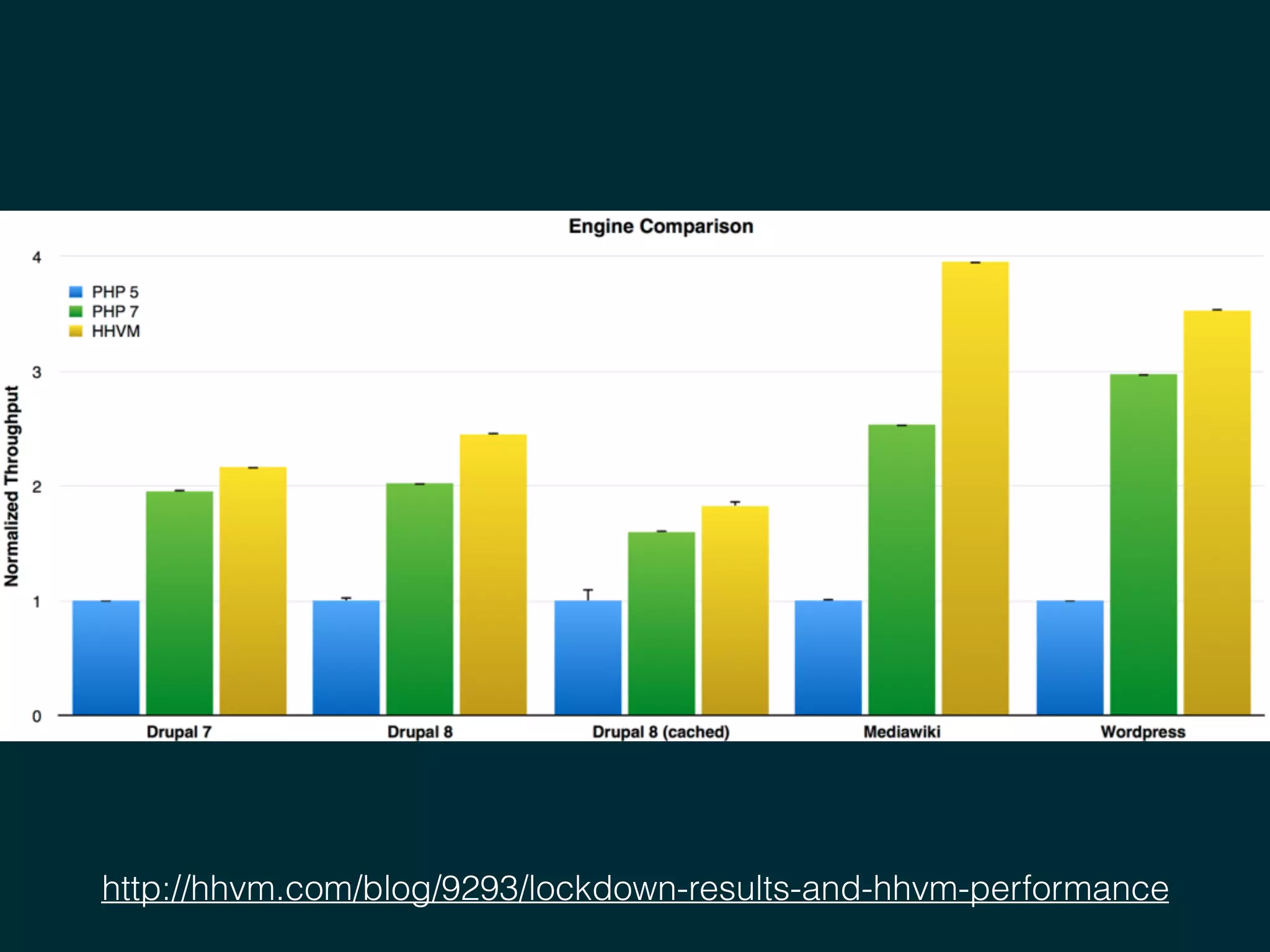
http://hhvm.com/blog/9293/lockdown-results-and-hhvm-performance
Agenda
• Mudanças para o usuário
• Mudanças internas
• PHP.NEXT
Mudanças para o usuário
• Quebras de compatibilidade
• Novos operadores
• Erros e exceções
• Indução de tipo escalar (Scalar type hint)
• Declaração de tipo de retorno (Return type hint)
• Classes anônimas (Anonymous classes)
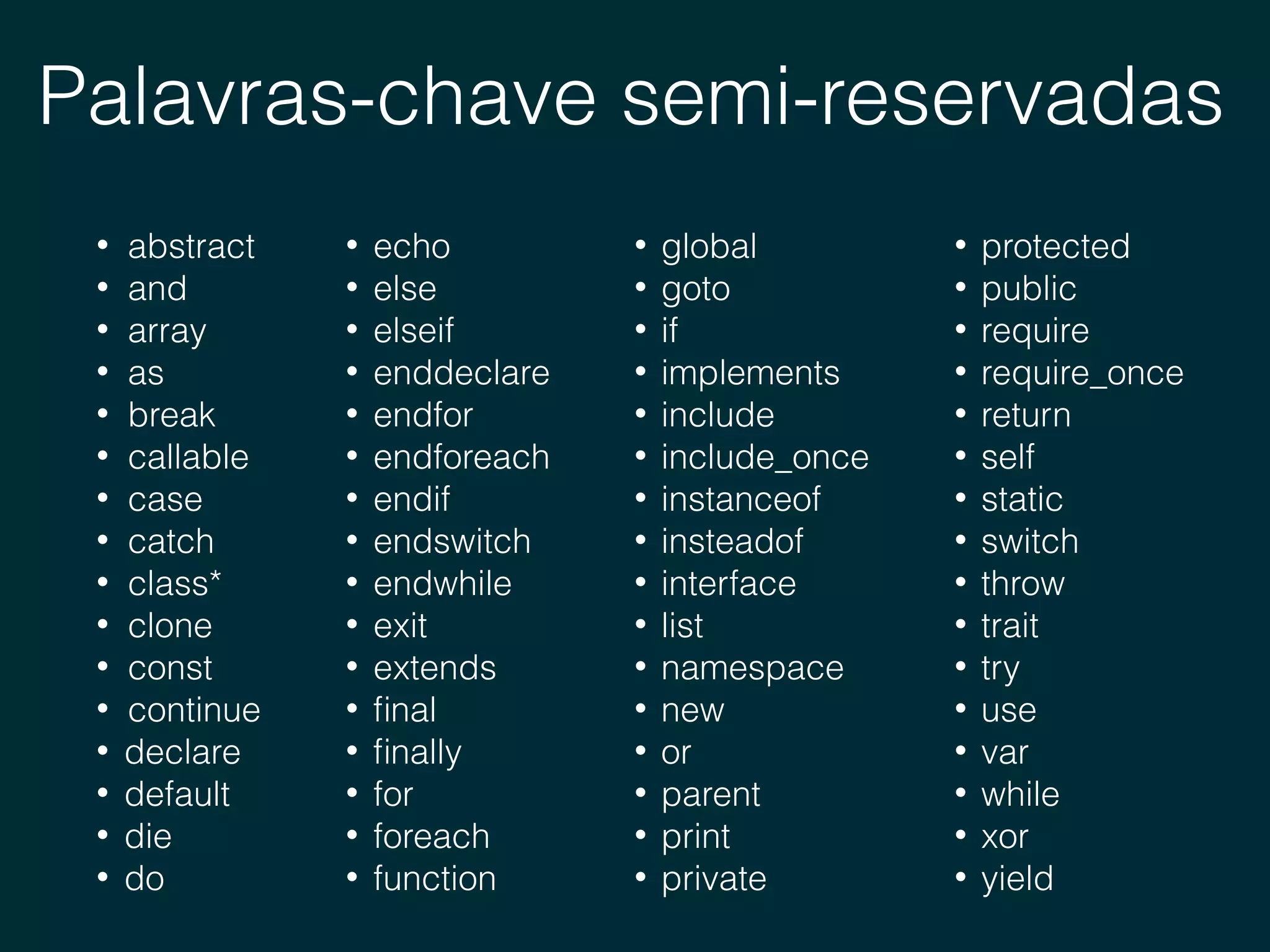
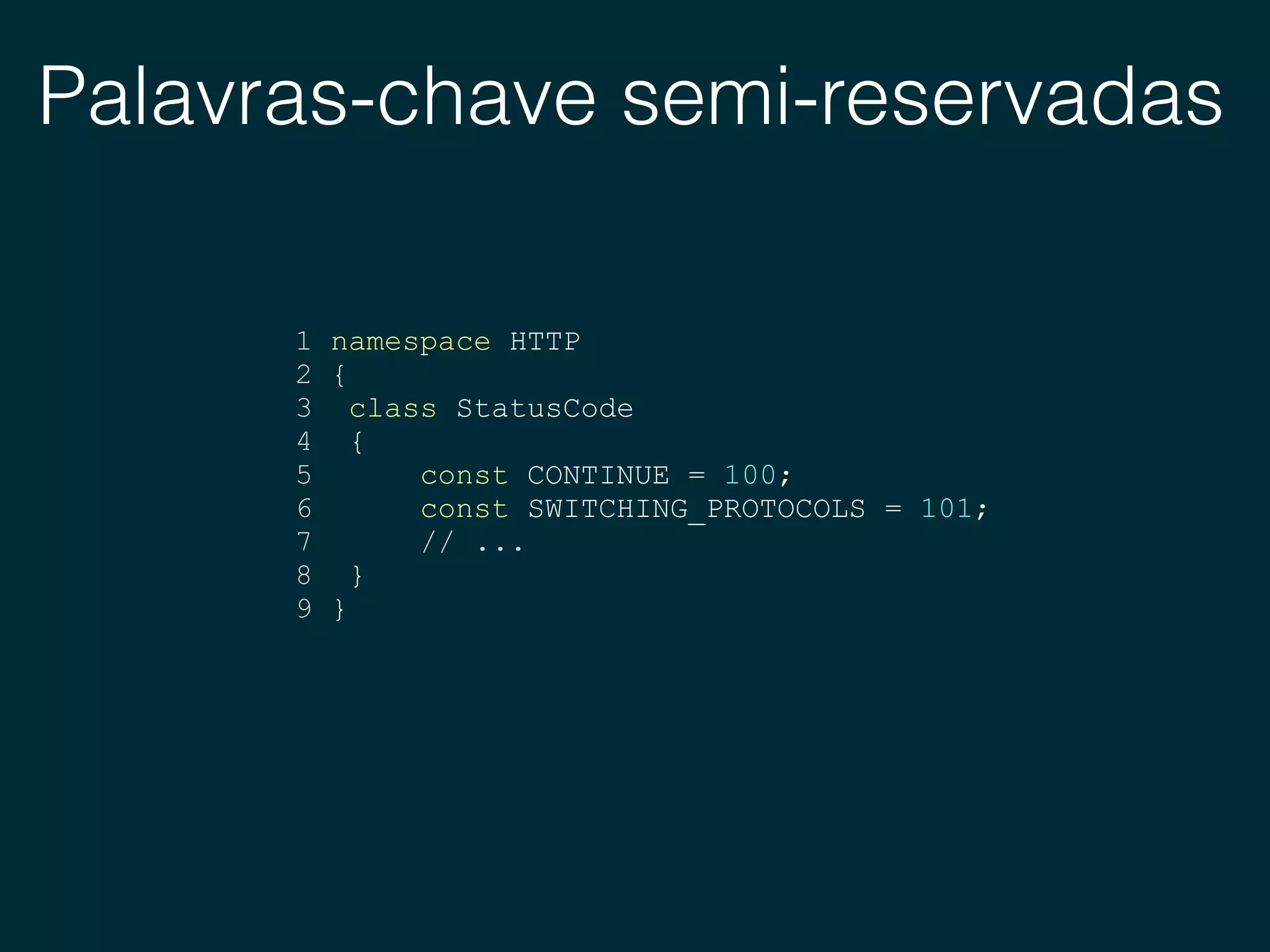
• Palavras-chave semi-reservadas
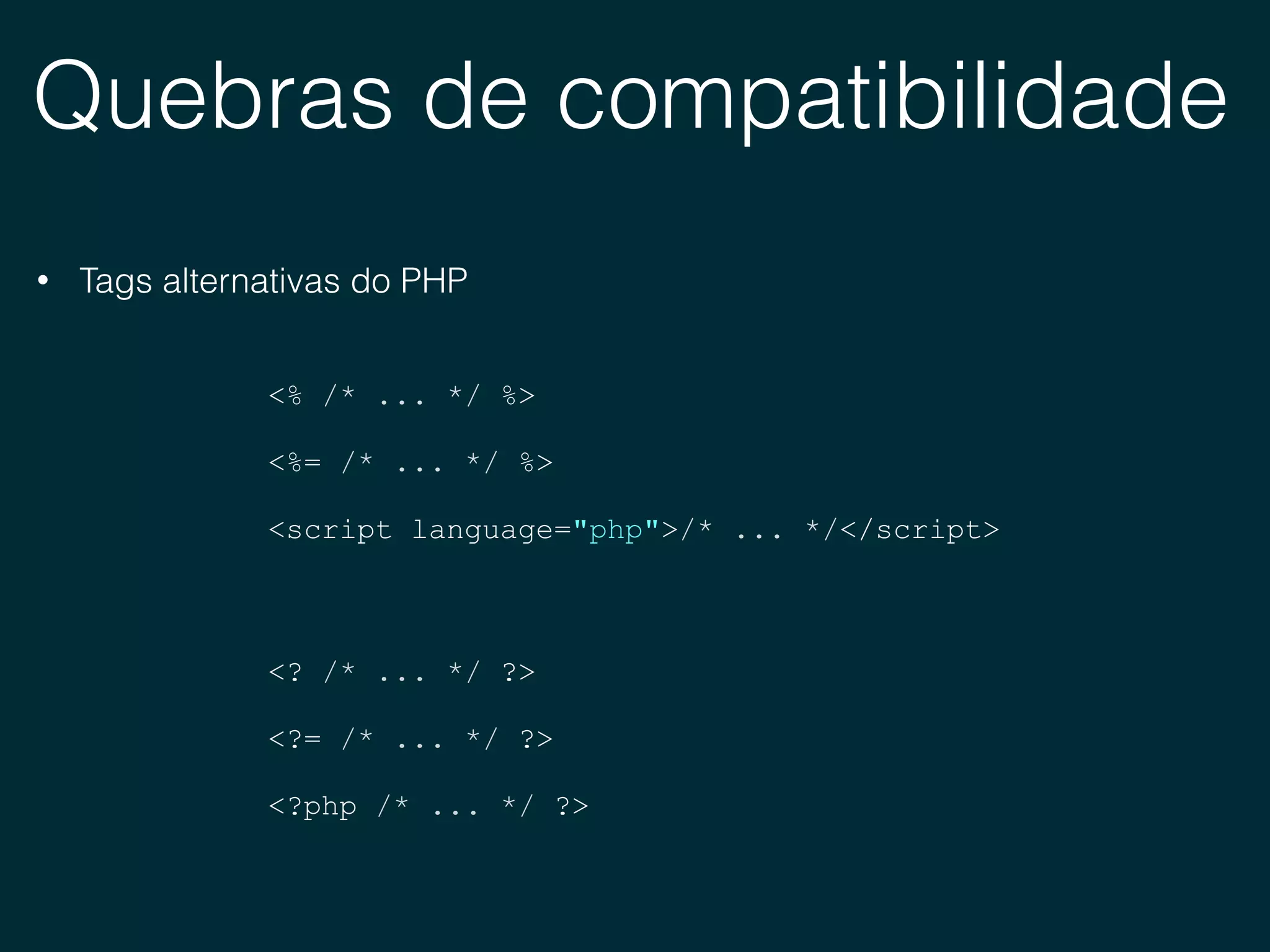
Quebras de compatibilidade
<% /* ... */ %>
<%= /* ... */ %>
<script language="php">/* ... */</script>
<? /* ... */ ?>
<?= /* ... */ ?>
<?php /* ... */ ?>
• Tags alternativas do PHP
Quebras de compatibilidade
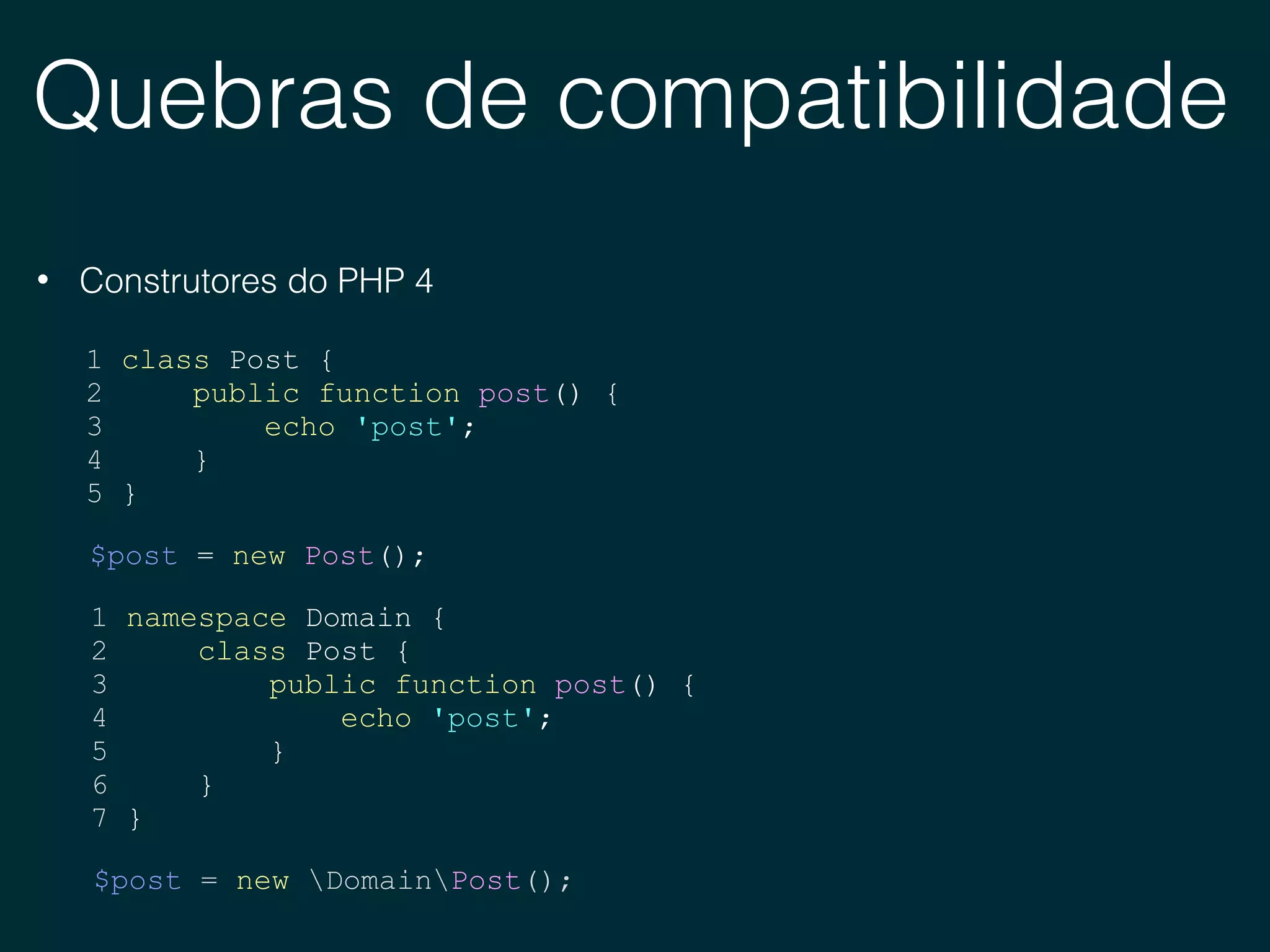
• Construtores do PHP 4
1 class Post {
2 public function post() {
3 echo 'post';
4 }
5 }
$post = new Post();
$post = new DomainPost();
1 namespace Domain {
2 class Post {
3 public function post() {
4 echo 'post';
5 }
6 }
7 }
Quebras de compatibilidade
• Mudanças de sintaxe (Uniform variable syntax)
• Novas combinações de operadores
$foo()['bar']()
[$obj1, $obj2][0]->prop
$foo->bar()::baz()
$foo->bar()()
(function () {})()
Quebras de compatibilidade
• Mudanças de sintaxe (Uniform variable syntax)
• Acesso indireto à variáveis, propriedades e métodos
Expressão Interpretação no PHP 5 Interpretação no PHP 7
$$foo['bar']['baz'] ${$foo['bar']['baz']} ($$foo)['bar']['baz']
$foo->$bar['baz'] $foo->{$bar['baz']} ($foo->$bar)['baz']
$foo->$bar['baz']() $foo->{$bar['baz']}() ($foo->$bar)['baz']()
Foo::$bar['baz']() Foo::{$bar['baz']}() (Foo::$bar)['baz']()
Quebras de compatibilidade
• Server APIs removidas:

aolserver, apache,
apache_hooks, apache2filter,
caudium, continuity, isapi, milter,
nsapi, phttpd, pi3web, roxen,
thttpd, tux, webjames
• Extensões depreciadas (PECL): 

ereg, mssql, mysql, sybase_ct
Novos operadores
• Null coalesce operator (??)
• Spaceship operator (<=>)
• Group use
• Unicode escape syntax (u)
Novos operadores
• Null coalesce operator (??)
$page = $_GET['page'] ?: 1;
if (isset($_GET['page'])) {
$page = $_GET['page'];
} else {
$page = 1;
}
$page = isset($_GET['page'])
? $_GET['page']
: 1
;
$page = $_GET['page'] ?? 1;
Novos operadores
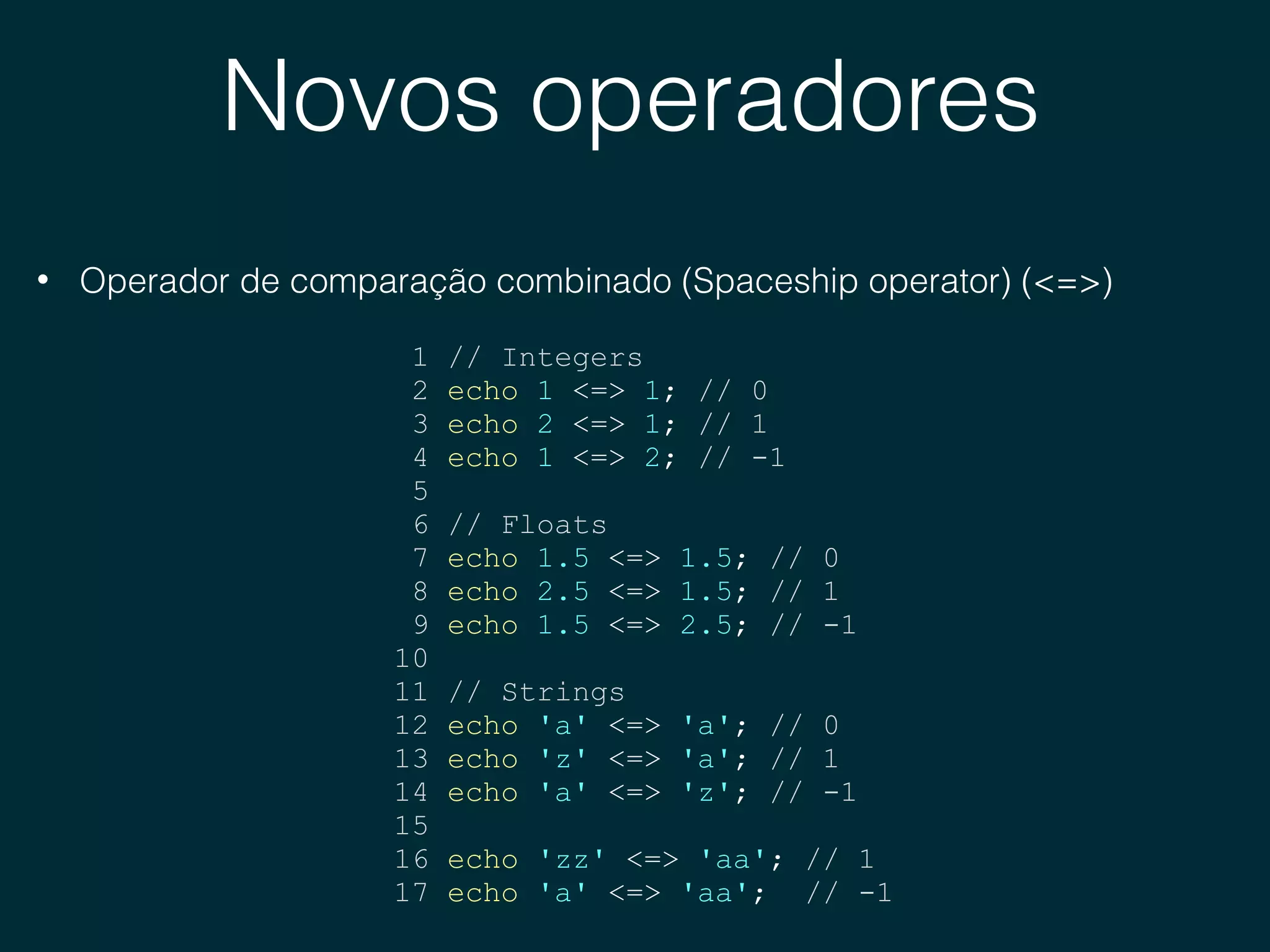
• Operador de comparação combinado (Spaceship operator) (<=>)
1 // Integers
2 echo 1 <=> 1; // 0
3 echo 2 <=> 1; // 1
4 echo 1 <=> 2; // -1
5
6 // Floats
7 echo 1.5 <=> 1.5; // 0
8 echo 2.5 <=> 1.5; // 1
9 echo 1.5 <=> 2.5; // -1
10
11 // Strings
12 echo 'a' <=> 'a'; // 0
13 echo 'z' <=> 'a'; // 1
14 echo 'a' <=> 'z'; // -1
15
16 echo 'zz' <=> 'aa'; // 1
17 echo 'a' <=> 'aa'; // -1
Novos operadores
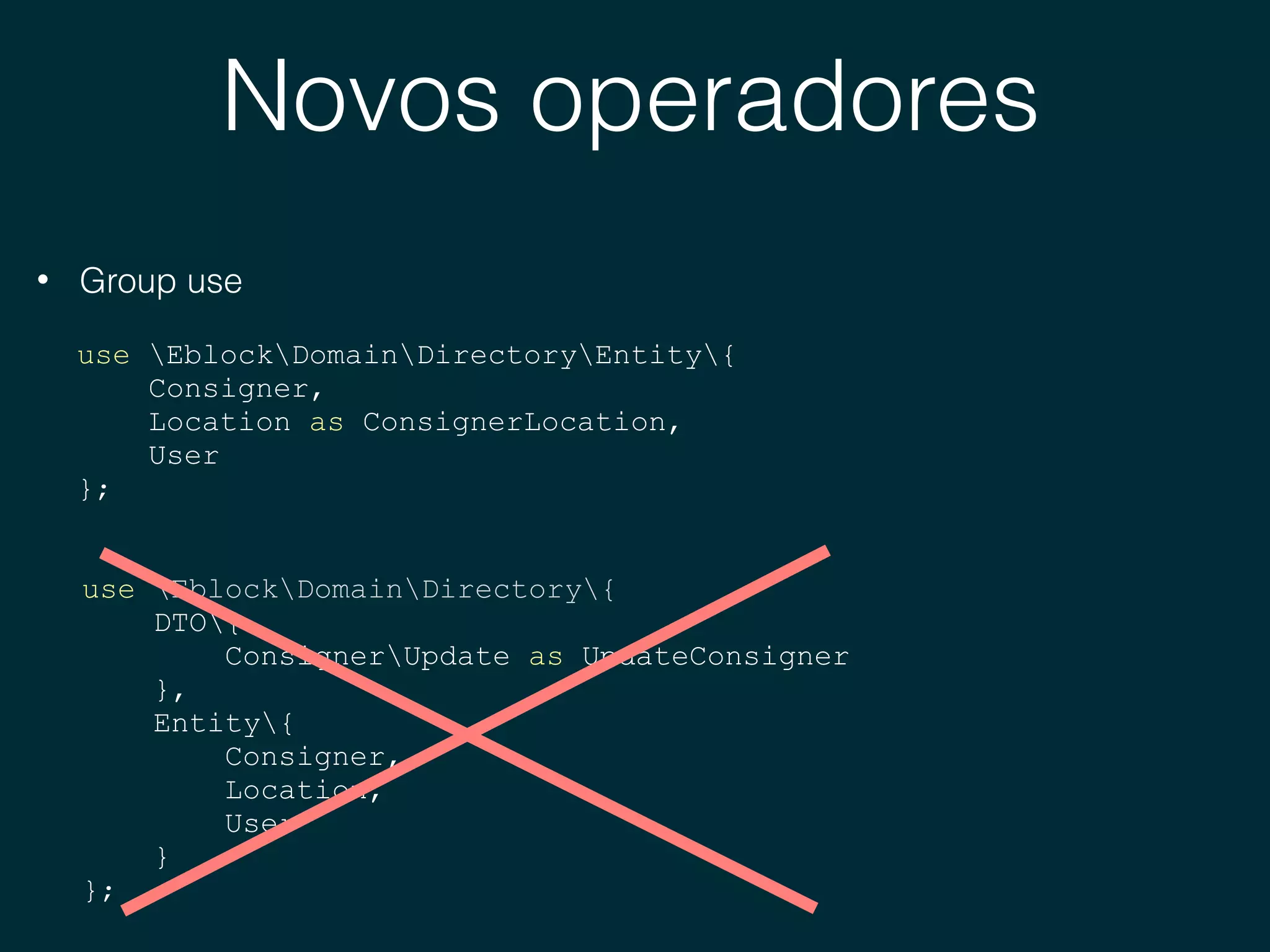
• Group use
use EblockDomainDirectoryEntity{
Consigner,
Location as ConsignerLocation,
User
};
use EblockDomainDirectory{
DTO{
ConsignerUpdate as UpdateConsigner
},
Entity{
Consigner,
Location,
User
}
};
Novos operadores
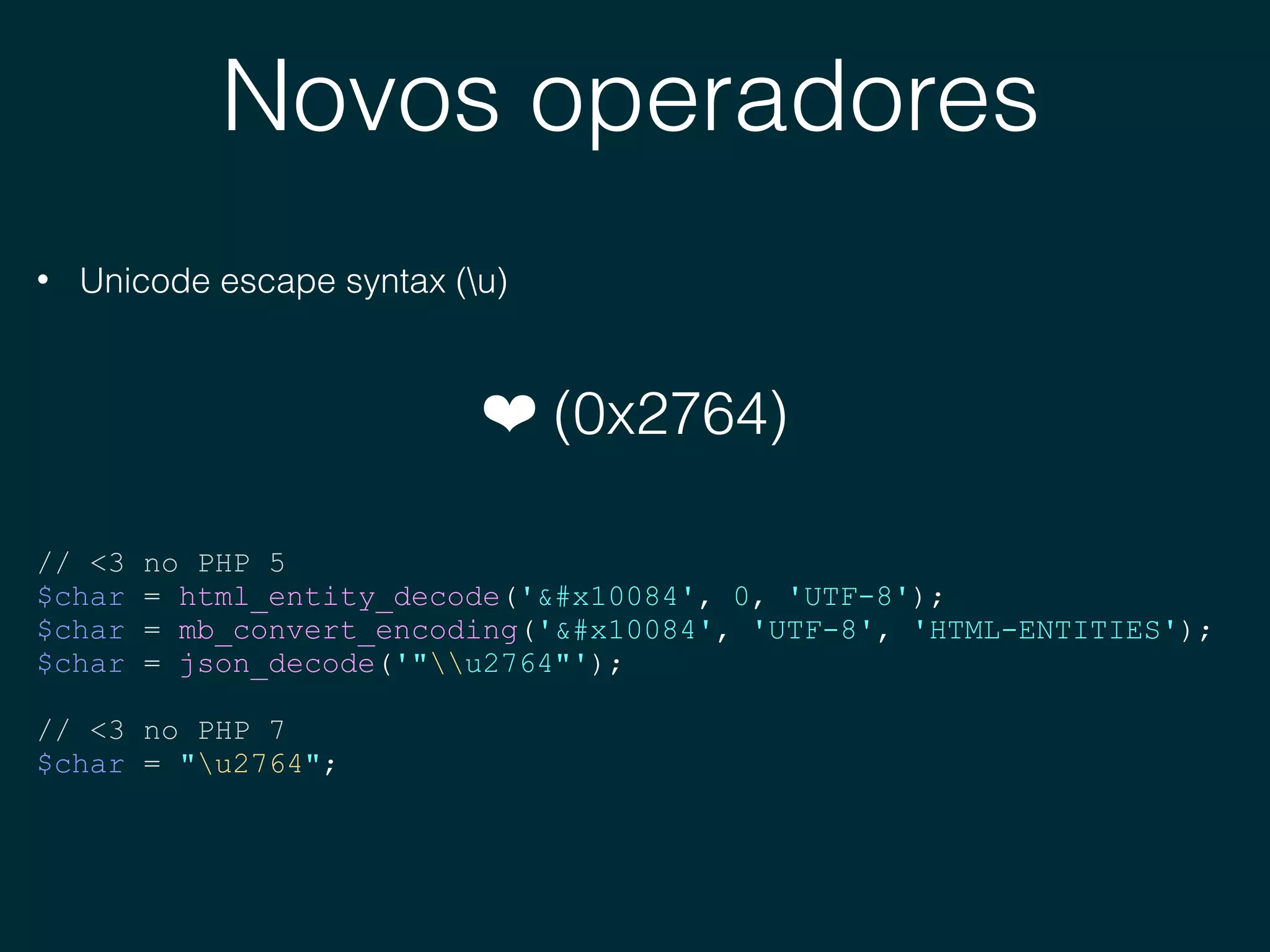
• Unicode escape syntax (u)
❤ (0x2764)
// <3 no PHP 5
$char = html_entity_decode('&#x10084', 0, 'UTF-8');
$char = mb_convert_encoding('&#x10084', 'UTF-8', 'HTML-ENTITIES');
$char = json_decode('"u2764"');
// <3 no PHP 7
$char = "u2764";
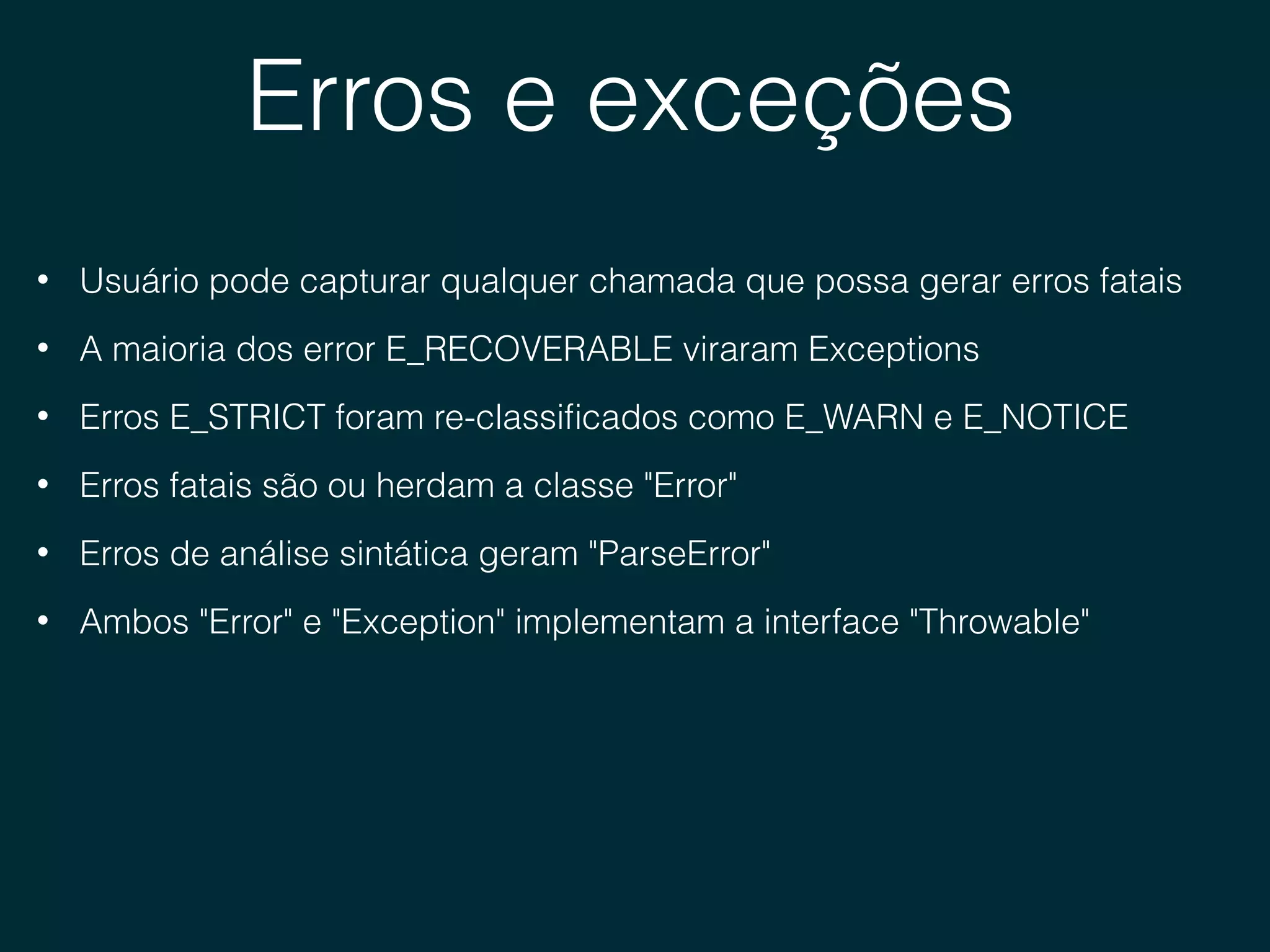
Erros e exceções
• Usuário pode capturar qualquer chamada que possa gerar erros fatais
• A maioria dos error E_RECOVERABLE viraram Exceptions
• Erros E_STRICT foram re-classificados como E_WARN e E_NOTICE
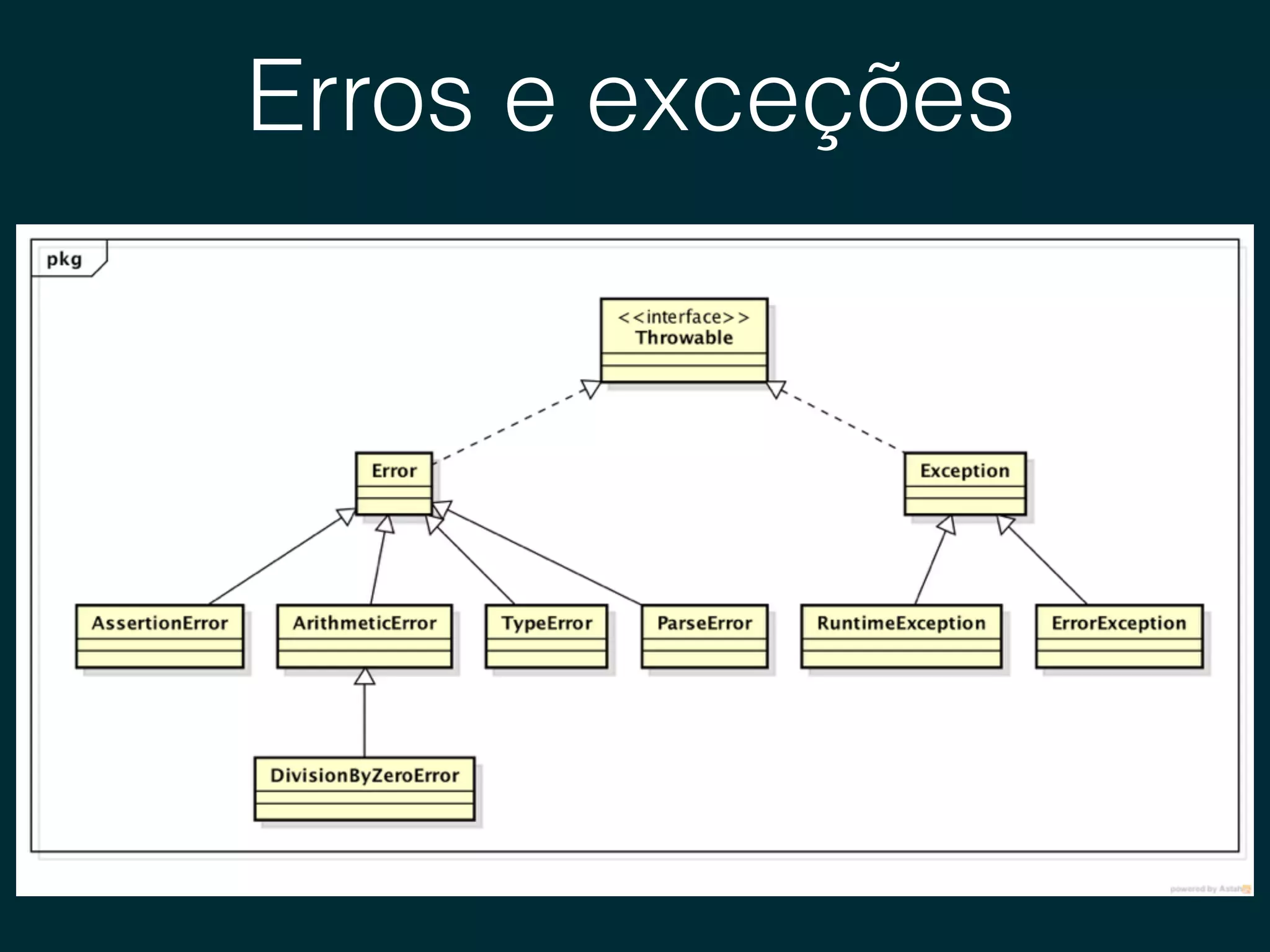
• Erros fatais são ou herdam a classe "Error"
• Erros de análise sintática geram "ParseError"
• Ambos "Error" e "Exception" implementam a interface "Throwable"
Erros e exceções
Erros e exceções
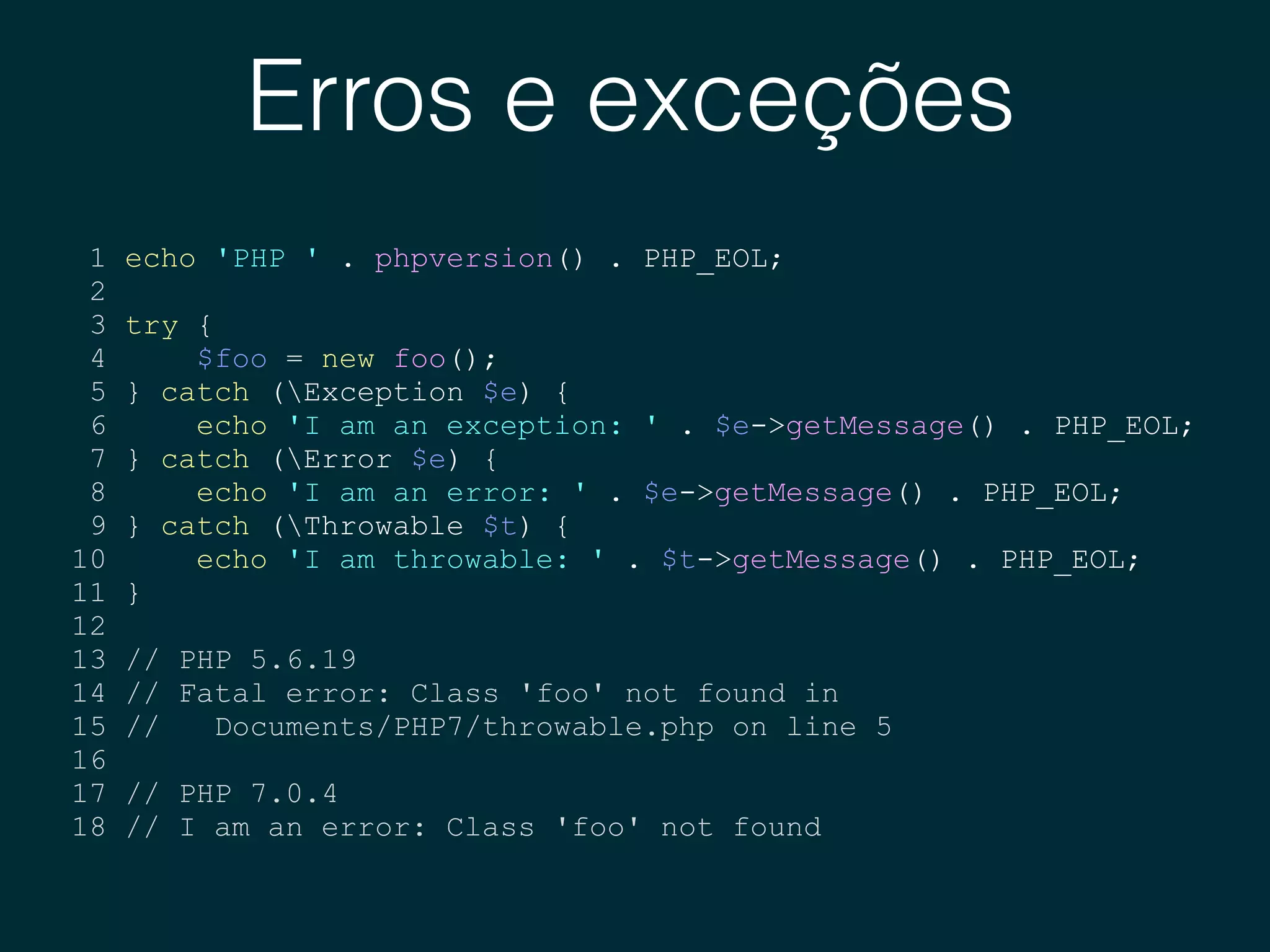
1 echo 'PHP ' . phpversion() . PHP_EOL;
2
3 try {
4 $foo = new foo();
5 } catch (Exception $e) {
6 echo 'I am an exception: ' . $e->getMessage() . PHP_EOL;
7 } catch (Error $e) {
8 echo 'I am an error: ' . $e->getMessage() . PHP_EOL;
9 } catch (Throwable $t) {
10 echo 'I am throwable: ' . $t->getMessage() . PHP_EOL;
11 }
12
13 // PHP 5.6.19
14 // Fatal error: Class 'foo' not found in
15 // Documents/PHP7/throwable.php on line 5
16
17 // PHP 7.0.4
18 // I am an error: Class 'foo' not found
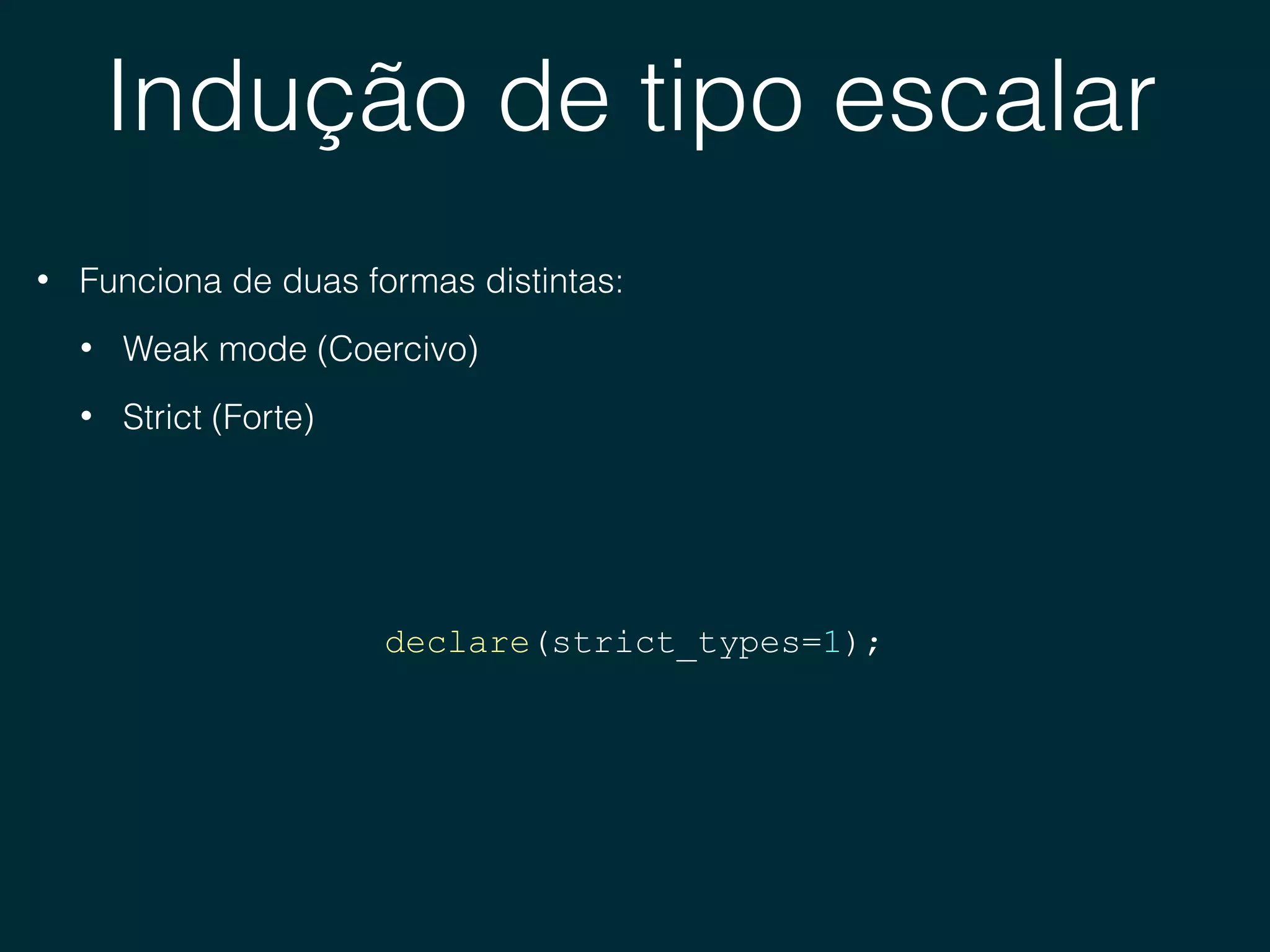
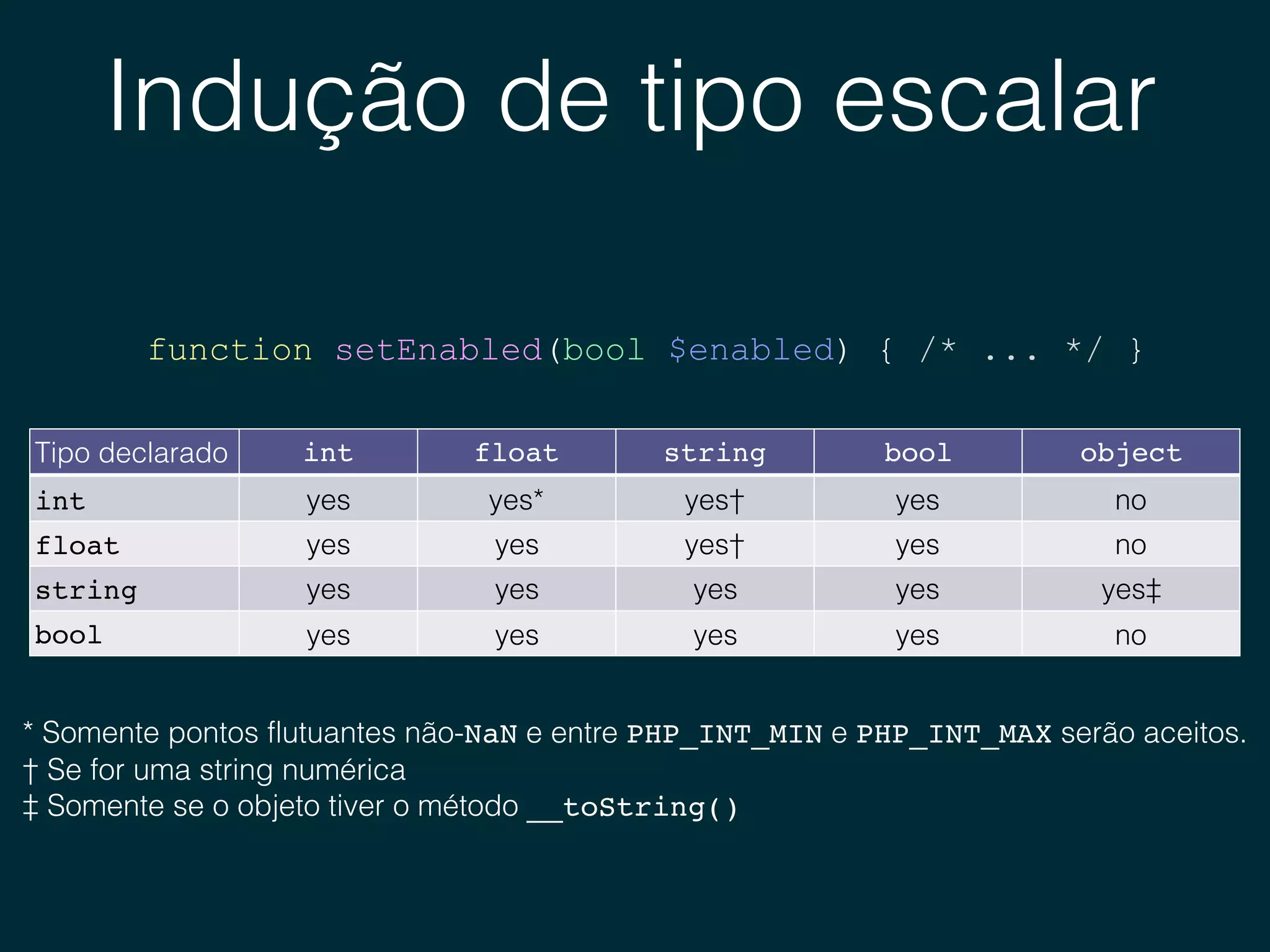
Indução de tipo escalar
• Funciona de duas formas distintas:
• Weak mode (Coercivo)
• Strict (Forte)
declare(strict_types=1);
Indução de tipo escalar
Tipo declarado int float string bool object
int yes yes* yes† yes no
float yes yes yes† yes no
string yes yes yes yes yes‡
bool yes yes yes yes no
* Somente pontos flutuantes não-NaN e entre PHP_INT_MIN e PHP_INT_MAX serão aceitos.
† Se for uma string numérica
‡ Somente se o objeto tiver o método __toString()
function setEnabled(bool $enabled) { /* ... */ }
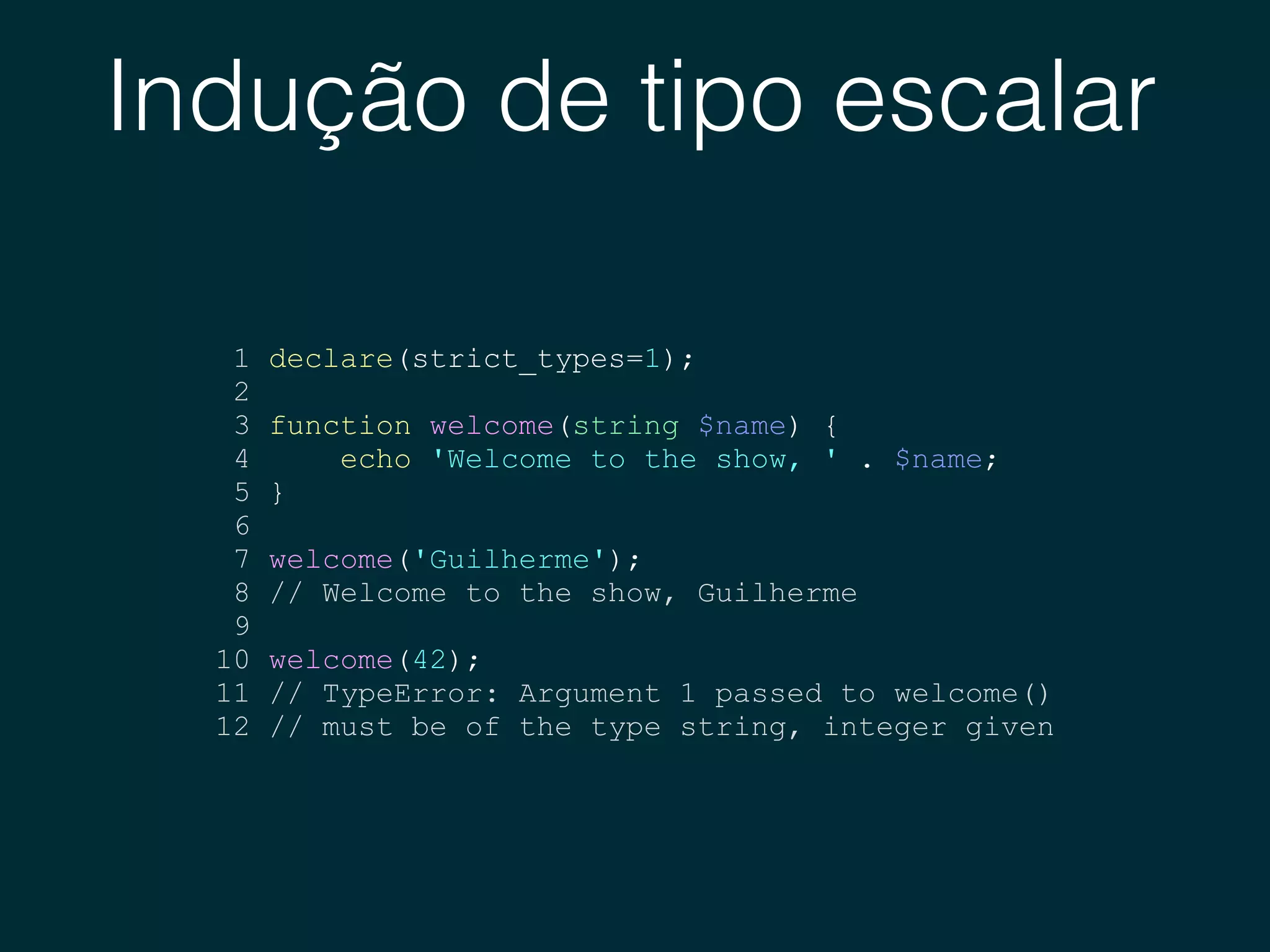
Indução de tipo escalar
1 declare(strict_types=1);
2
3 function welcome(string $name) {
4 echo 'Welcome to the show, ' . $name;
5 }
6
7 welcome('Guilherme');
8 // Welcome to the show, Guilherme
9
10 welcome(42);
11 // TypeError: Argument 1 passed to welcome()
12 // must be of the type string, integer given
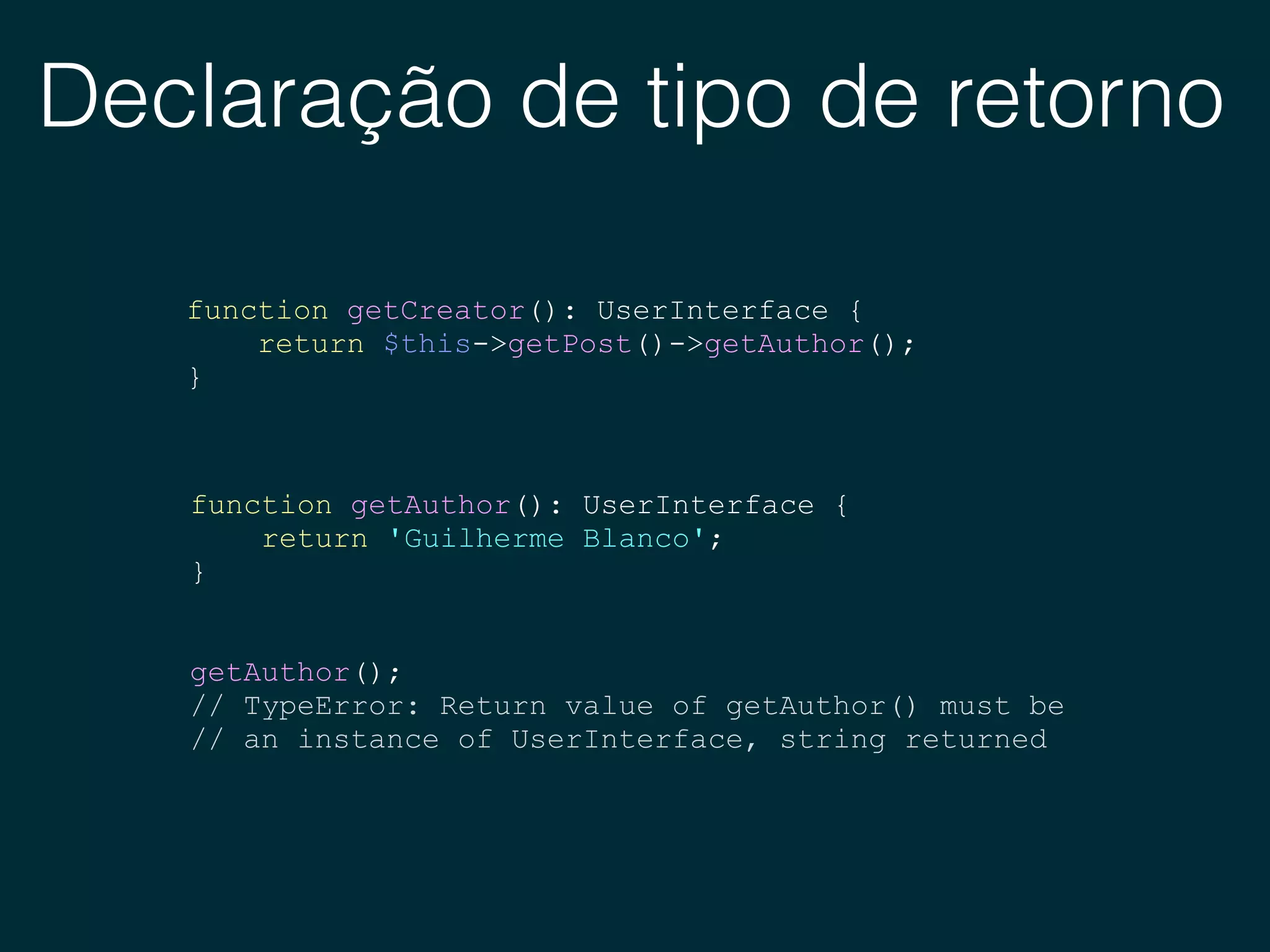
Declaração de tipo de retorno
function getCreator(): UserInterface {
return $this->getPost()->getAuthor();
}
function getAuthor(): UserInterface {
return 'Guilherme Blanco';
}
getAuthor();
// TypeError: Return value of getAuthor() must be
// an instance of UserInterface, string returned
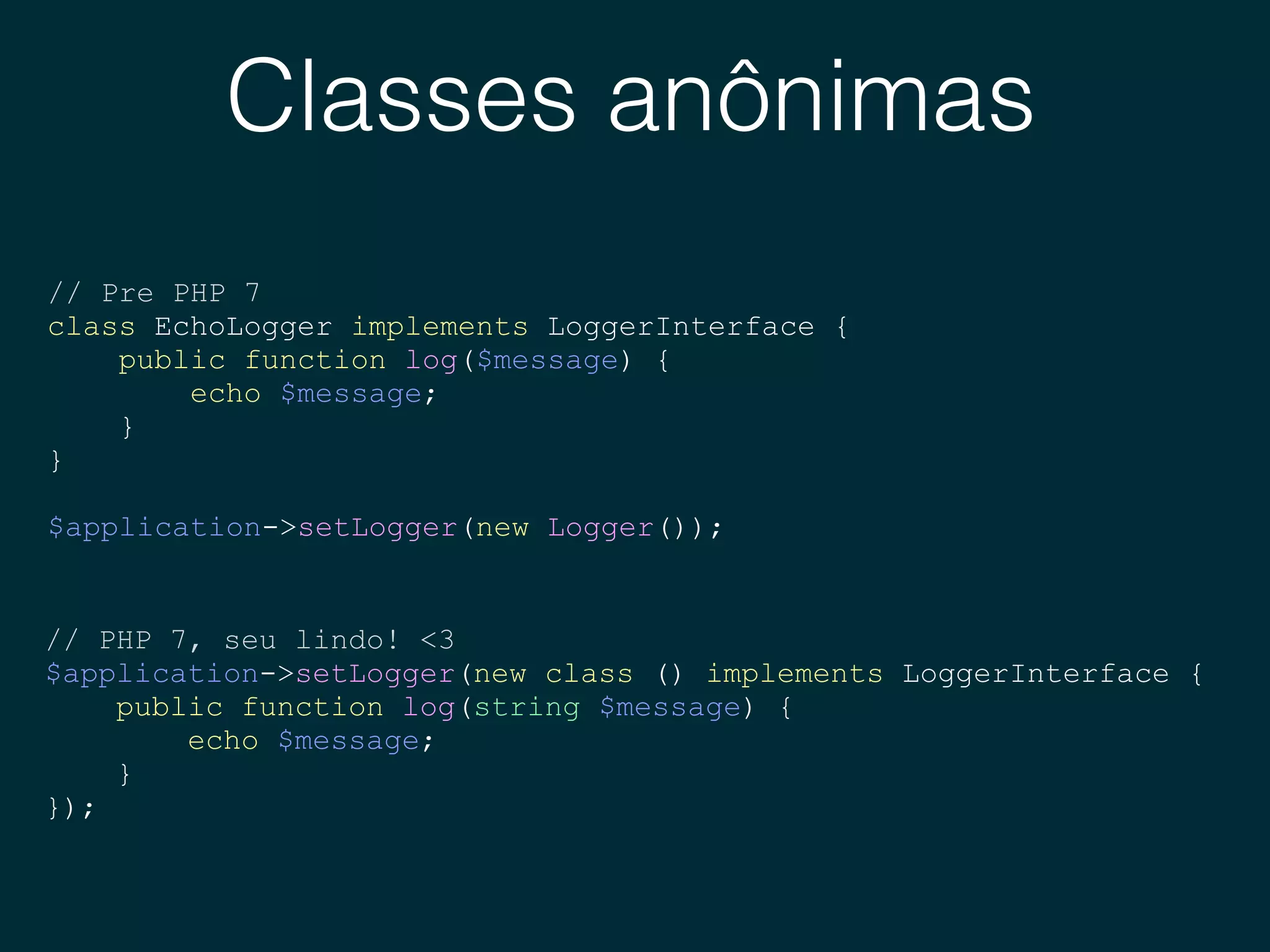
Classes anônimas
// Pre PHP 7
class EchoLogger implements LoggerInterface {
public function log($message) {
echo $message;
}
}
$application->setLogger(new Logger());
// PHP 7, seu lindo! <3
$application->setLogger(new class () implements LoggerInterface {
public function log(string $message) {
echo $message;
}
});
Palavras-chave semi-reservadas
• abstract
• and
• array
• as
• break
• callable
• case
• catch
• class*
• clone
• const
• continue
• declare
• default
• die
• do
• global
• goto
• if
• implements
• include
• include_once
• instanceof
• insteadof
• interface
• list
• namespace
• new
• or
• parent
• print
• private
• protected
• public
• require
• require_once
• return
• self
• static
• switch
• throw
• trait
• try
• use
• var
• while
• xor
• yield
• echo
• else
• elseif
• enddeclare
• endfor
• endforeach
• endif
• endswitch
• endwhile
• exit
• extends
• final
• finally
• for
• foreach
• function
Palavras-chave semi-reservadas
1 namespace HTTP
2 {
3 class StatusCode
4 {
5 const CONTINUE = 100;
6 const SWITCHING_PROTOCOLS = 101;
7 // ...
8 }
9 }
Palavras-chave semi-reservadas
1 $queryBuilder = $repository->createQueryBuilder('e');
2
3 $queryBuilder
4 ->where()
5 ->and()
6 ->field('e.projeto')
7 ->not()
8 ->like('%secreto%')
9 ->end()
10 ->field('e.prioridade')
11 ->gt(9)
12 ->end()
13 ->end()
14 ->or()
15 ->field('e.codigo')
16 ->in([4, 5, 6])
17 ->end()
18 ->end()
19 ->end()
20 ;
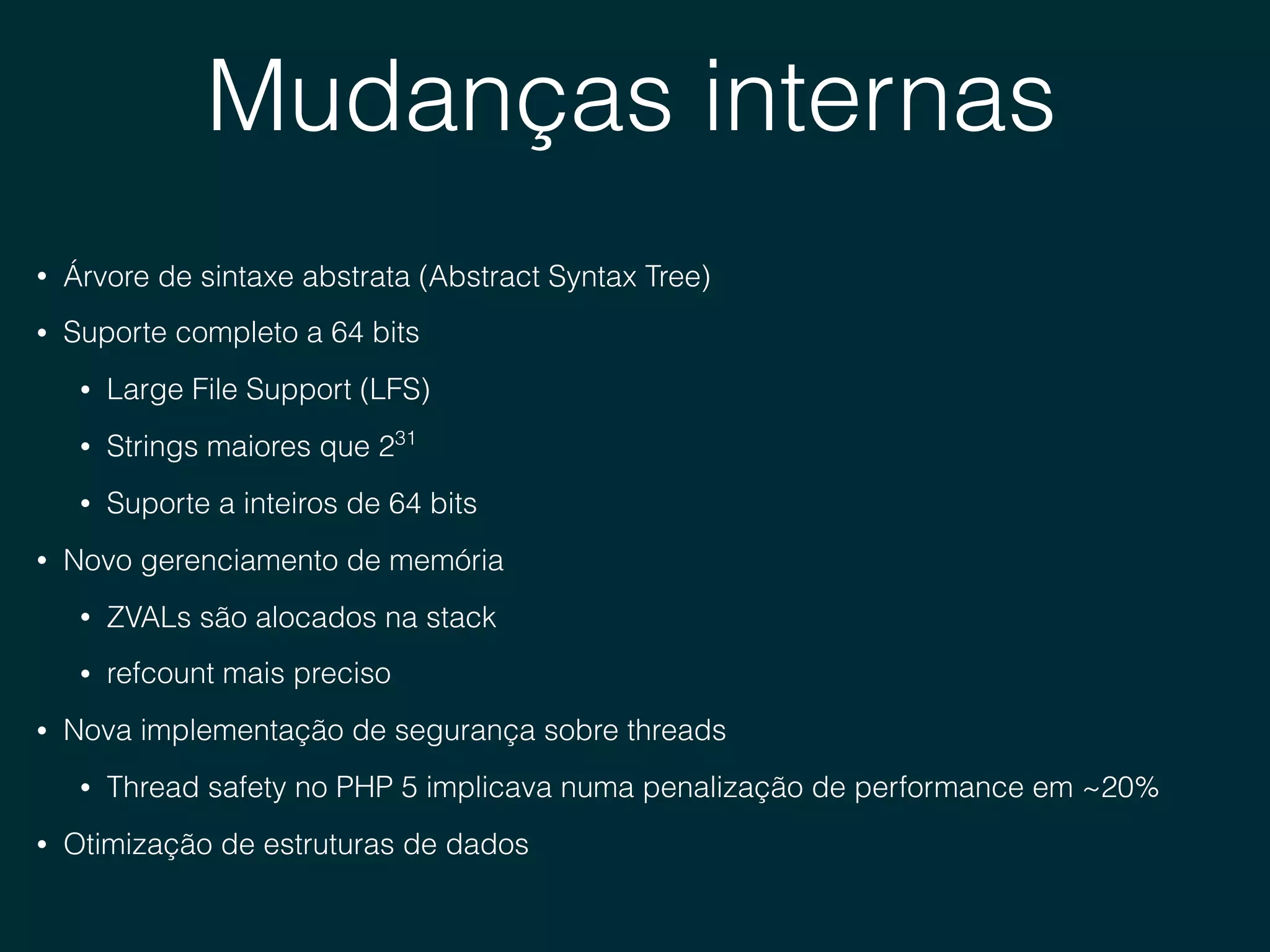
Mudanças internas
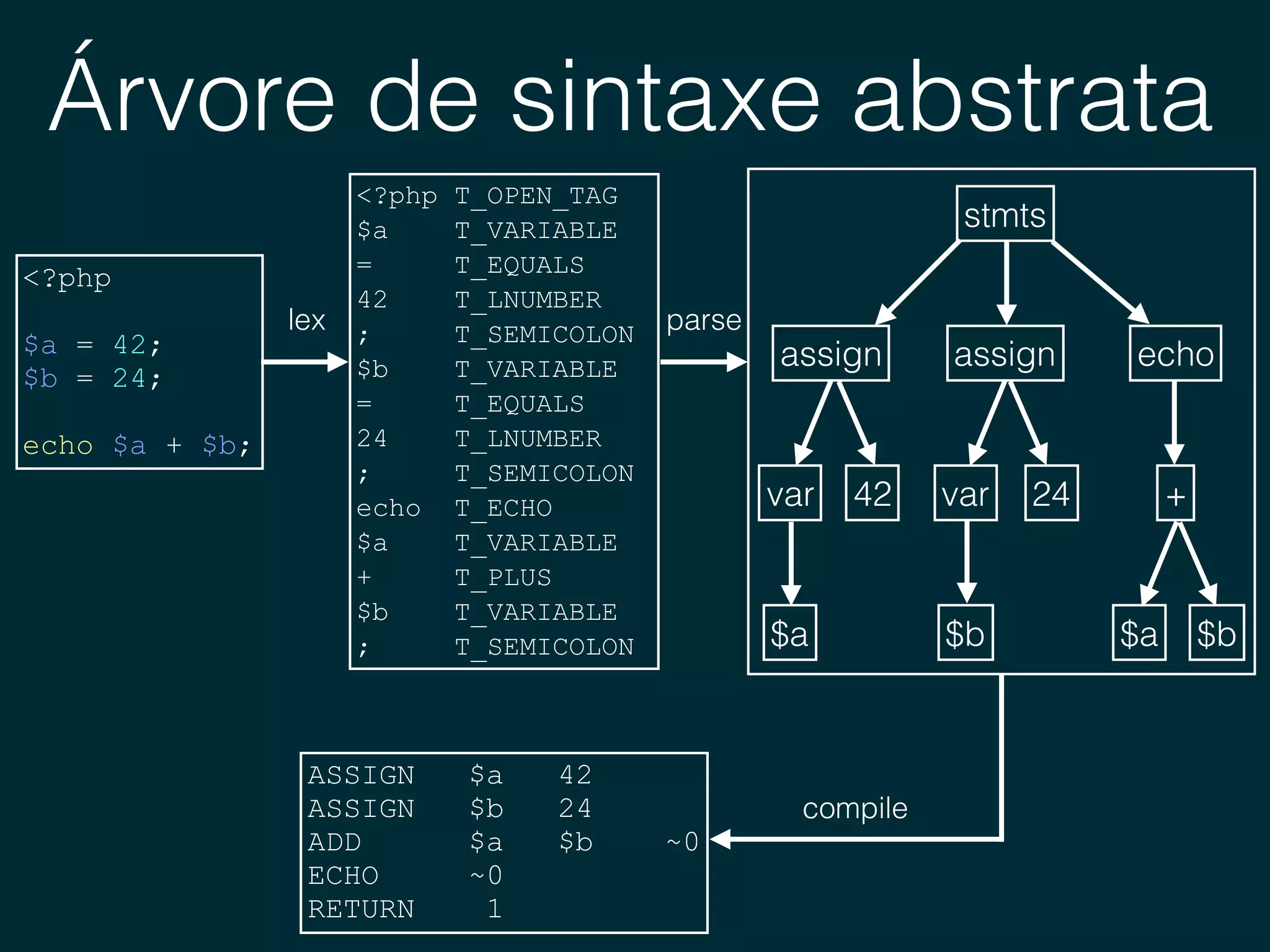
• Árvore de sintaxe abstrata (Abstract Syntax Tree)
• Suporte completo a 64 bits
• Large File Support (LFS)
• Strings maiores que 231
• Suporte a inteiros de 64 bits
• Novo gerenciamento de memória
• ZVALs são alocados na stack
• refcount mais preciso
• Nova implementação de segurança sobre threads
• Thread safety no PHP 5 implicava numa penalização de performance em ~20%
• Otimização de estruturas de dados
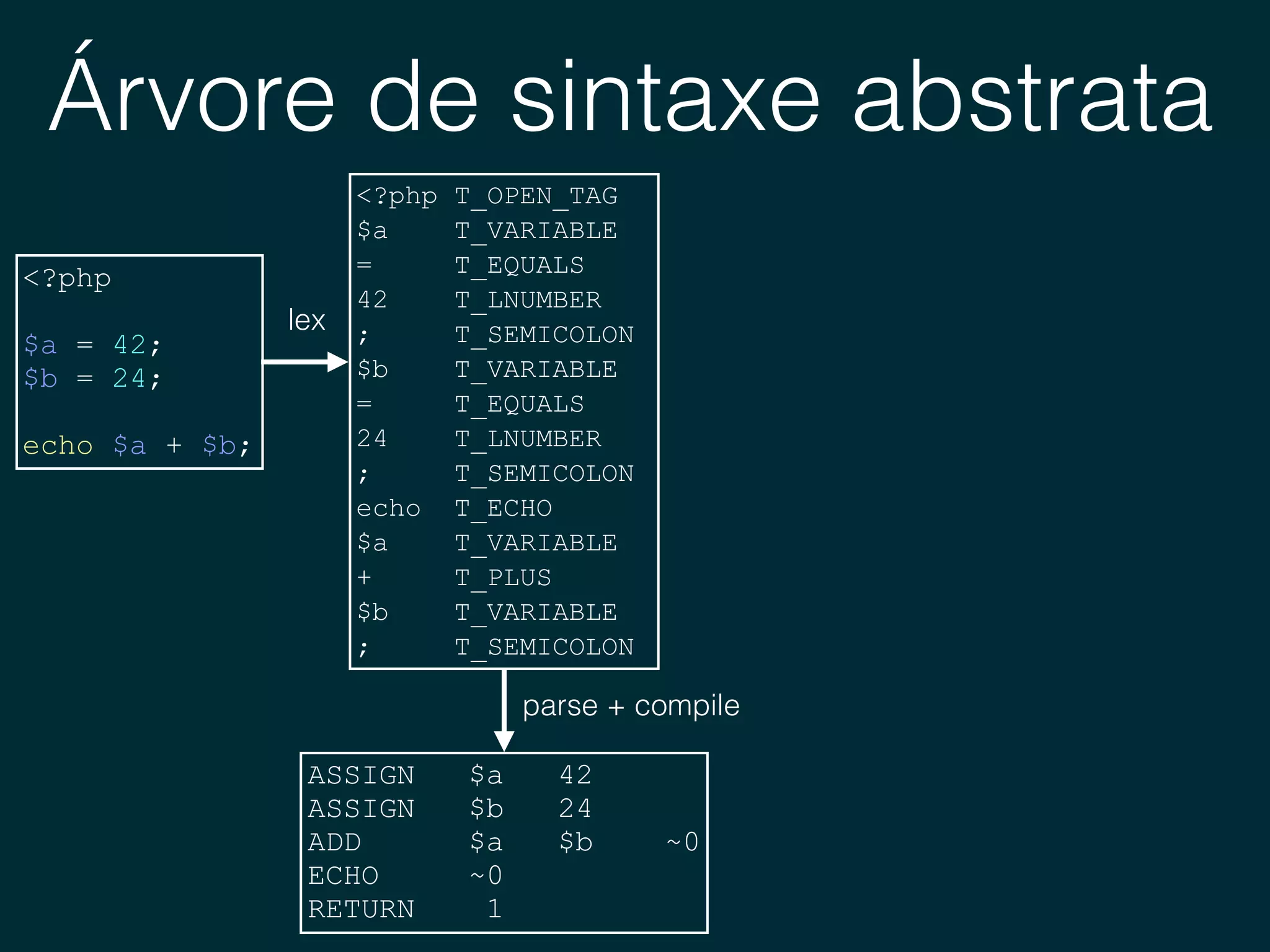
Árvore de sintaxe abstrata
<?php
$a = 42;
$b = 24;
echo $a + $b;
<?php T_OPEN_TAG

$a T_VARIABLE

= T_EQUALS

42 T_LNUMBER

; T_SEMICOLON

$b T_VARIABLE

= T_EQUALS

24 T_LNUMBER

; T_SEMICOLON

echo T_ECHO

$a T_VARIABLE

+ T_PLUS

$b T_VARIABLE

; T_SEMICOLON
lex
ASSIGN $a 42

ASSIGN $b 24

ADD $a $b ~0

ECHO ~0

RETURN 1
parse + compile
Árvore de sintaxe abstrata
<?php
$a = 42;
$b = 24;
echo $a + $b;
<?php T_OPEN_TAG

$a T_VARIABLE

= T_EQUALS

42 T_LNUMBER

; T_SEMICOLON

$b T_VARIABLE

= T_EQUALS

24 T_LNUMBER

; T_SEMICOLON

echo T_ECHO

$a T_VARIABLE

+ T_PLUS

$b T_VARIABLE

; T_SEMICOLON
lex
stmts
assign assign echo
42 24 +
$a $b $a $b
var var
parse
ASSIGN $a 42

ASSIGN $b 24

ADD $a $b ~0

ECHO ~0

RETURN 1
compile
Otimização de estruturas de dados
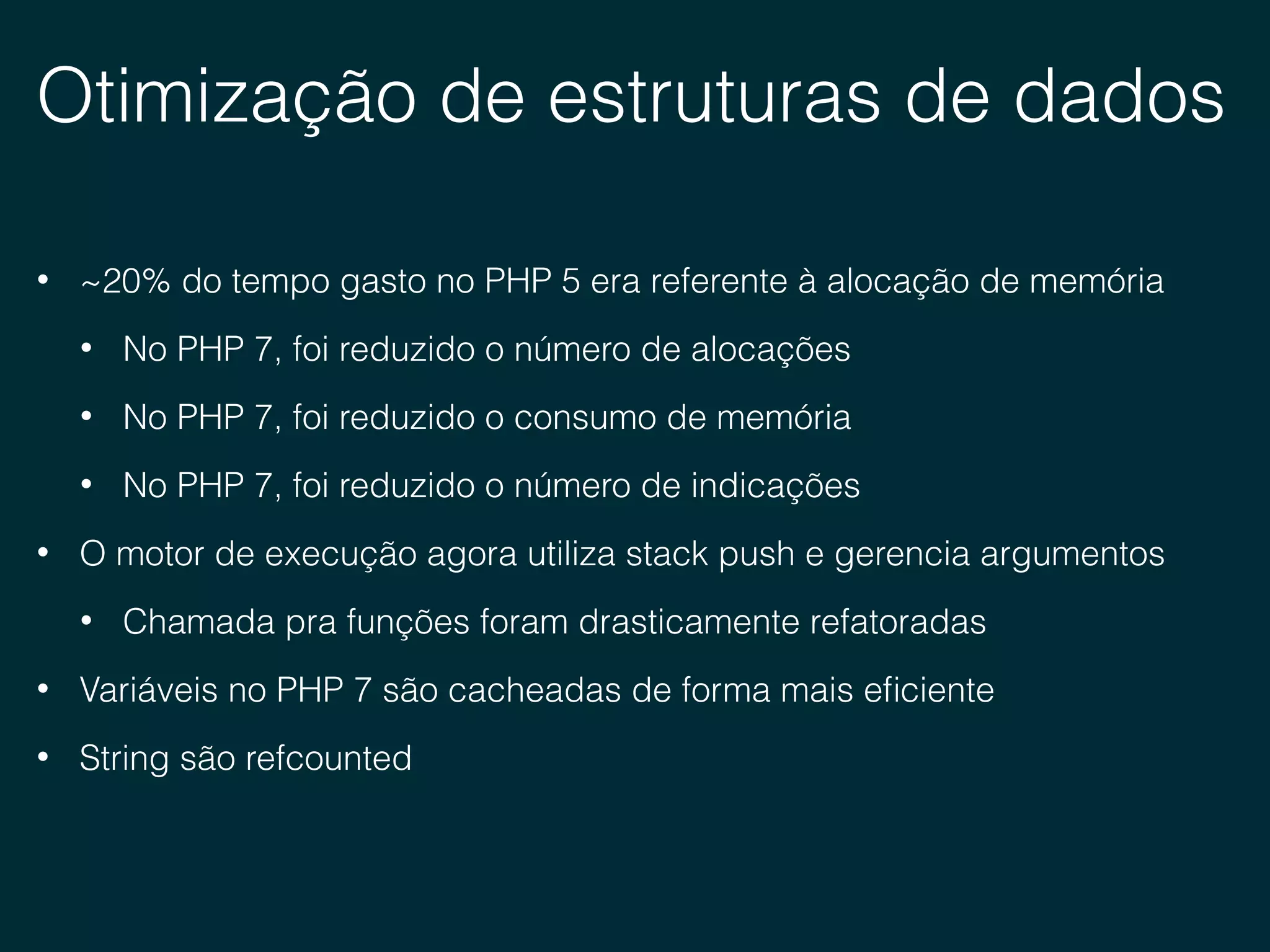
• ~20% do tempo gasto no PHP 5 era referente à alocação de memória
• No PHP 7, foi reduzido o número de alocações
• No PHP 7, foi reduzido o consumo de memória
• No PHP 7, foi reduzido o número de indicações
• O motor de execução agora utiliza stack push e gerencia argumentos
• Chamada pra funções foram drasticamente refatoradas
• Variáveis no PHP 7 são cacheadas de forma mais eficiente
• String são refcounted
Otimização de estruturas de dados
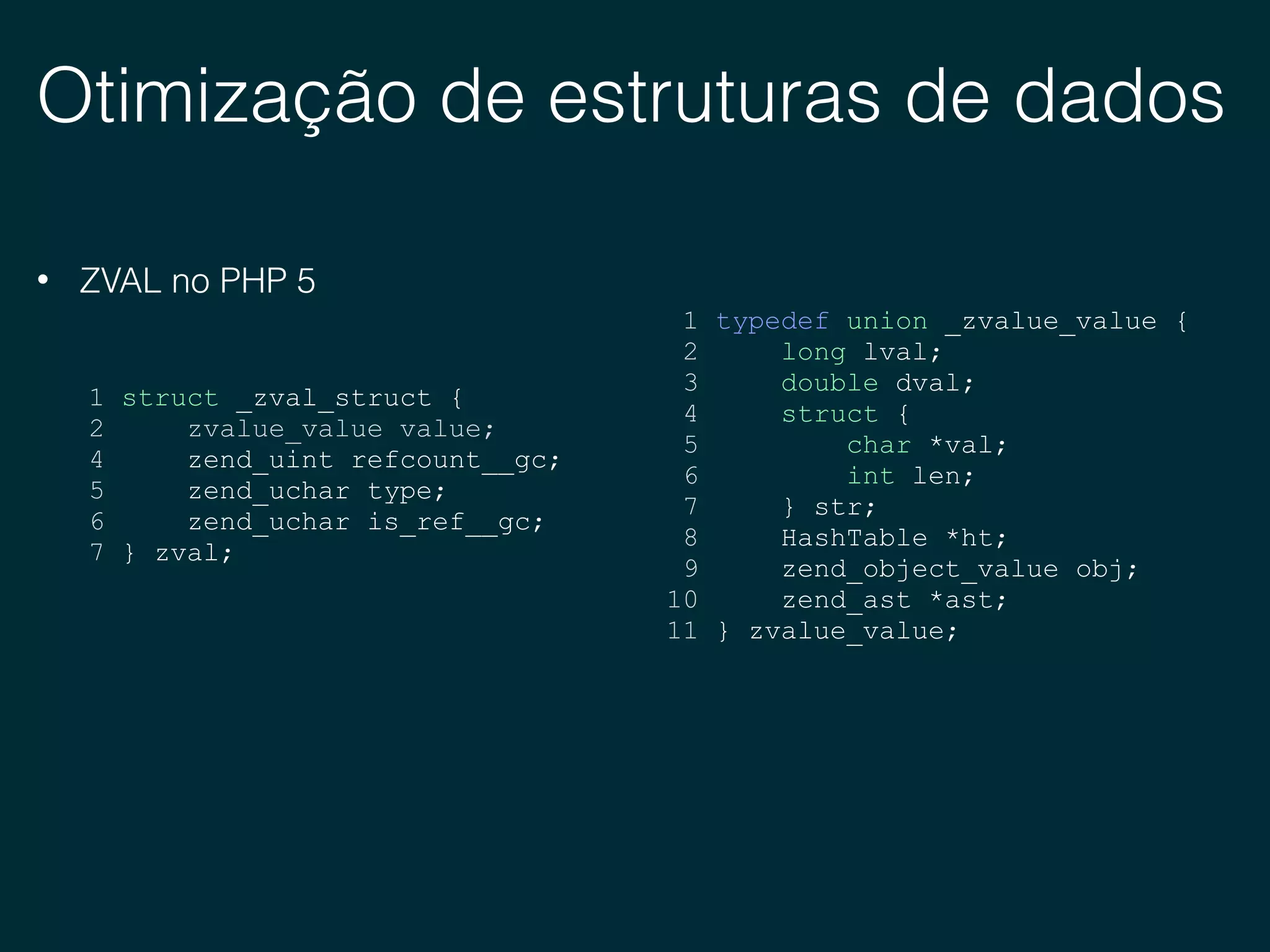
• ZVAL no PHP 5
1 typedef union _zvalue_value {
2 long lval;
3 double dval;
4 struct {
5 char *val;
6 int len;
7 } str;
8 HashTable *ht;
9 zend_object_value obj;
10 zend_ast *ast;
11 } zvalue_value;
1 struct _zval_struct {
2 zvalue_value value;
4 zend_uint refcount__gc;
5 zend_uchar type;
6 zend_uchar is_ref__gc;
7 } zval;
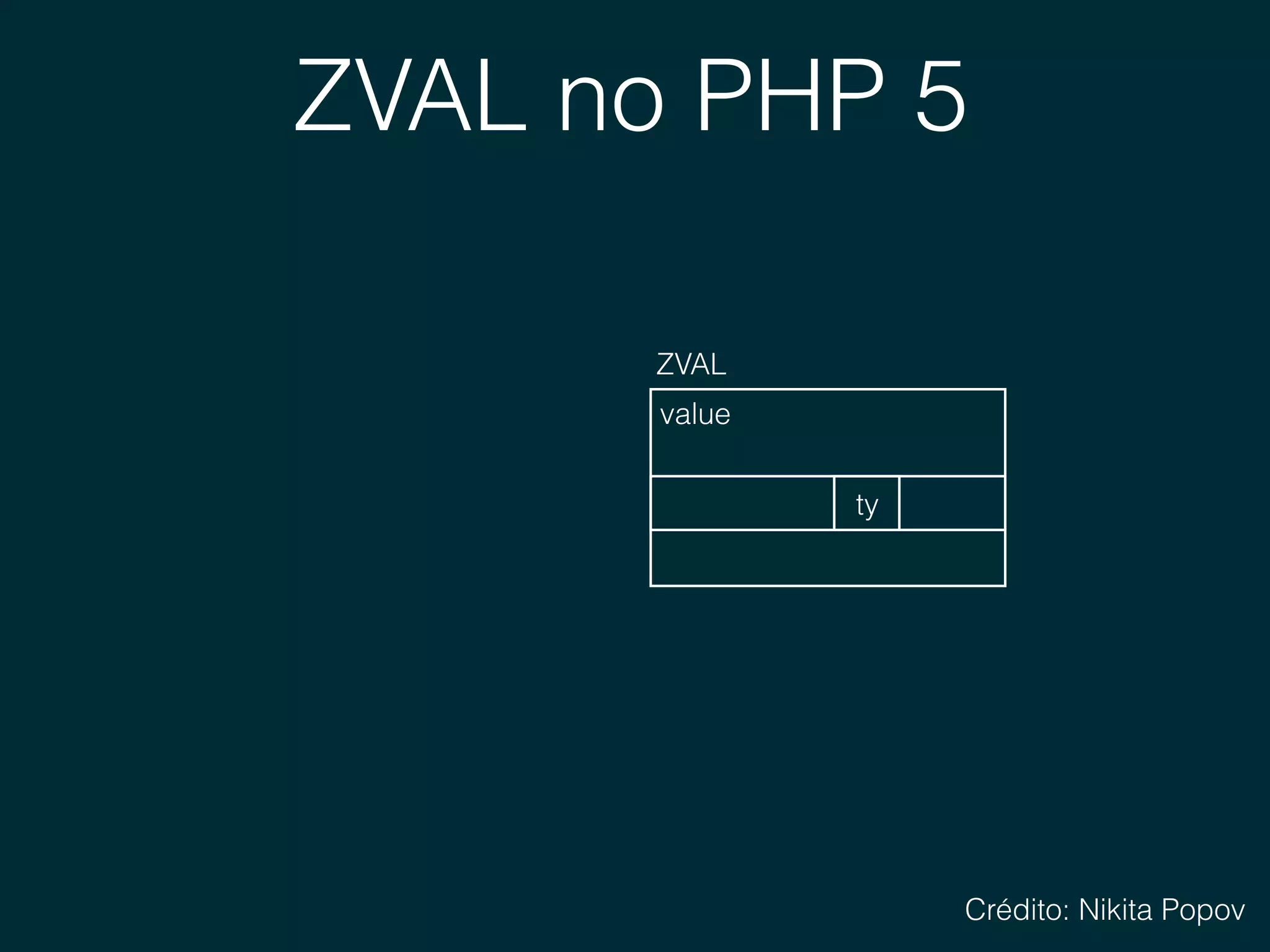
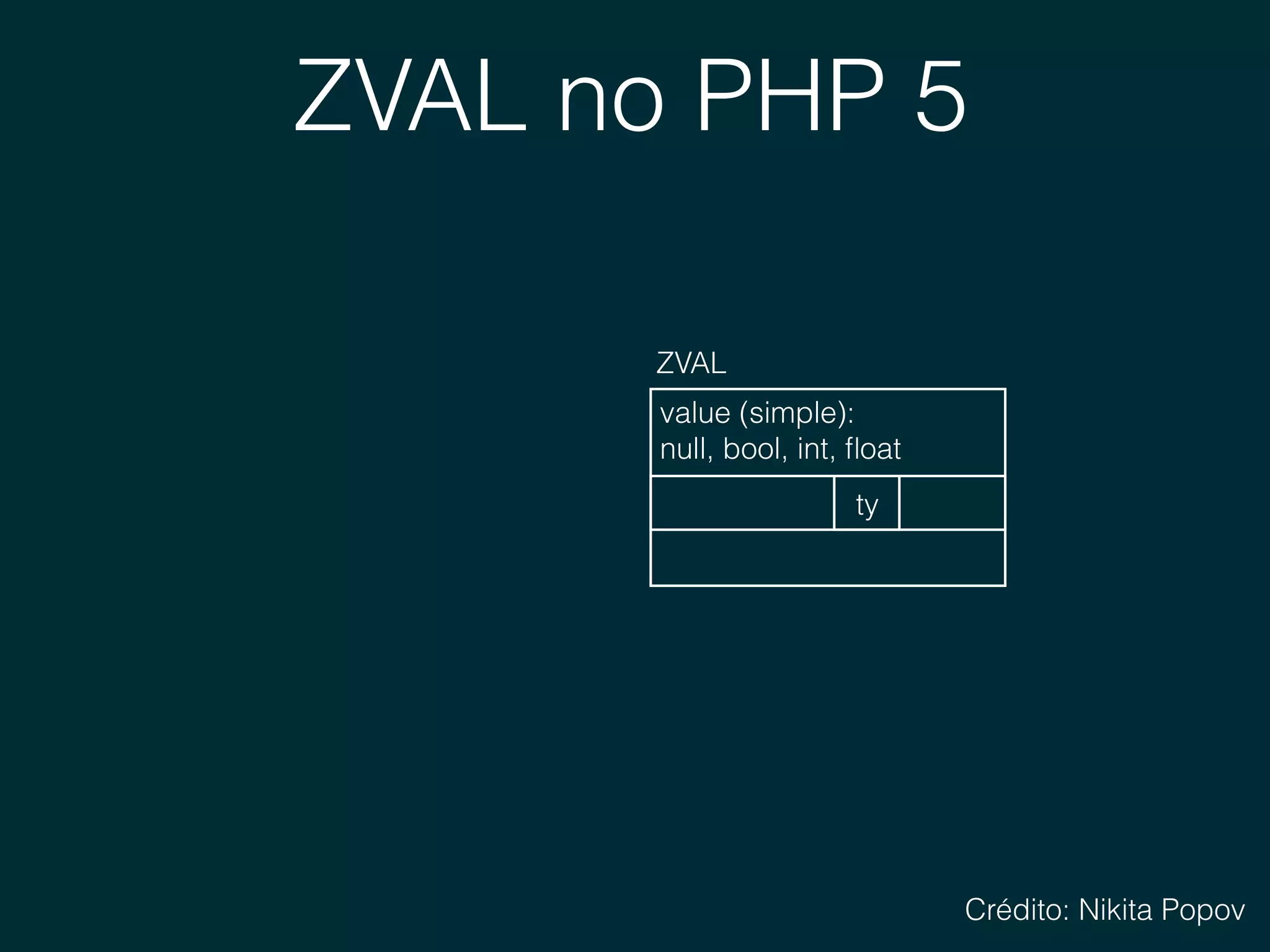
ZVAL no PHP 5
value

ZVAL
ty
Crédito: Nikita Popov
ZVAL no PHP 5
value (simple):

null, bool, int, float
ZVAL
ty
Crédito: Nikita Popov
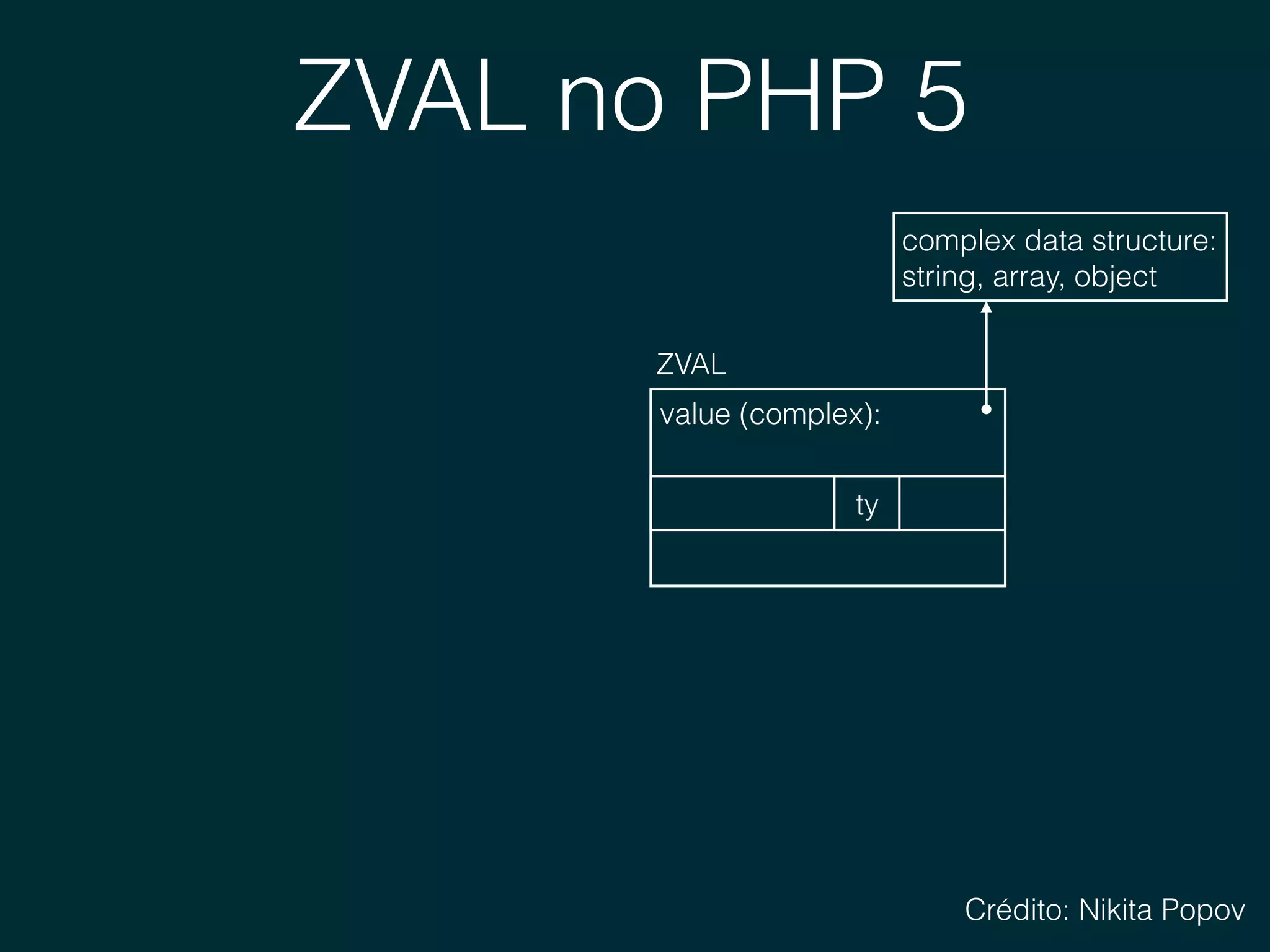
ZVAL no PHP 5
value (complex):

ZVAL
ty
complex data structure:

string, array, object
Crédito: Nikita Popov
ZVAL no PHP 5
1 $a = [];
zval *$a value (complex):

ZVAL
ty
complex data structure:

string, array, object
refcount = 1
Crédito: Nikita Popov
ZVAL no PHP 5
zval *$a
1 $a = [];
2 $b = $a;
value (complex):

ZVAL
ty
complex data structure:

string, array, object
refcount = 1
Crédito: Nikita Popov
ZVAL no PHP 5
zval *$a
1 $a = [];
2 $b = $a;
value (complex):

ZVAL
ty
complex data structure:

string, array, object
refcount = 2
zval *$b
Crédito: Nikita Popov
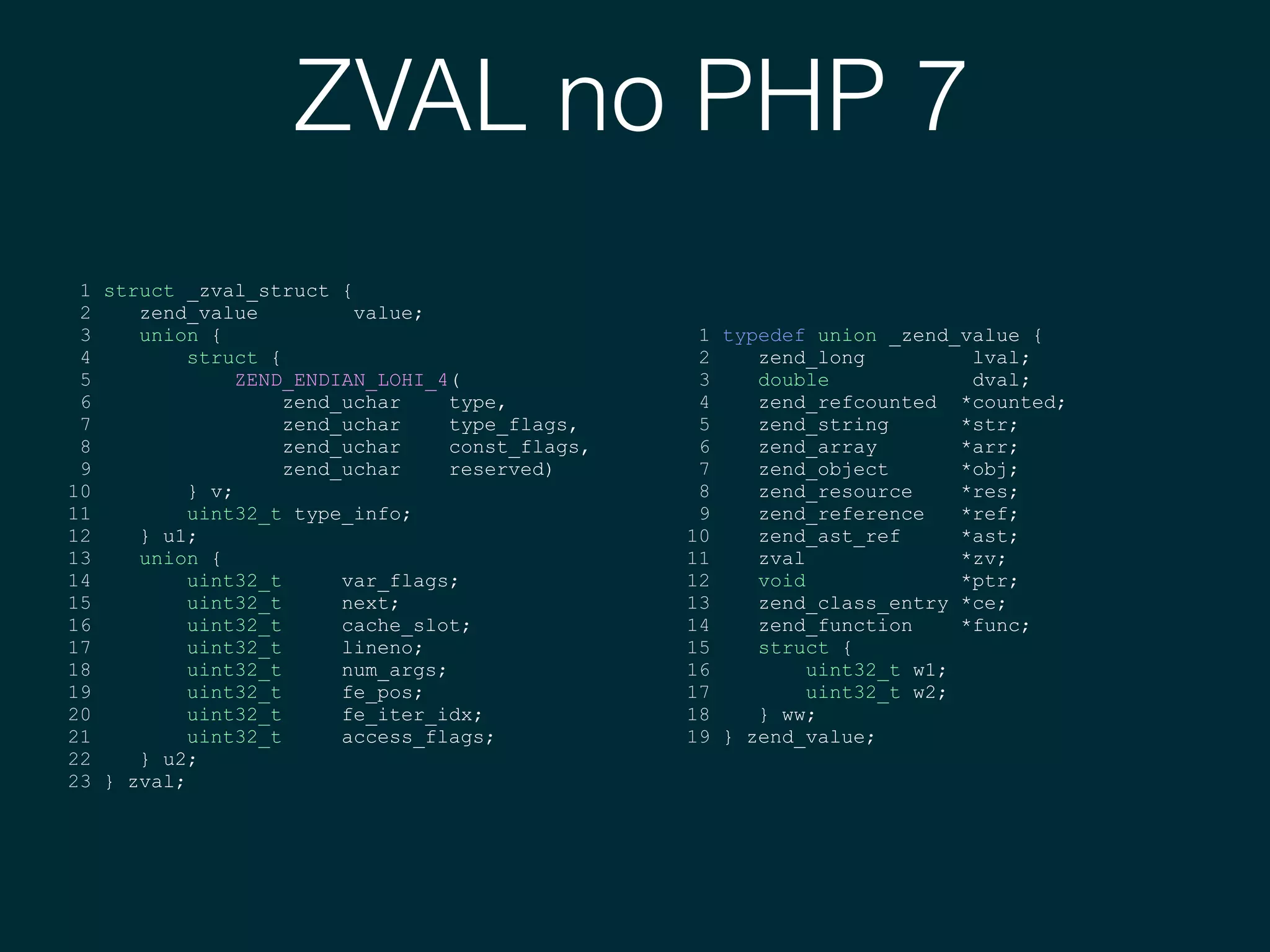
1 typedef union _zend_value {
2 zend_long lval;
3 double dval;
4 zend_refcounted *counted;
5 zend_string *str;
6 zend_array *arr;
7 zend_object *obj;
8 zend_resource *res;
9 zend_reference *ref;
10 zend_ast_ref *ast;
11 zval *zv;
12 void *ptr;
13 zend_class_entry *ce;
14 zend_function *func;
15 struct {
16 uint32_t w1;
17 uint32_t w2;
18 } ww;
19 } zend_value;
1 struct _zval_struct {
2 zend_value value;
3 union {
4 struct {
5 ZEND_ENDIAN_LOHI_4(
6 zend_uchar type,
7 zend_uchar type_flags,
8 zend_uchar const_flags,
9 zend_uchar reserved)
10 } v;
11 uint32_t type_info;
12 } u1;
13 union {
14 uint32_t var_flags;
15 uint32_t next;
16 uint32_t cache_slot;
17 uint32_t lineno;
18 uint32_t num_args;
19 uint32_t fe_pos;
20 uint32_t fe_iter_idx;
21 uint32_t access_flags;
22 } u2;
23 } zval;
ZVAL no PHP 7
ZVAL no PHP 7
zval *$a
1 $a = [];
2 $b = $a;
value (complex):

ZVAL
ty
zval *$b
complex data structure:

string, array, object
refcount = 2
Crédito: Nikita Popov
ZVAL no PHP 7
zval *$a
1 $a = [];
2 $b = $a;
zval *$b
complex data structure:

string, array, object
refcount = 2
ZVAL
value (complex):

type_info
Crédito: Nikita Popov
ZVAL no PHP 7
$a
1 $a = [];
2 $b = $a;
$b
complex data structure:

string, array, object
refcount = 2
value (complex):

type_info
value (complex):

type_info
Crédito: Nikita Popov
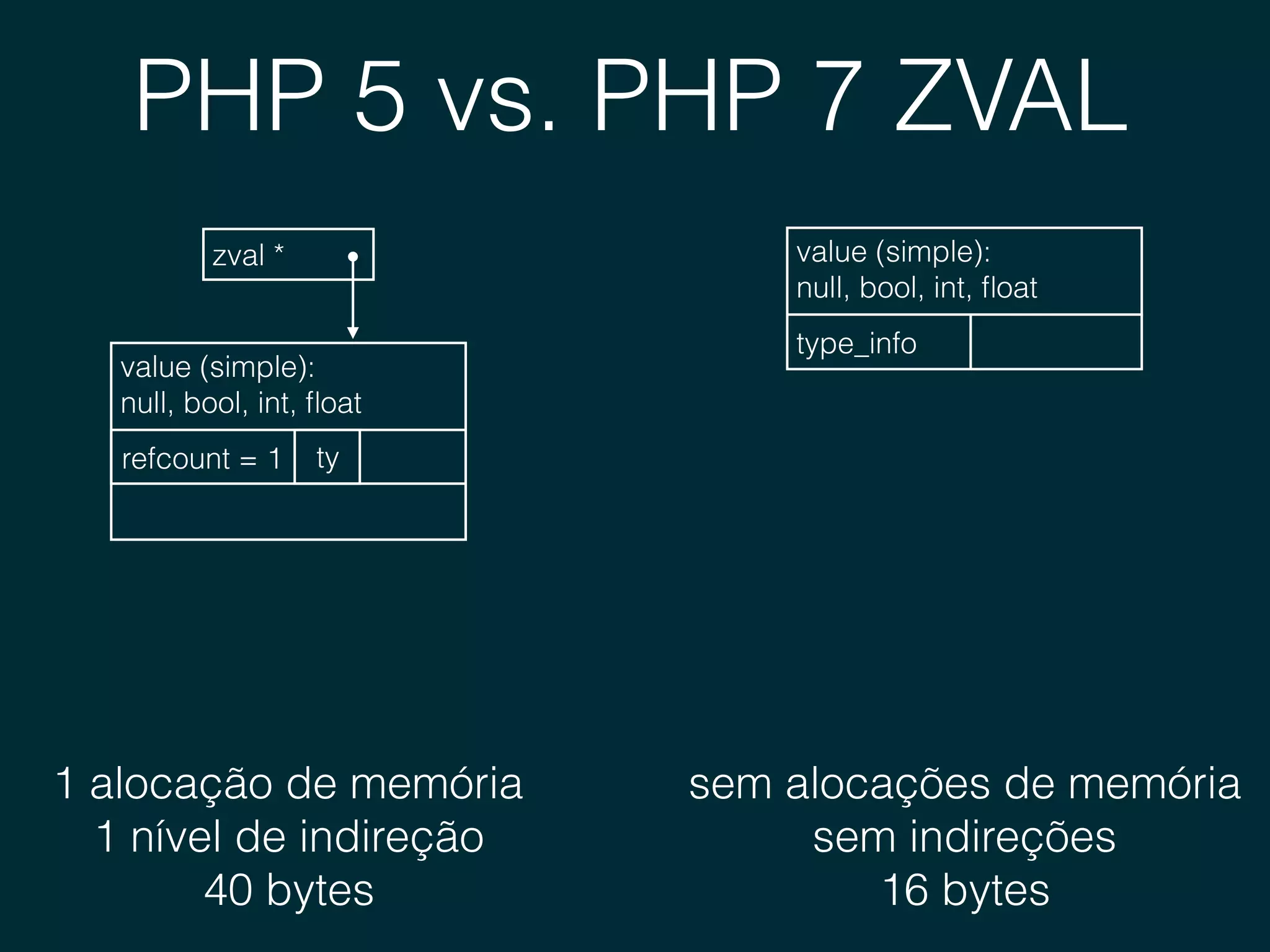
PHP 5 vs. PHP 7 ZVAL
zval *
value (simple):

null, bool, int, float
tyrefcount = 1
1 alocação de memória
1 nível de indireção
40 bytes
value (simple):

null, bool, int, float
type_info
sem alocações de memória
sem indireções
16 bytes
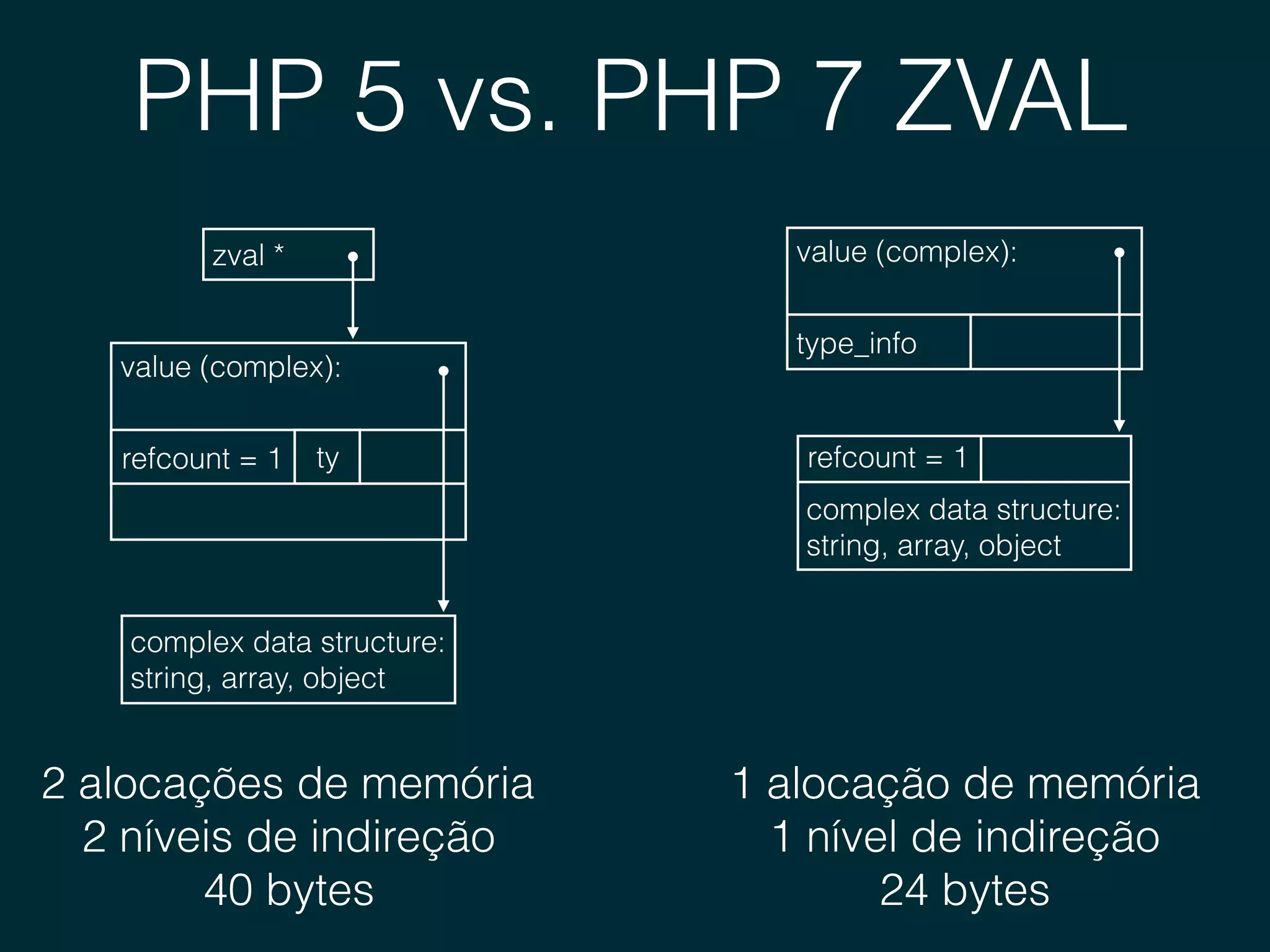
PHP 5 vs. PHP 7 ZVAL
zval *
complex data structure:

string, array, object
value (complex):

tyrefcount = 1
2 alocações de memória
2 níveis de indireção
40 bytes
complex data structure:

string, array, object
refcount = 1
value (complex):

type_info
1 alocação de memória
1 nível de indireção
24 bytes
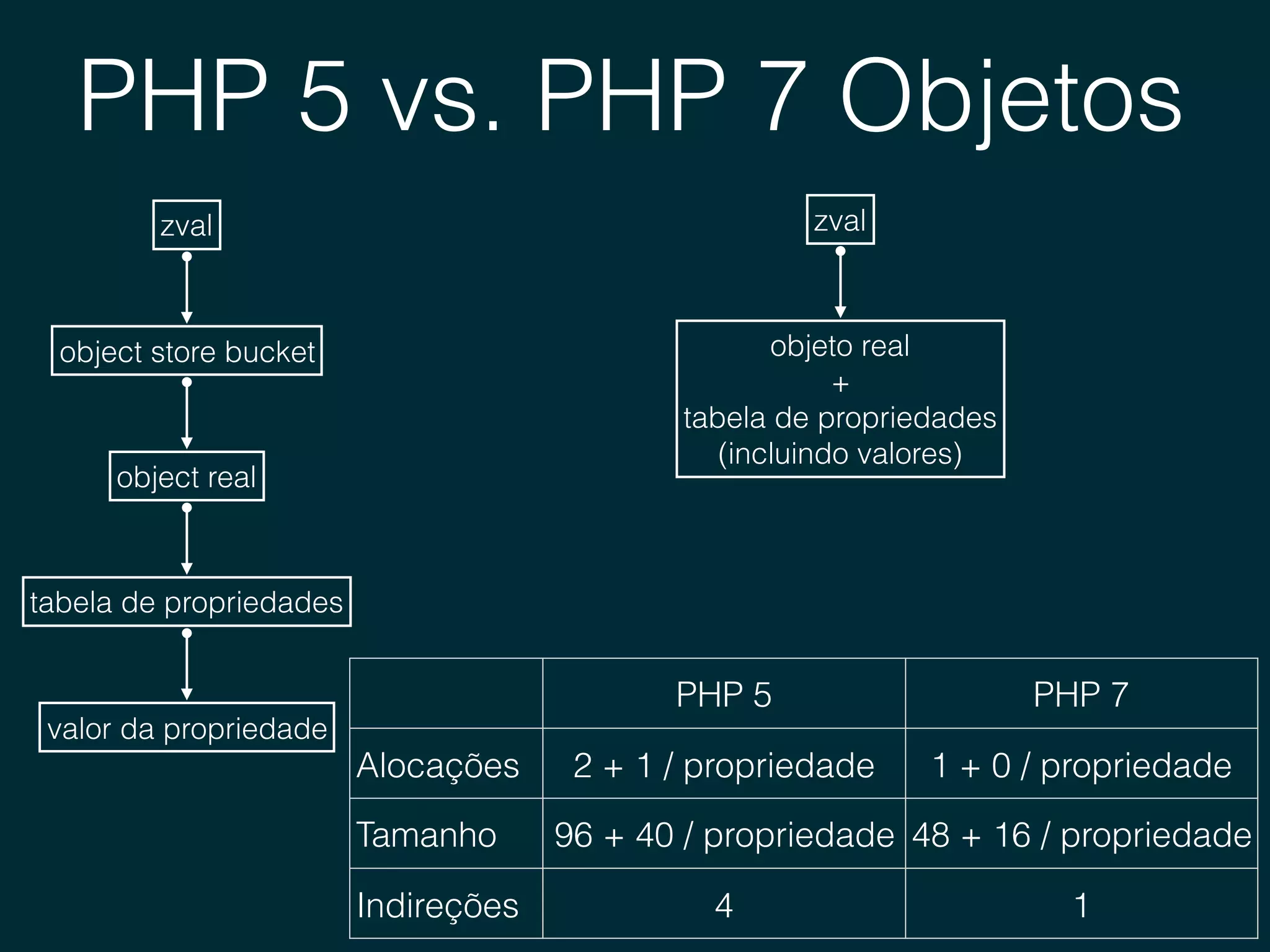
PHP 5 vs. PHP 7 Objetos
zval
object store bucket
object real
tabela de propriedades
valor da propriedade
zval
objeto real
+
tabela de propriedades

(incluindo valores)
PHP 5 PHP 7
Alocações 2 + 1 / propriedade 1 + 0 / propriedade
Tamanho 96 + 40 / propriedade 48 + 16 / propriedade
Indireções 4 1
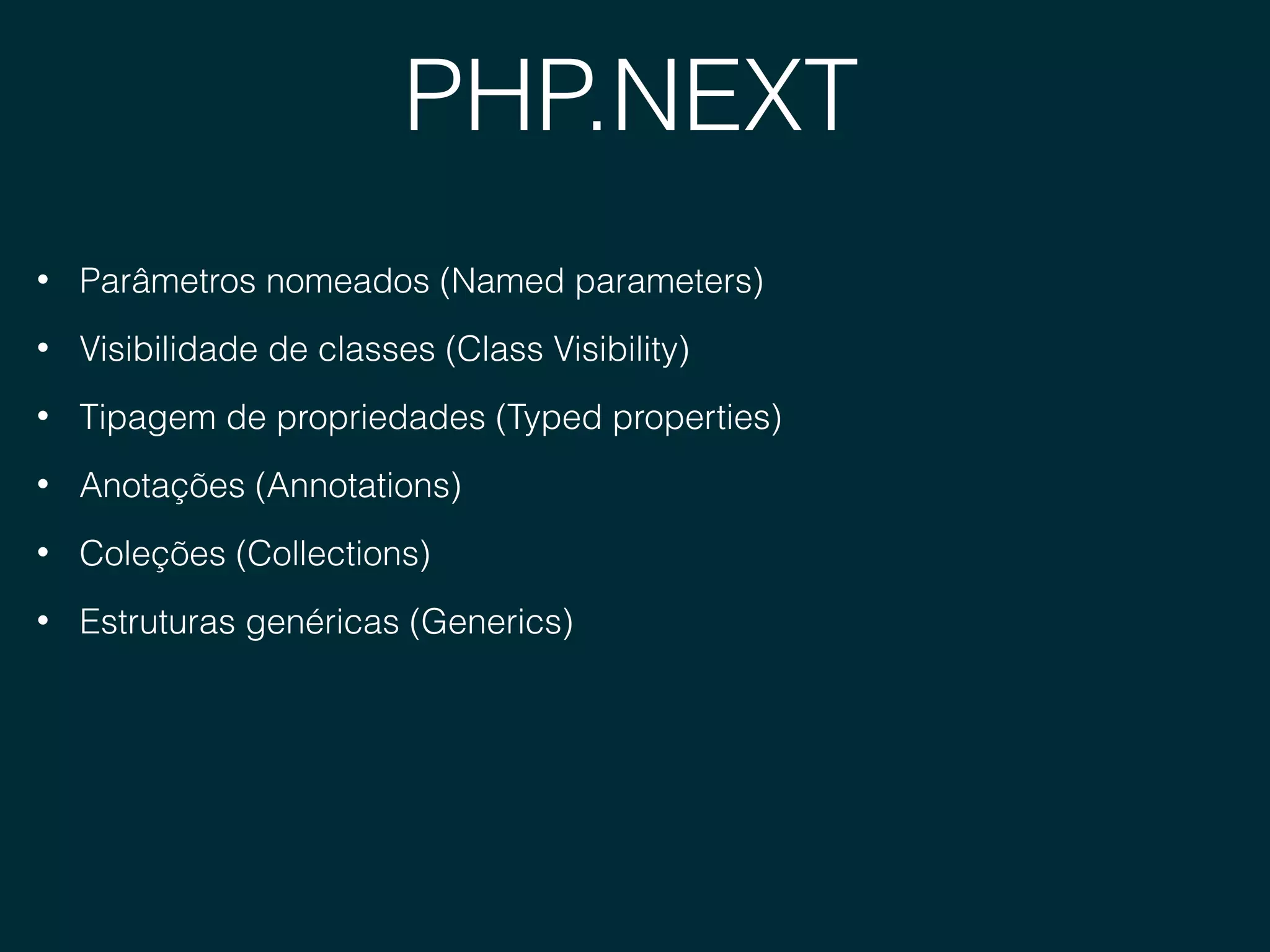
PHP.NEXT
• Parâmetros nomeados (Named parameters)
• Visibilidade de classes (Class Visibility)
• Tipagem de propriedades (Typed properties)
• Anotações (Annotations)
• Coleções (Collections)
• Estruturas genéricas (Generics)
Perguntas?
Thanks! =)
http://github.com/guilhermeblanco
@guilhermeblanco

PHP 7

  • 1.
  • 3.
  • 4.
  • 5.
  • 6.
    Agenda • Mudanças parao usuário • Mudanças internas • PHP.NEXT
  • 7.
    Mudanças para ousuário • Quebras de compatibilidade • Novos operadores • Erros e exceções • Indução de tipo escalar (Scalar type hint) • Declaração de tipo de retorno (Return type hint) • Classes anônimas (Anonymous classes) • Palavras-chave semi-reservadas
  • 8.
    Quebras de compatibilidade <%/* ... */ %> <%= /* ... */ %> <script language="php">/* ... */</script> <? /* ... */ ?> <?= /* ... */ ?> <?php /* ... */ ?> • Tags alternativas do PHP
  • 9.
    Quebras de compatibilidade •Construtores do PHP 4 1 class Post { 2 public function post() { 3 echo 'post'; 4 } 5 } $post = new Post(); $post = new DomainPost(); 1 namespace Domain { 2 class Post { 3 public function post() { 4 echo 'post'; 5 } 6 } 7 }
  • 10.
    Quebras de compatibilidade •Mudanças de sintaxe (Uniform variable syntax) • Novas combinações de operadores $foo()['bar']() [$obj1, $obj2][0]->prop $foo->bar()::baz() $foo->bar()() (function () {})()
  • 11.
    Quebras de compatibilidade •Mudanças de sintaxe (Uniform variable syntax) • Acesso indireto à variáveis, propriedades e métodos Expressão Interpretação no PHP 5 Interpretação no PHP 7 $$foo['bar']['baz'] ${$foo['bar']['baz']} ($$foo)['bar']['baz'] $foo->$bar['baz'] $foo->{$bar['baz']} ($foo->$bar)['baz'] $foo->$bar['baz']() $foo->{$bar['baz']}() ($foo->$bar)['baz']() Foo::$bar['baz']() Foo::{$bar['baz']}() (Foo::$bar)['baz']()
  • 12.
    Quebras de compatibilidade •Server APIs removidas:
 aolserver, apache, apache_hooks, apache2filter, caudium, continuity, isapi, milter, nsapi, phttpd, pi3web, roxen, thttpd, tux, webjames • Extensões depreciadas (PECL): 
 ereg, mssql, mysql, sybase_ct
  • 13.
    Novos operadores • Nullcoalesce operator (??) • Spaceship operator (<=>) • Group use • Unicode escape syntax (u)
  • 14.
    Novos operadores • Nullcoalesce operator (??) $page = $_GET['page'] ?: 1; if (isset($_GET['page'])) { $page = $_GET['page']; } else { $page = 1; } $page = isset($_GET['page']) ? $_GET['page'] : 1 ; $page = $_GET['page'] ?? 1;
  • 15.
    Novos operadores • Operadorde comparação combinado (Spaceship operator) (<=>) 1 // Integers 2 echo 1 <=> 1; // 0 3 echo 2 <=> 1; // 1 4 echo 1 <=> 2; // -1 5 6 // Floats 7 echo 1.5 <=> 1.5; // 0 8 echo 2.5 <=> 1.5; // 1 9 echo 1.5 <=> 2.5; // -1 10 11 // Strings 12 echo 'a' <=> 'a'; // 0 13 echo 'z' <=> 'a'; // 1 14 echo 'a' <=> 'z'; // -1 15 16 echo 'zz' <=> 'aa'; // 1 17 echo 'a' <=> 'aa'; // -1
  • 16.
    Novos operadores • Groupuse use EblockDomainDirectoryEntity{ Consigner, Location as ConsignerLocation, User }; use EblockDomainDirectory{ DTO{ ConsignerUpdate as UpdateConsigner }, Entity{ Consigner, Location, User } };
  • 17.
    Novos operadores • Unicodeescape syntax (u) ❤ (0x2764) // <3 no PHP 5 $char = html_entity_decode('&#x10084', 0, 'UTF-8'); $char = mb_convert_encoding('&#x10084', 'UTF-8', 'HTML-ENTITIES'); $char = json_decode('"u2764"'); // <3 no PHP 7 $char = "u2764";
  • 18.
    Erros e exceções •Usuário pode capturar qualquer chamada que possa gerar erros fatais • A maioria dos error E_RECOVERABLE viraram Exceptions • Erros E_STRICT foram re-classificados como E_WARN e E_NOTICE • Erros fatais são ou herdam a classe "Error" • Erros de análise sintática geram "ParseError" • Ambos "Error" e "Exception" implementam a interface "Throwable"
  • 19.
  • 20.
    Erros e exceções 1echo 'PHP ' . phpversion() . PHP_EOL; 2 3 try { 4 $foo = new foo(); 5 } catch (Exception $e) { 6 echo 'I am an exception: ' . $e->getMessage() . PHP_EOL; 7 } catch (Error $e) { 8 echo 'I am an error: ' . $e->getMessage() . PHP_EOL; 9 } catch (Throwable $t) { 10 echo 'I am throwable: ' . $t->getMessage() . PHP_EOL; 11 } 12 13 // PHP 5.6.19 14 // Fatal error: Class 'foo' not found in 15 // Documents/PHP7/throwable.php on line 5 16 17 // PHP 7.0.4 18 // I am an error: Class 'foo' not found
  • 21.
    Indução de tipoescalar • Funciona de duas formas distintas: • Weak mode (Coercivo) • Strict (Forte) declare(strict_types=1);
  • 22.
    Indução de tipoescalar Tipo declarado int float string bool object int yes yes* yes† yes no float yes yes yes† yes no string yes yes yes yes yes‡ bool yes yes yes yes no * Somente pontos flutuantes não-NaN e entre PHP_INT_MIN e PHP_INT_MAX serão aceitos. † Se for uma string numérica ‡ Somente se o objeto tiver o método __toString() function setEnabled(bool $enabled) { /* ... */ }
  • 23.
    Indução de tipoescalar 1 declare(strict_types=1); 2 3 function welcome(string $name) { 4 echo 'Welcome to the show, ' . $name; 5 } 6 7 welcome('Guilherme'); 8 // Welcome to the show, Guilherme 9 10 welcome(42); 11 // TypeError: Argument 1 passed to welcome() 12 // must be of the type string, integer given
  • 24.
    Declaração de tipode retorno function getCreator(): UserInterface { return $this->getPost()->getAuthor(); } function getAuthor(): UserInterface { return 'Guilherme Blanco'; } getAuthor(); // TypeError: Return value of getAuthor() must be // an instance of UserInterface, string returned
  • 25.
    Classes anônimas // PrePHP 7 class EchoLogger implements LoggerInterface { public function log($message) { echo $message; } } $application->setLogger(new Logger()); // PHP 7, seu lindo! <3 $application->setLogger(new class () implements LoggerInterface { public function log(string $message) { echo $message; } });
  • 26.
    Palavras-chave semi-reservadas • abstract •and • array • as • break • callable • case • catch • class* • clone • const • continue • declare • default • die • do • global • goto • if • implements • include • include_once • instanceof • insteadof • interface • list • namespace • new • or • parent • print • private • protected • public • require • require_once • return • self • static • switch • throw • trait • try • use • var • while • xor • yield • echo • else • elseif • enddeclare • endfor • endforeach • endif • endswitch • endwhile • exit • extends • final • finally • for • foreach • function
  • 27.
    Palavras-chave semi-reservadas 1 namespaceHTTP 2 { 3 class StatusCode 4 { 5 const CONTINUE = 100; 6 const SWITCHING_PROTOCOLS = 101; 7 // ... 8 } 9 }
  • 28.
    Palavras-chave semi-reservadas 1 $queryBuilder= $repository->createQueryBuilder('e'); 2 3 $queryBuilder 4 ->where() 5 ->and() 6 ->field('e.projeto') 7 ->not() 8 ->like('%secreto%') 9 ->end() 10 ->field('e.prioridade') 11 ->gt(9) 12 ->end() 13 ->end() 14 ->or() 15 ->field('e.codigo') 16 ->in([4, 5, 6]) 17 ->end() 18 ->end() 19 ->end() 20 ;
  • 29.
    Mudanças internas • Árvorede sintaxe abstrata (Abstract Syntax Tree) • Suporte completo a 64 bits • Large File Support (LFS) • Strings maiores que 231 • Suporte a inteiros de 64 bits • Novo gerenciamento de memória • ZVALs são alocados na stack • refcount mais preciso • Nova implementação de segurança sobre threads • Thread safety no PHP 5 implicava numa penalização de performance em ~20% • Otimização de estruturas de dados
  • 30.
    Árvore de sintaxeabstrata <?php $a = 42; $b = 24; echo $a + $b; <?php T_OPEN_TAG
 $a T_VARIABLE
 = T_EQUALS
 42 T_LNUMBER
 ; T_SEMICOLON
 $b T_VARIABLE
 = T_EQUALS
 24 T_LNUMBER
 ; T_SEMICOLON
 echo T_ECHO
 $a T_VARIABLE
 + T_PLUS
 $b T_VARIABLE
 ; T_SEMICOLON lex ASSIGN $a 42
 ASSIGN $b 24
 ADD $a $b ~0
 ECHO ~0
 RETURN 1 parse + compile
  • 31.
    Árvore de sintaxeabstrata <?php $a = 42; $b = 24; echo $a + $b; <?php T_OPEN_TAG
 $a T_VARIABLE
 = T_EQUALS
 42 T_LNUMBER
 ; T_SEMICOLON
 $b T_VARIABLE
 = T_EQUALS
 24 T_LNUMBER
 ; T_SEMICOLON
 echo T_ECHO
 $a T_VARIABLE
 + T_PLUS
 $b T_VARIABLE
 ; T_SEMICOLON lex stmts assign assign echo 42 24 + $a $b $a $b var var parse ASSIGN $a 42
 ASSIGN $b 24
 ADD $a $b ~0
 ECHO ~0
 RETURN 1 compile
  • 32.
    Otimização de estruturasde dados • ~20% do tempo gasto no PHP 5 era referente à alocação de memória • No PHP 7, foi reduzido o número de alocações • No PHP 7, foi reduzido o consumo de memória • No PHP 7, foi reduzido o número de indicações • O motor de execução agora utiliza stack push e gerencia argumentos • Chamada pra funções foram drasticamente refatoradas • Variáveis no PHP 7 são cacheadas de forma mais eficiente • String são refcounted
  • 33.
    Otimização de estruturasde dados • ZVAL no PHP 5 1 typedef union _zvalue_value { 2 long lval; 3 double dval; 4 struct { 5 char *val; 6 int len; 7 } str; 8 HashTable *ht; 9 zend_object_value obj; 10 zend_ast *ast; 11 } zvalue_value; 1 struct _zval_struct { 2 zvalue_value value; 4 zend_uint refcount__gc; 5 zend_uchar type; 6 zend_uchar is_ref__gc; 7 } zval;
  • 34.
    ZVAL no PHP5 value
 ZVAL ty Crédito: Nikita Popov
  • 35.
    ZVAL no PHP5 value (simple):
 null, bool, int, float ZVAL ty Crédito: Nikita Popov
  • 36.
    ZVAL no PHP5 value (complex):
 ZVAL ty complex data structure:
 string, array, object Crédito: Nikita Popov
  • 37.
    ZVAL no PHP5 1 $a = []; zval *$a value (complex):
 ZVAL ty complex data structure:
 string, array, object refcount = 1 Crédito: Nikita Popov
  • 38.
    ZVAL no PHP5 zval *$a 1 $a = []; 2 $b = $a; value (complex):
 ZVAL ty complex data structure:
 string, array, object refcount = 1 Crédito: Nikita Popov
  • 39.
    ZVAL no PHP5 zval *$a 1 $a = []; 2 $b = $a; value (complex):
 ZVAL ty complex data structure:
 string, array, object refcount = 2 zval *$b Crédito: Nikita Popov
  • 40.
    1 typedef union_zend_value { 2 zend_long lval; 3 double dval; 4 zend_refcounted *counted; 5 zend_string *str; 6 zend_array *arr; 7 zend_object *obj; 8 zend_resource *res; 9 zend_reference *ref; 10 zend_ast_ref *ast; 11 zval *zv; 12 void *ptr; 13 zend_class_entry *ce; 14 zend_function *func; 15 struct { 16 uint32_t w1; 17 uint32_t w2; 18 } ww; 19 } zend_value; 1 struct _zval_struct { 2 zend_value value; 3 union { 4 struct { 5 ZEND_ENDIAN_LOHI_4( 6 zend_uchar type, 7 zend_uchar type_flags, 8 zend_uchar const_flags, 9 zend_uchar reserved) 10 } v; 11 uint32_t type_info; 12 } u1; 13 union { 14 uint32_t var_flags; 15 uint32_t next; 16 uint32_t cache_slot; 17 uint32_t lineno; 18 uint32_t num_args; 19 uint32_t fe_pos; 20 uint32_t fe_iter_idx; 21 uint32_t access_flags; 22 } u2; 23 } zval; ZVAL no PHP 7
  • 41.
    ZVAL no PHP7 zval *$a 1 $a = []; 2 $b = $a; value (complex):
 ZVAL ty zval *$b complex data structure:
 string, array, object refcount = 2 Crédito: Nikita Popov
  • 42.
    ZVAL no PHP7 zval *$a 1 $a = []; 2 $b = $a; zval *$b complex data structure:
 string, array, object refcount = 2 ZVAL value (complex):
 type_info Crédito: Nikita Popov
  • 43.
    ZVAL no PHP7 $a 1 $a = []; 2 $b = $a; $b complex data structure:
 string, array, object refcount = 2 value (complex):
 type_info value (complex):
 type_info Crédito: Nikita Popov
  • 44.
    PHP 5 vs.PHP 7 ZVAL zval * value (simple):
 null, bool, int, float tyrefcount = 1 1 alocação de memória 1 nível de indireção 40 bytes value (simple):
 null, bool, int, float type_info sem alocações de memória sem indireções 16 bytes
  • 45.
    PHP 5 vs.PHP 7 ZVAL zval * complex data structure:
 string, array, object value (complex):
 tyrefcount = 1 2 alocações de memória 2 níveis de indireção 40 bytes complex data structure:
 string, array, object refcount = 1 value (complex):
 type_info 1 alocação de memória 1 nível de indireção 24 bytes
  • 46.
    PHP 5 vs.PHP 7 Objetos zval object store bucket object real tabela de propriedades valor da propriedade zval objeto real + tabela de propriedades
 (incluindo valores) PHP 5 PHP 7 Alocações 2 + 1 / propriedade 1 + 0 / propriedade Tamanho 96 + 40 / propriedade 48 + 16 / propriedade Indireções 4 1
  • 47.
    PHP.NEXT • Parâmetros nomeados(Named parameters) • Visibilidade de classes (Class Visibility) • Tipagem de propriedades (Typed properties) • Anotações (Annotations) • Coleções (Collections) • Estruturas genéricas (Generics)
  • 48.
  • 49.