Laser Scanning-An Emerging Technology in
Structural Engineering 1st Edition Belén Riveiro
(Editor) download
https://textbookfull.com/product/laser-scanning-an-emerging-
technology-in-structural-engineering-1st-edition-belen-riveiro-
editor/
Download more ebook from https://textbookfull.com
We believe these products will be a great fit for you. Click
the link to download now, or visit textbookfull.com
to discover even more!
Advances in Structural Engineering—Optimization:
Emerging Trends in Structural Optimization Sinan Melih
Nigdeli
https://textbookfull.com/product/advances-in-structural-
engineering-optimization-emerging-trends-in-structural-
optimization-sinan-melih-nigdeli/
Laser Scanning Systems in Highway and Safety
Assessment: Analysis of Highway Geometry and Safety
Using LiDAR Biswajeet Pradhan
https://textbookfull.com/product/laser-scanning-systems-in-
highway-and-safety-assessment-analysis-of-highway-geometry-and-
safety-using-lidar-biswajeet-pradhan/
Structural Materials Technology An NDT Conference 1996
First Edition Hartbower
https://textbookfull.com/product/structural-materials-technology-
an-ndt-conference-1996-first-edition-hartbower/
Laser Spectroscopy and Laser Imaging: An Introduction
1st Edition Helmut H. Telle
https://textbookfull.com/product/laser-spectroscopy-and-laser-
imaging-an-introduction-1st-edition-helmut-h-telle/
Double Prism Multi mode Scanning Principles and
Technology Anhu Li
https://textbookfull.com/product/double-prism-multi-mode-
scanning-principles-and-technology-anhu-li/
Laser Technology Applications in Adhesion and Related
Areas 1st Edition K. L. Mittal
https://textbookfull.com/product/laser-technology-applications-
in-adhesion-and-related-areas-1st-edition-k-l-mittal/
Optics Photonics and Laser Technology Paulo A. Ribeiro
https://textbookfull.com/product/optics-photonics-and-laser-
technology-paulo-a-ribeiro/
Optics Photonics and Laser Technology 2017 Paulo
Ribeiro
https://textbookfull.com/product/optics-photonics-and-laser-
technology-2017-paulo-ribeiro/
Emerging Technologies in Agricultural Engineering 1st
Edition Megh R. Goyal
https://textbookfull.com/product/emerging-technologies-in-
agricultural-engineering-1st-edition-megh-r-goyal/
LASER SCANNING
International Society for Photogrammetry and
Remote Sensing (ISPRS) Book Series
ISSN: 1572–3348
Book Series Editor
Zhilin Li
Department of Land Surveying and Geo-Informatics,
The Hong King Polytechnic University, Hong Kong,
P.R. China
Laser Scanning
An Emerging Technology in Structural
Engineering
Editors
Belén Riveiro
School of Industrial Engineering, University of Vigo, Vigo, Spain
Roderik Lindenbergh
Department of Geoscience and Remote Sensing, Delft University of Technology,
Delft, The Netherlands
CRC Press/Balkema is an imprint of the Taylor & Francis Group, an informa business
© 2020 ISPRS
Typeset by Apex CoVantage, LLC
All rights reserved. No part of this publication or the information contained herein may
be reproduced, stored in a retrieval system, or transmitted in any form or by any means,
electronic, mechanical, by photocopying, recording or otherwise, without written prior
permission from the publishers.
Although all care is taken to ensure integrity and the quality of this publication and the
information herein, no responsibility is assumed by the publishers nor the author for
any damage to the property or persons as a result of operation or use of this publication
and/or the information contained herein.
Library of Congress Cataloging-in-Publication Data
Applied for
Published by: 
CRC Press/Balkema
Schipholweg 107c, 2316 XC Leiden, The Netherlands
e-mail: Pub.NL@taylorandfrancis.com
www.crcpress.com – www.taylorandfrancis.com
ISBN: 978-1-138-49604-0 (Hbk)
ISBN: 978-1-351-01886-9 (eBook)
DOI: https://doi.org/10.1201/9781351018869
v
Laser Scanning – Riveiro and Lindenbergh
© 2020 ISPRS, ISBN 978-1-138-49604-0
Prefacevii
Editorsix
Contributorsxi
Chapter 1 Introduction 1
Belén Riveiro, Ana Sánchez-Rodríguez and Mario Soilán
Chapter 2 Multispectral terrestrial lidar: state of the art and challenges 5
Sanna Kaasalainen
Chapter 3 Multiplatform mobile laser scanning 19
Antero Kukko and Harri Kaartinen
Chapter 4 Introduction to mobile mapping with portable systems 37
Erica Nocerino, Pablo Rodriguez-Gonzálvez and Fabio Menna
Chapter 5 Indoor modeling with laser scanning 53
Cheng Wang and Chenglu Wen
Chapter 6 Geometric point cloud quality 79
Derek D. Lichti
Chapter 7 Semantic segmentation of dense point clouds 93
Martin Weinmann
Chapter 8 Laser scanning for operational multiscale structural monitoring 113
Roderik Lindenbergh, Sylvie Soudarissanane, Jinhu Wang, Abdul
Nurunnabi, Adriaan van Natijne and Cserép Máté
Chapter 9 A smart point cloud infrastructure for intelligent environments 127
Florent Poux and Roland Billen
Chapter 10 Integration of TLS and sonar for the modelling of semi-immersed structures 151
Emmanuel Moisan, Philippe Foucher, Pierre Charbonnier, Samuel
Guillemin, Matthieu Koehl and Pierre Grussenmeyer
Chapter 11 Integral diagnosis and structural analysis of historical constructions
by terrestrial laser scanning 169
Luis J. Sánchez-Aparicio, Susana Del Pozo, Pablo Rodríguez-Gonzálvez,
Ángel L. Muñoz-Nieto, Diego González-Aguilera and Luís F. Ramos
Chapter 12 Laser scanning for bridge inspection 189
Linh Truong Hong and Debra F. Laefer
Contents
vi
Chapter 13 Laser scanning data for inverse problems in structural engineering 215
Belén Riveiro, Manuel Cabaleiro, Borja Conde, Mario Soilán and
Ana Sánchez-Rodríguez
Chapter 14 Construction site monitoring based on laser scanning data 231
Daniel Wujanz
Chapter 15 Integrated modelling and management information system (MMIS)
for SCAN-to-BIM projects 247
Fabrizio Banfi and Luigi Barazzetti
Index265
ISPRS book series 269
vii
Laser Scanning – Riveiro and Lindenbergh
© 2020 ISPRS, ISBN 978-1-138-49604-0
Laser scanning technology has significantly evolved in the last years; its ability to collect large
amounts of accurate geometric 3D data at a relatively low cost has motivated the adoption of this
geomatic technology for many different applications. The growing need to digitally record our
environment in 3D, together with the developments in artificial intelligence, particularly relevant
for the automated interpretation of digital images, motivated the adoption of laser scanning as a
fundamental tool for geometrical recording. This is especially relevant in the construction and civil
engineering domains, among others, where laser scanners have been included as routine measuring
technology for projects requiring geometrical control, 3D modelling, or building/infrastructure
management, deformation of structural health monitoring, etc. As a consequence of its expansion
in other domains outside of geomatics, new needs appeared, namely: more efficient acquisition
systems, automated object identification and parameterization, etc.
Since terrestrial laser scanners have become more accessible to researchers and profession-
als working in the industrial sector, there has been an explosion of articles reporting successful
applications of the technology, proposing new acquisition systems, even new sensors, and more
intensely, automatic data processing procedures. Even though access to the huge number of papers
that are being published every day becomes easier, there exists a need to compile in a single doc-
ument those aspects of laser scanning technology that have evolved in the last years. Additionally,
such a document can serve to update the reference books for students, not only in the geomatic
domain but most importantly, for those students and professionals from other domains such as civil
engineering, construction, or architecture (among others), who are introducing this powerful geo-
matic technique as a basic tool for surveying, measurement, 3D modelling, and other subsequent
operations.
In this context, this book provides an overview on the evolution of laser scanning technology
and its noticeable impact in the structural engineering domain. It aims to provide an up-to-date
synthesis of the state of the art of the technology for the reverse engineering of built constructions.
Data processing of large point clouds collected with laser scanning systems has in parallel fash-
ion experienced an important advance, and thus, an intense activity in the development of auto-
mated data processing algorithms has been noticed. The emergence of these algorithms is related
to an intense demand of engineers and technicians from outside the geomatics domain. Different
applications have in common that they all demand an efficient conversion of the raw laser scan
point cloud data to 3D models, but all with purpose-dependent requirements. This book provides
an overview of state-of-the-art algorithms, different best practices, and most recent processing
tools such as the emergent application of deep learning to dense point clouds.
Finally, the book is completed with a set of chapters presenting some relevant practical appli-
cations of laser scanning point clouds to structural engineering such as routine bridge inspection,
documentation and automated inspection of historical constructions, exploitation of dense point
clouds to determine stresses in metallic structural members, construction site monitoring, and con-
version of point clouds into BIM models for a more efficient management of existing constructions.
Preface
ix
Laser Scanning – Riveiro and Lindenbergh
© 2020 ISPRS, ISBN 978-1-138-49604-0
Belén Riveiro was born in Pontevedra (Spain) in 1983. Since 2012, she is an Associate Professor
at the Department of Materials Engineering, Applied Mechanics and Construction at the Univer-
sity of Vigo (Spain). She holds an MSc in Construction Engineering (2015), an MESc in Forestry
Engineering (2006) and a PhD in Environmental Engineering (2011). She has been an Associate
Professor in Geomatics at Newcastle University (UK) in 2011, and was a postdoctoral research
fellow at the University of Minho (2012 and 2014), the University of Cambridge (2015), and at
Delft University of Technology (2016). Her research is focused on the application of remote sens-
ing technologies in structural engineering for the automated modelling, inspection and material
characterization using inverse analysis procedures. At a larger scale, she uses Lidar for the model-
ling of terrestrial transport infrastructure and urban spaces. She has been principal investigator in
several research and innovation projects (at national and international levels) and coordinator of an
European action focused on the resilience of transport infrastructure to extreme events (within the
H2020 Framework Program). She has published more than 80 research papers in SCI-JCR journals
(h-index 22) and more than 60 communications to international conferences. She is co-author of
nine patents and has supervised six PhD theses. She is the Secretary of the ISPRS WGII/10 3D
Mapping for Environmental  Infrastructure Monitoring for the period 2016–2020. In 2017 she
was awarded by the Spanish Royal Academy of Engineering with a medal of the Juan López de
Peñalver Prize within the Awards for Young Researchers.
Roderik Lindenbergh is Associate Professor in Laser Scanning at the Department. of Geoscience
and Remote Sensing of Delft University of Technology. He studied mathematics at the University
of Amsterdam and studied six months at RWTH Aachen for his MSc project on computational
group theory. After eight months at QMW College, London, he worked on his PhD in geometry
and topology at Utrecht University, where he obtained his PhD on limits of Voronoi diagrams in
2002. From then he has been working at the current Dept. of Geoscience and Remote Sensing of
TU Delft. His main research interests are properties, processing methodology, and applications of
laser scan point clouds and digital terrain analysis using satellite data. He was elected best lecturer
2017 of the Faculty of Civil Engineering and Geosciences. He was Chair of Laser Scanning 2017,
a workshop organized at the Geospatial Week in Wuhan, China. He is associate editor of the ISPRS
journal on photogrammetry and remote sensing, and he is the 2016–2020 Chair of ISPRS WG II/10
on 3D mapping for environmental and infrastructural monitoring.
Editors
xi
Laser Scanning – Riveiro and Lindenbergh
© 2020 ISPRS, ISBN 978-1-138-49604-0
Fabrizio Banfi
Department of Architecture, Built Environment
and Construction Engineering
Politecnico di Milan, Milan, Italy
Email: fabrizio.banfi@polimi.it
Luigi Barazzetti
Department of Architecture, Built Environment
and Construction Engineering
Politecnico di Milan, Milan, Italy
Email: luigi.barazzetti@polimi.it
Roland Billen
Geomatics Unit, University of Liège, Liège,
Belgium
Email: rbillen@uliege.be
Manuel Cabaleiro
Department of Materials Engineering, Applied
Mechanics and Construction
University of Vigo, Vigo, Spain
Email: mcabaleiro@uvigo.es
Pierre Charbonnier
Cerema, Equipe Projet ENDSUM,
Strasbourg, France
Email: Pierre.Charbonnier@cerema.fr
Borja Conde
Department of Materials Engineering, Applied
Mechanics and Construction
University of Vigo, Vigo, Spain
Email: bconde@uvigo.es
Susana Del Pozo
Department of Cartographic and Land
Engineering
University of Salamanca, Ávila, Spain
Email: s.p.aguilera@usal.es
Philippe Foucher
Cerema, Equipe Projet ENDSUM, Strasbourg,
France
Email: Philippe.Foucher@cerema.fr
Diego González-Aguilera
Department of Cartographic and Land
Engineering
University of Salamanca, Ávila, Spain
Email: daguilera@usal.es
Pierre Grussenmeyer
Photogrammetry and Geomatics Group,
ICube Laboratory UMR 7357, INSA,
Strasbourg, France
Email: pierre.grussenmeyer@insa-strasbourg.fr
Samuel Guillemin
Photogrammetry and Geomatics Group, ICube
Laboratory UMR 7357, INSA, Strasbourg, France
Email: samuel.guillemin@insa-strasbourg.fr
Harri Kaartinen
Departmentof RemoteSensingandPhotogrammetry
Finnish Geospatial Research Institute FGI,
Masala, Finland
Department of Geography and Geology,
University of Turku, Finland
Email: harri.kaartinen@nls.fi
Sanna Kaasalainen
Department of Navigation and Positioning,
Finnish Geospatial Research Institute – FGI,
Masala, Finland
Email: sanna.kaasalainen@nls.fi
Matthieu Koehl
Photogrammetry and Geomatics Group, ICube
Laboratory UMR 7357, INSA, Strasbourg, France
Email: mathieu.koehl@insa-strasbourg.fr
Antero Kukko
Department of Remote Sensing and
Photogrammetry
Finnish Geospatial Research Institute FGI
Masala, Finland
Department of Built Environment
Aalto University, Espoo, Finland
Email: antero.kukko@nls.fi
Contributors
xii
Debra F. Laefer
Center for Urban Science  Department of
Civil and Urban Engineering
New York University, New York, US
Email: debra.laefer@nyu.edu
Derek D. Lichti
Department of Geomatics Engineering
The University of Calgary, Calgary,
Alberta, Canada
Email: ddlichti@ucalgary.ca
Roderik Lindenbergh
Department of Geoscience and Remote Sensing
Delft University of Technology, Delft,
The Netherlands
Email: R.C.Lindenbergh@tudelft.nl
Cserep Mate
Department of Geoscience and Remote Sensing
Delft University of Technology, Delft,
The Netherlands
Email: mcserep@caesar.elte.hu
Fabio Menna
3D Optical Metrology Unit
Bruno Kessler Foundation, Trento, Italy
Email: fmenna@fbk.eu
Emmanuel Moisan
Cerema, Equipe Projet ENDSUM,
Strasbourg, France
Email: emmanuel.moisan@insa-strasbourg.fr
Ángel Luis Muñoz-Nieto
Department of Cartographic and Land
Engineering
University of Salamanca, Ávila, Spain
Email: almuni@usal.es
Adriaan van Natijne
Department of Geoscience and Remote Sensing
Delft University of Technology, Delft,
The Netherlands
Email: A.L.vanNatijne@tudelft.nl
Erica Nocerino
Laboratoire des Sciences de l’Information et des
Systèmes (LSIS laboratory), Aix-Marseille
Université, France
Theoretical Physics, ETH Zürich, Switzerland
Email: erica.NOCERINO@univ-amu.fr
Abdul Nurunnabi
Department of Geoscience and Remote Sensing
Delft University of Technology, Delft,
The Netherlands
Email: pyal1471@yahoo.com
Florent Poux
Geomatics Unit, University of Liège,
Liège, Belgium
Email: fpoux@uliege.be
Luís F. Ramos
ISISE, Department of Civil Engineering,
University of Minho, Guimarães, Portugal
Email: lramos@civil.uminho.pt
Belén Riveiro
Department of Materials Engineering, Applied
Mechanics and Construction
University of Vigo, Vigo, Spain
Email: belenriveiro@uvigo.es
Pablo Rodríguez-Gonzálvez
Department of Mining Technology,
Topography and Structures
Universidad de León, Ponferrada, Spain
Email: p.rodriguez@unileon.es
Luis J. Sánchez-Aparicio
Department of Cartographic and Land
Engineering
University of Salamanca, Ávila, Spain
Email: luisj@usal.es
Ana Sánchez Rodríguez
Department of Materials Engineering, Applied
Mechanics and Construction
University of Vigo, Vigo, Spain
Email: anasanchez@uvigo.es
Mario Soilán Rodríguez
Department of Materials Engineering, Applied
Mechanics and Construction
University of Vigo, Vigo, Spain
Email: msoilan@uvigo.es
Sylvie Soudarissanane
Department of Geoscience and Remote
Sensing
Delft University of Technology, Delft, The
Netherlands
Email: sylvie.soudarissanane@gmail.com
xiii
Linh Truong-Hong
Department of Geoscience  Remote Sensing
Delft University of Technology, Delft, The
Netherlands
Email: L.Truong@tudelft.nl
Cheng Wang
School of Information Science and Engineering
Xiamen University, Xiamen city, Fujian
Province, China
Email: cwang@xmu.edu.cn
Jinhu Wang
Department of Geoscience and Remote Sensing
Delft University of Technology, Delft, The
Netherlands
Email: jinhu.wang@hotmail.com
Martin Weinmann
Institute of Photogrammetry and Remote
Sensing
Karlsruhe Institute of Technology (KIT),
Karlsruhe, Germany
Email: martin.weinmann@kit.edu
Chenglu Wen
School of Information Science and Engineering
Xiamen University, Xiamen city, Fujian
Province, China
Email: clwen@xmu.edu.cn
Daniel Wujanz
technet GmbH
Am Lehnshof 8, 13467 Berlin, Germany
Email: daniel.wujanz@technet-gmbh.com
1
Laser Scanning – Riveiro and Lindenbergh
© 2020 ISPRS, ISBN 978-1-138-49604-0
Chapter 1
Introduction
Belén Riveiro, Ana Sánchez-Rodríguez and Mario Soilán
Terrestrial mobile mapping technologies have changed the vision on how to conduct routine sur-
veying and inspection of constructions, which for many years was done by visual inspection meth-
ods complemented with rudimentary measurements. With the growing of digital technology, the
inspection procedures also evolved thanks to the use of special machines, which in many cases
relied on remote and nondestructive techniques to measure and visually detect damages by an
experienced operator. Within these new approaches, laser scanning is probably one of the technol-
ogies that has impacted the construction and civil engineering fields in a greater manner due to its
ability to massively, accurately and efficiently register the 3D geometry of existing buildings and
structures.
Vosselman and Maas (2010) reported in the precedent book about Airborne and Terrestrial
Laser Scanning that laser scanning was (at that date) a relatively young technique, but the authors
already foresaw its impact as a 3D measuring technique for many different applications. In their
book, the fundamental principles and pioneer methods were already presented, so with the aim of
avoiding overlapping contents, the present book is focused to update the state of the art of laser
scanning by focusing in the advances suffered by the technique in the last years, with special appli-
cation to the structural engineering domain.
In the precedent publications, researchers and professionals were reporting works and investiga-
tions based on existing commercial laser scanners, which were accompanied by specific software
packages that permitted the processing of point clouds in a quite straightforward manner (scan
registration, point cloud visualization and measurements, ending with 3D modelling tools). How-
ever, in the last ten years, there has been a significant evolution of static stations to mobile scanning
systems that can be mounted in many different platforms such as vans, boats, backpack solutions,
indoor trolleys, etc. Similarly, talking about data processing, many authors had already proposed
automatic or semiautomatic methods applying different approaches that include heuristic rules,
or more advanced machine learning techniques, where deep learning applied to 3D point clouds
represents one of the hot topics in the state of the art.
This book has been structured in a set of chapters that cover those topics where laser scanning
has evolved more importantly in the last years, together with those particular applications to struc-
tural and construction engineering that have motivated the definitive adoption of laser scanning as
a basic but powerful technique within these sectors.
Thus, the book starts with some chapters devoted to data acquisition in laser scanning, namely
new sensors and innovative platforms.
Chapter 2 introduces one of the main innovations regarding sensors, referring to multispectral
laser scanning. Even though very few systems exist providing simultaneous 3D point clouds and
spectral measurements, research on multiwavelength laser returns has been reported in the liter-
ature. For that reason, this book starts with a chapter summarizing these first experiences on the
use of multispectral TLS and its potential to efficiently and robustly solve problems in science and
industry.
2
In continuation, a set of chapters focusing on new mobile scanning systems is presented. Thus,
Chapter 3 starts presenting the advances in kinematic scanning solutions, with a chapter presenting
multiplatform approaches to the application of mobile laser scanning in various surveying tasks
in outdoor environments (3D data for terrain modeling, industrial scenes, construction sites and
infrastructure, as well as urban mapping). The chapter outlines the idea of multiplatform mobile
laser scanning particularly implementing solutions such as vehicle-, trolley- and ATV-operated
data acquisition, and boat-mounted equipment. Chapter 4 continues focusing in portable mobile
mapping systems, whose main distinctive feature regarding the conventional mobile mapping sys-
tems is the ability to efficiently acquire 3D information on the move in narrow, indoor and con-
fined environments. The chapter includes a taxonomy of the available platforms together with a
description of hardware components and data processing algorithms. Chapter 5 continues focusing
on indoor modeling, thus presenting recent advances of laser scanning for this purpose. The chap-
ter focuses on two essential parts: first, the calibration for multibeam laser scanners and indoor
building modeling using backpacked laser scanning point clouds; second, an approach for seman-
tic labeling of laser scanning point cloud data into the walls, ceiling, floor and other objects. The
method ends with the extraction of line structures from the labeled points to achieve an initial
description of the building line framework.
Chapter 6 focuses on reviewing some fundamental concepts for point cloud quality control.
These includes reference measures to inform technicians when inspecting geometric changes in
the dimensions of structural members, namely: random and systematic errors, geometric network
design and error propagation, etc. The chapter ends with a real work where these concepts are
illustrated, particularly the effect of propagation of random errors.
Chapter 7 addresses key aspects in data processing: semantic segmentation of dense point clouds,
as this has been a field where laser scanning reported more investigations and publications. This
chapter revises the fundamentals for the three main approaches followed for point cloud segmen-
tation: standard classification techniques based on manually defined features for segmentation at
point level, strategies for point cloud segmentation at object level, and the most recent approaches
for point cloud segmentation based on deep learning. The chapter also presents some commonly
used benchmark datasets for evaluating the performance of a semantic segmentation approach.
The chapters regarding point cloud processing end with Chapter 9, where the Smart Point Cloud
concept is introduced, as this can be understood as a broad framework for the semantic enrichment
and structuration of point clouds for intelligent agents and decision-making systems. The approach
presented in the chapter provides a conceptual data model to structure 3D point data, semantics and
topology proficiently. A multimodal infrastructure that integrates the aforementioned data model
integrates knowledge extraction, knowledge integration and knowledge representation for auto-
matic agent-based decision-making over enriched point cloud data.
The last section of the book presents a series of chapters presenting different applications where
laser scanning has been demonstrated to be a very useful tool in the structural and construction
engineering domains. Thus, Chapter 10 presents a successful methodology to integrate laser and
sonar data and thus being able to reconstruct semi-immersed structures. Chapter 11 presents expe-
riences where point clouds acquired with laser scanners can contribute to the structural diagnosis of
historic constructions. Thus the geometry and the spectral backscattered reflectance data acquired
by terrestrial laser scanners can be used to map and evaluate structural and chemical damages of
historical constructions in a semiautomatic and robust way. Chapter 12 focuses on the application
of laser scanning to bridge inspection. A review of the state of the art is presented, where the
potential of laser scanning for bridge inspection is presented including geometric modelling, struc-
tural deformation, and damage detection. Chapter 13 reviews applications where laser scanning
has contributed to structural analysis including geometric modelling for the creation of structural
models and structural behavior simulation. In the second part of the chapter, it is demonstrated how
laser scanning data can be used to solve inverse problems (estimation of the value of influential
material properties), or even contribute in forensic of existing structures. Chapter 14 focuses on
monitoring of construction sites and how laser scanning can contribute as an efficient and accurate
3
tool. After evaluating some aspects relevant for the monitoring of construction sites, the focus is
set then on data acquisition and referencing of point clouds, which represents a vital prerequisite
for monitoring.
The last chapter addresses building information modelling (BIM) and how dense point clouds
and their smart processing can contribute to automatically elaborate these BIM models. The
authors present the SCAN to BIM approach. The authors propose a modelling management infor-
mation system (MMIS) which is able to convert point clouds into as-built BIM (AB-BIM), solving
some issues related to generative modelling, and in a more productive manner. The authors in their
approach considered the interoperability constrains in the models generated, so the implementation
of automatic verification systems is proposed to check metric accuracy between the original point
clouds and the 3D objects.
REFERENCE
Vosselman, G.  Maas, H.G. (2010) Airborne and Terrestrial Laser Scanning. CRC Press, Scotland, UK.
5
Laser Scanning – Riveiro and Lindenbergh
© 2020 ISPRS, ISBN 978-1-138-49604-0
1 
INTRODUCTION
Multispectral laser scanning enables target identification and analysis by combining both spectral
and spatial features. Multiwavelength airborne laser scanners are already on the market, such as the
Optech Titan 3-channel airborne laser scanner, and an increasing number of applications are being
published (e.g. Wichmann et al., 2015; Matikainen et al., 2017; Axelsson et al., 2018). Conversely,
multispectral terrestrial laser scanners (TLS) only exist as prototypes built by a few individual
research groups. This chapter summarizes the current status of multispectral TLS and discusses the
challenges and future prospects of this emerging technology.
Today, there are a few multispectral TLS and active imaging projects, ranging from two-dimensional
(2D) active spectral imaging, sometimes with a separate range measurement (Wei et al., 2012; Man-
ninen et al., 2014), to instruments producing full-scale three-dimensional (3D) point cloud data (Doug-
las et al., 2012; Powers and Davis, 2012; Hakala et al., 2012; Danson et al., 2014). There are also
pointwise systems, where only the intensity is measured for spectral analysis, and waveform lidars for
vertical profiling (Rall and Knox, 2004; Du et al., 2016). Alternatively, a point cloud is constructed
by combining data from separate monochromatic laser scanners (Gong et al., 2015; Hartzell et al.,
2014; Elsherif et al., 2018). While all these provide important input for analyzing the multispectral laser
returns, the main focus of this chapter is on the simultaneous capture of spectra and target 3D geometry.
The most obvious advantage of multispectral lidar has already been shown in the pioneering
studies (cf. Wichmann et al., 2015): no time gaps or registration errors exist between different
colors (or spectral channels) or between geometric (topography) and spectral features, which
improves the results compared to the traditional approach of combining point clouds with hyper-
spectral imagery (e.g. Guo et al., 2011). Also, the target identification capability of active hyper-
spectral imaging enables a wide variety of applications. But the prospect of mapping spectral
properties in 3D over the target and in the same spatial resolution as conventional lidars has not
yet been fully utilized or even understood. Many of the studies on multispectral laser scanning
have so far focused on spectral performance without including the spatial interpretation of the
point clouds. For example, Du et al. (2016) present leaf nitrogen retrieval with a 32-channel lidar,
Chapter 2
Multispectral terrestrial lidar
State of the art and challenges
Sanna Kaasalainen
ABSTRACT: The development of multispectral terrestrial laser scanning (TLS) is still at the very beginning,
with only four instruments worldwide providing simultaneous three-dimensional (3D) point cloud and spectral
measurement. Research on multiwavelength laser returns has been carried out by more groups, but there are
still only about ten research instruments published and no commercial availability. This chapter summarizes
the experiences from all these studies to provide an overview of the state of the art and future developments
needed to bring the multispectral TLS technology into the next level. Although the current number of appli-
cations is sparse, they already show that multispectral lidar technology has potential to disrupt many fields of
science and industry due to its robustness and the level of detail available.
6
but the topographic aspect is not considered. A similar approach was presented in Li et al. (2014),
who also focused on leaf spectral indices rather than point clouds. However, one-shot acquisition
of point cloud and spectral data will crucially increase the level of detail and information content
available from the measurements. There is also the prospect of getting non-destructive and large-
scale data on the properties that have so far been measurable with destructive means only (Hakala
et al., 2015), but this idea still needs comprehensive studies with improved instruments, as well as
systematic laboratory reference to be established as a method.
Radiometric calibration of lidar intensity has been studied for more than a decade by now. A
comprehensive review on radiometric calibration methods, along with the basic physical concepts,
is provided in Kashani et al. (2015). They classify the levels of intensity processing according to
the accuracy and information quality of the calibrated laser returns, starting from the digital num-
bers (raw intensity) available directly from the detector (level 0). Level 1 comprises the range or
incidence angle correction, while in level 2, scaling or normalization, such as histogram correction,
is carried out. Full radiometric calibration (level 3) results in values comparable to target reflec-
tance and requires the use of reference targets with known reflectance. The level 3 process is also
termed absolute radiometric calibration (Briese et al., 2012).
Kashani et al. (2015) also identified some important knowledge gaps, such as difficulty in compari-
son with intensities obtained with different lidar instruments or variation between different wavelengths.
That, plus the fact that lidar intensity is still somewhat underutilized, especially for TLS (Li et al., 2016;
Schofield et al., 2016), has been one of the drivers for the development of multiple-wavelength laser
scanners. Radiometric calibration has sometimes been seen as a preliminary step toward multispectral
lidar (Matikainen et al., 2017). Using multiple channels also enables the use of spectral ratios, which
may in some cases help overcome the problem that the laser backscatter intensity does not directly
represent the hemispherical reflectance and hence the target physical properties. Simultaneous data
acquisition at different wavelengths enables the comparison of spectral differences or trends, which can
sometimes be done without absolute radiometric calibration using only the range-corrected or normal-
ized return intensity (Kashani et al., 2015; Li et al., 2016). This kind of approach usually works when
changes in target properties are observed within the same experiment or with the same instrument.
However, even the relative measurements are prone to errors caused by inaccuracy in sampling or cali-
bration of the laser beam at different wavelengths. It has also turned out that the radiometric calibration
is instrument specific (Calders et al., 2017). In any case, rigorous radiometric calibration is necessary to
be able to interpret physically the reflectance measurements available from multispectral TLS. It is also
critical for combining and comparing results from different experiments.
This chapter aims to provide a comprehensive overview on the status of multispectral TLS so
far. It also discusses some important challenges related to multispectral laser scanning in particular,
although many of these problems are familiar to monochromatic TLS as well. Even though the
number of currently existing multispectral TLS instruments is sparse, those few available already
indicate the vast potential of this new technology. The chapter is organized as follows: Section 2
reviews the state of the art in multispectral TLS and identifies some difficulties commonly met in
instrument development and data analysis. Applications are summarized in Section 3, while Sec-
tion 4 highlights some future aspects related to the technology.
2 
MULTISPECTRAL TERRESTRIAL LIDAR: STATE OF THE ART
AND CHALLENGES
Even though the idea of active hyperspectral sensing has been available for almost two decades
(Johnson et al., 1999), the first multi-wavelength terrestrial laser scanner instruments were pre-
sented by Douglas et al. (2012), Powers and Davis (2012), Hakala et al. (2012), and Gaulton et al.
(2013). Research efforts for multispectral TLS technologies are slowly increasing. Some applica-
tions have been previously summarized by Eitel et al. (2016) and Hancock et al. (2017). Much of
the research has focused on vegetation (Wichmann et al., 2015).
7
2.1 
State of the art
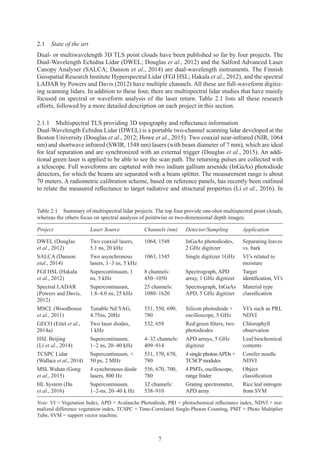
Dual- or multiwavelength 3D TLS point clouds have been published so far by four projects. The
Dual-Wavelength Echidna Lidar (DWEL; Douglas et al., 2012) and the Salford Advanced Laser
Canopy Analyser (SALCA; Danson et al., 2014) are dual-wavelength instruments. The Finnish
Geospatial Research Institute Hyperspectral Lidar (FGI HSL; Hakala et al., 2012), and the spectral
LADAR by Powers and Davis (2012) have multiple channels. All these are full-waveform digitiz-
ing scanning lidars. In addition to these four, there are multispectral lidar studies that have mainly
focused on spectral or waveform analysis of the laser return. Table 2.1 lists all these research
efforts, followed by a more detailed description on each project in this section.
2.1.1 
Multispectral TLS providing 3D topography and reflectance information
Dual-Wavelength Echidna Lidar (DWEL) is a portable two-channel scanning lidar developed at the
Boston University (Douglas et al., 2012; Howe et al., 2015). Two coaxial near-infrared (NIR, 1064
nm) and shortwave infrared (SWIR, 1548 nm) lasers (with beam diameter of 7 mm), which are ideal
for leaf separation and are synchronized with an external trigger (Douglas et al., 2015). An addi-
tional green laser is applied to be able to see the scan path. The returning pulses are collected with
a telescope. Full waveforms are captured with two indium gallium arsenide (InGaAs) photodiode
detectors, for which the beams are separated with a beam splitter. The measurement range is about
70 meters. A radiometric calibration scheme, based on reference panels, has recently been outlined
to relate the measured reflectance to target radiative and structural properties (Li et al., 2016). In
Table 2.1 Summary of multispectral lidar projects. The top four provide one-shot multispectral point clouds,
whereas the others focus on spectral analysis of pointwise or two-dimensional depth images.
Project Laser Source Channels (nm) Detector/Sampling Application
DWEL (Douglas
et al., 2012)
Two coaxial lasers,
5.1 ns, 20 kHz
1064, 1548 InGaAs photodiodes,
2 GHz digitizer
Separating leaves
vs. bark
SALCA (Danson
etal., 2014)
Two asynchronous
lasers, 1–3 ns, 5 kHz
1063, 1545 Single digitizer 1GHz VI’s related to
moisture
FGI HSL (Hakala
et al., 2012)
Supercontinuum, 1
ns, 5 kHz
8 channels:
450–1050
Spectrograph, APD
array, 1 GHz digitizer
Target
identification, VI’s
Spectral LADAR
(Powers and Davis,
2012)
Supercontinuum,
1.8–4.0 ns, 25 kHz
25 channels:
1080–1620
Spectrograph, InGaAs
APD, 5 GHz digitizer
Material type
classification
MSCL (Woodhouse
et al., 2011)
Tunable Nd:YAG,
4.75ns, 20Hz
531, 550, 690,
780
Silicon photodiode +
oscilloscope, 5 GHz
VI’s such as PRI,
NDVI
GECO (Eitel et al.,
2014a)
Two laser diodes,
1 kHz
532, 658 Red/green filters, two
photodiodes
Chlorophyll
observation
HSL Beijing
(Li et al., 2014)
Supercontinuum,
1–2 ns, 20–40 kHz
4–32 channels:
409–914
APD arrays, 5 GHz
digitizer
Leaf biochemical
contents
TCSPC Lidar
(Wallace et al., 2014)
Supercontinuum, 
50 ps, 2 MHz
531, 570, 670,
780
4 single photonAPDs +
TCSCPmodules
Conifer needle
NDVI
MSL Wuhan (Gong
et al., 2015)
4 synchronous diode
lasers, 800 Hz
556, 670, 700,
780
4 PMTs, oscilloscope,
range finder
Object
classification
HL System (Du
et al., 2016)
Supercontinuum,
1–2-ns, 20–40 k Hz
32 channels:
538–910
Grating spectrometer,
APD array
Rice leaf nitrogen
from SVM
Note: VI = Vegetation Index, APD = Avalanche Photodiode, PRI = photochemical reflectance index, NDVI = nor-
malized difference vegetation index, TCSPC = Time-Correlated Single-Photon Counting, PMT = Photo Multiplier
Tube, SVM = support vector machine.
8
addition to improving the quantitative results on vegetation structure from spectral responses, the
calibration scheme also enables the comparison and collaborative use of different instruments.
Salford Advanced Laser Canopy Analyser (SALCA; Gaulton et al., 2013; Danson et al., 2014)
uses two sequentially emitting lasers. Full waveforms at NIR (1063 nm) and SWIR wavelengths
(1545 nm) are detected and digitized with a single detector. These wavelengths have proven ideal
in, e.g., leaf-bark separation. Because of the asynchronous pulses, there is a small (1%) offset in the
footprints. Calibration is done by means of reference panels. The maximum range is 105 m, and the
footprint sizes are 8.0 mm (1063 nm) and 9.2 mm (1545 nm) at 10 m. The capability of the SALCA
lidar in leaf water content retrieval has been demonstrated with normalized difference (vegetation)
indices observed for three different species (Gaulton et al., 2013). Recently, a radiometric calibra-
tion scheme based on neural networks was presented for SALCA (Schofield et al., 2016). As the
radiometric response to range, reflectance, and laser temperature was found to be complex, a neural
network solution proved a robust tool for reflectance calibration. An effect of internal temperature
on intensity was detected, and since it was more pronounced in SWIR, this might pose another
challenge to multispectral lidar measurement and analysis in general.
The FGI Hyperspectral lidar (HSL; Hakala et al., 2012) is a multiwavelength full-waveform laser
scanner, with a supercontinuum laser light source producing 1 ns pulses at 420–2400 nm (the spot
size being 5 mm at 4 m for 543 nm). The optical system consists of a parabolic mirror, which collects
the returned pulse energy into an optical fiber connected to a spectrograph. The spectral dispersion is
detected with an avalanche photodiode (APD) array (with 450–1050 nm response range). Currently, 8
of 16 available APD spectral channels can be digitized, but the APD array can be moved with respect
to the spectrograph to adjust the wavelengths to be detected. In the 2012 breadboard prototype, the
digitizer operated on 1 GHz sampling rate, but increasing the digitization rate is investigated as part
of an ongoing development work toward an operational field instrument and improved target char-
acterization (Kaasalainen et al., 2018b). The ongoing development and intensity calibration efforts
also aim at increasing the detector sensitivity and extending the measurement range from currently
achieved 5–50 meters. Here too, external reference panels are used in the calibration.
The spectral laser detection and ranging (LADAR) laboratory demonstrator prototype devel-
oped in Maryland by Powers and Davis (2012) is also based on supercontinuum technology. In
addition to the supercontinuum source, the system comprises transmitter and receiver mirrors and
optics, a mechanically tuned spectrometer, APD array driving a transimpedance amplifier (TIA),
and a 5 GSa/s digitizer. Similarly to the FGI HSL, the time-of-flight measurement is triggered by
picking up a fraction of the outgoing beam with a beam splitter. The measured range has been
tested up to 40 m. The instrument was designed with military imaging applications in mind, and
therefore its capability of detecting obscured objects from behind a camouflage was demonstrated.
The near-infrared wavelengths of operation also ensure eye safety.
2.1.2 
Lidar projects focusing on spectral analysis
There are also lidar studies, where mainly the intensity or the spectrum of the returning laser
pulse is analyzed from a fixed point on the target surface. An instrument closest to a one-shot
multi-wavelength lidar was introduced by Gong et al. (2015). Their approach was based on Wei et al.
(2012), where a four-wavelength synthesized beam was produced with four semiconductor laser
diodes (555, 670, 700, and 780 nm). Spatial data were obtained using a simultaneous laser range
finder for distance measurement, which means that the spectral and spatial information would not
come from the same source. The technical solution was described to be equivalent to four mono-
chromatic lidars, but the combination of a single-wavelength point cloud and a multispectral image
could be used for classification similarly to multispectral TLS. The study focused on classification
algorithms for target identification, e.g. separating green and dry leaves and inorganic materials.
The Edinburgh University Multispectral Canopy Lidar (MSCL) is based on tuneable laser
operation in four wavelengths: 531, 550, 690, and 780 nm (Woodhouse et al., 2011). No point
clouds were presented, but tree vertical structure was analyzed from digitized waveforms, together
with intensity information for analyzing bark, twigs, and leaves. The full-waveform configuration
9
allowed the acquisition of canopy profile and NDVI with respect to tree height. The NDVI pro-
files could be related to chlorophyll concentration (Morsdorf et al., 2009). Four wavelengths were
also recorded with a time-correlated single-photon counting (TCSPC) technique by Wallace et al.
(2014), which would also allow the collection of 3D depth image data. Supercontinuum laser was
used as a source, but the output was filtered. The single photon counting approach was based on an
earlier design by Buller et al. (2005). The TCSPC lidar was also used to produce underwater 3D
depth images at a single wavelength (Maccarone et al., 2015).
Crop foliar nitrogen retrieval was carried out with the Green Economic Chlorophyll Observa-
tion (GECO) sensor, consisting of two laser diodes (532 and 658 nm; Eitel et al., 2014a). Only the
returning laser intensity was analyzed, and range data were not utilized. A horizontal path lidar for
chlorophyll estimation in two wavelengths was also presented by Rall and Knox (2004).
Supercontinuum laser has been tested for target spectral analysis by Du et al. (2016) and Sun
et al. (2017), who measured rice leaf nitrogen at 32 channels ranging from 538 to 910 nm. In this
experiment, the laser was pointed to the target at a fixed incidence angle.Agrating spectrometer was
used for creating the dispersion of the returned supercontinuum laser pulse. Nitrogen content was
retrieved and classified using the spectral data only. A similar approach with full-waveform digitiz-
ing capacity was developed by Li et al. (2014) for measuring leaf biochemical contents, e.g. nitro-
gen. Point clouds were not presented either, but range measurement was tested in a later study (Niu
et al., 2015). They also investigated the ranging accuracy but presented no 3D point clouds either.
2.2 Challenges
As multispectral TLS instruments are not available commercially, and because of the novelty of
the technologies, there are many challenges related to hardware design, e.g. beam alignment in
multilaser systems, range accuracy, detector sensitivity (especially signal to noise), etc. (cf. Danson
et al., 2014; Howe et al., 2015). Many of these are related to the fact that the laser power is dispersed
into multiple channels. Also, much of the analysis is based on comparison of intensity values or
trends, which emphasizes the need for consistent spectral performance to be able to separate reli-
ably the hits from different targets. This causes extra work with data pre-processing, calibration,
and information extraction (cf. Danson et al., 2018).
Laser stability is vital for spectral performance. Temperature was found to affect the intensity
of SALCA returns (Danson et al., 2018). For DWEL, the drifts in laser power are monitored with
a reference panel sampling the outgoing pulses during each mirror rotation (Li et al., 2016). In the
case of supercontinuum laser used in the FGI HSL, fluctuations in laser stability are normalized by
dividing each pulse with the trigger pulse, which is separated from each transmitted pulse with a
beam sampler. Initial tests have indicated a reasonable spectral stability, but the stability is being
further assessed in the ongoing calibration study (Kaasalainen et al., 2018b). Powers and Davis
(2012) also use the transmitted pulse to normalize the backscattered signal.
Another important issue is the considerable data volume, especially when the number of chan-
nels and scanning resolution are increased. This introduces more demands for data processing,
storage, and transfer, especially if on-site pre-processing is needed for real-time operation. There-
fore, even if the addition of channels would be technically straightforward, for example by just
adding another digitizer component, dealing with the increased data volume would require con-
siderable changes in the processing and calibration procedures. Optimizing the processing steps
is one of the future aims, and the solutions are likely to be application specific. The challenges of
processing, storing, and analyzing vast amounts of data produced by full-waveform lidar in general
have been addressed in many studies (e.g. Pfeifer et al., 2014).
It is already known from single-wavelength TLS that full-waveform echo digitizing will improve
not only the range but also target detection capacity (Ullrich and Pfennigbauer, 2011). A lot of
effort has been put into sampling the laser waveforms. As a preprocessing step, sampling is usually
implemented by the manufacturer in commercial scanners (cf. Calders et al. (2017) who discuss
the pulse sampling for RIEGL VZ-400 terrestrial lidar), but as multispectral lidars are research
10
instruments, the sampling has to be individually solved in each case. Narrow-width pulses can be
expected from low signal returns (Danson et al., 2018). This may not cause a major problem in, e.g.
vegetation mapping, where strong differences between NIR and visible are easily observed. But for
targets for which the spectral differences are small (or multiple hits must be detected) or those with
great variation in intensity, the inaccuracy of weak signals may be an issue, especially when the
digitizing rate is the same order as the pulse width (e.g. sampling 1 ns pulses at 1 GHz; Kaasalainen
et al., 2018b). Pulse width is also crucial for range resolution, which can also be improved in the
full-waveform case with signal processing approaches (Powers and Davis, 2012).
There are other effects, such as ringing artifacts (Hakala et al., 2012; Li et al., 2016; Danson
et al., 2018) and telescopic and saturation, which occur especially when scanning from near
to far ranges (Li et al., 2016). There is another calibration challenge coming from far-range
measurements, where the signal to noise ratio falls and hence decreases the accuracy. Specifi-
cations, such as scanning resolution versus beam divergence, also need to be optimized (Li et
al., 2018). Niu et al. (2015) discovered a synchronization inaccuracy between wavelengths for a
supercontinuum laser, which may affect the range accuracy. While solutions can be found for all
these problems, there is still a great need for comprehensive data collection to be able to utilize
better the combined spectral and point cloud information accurately and robustly. This is partic-
ularly true because so few multispectral TLS instruments are available, and most applications
are still to be developed. New applications are likely to call for further hardware and software
development.
3 
APPLICATIONS
3.1 Vegetation
While the potential of TLS in measuring vegetation structure can be utilized with monochromatic
scanners, the added value from simultaneous spectral data is considerable. Woodhouse et al. (2011)
identified some potential vegetation applications for multispectral lidar, such as mapping species
composition, identifying healthy versus stressed canopies, monitoring the plant photosynthetic
capabilities, or diagnostic monitoring via pigment concentrations. Many of these have since been
tested with newly developed instruments. Vegetation targets are usually challenging, since they
represent complex, multitarget situations, where each laser pulse is likely to hit more than one
surface.
3.1.1 
Monitoring the photosynthetic activity and health
Vegetation photosynthetic capacity is an important research topic because it is directly related to
the role of forests as carbon sinks, which is important in understanding the dynamics of climate
change and the global carbon cycle (Gaulton et al., 2013; Wallace et al., 2014). Vegetation health,
productivity, and stress level are related to the leaf biophysical parameters, such as the amount of
chlorophyll in plants. Chlorophyll can be monitored by measuring the changes in the so-called
vegetation spectral red-edge and estimating the chlorophyll levels with various vegetation indices
using values near the red-edge domain (Rall and Knox, 2004). Therefore, there is a strong research
interest toward retrieving vegetation spectral indices with multispectral TLS. These indices were
previously studied by means of passive remote sensing (e.g. Kalacska et al., 2015; Jay et al., 2017).
Nevalainen et al. (2014) provide a summary of 27 published vegetation indices and tested them for
pine chlorophyll retrieval with the FGI HSL. The modified simple ratio (MSR) and the modified
chlorophyll absorption ratio index (MCARI), where reflectance values at 705 and 750 nm (i.e.
those near the spectral red edge) were utilized, were found to be most sensitive for chlorophyll
estimation. Similar indices were later monitored throughout the growing season with the FGI HSL
to demonstrate a non-destructive time series of pine chlorophyll content, validated with laboratory
analysis (Hakala et al., 2015).
11
In addition to forests, crop monitoring has also been explored. Nitrogen concentration in oat
samples was derived from the FGI HSL data by means of the chlorophyll absorption ratio index
(CARI), for which laser returns at reflectance 700 nm, 670 nm, and 550 nm were selected (Neva-
lainen et al., 2013). Support vector machine regression was tested for nitrogen concentration in rice
crops by Du et al. (2016). Here the number of wavelengths played a crucial role.
Vegetation moisture content is an important indicator of tree health, drought stress, and fire risk.
Moisture content has been mapped from SALCA point clouds using SALCA normalized ratio
index (SNRI) and other indices, where laser return intensities at 1064 nm and 1545 nm were com-
pared (Gaulton et al., 2013; Hancock et al., 2017). A relationship was found between equivalent
water thickness (EWT) and SALCA reflectance at both channels, but the relationship was strongest
with EWT and spectral indices. The suitability of SALCAwavelengths for leaf moisture estimation
was also demonstrated with a leaf reflectance model.
3.1.2 
Identifying tree parts or tree species
DWEL and SALCA have also been applied in the separation of leaf (foliage) and woody mate-
rial (such as bark) to be able to study forest structure and function (Douglas et al., 2015; Danson
et al., 2018). The recognition is based on the stronger leaf absorption at 1548 nm compared to
stems, resulting in a difference between the intensities from two NIR channels, which can then be
observed for each point. This improves substantially the separation capability, since for monochro-
matic laser scanners, even the waveform is not enough to separate hits from leaves with partial
hits from edges of trunks or branches (Douglas et al., 2015). Leaves can also be separated by point
cloud classification using vegetation indices such as NDVI for each point (Woodhouse et al., 2011;
Nevalainen et al., 2014).
Tree species classification has been demonstrated for spruce and pine with the FGI HSL (Vauh-
konen et al., 2013) based on classification features that combined range and reflectance properties.
The returns from inside the foliage turned out to be essential with respect to the classification
accuracy. The results are somewhat similar to those obtained with a multispectral airborne laser
scanning at three wavelengths with Optech Titan X (Axelsson et al., 2018), where combined spec-
tral and range information proved most efficient in classification.
3.2 
Object classification
3.2.1 
Separating different materials
Multispectral TLS has also been used to separate inorganic materials from organic ones or each
other (see Figure 2.1 for an example). Initial tests of the FGI HSL have been carried out to explore
its potential for other applications than vegetation. Monitoring target moisture has been tested for
cardboard and wooden objects in indoor conditions with spectral indices related to water absorp-
tion band at 970 nm (Kaasalainen et al., 2017). Moisture in targets can be detected from these indi-
ces, while it can be automatically localized from point cloud information. Preliminary results for
snow surfaces have also been obtained, mainly to explore the capability of the HSL to distinguish
pollution or to investigate the possible wavelength effects on the incidence angle on snow (Ant-
tila et al., 2016). The incidence angle behavior was found to be similar for all HSL wavelengths
(540–1000 nm) for a sample of melting (wet) snow. An ongoing research effort focuses on mineral
identification in mines, where ores are distinguished from their spectral properties and mapped
from 3D point clouds of mine tunnels. In comparison with strong signatures in the vegetation
red-edge domain, mineral detection has proven somewhat more challenging, as the differences in
intensity are more subtle and hence pose more challenges to the accuracy of the radiometric cali-
bration (Kaasalainen et al., 2018b).
Gong et al. (2015) used both spectral and spatial information to classify and distinguish different
objects with the Wuhan MSL: white wall, ceramic pots, Cactaceae, carton, plastic foam block, and
healthy and dead leaves, with a support vector machine (SVM) supervised classification method.
The point clouds were obtained by combining a multispectral image captured with four lasers and
12
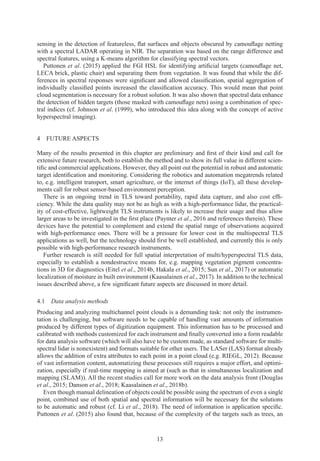
Figure 2.1. Example of target identification from a multispectral point cloud: camouflage and artificial tar-
gets can be separated from vegetation based on both spectral and shape recognition. The same applies for
tree trunks and leaves. Point cloud obtained with the FGI HSL (Hakala et al., 2012; Nevalainen et al., 2014;
Puttonen et al., 2015).
Source: Image by Olli Nevalainen, FGI.
range information from a traditional lidar. Comparison of results to those from single-wavelength
lidar or traditional passive remote sensing only indicated that a higher classification was achieved
with simultaneous multispectral and spatial data.
3.2.2 
Defense and security applications
There has been a long interest in active spectral imaging for military applications. Besides target
classification, detection of concealed targets, e.g. those behind a camouflage nets have been an
object of interest (Johnson et al., 1999; Nischan et al., 2003; Powers and Davis, 2012). Other
important features in defense- and security-related imaging are the eye safety and the capability of
long-range measurement, even up to 1 km (Manninen et al., 2014). 3D spectral point clouds have
been utilized by Powers and Davis (2012), who demonstrated the advantages over passive spectral
13
sensing in the detection of featureless, flat surfaces and objects obscured by camouflage netting
with a spectral LADAR operating in NIR. The separation was based on the range difference and
spectral features, using a K-means algorithm for classifying spectral vectors.
Puttonen et al. (2015) applied the FGI HSL for identifying artificial targets (camouflage net,
LECA brick, plastic chair) and separating them from vegetation. It was found that while the dif-
ferences in spectral responses were significant and allowed classification, spatial aggregation of
individually classified points increased the classification accuracy. This would mean that point
cloud segmentation is necessary for a robust solution. It was also shown that spectral data enhance
the detection of hidden targets (those masked with camouflage nets) using a combination of spec-
tral indices (cf. Johnson et al. (1999), who introduced this idea along with the concept of active
hyperspectral imaging).
4 
FUTURE ASPECTS
Many of the results presented in this chapter are preliminary and first of their kind and call for
extensive future research, both to establish the method and to show its full value in different scien-
tific and commercial applications. However, they all point out the potential in robust and automatic
target identification and monitoring. Considering the robotics and automation megatrends related
to, e.g. intelligent transport, smart agriculture, or the internet of things (IoT), all these develop-
ments call for robust sensor-based environment perception.
There is an ongoing trend in TLS toward portability, rapid data capture, and also cost effi-
ciency. While the data quality may not be as high as with a high-performance lidar, the practical-
ity of cost-effective, lightweight TLS instruments is likely to increase their usage and thus allow
larger areas to be investigated in the first place (Paynter et al., 2016 and references therein). These
devices have the potential to complement and extend the spatial range of observations acquired
with high-performance ones. There will be a pressure for lower cost in the multispectral TLS
applications as well, but the technology should first be well established, and currently this is only
possible with high-performance research instruments.
Further research is still needed for full spatial interpretation of multi/hyperspectral TLS data,
especially to establish a nondestructive means for, e.g. mapping vegetation pigment concentra-
tions in 3D for diagnostics (Eitel et al., 2014b, Hakala et al., 2015; Sun et al., 2017) or automatic
localization of moisture in built environment (Kaasalainen et al., 2017). In addition to the technical
issues described above, a few significant future aspects are discussed in more detail.
4.1 
Data analysis methods
Producing and analyzing multichannel point clouds is a demanding task: not only the instrumen-
tation is challenging, but software needs to be capable of handling vast amounts of information
produced by different types of digitization equipment. This information has to be processed and
calibrated with methods customized for each instrument and finally converted into a form readable
for data analysis software (which will also have to be custom made, as standard software for multi-
spectral lidar is nonexistent) and formats suitable for other users. The LASer (LAS) format already
allows the addition of extra attributes to each point in a point cloud (e.g. RIEGL, 2012). Because
of vast information content, automatizing these processes still requires a major effort, and optimi-
zation, especially if real-time mapping is aimed at (such as that in simultaneous localization and
mapping (SLAM)). All the recent studies call for more work on the data analysis front (Douglas
et al., 2015; Danson et al., 2018; Kaasalainen et al., 2018b).
Even though manual delineation of objects could be possible using the spectrum of even a single
point, combined use of both spatial and spectral information will be necessary for the solutions
to be automatic and robust (cf. Li et al., 2018). The need of information is application specific.
Puttonen et al. (2015) also found that, because of the complexity of the targets such as trees, an
14
individual laser return can have almost any intensity, and hence it is difficult to identify a source of
a single return. It was also shown that more than one spectral index was needed to separate some
camouflage objects from organic ones. Kaasalainen et al. (2018a) found that for vegetation, leaf
angles affect the spectrum of some plants, and a physical correction of this inaccuracy is not real-
istic. This may introduce uncertainty in the vegetation indices.
While spectral (vegetation) indices have played a major role in multispectral lidar studies so far,
other detection methods, such as spectral unmixing algorithms (Powers and Davis, 2012; Altmann
et al., 2015) can be applied. This calls for increasing the number of channels (from two or four),
which is most practical by the use of supercontinuum lasers. Du et al. (2016) suggested that adding
more channels improves the classification accuracy in the SVM regression.
4.2 Measurement geometry
Effects of measurement geometry, in this case, the incidence angle must be better understood.
They have recently been shown to affect the spectral indices measured with laser scanners (Eitel et
al., 2014a, Hancock et al., 2017). It is not possible to correct these for leaf canopies since the leaf
incidence angle is mostly not known. Therefore, an empirical correction scheme may turn out to
be the only alternative for vegetation (Kaasalainen et al., 2018a) but in any case, the variation in
incidence angles is likely to limit the accuracy of leaf spectral data (Hancock et al., 2017). Further
work is also needed to find out whether the incidence angle behavior would be different for relative
(such as NDVI) or absolute vegetation indices (MCARI; cf. Nevalainen et al., 2014). Gaulton et
al. (2013) and Shi et al. (2015) did not observe the incidence angle effect but discussed the use
of relative indices to cancel out or reduce it. Some targets do not exhibit any difference between
wavelengths, such as a sample of wet snow (Anttila et al., 2016). It is clear that more testing and
further experiments are needed.
4.3 
Eye safety versus number of channels
Near-infrared lasers have provided useful in moisture estimation (Gaulton et al., 2013; Manninen
et al., 2014), and it is possible to build systems that meet the eye safety requirements. Overall, the eye
safety problem is easier to tackle with instruments operating at discrete laser wavelengths, because
they are easier to detect, as all laser power is concentrated on narrow wavelength bands. The down-
side is the inaccuracy in the co-alignment of the laser beams (Li et al., 2018). Then again, super-
continuum lasers provide the only way to increase the number of channels or make a hyperspectral
implementation. For visible wavelengths, filtering is one option, especially if the number of channels
can be limited. For experiments carried out in laboratory or indoor environments (such as tunnels),
this problem may be solved with traditional laser safety measures (limiting the access, safety goggles,
etc.). Furthermore, the need for laser power in supercontinuum applications may decrease along with
improving detectors as the technical readiness level increases from prototype level, or the power can
be otherwise lowered in close-range experiments. In any case, hyperspectral TLS utilizing supercon-
tinuum lasers may never be a multipurpose instrument, but it should be tailored for the purpose to
optimize the laser safety vs. wavelength range. Technical solutions enabling versatility will be crucial.
5 
SUMMARY
Multispectral lidars represent the next generation of terrestrial laser scanning. This chapter has
reviewed the current state of the art and discussed the prospects and challenges related to instru-
mentation, usage, and data interpretation from multispectral TLS. Once these challenges have been
tackled, multispectral TLS will provide comprehensive environment perception and target identifi-
cation in an entirely new level of robustness, detail, and accuracy. It has already been shown with
the applications demonstrated so far that multispectral TLS has the potential of disrupting many
Another Random Scribd Document
with Unrelated Content
recusaram—Carlos de pé junto da mesa onde terminára por pousar
a bengala, Ega passando a outra gravura onde dois frades se
emborrachavam. Depois, quando o criado sahiu, Ega acercou-se,
tocou com bonhomia no hombro do jornalista:
—Cem mil reis são uma linda somma, Palma amigo! E olhe que se
lhe offerecem por delicadeza comsigo. Porque artiguinhos como este
da Corneta, apresentados na Boa-Hora, levam á grilheta!... Está
claro, este caso é outro, vossê não teve intenção d'offender; mas
levam á grilheta!... Foi assim que o Severino marchou para a Africa.
Alli no porãosinho d'um navio, com ração de marujo e chibatadas.
Desagradavel, muito desagradavel. Por isso eu quiz que tratassemos
isto aqui, entre cavalheiros, e em amizade.
Palma, com a cabeça baixa, desfazia torrões de assucar dentro do
copo de genebra. E suspirou, findou por dizer, um pouco murcho,
que era por ser entre cavalheiros, e com amizade, que aceitava os
cem mil reis...
Immediatamente Carlos tirou da algibeira das calças um punhado de
libras, que começou a deixar cahir em silencio uma a uma dentro
d'um prato. E Palma Cavallão, agitado com o tinir do ouro,
desabotoou logo o jaquetão, sacou uma carteira onde reluzia um
pesado monogramma de prata sob uma enorme corôa de visconde.
Os dedos tremiam-lhe; por fim desdobrou, estendeu tres papeis
sobre a mesa. Ega, que esperava, com o monoculo sôfrego, teve um
brado de triumpho. Reconhecera a letra do Damaso!
Carlos examinou os papeis lentamente. Era uma carta do Damaso ao
Palma, curta e em calão, remettendo o artigo, recommendando-lhe
«que o apimentasse». Era o rascunho do artigo, laboriosamente
trabalhado pelo Damaso, com entrelinhas. Era a lista, escripta pelo
Damaso, das pessoas que deviam receber a Corneta: vinha lá a
Gouvarinho, o ministro do Brazil, D. Maria da Cunha, El-Rei, todos os
amigos do Ramalhete, o Cohen, varias authoridades, e a Fancelli
prima-donna...
Palma no emtanto, nervoso, rufava com os dedos sobre a toalha,
junto ao prato onde reluziam as libras. E foi o Ega que o animou,
depois de relancear os olhos aos documentos por cima do hombro
de Carlos:
—Recolha o bago, amigo Palma! Negocios são negocios, e o
baguinho está ahi a arrefecer!
Então, ao palpar o ouro, Palma Cavallão commoveu-se. Palavra,
caramba, se soubesse que se tratava d'um cavalheiro como o snr.
Maia não tinha aceitado o artigo! Mas então!... Fôra o Eusebio
Silveira, rapaz amigo, que lhe viera fallar. Depois o Salcede. E ambos
com muitas lérias, e que era uma brincadeira, e que o Maia não se
importava, e isto e aquillo, e muita promessa... Emfim deixára-se
tentar. E tanto o Salcede como o Silveira se tinham portado
pulhamente.
—Foi uma sorte que se escangalhasse a machina! Senão estava
agora entalado, irra! E tinha desgosto, palavra, caramba, tinha
desgosto! Mas acabou-se! O mal não foi grande, e sempre se fez
alguma coisa pela porca da vida.
Vivamente, com um olhar, recontára o dinheiro na palma da mão:
depois esvaziou a genebra, d'um trago consolado e ruidoso. Carlos
guardára as cartas do Damaso, levantava já o fecho da porta. Mas
voltou-se ainda, n'uma derradeira averiguação:
—Então esse meu amigo Eusebio Silveira tambem se metteu no
negocio?...
O snr. Palma, muito lealmente, afiançou que o Eusebio lhe fallára
apenas em nome do Damaso!
—O Eusebio, coitado, veio só como embaixador... Que o Damaso e
eu não vamos muito na mesma bola. Ficámos exquisitos, desde uma
péga em casa da Biscainha. Aqui p'ra nós, eu prometti-lhe dois
estalos na cara, e elle embuchou. Passados tempos tornámos a
fallar, quando eu fazia o High-life na Verdade. Elle veio-me pedir com
bons modos, em nome do conde de Landim, para eu dar umas
piadas catitas sobre um baile d'annos... Depois, quando o Damaso
fez tambem annos, eu dei outra piadita. Elle pagou a ceia, ficámos
mais calhados... Mas é traste... E lá o Eusebiosinho, coitado, veio só
d'embaixador.
Sem uma palavra, sem um aceno ao Palma, Carlos virou as costas,
deixou o cubiculo. O redactor da Corneta ainda baixou a cabeça para
a porta; depois, sem se offender, voltou alegremente á genebra,
dando outro puxão ás calças. Ega no emtanto accendia devagar o
charuto.
—Vossê agora é que redige o jornal todo, Palma?
—O Silvestre, tambem...
—Que Silvestre?
—O que está com a Pingada. Vossê não conhece, creio eu. Um
rapazola magro, que não é feio... Semsaborão, escreve uma
palhada... Mas sabe coisas da sociedade. Esteve um tempo com a
viscondessa de Cabellas, que elle chama a sua cabelluda... Que o
Silvestre ás vezes tem graça! E sabe, sabe coisas da sociedade,
assim maroteiras de fidalgos, amigações, pulhices... Vossê nunca leu
nada d'elle? Chôcho. Tenho sempre de lhe arranjar o estylo... N'este
numero é que havia um folhetimzito meu, catita, cá á moderna,
como eu gósto, alli com a piadinha realista a bater... Emfim fica para
outra vez. E outra coisa, Ega, olhe que lhe agradeço. Quando quizer,
eu e a Corneta ás ordens!
Ega estendeu-lhe a mão:
—Obrigado, digno Palma! E adiós!
—Pues vaya usted con Dios, Don Juanito! exclamou logo o
benemerito homem com infinito salero.
Em baixo Carlos esperava, dentro do coupé.
—E agora? perguntou Ega, á portinhola.
—Agora salta para dentro e vamos liquidar com o Damaso...
Carlos já esboçára summariamente o plano d'essa liquidação. Queria
mandar desafiar o Damaso como author comprovado d'um artigo de
jornal que o injuriava. O duello devia ser á espada ou ao florete, um
d'esses ferros cujo lampejo, na sala d'armas do Ramalhete, fazia
empallidecer o Damaso. Se contra toda a verosimilhança elle se
batesse, Carlos fazia-lhe algures, entre a bochecha e o ventre, um
furo que o cravasse mezes na cama. Senão a unica explicação que
Carlos aceitaria do snr. Salcede seria um documento em que elle
escrevesse esta coisa simples: «Eu abaixo assignado declaro que sou
um infame.» E para estes serviços Carlos contava com o Ega.
—Agradeço! agradeço! Vamos a isso! exclamava o Ega esfregando
as mãos, faiscando de jubilo.
No emtanto, dizia elle, a etiqueta funebre reclamava outro padrinho;
e lembrou o Cruges, moço passivo e malleavel. Mas era impossivel
encontrar o maestro, porque invariavelmente a criada affirmava que
o menino Victorino não estava em casa... Decidiram ir ao Gremio,
mandar de lá um bilhete chamando o Cruges—«para um caso
urgente d'amizade e d'arte».
—Com quê, dizia o Ega continuando a esfregar as mãos emquanto a
tipoia trotava para a rua de S. Francisco, com quê, demolir o nosso
Damaso?
—Sim, é necessario acabar com esta perseguição. Chega a ser
ridiculo... E com uma estocada, ou com a carta, temos esse biltre
aniquilado por algum tempo. Eu preferia a estocada. Senão deixo-te
a ti arranjar os termos d'uma carta forte...
—Has de ter uma boa carta! disse o Ega com um sorriso de
ferocidade.
No Gremio, depois de redigirem o bilhete ao Cruges, vieram esperar
por elle na sala das Illustrações. O conde de Gouvarinho e
Steinbroken conversavam de pé, no vão d'uma janella. E foi uma
surpreza. O ministro da Filandia abriu os braços para o cher Maia,
que elle não vira desde a partida d'Affonso para Santa Olavia.
Gouvarinho acolheu o Ega risonhamente, reatando uma certa
camaradagem que entre elles se formára n'esse verão, em Cintra:
mas o aperto de mão a Carlos foi sêcco e curto. Já dias antes,
tendo-se encontrado no Loreto, o Gouvarinho murmurára de leve e
de passagem «um como está, Maia?» em que se sentia
arrefecimento. Ah! já não eram essas effusões, essas palmadas
enternecidas pelos hombros, dos tempos em que Carlos e a
condessa fumavam cigarettes na cama da titi em Santa Isabel.
Agora que Carlos abandonára a snr.a
condessa de Gouvarinho, a rua
de S. Marçal e o commodo sofá em que ella cahia com um rumor de
saias amarrotadas—o marido amuava, como abandonado tambem.
—Tenho tido saudade das nossas bellas discussões em Cintra! disse
elle, dando ao Ega a palmada carinhosa nas costas que outr'ora
pertencia ao Maia. Tivemol-as de primeira ordem!
Eram realmente «pégas tremendas» no pateo do Victor sobre
litteratura, sobre religião, sobre moral... Uma noite mesmo tinham-
se zangado por causa da divindade de Jesus.
—É verdade! acudiu o Ega. Vossê n'essa noite parecia ter ás costas
uma opa de irmão do Senhor dos Passos!
O conde sorriu. Irmão do Senhor dos Passos não, graças a Deus!
Ninguem melhor do que elle sabia que n'esses sublimes episodios do
Evangelho reinava bastante lenda... Mas emfim eram lendas que
serviam para consolar a alma humana. É o que elle objectára n'essa
noite ao amigo Ega... Sentiam-se a philosophia e o racionalismo
capazes de consolar a mãi que chora? Não. Então...
—Em todo o caso, tivemol-as brilhantes! concluiu elle olhando o
relogio. E, eu confesso, uma discussão elevada sobre religião, sobre
metaphysica, encanta-me... Se a politica me deixasse vagares
dedicava-me á philosophia... Nasci para isso, para aprofundar
problemas.
Steinbroken no emtanto, esticado na sua sobrecasaca azul, com um
raminho d'alecrim ao peito, tomára as mãos de Carlos:
—Mais vous êtes encore devenu plus fort!... Et Affonso da Maia,
toujours dans ses terres?... Est-ce qu'on ne va pas le voir un peu cet
hiver?
E immediatamente lamentou não ter visitado Santa Olavia. Mas quê!
a familia real installára-se em Cintra; elle fôra forçado a acompanhal-
a, fazer a sua côrte... Depois necessitára ir de fugida a Inglaterra
d'onde acabava de chegar, havia dias.
Sim, Carlos sabia, vira na Gazeta Illustrada...
—Vous avez lu ça? Oh oui, on a été très aimable, très aimable pour
moi à la Gazette...
Tinham-lhe annunciado a partida, depois a chegada, com palavras
de amizade particularmente bem escolhidas. Nem podia deixar de
ser, dada esta affeição sincera que liga Portugal e a Filandia... «Mais
enfin on avait été charmant, charmant!...»
—Seulement—ajuntou elle, sorrindo com finura e voltando-se
tambem para o Gouvarinho—on a fait une petite erreur... On a dit
que j'étais venu de Southampton par le Royal Mail... Ce n'est pas
vrai, non! Je me suis embarqué à Bordeaux dans les Messageries.
J'ai même pensé à écrire à Mr. Pinto, redacteur de la Gazette, qui est
un charmant garçon... Puis, j'ai reflechi, je me suis dit: «Mon Dieu,
on va croire que je veux donner une leçon d'exactitude à la Gazette,
c'est très grave...» Alors, voilà, très prudemment, j'ai gardé le
silence... Mais enfin c'est une erreur: je me suis embarqué à
Bordeaux.
Ega murmurou que a Historia se encarregaria um dia de rectificar
esse facto. O ministro sorria modestamente, fazendo um gesto em
que parecia desejar, por polidez, que a Historia se não
incommodasse. E então o Gouvarinho, que accendêra o charuto,
espreitára outra vez o relogio, perguntou se os amigos tinham
ouvido alguma coisa do ministerio e da crise.
Foi uma surpreza para ambos, que não tinham lido os jornaes...
Mas, exclamou logo o Ega, crise porquê, assim em pleno remanso,
com as camaras fechadas, tudo contente, um tão lindo tempo
d'outono?
O Gouvarinho encolheu os hombros com reserva. Houvera na
vespera, á noitinha, uma reunião de ministros; n'essa manhã o
presidente do conselho fôra ao paço, fardado, determinado a «largar
o poder»... Não sabia mais. Não conferenciára com os seus amigos,
nem mesmo fôra ao seu Centro. Como n'outras occasiões de crise,
conservára-se retirado, calado, esperando... Alli estivera toda a
manhã, com o seu charuto, e a Revista dos Dois Mundos.
Isto parecia a Carlos uma abstenção pouco patriotica...
—Porque emfim, Gouvarinho, se os seus amigos subirem...
—Exactamente por isso, acudiu o conde com uma côr viva na face,
não desejo pôr-me em evidencia... Tenho o meu orgulho, talvez
motivos para o ter... Se a minha experiencia, a minha palavra, o meu
nome são necessarios, os meus correligionarios sabem onde eu
estou, venham pedir-m'os...
Calou-se, trincando nervosamente o charuto. E Steinbroken, perante
estas coisas politicas, começou logo a retrahir-se para o fundo da
janella, limpando os vidros da luneta, recolhido, já impenetravel, no
grande recato neutral que competia á Filandia. Ega no emtanto não
sahia do seu espanto. Mas porque cahia, porque cahia assim um
governo com maioria nas camaras, socego no paiz, o apoio do
exercito, a benção da Igreja, a protecção do Comptoir
d'Escompte?...
O Gouvarinho correu devagar os dedos pela pera, e murmurou esta
razão:
—O ministerio estava gasto.
—Como uma vela de sebo? exclamou Ega, rindo.
O conde hesitou. Como uma vela de sebo não diria... Sebo
subentendia obtusidade... Ora n'este ministerio sobrava o talento.
Incontestavelmente havia lá talentos pujantes...
—Essa é outra! gritou Ega atirando os braços ao ar. É extraordinario!
N'este abençoado paiz todos os politicos têm immenso talento. A
opposição confessa sempre que os ministros, que ella cobre
d'injurias, têm, á parte os disparates que fazem, um talento de
primeira ordem! Por outro lado a maioria admitte que a opposição, a
quem ella constantemente recrimina pelos disparates que fez, está
cheia de robustissimos talentos! De resto todo o mundo concorda
que o paiz é uma choldra. E resulta portanto este facto supra-
comico: um paiz governado com immenso talento, que é de todos
na Europa, segundo o consenso unanime, o mais estupidamente
governado! Eu proponho isto, a vêr: que como os talentos sempre
falham, se experimentem uma vez os imbecis!
O conde sorria com bonhomia e superioridade a estes exageros de
phantasista. E Carlos, ancioso por ser amavel, atalhou, accendendo
o charuto no d'elle:
—Que pasta preferiria você, Gouvarinho, se os seus amigos
subissem? A dos Estrangeiros, está claro...
O conde fez um largo gesto d'abnegação. Era pouco natural que os
seus amigos necessitassem da sua experiencia politica. Elle tornára-
se sobretudo um homem d'estudo e de theoria. Além d'isso não
sabia bem se as occupações da sua casa, a sua saude, os seus
habitos lhe permittiriam tomar o fardo do governo. Em todo o caso,
decerto, a pasta dos Estrangeiros não o tentava...
—Essa, nunca! proseguiu elle, muito compenetrado. Para se poder
fallar d'alto na Europa, como ministro dos Estrangeiros, é necessario
ter por traz um exercito de duzentos mil homens e uma esquadra
com torpedos. Nós, infelizmente, somos fracos... E eu, para papeis
subalternos, para que venha um Bismarck, um Gladstone, dizer-me
«ha de ser assim», não estou!... Pois não acha, Steinbroken?
O ministro tossiu, balbuciou:
—Certainement... C'est très grave... C'est excessivement grave...
Ega então affirmou que o amigo Gouvarinho, com o seu interresse
geographico pela Africa, faria um ministro da Marinha iniciador,
original, rasgado...
Toda a face do conde reluzia, escarlate de prazer.
—Sim, talvez... Mas eu lhe digo, meu querido Ega, nas colonias
todas as coisas bellas, todas as coisas grandes estão feitas.
Libertaram-se já os escravos; deu-se-lhes já uma sufficiente noção
da moral christã; organisaram-se já os serviços aduaneiros... Emfim
o melhor está feito. Em todo o caso ha ainda detalhes interessantes
a terminar... Por exemplo, em Loanda... Menciono isto apenas como
um pormenor, um retoque mais de progresso a dar. Em Loanda
precisava-se bem um theatro normal como elemento civilisador!
N'esse momento um criado veio annunciar a Carlos—que o snr.
Cruges estava em baixo, no portal, á espera. Immediatamente os
dois amigos desceram.
—Extraordinario, este Gouvarinho! dizia o Ega na escada.
—E este, observou Carlos com um immenso desdem de mundano, é
um dos melhores que ha na politica. Pensando mesmo bem, e
mettendo a roupa branca em linha de conta, este é talvez o melhor!
Acharam o Cruges á porta, de jaquetão claro, embrulhando um
cigarro. E Carlos pediu-lhe logo que voltasse a casa vestir uma
sobrecasaca preta. O maestro arregalava os olhos.
—É jantar?
—É enterro.
E rapidamente, sem alludir a Maria, contaram ao maestro que o
Damaso publicára n'um jornal, a Corneta do Diabo (cuja tiragem
elles tinham supprimido, não sendo possivel por isso mostrar o
numero immundo) um artigo em que a coisa mais dôce que se
chamava a Carlos era pulha. Portanto Ega e elle Cruges iam a casa
do Damaso pedir-lhe a honra ou a vida.
—Bem, rosnou o maestro. Que tenho eu a fazer?... Que eu d'essas
coisas não entendo.
—Tens, explicou Ega, d'ir vestir uma sobrecasaca preta e franzir o
sobr'olho. Depois vir commigo; não dizer nada; tratar o Damaso por
«v. exc.a
»; assentar em tudo o que eu propuzer; e nunca desfranzir
o sobr'olho nem despir a sobrecasaca...
Sem outra observação, Cruges partiu a cobrir-se de ceremonia e de
negro. Mas no meio da rua retrocedeu:
—Ó Carlos, olha que eu fallei lá em casa. Os quartos do primeiro
andar estão livres, e forrados de papel novo...
—Obrigado. Vai-te fazer sombrio, depressa!...
O maestro abalára, quando diante do Gremio estacou a todo o trote
uma caleche. De dentro saltou o Telles da Gama que, ainda com a
mão no fecho da portinhola, gritou aos dois amigos:
—O Gouvarinho? está lá em cima?
—Está... Novidade fresca?
—Os homens cahiram. Foi chamado o Sá Nunes!
E enfiou pelo pateo, correndo. Carlos e Ega continuaram devagar até
ao portão do Cruges. As janellas do primeiro andar estavam abertas,
sem cortinas. Carlos, erguendo para lá os olhos, pensava n'essa
tarde das corridas em que elle viera no phaeton, de Belem, para vêr
aquellas janellas: ia então escurecendo, por traz dos stores fechados
surgira uma luz, elle contemplára-a como uma estrella inaccessivel...
Como tudo passa!
Retrocederam para o Gremio. Justamente o Gouvarinho e Telles
atiravam-se á pressa para dentro da caleche que esperára. Ega
parou, deixou cahir os braços:
—Lá vae o Gouvarinho batendo para o Poder, a mandar representar
a Dama das Camelias no sertão! Deus se amerceie de nós!
Mas o Cruges appareceu emfim de chapéo alto, entalado n'uma
sobrecasaca solemne, com botins novos de verniz. Apilharam-se logo
na tipoia estreita e dura. Carlos ia leval-os a casa do Damaso. E
como queria ainda jantar nos Olivaes, esperaria por elles, para saber
o resultado «do chinfrin», no jardim da Estrella, junto ao coreto.
—Sêde rapidos e medonhos!
A casa do Damaso, velha e d'um andar só, tinha um enorme portão
verde, com um arame pendente que fez resoar dentro uma sineta
triste de convento: e os dois amigos esperaram muito antes que
apparecesse, arrastando as chinelas, o gallego achavascado que o
Damaso (agora livre de Carlos e das suas pompas) já não trazia
torturado em botins crueis de verniz. A um canto do pateo uma
portinha abria sobre a luz d'um quintal, que parecia ser um deposito
de caixotes, de garrafas vazias e de lixo.
O gallego, que reconhecera o snr. Ega, conduziu-os logo, por uma
escadinha esteirada, a um corredor largo, escuro, com cheiro a
môfo. Depois, batendo o chinelo, correu ao fundo, onde alvejava a
claridade d'uma porta entreaberta. Quasi immediatamente Damaso
gritou de lá:
—Ó Ega, é você? Entre para aqui, homem! Que diabo!... Eu estou-
me a vestir...
Embaraçado com estes brados de intimidade e tanta effusão, Ega
ergueu a voz da sombra do corredor, gravemente:
—Não tem duvida, nós esperamos...
O Damaso insistia, á porta, em mangas de camisa, cruzando os
suspensorios:
—Venha você, homem! Que diabo, eu não tenho vergonha, já estou
de calças!
—Ha aqui uma pessoa de ceremonia, gritou o Ega para findar.
A porta ao fundo cerrou-se, o gallego veio abrir a sala. O tapete era
exactamente igual aos dos quartos de Carlos no Ramalhete. E em
redor abundavam os vestigios da antiga amizade com o Maia: o
retrato de Carlos a cavallo, n'um vistoso caixilho de flôres em
faiança: uma das colchas da India das senhoras Medeiros, branca e
verde, enroupando o piano, arranjada por Carlos com alfinetes: e
sobre um contador hespanhol, debaixo de redoma, um sapatinho de
setim de mulher, novo, que o Damaso comprára no Serra, por ter
ouvido um dia a Carlos que «em todo o quarto de rapaz deve
apparecer, discretamente disposta, alguma reliquia d'amor...»
Sob estes retoques de chic, dados á pressa sob a influencia do Maia,
impertigava-se a sólida mobilia do pai Salcede, de mogno e velludo
azul; a console de marmore, com um relogio de bronze dourado,
onde Diana acariciava um galgo; o grande e dispendioso espelho,
tendo entalado no caixilho uma fila de bilhetes de visita, de retratos
de cantoras, de convites para soirées. E Cruges ia examinar estes
documentos, quando os passos alegres do Damaso soaram no
corredor. O maestro correu logo a perfilar-se ao lado do Ega, diante
do canapé de velludo, teso, commodo, com o seu chapéo alto na
mão.
Ao vêl-o, o bom Damaso, que se abotoára todo n'uma sobrecasaca
azul, florida por um botão de camelia, atirou risonhamente os braços
ao ar:
—Então esta é que é a pessoa de ceremonia? Sempre vocês têm
coisas! E eu a pôr sobrecasaca... Por pouco que não lhe afinfo com o
habito de Christo!...
Ega atalhou, muito sério:
—O Cruges não é de ceremonia, mas o motivo que aqui nos traz é
delicado e grave, Damaso.
Damaso arregalou os olhos, reparando emfim n'aquelle estranho
modo dos seus amigos, ambos de negro, seccos, tão solemnes. E
recuou, todo o sorriso se lhe apagou na face.
—Que diabo é isso? Sentem-se, sentem-se vocês...
A voz apagava-se-lhe tambem. Pousado á borda d'uma poltrona
baixa, junto d'uma mesa coberta d'encadernações ricas, com as
mãos nos joelhos, ficou esperando, n'uma anciedade.
—Nós vimos aqui, começou Ega, em nome do nosso amigo Carlos da
Maia...
Uma brusca onda de sangue cobriu a face rechonchuda do Damaso
até á risca do cabello encaracolado a ferro. E não achou uma
palavra, attonito, suffocado, esfregando estupidamente os joelhos.
Ega proseguiu, lento, direito no canapé:
—O nosso amigo Carlos da Maia queixa-se de que o Damaso
publicou, ou fez publicar, um artigo extremamente injurioso para elle
e para uma senhora das relações d'elle na Corneta do Diabo...
—Na Corneta, eu? acudiu o Damaso, balbuciando. Que Corneta?
Nunca escrevi em jornaes, graças a Deus! Ora essa, a Corneta!...
Ega, muito friamente, tirou do bolso um masso de papeis. E veio
collocal-os um por um, ao lado do Damaso, na mesa, sobre um
magnifico volume da Biblia de Doré.
—Aqui está a sua carta remettendo ao Palma Cavallão o rascunho do
artigo... Aqui está, pela sua letra igualmente, a lista das pessoas a
quem se devia mandar a Corneta, desde o Rei até á Fancelli... Além
d'isso nós temos as declarações do Palma. O Damaso é não só o
inspirador, mas materialmente o auctor do artigo... O nosso amigo
Carlos da Maia exige, pois, como injuriado, uma reparação pelas
armas...
Damaso deu um salto da poltrona, tão arrebatado—que
involuntariamente Ega recuou, no receio d'uma brutalidade. Mas já o
Damaso estava no meio da sala, esgazeado, com os braços tremulos
no ar:
—Então o Carlos manda-me desafiar? A mim?... Que lhe fiz eu? Elle
a mim é que me pregou uma partida!... Foi elle, vocês sabem
perfeitamente que foi elle!...
E desabafou, n'um prodigioso fluxo de loquacidade, atirando
palmadas ao peito, com os olhos marejados de lagrimas. Fôra
Carlos, Carlos, que o desfeitiára a elle, mortalmente! Durante todo o
inverno tinha-o perseguido para que elle o apresentasse a uma
senhora brazileira muito chic, que vivia em Paris, e que lhe fazia
olho... E elle, bondoso como era, promettia, dizia: «Deixa estar, eu
te apresento!» Pois, senhores, que faz Carlos? Aproveita uma
occasião sagrada, um momento de luto, quando elle Damaso fôra ao
Norte por causa da morte do tio, e mette-se dentro da casa da
brazileira... E tanto intriga, que leva a pobre senhora a fechar-lhe a
sua porta, a elle, Damaso, que era intimo do marido, intimo de tu!
Caramba, elle é que devia mandar desafiar Carlos! Mas não! fôra
prudente, evitára o escandalo por causa do snr. Affonso da Maia...
Queixára-se de Carlos, é verdade... Mas no Gremio, na Casa
Havaneza, entre rapaziada amiga... E no fim Carlos préga-lhe uma
d'estas!
—Mandar-me desafiar, a mim! A mim, que todo o mundo conhece!...
Calou-se, engasgado. E Ega, estendendo a mão, observou
placidamente que se desviavam do ponto vivo da questão. O
Damaso concebera, rascunhára, pagára o artigo da Corneta. Isso
não o negava, nem o podia negar: as provas estavam alli, abertas
sobre a mesa: elles tinham além d'isso a declaração do Palma...
—Esse desavergonhado! gritou o Damaso, levado n'outra rajada
d'indignação que o fez redemoinhar, estonteado, tropeçando nos
moveis. Esse descarado do Palma! Com esse é que eu me quero
vêr!... Lá a questão com o Carlos não vale nada, arranja-se, somos
todos rapazes finos... Com o Palma é que é! Esse traidor é que eu
quero rachar! Um homem a quem eu tenho dado ás meias libras,
aos sete mil reis! E ceias, e tipoias! Um ladrão que pediu o relogio
ao Zeferino para figurar n'um baptisado, e pôl-o no prégo!... E faz-
me uma d'estas!... Mas hei de escavacal-o! Onde é que você o viu,
Ega? Diga lá, homem! Que quero ir procural-o, hoje mesmo, correl-o
a chicotadas... Traições não, não admitto a ninguem!
Ega, com a tranquillidade paciente de quem sente a prêsa certa,
lembrou de novo a inutilidade d'aquellas divagações:
—Assim nunca acabamos, Damaso... O nosso ponto é este: o
Damaso injuriou Carlos da Maia: ou se retracta publicamente d'essa
injuria, ou dá uma reparação pelas armas...
Mas o Damaso, sem escutar, appellava desesperadamente para o
Cruges, que se não movera do sofá de velludo, esfregando, um
contra o outro, com um ar arripiado e de dôr, os dois sapatos novos
de verniz.
—Aquelle Carlos! Um homem que se dizia meu amigo intimo! Um
homem que fazia de mim tudo! Até lhe copiava coisas... Você bem
viu, Cruges. Diga! Falle, homem! Não sejam vocês todos contra
mim!... Até ás vezes ia á alfandega despachar-lhe caixotes...
O maestro baixava os olhos, vermelho, n'um infinito mal-estar. E
Ega, por fim, já farto, lançou uma intimação derradeira:
—Em resumo, Damaso, desdiz-se ou bate-se?
—Desdizer-me? tartamudeou o outro, impertigando-se, n'um penoso
esforço de dignidade, a tremer todo. E de quê? Ora essa! É boa! Eu
sou lá homem que me desdiga!
—Perfeitamente, então bate-se...
Damaso cambaleou para traz, desvairado:
—Qual bater-me! Eu sou lá homem que me bata! Eu cá é a sôcco.
Que venha para cá, não tenho medo d'elle, arrombo-o...
Dava pulinhos curtos de gordo, através do tapete, com os punhos
fechados e em riste. E queria Carlos alli para o escavacar! Não lhe
faltava mais senão bater-se... E então duellos em Portugal, que
acabavam sempre por troça!
Ega no emtanto, como se a sua missão estivesse finda, abotoára a
sobrecasaca e recolhia os papeis espalhados sobre a Biblia. Depois,
serenamente, fez a ultima declaração de que fôra incumbido. Como
o snr. Damaso Salcede recusava retractar-se e rejeitava tambem
uma reparação pelas armas, Carlos da Maia prevenia-o de que em
qualquer parte que o encontrasse d'ahi por diante, fosse uma rua,
fosse um theatro, lhe escarraria na face...
—Escarrar-me! berrou o outro, livido, recuando, como se o escarro
já viesse no ar.
E de repente, espavorido, coberto de bagas de suor, precipitou-se
sobre o Ega, agarrando-lhe as mãos, n'uma agonia:
—Ó João, ó João, tu, que és meu amigo, por quem és, livra-me
d'esta entaladella!
Ega foi generoso. Desprendeu-se d'elle, empurrou-o brandamente
para a poltrona, calmando-o com palmadinhas fraternaes pelo
hombro. E declarou que, desde que Damaso appellava para a sua
amizade, desapparecia o enviado de Carlos necessariamente
exigente, ficava só o camarada, como no tempo dos Cohens e da
villa Balzac. Queria pois o amigo Damaso um conselho? Era assignar
uma carta affirmando que tudo o que fizera publicar na Corneta
sobre o snr. Carlos da Maia e certa senhora fôra invenção falsa e
gratuita. Só isto o salvava. D'outro modo, Carlos um dia, no Chiado,
em S. Carlos, escarrava-lhe na cara. E, dado esse desastre,
Damasosinho, a não querer ser apontado em Lisboa como um
incomparavel cobarde, tinha de se bater á espada ou á pistola...
—Ora, em qualquer d'esses casos, você era um homem morto.
O outro escutava, esbarrondado no fundo do assento de velludo,
com a face emparvecida para o Ega. Alargou mollemente os braços,
murmurou da profundidade do seu terror:
—Pois sim, eu assigno, João, eu assigno...
—É o que lhe convém... Arranje então papel. Você está perturbado,
eu mesmo redijo.
Damaso ergueu-se, com as pernas frouxas, atirando um olhar tonto
e vago por sobre os moveis:
—Papel de carta? É para carta?
—Sim, está claro, uma carta ao Carlos!
Os passos do desgraçado perderam-se emfim no corredor, pesados e
succumbidos.
—Coitado! suspirou o Cruges levando de novo, com um ar de arripio,
a mão aos sapatos.
Ega lançou-lhe um chut severo. Damaso voltava com o seu
sumptuoso papel de monogramma e corôa. Para envolver em
silencio e segredo aquelle transe amargo, cerrou o reposteiro; e o
vasto pano de velludo, desdobrando-se, mostrou o brazão de
Salcede, onde havia um leão, uma torre, um braço armado, e por
baixo, a letras d'ouro, a sua formidavel divisa: Sou forte!
Immediatamente Ega afastou os livros na mesa, abancou, atirou
largamente ao papel a data e a adresse do Damaso...
—Eu faço o rascunho, você depois copía...
—Pois sim! gemeu o outro, de novo, aluido na poltrona, passando o
lenço pelo pescoço e pela face.
Ega no emtanto escrevia muito lentamente, com amor. E n'aquelle
silencio, que o embaraçava, Cruges terminou por se erguer, foi
coxeando até ao espelho onde se desenrolavam, entalados na
frincha do caixilho, bilhetes e photographias. Eram as glorias sociaes
do Damaso, os documentos do chic a valer que era a paixão da sua
vida: bilhetes com titulos, retratos de cantoras, convites para bailes,
cartas de entrada no Hippodromo, diplomas de membro do Club
Naval, de membro do Jockey Club, de membro do Tiro aos Pombos:
—até pedaços cortados de jornaes annunciando os annos, as
partidas, as chegadas do snr. Salcede, «um dos nossos mais
distinctos sportmen».
Desventuroso sportman! Aquella folha de papel, onde o Ega
rascunhava, ia-o enchendo pouco a pouco d'um terror angustioso.
Santo Deus! Para que eram tantos apuros n'uma carta ao Carlos, um
rapaz intimo? Uma linha bastaria:—«Meu querido Carlos, não te
zangues, desculpa, foi brincadeira.» Mas não! Toda uma pagina de
letra miuda com entrelinhas! Já mesmo Ega voltava a folha, molhava
a penna, como se d'ella devessem escorrer sem cessar coisas
humilhadoras! Não se conteve, estendeu a face por sobre a mesa,
até o papel:
—Ó Ega, isso não é para publicar, pois não é verdade?
Ega reflectiu, com a penna no ar:
—Talvez não... Estou certo que não. Naturalmente Carlos, vendo o
seu arrependimento, deixa isto esquecido no fundo d'uma gaveta.
Damaso respirou com allivio. Ah, bem! Isso parecia-lhe mais decente
entre amigos! Que lá isso, mostrar o seu arrependimento, até elle
desejava! Com effeito o artigo fôra uma tolice... Mas então! Em
questões de mulheres era assim, assomado, um leão...
Abanou-se com o lenço, desanuviado, recomeçando a achar sabôr á
vida. Findou mesmo por accender um charuto, levantar-se sem
rumor, acercar-se do Cruges—que, coxeando através das
curiosidades da sala, encalhára sobre o piano e sobre os livros de
musica, com o pé dorido no ar.
—Então tem-se feito alguma coisa de novo, Cruges?
Cruges, muito vermelho, resmungou que não tinha feito nada.
Damaso ficou alli um momento, a mascar o charuto. Depois,
atirando um olhar inquieto á mesa onde o Ega rascunhava
interminavelmente, murmurou, sobre o hombro do maestro:
—Uma entaladella assim! Eu é por causa da gente conhecida...
Senão não me importava! Mas veja você tambem se arranja as
coisas e se o Carlos deixa aquillo na gaveta...
Justamente Ega erguera-se com o papel na mão e caminhava para o
piano, devagar, relendo baixo.
—Ficou optimo, salva tudo! exclamou por fim. Vai em fórma de carta
ao Carlos, é mais correcto. Você depois copía e assigna. Ouça lá:
«Exc.mo
snr....» Está claro, você dá-lhe excellencia, porque é um
documento d'honra... «Exc.mo
snr.—Tendo-me v. exc.a
, por
intermédio dos seus amigos João da Ega e Victorino Cruges,
manifestado a indignação que lhe causára um certo artigo da
Corneta do Diabo de que eu escrevi o rascunho e de que promovi a
publicação, venho declarar francamente a v. exc.a
que esse artigo,
como agora reconheço, não continha senão falsidades e
incoherencias: e a minha desculpa unica está em que o compuz e
enviei á redacção da Corneta no momento de me achar no mais
completo estado d'embriaguez...»
Parou. E nem se voltou para o Damaso, que deixára pender os
braços, rolar o charuto no tapete, varado. Foi ao Cruges que se
dirigiu, entalando o monoculo:
—Achas talvez forte?... Pois eu redigi assim por ser justamente a
unica maneira de resalvar a dignidade do nosso Damaso.
E desenvolveu a sua idéa, mostrando quanto era generosa e habil—
emquanto o Damaso, aparvalhado, apanhava o charuto. Nem Carlos
nem elle queriam que o Damaso n'uma carta (que se podia tornar
publica) declarasse «que calumniára por ser calumniador». Era
necessario, pois, dar á calumnia uma d'essas causas fortuitas e
ingovernaveis que tiram a responsabilidade ás acções. E que melhor,
tratando-se d'um rapaz mundano e femeeiro, do que estar
bebedo?... Não era vergonha para ninguem embebedar-se... O
proprio Carlos, todos elles alli, homens de gosto e de honra, se
tinham embebedado. Sem remontar aos romanos, onde isso era
uma hygiene e um luxo, muitos grandes homens na Historia bebiam
de mais. Em Inglaterra era tão chic, que Pitt, Fox e outros nunca
fallavam na Camara dos communs senão aos bordos. Musset, por
exemplo, que bebedo! Emfim a Historia, a Litteratura, a Politica,
tudo fervilhava de piteiras... Ora, desde que o Damaso se declarava
borracho, a sua honra ficava salva. Era um homem de bem que
apanhára uma carraspana e que commettera uma indiscrição... Nada
mais!
—Pois não te parece, Cruges?
—Sim, talvez, que estava bebedo, murmurou o maestro
timidamente.
—Pois não lhe parece a você, francamente, Damaso?
—Sim, que estava bebedo, balbuciou o desgraçado.
Immediatamente Ega retomou a leitura: «Agora que voltei a mim
reconheço, como sempre reconheci e proclamei, que é v. exc.a
um
caracter absolutamente nobre; e as outras pessoas, que n'esse
momento d'embriaguez ousei salpicar de lama, são-me só
merecedoras de veneração e louvor. Mais declaro que se por acaso
tornasse a succeder soltar eu alguma palavra offensiva para v. exc.a
,
não lhe devia dar v. exc.a
, ou aquelles que a escutassem, mais
importancia do que a que se dá a uma involuntaria baforada d'alcool
—pois que, por um habito hereditario que reapparece
frequentemente na minha familia, me acho repetidas vezes em
estado de embriaguez... De v. exc.a
, com toda a estima etc....»
Rodou sobre os tacões, pousou o rascunho na mesa—e accendendo
o charuto ao lume do Damaso, explicou com amizade, com
bonhomia, o que o determinára áquella confissão de bebedeira
incorrigivel e palreira. Fôra ainda o desejo de garantir a
tranquillidade do «nosso Damaso». Attribuindo todas as
imprudencias em que pudesse cahir a um habito d'intemperança
hereditaria, de que tinha tão pouca culpa como de ser baixo e
gordo, o Damaso punha-se para sempre ao abrigo das provocações
de Carlos...
—Você, Damaso, tem genio, tem lingua... Um dia esquece-se, e no
Gremio, sem querer, na cavaqueira depois do theatro, lá lhe escapa
uma palavra contra Carlos... Sem esta precaução, ahi recomeça a
questão, o escarro, o duello... Assim já Carlos não se póde queixar.
Lá tem a explicação que tudo cobre, uma gotta de mais, a gotta
tomada por impulso de borrachice hereditaria... Você alcança d'este
modo a coisa que mais se appetece n'este nosso seculo XIX—a
irresponsabilidade!... E depois para a sua familia não é vergonha,
porque você não tem familia. Em resumo, convem-lhe?
O pobre Damaso escutava-o, esmagado, enervado, sem
comprehender aquellas roncantes phrases sobre «a
hereditariedade», sobre «o seculo XIX». E um unico sentimento vivo
o dominava, acabar, reentrar na sua paz pachorrenta, livre de
floretes e de escarros. Encolheu os hombros, sem força:
—Que lhe hei de eu fazer?... Para evitar fallatorios.
E abancou, metteu um bico novo na penna, escolheu uma folha de
papel em que o monogramma luzia mais largo, começou a copiar a
carta na sua maravilhosa letra, com finos e grossos, d'uma nitidez de
gravura em aço.
Ega no emtanto, de sobrecasaca desabotoada e charuto fumegante,
rondava em torno da mesa, seguindo sôfregamente as linhas que
traçava a mão applicada do Damaso, ornada d'um grosso annel
d'armas. E durante um momento atravessou-o um susto... Damaso
parára, com a penna indecisa. Diabo! Acordaria emfim, no fundo de
toda aquella gordura balofa, um resto escondido de dignidade,
Damaso alçou para elle os olhos embaciados:
—Embriaguez é com n ou com m?
—Com um m, um m só, Damaso! acudiu Ega affectuosamente. Vai
muito bem... Que linda letra você tem, caramba!
E o infeliz sorriu á sua propria letra—pondo a cabeça de lado, no
orgulho sincero d'aquella soberba prenda.
Quando findou a cópia foi Ega que conferiu, pôz a pontuação. Era
necessario que o documento fosse chic e perfeito.
—Quem é o seu tabellião, Damaso?
—O Nunes, na rua do Ouro... Porque?
—Oh! nada. É um detalhe que n'estes casos se pergunta sempre.
Mera ceremonia... Pois amigos, como papel, como letra, como
estylo, está d'appetite a cartinha!
Metteu-a logo n'um enveloppe onde rebrilhava a divisa «Sou Forte»,
sepultou-a preciosamente no interior da sobrecasaca. Depois,
agarrando o chapéo, batendo no hombro do Damaso com uma
familiaridade folgazã e leve:
—Pois, Damaso, felicitemo-nos todos! Isto podia acabar fóra de
portas, n'uma poça de sangue! Assim é uma delicia. E adeus... Não
se incommode você. Então o grande sarau sempre é na segunda-
feira? Vai lá tudo, hein! Não venha cá, homem... Adeus!
Mas o Damaso acompanhou-os pelo corredor, mudo, murcho,
cabisbaixo. E no patamar reteve o Ega, desafogou outra inquietação
que o assaltára:
—Isso não se mostra a ninguem, não é verdade, Ega?
Ega encolheu os hombros. O documento pertencia a Carlos... Mas
emfim Carlos era tão bom rapaz, tão generoso!
Esta incerteza, que o ficava minando, arrancou um suspiro ao
Damaso:
—E chamei eu áquelle homem meu amigo!
—Tudo na vida são desapontamentos, meu Damaso! foi a
observação do Ega, saltando alegremente os degraus.
Quando o calhambeque parou no Jardim da Estrella, Carlos já
esperava ao portão de ferro, n'uma impaciencia, por causa do jantar
na Toca. Enfiou logo para dentro atropellando o maestro, bradou ao
cocheiro que voasse ao Loreto.
—E então, meus senhores, temos sangue?
—Temos melhor! exclamou Ega no barulho das rodas, floreando o
enveloppe.
Carlos leu a carta do Damaso. E foi um immenso assombro:
—Isto é incrivel!... Chega a ser humilhante para a natureza humana!
—O Damaso não é o genero humano, acudiu Ega. Que diabo
esperavas tu? Que elle se batesse?
—Não sei, corta o coração... Que se ha de fazer a isto?
Segundo o Ega não se devia publicar; seria crear curiosidade e
escandalo em torno do artigo da Corneta que custára trinta libras a
suffocar. Mas convinha conservar aquillo como uma ameaça pairando
sobre o Damaso, tornando-o para longos annos nullo e inoffensivo.
—Eu estou mais que vingado, concluiu Carlos. Guarda o papel: é
obra tua, usa-o como quizeres...
Ega guardou-o com prazer, emquanto Carlos, batendo no joelho do
maestro, queria saber como elle se portára n'aquelle lance d'honra...
—Pessimamente! gritou Ega. Com expressões de compaixão; sem
linha nenhuma; estendido por cima do piano; agarrando com a mão
no sapato...
—Pudera! exclamou Cruges desafogando emfim. Vocês dizem-me
que me ponha de ceremonia, calço uns sapatos novos de verniz,
estive toda a tarde n'um tormento!
E não se conteve mais, arrancou o sapato, pallido, com um medonho
suspiro de consolação.
No dia seguinte, depois do almoço, emquanto uma chuva grossa
alagava os vidros sob as lufadas de sudoeste, Ega, no fumoir,
enterrado n'uma poltrona, com os pés para o lume, relia a carta do
Damaso: e pouco a pouco subia n'elle a mágoa de que esse colossal
documento de cobardia humana, tão interessante para a physiologia
e para a arte, ficasse para sempre inaproveitado no escuro d'uma
gaveta!... Que effeito, que soberbo effeito se aquella confissão do
«nosso distincto sportman» surgisse um dia na Gazeta Illustrada ou
no novo jornal A Tarde, nas columnas do High-life, sob este titulo—
Pendencia d'honra! E que lição, que meritorio acto de justiça social!
Todo esse verão, Ega detestára o Damaso, certo, desde Cintra, de
que elle era o amante da Cohen—e de que, por esse imbecil de
grossas nadegas, esquecera ella para sempre a villa Balzac, as
manhãs na colcha de setim preto, os seus beijos delicados, os versos
de Musset que lhe lia, os lunchesinhos de perdiz, tantos encantos
poeticos. Mas o que lhe tornára o Damaso intoleravel—fôra a sua
farofia radiante de homem preferido; o ar de posse com que
passeava ao lado de Rachel pelas estradas de Cintra, vestido de
flanella branca; os segredinhos que tinha sempre a cochichar-lhe
sobre o hombro; e o acênosinho desdenhoso, com um dedo, que lhe
atirava de lado, ao passar, a elle proprio, Ega... Era odioso! Odiava-
o: e através d'esse odio ruminára sempre o desejo d'uma vingança—
pancada, deshonra ou ridiculo que tornasse o snr. Salcede, aos olhos
de Rachel, desprezivel, grutesco, chato como um balão furado...
E agora alli tinha essa carta providencial, em que o homem
solemnemente se declarava bebedo. «Sou um bebedo, estou sempre
bebedo»! Assim o dizia, no seu papel de monogramma d'ouro, o snr.
Salcede, n'um medo vil de cão gôso, rastejando com o rabo entre as
pernas diante de qualquer pau!... Nenhuma mulher resistiria a isto...
E havia d'encafuar tão decisivo documento no fundo d'um gavetão?
Publical-o na Gazeta Illustrada ou na Tarde não podia, infelizmente,
por interesse de Carlos. Mas porque o não mostraria «em segredo»,
como uma curiosidade psychologica, ao Craft, ao marquez, ao Telles,
ao Gouvarinho, ao primo do Cohen? Podia mesmo confiar uma cópia
ao Taveira que, resentido eternamente da questão com o Damaso
em casa da Lola Gorda, correria a lêl-a em segredo na Casa
Havaneza, no bilhar do Gremio, no Silva, nos camarins de cantoras...
E ao fim de uma semana a snr.a
D. Rachel saberia inevitavelmente
que o escolhido do seu coração era por confissão propria um
calumniador e um bebedo!... Delicioso!
Tão delicioso que não hesitou mais, subiu ao quarto para copiar a
carta do Damaso. Mas quasi immediatamente um criado trouxe-lhe
um telegramma de Affonso da Maia annunciando que chegava no
dia seguinte ao Ramalhete. Ega teve de sahir, telegraphar para os
Olivaes, avisar Carlos.
Carlos appareceu n'essa noite, já tarde, transido de frio, com um
monte de bagagens—porque abandonára definitivamente os Olivaes.
Maria Eduarda regressava tambem a Lisboa, para o primeiro andar
da rua de S. Francisco, tomado agora por seis mezes, tapetado de
novo pela mãi Cruges. E Carlos vinha muito impressionado, com
profundas saudades da Toca. Depois de cear, ao fogão, acabando o
charuto, relembrou infindavelmente esses dias alegres, a sua
casinhola, o banho da manhã tomado dentro d'uma dorna, a festa
do deus Tchi, as guitarradas do marquez, as longas cavaqueiras ao
café com as janellas abertas e as borboletas voando em torno aos
candieiros... Fóra as cordas d'agua, sob o vento d'inverno, batiam os
vidros na mudez da noite negra. Ambos terminaram por ficar
calados, pensativos, com os olhos no lume.
—Quando esta tarde dei pela ultima vez uma volta na quinta, disse
por fim Carlos, já não havia uma unica folha nas arvores... Tu não
sentes sempre uma grande melancolia n'estes fins de outono?...
—Immensa! murmurou Ega lugubremente.
Ao outro dia a manhã clareava, limpa e branca, quando Ega e
Carlos, ainda estremunhados e tiritando, se apearam em Santa
Apolonia. O comboio acabava justamente de chegar; e viram logo,
entre o rumor de gente que se escoava das portinholas abertas,
Affonso, com o seu velho capote de gola de velludo, apegado a uma
bengala, debatendo-se entre homens de boné agaloado que lhe
offereciam o Hotel Terreirense e a Pomba d'Ouro. Atraz Mr. Antoine,
o chefe francez, grave, de chapéo alto, trazia o cesto em que viajára
o reverendo Bonifacio.
Carlos e Ega acharam Affonso mais acabado, mais pesado. Todavia
gabaram-lhe muito, entre os primeiros abraços, a sua robustez de
patriarcha. Elle encolheu os hombros, queixando-se de ter sentido
desde o fim do verão vertigens, um cansaço vago...
—Vocês é que estão excellentes, acrescentou abraçando outra vez
Carlos e sorrindo ao Ega. E que ingratidão foi essa tua, John,
mettido aqui todo um verão sem me ir visitar?... Que tens tu feito?
Que têm vocês feito?
—Mil coisas! acudiu Ega alegremente. Planos, ideias, titulos... Temos
sobretudo o projecto d'uma Revista, um apparelho d'educação
superior que vamos montar com uma força de mil cavallos!... Emfim
logo se lhe conta tudo ao almoço.
E ao almoço, com effeito, para justificarem as suas occupações em
Lisboa, fallaram da Revista como se ella já estivesse organisada e os
artigos a imprimir na officina—tanta foi a precisão com que lhe
descreveram as tendencias, a feição critica, as linhas de pensamento
sobre que ella devia rolar... Ega já preparára um trabalho para o
primeiro numero—A capital dos portuguezes. Carlos meditava uma
série d'ensaios á ingleza, sob este titulo—Porque falhou entre nós o
systema constitucional. E Affonso escutava, encantado com aquellas
bellas ambições de lucta, querendo partilhar da grande obra como
socio capitalista... Mas Ega entendia que o snr. Affonso da Maia
devia descer á arena, lançar tambem a palavra do seu saber e da
sua experiencia. Então o velho riu. O quê! compôr prosa, elle, que
hesitava para traçar uma carta ao feitor? De resto o que teria a dizer
ao seu paiz, como fructo da sua experiencia, reduzia-se pobremente
a tres conselhos em tres phrases: aos politicos—«menos liberalismo
e mais caracter»; aos homens de letras—«menos eloquencia e mais
ideia»; aos cidadãos em geral—«menos progresso e mais moral».
Isto enthusiasmou o Ega! Justamente, ahi estavam as verdadeiras
feições da reforma espiritual que a Revista devia prégar! Era
necessario tomal-as como moto symbolico, inscrevel-as em letras
gothicas no frontispicio—porque Ega queria que a Revista fosse
original logo na capa. E então a conversação desviou para o exterior
da Revista—Carlos pretendendo que fosse azul-claro com typo
Renascença, Ega exigindo uma cópia exacta da Revista dos Dois
Mundos, n'uma nuance mais côr de canario. E, levados pela sua
imaginação de meridionaes, já não era só para agradar a Affonso da
Maia que iam levantando e dando fórma áquelle confuso plano.
Carlos exclamava para o Ega, com os olhos já apaixonados:
—Isto agora é sério. Precisamos arranjar immediatamente a casa
para a redacção!
Ega bracejava:
—Pudera! E moveis! E machinas!
Toda a manhã, no escriptorio d'Affonso, azafamados, com papel e
lapis, se occuparam em fixar uma lista de collaboradores. Mas já as
difficuldades surgiam. Quasi todos os escriptores suggeridos
desagradavam ao Ega, por lhes faltar no estylo aquelle requinte
plastico e parnasiano de que elle desejava que a Revista fosse o
impeccavel modelo. E a Carlos alguns homens de letras pareciam
impossiveis—sem querer confessar que n'elles lhe repugnava
exclusivamente a falta de linha e o fato mal feito...
Uma coisa porém ficou decidida: a casa da redacção. Devia ser
mobilada luxuosamente, com sofás do consultorio de Carlos e algum
bric-à-brac da Toca: e sobre a porta (ornada d'um guarda-portão de
libré) a taboleta de verniz preto, com Revista de Portugal em altas
letras a ouro. Carlos sorria, esfregava as mãos, pensando na alegria
de Maria ao saber esta decisão que o lançava, como era o desejo
d'ella, na actividade, n'uma lucta interessante d'ideias. Ega, esse, via
já a brochura côr de canario aos montões nas vitrines dos livreiros,
discutida nas soirées do Gouvarinho, folheada na camara com
espanto pelos politicos...
—Vai-se remexer Lisboa este inverno, snr. Affonso da Maia! gritou
elle atirando um gesto immenso até ao tecto.
E o mais contente era o velho.
Depois de jantar, Carlos pediu ao Ega para ir com elle á rua de S.
Francisco (onde Maria se installára n'essa manhã) levarem a nova da
grande obra. Mas encontraram á porta uma carroça descarregando
malas; e a senhora, contou o Domingos que ajudava os carroceiros,
estava ainda jantando a um canto da mesa e sem toalha. Com tanta
confusão na casa, Ega não quiz subir.
—Até logo, disse elle. Vou talvez procurar o Simão Craveiro e fallar-
lhe da Revista.
Subiu lentamente o Chiado, leu os telegrammas na Casa Havaneza.
Depois á esquina da rua Nova da Trindade, um homem rouco,
sumido n'um paletot, offereceu-lhe uma «senhasinha». Outros, em
volta, gritavam na sombra do Hotel Alliança:
—Bilhete para o Gymnasio! Mais barato... Bilhete para o Gymnasio!
Quem vende?...
Havia um cruzar animado de carruagens com librés. Os bicos de gaz
do Gymnasio tinham um fulgor de festa. E Ega deu de rosto com o
Craft que atravessava do lado do Loreto, de gravata branca e flôr no
paletot.
—Que é isto?
—Festa de beneficencia, não sei, disse o Craft. Uma coisa promovida
por senhoras, a baroneza d'Alvim mandou-me um bilhete... Venha
você d'ahi ajudar-me a levar esta caridade ao Calvario.
E na esperança de flirtar com a Alvim, Ega comprou logo uma
senha. No perystilo do Gymnasio encontraram Taveira passeando e
fumando solitariamente, á espera que findasse a primeira comedia,
o Fructo prohibido. Então Craft propôz «botequim e genebra».
—E que ha do ministerio? perguntou elle, apenas abancaram a um
canto.
O Taveira não sabia. Todos esses dois longos dias se intrigára
desesperadamente. O Gouvarinho queria as Obras Publicas: o
Videira tambem. E fallava-se d'uma scena terrivel por causa de
syndicatos, em casa do presidente do conselho, o Sá Nunes, que
terminára por dar um murro na mesa, gritar: «Irra! que isto não é o
pinhal d'Azambuja!»
—Canalha! rosnou Ega com odio.
Depois fallaram do Ramalhete, da volta d'Affonso, da reapparição de
Carlos. Craft louvou Deus por haver outra vez n'esse inverno uma
casa com fogões, onde se passasse uma hora civilisada e
intelligente.
Taveira acudiu com o olho brilhante:
—Diz que vamos ter um centrosinho muito mais interessante ainda,
na rua de S. Francisco! Foi o marquez que me disse. Madame Mac-
Gren vai receber.
Craft não sabia mesmo que ella já tivesse recolhido da Toca.
—Voltou hoje, disse o Ega. Você ainda não a conhece?...
Encantadora.
—Creio que sim.
O Taveira vira-a de relance no Chiado. Parecera-lhe uma belleza. E
um ar tão sympathico!
—Encantadora! repetiu Ega.
Mas o Fructo prohibido findára, os homens enchiam o peristylo, n'um
rumor lento, accendendo os cigarros. E Ega, deixando o Craft e
Taveira com a genebra, correu á plateia para descobrir o camarote
da Alvim.
Mal erguera porém a cortina e assestára o monoculo—avistou
defronte, na primeira ordem, a Cohen, toda de preto, com um
grande leque de rendas brancas; por traz negrejavam as suissas
fortes do marido; e em face d'ella, recostado no velludo da grade, de
casaca, com a bochecha risonha, uma grossa perola no peitilho da
camisa, o Damaso, o bebedo!
Ega cahiu mollemente, ao acaso, na borda d'uma cadeira: e
perturbado, já esquecido da Alvim, alli ficou a olhar o panno coberto
d'annuncios, correndo os dedos tremulos pelo bigode.
No emtanto a campainha retinia, a gente vagarosamente reentrava
na plateia. Um cavalheiro gordo e carrancudo tropeçou no joelho do
Ega: outro, de luvas claras, com uma polidez adocicada, pediu
permissão a s. exc.a
Elle não escutava, não percebia: os seus olhos,
um momento errantes, tinham-se emfim cravado no camarote da
Cohen e não se desviaram de lá, n'uma emoção que o empallidecia.
Não a tornára a encontrar desde Cintra, onde só a via de longe, com
vestidos claros sob o verde das arvores; e agora alli, toda de preto,
em cabello, com um decote curto onde brilhava a perfeita brancura
do seu collo, ella era outra vez a sua Rachel, dos tempos divinos da
villa Balzac. Era assim que elle, todas as noites em S. Carlos, a
contemplava do fundo da frisa de Carlos, com a cabeça encostada
ao tabique, saturado de felicidade. Lá tinha a sua luneta d'ouro,
presa por um fio d'ouro. Parecia mais pallida, mais delicada, com o
longo quebranto dos olhos pisados, o seu ar de romance e de lirio
meio murcho: e como então os seus cabellos magnificos e pesados
cahiam habilmente n'uma massa meia solta sobre as costas, n'um
desalinho de nudez. Pouco a pouco, entre o afinar de rebecas e o
rumor das cadeiras Ega revia, n'uma onda de recordações que o
suffocava, o grande leito da villa Balzac, certos beijos e certos risos,
as perdizes comidas em camisa á borda do sofá, e a melancolia
deliciosa das tardes, quando ella sahia furtivamente, coberta de
véos, e elle ficava, cansado, no crepusculo poetico do quarto,
cantarolando a Traviata...
—V. exc.a
dá licença, snr. Ega?
Era um sujeito escaveirado, de barba rala, que reclamava a sua
cadeira. Ega ergueu-se, confusamente, sem reconhecer o snr. Sousa
Netto. O panno subira. Á borda da rampa um lacaio, piscando o olho
á Plateia, fazia confidencias sobre a patrôa, de espanejador debaixo
do braço. E Cohen, agora de pé, enchia o meio do camarote,
cofiando as suissas com um correr lento da mão bem tratada, onde
reluzia um diamante.
Ega então, n'um soberbo alarde d'indifferença, cravou o monoculo
no palco. O lacaio abalára espavorido, a um repique furioso de
sineta; e uma megera azeda, de roupão verde e touca á banda,
rompera de dentro, meneando desesperadamente o leque, ralhando
com uma mocinha delambida que batia o tacão, se esganiçava:
«Pois hei de amal-o sempre! hei de amal-o sempre!»
Irresistivelmente Ega revirou o canto do olho para o camarote:
Rachel e o Damaso, com as cabeças chegadas como em Cintra,
cochichavam n'um sorriso. E tudo logo dentro do Ega se resumiu
n'um immenso odio ao Damaso! Collado á umbreira da porta, rilhava
os dentes, n'um desejo de subir, escarrar-lhe na bochecha gorda.
E não desviava d'elle os olhos, que dardejavam. Na scena, um velho
general, gottoso e resmungão, sacudia um jornal, gritava pela sua
tapioca. A Plateia ria, o Cohen ria. E n'esse momento Damaso, que
se debruçára no camarote com as mãos de fóra, calçadas de gris-
perle, descobriu o Ega, sorriu, atirou-lhe como em Cintra um
acenosinho petulante, muito d'alto, na ponta dos dedos. Isto feriu o
Ega como um insulto. E ainda na vespera aquelle covarde se lhe
agarrára ás mãos, tremendo todo, a gritar «que o salvasse!...»
Subitamente, com uma idéa, palpou por sobre o bolso a carteira
onde na vespera guardára a carta do Damaso... «Eu t'arranjo!»
murmurou elle. E abalou, desceu a rua da Trindade, cortou pelo
Loreto como uma pedra que rola, enfiou, ao fundo da praça de
Camões, n'um grande portão que uma lanterna alumiava. Era a
redacção da Tarde.
Dentro do pateo d'esse jornal elegante fedia. Na escadaria de pedra,
sem luz, cruzou um sujeito encatarrhoado que lhe disse que o Neves
estava em cima ao cavaco. O Neves, deputado, politico, director da
Tarde, fôra, havia annos, n'umas ferias, seu companheiro de casa no
largo do Carmo; e desde esse verão alegre em que o Neves lhe
ficára sempre devendo tres moedas, os dois tratavam-se por tu.
Foi encontral-o n'uma vasta sala alumiada por bicos de gaz sem
globo, sentado na borda d'uma mesa atulhada de jornaes, com o
chapéo para a nuca, discursando a alguns cavalheiros de provincia
que o escutavam de pé, n'um respeito de crentes. N'um vão de
janella, com dois homens d'idade, um rapaz esgalgado, de jaquetão
de cheviote claro e uma cabelleira crespa que parecia erguida n'uma
rajada de vento, bracejava como um moinho na crista d'um monte.
E, abancado, outro sujeito já calvo rascunhava laboriosamente uma
tira de papel.
Ao vêr o Ega (um intimo do Gouvarinho) alli na redacção, n'aquella
noite de intriga e de crise, Neves cravou n'elle os olhos tão curiosos,
tão inquietos, que o Ega apressou-se a dizer:
—Nada de politica, negocio particular... Não te interrompas. Depois
fallaremos.
O outro findou a injuria que estava lançando ao José Bento, «essa
grande besta que fôra metter tudo no bico da amiga do Sousa e Sá,
o par do reino»—e na sua impaciencia saltou da mesa, travou do
braço do Ega arrastando-o para um canto:
—Então que é?
—É isto, em quatro palavras. O Carlos da Maia foi offendido ahi por
um sujeito muito conhecido. Nada d'interessante. Um paragrapho
immundo na Corneta do Diabo, por uma questão de cavallos... O
Maia pediu-lhe explicações. O outro deu-as, chatas, medonhas,
n'uma carta que quero que vocês publiquem.
A curiosidade do Neves flammejou:
—Quem é?
—O Damaso.
Welcome to our website – the ideal destination for book lovers and
knowledge seekers. With a mission to inspire endlessly, we offer a
vast collection of books, ranging from classic literary works to
specialized publications, self-development books, and children's
literature. Each book is a new journey of discovery, expanding
knowledge and enriching the soul of the reade
Our website is not just a platform for buying books, but a bridge
connecting readers to the timeless values of culture and wisdom. With
an elegant, user-friendly interface and an intelligent search system,
we are committed to providing a quick and convenient shopping
experience. Additionally, our special promotions and home delivery
services ensure that you save time and fully enjoy the joy of reading.
Let us accompany you on the journey of exploring knowledge and
personal growth!
textbookfull.com

Laser Scanning-An Emerging Technology in Structural Engineering 1st Edition Belén Riveiro (Editor)


  • 1.
    Laser Scanning-An EmergingTechnology in Structural Engineering 1st Edition Belén Riveiro (Editor) download https://textbookfull.com/product/laser-scanning-an-emerging- technology-in-structural-engineering-1st-edition-belen-riveiro- editor/ Download more ebook from https://textbookfull.com

  • 2.
    We believe theseproducts will be a great fit for you. Click the link to download now, or visit textbookfull.com to discover even more! Advances in Structural Engineering—Optimization: Emerging Trends in Structural Optimization Sinan Melih Nigdeli https://textbookfull.com/product/advances-in-structural- engineering-optimization-emerging-trends-in-structural- optimization-sinan-melih-nigdeli/ Laser Scanning Systems in Highway and Safety Assessment: Analysis of Highway Geometry and Safety Using LiDAR Biswajeet Pradhan https://textbookfull.com/product/laser-scanning-systems-in- highway-and-safety-assessment-analysis-of-highway-geometry-and- safety-using-lidar-biswajeet-pradhan/ Structural Materials Technology An NDT Conference 1996 First Edition Hartbower https://textbookfull.com/product/structural-materials-technology- an-ndt-conference-1996-first-edition-hartbower/ Laser Spectroscopy and Laser Imaging: An Introduction 1st Edition Helmut H. Telle https://textbookfull.com/product/laser-spectroscopy-and-laser- imaging-an-introduction-1st-edition-helmut-h-telle/
  • 3.
    Double Prism Multimode Scanning Principles and Technology Anhu Li https://textbookfull.com/product/double-prism-multi-mode- scanning-principles-and-technology-anhu-li/ Laser Technology Applications in Adhesion and Related Areas 1st Edition K. L. Mittal https://textbookfull.com/product/laser-technology-applications- in-adhesion-and-related-areas-1st-edition-k-l-mittal/ Optics Photonics and Laser Technology Paulo A. Ribeiro https://textbookfull.com/product/optics-photonics-and-laser- technology-paulo-a-ribeiro/ Optics Photonics and Laser Technology 2017 Paulo Ribeiro https://textbookfull.com/product/optics-photonics-and-laser- technology-2017-paulo-ribeiro/ Emerging Technologies in Agricultural Engineering 1st Edition Megh R. Goyal https://textbookfull.com/product/emerging-technologies-in- agricultural-engineering-1st-edition-megh-r-goyal/
  • 5.
  • 6.
    International Society forPhotogrammetry and Remote Sensing (ISPRS) Book Series ISSN: 1572–3348 Book Series Editor Zhilin Li Department of Land Surveying and Geo-Informatics, The Hong King Polytechnic University, Hong Kong, P.R. China
  • 7.
    Laser Scanning An EmergingTechnology in Structural Engineering Editors Belén Riveiro School of Industrial Engineering, University of Vigo, Vigo, Spain Roderik Lindenbergh Department of Geoscience and Remote Sensing, Delft University of Technology, Delft, The Netherlands
  • 8.
    CRC Press/Balkema isan imprint of the Taylor & Francis Group, an informa business © 2020 ISPRS Typeset by Apex CoVantage, LLC All rights reserved. No part of this publication or the information contained herein may be reproduced, stored in a retrieval system, or transmitted in any form or by any means, electronic, mechanical, by photocopying, recording or otherwise, without written prior permission from the publishers. Although all care is taken to ensure integrity and the quality of this publication and the information herein, no responsibility is assumed by the publishers nor the author for any damage to the property or persons as a result of operation or use of this publication and/or the information contained herein. Library of Congress Cataloging-in-Publication Data Applied for Published by:  CRC Press/Balkema Schipholweg 107c, 2316 XC Leiden, The Netherlands e-mail: Pub.NL@taylorandfrancis.com www.crcpress.com – www.taylorandfrancis.com ISBN: 978-1-138-49604-0 (Hbk) ISBN: 978-1-351-01886-9 (eBook) DOI: https://doi.org/10.1201/9781351018869
  • 9.
    v Laser Scanning –Riveiro and Lindenbergh © 2020 ISPRS, ISBN 978-1-138-49604-0 Prefacevii Editorsix Contributorsxi Chapter 1 Introduction 1 Belén Riveiro, Ana Sánchez-Rodríguez and Mario Soilán Chapter 2 Multispectral terrestrial lidar: state of the art and challenges 5 Sanna Kaasalainen Chapter 3 Multiplatform mobile laser scanning 19 Antero Kukko and Harri Kaartinen Chapter 4 Introduction to mobile mapping with portable systems 37 Erica Nocerino, Pablo Rodriguez-Gonzálvez and Fabio Menna Chapter 5 Indoor modeling with laser scanning 53 Cheng Wang and Chenglu Wen Chapter 6 Geometric point cloud quality 79 Derek D. Lichti Chapter 7 Semantic segmentation of dense point clouds 93 Martin Weinmann Chapter 8 Laser scanning for operational multiscale structural monitoring 113 Roderik Lindenbergh, Sylvie Soudarissanane, Jinhu Wang, Abdul Nurunnabi, Adriaan van Natijne and Cserép Máté Chapter 9 A smart point cloud infrastructure for intelligent environments 127 Florent Poux and Roland Billen Chapter 10 Integration of TLS and sonar for the modelling of semi-immersed structures 151 Emmanuel Moisan, Philippe Foucher, Pierre Charbonnier, Samuel Guillemin, Matthieu Koehl and Pierre Grussenmeyer Chapter 11 Integral diagnosis and structural analysis of historical constructions by terrestrial laser scanning 169 Luis J. Sánchez-Aparicio, Susana Del Pozo, Pablo Rodríguez-Gonzálvez, Ángel L. Muñoz-Nieto, Diego González-Aguilera and Luís F. Ramos Chapter 12 Laser scanning for bridge inspection 189 Linh Truong Hong and Debra F. Laefer Contents
  • 10.
    vi Chapter 13 Laserscanning data for inverse problems in structural engineering 215 Belén Riveiro, Manuel Cabaleiro, Borja Conde, Mario Soilán and Ana Sánchez-Rodríguez Chapter 14 Construction site monitoring based on laser scanning data 231 Daniel Wujanz Chapter 15 Integrated modelling and management information system (MMIS) for SCAN-to-BIM projects 247 Fabrizio Banfi and Luigi Barazzetti Index265 ISPRS book series 269
  • 11.
    vii Laser Scanning –Riveiro and Lindenbergh © 2020 ISPRS, ISBN 978-1-138-49604-0 Laser scanning technology has significantly evolved in the last years; its ability to collect large amounts of accurate geometric 3D data at a relatively low cost has motivated the adoption of this geomatic technology for many different applications. The growing need to digitally record our environment in 3D, together with the developments in artificial intelligence, particularly relevant for the automated interpretation of digital images, motivated the adoption of laser scanning as a fundamental tool for geometrical recording. This is especially relevant in the construction and civil engineering domains, among others, where laser scanners have been included as routine measuring technology for projects requiring geometrical control, 3D modelling, or building/infrastructure management, deformation of structural health monitoring, etc. As a consequence of its expansion in other domains outside of geomatics, new needs appeared, namely: more efficient acquisition systems, automated object identification and parameterization, etc. Since terrestrial laser scanners have become more accessible to researchers and profession- als working in the industrial sector, there has been an explosion of articles reporting successful applications of the technology, proposing new acquisition systems, even new sensors, and more intensely, automatic data processing procedures. Even though access to the huge number of papers that are being published every day becomes easier, there exists a need to compile in a single doc- ument those aspects of laser scanning technology that have evolved in the last years. Additionally, such a document can serve to update the reference books for students, not only in the geomatic domain but most importantly, for those students and professionals from other domains such as civil engineering, construction, or architecture (among others), who are introducing this powerful geo- matic technique as a basic tool for surveying, measurement, 3D modelling, and other subsequent operations. In this context, this book provides an overview on the evolution of laser scanning technology and its noticeable impact in the structural engineering domain. It aims to provide an up-to-date synthesis of the state of the art of the technology for the reverse engineering of built constructions. Data processing of large point clouds collected with laser scanning systems has in parallel fash- ion experienced an important advance, and thus, an intense activity in the development of auto- mated data processing algorithms has been noticed. The emergence of these algorithms is related to an intense demand of engineers and technicians from outside the geomatics domain. Different applications have in common that they all demand an efficient conversion of the raw laser scan point cloud data to 3D models, but all with purpose-dependent requirements. This book provides an overview of state-of-the-art algorithms, different best practices, and most recent processing tools such as the emergent application of deep learning to dense point clouds. Finally, the book is completed with a set of chapters presenting some relevant practical appli- cations of laser scanning point clouds to structural engineering such as routine bridge inspection, documentation and automated inspection of historical constructions, exploitation of dense point clouds to determine stresses in metallic structural members, construction site monitoring, and con- version of point clouds into BIM models for a more efficient management of existing constructions. Preface
  • 13.
    ix Laser Scanning –Riveiro and Lindenbergh © 2020 ISPRS, ISBN 978-1-138-49604-0 Belén Riveiro was born in Pontevedra (Spain) in 1983. Since 2012, she is an Associate Professor at the Department of Materials Engineering, Applied Mechanics and Construction at the Univer- sity of Vigo (Spain). She holds an MSc in Construction Engineering (2015), an MESc in Forestry Engineering (2006) and a PhD in Environmental Engineering (2011). She has been an Associate Professor in Geomatics at Newcastle University (UK) in 2011, and was a postdoctoral research fellow at the University of Minho (2012 and 2014), the University of Cambridge (2015), and at Delft University of Technology (2016). Her research is focused on the application of remote sens- ing technologies in structural engineering for the automated modelling, inspection and material characterization using inverse analysis procedures. At a larger scale, she uses Lidar for the model- ling of terrestrial transport infrastructure and urban spaces. She has been principal investigator in several research and innovation projects (at national and international levels) and coordinator of an European action focused on the resilience of transport infrastructure to extreme events (within the H2020 Framework Program). She has published more than 80 research papers in SCI-JCR journals (h-index 22) and more than 60 communications to international conferences. She is co-author of nine patents and has supervised six PhD theses. She is the Secretary of the ISPRS WGII/10 3D Mapping for Environmental Infrastructure Monitoring for the period 2016–2020. In 2017 she was awarded by the Spanish Royal Academy of Engineering with a medal of the Juan López de Peñalver Prize within the Awards for Young Researchers. Roderik Lindenbergh is Associate Professor in Laser Scanning at the Department. of Geoscience and Remote Sensing of Delft University of Technology. He studied mathematics at the University of Amsterdam and studied six months at RWTH Aachen for his MSc project on computational group theory. After eight months at QMW College, London, he worked on his PhD in geometry and topology at Utrecht University, where he obtained his PhD on limits of Voronoi diagrams in 2002. From then he has been working at the current Dept. of Geoscience and Remote Sensing of TU Delft. His main research interests are properties, processing methodology, and applications of laser scan point clouds and digital terrain analysis using satellite data. He was elected best lecturer 2017 of the Faculty of Civil Engineering and Geosciences. He was Chair of Laser Scanning 2017, a workshop organized at the Geospatial Week in Wuhan, China. He is associate editor of the ISPRS journal on photogrammetry and remote sensing, and he is the 2016–2020 Chair of ISPRS WG II/10 on 3D mapping for environmental and infrastructural monitoring. Editors
  • 15.
    xi Laser Scanning –Riveiro and Lindenbergh © 2020 ISPRS, ISBN 978-1-138-49604-0 Fabrizio Banfi Department of Architecture, Built Environment and Construction Engineering Politecnico di Milan, Milan, Italy Email: fabrizio.banfi@polimi.it Luigi Barazzetti Department of Architecture, Built Environment and Construction Engineering Politecnico di Milan, Milan, Italy Email: luigi.barazzetti@polimi.it Roland Billen Geomatics Unit, University of Liège, Liège, Belgium Email: rbillen@uliege.be Manuel Cabaleiro Department of Materials Engineering, Applied Mechanics and Construction University of Vigo, Vigo, Spain Email: mcabaleiro@uvigo.es Pierre Charbonnier Cerema, Equipe Projet ENDSUM, Strasbourg, France Email: Pierre.Charbonnier@cerema.fr Borja Conde Department of Materials Engineering, Applied Mechanics and Construction University of Vigo, Vigo, Spain Email: bconde@uvigo.es Susana Del Pozo Department of Cartographic and Land Engineering University of Salamanca, Ávila, Spain Email: s.p.aguilera@usal.es Philippe Foucher Cerema, Equipe Projet ENDSUM, Strasbourg, France Email: Philippe.Foucher@cerema.fr Diego González-Aguilera Department of Cartographic and Land Engineering University of Salamanca, Ávila, Spain Email: daguilera@usal.es Pierre Grussenmeyer Photogrammetry and Geomatics Group, ICube Laboratory UMR 7357, INSA, Strasbourg, France Email: pierre.grussenmeyer@insa-strasbourg.fr Samuel Guillemin Photogrammetry and Geomatics Group, ICube Laboratory UMR 7357, INSA, Strasbourg, France Email: samuel.guillemin@insa-strasbourg.fr Harri Kaartinen Departmentof RemoteSensingandPhotogrammetry Finnish Geospatial Research Institute FGI, Masala, Finland Department of Geography and Geology, University of Turku, Finland Email: harri.kaartinen@nls.fi Sanna Kaasalainen Department of Navigation and Positioning, Finnish Geospatial Research Institute – FGI, Masala, Finland Email: sanna.kaasalainen@nls.fi Matthieu Koehl Photogrammetry and Geomatics Group, ICube Laboratory UMR 7357, INSA, Strasbourg, France Email: mathieu.koehl@insa-strasbourg.fr Antero Kukko Department of Remote Sensing and Photogrammetry Finnish Geospatial Research Institute FGI Masala, Finland Department of Built Environment Aalto University, Espoo, Finland Email: antero.kukko@nls.fi Contributors
  • 16.
    xii Debra F. Laefer Centerfor Urban Science Department of Civil and Urban Engineering New York University, New York, US Email: debra.laefer@nyu.edu Derek D. Lichti Department of Geomatics Engineering The University of Calgary, Calgary, Alberta, Canada Email: ddlichti@ucalgary.ca Roderik Lindenbergh Department of Geoscience and Remote Sensing Delft University of Technology, Delft, The Netherlands Email: R.C.Lindenbergh@tudelft.nl Cserep Mate Department of Geoscience and Remote Sensing Delft University of Technology, Delft, The Netherlands Email: mcserep@caesar.elte.hu Fabio Menna 3D Optical Metrology Unit Bruno Kessler Foundation, Trento, Italy Email: fmenna@fbk.eu Emmanuel Moisan Cerema, Equipe Projet ENDSUM, Strasbourg, France Email: emmanuel.moisan@insa-strasbourg.fr Ángel Luis Muñoz-Nieto Department of Cartographic and Land Engineering University of Salamanca, Ávila, Spain Email: almuni@usal.es Adriaan van Natijne Department of Geoscience and Remote Sensing Delft University of Technology, Delft, The Netherlands Email: A.L.vanNatijne@tudelft.nl Erica Nocerino Laboratoire des Sciences de l’Information et des Systèmes (LSIS laboratory), Aix-Marseille Université, France Theoretical Physics, ETH Zürich, Switzerland Email: erica.NOCERINO@univ-amu.fr Abdul Nurunnabi Department of Geoscience and Remote Sensing Delft University of Technology, Delft, The Netherlands Email: pyal1471@yahoo.com Florent Poux Geomatics Unit, University of Liège, Liège, Belgium Email: fpoux@uliege.be Luís F. Ramos ISISE, Department of Civil Engineering, University of Minho, Guimarães, Portugal Email: lramos@civil.uminho.pt Belén Riveiro Department of Materials Engineering, Applied Mechanics and Construction University of Vigo, Vigo, Spain Email: belenriveiro@uvigo.es Pablo Rodríguez-Gonzálvez Department of Mining Technology, Topography and Structures Universidad de León, Ponferrada, Spain Email: p.rodriguez@unileon.es Luis J. Sánchez-Aparicio Department of Cartographic and Land Engineering University of Salamanca, Ávila, Spain Email: luisj@usal.es Ana Sánchez Rodríguez Department of Materials Engineering, Applied Mechanics and Construction University of Vigo, Vigo, Spain Email: anasanchez@uvigo.es Mario Soilán Rodríguez Department of Materials Engineering, Applied Mechanics and Construction University of Vigo, Vigo, Spain Email: msoilan@uvigo.es Sylvie Soudarissanane Department of Geoscience and Remote Sensing Delft University of Technology, Delft, The Netherlands Email: sylvie.soudarissanane@gmail.com
  • 17.
    xiii Linh Truong-Hong Department ofGeoscience Remote Sensing Delft University of Technology, Delft, The Netherlands Email: L.Truong@tudelft.nl Cheng Wang School of Information Science and Engineering Xiamen University, Xiamen city, Fujian Province, China Email: cwang@xmu.edu.cn Jinhu Wang Department of Geoscience and Remote Sensing Delft University of Technology, Delft, The Netherlands Email: jinhu.wang@hotmail.com Martin Weinmann Institute of Photogrammetry and Remote Sensing Karlsruhe Institute of Technology (KIT), Karlsruhe, Germany Email: martin.weinmann@kit.edu Chenglu Wen School of Information Science and Engineering Xiamen University, Xiamen city, Fujian Province, China Email: clwen@xmu.edu.cn Daniel Wujanz technet GmbH Am Lehnshof 8, 13467 Berlin, Germany Email: daniel.wujanz@technet-gmbh.com
  • 19.
    1 Laser Scanning –Riveiro and Lindenbergh © 2020 ISPRS, ISBN 978-1-138-49604-0 Chapter 1 Introduction Belén Riveiro, Ana Sánchez-Rodríguez and Mario Soilán Terrestrial mobile mapping technologies have changed the vision on how to conduct routine sur- veying and inspection of constructions, which for many years was done by visual inspection meth- ods complemented with rudimentary measurements. With the growing of digital technology, the inspection procedures also evolved thanks to the use of special machines, which in many cases relied on remote and nondestructive techniques to measure and visually detect damages by an experienced operator. Within these new approaches, laser scanning is probably one of the technol- ogies that has impacted the construction and civil engineering fields in a greater manner due to its ability to massively, accurately and efficiently register the 3D geometry of existing buildings and structures. Vosselman and Maas (2010) reported in the precedent book about Airborne and Terrestrial Laser Scanning that laser scanning was (at that date) a relatively young technique, but the authors already foresaw its impact as a 3D measuring technique for many different applications. In their book, the fundamental principles and pioneer methods were already presented, so with the aim of avoiding overlapping contents, the present book is focused to update the state of the art of laser scanning by focusing in the advances suffered by the technique in the last years, with special appli- cation to the structural engineering domain. In the precedent publications, researchers and professionals were reporting works and investiga- tions based on existing commercial laser scanners, which were accompanied by specific software packages that permitted the processing of point clouds in a quite straightforward manner (scan registration, point cloud visualization and measurements, ending with 3D modelling tools). How- ever, in the last ten years, there has been a significant evolution of static stations to mobile scanning systems that can be mounted in many different platforms such as vans, boats, backpack solutions, indoor trolleys, etc. Similarly, talking about data processing, many authors had already proposed automatic or semiautomatic methods applying different approaches that include heuristic rules, or more advanced machine learning techniques, where deep learning applied to 3D point clouds represents one of the hot topics in the state of the art. This book has been structured in a set of chapters that cover those topics where laser scanning has evolved more importantly in the last years, together with those particular applications to struc- tural and construction engineering that have motivated the definitive adoption of laser scanning as a basic but powerful technique within these sectors. Thus, the book starts with some chapters devoted to data acquisition in laser scanning, namely new sensors and innovative platforms. Chapter 2 introduces one of the main innovations regarding sensors, referring to multispectral laser scanning. Even though very few systems exist providing simultaneous 3D point clouds and spectral measurements, research on multiwavelength laser returns has been reported in the liter- ature. For that reason, this book starts with a chapter summarizing these first experiences on the use of multispectral TLS and its potential to efficiently and robustly solve problems in science and industry.
  • 20.
    2 In continuation, aset of chapters focusing on new mobile scanning systems is presented. Thus, Chapter 3 starts presenting the advances in kinematic scanning solutions, with a chapter presenting multiplatform approaches to the application of mobile laser scanning in various surveying tasks in outdoor environments (3D data for terrain modeling, industrial scenes, construction sites and infrastructure, as well as urban mapping). The chapter outlines the idea of multiplatform mobile laser scanning particularly implementing solutions such as vehicle-, trolley- and ATV-operated data acquisition, and boat-mounted equipment. Chapter 4 continues focusing in portable mobile mapping systems, whose main distinctive feature regarding the conventional mobile mapping sys- tems is the ability to efficiently acquire 3D information on the move in narrow, indoor and con- fined environments. The chapter includes a taxonomy of the available platforms together with a description of hardware components and data processing algorithms. Chapter 5 continues focusing on indoor modeling, thus presenting recent advances of laser scanning for this purpose. The chap- ter focuses on two essential parts: first, the calibration for multibeam laser scanners and indoor building modeling using backpacked laser scanning point clouds; second, an approach for seman- tic labeling of laser scanning point cloud data into the walls, ceiling, floor and other objects. The method ends with the extraction of line structures from the labeled points to achieve an initial description of the building line framework. Chapter 6 focuses on reviewing some fundamental concepts for point cloud quality control. These includes reference measures to inform technicians when inspecting geometric changes in the dimensions of structural members, namely: random and systematic errors, geometric network design and error propagation, etc. The chapter ends with a real work where these concepts are illustrated, particularly the effect of propagation of random errors. Chapter 7 addresses key aspects in data processing: semantic segmentation of dense point clouds, as this has been a field where laser scanning reported more investigations and publications. This chapter revises the fundamentals for the three main approaches followed for point cloud segmen- tation: standard classification techniques based on manually defined features for segmentation at point level, strategies for point cloud segmentation at object level, and the most recent approaches for point cloud segmentation based on deep learning. The chapter also presents some commonly used benchmark datasets for evaluating the performance of a semantic segmentation approach. The chapters regarding point cloud processing end with Chapter 9, where the Smart Point Cloud concept is introduced, as this can be understood as a broad framework for the semantic enrichment and structuration of point clouds for intelligent agents and decision-making systems. The approach presented in the chapter provides a conceptual data model to structure 3D point data, semantics and topology proficiently. A multimodal infrastructure that integrates the aforementioned data model integrates knowledge extraction, knowledge integration and knowledge representation for auto- matic agent-based decision-making over enriched point cloud data. The last section of the book presents a series of chapters presenting different applications where laser scanning has been demonstrated to be a very useful tool in the structural and construction engineering domains. Thus, Chapter 10 presents a successful methodology to integrate laser and sonar data and thus being able to reconstruct semi-immersed structures. Chapter 11 presents expe- riences where point clouds acquired with laser scanners can contribute to the structural diagnosis of historic constructions. Thus the geometry and the spectral backscattered reflectance data acquired by terrestrial laser scanners can be used to map and evaluate structural and chemical damages of historical constructions in a semiautomatic and robust way. Chapter 12 focuses on the application of laser scanning to bridge inspection. A review of the state of the art is presented, where the potential of laser scanning for bridge inspection is presented including geometric modelling, struc- tural deformation, and damage detection. Chapter 13 reviews applications where laser scanning has contributed to structural analysis including geometric modelling for the creation of structural models and structural behavior simulation. In the second part of the chapter, it is demonstrated how laser scanning data can be used to solve inverse problems (estimation of the value of influential material properties), or even contribute in forensic of existing structures. Chapter 14 focuses on monitoring of construction sites and how laser scanning can contribute as an efficient and accurate
  • 21.
    3 tool. After evaluatingsome aspects relevant for the monitoring of construction sites, the focus is set then on data acquisition and referencing of point clouds, which represents a vital prerequisite for monitoring. The last chapter addresses building information modelling (BIM) and how dense point clouds and their smart processing can contribute to automatically elaborate these BIM models. The authors present the SCAN to BIM approach. The authors propose a modelling management infor- mation system (MMIS) which is able to convert point clouds into as-built BIM (AB-BIM), solving some issues related to generative modelling, and in a more productive manner. The authors in their approach considered the interoperability constrains in the models generated, so the implementation of automatic verification systems is proposed to check metric accuracy between the original point clouds and the 3D objects. REFERENCE Vosselman, G. Maas, H.G. (2010) Airborne and Terrestrial Laser Scanning. CRC Press, Scotland, UK.
  • 23.
    5 Laser Scanning –Riveiro and Lindenbergh © 2020 ISPRS, ISBN 978-1-138-49604-0 1 INTRODUCTION Multispectral laser scanning enables target identification and analysis by combining both spectral and spatial features. Multiwavelength airborne laser scanners are already on the market, such as the Optech Titan 3-channel airborne laser scanner, and an increasing number of applications are being published (e.g. Wichmann et al., 2015; Matikainen et al., 2017; Axelsson et al., 2018). Conversely, multispectral terrestrial laser scanners (TLS) only exist as prototypes built by a few individual research groups. This chapter summarizes the current status of multispectral TLS and discusses the challenges and future prospects of this emerging technology. Today, there are a few multispectral TLS and active imaging projects, ranging from two-dimensional (2D) active spectral imaging, sometimes with a separate range measurement (Wei et al., 2012; Man- ninen et al., 2014), to instruments producing full-scale three-dimensional (3D) point cloud data (Doug- las et al., 2012; Powers and Davis, 2012; Hakala et al., 2012; Danson et al., 2014). There are also pointwise systems, where only the intensity is measured for spectral analysis, and waveform lidars for vertical profiling (Rall and Knox, 2004; Du et al., 2016). Alternatively, a point cloud is constructed by combining data from separate monochromatic laser scanners (Gong et al., 2015; Hartzell et al., 2014; Elsherif et al., 2018). While all these provide important input for analyzing the multispectral laser returns, the main focus of this chapter is on the simultaneous capture of spectra and target 3D geometry. The most obvious advantage of multispectral lidar has already been shown in the pioneering studies (cf. Wichmann et al., 2015): no time gaps or registration errors exist between different colors (or spectral channels) or between geometric (topography) and spectral features, which improves the results compared to the traditional approach of combining point clouds with hyper- spectral imagery (e.g. Guo et al., 2011). Also, the target identification capability of active hyper- spectral imaging enables a wide variety of applications. But the prospect of mapping spectral properties in 3D over the target and in the same spatial resolution as conventional lidars has not yet been fully utilized or even understood. Many of the studies on multispectral laser scanning have so far focused on spectral performance without including the spatial interpretation of the point clouds. For example, Du et al. (2016) present leaf nitrogen retrieval with a 32-channel lidar, Chapter 2 Multispectral terrestrial lidar State of the art and challenges Sanna Kaasalainen ABSTRACT: The development of multispectral terrestrial laser scanning (TLS) is still at the very beginning, with only four instruments worldwide providing simultaneous three-dimensional (3D) point cloud and spectral measurement. Research on multiwavelength laser returns has been carried out by more groups, but there are still only about ten research instruments published and no commercial availability. This chapter summarizes the experiences from all these studies to provide an overview of the state of the art and future developments needed to bring the multispectral TLS technology into the next level. Although the current number of appli- cations is sparse, they already show that multispectral lidar technology has potential to disrupt many fields of science and industry due to its robustness and the level of detail available.
  • 24.
    6 but the topographicaspect is not considered. A similar approach was presented in Li et al. (2014), who also focused on leaf spectral indices rather than point clouds. However, one-shot acquisition of point cloud and spectral data will crucially increase the level of detail and information content available from the measurements. There is also the prospect of getting non-destructive and large- scale data on the properties that have so far been measurable with destructive means only (Hakala et al., 2015), but this idea still needs comprehensive studies with improved instruments, as well as systematic laboratory reference to be established as a method. Radiometric calibration of lidar intensity has been studied for more than a decade by now. A comprehensive review on radiometric calibration methods, along with the basic physical concepts, is provided in Kashani et al. (2015). They classify the levels of intensity processing according to the accuracy and information quality of the calibrated laser returns, starting from the digital num- bers (raw intensity) available directly from the detector (level 0). Level 1 comprises the range or incidence angle correction, while in level 2, scaling or normalization, such as histogram correction, is carried out. Full radiometric calibration (level 3) results in values comparable to target reflec- tance and requires the use of reference targets with known reflectance. The level 3 process is also termed absolute radiometric calibration (Briese et al., 2012). Kashani et al. (2015) also identified some important knowledge gaps, such as difficulty in compari- son with intensities obtained with different lidar instruments or variation between different wavelengths. That, plus the fact that lidar intensity is still somewhat underutilized, especially for TLS (Li et al., 2016; Schofield et al., 2016), has been one of the drivers for the development of multiple-wavelength laser scanners. Radiometric calibration has sometimes been seen as a preliminary step toward multispectral lidar (Matikainen et al., 2017). Using multiple channels also enables the use of spectral ratios, which may in some cases help overcome the problem that the laser backscatter intensity does not directly represent the hemispherical reflectance and hence the target physical properties. Simultaneous data acquisition at different wavelengths enables the comparison of spectral differences or trends, which can sometimes be done without absolute radiometric calibration using only the range-corrected or normal- ized return intensity (Kashani et al., 2015; Li et al., 2016). This kind of approach usually works when changes in target properties are observed within the same experiment or with the same instrument. However, even the relative measurements are prone to errors caused by inaccuracy in sampling or cali- bration of the laser beam at different wavelengths. It has also turned out that the radiometric calibration is instrument specific (Calders et al., 2017). In any case, rigorous radiometric calibration is necessary to be able to interpret physically the reflectance measurements available from multispectral TLS. It is also critical for combining and comparing results from different experiments. This chapter aims to provide a comprehensive overview on the status of multispectral TLS so far. It also discusses some important challenges related to multispectral laser scanning in particular, although many of these problems are familiar to monochromatic TLS as well. Even though the number of currently existing multispectral TLS instruments is sparse, those few available already indicate the vast potential of this new technology. The chapter is organized as follows: Section 2 reviews the state of the art in multispectral TLS and identifies some difficulties commonly met in instrument development and data analysis. Applications are summarized in Section 3, while Sec- tion 4 highlights some future aspects related to the technology. 2 MULTISPECTRAL TERRESTRIAL LIDAR: STATE OF THE ART AND CHALLENGES Even though the idea of active hyperspectral sensing has been available for almost two decades (Johnson et al., 1999), the first multi-wavelength terrestrial laser scanner instruments were pre- sented by Douglas et al. (2012), Powers and Davis (2012), Hakala et al. (2012), and Gaulton et al. (2013). Research efforts for multispectral TLS technologies are slowly increasing. Some applica- tions have been previously summarized by Eitel et al. (2016) and Hancock et al. (2017). Much of the research has focused on vegetation (Wichmann et al., 2015).
  • 25.
    7 2.1  State of theart Dual- or multiwavelength 3D TLS point clouds have been published so far by four projects. The Dual-Wavelength Echidna Lidar (DWEL; Douglas et al., 2012) and the Salford Advanced Laser Canopy Analyser (SALCA; Danson et al., 2014) are dual-wavelength instruments. The Finnish Geospatial Research Institute Hyperspectral Lidar (FGI HSL; Hakala et al., 2012), and the spectral LADAR by Powers and Davis (2012) have multiple channels. All these are full-waveform digitiz- ing scanning lidars. In addition to these four, there are multispectral lidar studies that have mainly focused on spectral or waveform analysis of the laser return. Table 2.1 lists all these research efforts, followed by a more detailed description on each project in this section. 2.1.1  Multispectral TLS providing 3D topography and reflectance information Dual-Wavelength Echidna Lidar (DWEL) is a portable two-channel scanning lidar developed at the Boston University (Douglas et al., 2012; Howe et al., 2015). Two coaxial near-infrared (NIR, 1064 nm) and shortwave infrared (SWIR, 1548 nm) lasers (with beam diameter of 7 mm), which are ideal for leaf separation and are synchronized with an external trigger (Douglas et al., 2015). An addi- tional green laser is applied to be able to see the scan path. The returning pulses are collected with a telescope. Full waveforms are captured with two indium gallium arsenide (InGaAs) photodiode detectors, for which the beams are separated with a beam splitter. The measurement range is about 70 meters. A radiometric calibration scheme, based on reference panels, has recently been outlined to relate the measured reflectance to target radiative and structural properties (Li et al., 2016). In Table 2.1 Summary of multispectral lidar projects. The top four provide one-shot multispectral point clouds, whereas the others focus on spectral analysis of pointwise or two-dimensional depth images. Project Laser Source Channels (nm) Detector/Sampling Application DWEL (Douglas et al., 2012) Two coaxial lasers, 5.1 ns, 20 kHz 1064, 1548 InGaAs photodiodes, 2 GHz digitizer Separating leaves vs. bark SALCA (Danson etal., 2014) Two asynchronous lasers, 1–3 ns, 5 kHz 1063, 1545 Single digitizer 1GHz VI’s related to moisture FGI HSL (Hakala et al., 2012) Supercontinuum, 1 ns, 5 kHz 8 channels: 450–1050 Spectrograph, APD array, 1 GHz digitizer Target identification, VI’s Spectral LADAR (Powers and Davis, 2012) Supercontinuum, 1.8–4.0 ns, 25 kHz 25 channels: 1080–1620 Spectrograph, InGaAs APD, 5 GHz digitizer Material type classification MSCL (Woodhouse et al., 2011) Tunable Nd:YAG, 4.75ns, 20Hz 531, 550, 690, 780 Silicon photodiode + oscilloscope, 5 GHz VI’s such as PRI, NDVI GECO (Eitel et al., 2014a) Two laser diodes, 1 kHz 532, 658 Red/green filters, two photodiodes Chlorophyll observation HSL Beijing (Li et al., 2014) Supercontinuum, 1–2 ns, 20–40 kHz 4–32 channels: 409–914 APD arrays, 5 GHz digitizer Leaf biochemical contents TCSPC Lidar (Wallace et al., 2014) Supercontinuum, 50 ps, 2 MHz 531, 570, 670, 780 4 single photonAPDs + TCSCPmodules Conifer needle NDVI MSL Wuhan (Gong et al., 2015) 4 synchronous diode lasers, 800 Hz 556, 670, 700, 780 4 PMTs, oscilloscope, range finder Object classification HL System (Du et al., 2016) Supercontinuum, 1–2-ns, 20–40 k Hz 32 channels: 538–910 Grating spectrometer, APD array Rice leaf nitrogen from SVM Note: VI = Vegetation Index, APD = Avalanche Photodiode, PRI = photochemical reflectance index, NDVI = nor- malized difference vegetation index, TCSPC = Time-Correlated Single-Photon Counting, PMT = Photo Multiplier Tube, SVM = support vector machine.
  • 26.
    8 addition to improvingthe quantitative results on vegetation structure from spectral responses, the calibration scheme also enables the comparison and collaborative use of different instruments. Salford Advanced Laser Canopy Analyser (SALCA; Gaulton et al., 2013; Danson et al., 2014) uses two sequentially emitting lasers. Full waveforms at NIR (1063 nm) and SWIR wavelengths (1545 nm) are detected and digitized with a single detector. These wavelengths have proven ideal in, e.g., leaf-bark separation. Because of the asynchronous pulses, there is a small (1%) offset in the footprints. Calibration is done by means of reference panels. The maximum range is 105 m, and the footprint sizes are 8.0 mm (1063 nm) and 9.2 mm (1545 nm) at 10 m. The capability of the SALCA lidar in leaf water content retrieval has been demonstrated with normalized difference (vegetation) indices observed for three different species (Gaulton et al., 2013). Recently, a radiometric calibra- tion scheme based on neural networks was presented for SALCA (Schofield et al., 2016). As the radiometric response to range, reflectance, and laser temperature was found to be complex, a neural network solution proved a robust tool for reflectance calibration. An effect of internal temperature on intensity was detected, and since it was more pronounced in SWIR, this might pose another challenge to multispectral lidar measurement and analysis in general. The FGI Hyperspectral lidar (HSL; Hakala et al., 2012) is a multiwavelength full-waveform laser scanner, with a supercontinuum laser light source producing 1 ns pulses at 420–2400 nm (the spot size being 5 mm at 4 m for 543 nm). The optical system consists of a parabolic mirror, which collects the returned pulse energy into an optical fiber connected to a spectrograph. The spectral dispersion is detected with an avalanche photodiode (APD) array (with 450–1050 nm response range). Currently, 8 of 16 available APD spectral channels can be digitized, but the APD array can be moved with respect to the spectrograph to adjust the wavelengths to be detected. In the 2012 breadboard prototype, the digitizer operated on 1 GHz sampling rate, but increasing the digitization rate is investigated as part of an ongoing development work toward an operational field instrument and improved target char- acterization (Kaasalainen et al., 2018b). The ongoing development and intensity calibration efforts also aim at increasing the detector sensitivity and extending the measurement range from currently achieved 5–50 meters. Here too, external reference panels are used in the calibration. The spectral laser detection and ranging (LADAR) laboratory demonstrator prototype devel- oped in Maryland by Powers and Davis (2012) is also based on supercontinuum technology. In addition to the supercontinuum source, the system comprises transmitter and receiver mirrors and optics, a mechanically tuned spectrometer, APD array driving a transimpedance amplifier (TIA), and a 5 GSa/s digitizer. Similarly to the FGI HSL, the time-of-flight measurement is triggered by picking up a fraction of the outgoing beam with a beam splitter. The measured range has been tested up to 40 m. The instrument was designed with military imaging applications in mind, and therefore its capability of detecting obscured objects from behind a camouflage was demonstrated. The near-infrared wavelengths of operation also ensure eye safety. 2.1.2  Lidar projects focusing on spectral analysis There are also lidar studies, where mainly the intensity or the spectrum of the returning laser pulse is analyzed from a fixed point on the target surface. An instrument closest to a one-shot multi-wavelength lidar was introduced by Gong et al. (2015). Their approach was based on Wei et al. (2012), where a four-wavelength synthesized beam was produced with four semiconductor laser diodes (555, 670, 700, and 780 nm). Spatial data were obtained using a simultaneous laser range finder for distance measurement, which means that the spectral and spatial information would not come from the same source. The technical solution was described to be equivalent to four mono- chromatic lidars, but the combination of a single-wavelength point cloud and a multispectral image could be used for classification similarly to multispectral TLS. The study focused on classification algorithms for target identification, e.g. separating green and dry leaves and inorganic materials. The Edinburgh University Multispectral Canopy Lidar (MSCL) is based on tuneable laser operation in four wavelengths: 531, 550, 690, and 780 nm (Woodhouse et al., 2011). No point clouds were presented, but tree vertical structure was analyzed from digitized waveforms, together with intensity information for analyzing bark, twigs, and leaves. The full-waveform configuration
  • 27.
    9 allowed the acquisitionof canopy profile and NDVI with respect to tree height. The NDVI pro- files could be related to chlorophyll concentration (Morsdorf et al., 2009). Four wavelengths were also recorded with a time-correlated single-photon counting (TCSPC) technique by Wallace et al. (2014), which would also allow the collection of 3D depth image data. Supercontinuum laser was used as a source, but the output was filtered. The single photon counting approach was based on an earlier design by Buller et al. (2005). The TCSPC lidar was also used to produce underwater 3D depth images at a single wavelength (Maccarone et al., 2015). Crop foliar nitrogen retrieval was carried out with the Green Economic Chlorophyll Observa- tion (GECO) sensor, consisting of two laser diodes (532 and 658 nm; Eitel et al., 2014a). Only the returning laser intensity was analyzed, and range data were not utilized. A horizontal path lidar for chlorophyll estimation in two wavelengths was also presented by Rall and Knox (2004). Supercontinuum laser has been tested for target spectral analysis by Du et al. (2016) and Sun et al. (2017), who measured rice leaf nitrogen at 32 channels ranging from 538 to 910 nm. In this experiment, the laser was pointed to the target at a fixed incidence angle.Agrating spectrometer was used for creating the dispersion of the returned supercontinuum laser pulse. Nitrogen content was retrieved and classified using the spectral data only. A similar approach with full-waveform digitiz- ing capacity was developed by Li et al. (2014) for measuring leaf biochemical contents, e.g. nitro- gen. Point clouds were not presented either, but range measurement was tested in a later study (Niu et al., 2015). They also investigated the ranging accuracy but presented no 3D point clouds either. 2.2 Challenges As multispectral TLS instruments are not available commercially, and because of the novelty of the technologies, there are many challenges related to hardware design, e.g. beam alignment in multilaser systems, range accuracy, detector sensitivity (especially signal to noise), etc. (cf. Danson et al., 2014; Howe et al., 2015). Many of these are related to the fact that the laser power is dispersed into multiple channels. Also, much of the analysis is based on comparison of intensity values or trends, which emphasizes the need for consistent spectral performance to be able to separate reli- ably the hits from different targets. This causes extra work with data pre-processing, calibration, and information extraction (cf. Danson et al., 2018). Laser stability is vital for spectral performance. Temperature was found to affect the intensity of SALCA returns (Danson et al., 2018). For DWEL, the drifts in laser power are monitored with a reference panel sampling the outgoing pulses during each mirror rotation (Li et al., 2016). In the case of supercontinuum laser used in the FGI HSL, fluctuations in laser stability are normalized by dividing each pulse with the trigger pulse, which is separated from each transmitted pulse with a beam sampler. Initial tests have indicated a reasonable spectral stability, but the stability is being further assessed in the ongoing calibration study (Kaasalainen et al., 2018b). Powers and Davis (2012) also use the transmitted pulse to normalize the backscattered signal. Another important issue is the considerable data volume, especially when the number of chan- nels and scanning resolution are increased. This introduces more demands for data processing, storage, and transfer, especially if on-site pre-processing is needed for real-time operation. There- fore, even if the addition of channels would be technically straightforward, for example by just adding another digitizer component, dealing with the increased data volume would require con- siderable changes in the processing and calibration procedures. Optimizing the processing steps is one of the future aims, and the solutions are likely to be application specific. The challenges of processing, storing, and analyzing vast amounts of data produced by full-waveform lidar in general have been addressed in many studies (e.g. Pfeifer et al., 2014). It is already known from single-wavelength TLS that full-waveform echo digitizing will improve not only the range but also target detection capacity (Ullrich and Pfennigbauer, 2011). A lot of effort has been put into sampling the laser waveforms. As a preprocessing step, sampling is usually implemented by the manufacturer in commercial scanners (cf. Calders et al. (2017) who discuss the pulse sampling for RIEGL VZ-400 terrestrial lidar), but as multispectral lidars are research
  • 28.
    10 instruments, the samplinghas to be individually solved in each case. Narrow-width pulses can be expected from low signal returns (Danson et al., 2018). This may not cause a major problem in, e.g. vegetation mapping, where strong differences between NIR and visible are easily observed. But for targets for which the spectral differences are small (or multiple hits must be detected) or those with great variation in intensity, the inaccuracy of weak signals may be an issue, especially when the digitizing rate is the same order as the pulse width (e.g. sampling 1 ns pulses at 1 GHz; Kaasalainen et al., 2018b). Pulse width is also crucial for range resolution, which can also be improved in the full-waveform case with signal processing approaches (Powers and Davis, 2012). There are other effects, such as ringing artifacts (Hakala et al., 2012; Li et al., 2016; Danson et al., 2018) and telescopic and saturation, which occur especially when scanning from near to far ranges (Li et al., 2016). There is another calibration challenge coming from far-range measurements, where the signal to noise ratio falls and hence decreases the accuracy. Specifi- cations, such as scanning resolution versus beam divergence, also need to be optimized (Li et al., 2018). Niu et al. (2015) discovered a synchronization inaccuracy between wavelengths for a supercontinuum laser, which may affect the range accuracy. While solutions can be found for all these problems, there is still a great need for comprehensive data collection to be able to utilize better the combined spectral and point cloud information accurately and robustly. This is partic- ularly true because so few multispectral TLS instruments are available, and most applications are still to be developed. New applications are likely to call for further hardware and software development. 3 APPLICATIONS 3.1 Vegetation While the potential of TLS in measuring vegetation structure can be utilized with monochromatic scanners, the added value from simultaneous spectral data is considerable. Woodhouse et al. (2011) identified some potential vegetation applications for multispectral lidar, such as mapping species composition, identifying healthy versus stressed canopies, monitoring the plant photosynthetic capabilities, or diagnostic monitoring via pigment concentrations. Many of these have since been tested with newly developed instruments. Vegetation targets are usually challenging, since they represent complex, multitarget situations, where each laser pulse is likely to hit more than one surface. 3.1.1  Monitoring the photosynthetic activity and health Vegetation photosynthetic capacity is an important research topic because it is directly related to the role of forests as carbon sinks, which is important in understanding the dynamics of climate change and the global carbon cycle (Gaulton et al., 2013; Wallace et al., 2014). Vegetation health, productivity, and stress level are related to the leaf biophysical parameters, such as the amount of chlorophyll in plants. Chlorophyll can be monitored by measuring the changes in the so-called vegetation spectral red-edge and estimating the chlorophyll levels with various vegetation indices using values near the red-edge domain (Rall and Knox, 2004). Therefore, there is a strong research interest toward retrieving vegetation spectral indices with multispectral TLS. These indices were previously studied by means of passive remote sensing (e.g. Kalacska et al., 2015; Jay et al., 2017). Nevalainen et al. (2014) provide a summary of 27 published vegetation indices and tested them for pine chlorophyll retrieval with the FGI HSL. The modified simple ratio (MSR) and the modified chlorophyll absorption ratio index (MCARI), where reflectance values at 705 and 750 nm (i.e. those near the spectral red edge) were utilized, were found to be most sensitive for chlorophyll estimation. Similar indices were later monitored throughout the growing season with the FGI HSL to demonstrate a non-destructive time series of pine chlorophyll content, validated with laboratory analysis (Hakala et al., 2015).
  • 29.
    11 In addition toforests, crop monitoring has also been explored. Nitrogen concentration in oat samples was derived from the FGI HSL data by means of the chlorophyll absorption ratio index (CARI), for which laser returns at reflectance 700 nm, 670 nm, and 550 nm were selected (Neva- lainen et al., 2013). Support vector machine regression was tested for nitrogen concentration in rice crops by Du et al. (2016). Here the number of wavelengths played a crucial role. Vegetation moisture content is an important indicator of tree health, drought stress, and fire risk. Moisture content has been mapped from SALCA point clouds using SALCA normalized ratio index (SNRI) and other indices, where laser return intensities at 1064 nm and 1545 nm were com- pared (Gaulton et al., 2013; Hancock et al., 2017). A relationship was found between equivalent water thickness (EWT) and SALCA reflectance at both channels, but the relationship was strongest with EWT and spectral indices. The suitability of SALCAwavelengths for leaf moisture estimation was also demonstrated with a leaf reflectance model. 3.1.2  Identifying tree parts or tree species DWEL and SALCA have also been applied in the separation of leaf (foliage) and woody mate- rial (such as bark) to be able to study forest structure and function (Douglas et al., 2015; Danson et al., 2018). The recognition is based on the stronger leaf absorption at 1548 nm compared to stems, resulting in a difference between the intensities from two NIR channels, which can then be observed for each point. This improves substantially the separation capability, since for monochro- matic laser scanners, even the waveform is not enough to separate hits from leaves with partial hits from edges of trunks or branches (Douglas et al., 2015). Leaves can also be separated by point cloud classification using vegetation indices such as NDVI for each point (Woodhouse et al., 2011; Nevalainen et al., 2014). Tree species classification has been demonstrated for spruce and pine with the FGI HSL (Vauh- konen et al., 2013) based on classification features that combined range and reflectance properties. The returns from inside the foliage turned out to be essential with respect to the classification accuracy. The results are somewhat similar to those obtained with a multispectral airborne laser scanning at three wavelengths with Optech Titan X (Axelsson et al., 2018), where combined spec- tral and range information proved most efficient in classification. 3.2  Object classification 3.2.1  Separating different materials Multispectral TLS has also been used to separate inorganic materials from organic ones or each other (see Figure 2.1 for an example). Initial tests of the FGI HSL have been carried out to explore its potential for other applications than vegetation. Monitoring target moisture has been tested for cardboard and wooden objects in indoor conditions with spectral indices related to water absorp- tion band at 970 nm (Kaasalainen et al., 2017). Moisture in targets can be detected from these indi- ces, while it can be automatically localized from point cloud information. Preliminary results for snow surfaces have also been obtained, mainly to explore the capability of the HSL to distinguish pollution or to investigate the possible wavelength effects on the incidence angle on snow (Ant- tila et al., 2016). The incidence angle behavior was found to be similar for all HSL wavelengths (540–1000 nm) for a sample of melting (wet) snow. An ongoing research effort focuses on mineral identification in mines, where ores are distinguished from their spectral properties and mapped from 3D point clouds of mine tunnels. In comparison with strong signatures in the vegetation red-edge domain, mineral detection has proven somewhat more challenging, as the differences in intensity are more subtle and hence pose more challenges to the accuracy of the radiometric cali- bration (Kaasalainen et al., 2018b). Gong et al. (2015) used both spectral and spatial information to classify and distinguish different objects with the Wuhan MSL: white wall, ceramic pots, Cactaceae, carton, plastic foam block, and healthy and dead leaves, with a support vector machine (SVM) supervised classification method. The point clouds were obtained by combining a multispectral image captured with four lasers and
  • 30.
    12 Figure 2.1. Exampleof target identification from a multispectral point cloud: camouflage and artificial tar- gets can be separated from vegetation based on both spectral and shape recognition. The same applies for tree trunks and leaves. Point cloud obtained with the FGI HSL (Hakala et al., 2012; Nevalainen et al., 2014; Puttonen et al., 2015). Source: Image by Olli Nevalainen, FGI. range information from a traditional lidar. Comparison of results to those from single-wavelength lidar or traditional passive remote sensing only indicated that a higher classification was achieved with simultaneous multispectral and spatial data. 3.2.2  Defense and security applications There has been a long interest in active spectral imaging for military applications. Besides target classification, detection of concealed targets, e.g. those behind a camouflage nets have been an object of interest (Johnson et al., 1999; Nischan et al., 2003; Powers and Davis, 2012). Other important features in defense- and security-related imaging are the eye safety and the capability of long-range measurement, even up to 1 km (Manninen et al., 2014). 3D spectral point clouds have been utilized by Powers and Davis (2012), who demonstrated the advantages over passive spectral
  • 31.
    13 sensing in thedetection of featureless, flat surfaces and objects obscured by camouflage netting with a spectral LADAR operating in NIR. The separation was based on the range difference and spectral features, using a K-means algorithm for classifying spectral vectors. Puttonen et al. (2015) applied the FGI HSL for identifying artificial targets (camouflage net, LECA brick, plastic chair) and separating them from vegetation. It was found that while the dif- ferences in spectral responses were significant and allowed classification, spatial aggregation of individually classified points increased the classification accuracy. This would mean that point cloud segmentation is necessary for a robust solution. It was also shown that spectral data enhance the detection of hidden targets (those masked with camouflage nets) using a combination of spec- tral indices (cf. Johnson et al. (1999), who introduced this idea along with the concept of active hyperspectral imaging). 4 FUTURE ASPECTS Many of the results presented in this chapter are preliminary and first of their kind and call for extensive future research, both to establish the method and to show its full value in different scien- tific and commercial applications. However, they all point out the potential in robust and automatic target identification and monitoring. Considering the robotics and automation megatrends related to, e.g. intelligent transport, smart agriculture, or the internet of things (IoT), all these develop- ments call for robust sensor-based environment perception. There is an ongoing trend in TLS toward portability, rapid data capture, and also cost effi- ciency. While the data quality may not be as high as with a high-performance lidar, the practical- ity of cost-effective, lightweight TLS instruments is likely to increase their usage and thus allow larger areas to be investigated in the first place (Paynter et al., 2016 and references therein). These devices have the potential to complement and extend the spatial range of observations acquired with high-performance ones. There will be a pressure for lower cost in the multispectral TLS applications as well, but the technology should first be well established, and currently this is only possible with high-performance research instruments. Further research is still needed for full spatial interpretation of multi/hyperspectral TLS data, especially to establish a nondestructive means for, e.g. mapping vegetation pigment concentra- tions in 3D for diagnostics (Eitel et al., 2014b, Hakala et al., 2015; Sun et al., 2017) or automatic localization of moisture in built environment (Kaasalainen et al., 2017). In addition to the technical issues described above, a few significant future aspects are discussed in more detail. 4.1  Data analysis methods Producing and analyzing multichannel point clouds is a demanding task: not only the instrumen- tation is challenging, but software needs to be capable of handling vast amounts of information produced by different types of digitization equipment. This information has to be processed and calibrated with methods customized for each instrument and finally converted into a form readable for data analysis software (which will also have to be custom made, as standard software for multi- spectral lidar is nonexistent) and formats suitable for other users. The LASer (LAS) format already allows the addition of extra attributes to each point in a point cloud (e.g. RIEGL, 2012). Because of vast information content, automatizing these processes still requires a major effort, and optimi- zation, especially if real-time mapping is aimed at (such as that in simultaneous localization and mapping (SLAM)). All the recent studies call for more work on the data analysis front (Douglas et al., 2015; Danson et al., 2018; Kaasalainen et al., 2018b). Even though manual delineation of objects could be possible using the spectrum of even a single point, combined use of both spatial and spectral information will be necessary for the solutions to be automatic and robust (cf. Li et al., 2018). The need of information is application specific. Puttonen et al. (2015) also found that, because of the complexity of the targets such as trees, an
  • 32.
    14 individual laser returncan have almost any intensity, and hence it is difficult to identify a source of a single return. It was also shown that more than one spectral index was needed to separate some camouflage objects from organic ones. Kaasalainen et al. (2018a) found that for vegetation, leaf angles affect the spectrum of some plants, and a physical correction of this inaccuracy is not real- istic. This may introduce uncertainty in the vegetation indices. While spectral (vegetation) indices have played a major role in multispectral lidar studies so far, other detection methods, such as spectral unmixing algorithms (Powers and Davis, 2012; Altmann et al., 2015) can be applied. This calls for increasing the number of channels (from two or four), which is most practical by the use of supercontinuum lasers. Du et al. (2016) suggested that adding more channels improves the classification accuracy in the SVM regression. 4.2 Measurement geometry Effects of measurement geometry, in this case, the incidence angle must be better understood. They have recently been shown to affect the spectral indices measured with laser scanners (Eitel et al., 2014a, Hancock et al., 2017). It is not possible to correct these for leaf canopies since the leaf incidence angle is mostly not known. Therefore, an empirical correction scheme may turn out to be the only alternative for vegetation (Kaasalainen et al., 2018a) but in any case, the variation in incidence angles is likely to limit the accuracy of leaf spectral data (Hancock et al., 2017). Further work is also needed to find out whether the incidence angle behavior would be different for relative (such as NDVI) or absolute vegetation indices (MCARI; cf. Nevalainen et al., 2014). Gaulton et al. (2013) and Shi et al. (2015) did not observe the incidence angle effect but discussed the use of relative indices to cancel out or reduce it. Some targets do not exhibit any difference between wavelengths, such as a sample of wet snow (Anttila et al., 2016). It is clear that more testing and further experiments are needed. 4.3  Eye safety versus number of channels Near-infrared lasers have provided useful in moisture estimation (Gaulton et al., 2013; Manninen et al., 2014), and it is possible to build systems that meet the eye safety requirements. Overall, the eye safety problem is easier to tackle with instruments operating at discrete laser wavelengths, because they are easier to detect, as all laser power is concentrated on narrow wavelength bands. The down- side is the inaccuracy in the co-alignment of the laser beams (Li et al., 2018). Then again, super- continuum lasers provide the only way to increase the number of channels or make a hyperspectral implementation. For visible wavelengths, filtering is one option, especially if the number of channels can be limited. For experiments carried out in laboratory or indoor environments (such as tunnels), this problem may be solved with traditional laser safety measures (limiting the access, safety goggles, etc.). Furthermore, the need for laser power in supercontinuum applications may decrease along with improving detectors as the technical readiness level increases from prototype level, or the power can be otherwise lowered in close-range experiments. In any case, hyperspectral TLS utilizing supercon- tinuum lasers may never be a multipurpose instrument, but it should be tailored for the purpose to optimize the laser safety vs. wavelength range. Technical solutions enabling versatility will be crucial. 5 SUMMARY Multispectral lidars represent the next generation of terrestrial laser scanning. This chapter has reviewed the current state of the art and discussed the prospects and challenges related to instru- mentation, usage, and data interpretation from multispectral TLS. Once these challenges have been tackled, multispectral TLS will provide comprehensive environment perception and target identifi- cation in an entirely new level of robustness, detail, and accuracy. It has already been shown with the applications demonstrated so far that multispectral TLS has the potential of disrupting many
  • 33.
    Another Random ScribdDocument with Unrelated Content
  • 34.
    recusaram—Carlos de péjunto da mesa onde terminára por pousar a bengala, Ega passando a outra gravura onde dois frades se emborrachavam. Depois, quando o criado sahiu, Ega acercou-se, tocou com bonhomia no hombro do jornalista: —Cem mil reis são uma linda somma, Palma amigo! E olhe que se lhe offerecem por delicadeza comsigo. Porque artiguinhos como este da Corneta, apresentados na Boa-Hora, levam á grilheta!... Está claro, este caso é outro, vossê não teve intenção d'offender; mas levam á grilheta!... Foi assim que o Severino marchou para a Africa. Alli no porãosinho d'um navio, com ração de marujo e chibatadas. Desagradavel, muito desagradavel. Por isso eu quiz que tratassemos isto aqui, entre cavalheiros, e em amizade. Palma, com a cabeça baixa, desfazia torrões de assucar dentro do copo de genebra. E suspirou, findou por dizer, um pouco murcho, que era por ser entre cavalheiros, e com amizade, que aceitava os cem mil reis... Immediatamente Carlos tirou da algibeira das calças um punhado de libras, que começou a deixar cahir em silencio uma a uma dentro d'um prato. E Palma Cavallão, agitado com o tinir do ouro, desabotoou logo o jaquetão, sacou uma carteira onde reluzia um pesado monogramma de prata sob uma enorme corôa de visconde. Os dedos tremiam-lhe; por fim desdobrou, estendeu tres papeis sobre a mesa. Ega, que esperava, com o monoculo sôfrego, teve um brado de triumpho. Reconhecera a letra do Damaso! Carlos examinou os papeis lentamente. Era uma carta do Damaso ao Palma, curta e em calão, remettendo o artigo, recommendando-lhe «que o apimentasse». Era o rascunho do artigo, laboriosamente trabalhado pelo Damaso, com entrelinhas. Era a lista, escripta pelo Damaso, das pessoas que deviam receber a Corneta: vinha lá a Gouvarinho, o ministro do Brazil, D. Maria da Cunha, El-Rei, todos os amigos do Ramalhete, o Cohen, varias authoridades, e a Fancelli prima-donna...
  • 35.
    Palma no emtanto,nervoso, rufava com os dedos sobre a toalha, junto ao prato onde reluziam as libras. E foi o Ega que o animou, depois de relancear os olhos aos documentos por cima do hombro de Carlos: —Recolha o bago, amigo Palma! Negocios são negocios, e o baguinho está ahi a arrefecer! Então, ao palpar o ouro, Palma Cavallão commoveu-se. Palavra, caramba, se soubesse que se tratava d'um cavalheiro como o snr. Maia não tinha aceitado o artigo! Mas então!... Fôra o Eusebio Silveira, rapaz amigo, que lhe viera fallar. Depois o Salcede. E ambos com muitas lérias, e que era uma brincadeira, e que o Maia não se importava, e isto e aquillo, e muita promessa... Emfim deixára-se tentar. E tanto o Salcede como o Silveira se tinham portado pulhamente. —Foi uma sorte que se escangalhasse a machina! Senão estava agora entalado, irra! E tinha desgosto, palavra, caramba, tinha desgosto! Mas acabou-se! O mal não foi grande, e sempre se fez alguma coisa pela porca da vida. Vivamente, com um olhar, recontára o dinheiro na palma da mão: depois esvaziou a genebra, d'um trago consolado e ruidoso. Carlos guardára as cartas do Damaso, levantava já o fecho da porta. Mas voltou-se ainda, n'uma derradeira averiguação: —Então esse meu amigo Eusebio Silveira tambem se metteu no negocio?... O snr. Palma, muito lealmente, afiançou que o Eusebio lhe fallára apenas em nome do Damaso! —O Eusebio, coitado, veio só como embaixador... Que o Damaso e eu não vamos muito na mesma bola. Ficámos exquisitos, desde uma
  • 36.
    péga em casada Biscainha. Aqui p'ra nós, eu prometti-lhe dois estalos na cara, e elle embuchou. Passados tempos tornámos a fallar, quando eu fazia o High-life na Verdade. Elle veio-me pedir com bons modos, em nome do conde de Landim, para eu dar umas piadas catitas sobre um baile d'annos... Depois, quando o Damaso fez tambem annos, eu dei outra piadita. Elle pagou a ceia, ficámos mais calhados... Mas é traste... E lá o Eusebiosinho, coitado, veio só d'embaixador. Sem uma palavra, sem um aceno ao Palma, Carlos virou as costas, deixou o cubiculo. O redactor da Corneta ainda baixou a cabeça para a porta; depois, sem se offender, voltou alegremente á genebra, dando outro puxão ás calças. Ega no emtanto accendia devagar o charuto. —Vossê agora é que redige o jornal todo, Palma? —O Silvestre, tambem... —Que Silvestre? —O que está com a Pingada. Vossê não conhece, creio eu. Um rapazola magro, que não é feio... Semsaborão, escreve uma palhada... Mas sabe coisas da sociedade. Esteve um tempo com a viscondessa de Cabellas, que elle chama a sua cabelluda... Que o Silvestre ás vezes tem graça! E sabe, sabe coisas da sociedade, assim maroteiras de fidalgos, amigações, pulhices... Vossê nunca leu nada d'elle? Chôcho. Tenho sempre de lhe arranjar o estylo... N'este numero é que havia um folhetimzito meu, catita, cá á moderna, como eu gósto, alli com a piadinha realista a bater... Emfim fica para outra vez. E outra coisa, Ega, olhe que lhe agradeço. Quando quizer, eu e a Corneta ás ordens! Ega estendeu-lhe a mão: —Obrigado, digno Palma! E adiós!
  • 37.
    —Pues vaya ustedcon Dios, Don Juanito! exclamou logo o benemerito homem com infinito salero. Em baixo Carlos esperava, dentro do coupé. —E agora? perguntou Ega, á portinhola. —Agora salta para dentro e vamos liquidar com o Damaso... Carlos já esboçára summariamente o plano d'essa liquidação. Queria mandar desafiar o Damaso como author comprovado d'um artigo de jornal que o injuriava. O duello devia ser á espada ou ao florete, um d'esses ferros cujo lampejo, na sala d'armas do Ramalhete, fazia empallidecer o Damaso. Se contra toda a verosimilhança elle se batesse, Carlos fazia-lhe algures, entre a bochecha e o ventre, um furo que o cravasse mezes na cama. Senão a unica explicação que Carlos aceitaria do snr. Salcede seria um documento em que elle escrevesse esta coisa simples: «Eu abaixo assignado declaro que sou um infame.» E para estes serviços Carlos contava com o Ega. —Agradeço! agradeço! Vamos a isso! exclamava o Ega esfregando as mãos, faiscando de jubilo. No emtanto, dizia elle, a etiqueta funebre reclamava outro padrinho; e lembrou o Cruges, moço passivo e malleavel. Mas era impossivel encontrar o maestro, porque invariavelmente a criada affirmava que o menino Victorino não estava em casa... Decidiram ir ao Gremio, mandar de lá um bilhete chamando o Cruges—«para um caso urgente d'amizade e d'arte». —Com quê, dizia o Ega continuando a esfregar as mãos emquanto a tipoia trotava para a rua de S. Francisco, com quê, demolir o nosso Damaso? —Sim, é necessario acabar com esta perseguição. Chega a ser
  • 38.
    ridiculo... E comuma estocada, ou com a carta, temos esse biltre aniquilado por algum tempo. Eu preferia a estocada. Senão deixo-te a ti arranjar os termos d'uma carta forte... —Has de ter uma boa carta! disse o Ega com um sorriso de ferocidade. No Gremio, depois de redigirem o bilhete ao Cruges, vieram esperar por elle na sala das Illustrações. O conde de Gouvarinho e Steinbroken conversavam de pé, no vão d'uma janella. E foi uma surpreza. O ministro da Filandia abriu os braços para o cher Maia, que elle não vira desde a partida d'Affonso para Santa Olavia. Gouvarinho acolheu o Ega risonhamente, reatando uma certa camaradagem que entre elles se formára n'esse verão, em Cintra: mas o aperto de mão a Carlos foi sêcco e curto. Já dias antes, tendo-se encontrado no Loreto, o Gouvarinho murmurára de leve e de passagem «um como está, Maia?» em que se sentia arrefecimento. Ah! já não eram essas effusões, essas palmadas enternecidas pelos hombros, dos tempos em que Carlos e a condessa fumavam cigarettes na cama da titi em Santa Isabel. Agora que Carlos abandonára a snr.a condessa de Gouvarinho, a rua de S. Marçal e o commodo sofá em que ella cahia com um rumor de saias amarrotadas—o marido amuava, como abandonado tambem. —Tenho tido saudade das nossas bellas discussões em Cintra! disse elle, dando ao Ega a palmada carinhosa nas costas que outr'ora pertencia ao Maia. Tivemol-as de primeira ordem! Eram realmente «pégas tremendas» no pateo do Victor sobre litteratura, sobre religião, sobre moral... Uma noite mesmo tinham- se zangado por causa da divindade de Jesus. —É verdade! acudiu o Ega. Vossê n'essa noite parecia ter ás costas uma opa de irmão do Senhor dos Passos!
  • 39.
    O conde sorriu.Irmão do Senhor dos Passos não, graças a Deus! Ninguem melhor do que elle sabia que n'esses sublimes episodios do Evangelho reinava bastante lenda... Mas emfim eram lendas que serviam para consolar a alma humana. É o que elle objectára n'essa noite ao amigo Ega... Sentiam-se a philosophia e o racionalismo capazes de consolar a mãi que chora? Não. Então... —Em todo o caso, tivemol-as brilhantes! concluiu elle olhando o relogio. E, eu confesso, uma discussão elevada sobre religião, sobre metaphysica, encanta-me... Se a politica me deixasse vagares dedicava-me á philosophia... Nasci para isso, para aprofundar problemas. Steinbroken no emtanto, esticado na sua sobrecasaca azul, com um raminho d'alecrim ao peito, tomára as mãos de Carlos: —Mais vous êtes encore devenu plus fort!... Et Affonso da Maia, toujours dans ses terres?... Est-ce qu'on ne va pas le voir un peu cet hiver? E immediatamente lamentou não ter visitado Santa Olavia. Mas quê! a familia real installára-se em Cintra; elle fôra forçado a acompanhal- a, fazer a sua côrte... Depois necessitára ir de fugida a Inglaterra d'onde acabava de chegar, havia dias. Sim, Carlos sabia, vira na Gazeta Illustrada... —Vous avez lu ça? Oh oui, on a été très aimable, très aimable pour moi à la Gazette... Tinham-lhe annunciado a partida, depois a chegada, com palavras de amizade particularmente bem escolhidas. Nem podia deixar de ser, dada esta affeição sincera que liga Portugal e a Filandia... «Mais enfin on avait été charmant, charmant!...» —Seulement—ajuntou elle, sorrindo com finura e voltando-se
  • 40.
    tambem para oGouvarinho—on a fait une petite erreur... On a dit que j'étais venu de Southampton par le Royal Mail... Ce n'est pas vrai, non! Je me suis embarqué à Bordeaux dans les Messageries. J'ai même pensé à écrire à Mr. Pinto, redacteur de la Gazette, qui est un charmant garçon... Puis, j'ai reflechi, je me suis dit: «Mon Dieu, on va croire que je veux donner une leçon d'exactitude à la Gazette, c'est très grave...» Alors, voilà, très prudemment, j'ai gardé le silence... Mais enfin c'est une erreur: je me suis embarqué à Bordeaux. Ega murmurou que a Historia se encarregaria um dia de rectificar esse facto. O ministro sorria modestamente, fazendo um gesto em que parecia desejar, por polidez, que a Historia se não incommodasse. E então o Gouvarinho, que accendêra o charuto, espreitára outra vez o relogio, perguntou se os amigos tinham ouvido alguma coisa do ministerio e da crise. Foi uma surpreza para ambos, que não tinham lido os jornaes... Mas, exclamou logo o Ega, crise porquê, assim em pleno remanso, com as camaras fechadas, tudo contente, um tão lindo tempo d'outono? O Gouvarinho encolheu os hombros com reserva. Houvera na vespera, á noitinha, uma reunião de ministros; n'essa manhã o presidente do conselho fôra ao paço, fardado, determinado a «largar o poder»... Não sabia mais. Não conferenciára com os seus amigos, nem mesmo fôra ao seu Centro. Como n'outras occasiões de crise, conservára-se retirado, calado, esperando... Alli estivera toda a manhã, com o seu charuto, e a Revista dos Dois Mundos. Isto parecia a Carlos uma abstenção pouco patriotica... —Porque emfim, Gouvarinho, se os seus amigos subirem... —Exactamente por isso, acudiu o conde com uma côr viva na face, não desejo pôr-me em evidencia... Tenho o meu orgulho, talvez
  • 41.
    motivos para oter... Se a minha experiencia, a minha palavra, o meu nome são necessarios, os meus correligionarios sabem onde eu estou, venham pedir-m'os... Calou-se, trincando nervosamente o charuto. E Steinbroken, perante estas coisas politicas, começou logo a retrahir-se para o fundo da janella, limpando os vidros da luneta, recolhido, já impenetravel, no grande recato neutral que competia á Filandia. Ega no emtanto não sahia do seu espanto. Mas porque cahia, porque cahia assim um governo com maioria nas camaras, socego no paiz, o apoio do exercito, a benção da Igreja, a protecção do Comptoir d'Escompte?... O Gouvarinho correu devagar os dedos pela pera, e murmurou esta razão: —O ministerio estava gasto. —Como uma vela de sebo? exclamou Ega, rindo. O conde hesitou. Como uma vela de sebo não diria... Sebo subentendia obtusidade... Ora n'este ministerio sobrava o talento. Incontestavelmente havia lá talentos pujantes... —Essa é outra! gritou Ega atirando os braços ao ar. É extraordinario! N'este abençoado paiz todos os politicos têm immenso talento. A opposição confessa sempre que os ministros, que ella cobre d'injurias, têm, á parte os disparates que fazem, um talento de primeira ordem! Por outro lado a maioria admitte que a opposição, a quem ella constantemente recrimina pelos disparates que fez, está cheia de robustissimos talentos! De resto todo o mundo concorda que o paiz é uma choldra. E resulta portanto este facto supra- comico: um paiz governado com immenso talento, que é de todos na Europa, segundo o consenso unanime, o mais estupidamente governado! Eu proponho isto, a vêr: que como os talentos sempre falham, se experimentem uma vez os imbecis!
  • 42.
    O conde sorriacom bonhomia e superioridade a estes exageros de phantasista. E Carlos, ancioso por ser amavel, atalhou, accendendo o charuto no d'elle: —Que pasta preferiria você, Gouvarinho, se os seus amigos subissem? A dos Estrangeiros, está claro... O conde fez um largo gesto d'abnegação. Era pouco natural que os seus amigos necessitassem da sua experiencia politica. Elle tornára- se sobretudo um homem d'estudo e de theoria. Além d'isso não sabia bem se as occupações da sua casa, a sua saude, os seus habitos lhe permittiriam tomar o fardo do governo. Em todo o caso, decerto, a pasta dos Estrangeiros não o tentava... —Essa, nunca! proseguiu elle, muito compenetrado. Para se poder fallar d'alto na Europa, como ministro dos Estrangeiros, é necessario ter por traz um exercito de duzentos mil homens e uma esquadra com torpedos. Nós, infelizmente, somos fracos... E eu, para papeis subalternos, para que venha um Bismarck, um Gladstone, dizer-me «ha de ser assim», não estou!... Pois não acha, Steinbroken? O ministro tossiu, balbuciou: —Certainement... C'est très grave... C'est excessivement grave... Ega então affirmou que o amigo Gouvarinho, com o seu interresse geographico pela Africa, faria um ministro da Marinha iniciador, original, rasgado... Toda a face do conde reluzia, escarlate de prazer. —Sim, talvez... Mas eu lhe digo, meu querido Ega, nas colonias todas as coisas bellas, todas as coisas grandes estão feitas. Libertaram-se já os escravos; deu-se-lhes já uma sufficiente noção da moral christã; organisaram-se já os serviços aduaneiros... Emfim
  • 43.
    o melhor estáfeito. Em todo o caso ha ainda detalhes interessantes a terminar... Por exemplo, em Loanda... Menciono isto apenas como um pormenor, um retoque mais de progresso a dar. Em Loanda precisava-se bem um theatro normal como elemento civilisador! N'esse momento um criado veio annunciar a Carlos—que o snr. Cruges estava em baixo, no portal, á espera. Immediatamente os dois amigos desceram. —Extraordinario, este Gouvarinho! dizia o Ega na escada. —E este, observou Carlos com um immenso desdem de mundano, é um dos melhores que ha na politica. Pensando mesmo bem, e mettendo a roupa branca em linha de conta, este é talvez o melhor! Acharam o Cruges á porta, de jaquetão claro, embrulhando um cigarro. E Carlos pediu-lhe logo que voltasse a casa vestir uma sobrecasaca preta. O maestro arregalava os olhos. —É jantar? —É enterro. E rapidamente, sem alludir a Maria, contaram ao maestro que o Damaso publicára n'um jornal, a Corneta do Diabo (cuja tiragem elles tinham supprimido, não sendo possivel por isso mostrar o numero immundo) um artigo em que a coisa mais dôce que se chamava a Carlos era pulha. Portanto Ega e elle Cruges iam a casa do Damaso pedir-lhe a honra ou a vida. —Bem, rosnou o maestro. Que tenho eu a fazer?... Que eu d'essas coisas não entendo. —Tens, explicou Ega, d'ir vestir uma sobrecasaca preta e franzir o sobr'olho. Depois vir commigo; não dizer nada; tratar o Damaso por
  • 44.
    «v. exc.a »; assentarem tudo o que eu propuzer; e nunca desfranzir o sobr'olho nem despir a sobrecasaca... Sem outra observação, Cruges partiu a cobrir-se de ceremonia e de negro. Mas no meio da rua retrocedeu: —Ó Carlos, olha que eu fallei lá em casa. Os quartos do primeiro andar estão livres, e forrados de papel novo... —Obrigado. Vai-te fazer sombrio, depressa!... O maestro abalára, quando diante do Gremio estacou a todo o trote uma caleche. De dentro saltou o Telles da Gama que, ainda com a mão no fecho da portinhola, gritou aos dois amigos: —O Gouvarinho? está lá em cima? —Está... Novidade fresca? —Os homens cahiram. Foi chamado o Sá Nunes! E enfiou pelo pateo, correndo. Carlos e Ega continuaram devagar até ao portão do Cruges. As janellas do primeiro andar estavam abertas, sem cortinas. Carlos, erguendo para lá os olhos, pensava n'essa tarde das corridas em que elle viera no phaeton, de Belem, para vêr aquellas janellas: ia então escurecendo, por traz dos stores fechados surgira uma luz, elle contemplára-a como uma estrella inaccessivel... Como tudo passa! Retrocederam para o Gremio. Justamente o Gouvarinho e Telles atiravam-se á pressa para dentro da caleche que esperára. Ega parou, deixou cahir os braços: —Lá vae o Gouvarinho batendo para o Poder, a mandar representar a Dama das Camelias no sertão! Deus se amerceie de nós!
  • 45.
    Mas o Crugesappareceu emfim de chapéo alto, entalado n'uma sobrecasaca solemne, com botins novos de verniz. Apilharam-se logo na tipoia estreita e dura. Carlos ia leval-os a casa do Damaso. E como queria ainda jantar nos Olivaes, esperaria por elles, para saber o resultado «do chinfrin», no jardim da Estrella, junto ao coreto. —Sêde rapidos e medonhos! A casa do Damaso, velha e d'um andar só, tinha um enorme portão verde, com um arame pendente que fez resoar dentro uma sineta triste de convento: e os dois amigos esperaram muito antes que apparecesse, arrastando as chinelas, o gallego achavascado que o Damaso (agora livre de Carlos e das suas pompas) já não trazia torturado em botins crueis de verniz. A um canto do pateo uma portinha abria sobre a luz d'um quintal, que parecia ser um deposito de caixotes, de garrafas vazias e de lixo. O gallego, que reconhecera o snr. Ega, conduziu-os logo, por uma escadinha esteirada, a um corredor largo, escuro, com cheiro a môfo. Depois, batendo o chinelo, correu ao fundo, onde alvejava a claridade d'uma porta entreaberta. Quasi immediatamente Damaso gritou de lá: —Ó Ega, é você? Entre para aqui, homem! Que diabo!... Eu estou- me a vestir... Embaraçado com estes brados de intimidade e tanta effusão, Ega ergueu a voz da sombra do corredor, gravemente: —Não tem duvida, nós esperamos... O Damaso insistia, á porta, em mangas de camisa, cruzando os suspensorios:
  • 46.
    —Venha você, homem!Que diabo, eu não tenho vergonha, já estou de calças! —Ha aqui uma pessoa de ceremonia, gritou o Ega para findar. A porta ao fundo cerrou-se, o gallego veio abrir a sala. O tapete era exactamente igual aos dos quartos de Carlos no Ramalhete. E em redor abundavam os vestigios da antiga amizade com o Maia: o retrato de Carlos a cavallo, n'um vistoso caixilho de flôres em faiança: uma das colchas da India das senhoras Medeiros, branca e verde, enroupando o piano, arranjada por Carlos com alfinetes: e sobre um contador hespanhol, debaixo de redoma, um sapatinho de setim de mulher, novo, que o Damaso comprára no Serra, por ter ouvido um dia a Carlos que «em todo o quarto de rapaz deve apparecer, discretamente disposta, alguma reliquia d'amor...» Sob estes retoques de chic, dados á pressa sob a influencia do Maia, impertigava-se a sólida mobilia do pai Salcede, de mogno e velludo azul; a console de marmore, com um relogio de bronze dourado, onde Diana acariciava um galgo; o grande e dispendioso espelho, tendo entalado no caixilho uma fila de bilhetes de visita, de retratos de cantoras, de convites para soirées. E Cruges ia examinar estes documentos, quando os passos alegres do Damaso soaram no corredor. O maestro correu logo a perfilar-se ao lado do Ega, diante do canapé de velludo, teso, commodo, com o seu chapéo alto na mão. Ao vêl-o, o bom Damaso, que se abotoára todo n'uma sobrecasaca azul, florida por um botão de camelia, atirou risonhamente os braços ao ar: —Então esta é que é a pessoa de ceremonia? Sempre vocês têm coisas! E eu a pôr sobrecasaca... Por pouco que não lhe afinfo com o habito de Christo!...
  • 47.
    Ega atalhou, muitosério: —O Cruges não é de ceremonia, mas o motivo que aqui nos traz é delicado e grave, Damaso. Damaso arregalou os olhos, reparando emfim n'aquelle estranho modo dos seus amigos, ambos de negro, seccos, tão solemnes. E recuou, todo o sorriso se lhe apagou na face. —Que diabo é isso? Sentem-se, sentem-se vocês... A voz apagava-se-lhe tambem. Pousado á borda d'uma poltrona baixa, junto d'uma mesa coberta d'encadernações ricas, com as mãos nos joelhos, ficou esperando, n'uma anciedade. —Nós vimos aqui, começou Ega, em nome do nosso amigo Carlos da Maia... Uma brusca onda de sangue cobriu a face rechonchuda do Damaso até á risca do cabello encaracolado a ferro. E não achou uma palavra, attonito, suffocado, esfregando estupidamente os joelhos. Ega proseguiu, lento, direito no canapé: —O nosso amigo Carlos da Maia queixa-se de que o Damaso publicou, ou fez publicar, um artigo extremamente injurioso para elle e para uma senhora das relações d'elle na Corneta do Diabo... —Na Corneta, eu? acudiu o Damaso, balbuciando. Que Corneta? Nunca escrevi em jornaes, graças a Deus! Ora essa, a Corneta!... Ega, muito friamente, tirou do bolso um masso de papeis. E veio collocal-os um por um, ao lado do Damaso, na mesa, sobre um magnifico volume da Biblia de Doré. —Aqui está a sua carta remettendo ao Palma Cavallão o rascunho do
  • 48.
    artigo... Aqui está,pela sua letra igualmente, a lista das pessoas a quem se devia mandar a Corneta, desde o Rei até á Fancelli... Além d'isso nós temos as declarações do Palma. O Damaso é não só o inspirador, mas materialmente o auctor do artigo... O nosso amigo Carlos da Maia exige, pois, como injuriado, uma reparação pelas armas... Damaso deu um salto da poltrona, tão arrebatado—que involuntariamente Ega recuou, no receio d'uma brutalidade. Mas já o Damaso estava no meio da sala, esgazeado, com os braços tremulos no ar: —Então o Carlos manda-me desafiar? A mim?... Que lhe fiz eu? Elle a mim é que me pregou uma partida!... Foi elle, vocês sabem perfeitamente que foi elle!... E desabafou, n'um prodigioso fluxo de loquacidade, atirando palmadas ao peito, com os olhos marejados de lagrimas. Fôra Carlos, Carlos, que o desfeitiára a elle, mortalmente! Durante todo o inverno tinha-o perseguido para que elle o apresentasse a uma senhora brazileira muito chic, que vivia em Paris, e que lhe fazia olho... E elle, bondoso como era, promettia, dizia: «Deixa estar, eu te apresento!» Pois, senhores, que faz Carlos? Aproveita uma occasião sagrada, um momento de luto, quando elle Damaso fôra ao Norte por causa da morte do tio, e mette-se dentro da casa da brazileira... E tanto intriga, que leva a pobre senhora a fechar-lhe a sua porta, a elle, Damaso, que era intimo do marido, intimo de tu! Caramba, elle é que devia mandar desafiar Carlos! Mas não! fôra prudente, evitára o escandalo por causa do snr. Affonso da Maia... Queixára-se de Carlos, é verdade... Mas no Gremio, na Casa Havaneza, entre rapaziada amiga... E no fim Carlos préga-lhe uma d'estas! —Mandar-me desafiar, a mim! A mim, que todo o mundo conhece!... Calou-se, engasgado. E Ega, estendendo a mão, observou
  • 49.
    placidamente que sedesviavam do ponto vivo da questão. O Damaso concebera, rascunhára, pagára o artigo da Corneta. Isso não o negava, nem o podia negar: as provas estavam alli, abertas sobre a mesa: elles tinham além d'isso a declaração do Palma... —Esse desavergonhado! gritou o Damaso, levado n'outra rajada d'indignação que o fez redemoinhar, estonteado, tropeçando nos moveis. Esse descarado do Palma! Com esse é que eu me quero vêr!... Lá a questão com o Carlos não vale nada, arranja-se, somos todos rapazes finos... Com o Palma é que é! Esse traidor é que eu quero rachar! Um homem a quem eu tenho dado ás meias libras, aos sete mil reis! E ceias, e tipoias! Um ladrão que pediu o relogio ao Zeferino para figurar n'um baptisado, e pôl-o no prégo!... E faz- me uma d'estas!... Mas hei de escavacal-o! Onde é que você o viu, Ega? Diga lá, homem! Que quero ir procural-o, hoje mesmo, correl-o a chicotadas... Traições não, não admitto a ninguem! Ega, com a tranquillidade paciente de quem sente a prêsa certa, lembrou de novo a inutilidade d'aquellas divagações: —Assim nunca acabamos, Damaso... O nosso ponto é este: o Damaso injuriou Carlos da Maia: ou se retracta publicamente d'essa injuria, ou dá uma reparação pelas armas... Mas o Damaso, sem escutar, appellava desesperadamente para o Cruges, que se não movera do sofá de velludo, esfregando, um contra o outro, com um ar arripiado e de dôr, os dois sapatos novos de verniz. —Aquelle Carlos! Um homem que se dizia meu amigo intimo! Um homem que fazia de mim tudo! Até lhe copiava coisas... Você bem viu, Cruges. Diga! Falle, homem! Não sejam vocês todos contra mim!... Até ás vezes ia á alfandega despachar-lhe caixotes... O maestro baixava os olhos, vermelho, n'um infinito mal-estar. E Ega, por fim, já farto, lançou uma intimação derradeira:
  • 50.
    —Em resumo, Damaso,desdiz-se ou bate-se? —Desdizer-me? tartamudeou o outro, impertigando-se, n'um penoso esforço de dignidade, a tremer todo. E de quê? Ora essa! É boa! Eu sou lá homem que me desdiga! —Perfeitamente, então bate-se... Damaso cambaleou para traz, desvairado: —Qual bater-me! Eu sou lá homem que me bata! Eu cá é a sôcco. Que venha para cá, não tenho medo d'elle, arrombo-o... Dava pulinhos curtos de gordo, através do tapete, com os punhos fechados e em riste. E queria Carlos alli para o escavacar! Não lhe faltava mais senão bater-se... E então duellos em Portugal, que acabavam sempre por troça! Ega no emtanto, como se a sua missão estivesse finda, abotoára a sobrecasaca e recolhia os papeis espalhados sobre a Biblia. Depois, serenamente, fez a ultima declaração de que fôra incumbido. Como o snr. Damaso Salcede recusava retractar-se e rejeitava tambem uma reparação pelas armas, Carlos da Maia prevenia-o de que em qualquer parte que o encontrasse d'ahi por diante, fosse uma rua, fosse um theatro, lhe escarraria na face... —Escarrar-me! berrou o outro, livido, recuando, como se o escarro já viesse no ar. E de repente, espavorido, coberto de bagas de suor, precipitou-se sobre o Ega, agarrando-lhe as mãos, n'uma agonia: —Ó João, ó João, tu, que és meu amigo, por quem és, livra-me d'esta entaladella!
  • 51.
    Ega foi generoso.Desprendeu-se d'elle, empurrou-o brandamente para a poltrona, calmando-o com palmadinhas fraternaes pelo hombro. E declarou que, desde que Damaso appellava para a sua amizade, desapparecia o enviado de Carlos necessariamente exigente, ficava só o camarada, como no tempo dos Cohens e da villa Balzac. Queria pois o amigo Damaso um conselho? Era assignar uma carta affirmando que tudo o que fizera publicar na Corneta sobre o snr. Carlos da Maia e certa senhora fôra invenção falsa e gratuita. Só isto o salvava. D'outro modo, Carlos um dia, no Chiado, em S. Carlos, escarrava-lhe na cara. E, dado esse desastre, Damasosinho, a não querer ser apontado em Lisboa como um incomparavel cobarde, tinha de se bater á espada ou á pistola... —Ora, em qualquer d'esses casos, você era um homem morto. O outro escutava, esbarrondado no fundo do assento de velludo, com a face emparvecida para o Ega. Alargou mollemente os braços, murmurou da profundidade do seu terror: —Pois sim, eu assigno, João, eu assigno... —É o que lhe convém... Arranje então papel. Você está perturbado, eu mesmo redijo. Damaso ergueu-se, com as pernas frouxas, atirando um olhar tonto e vago por sobre os moveis: —Papel de carta? É para carta? —Sim, está claro, uma carta ao Carlos! Os passos do desgraçado perderam-se emfim no corredor, pesados e succumbidos. —Coitado! suspirou o Cruges levando de novo, com um ar de arripio, a mão aos sapatos.
  • 52.
    Ega lançou-lhe umchut severo. Damaso voltava com o seu sumptuoso papel de monogramma e corôa. Para envolver em silencio e segredo aquelle transe amargo, cerrou o reposteiro; e o vasto pano de velludo, desdobrando-se, mostrou o brazão de Salcede, onde havia um leão, uma torre, um braço armado, e por baixo, a letras d'ouro, a sua formidavel divisa: Sou forte! Immediatamente Ega afastou os livros na mesa, abancou, atirou largamente ao papel a data e a adresse do Damaso... —Eu faço o rascunho, você depois copía... —Pois sim! gemeu o outro, de novo, aluido na poltrona, passando o lenço pelo pescoço e pela face. Ega no emtanto escrevia muito lentamente, com amor. E n'aquelle silencio, que o embaraçava, Cruges terminou por se erguer, foi coxeando até ao espelho onde se desenrolavam, entalados na frincha do caixilho, bilhetes e photographias. Eram as glorias sociaes do Damaso, os documentos do chic a valer que era a paixão da sua vida: bilhetes com titulos, retratos de cantoras, convites para bailes, cartas de entrada no Hippodromo, diplomas de membro do Club Naval, de membro do Jockey Club, de membro do Tiro aos Pombos: —até pedaços cortados de jornaes annunciando os annos, as partidas, as chegadas do snr. Salcede, «um dos nossos mais distinctos sportmen». Desventuroso sportman! Aquella folha de papel, onde o Ega rascunhava, ia-o enchendo pouco a pouco d'um terror angustioso. Santo Deus! Para que eram tantos apuros n'uma carta ao Carlos, um rapaz intimo? Uma linha bastaria:—«Meu querido Carlos, não te zangues, desculpa, foi brincadeira.» Mas não! Toda uma pagina de letra miuda com entrelinhas! Já mesmo Ega voltava a folha, molhava a penna, como se d'ella devessem escorrer sem cessar coisas humilhadoras! Não se conteve, estendeu a face por sobre a mesa, até o papel:
  • 53.
    —Ó Ega, issonão é para publicar, pois não é verdade? Ega reflectiu, com a penna no ar: —Talvez não... Estou certo que não. Naturalmente Carlos, vendo o seu arrependimento, deixa isto esquecido no fundo d'uma gaveta. Damaso respirou com allivio. Ah, bem! Isso parecia-lhe mais decente entre amigos! Que lá isso, mostrar o seu arrependimento, até elle desejava! Com effeito o artigo fôra uma tolice... Mas então! Em questões de mulheres era assim, assomado, um leão... Abanou-se com o lenço, desanuviado, recomeçando a achar sabôr á vida. Findou mesmo por accender um charuto, levantar-se sem rumor, acercar-se do Cruges—que, coxeando através das curiosidades da sala, encalhára sobre o piano e sobre os livros de musica, com o pé dorido no ar. —Então tem-se feito alguma coisa de novo, Cruges? Cruges, muito vermelho, resmungou que não tinha feito nada. Damaso ficou alli um momento, a mascar o charuto. Depois, atirando um olhar inquieto á mesa onde o Ega rascunhava interminavelmente, murmurou, sobre o hombro do maestro: —Uma entaladella assim! Eu é por causa da gente conhecida... Senão não me importava! Mas veja você tambem se arranja as coisas e se o Carlos deixa aquillo na gaveta... Justamente Ega erguera-se com o papel na mão e caminhava para o piano, devagar, relendo baixo. —Ficou optimo, salva tudo! exclamou por fim. Vai em fórma de carta ao Carlos, é mais correcto. Você depois copía e assigna. Ouça lá:
  • 54.
    «Exc.mo snr....» Está claro,você dá-lhe excellencia, porque é um documento d'honra... «Exc.mo snr.—Tendo-me v. exc.a , por intermédio dos seus amigos João da Ega e Victorino Cruges, manifestado a indignação que lhe causára um certo artigo da Corneta do Diabo de que eu escrevi o rascunho e de que promovi a publicação, venho declarar francamente a v. exc.a que esse artigo, como agora reconheço, não continha senão falsidades e incoherencias: e a minha desculpa unica está em que o compuz e enviei á redacção da Corneta no momento de me achar no mais completo estado d'embriaguez...» Parou. E nem se voltou para o Damaso, que deixára pender os braços, rolar o charuto no tapete, varado. Foi ao Cruges que se dirigiu, entalando o monoculo: —Achas talvez forte?... Pois eu redigi assim por ser justamente a unica maneira de resalvar a dignidade do nosso Damaso. E desenvolveu a sua idéa, mostrando quanto era generosa e habil— emquanto o Damaso, aparvalhado, apanhava o charuto. Nem Carlos nem elle queriam que o Damaso n'uma carta (que se podia tornar publica) declarasse «que calumniára por ser calumniador». Era necessario, pois, dar á calumnia uma d'essas causas fortuitas e ingovernaveis que tiram a responsabilidade ás acções. E que melhor, tratando-se d'um rapaz mundano e femeeiro, do que estar bebedo?... Não era vergonha para ninguem embebedar-se... O proprio Carlos, todos elles alli, homens de gosto e de honra, se tinham embebedado. Sem remontar aos romanos, onde isso era uma hygiene e um luxo, muitos grandes homens na Historia bebiam de mais. Em Inglaterra era tão chic, que Pitt, Fox e outros nunca fallavam na Camara dos communs senão aos bordos. Musset, por exemplo, que bebedo! Emfim a Historia, a Litteratura, a Politica, tudo fervilhava de piteiras... Ora, desde que o Damaso se declarava borracho, a sua honra ficava salva. Era um homem de bem que apanhára uma carraspana e que commettera uma indiscrição... Nada
  • 55.
    mais! —Pois não teparece, Cruges? —Sim, talvez, que estava bebedo, murmurou o maestro timidamente. —Pois não lhe parece a você, francamente, Damaso? —Sim, que estava bebedo, balbuciou o desgraçado. Immediatamente Ega retomou a leitura: «Agora que voltei a mim reconheço, como sempre reconheci e proclamei, que é v. exc.a um caracter absolutamente nobre; e as outras pessoas, que n'esse momento d'embriaguez ousei salpicar de lama, são-me só merecedoras de veneração e louvor. Mais declaro que se por acaso tornasse a succeder soltar eu alguma palavra offensiva para v. exc.a , não lhe devia dar v. exc.a , ou aquelles que a escutassem, mais importancia do que a que se dá a uma involuntaria baforada d'alcool —pois que, por um habito hereditario que reapparece frequentemente na minha familia, me acho repetidas vezes em estado de embriaguez... De v. exc.a , com toda a estima etc....» Rodou sobre os tacões, pousou o rascunho na mesa—e accendendo o charuto ao lume do Damaso, explicou com amizade, com bonhomia, o que o determinára áquella confissão de bebedeira incorrigivel e palreira. Fôra ainda o desejo de garantir a tranquillidade do «nosso Damaso». Attribuindo todas as imprudencias em que pudesse cahir a um habito d'intemperança hereditaria, de que tinha tão pouca culpa como de ser baixo e gordo, o Damaso punha-se para sempre ao abrigo das provocações de Carlos... —Você, Damaso, tem genio, tem lingua... Um dia esquece-se, e no Gremio, sem querer, na cavaqueira depois do theatro, lá lhe escapa uma palavra contra Carlos... Sem esta precaução, ahi recomeça a
  • 56.
    questão, o escarro,o duello... Assim já Carlos não se póde queixar. Lá tem a explicação que tudo cobre, uma gotta de mais, a gotta tomada por impulso de borrachice hereditaria... Você alcança d'este modo a coisa que mais se appetece n'este nosso seculo XIX—a irresponsabilidade!... E depois para a sua familia não é vergonha, porque você não tem familia. Em resumo, convem-lhe? O pobre Damaso escutava-o, esmagado, enervado, sem comprehender aquellas roncantes phrases sobre «a hereditariedade», sobre «o seculo XIX». E um unico sentimento vivo o dominava, acabar, reentrar na sua paz pachorrenta, livre de floretes e de escarros. Encolheu os hombros, sem força: —Que lhe hei de eu fazer?... Para evitar fallatorios. E abancou, metteu um bico novo na penna, escolheu uma folha de papel em que o monogramma luzia mais largo, começou a copiar a carta na sua maravilhosa letra, com finos e grossos, d'uma nitidez de gravura em aço. Ega no emtanto, de sobrecasaca desabotoada e charuto fumegante, rondava em torno da mesa, seguindo sôfregamente as linhas que traçava a mão applicada do Damaso, ornada d'um grosso annel d'armas. E durante um momento atravessou-o um susto... Damaso parára, com a penna indecisa. Diabo! Acordaria emfim, no fundo de toda aquella gordura balofa, um resto escondido de dignidade, Damaso alçou para elle os olhos embaciados: —Embriaguez é com n ou com m? —Com um m, um m só, Damaso! acudiu Ega affectuosamente. Vai muito bem... Que linda letra você tem, caramba! E o infeliz sorriu á sua propria letra—pondo a cabeça de lado, no orgulho sincero d'aquella soberba prenda.
  • 57.
    Quando findou acópia foi Ega que conferiu, pôz a pontuação. Era necessario que o documento fosse chic e perfeito. —Quem é o seu tabellião, Damaso? —O Nunes, na rua do Ouro... Porque? —Oh! nada. É um detalhe que n'estes casos se pergunta sempre. Mera ceremonia... Pois amigos, como papel, como letra, como estylo, está d'appetite a cartinha! Metteu-a logo n'um enveloppe onde rebrilhava a divisa «Sou Forte», sepultou-a preciosamente no interior da sobrecasaca. Depois, agarrando o chapéo, batendo no hombro do Damaso com uma familiaridade folgazã e leve: —Pois, Damaso, felicitemo-nos todos! Isto podia acabar fóra de portas, n'uma poça de sangue! Assim é uma delicia. E adeus... Não se incommode você. Então o grande sarau sempre é na segunda- feira? Vai lá tudo, hein! Não venha cá, homem... Adeus! Mas o Damaso acompanhou-os pelo corredor, mudo, murcho, cabisbaixo. E no patamar reteve o Ega, desafogou outra inquietação que o assaltára: —Isso não se mostra a ninguem, não é verdade, Ega? Ega encolheu os hombros. O documento pertencia a Carlos... Mas emfim Carlos era tão bom rapaz, tão generoso! Esta incerteza, que o ficava minando, arrancou um suspiro ao Damaso: —E chamei eu áquelle homem meu amigo! —Tudo na vida são desapontamentos, meu Damaso! foi a
  • 58.
    observação do Ega,saltando alegremente os degraus. Quando o calhambeque parou no Jardim da Estrella, Carlos já esperava ao portão de ferro, n'uma impaciencia, por causa do jantar na Toca. Enfiou logo para dentro atropellando o maestro, bradou ao cocheiro que voasse ao Loreto. —E então, meus senhores, temos sangue? —Temos melhor! exclamou Ega no barulho das rodas, floreando o enveloppe. Carlos leu a carta do Damaso. E foi um immenso assombro: —Isto é incrivel!... Chega a ser humilhante para a natureza humana! —O Damaso não é o genero humano, acudiu Ega. Que diabo esperavas tu? Que elle se batesse? —Não sei, corta o coração... Que se ha de fazer a isto? Segundo o Ega não se devia publicar; seria crear curiosidade e escandalo em torno do artigo da Corneta que custára trinta libras a suffocar. Mas convinha conservar aquillo como uma ameaça pairando sobre o Damaso, tornando-o para longos annos nullo e inoffensivo. —Eu estou mais que vingado, concluiu Carlos. Guarda o papel: é obra tua, usa-o como quizeres... Ega guardou-o com prazer, emquanto Carlos, batendo no joelho do maestro, queria saber como elle se portára n'aquelle lance d'honra... —Pessimamente! gritou Ega. Com expressões de compaixão; sem linha nenhuma; estendido por cima do piano; agarrando com a mão no sapato...
  • 59.
    —Pudera! exclamou Crugesdesafogando emfim. Vocês dizem-me que me ponha de ceremonia, calço uns sapatos novos de verniz, estive toda a tarde n'um tormento! E não se conteve mais, arrancou o sapato, pallido, com um medonho suspiro de consolação. No dia seguinte, depois do almoço, emquanto uma chuva grossa alagava os vidros sob as lufadas de sudoeste, Ega, no fumoir, enterrado n'uma poltrona, com os pés para o lume, relia a carta do Damaso: e pouco a pouco subia n'elle a mágoa de que esse colossal documento de cobardia humana, tão interessante para a physiologia e para a arte, ficasse para sempre inaproveitado no escuro d'uma gaveta!... Que effeito, que soberbo effeito se aquella confissão do «nosso distincto sportman» surgisse um dia na Gazeta Illustrada ou no novo jornal A Tarde, nas columnas do High-life, sob este titulo— Pendencia d'honra! E que lição, que meritorio acto de justiça social! Todo esse verão, Ega detestára o Damaso, certo, desde Cintra, de que elle era o amante da Cohen—e de que, por esse imbecil de grossas nadegas, esquecera ella para sempre a villa Balzac, as manhãs na colcha de setim preto, os seus beijos delicados, os versos de Musset que lhe lia, os lunchesinhos de perdiz, tantos encantos poeticos. Mas o que lhe tornára o Damaso intoleravel—fôra a sua farofia radiante de homem preferido; o ar de posse com que passeava ao lado de Rachel pelas estradas de Cintra, vestido de flanella branca; os segredinhos que tinha sempre a cochichar-lhe sobre o hombro; e o acênosinho desdenhoso, com um dedo, que lhe atirava de lado, ao passar, a elle proprio, Ega... Era odioso! Odiava- o: e através d'esse odio ruminára sempre o desejo d'uma vingança— pancada, deshonra ou ridiculo que tornasse o snr. Salcede, aos olhos de Rachel, desprezivel, grutesco, chato como um balão furado... E agora alli tinha essa carta providencial, em que o homem solemnemente se declarava bebedo. «Sou um bebedo, estou sempre
  • 60.
    bebedo»! Assim odizia, no seu papel de monogramma d'ouro, o snr. Salcede, n'um medo vil de cão gôso, rastejando com o rabo entre as pernas diante de qualquer pau!... Nenhuma mulher resistiria a isto... E havia d'encafuar tão decisivo documento no fundo d'um gavetão? Publical-o na Gazeta Illustrada ou na Tarde não podia, infelizmente, por interesse de Carlos. Mas porque o não mostraria «em segredo», como uma curiosidade psychologica, ao Craft, ao marquez, ao Telles, ao Gouvarinho, ao primo do Cohen? Podia mesmo confiar uma cópia ao Taveira que, resentido eternamente da questão com o Damaso em casa da Lola Gorda, correria a lêl-a em segredo na Casa Havaneza, no bilhar do Gremio, no Silva, nos camarins de cantoras... E ao fim de uma semana a snr.a D. Rachel saberia inevitavelmente que o escolhido do seu coração era por confissão propria um calumniador e um bebedo!... Delicioso! Tão delicioso que não hesitou mais, subiu ao quarto para copiar a carta do Damaso. Mas quasi immediatamente um criado trouxe-lhe um telegramma de Affonso da Maia annunciando que chegava no dia seguinte ao Ramalhete. Ega teve de sahir, telegraphar para os Olivaes, avisar Carlos. Carlos appareceu n'essa noite, já tarde, transido de frio, com um monte de bagagens—porque abandonára definitivamente os Olivaes. Maria Eduarda regressava tambem a Lisboa, para o primeiro andar da rua de S. Francisco, tomado agora por seis mezes, tapetado de novo pela mãi Cruges. E Carlos vinha muito impressionado, com profundas saudades da Toca. Depois de cear, ao fogão, acabando o charuto, relembrou infindavelmente esses dias alegres, a sua casinhola, o banho da manhã tomado dentro d'uma dorna, a festa do deus Tchi, as guitarradas do marquez, as longas cavaqueiras ao café com as janellas abertas e as borboletas voando em torno aos candieiros... Fóra as cordas d'agua, sob o vento d'inverno, batiam os vidros na mudez da noite negra. Ambos terminaram por ficar calados, pensativos, com os olhos no lume.
  • 61.
    —Quando esta tardedei pela ultima vez uma volta na quinta, disse por fim Carlos, já não havia uma unica folha nas arvores... Tu não sentes sempre uma grande melancolia n'estes fins de outono?... —Immensa! murmurou Ega lugubremente. Ao outro dia a manhã clareava, limpa e branca, quando Ega e Carlos, ainda estremunhados e tiritando, se apearam em Santa Apolonia. O comboio acabava justamente de chegar; e viram logo, entre o rumor de gente que se escoava das portinholas abertas, Affonso, com o seu velho capote de gola de velludo, apegado a uma bengala, debatendo-se entre homens de boné agaloado que lhe offereciam o Hotel Terreirense e a Pomba d'Ouro. Atraz Mr. Antoine, o chefe francez, grave, de chapéo alto, trazia o cesto em que viajára o reverendo Bonifacio. Carlos e Ega acharam Affonso mais acabado, mais pesado. Todavia gabaram-lhe muito, entre os primeiros abraços, a sua robustez de patriarcha. Elle encolheu os hombros, queixando-se de ter sentido desde o fim do verão vertigens, um cansaço vago... —Vocês é que estão excellentes, acrescentou abraçando outra vez Carlos e sorrindo ao Ega. E que ingratidão foi essa tua, John, mettido aqui todo um verão sem me ir visitar?... Que tens tu feito? Que têm vocês feito? —Mil coisas! acudiu Ega alegremente. Planos, ideias, titulos... Temos sobretudo o projecto d'uma Revista, um apparelho d'educação superior que vamos montar com uma força de mil cavallos!... Emfim logo se lhe conta tudo ao almoço. E ao almoço, com effeito, para justificarem as suas occupações em Lisboa, fallaram da Revista como se ella já estivesse organisada e os artigos a imprimir na officina—tanta foi a precisão com que lhe descreveram as tendencias, a feição critica, as linhas de pensamento
  • 62.
    sobre que elladevia rolar... Ega já preparára um trabalho para o primeiro numero—A capital dos portuguezes. Carlos meditava uma série d'ensaios á ingleza, sob este titulo—Porque falhou entre nós o systema constitucional. E Affonso escutava, encantado com aquellas bellas ambições de lucta, querendo partilhar da grande obra como socio capitalista... Mas Ega entendia que o snr. Affonso da Maia devia descer á arena, lançar tambem a palavra do seu saber e da sua experiencia. Então o velho riu. O quê! compôr prosa, elle, que hesitava para traçar uma carta ao feitor? De resto o que teria a dizer ao seu paiz, como fructo da sua experiencia, reduzia-se pobremente a tres conselhos em tres phrases: aos politicos—«menos liberalismo e mais caracter»; aos homens de letras—«menos eloquencia e mais ideia»; aos cidadãos em geral—«menos progresso e mais moral». Isto enthusiasmou o Ega! Justamente, ahi estavam as verdadeiras feições da reforma espiritual que a Revista devia prégar! Era necessario tomal-as como moto symbolico, inscrevel-as em letras gothicas no frontispicio—porque Ega queria que a Revista fosse original logo na capa. E então a conversação desviou para o exterior da Revista—Carlos pretendendo que fosse azul-claro com typo Renascença, Ega exigindo uma cópia exacta da Revista dos Dois Mundos, n'uma nuance mais côr de canario. E, levados pela sua imaginação de meridionaes, já não era só para agradar a Affonso da Maia que iam levantando e dando fórma áquelle confuso plano. Carlos exclamava para o Ega, com os olhos já apaixonados: —Isto agora é sério. Precisamos arranjar immediatamente a casa para a redacção! Ega bracejava: —Pudera! E moveis! E machinas! Toda a manhã, no escriptorio d'Affonso, azafamados, com papel e lapis, se occuparam em fixar uma lista de collaboradores. Mas já as
  • 63.
    difficuldades surgiam. Quasitodos os escriptores suggeridos desagradavam ao Ega, por lhes faltar no estylo aquelle requinte plastico e parnasiano de que elle desejava que a Revista fosse o impeccavel modelo. E a Carlos alguns homens de letras pareciam impossiveis—sem querer confessar que n'elles lhe repugnava exclusivamente a falta de linha e o fato mal feito... Uma coisa porém ficou decidida: a casa da redacção. Devia ser mobilada luxuosamente, com sofás do consultorio de Carlos e algum bric-à-brac da Toca: e sobre a porta (ornada d'um guarda-portão de libré) a taboleta de verniz preto, com Revista de Portugal em altas letras a ouro. Carlos sorria, esfregava as mãos, pensando na alegria de Maria ao saber esta decisão que o lançava, como era o desejo d'ella, na actividade, n'uma lucta interessante d'ideias. Ega, esse, via já a brochura côr de canario aos montões nas vitrines dos livreiros, discutida nas soirées do Gouvarinho, folheada na camara com espanto pelos politicos... —Vai-se remexer Lisboa este inverno, snr. Affonso da Maia! gritou elle atirando um gesto immenso até ao tecto. E o mais contente era o velho. Depois de jantar, Carlos pediu ao Ega para ir com elle á rua de S. Francisco (onde Maria se installára n'essa manhã) levarem a nova da grande obra. Mas encontraram á porta uma carroça descarregando malas; e a senhora, contou o Domingos que ajudava os carroceiros, estava ainda jantando a um canto da mesa e sem toalha. Com tanta confusão na casa, Ega não quiz subir. —Até logo, disse elle. Vou talvez procurar o Simão Craveiro e fallar- lhe da Revista. Subiu lentamente o Chiado, leu os telegrammas na Casa Havaneza. Depois á esquina da rua Nova da Trindade, um homem rouco, sumido n'um paletot, offereceu-lhe uma «senhasinha». Outros, em
  • 64.
    volta, gritavam nasombra do Hotel Alliança: —Bilhete para o Gymnasio! Mais barato... Bilhete para o Gymnasio! Quem vende?... Havia um cruzar animado de carruagens com librés. Os bicos de gaz do Gymnasio tinham um fulgor de festa. E Ega deu de rosto com o Craft que atravessava do lado do Loreto, de gravata branca e flôr no paletot. —Que é isto? —Festa de beneficencia, não sei, disse o Craft. Uma coisa promovida por senhoras, a baroneza d'Alvim mandou-me um bilhete... Venha você d'ahi ajudar-me a levar esta caridade ao Calvario. E na esperança de flirtar com a Alvim, Ega comprou logo uma senha. No perystilo do Gymnasio encontraram Taveira passeando e fumando solitariamente, á espera que findasse a primeira comedia, o Fructo prohibido. Então Craft propôz «botequim e genebra». —E que ha do ministerio? perguntou elle, apenas abancaram a um canto. O Taveira não sabia. Todos esses dois longos dias se intrigára desesperadamente. O Gouvarinho queria as Obras Publicas: o Videira tambem. E fallava-se d'uma scena terrivel por causa de syndicatos, em casa do presidente do conselho, o Sá Nunes, que terminára por dar um murro na mesa, gritar: «Irra! que isto não é o pinhal d'Azambuja!» —Canalha! rosnou Ega com odio. Depois fallaram do Ramalhete, da volta d'Affonso, da reapparição de Carlos. Craft louvou Deus por haver outra vez n'esse inverno uma casa com fogões, onde se passasse uma hora civilisada e
  • 65.
    intelligente. Taveira acudiu como olho brilhante: —Diz que vamos ter um centrosinho muito mais interessante ainda, na rua de S. Francisco! Foi o marquez que me disse. Madame Mac- Gren vai receber. Craft não sabia mesmo que ella já tivesse recolhido da Toca. —Voltou hoje, disse o Ega. Você ainda não a conhece?... Encantadora. —Creio que sim. O Taveira vira-a de relance no Chiado. Parecera-lhe uma belleza. E um ar tão sympathico! —Encantadora! repetiu Ega. Mas o Fructo prohibido findára, os homens enchiam o peristylo, n'um rumor lento, accendendo os cigarros. E Ega, deixando o Craft e Taveira com a genebra, correu á plateia para descobrir o camarote da Alvim. Mal erguera porém a cortina e assestára o monoculo—avistou defronte, na primeira ordem, a Cohen, toda de preto, com um grande leque de rendas brancas; por traz negrejavam as suissas fortes do marido; e em face d'ella, recostado no velludo da grade, de casaca, com a bochecha risonha, uma grossa perola no peitilho da camisa, o Damaso, o bebedo! Ega cahiu mollemente, ao acaso, na borda d'uma cadeira: e perturbado, já esquecido da Alvim, alli ficou a olhar o panno coberto d'annuncios, correndo os dedos tremulos pelo bigode.
  • 66.
    No emtanto acampainha retinia, a gente vagarosamente reentrava na plateia. Um cavalheiro gordo e carrancudo tropeçou no joelho do Ega: outro, de luvas claras, com uma polidez adocicada, pediu permissão a s. exc.a Elle não escutava, não percebia: os seus olhos, um momento errantes, tinham-se emfim cravado no camarote da Cohen e não se desviaram de lá, n'uma emoção que o empallidecia. Não a tornára a encontrar desde Cintra, onde só a via de longe, com vestidos claros sob o verde das arvores; e agora alli, toda de preto, em cabello, com um decote curto onde brilhava a perfeita brancura do seu collo, ella era outra vez a sua Rachel, dos tempos divinos da villa Balzac. Era assim que elle, todas as noites em S. Carlos, a contemplava do fundo da frisa de Carlos, com a cabeça encostada ao tabique, saturado de felicidade. Lá tinha a sua luneta d'ouro, presa por um fio d'ouro. Parecia mais pallida, mais delicada, com o longo quebranto dos olhos pisados, o seu ar de romance e de lirio meio murcho: e como então os seus cabellos magnificos e pesados cahiam habilmente n'uma massa meia solta sobre as costas, n'um desalinho de nudez. Pouco a pouco, entre o afinar de rebecas e o rumor das cadeiras Ega revia, n'uma onda de recordações que o suffocava, o grande leito da villa Balzac, certos beijos e certos risos, as perdizes comidas em camisa á borda do sofá, e a melancolia deliciosa das tardes, quando ella sahia furtivamente, coberta de véos, e elle ficava, cansado, no crepusculo poetico do quarto, cantarolando a Traviata... —V. exc.a dá licença, snr. Ega? Era um sujeito escaveirado, de barba rala, que reclamava a sua cadeira. Ega ergueu-se, confusamente, sem reconhecer o snr. Sousa Netto. O panno subira. Á borda da rampa um lacaio, piscando o olho á Plateia, fazia confidencias sobre a patrôa, de espanejador debaixo do braço. E Cohen, agora de pé, enchia o meio do camarote, cofiando as suissas com um correr lento da mão bem tratada, onde reluzia um diamante.
  • 67.
    Ega então, n'umsoberbo alarde d'indifferença, cravou o monoculo no palco. O lacaio abalára espavorido, a um repique furioso de sineta; e uma megera azeda, de roupão verde e touca á banda, rompera de dentro, meneando desesperadamente o leque, ralhando com uma mocinha delambida que batia o tacão, se esganiçava: «Pois hei de amal-o sempre! hei de amal-o sempre!» Irresistivelmente Ega revirou o canto do olho para o camarote: Rachel e o Damaso, com as cabeças chegadas como em Cintra, cochichavam n'um sorriso. E tudo logo dentro do Ega se resumiu n'um immenso odio ao Damaso! Collado á umbreira da porta, rilhava os dentes, n'um desejo de subir, escarrar-lhe na bochecha gorda. E não desviava d'elle os olhos, que dardejavam. Na scena, um velho general, gottoso e resmungão, sacudia um jornal, gritava pela sua tapioca. A Plateia ria, o Cohen ria. E n'esse momento Damaso, que se debruçára no camarote com as mãos de fóra, calçadas de gris- perle, descobriu o Ega, sorriu, atirou-lhe como em Cintra um acenosinho petulante, muito d'alto, na ponta dos dedos. Isto feriu o Ega como um insulto. E ainda na vespera aquelle covarde se lhe agarrára ás mãos, tremendo todo, a gritar «que o salvasse!...» Subitamente, com uma idéa, palpou por sobre o bolso a carteira onde na vespera guardára a carta do Damaso... «Eu t'arranjo!» murmurou elle. E abalou, desceu a rua da Trindade, cortou pelo Loreto como uma pedra que rola, enfiou, ao fundo da praça de Camões, n'um grande portão que uma lanterna alumiava. Era a redacção da Tarde. Dentro do pateo d'esse jornal elegante fedia. Na escadaria de pedra, sem luz, cruzou um sujeito encatarrhoado que lhe disse que o Neves estava em cima ao cavaco. O Neves, deputado, politico, director da Tarde, fôra, havia annos, n'umas ferias, seu companheiro de casa no largo do Carmo; e desde esse verão alegre em que o Neves lhe ficára sempre devendo tres moedas, os dois tratavam-se por tu.
  • 68.
    Foi encontral-o n'umavasta sala alumiada por bicos de gaz sem globo, sentado na borda d'uma mesa atulhada de jornaes, com o chapéo para a nuca, discursando a alguns cavalheiros de provincia que o escutavam de pé, n'um respeito de crentes. N'um vão de janella, com dois homens d'idade, um rapaz esgalgado, de jaquetão de cheviote claro e uma cabelleira crespa que parecia erguida n'uma rajada de vento, bracejava como um moinho na crista d'um monte. E, abancado, outro sujeito já calvo rascunhava laboriosamente uma tira de papel. Ao vêr o Ega (um intimo do Gouvarinho) alli na redacção, n'aquella noite de intriga e de crise, Neves cravou n'elle os olhos tão curiosos, tão inquietos, que o Ega apressou-se a dizer: —Nada de politica, negocio particular... Não te interrompas. Depois fallaremos. O outro findou a injuria que estava lançando ao José Bento, «essa grande besta que fôra metter tudo no bico da amiga do Sousa e Sá, o par do reino»—e na sua impaciencia saltou da mesa, travou do braço do Ega arrastando-o para um canto: —Então que é? —É isto, em quatro palavras. O Carlos da Maia foi offendido ahi por um sujeito muito conhecido. Nada d'interessante. Um paragrapho immundo na Corneta do Diabo, por uma questão de cavallos... O Maia pediu-lhe explicações. O outro deu-as, chatas, medonhas, n'uma carta que quero que vocês publiquem. A curiosidade do Neves flammejou: —Quem é? —O Damaso.
  • 69.
    Welcome to ourwebsite – the ideal destination for book lovers and knowledge seekers. With a mission to inspire endlessly, we offer a vast collection of books, ranging from classic literary works to specialized publications, self-development books, and children's literature. Each book is a new journey of discovery, expanding knowledge and enriching the soul of the reade Our website is not just a platform for buying books, but a bridge connecting readers to the timeless values of culture and wisdom. With an elegant, user-friendly interface and an intelligent search system, we are committed to providing a quick and convenient shopping experience. Additionally, our special promotions and home delivery services ensure that you save time and fully enjoy the joy of reading. Let us accompany you on the journey of exploring knowledge and personal growth! textbookfull.com