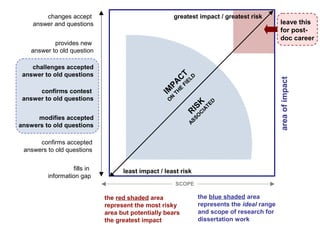
This document provides guidance on selecting a dissertation topic based on Charles Tilly's conceptual illustration. It recommends aiming for a topic that fills an information gap or provides new answers to old questions using evidence from several instances, as these have the ideal scope and range for dissertation work. More innovative or wide-reaching topics that could greatly impact the field but also face greater risk of opposition are best left for post-doctoral research. The document also includes questionnaires to help formulate research questions and evaluate proposed answers.
graphical reproduction basedon a conceptual illustration by Charles Tilly (2006)
selecting a dissertation topic:
range and scope
based on a conceptual illustration
by charles tilly, columbia university
2006
powerpointpreparedbysinamossayeb
2.
graphical reproduction basedon a conceptual illustration by Charles Tilly (2006)
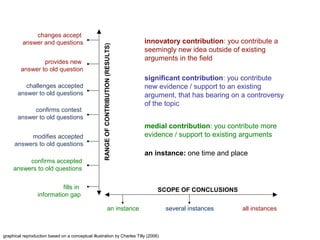
SCOPE OF CONCLUSIONS
RANGEOFCONTRIBUTION(RESULTS)
fills in
information gap
an instance all instances
medial contribution: you contribute more
evidence / support to existing arguments
significant contribution: you contribute
new evidence / support to an existing
argument, that has bearing on a controversy
of the topic
innovatory contribution: you contribute a
seemingly new idea outside of existing
arguments in the field
an instance: one time and place
confirms accepted
answers to old questions
modifies accepted
answers to old questions
confirms contest
answer to old questions
challenges accepted
answer to old questions
provides new
answer to old question
changes accept
answer and questions
several instances
3.
graphical reproduction basedon a conceptual illustration by Charles Tilly (2006)
IM
PA
C
T
O
N
TH
E
FIELDR
ISK
ASSO
C
IATED
SCOPE
greatestimpact
degreeofimpact
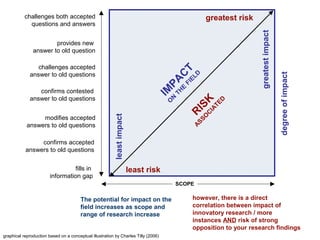
however, there is a direct
correlation between impact of
innovatory research / more
instances AND risk of strong
opposition to your research findings
The potential for impact on the
field increases as scope and
range of research increase
fills in
information gap
confirms accepted
answers to old questions
modifies accepted
answers to old questions
confirms contested
answer to old questions
challenges accepted
answer to old questions
provides new
answer to old question
challenges both accepted
questions and answers
greatest risk
leastimpact
least risk
4.
graphical reproduction basedon a conceptual illustration by Charles Tilly (2006)
IM
PAC
T
O
N
TH
E
FIELDR
ISK
ASSO
C
IATED
SCOPE
areaofimpact
fills in
information gap
confirms accepted
answers to old questions
provides new
answer to old question
changes accept
answer and questions
least impact / least risk
greatest impact / greatest risk
the blue shaded area
represents the ideal range
and scope of research for
dissertation work
the red shaded area
represent the most risky
area but potentially bears
the greatest impact
leave this
for post-
doc career
modifies accepted
answers to old questions
confirms contest
answer to old questions
challenges accepted
answer to old questions
5.
graphical reproduction basedon a conceptual illustration by Charles Tilly (2006)
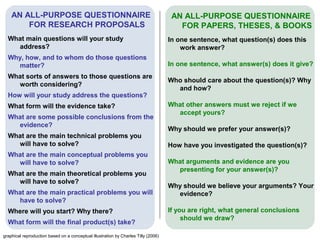
AN ALL-PURPOSE QUESTIONNAIRE
FOR RESEARCH PROPOSALS
What main questions will your study
address?
Why, how, and to whom do those questions
matter?
What sorts of answers to those questions are
worth considering?
How will your study address the questions?
What form will the evidence take?
What are some possible conclusions from the
evidence?
What are the main technical problems you
will have to solve?
What are the main conceptual problems you
will have to solve?
What are the main theoretical problems you
will have to solve?
What are the main practical problems you will
have to solve?
Where will you start? Why there?
What form will the final product(s) take?
AN ALL-PURPOSE QUESTIONNAIRE
FOR PAPERS, THESES, & BOOKS
In one sentence, what question(s) does this
work answer?
In one sentence, what answer(s) does it give?
Who should care about the question(s)? Why
and how?
What other answers must we reject if we
accept yours?
Why should we prefer your answer(s)?
How have you investigated the question(s)?
What arguments and evidence are you
presenting for your answer(s)?
Why should we believe your arguments? Your
evidence?
If you are right, what general conclusions
should we draw?
6.
graphical reproduction basedon a conceptual illustration by Charles Tilly (2006)
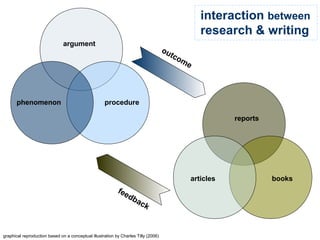
phenomenon procedure
argument
articles books
reports
outcome
feedback
interaction between
research & writing
7.
graphical reproduction basedon a conceptual illustration by Charles Tilly (2006)
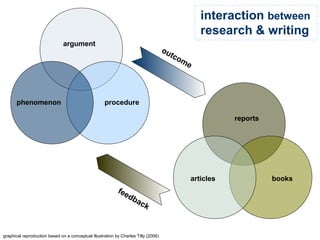
phenomenon procedure
argument
articles books
reports
outcome
feedback
interaction between
research & writing