Lecture 4 &5 -
Carbohydrates
For BS. Islamiat Studies (SEM-I)
2.
Learning Outcomes
Types,
Role in body,
Dietary fiber, bulk and alternative sweeteners,
Recommended intake and energy value
4.
What are Carbohydrates?
Carbohydratescontain carbon, hydrogen and oxygen.
o They are widely distributed in plants in which they are formed from carbon
dioxide of the atmosphere and water from the soil through photosynthesis.
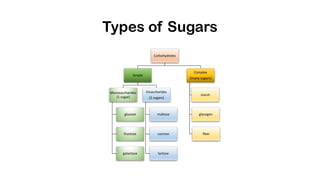
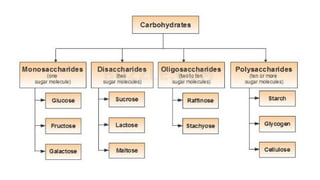
The nutritionally important major groups of carbohydrates are:
o Sugars (monosaccharides and disaccharides)
o Oligosaccharides
o Polysaccharides (starch, cellulose, pectic substances and related
compounds).
Carbohydrates constitute by far the greatest portion of diet in developing
countries, as much as 80% in some cases. In industrialized countries 45 to
50% carbohydrates are included in the diet of a person.
5.
Types of Carbohydrates
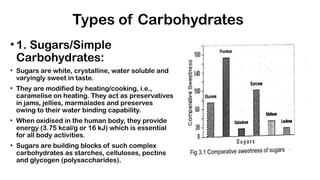
•1. Sugars/Simple
Carbohydrates:
• Sugars are white, crystalline, water soluble and
varyingly sweet in taste.
• They are modified by heating/cooking, i.e.,
caramelise on heating. They act as preservatives
in jams, jellies, marmalades and preserves
owing to their water binding capability.
• When oxidised in the human body, they provide
energy (3.75 kcal/g or 16 kJ) which is essential
for all body activities.
• Sugars are building blocks of such complex
carbohydrates as starches, celluloses, pectins
and glycogen (polysaccharides).
6.
How Sugar isHarmful?
• Sugars naturally present in the cellular structure of fruits,
some vegetables, are intrinsic and pose no threat to
health.
• Those extracted, refined, and concentrated (household
sugar) are extrinsic sugars. These can contribute to dental
caries, obesity and other ailments.
Monosaccharides
• Monosaccharides containjust one sugar unit, so they’re the smallest of the
carbohydrates. (The prefix “mono-” means “one.”)
• The small size of monosaccharides gives them a special role in digestion and
metabolism.
• Food carbohydrates have to be broken down to monosaccharides before they can
be absorbed in the gastrointestinal tract, and they also circulate in blood in
monosaccharide form.
• There are 3 monosaccharides:
1. Glucose
2. Fructose
3. Galactose
9.
Glucose
• You’re alreadyfamiliar with glucose, because it’s the main product of
photosynthesis. Plants make glucose as a way of storing the sun’s energy in
a form that it can use for growth and reproduction.
• In humans, glucose is one of the most important nutrients for fueling the
body. It’s especially important for the brain and nervous system, which aren’t
very good at using other fuel sources.
• Muscles, on the other hand, can use fat as an energy source.
• Food sources of glucose: Glucose is found in fruits and vegetables, as well
as honey, corn syrup, and high fructose corn syrup. (All plants make glucose,
but much of the glucose is used to make starch, fiber, and other nutrients.
The foods listed here have glucose in its monosaccharide form.)
10.
Fructose
• Fructose isspecial because it is the sweetest carbohydrate.
• Plants make a lot of fructose as a way of attracting insects and animals,
which help plants to reproduce.
• For example, plants make nectar, which is high in fructose and very sweet,
to attract insects that will pollinate it.
• Plants also put fructose into fruit to make it tastier.
• Animals eat the fruit, wander away, and later poop out the seeds from the
fruit, thereby sowing the seeds of the next generation. Animal gets a meal,
and the plant gets to reproduce: win-win!
11.
Galactose
• Food sourcesof galactose:
• Galactose is found in milk (and dairy products made from
milk), but it’s almost always linked to glucose to form a
disaccharide (more on that in a minute).
• We rarely find it in our food supply in monosaccharide
form.
12.
Disaccharides
• The secondtype of simple carbohydrates is
disaccharides. They contain two sugar units bonded
together.
• There are 3 disaccharides:
1. Maltose (glucose + glucose)
2. Sucrose (glucose + fructose)
3. Lactose (glucose + galactose)
13.
Oligosaccharides
• Oligosaccharides areglycosides, water-soluble polymers of a few (3 to 10
carbon atoms) condensed monosaccharides.
• Those most commonly found in foods are generally homopolymers of D-
glucose (malto-oligosaccharides) or heteropolymers of D-glucose
condensed with D. fructose or D-galactose (raffinose, stachyose, fructo
oligosaccharides).
• The oligosaccharides occur as
1. Fructo-oligosaccharides (in onions and garlic),
2. Galacto-oligosaccharides-+ or soybean oligosaccharides in the form of
raffinose and stachyose in soybean.
3. Xylo-oligosaccharides, composed of xylobiose and xylotriose are found
in fruits, honey and milk.
14.
Oligosaccharides
• The physiologicallyfunctional oligosaccharides are short-chain
• polysaccharides that meet two specific requirements:
• a. They are not digested by human gastric juice.
• b. They are preferentially consumed by beneficial intestinal
• bacteria, the Bifidobacteria, in the colon.
• Bifidobacteria produce some short chain fatty acids, mainly acetic and lactic acids
and some antibiotic material. These bacteria possess antagonistic effect. They
suppress the activity of putrefactive and pathogenic bacteria and reduce
formation of toxic fermentation. In addition, Bifidobacteria produce some
vitamins of the B group.
15.
Oligosaccharides
• Oligosaccharides havebecome popular functional food components in Japan and some
other developed countries.
• These are consumed as such or as food ingredients. Most common products are
beverages, infant milk formulations, confectionery, bakery products, yoghurts and dairy
desserts.
• Two to three grams oligosaccharides per day are recommended in the diet of adults to
provide following beneficial effects: -
• a. Help in the proliferation of Bifidobacteria that reduce the numbers of detrimental
bacteria including pathogenic organisms.
• b. Reduce toxic metabolites and deleterious enzymes and increase the production of
useful nutrients.
• c. Prevent constipation and protect liver functions.
• d. Reduce serum cholesterol level and blood pressure.
• e. Have an anticancer effect.
17.
Complex Carbohydrates
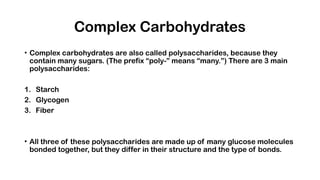
• Complexcarbohydrates are also called polysaccharides, because they
contain many sugars. (The prefix “poly-” means “many.”) There are 3 main
polysaccharides:
1. Starch
2. Glycogen
3. Fiber
• All three of these polysaccharides are made up of many glucose molecules
bonded together, but they differ in their structure and the type of bonds.
18.
Complex Carbohydrates
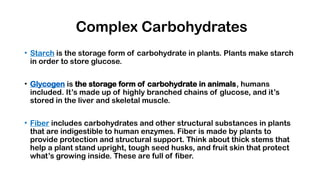
• Starchis the storage form of carbohydrate in plants. Plants make starch
in order to store glucose.
• Glycogen is the storage form of carbohydrate in animals, humans
included. It’s made up of highly branched chains of glucose, and it’s
stored in the liver and skeletal muscle.
• Fiber includes carbohydrates and other structural substances in plants
that are indigestible to human enzymes. Fiber is made by plants to
provide protection and structural support. Think about thick stems that
help a plant stand upright, tough seed husks, and fruit skin that protect
what’s growing inside. These are full of fiber.
19.
Energy
• Energy isobtained by the oxidation of carbohydrates, oils, fats and
proteins contained in the diet as well as from chemical reactions in
the body.
• Many people consider energy as good and calories as bad or
fattening. Both are actually the same.
• Calorie (Cal) or kilocalorie (kcal) is the unit of measurement of
energy. Joule (J) or kiloJoule (kJ) is the equivalent international (S.I.)
unit.
• Calorie (Cal or kcal) is defined as the amount of heat required to
raise the temperature of one kilogram of water by 1°C.
20.
Energy
• About halfof the daily intake of energy is obtained from controlled
oxidation of carbohydrates, fats and proteins in the diet.
• It is used for self-maintenance, including: -
• a. Liberation of energy from glucose and fatty acids reactions.
• b. Synthesis of new proteins for growth and repair.
• c. Elimination of wastes from blood by kidney.
• d. Maintenance of body temperature at 37°C.
• e. Maintenance of electrolyte concentration in the cells.
• f. Contraction of muscles in breathing.
• g. Contraction of heart muscles.
Notas do Editor
#16 Raffinose = one molecule of galactose, one molecule of glucose, and one molecule of fructose
Stachyose = two galactose units, one glucose unit, and one fructose unit.