The document explores the potential of game-based learning as an innovative pedagogical approach in education for sustainable development (ESD) and global citizenship education (GCED). It emphasizes that games can enhance educational outcomes through storytelling and engaging mechanics, while also discussing the importance of the teacher's role in shaping educational agendas. Furthermore, it highlights various resources and studies that indicate the positive impact of gaming on cultural perceptions and learning in diverse environments.
Innovative Pedagogies forESD and
GCED:
Is Game-Based Learning the Future?
Paul Darvasi @pauldarvasi
Aleksander Isaksen Husøy @alhusoy
Sandhya Nankani @litsafari / @litsafariapps
Alexandr Iscenco, MEGA Co-founder
The rise ofcomputers has paralleled the
resurgence of games in our culture. This is no
accident. Games like Chess, Go, and Parcheesi are
much like digital computers, machines for creating
and storing numerical states. In this sense,
computers didn’t create games; games created
computers.
- Eric Zimmerman
4.
When information isput at play, game-like
experiences replace linear media. Media and culture
in the Ludic Century is increasingly systemic,
modular, customizable, and participatory. Games
embody all of these characteristics in a very direct
sense. Increasingly, the ways that people spend their
leisure time and consume art, design, and
entertainment will be games - or experiences very
much like games.
- Eric Zimmerman
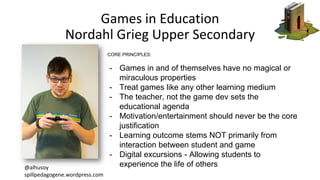
Games in Education
NordahlGrieg Upper Secondary
@alhusoy
spillpedagogene.wordpress.com
CORE PRINCIPLES:
- Games in and of themselves have no magical or
miraculous properties
- Treat games like any other learning medium
- The teacher, not the game dev sets the
educational agenda
- Motivation/entertainment should never be the core
justification
- Learning outcome stems NOT primarily from
interaction between student and game
- Digital excursions - Allowing students to
experience the life of others
GAMES THEN …
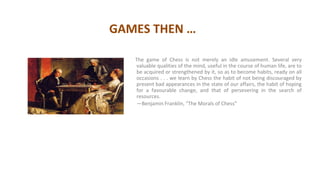
Thegame of Chess is not merely an idle amusement. Several very
valuable qualities of the mind, useful in the course of human life, are to
be acquired or strengthened by it, so as to become habits, ready on all
occasions . . . we learn by Chess the habit of not being discouraged by
present bad appearances in the state of our affairs, the habit of hoping
for a favourable change, and that of persevering in the search of
resources.
—Benjamin Franklin, “The Morals of Chess”
GAMES FOR CHANGE
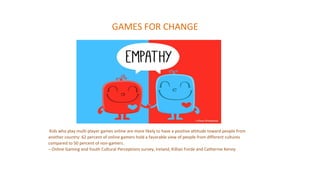
Kidswho play multi-player games online are more likely to have a positive attitude toward people from
another country: 62 percent of online gamers hold a favorable view of people from different cultures
compared to 50 percent of non-gamers.
– Online Gaming and Youth Cultural Perceptions survey, Ireland, Killian Forde and Catherine Kenny
13.
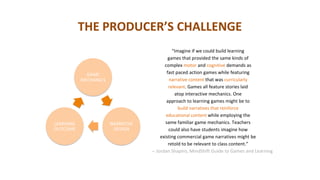
THE PRODUCER’S CHALLENGE
“
“Imagineif we could build learning
games that provided the same kinds of
complex motor and cognitive demands as
fast paced action games while featuring
narrative content that was curricularly
relevant. Games all feature stories laid
atop interactive mechanics. One
approach to learning games might be to
build narratives that reinforce
educational content while employing the
same familiar game mechanics. Teachers
could also have students imagine how
existing commercial game narratives might be
retold to be relevant to class content.”
– Jordan Shapiro, MindShift Guide to Games and Learning
14.
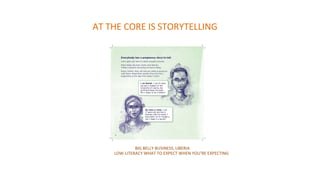
AT THE COREIS STORYTELLING
BIG BELLY BUSINESS, LIBERIA
LOW-LITERACY WHAT TO EXPECT WHEN YOU’RE EXPECTING
Resources on GBL
•www.IKTipraksis.no (Guides/lesson plans to using non-ed games)
• http://store.steampowered.com/curator/7389497-Extra-Credits-EDU/
• www.etc.cmu.edu/ - Carnegie Mellon
• www.gamesforchange.org/play/ (games organized by ages and topics)
• www.commonsensemedia.org/game-reviews (Curated learning games rated by educators)
• https://killscreen.com/ (Quality game journalism)
• http://www.polygon.com/
• http://www.teachapps.org - National Literacy Trust, UK
• http://teacherswithapps.org - Reviews for and by teachers
• http://www.childrenstech.org - Children’s Technology Review
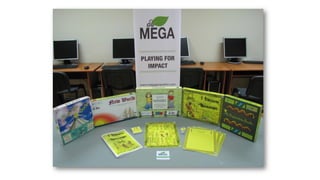
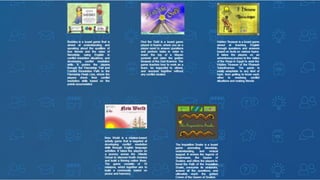
• http://megageneration.com - Example of game-based e-learning for ESD: MEGA Game
• https://www.khanacademy.org - Example of gamification-based e-learning: Khan Academy
• http://peace.americancouncils.md - Games on conflict resolution and peace building
• https://www.coursera.org/certificate/gamification - Course on introduction into gamification
• http://www.joinkidmap.org - forthcoming checklist for evaluating children’s media w/ratings