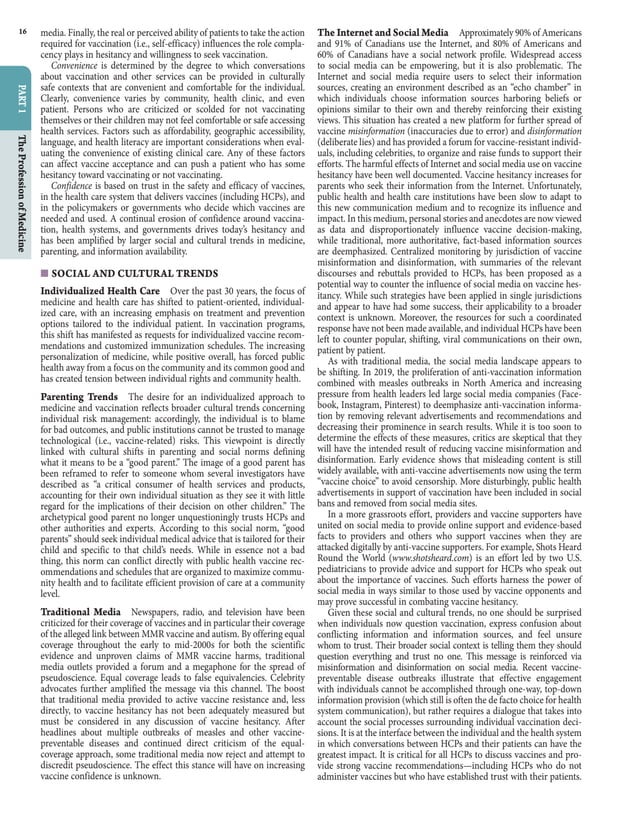
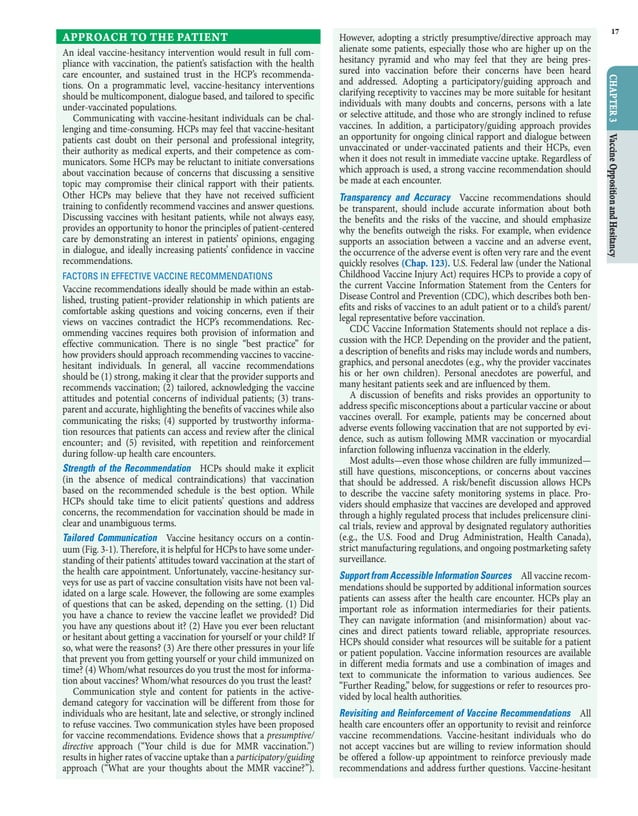
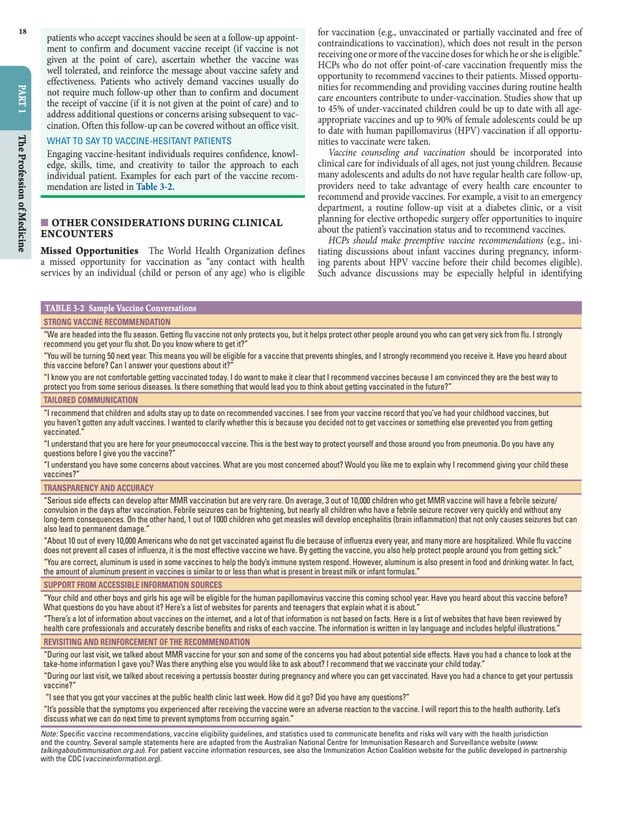
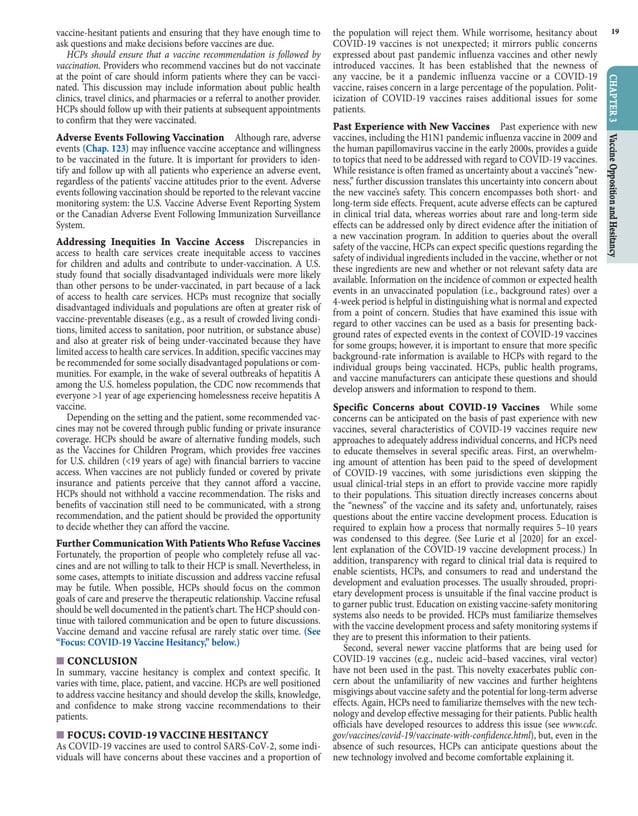
Harrisons Principles of Internal Medicine (2022).pdf
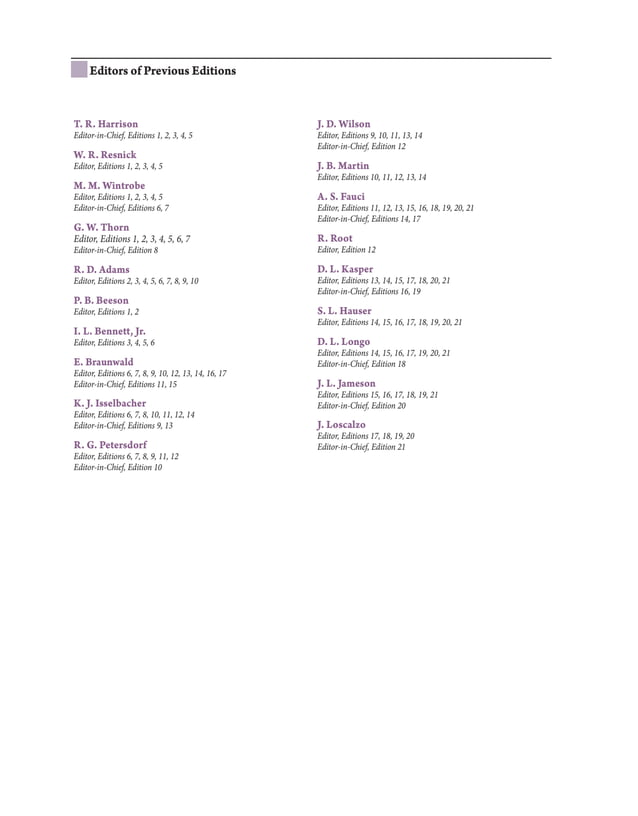
This document provides information about the 21st edition of the medical textbook "Principles of Internal Medicine". It lists the editors of previous editions, with E. Braunwald, K.J. Isselbacher, R.G. Petersdorf, and others having served as editors for multiple editions. The current editors are Joseph Loscalzo, Dennis L. Kasper, Dan L. Longo, Anthony S. Fauci, Stephen L. Hauser, and J. Larry Jameson. The document provides background on the long history and tradition of the textbook.
Harrisons Principles of Internal Medicine (2022).pdf
2.
P R IN C I P L E S O F
I N T E R N A L
M E D I C I N E
21st Edition
®
HPIM 21e_FM_VOL1_pi-pxl.indd 1 21/01/22 7:01 PM
3.
T. R. Harrison
Editor-in-Chief,Editions 1, 2, 3, 4, 5
W. R. Resnick
Editor, Editions 1, 2, 3, 4, 5
M. M. Wintrobe
Editor, Editions 1, 2, 3, 4, 5
Editor-in-Chief, Editions 6, 7
G. W. Thorn
Editor, Editions 1, 2, 3, 4, 5, 6, 7
Editor-in-Chief, Edition 8
R. D. Adams
Editor, Editions 2, 3, 4, 5, 6, 7, 8, 9, 10
P. B. Beeson
Editor, Editions 1, 2
I. L. Bennett, Jr.
Editor, Editions 3, 4, 5, 6
E. Braunwald
Editor, Editions 6, 7, 8, 9, 10, 12, 13, 14, 16, 17
Editor-in-Chief, Editions 11, 15
K. J. Isselbacher
Editor, Editions 6, 7, 8, 10, 11, 12, 14
Editor-in-Chief, Editions 9, 13
R. G. Petersdorf
Editor, Editions 6, 7, 8, 9, 11, 12
Editor-in-Chief, Edition 10
J. D. Wilson
Editor, Editions 9, 10, 11, 13, 14
Editor-in-Chief, Edition 12
J. B. Martin
Editor, Editions 10, 11, 12, 13, 14
A. S. Fauci
Editor, Editions 11, 12, 13, 15, 16, 18, 19, 20, 21
Editor-in-Chief, Editions 14, 17
R. Root
Editor, Edition 12
D. L. Kasper
Editor, Editions 13, 14, 15, 17, 18, 20, 21
Editor-in-Chief, Editions 16, 19
S. L. Hauser
Editor, Editions 14, 15, 16, 17, 18, 19, 20, 21
D. L. Longo
Editor, Editions 14, 15, 16, 17, 19, 20, 21
Editor-in-Chief, Edition 18
J. L. Jameson
Editor, Editions 15, 16, 17, 18, 19, 21
Editor-in-Chief, Edition 20
J. Loscalzo
Editor, Editions 17, 18, 19, 20
Editor-in-Chief, Edition 21
Editors of Previous Editions
HPIM 21e_FM_VOL1_pi-pxl.indd 2 21/01/22 7:01 PM
4.
Joseph Loscalzo, MD,PhD
Hersey Professor of the Theory and Practice of Medicine, Harvard
Medical School; Chairman, Department of Medicine; Soma Weiss MD
Distinguished Chair in Medicine; Physician-in-Chief, Brigham
and Women’s Hospital, Boston, Massachusetts
Dennis L. Kasper, MD
William Ellery Channing Professor of Medicine and Professor of
Immunology, Department of Immunology, Harvard Medical School;
Division of Infectious Diseases, Brigham and Women’s Hospital,
Boston, Massachusetts
Dan L. Longo, MD
Professor of Medicine, Harvard Medical School; Senior Physician,
Brigham and Women’s Hospital; Deputy Editor, New England Journal
of Medicine, Boston, Massachusetts
Anthony S. Fauci, MD
Chief, Laboratory of Immunoregulation; Director, National Institute
of Allergy and Infectious Diseases, National Institutes of Health,
Bethesda, Maryland
Stephen L. Hauser, MD
Robert A. Fishman Distinguished Professor, Department of
Neurology; Director, UCSF Weill Institute for Neurosciences,
University of California, San Francisco, San Francisco, California
J. Larry Jameson, MD, PhD
Robert G. Dunlop Professor of Medicine; Dean, Raymond and Ruth
Perelman School of Medicine; Executive Vice President, University of
Pennsylvania for the Health System, Philadelphia, Pennsylvania
P R I N C I P L E S O F
I N T E R N A L
M E D I C I N E
21st Edition
®
New York Chicago San Francisco Athens London Madrid Mexico City
New Delhi Milan Singapore Sydney Toronto
VOLUME I
Editors
HPIM 21e_FM_VOL1_pi-pxl.indd 3 21/01/22 7:01 PM
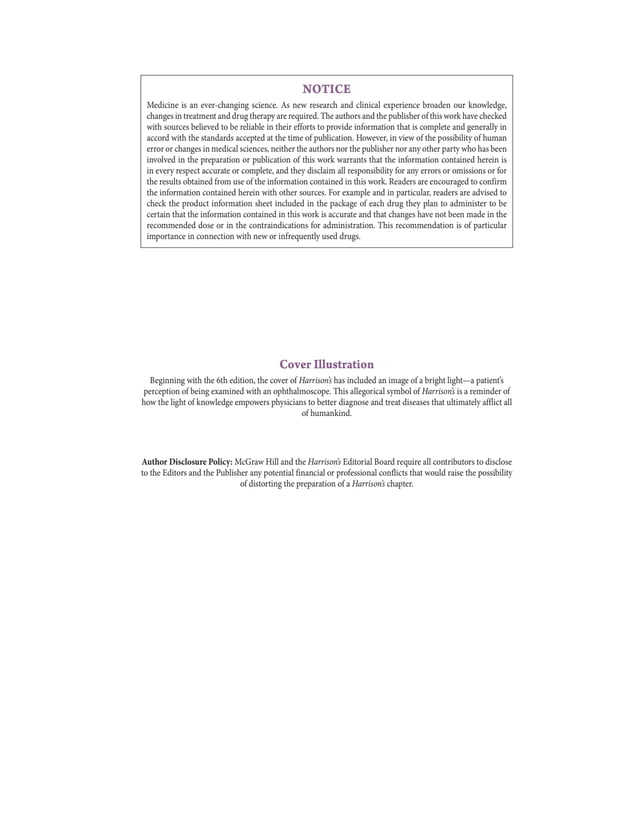
Cover Illustration
Beginning withthe 6th edition, the cover of Harrison’s has included an image of a bright light—a patient’s
perception of being examined with an ophthalmoscope. This allegorical symbol of Harrison’s is a reminder of
how the light of knowledge empowers physicians to better diagnose and treat diseases that ultimately afflict all
of humankind.
Author Disclosure Policy: McGraw Hill and the Harrison’s Editorial Board require all contributors to disclose
to the Editors and the Publisher any potential financial or professional conflicts that would raise the possibility
of distorting the preparation of a Harrison’s chapter.
NOTICE
Medicine is an ever-changing science. As new research and clinical experience broaden our knowledge,
changes in treatment and drug therapy are required. The authors and the publisher of this work have checked
with sources believed to be reliable in their efforts to provide information that is complete and generally in
accord with the standards accepted at the time of publication. However, in view of the possibility of human
error or changes in medical sciences, neither the authors nor the publisher nor any other party who has been
involved in the preparation or publication of this work warrants that the information contained herein is
in every respect accurate or complete, and they disclaim all responsibility for any errors or omissions or for
the results obtained from use of the information contained in this work. Readers are encouraged to confirm
the information contained herein with other sources. For example and in particular, readers are advised to
check the product information sheet included in the package of each drug they plan to administer to be
certain that the information contained in this work is accurate and that changes have not been made in the
recommended dose or in the contraindications for administration. This recommendation is of particular
importance in connection with new or infrequently used drugs.
HPIM 21e_FM_VOL1_pi-pxl.indd 5 21/01/22 7:01 PM
7.
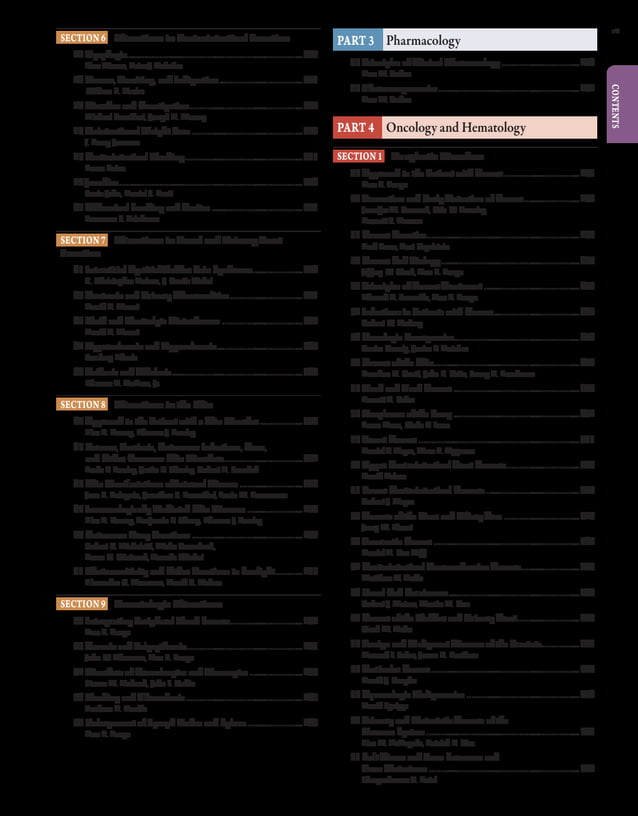
Contents
Contributors............................................................................. xviii
Preface.....................................................................................xxxix
Harrison’s RelatedResources.........................................................xl
PART 1 The Profession of Medicine
1 The Practice of Medicine....................................................1
The Editors
2 Promoting Good Health.....................................................8
Donald M. Lloyd-Jones, Kathleen M. McKibbin
3 Vaccine Opposition and Hesitancy....................................13
Julie A. Bettinger, Hana Mitchell
4 Decision-Making in Clinical Medicine.............................21
Daniel B. Mark, John B. Wong
5 Precision Medicine and Clinical Care................................30
The Editors
6 Screening and Prevention of Disease.................................37
Katrina A. Armstrong, Gary J. Martin
7 Global Diversity of Health System Financing
and Delivery.....................................................................42
Richard B. Saltman
8 The Safety and Quality of Health Care..............................50
David W. Bates
9 Diagnosis: Reducing Errors and Improving Quality..........54
Gordon Schiff
10 Racial and Ethnic Disparities in Health Care.....................59
Lenny López, Joseph R. Betancourt
11 Ethical Issues in Clinical Medicine....................................67
Christine Grady, Bernard Lo
12 Palliative and End-of-Life Care........................................72
Ezekiel J. Emanuel
PART2 Cardinal Manifestations and
Presentation of Diseases
SECTION 1 Pain
13 Pain: Pathophysiology and Management...........................91
James P. Rathmell, Howard L. Fields
14 Chest Discomfort...........................................................100
David A. Morrow
15 Abdominal Pain..............................................................108
Danny O. Jacobs
16 Headache........................................................................112
Peter J. Goadsby
17 Back and Neck Pain........................................................117
John W. Engstrom
SECTION 2 Alterations in Body Temperature
18 Fever..............................................................................130
Neeraj K. Surana, Charles A. Dinarello, Reuven Porat
19 Fever and Rash...............................................................133
Elaine T. Kaye, Kenneth M. Kaye
20 Fever of Unknown Origin...............................................145
Chantal P. Bleeker-Rovers, Catharina M. Mulders-Manders,
Jos W. M. van der Meer
SECTION 3 Nervous System Dysfunction
21 Syncope..........................................................................152
Roy Freeman
22 Dizziness and Vertigo.....................................................159
Mark F. Walker, Robert B. Daroff
23 Fatigue...........................................................................162
Jeffrey M. Gelfand, Vanja C. Douglas
24 Neurologic Causes of Weakness and Paralysis..................165
Stephen L. Hauser
25 Numbness,Tingling, and Sensory Loss...........................168
Stephen L. Hauser
26 Gait Disorders, Imbalance, and Falls...............................173
Jessica M. Baker
27 Confusion and Delirium.................................................178
S. Andrew Josephson, Bruce L. Miller
28 Coma.............................................................................183
S. Andrew Josephson, Allan H. Ropper, Stephen L. Hauser
29 Dementia........................................................................189
William W. Seeley, Gil D. Rabinovici, Bruce L. Miller
30 Aphasia, Memory Loss, and Other Cognitive
Disorders........................................................................195
M.-Marsel Mesulam
31 Sleep Disorders...............................................................204
Thomas E. Scammell, Clifford B. Saper, Charles A. Czeisler
SECTION 4 Disorders of Eyes, Ears, Nose, and Throat
32 Disorders of the Eye........................................................215
Jonathan C. Horton
33 Disorders of Smell andTaste...........................................232
Richard L. Doty, Steven M. Bromley
34 Disorders of Hearing......................................................238
Anil K. Lalwani
35 Upper Respiratory Symptoms, Including Earache,
Sinus Symptoms, and SoreThroat...................................247
Rachel L. Amdur, Jeffrey A. Linder
36 Oral Manifestations of Disease.......................................256
Samuel C. Durso
SECTION 5 Alterations in Circulatory and
Respiratory Functions
37 Dyspnea.........................................................................263
Rebecca M. Baron
38 Cough............................................................................267
Christopher H. Fanta
39 Hemoptysis....................................................................270
Carolyn M. D’Ambrosio
40 Hypoxia and Cyanosis.....................................................272
Joseph Loscalzo
41 Edema............................................................................275
Joseph Loscalzo
42 Approach to the Patient with a Heart Murmur................278
Patrick T. O’Gara, Joseph Loscalzo
43 Palpitations.....................................................................286
Joseph Loscalzo
HPIM 21e_FM_VOL1_pi-pxl.indd 6 21/01/22 7:01 PM
8.
CONTENTS
vii
SECTION 6 Alterationsin Gastrointestinal Function
44 Dysphagia......................................................................287
Ikuo Hirano, Peter J. Kahrilas
45 Nausea,Vomiting, and Indigestion..................................291
William L. Hasler
46 Diarrhea and Constipation..............................................297
Michael Camilleri, Joseph A. Murray
47 Unintentional Weight Loss.............................................309
J. Larry Jameson
48 Gastrointestinal Bleeding................................................311
Loren Laine
49 Jaundice..........................................................................315
Savio John, Daniel S. Pratt
50 Abdominal Swelling and Ascites.....................................321
Lawrence S. Friedman
SECTION 7 Alterations in Renal and Urinary Tract
Function
51 Interstitial Cystitis/Bladder Pain Syndrome.....................325
R. Christopher Doiron, J. Curtis Nickel
52 Azotemia and Urinary Abnormalities..............................331
David B. Mount
53 Fluid and Electrolyte Disturbances.................................338
David B. Mount
54 Hypercalcemia and Hypocalcemia...................................356
Sundeep Khosla
55 Acidosis and Alkalosis.....................................................359
Thomas D. DuBose, Jr.
SECTION 8 Alterations in the Skin
56 Approach to the Patient with a Skin Disorder..................369
Kim B. Yancey, Thomas J. Lawley
57 Eczema, Psoriasis, Cutaneous Infections, Acne,
and Other Common Skin Disorders................................374
Leslie P. Lawley, Justin T. Cheeley, Robert A. Swerlick
58 Skin Manifestations of Internal Disease..........................383
Jean L. Bolognia, Jonathan S. Leventhal, Irwin M. Braverman
59 Immunologically Mediated Skin Diseases.......................400
Kim B. Yancey, Benjamin F. Chong, Thomas J. Lawley
60 Cutaneous Drug Reactions.............................................407
Robert G. Micheletti, Misha Rosenbach,
Bruce U. Wintroub, Kanade Shinkai
61 Photosensitivity and Other Reactions to Sunlight............417
Alexander G. Marneros, David R. Bickers
SECTION 9 Hematologic Alterations
62 Interpreting Peripheral Blood Smears..............................424
Dan L. Longo
63 Anemia and Polycythemia...............................................431
John W. Adamson, Dan L. Longo
64 Disorders of Granulocytes and Monocytes......................439
Steven M. Holland, John I. Gallin
65 Bleeding andThrombosis................................................450
Barbara A. Konkle
66 Enlargement of Lymph Nodes and Spleen.......................457
Dan L. Longo
PART3 Pharmacology
67 Principles of Clinical Pharmacology................................465
Dan M. Roden
68 Pharmacogenomics.........................................................474
Dan M. Roden
PART4 Oncology and Hematology
SECTION 1 Neoplastic Disorders
69 Approach to the Patient with Cancer...............................481
Dan L. Longo
70 Prevention and Early Detection of Cancer.......................490
Jennifer M. Croswell, Otis W. Brawley,
Barnett S. Kramer
71 Cancer Genetics.............................................................498
Fred Bunz, Bert Vogelstein
72 Cancer Cell Biology........................................................508
Jeffrey W. Clark, Dan L. Longo
73 Principles of CancerTreatment.......................................529
Edward A. Sausville, Dan L. Longo
74 Infections in Patients with Cancer...................................556
Robert W. Finberg
75 Oncologic Emergencies...................................................565
Rasim Gucalp, Janice P. Dutcher
76 Cancer of the Skin..........................................................578
Brendan D. Curti, John T. Vetto, Sancy A. Leachman
77 Head and Neck Cancer...................................................590
Everett E. Vokes
78 Neoplasms of the Lung...................................................594
Leora Horn, Wade T. Iams
79 Breast Cancer.................................................................611
Daniel F. Hayes, Marc E. Lippman
80 Upper GastrointestinalTract Cancers..............................626
David Kelsen
81 Lower Gastrointestinal Cancers......................................636
Robert J. Mayer
82 Tumors of the Liver and BiliaryTree...............................643
Josep M. Llovet
83 Pancreatic Cancer...........................................................657
Daniel D. Von Hoff
84 Gastrointestinal NeuroendocrineTumors........................663
Matthew H. Kulke
85 Renal Cell Carcinoma.....................................................673
Robert J. Motzer, Martin H. Voss
86 Cancer of the Bladder and UrinaryTract..........................676
Noah M. Hahn
87 Benign and Malignant Diseases of the Prostate................681
Howard I. Scher, James A. Eastham
88 Testicular Cancer............................................................689
David J. Vaughn
89 Gynecologic Malignancies..............................................695
David Spriggs
90 Primary and MetastaticTumors of the
Nervous System..............................................................701
Lisa M. DeAngelis, Patrick Y. Wen
91 SoftTissue and Bone Sarcomas and
Bone Metastases.............................................................712
Shreyaskumar R. Patel
HPIM 21e_FM_VOL1_pi-pxl.indd 7 21/01/22 7:01 PM
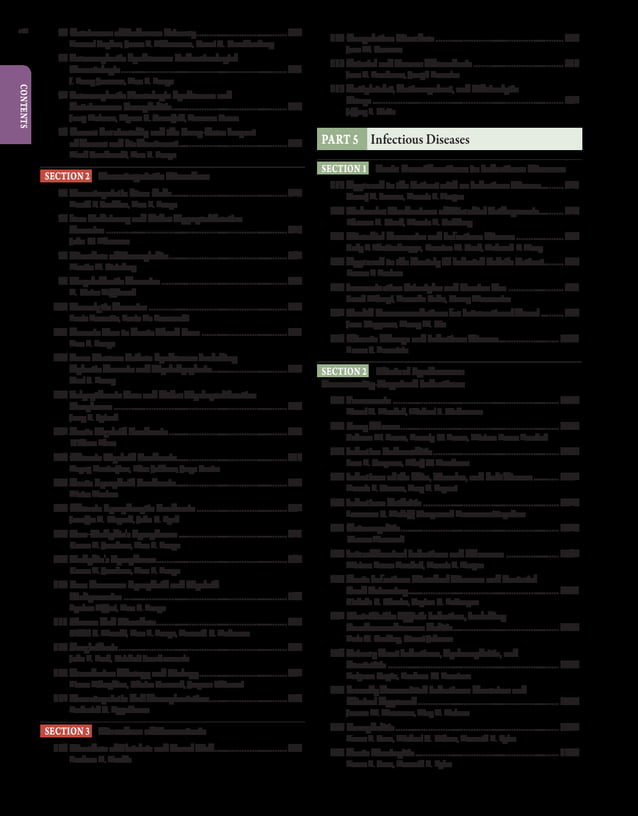
9.
CONTENTS
viii 92 Carcinomaof Unknown Primary.....................................716
Kanwal Raghav, James L. Abbruzzese, Gauri R. Varadhachary
93 Paraneoplastic Syndromes: Endocrinologic/
Hematologic...................................................................721
J. Larry Jameson, Dan L. Longo
94 Paraneoplastic Neurologic Syndromes and
Autoimmune Encephalitis...............................................728
Josep Dalmau, Myrna R. Rosenfeld, Francesc Graus
95 Cancer Survivorship and the Long-Term Impact
of Cancer and ItsTreatment............................................736
Mark Roschewski, Dan L. Longo
SECTION 2 Hematopoietic Disorders
96 Hematopoietic Stem Cells...............................................743
David T. Scadden, Dan L. Longo
97 Iron Deficiency and Other Hypoproliferative
Anemias.........................................................................747
John W. Adamson
98 Disorders of Hemoglobin................................................754
Martin H. Steinberg
99 Megaloblastic Anemias...................................................766
A. Victor Hoffbrand
100 Hemolytic Anemias........................................................776
Lucio Luzzatto, Lucia De Franceschi
101 Anemia Due to Acute Blood Loss...................................791
Dan L. Longo
102 Bone Marrow Failure Syndromes Including
Aplastic Anemia and Myelodysplasia...............................792
Neal S. Young
103 Polycythemia Vera and Other Myeloproliferative
Neoplasms......................................................................802
Jerry L. Spivak
104 Acute Myeloid Leukemia................................................809
William Blum
105 Chronic Myeloid Leukemia.............................................818
Hagop Kantarjian, Elias Jabbour, Jorge Cortes
106 Acute Lymphoid Leukemia.............................................828
Dieter Hoelzer
107 Chronic Lymphocytic Leukemia.....................................834
Jennifer A. Woyach, John C. Byrd
108 Non-Hodgkin’s Lymphoma............................................841
Caron A. Jacobson, Dan L. Longo
109 Hodgkin’s Lymphoma.....................................................852
Caron A. Jacobson, Dan L. Longo
110 Less Common Lymphoid and Myeloid
Malignancies..................................................................855
Ayalew Tefferi, Dan L. Longo
111 Plasma Cell Disorders.....................................................866
Nikhil C. Munshi, Dan L. Longo, Kenneth C. Anderson
112 Amyloidosis....................................................................878
John L. Berk, Vaishali Sanchorawala
113 TransfusionTherapy and Biology....................................884
Pierre Tiberghien, Olivier Garraud, Jacques Chiaroni
114 Hematopoietic CellTransplantation................................897
Frederick R. Appelbaum
SECTION 3 Disorders of Hemostasis
115 Disorders of Platelets and Vessel Wall..............................903
Barbara A. Konkle
116 Coagulation Disorders....................................................910
Jean M. Connors
117 Arterial and VenousThrombosis.....................................919
Jane E. Freedman, Joseph Loscalzo
118 Antiplatelet, Anticoagulant, and Fibrinolytic
Drugs.............................................................................924
Jeffrey I. Weitz
PART5 Infectious Diseases
SECTION 1 Basic Considerations in Infectious Diseases
119 Approach to the Patient with an Infectious Disease..........941
Neeraj K. Surana, Dennis L. Kasper
120 Molecular Mechanisms of Microbial Pathogenesis...........948
Thomas E. Wood, Marcia B. Goldberg
121 Microbial Genomics and Infectious Disease....................960
Roby P. Bhattacharyya, Yonatan H. Grad, Deborah T. Hung
122 Approach to the Acutely Ill Infected Febrile Patient.........973
Tamar F. Barlam
123 Immunization Principles and Vaccine Use.......................981
Sarah Mbaeyi, Amanda Cohn, Nancy Messonnier
124 Health Recommendations for InternationalTravel..........989
Jesse Waggoner, Henry M. Wu
125 Climate Change and Infectious Disease.........................1001
Aaron S. Bernstein
SECTION 2 Clinical Syndromes:
Community-Acquired Infections
126 Pneumonia...................................................................1009
Lionel A. Mandell, Michael S. Niederman
127 Lung Abscess................................................................1020
Rebecca M. Baron, Beverly W. Baron, Miriam Baron Barshak
128 Infective Endocarditis...................................................1022
Sara E. Cosgrove, Adolf W. Karchmer
129 Infections of the Skin, Muscles, and SoftTissues...........1034
Dennis L. Stevens, Amy E. Bryant
130 Infectious Arthritis.......................................................1040
Lawrence C. Madoff, Nongnooch Poowanawittayakom
131 Osteomyelitis................................................................1046
Werner Zimmerli
132 Intraabdominal Infections and Abscesses......................1054
Miriam Baron Barshak, Dennis L. Kasper
133 Acute Infectious Diarrheal Diseases and Bacterial
Food Poisoning.............................................................1061
Richelle C. Charles, Regina C. LaRocque
134 Clostridioides difficile Infection, Including
Pseudomembranous Colitis...........................................1066
Dale N. Gerding, Stuart Johnson
135 UrinaryTract Infections, Pyelonephritis, and
Prostatitis.....................................................................1070
Kalpana Gupta, Barbara W. Trautner
136 SexuallyTransmitted Infections: Overview and
Clinical Approach.........................................................1078
Jeanne M. Marrazzo, King K. Holmes
137 Encephalitis..................................................................1094
Karen L. Roos, Michael R. Wilson, Kenneth L. Tyler
138 Acute Meningitis..........................................................1100
Karen L. Roos, Kenneth L. Tyler
HPIM 21e_FM_VOL1_pi-pxl.indd 8 21/01/22 7:01 PM
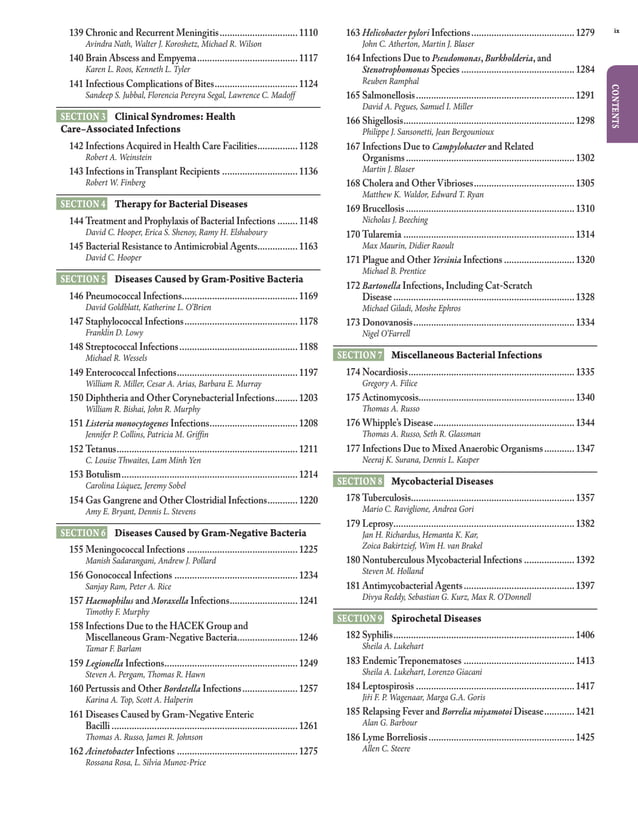
10.
CONTENTS
ix
139 Chronic andRecurrent Meningitis................................1110
Avindra Nath, Walter J. Koroshetz, Michael R. Wilson
140 Brain Abscess and Empyema.........................................1117
Karen L. Roos, Kenneth L. Tyler
141 Infectious Complications of Bites..................................1124
Sandeep S. Jubbal, Florencia Pereyra Segal, Lawrence C. Madoff
SECTION 3 Clinical Syndromes: Health
Care–Associated Infections
142 Infections Acquired in Health Care Facilities.................1128
Robert A. Weinstein
143 Infections inTransplant Recipients...............................1136
Robert W. Finberg
SECTION 4 Therapy for Bacterial Diseases
144 Treatment and Prophylaxis of Bacterial Infections.........1148
David C. Hooper, Erica S. Shenoy, Ramy H. Elshaboury
145 Bacterial Resistance to Antimicrobial Agents................1163
David C. Hooper
SECTION 5 Diseases Caused by Gram-Positive Bacteria
146 Pneumococcal Infections...............................................1169
David Goldblatt, Katherine L. O’Brien
147 Staphylococcal Infections..............................................1178
Franklin D. Lowy
148 Streptococcal Infections................................................1188
Michael R. Wessels
149 Enterococcal Infections.................................................1197
William R. Miller, Cesar A. Arias, Barbara E. Murray
150 Diphtheria and Other Corynebacterial Infections..........1203
William R. Bishai, John R. Murphy
151 Listeria monocytogenes Infections....................................1208
Jennifer P. Collins, Patricia M. Griffin
152 Tetanus.........................................................................1211
C. Louise Thwaites, Lam Minh Yen
153 Botulism.......................................................................1214
Carolina Lúquez, Jeremy Sobel
154 Gas Gangrene and Other Clostridial Infections.............1220
Amy E. Bryant, Dennis L. Stevens
SECTION 6 Diseases Caused by Gram-Negative Bacteria
155 Meningococcal Infections.............................................1225
Manish Sadarangani, Andrew J. Pollard
156 Gonococcal Infections..................................................1234
Sanjay Ram, Peter A. Rice
157 Haemophilus and Moraxella Infections............................1241
Timothy F. Murphy
158 Infections Due to the HACEK Group and
Miscellaneous Gram-Negative Bacteria.........................1246
Tamar F. Barlam
159 Legionella Infections......................................................1249
Steven A. Pergam, Thomas R. Hawn
160 Pertussis and Other Bordetella Infections.......................1257
Karina A. Top, Scott A. Halperin
161 Diseases Caused by Gram-Negative Enteric
Bacilli...........................................................................1261
Thomas A. Russo, James R. Johnson
162 Acinetobacter Infections.................................................1275
Rossana Rosa, L. Silvia Munoz-Price
163 Helicobacter pylori Infections..........................................1279
John C. Atherton, Martin J. Blaser
164 Infections Due to Pseudomonas, Burkholderia, and
Stenotrophomonas Species..............................................1284
Reuben Ramphal
165 Salmonellosis................................................................1291
David A. Pegues, Samuel I. Miller
166 Shigellosis.....................................................................1298
Philippe J. Sansonetti, Jean Bergounioux
167 Infections Due to Campylobacter and Related
Organisms....................................................................1302
Martin J. Blaser
168 Cholera and Other Vibrioses.........................................1305
Matthew K. Waldor, Edward T. Ryan
169 Brucellosis....................................................................1310
Nicholas J. Beeching
170 Tularemia.....................................................................1314
Max Maurin, Didier Raoult
171 Plague and Other Yersinia Infections.............................1320
Michael B. Prentice
172 Bartonella Infections, Including Cat-Scratch
Disease.........................................................................1328
Michael Giladi, Moshe Ephros
173 Donovanosis.................................................................1334
Nigel O’Farrell
SECTION 7 Miscellaneous Bacterial Infections
174 Nocardiosis...................................................................1335
Gregory A. Filice
175 Actinomycosis...............................................................1340
Thomas A. Russo
176 Whipple’s Disease.........................................................1344
Thomas A. Russo, Seth R. Glassman
177 Infections Due to Mixed Anaerobic Organisms.............1347
Neeraj K. Surana, Dennis L. Kasper
SECTION 8 Mycobacterial Diseases
178 Tuberculosis..................................................................1357
Mario C. Raviglione, Andrea Gori
179 Leprosy.........................................................................1382
Jan H. Richardus, Hemanta K. Kar,
Zoica Bakirtzief, Wim H. van Brakel
180 Nontuberculous Mycobacterial Infections.....................1392
Steven M. Holland
181 Antimycobacterial Agents.............................................1397
Divya Reddy, Sebastian G. Kurz, Max R. O’Donnell
SECTION 9 Spirochetal Diseases
182 Syphilis.........................................................................1406
Sheila A. Lukehart
183 EndemicTreponematoses.............................................1413
Sheila A. Lukehart, Lorenzo Giacani
184 Leptospirosis................................................................1417
Jiři F. P. Wagenaar, Marga G.A. Goris
185 Relapsing Fever and Borrelia miyamotoi Disease.............1421
Alan G. Barbour
186 Lyme Borreliosis...........................................................1425
Allen C. Steere
HPIM 21e_FM_VOL1_pi-pxl.indd 9 21/01/22 7:01 PM
11.
CONTENTS
x
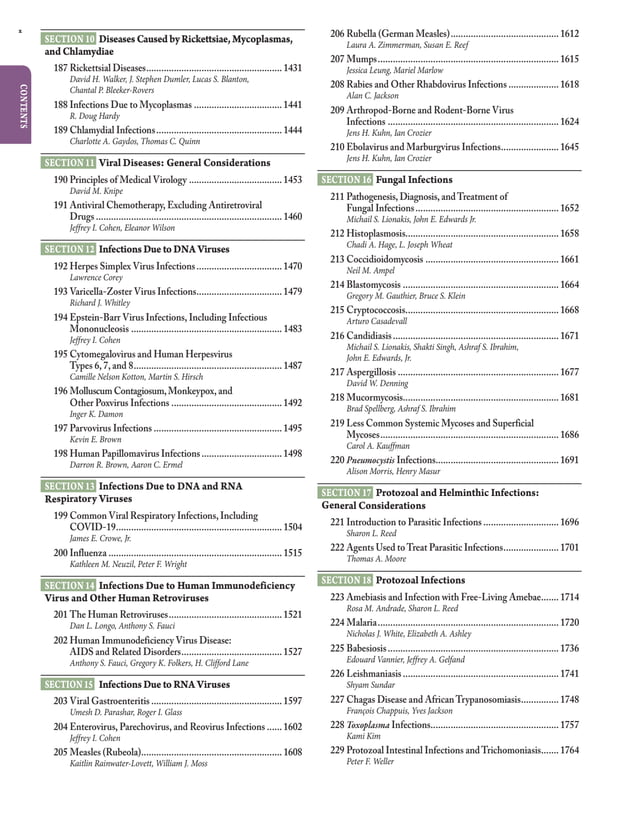
SECTION 10 DiseasesCausedbyRickettsiae,Mycoplasmas,
and Chlamydiae
187 Rickettsial Diseases.......................................................1431
David H. Walker, J. Stephen Dumler, Lucas S. Blanton,
Chantal P. Bleeker-Rovers
188 Infections Due to Mycoplasmas....................................1441
R. Doug Hardy
189 Chlamydial Infections...................................................1444
Charlotte A. Gaydos, Thomas C. Quinn
SECTION 11 Viral Diseases: General Considerations
190 Principles of Medical Virology......................................1453
David M. Knipe
191 Antiviral Chemotherapy, Excluding Antiretroviral
Drugs...........................................................................1460
Jeffrey I. Cohen, Eleanor Wilson
SECTION 12 InfectionsDuetoDNAViruses
192 Herpes Simplex Virus Infections...................................1470
Lawrence Corey
193 Varicella-Zoster Virus Infections...................................1479
Richard J. Whitley
194 Epstein-Barr Virus Infections, Including Infectious
Mononucleosis.............................................................1483
Jeffrey I. Cohen
195 Cytomegalovirus and Human Herpesvirus
Types 6, 7, and 8............................................................1487
Camille Nelson Kotton, Martin S. Hirsch
196 Molluscum Contagiosum,Monkeypox, and
Other Poxvirus Infections.............................................1492
Inger K. Damon
197 Parvovirus Infections....................................................1495
Kevin E. Brown
198 Human Papillomavirus Infections.................................1498
Darron R. Brown, Aaron C. Ermel
SECTION 13 Infections Due to DNA and RNA
Respiratory Viruses
199 Common Viral Respiratory Infections, Including
COVID-19...................................................................1504
James E. Crowe, Jr.
200 Influenza......................................................................1515
Kathleen M. Neuzil, Peter F. Wright
SECTION 14 Infections Due to Human Immunodeficiency
Virus and Other Human Retroviruses
201 The Human Retroviruses..............................................1521
Dan L. Longo, Anthony S. Fauci
202 Human Immunodeficiency Virus Disease:
AIDS and Related Disorders.........................................1527
Anthony S. Fauci, Gregory K. Folkers, H. Clifford Lane
SECTION15 InfectionsDuetoRNAViruses
203 Viral Gastroenteritis.....................................................1597
Umesh D. Parashar, Roger I. Glass
204 Enterovirus, Parechovirus, and Reovirus Infections.......1602
Jeffrey I. Cohen
205 Measles (Rubeola).........................................................1608
Kaitlin Rainwater-Lovett, William J. Moss
206 Rubella (German Measles)............................................1612
Laura A. Zimmerman, Susan E. Reef
207 Mumps.........................................................................1615
Jessica Leung, Mariel Marlow
208 Rabies and Other Rhabdovirus Infections.....................1618
Alan C. Jackson
209 Arthropod-Borne and Rodent-Borne Virus
Infections.....................................................................1624
Jens H. Kuhn, Ian Crozier
210 Ebolavirus and Marburgvirus Infections........................1645
Jens H. Kuhn, Ian Crozier
SECTION 16 Fungal Infections
211 Pathogenesis,Diagnosis,andTreatment of
Fungal Infections..........................................................1652
Michail S. Lionakis, John E. Edwards Jr.
212 Histoplasmosis.............................................................1658
Chadi A. Hage, L. Joseph Wheat
213 Coccidioidomycosis......................................................1661
Neil M. Ampel
214 Blastomycosis...............................................................1664
Gregory M. Gauthier, Bruce S. Klein
215 Cryptococcosis..............................................................1668
Arturo Casadevall
216 Candidiasis...................................................................1671
Michail S. Lionakis, Shakti Singh, Ashraf S. Ibrahim,
John E. Edwards, Jr.
217 Aspergillosis.................................................................1677
David W. Denning
218 Mucormycosis...............................................................1681
Brad Spellberg, Ashraf S. Ibrahim
219 Less Common Systemic Mycoses and Superficial
Mycoses........................................................................1686
Carol A. Kauffman
220 Pneumocystis Infections.................................................1691
Alison Morris, Henry Masur
SECTION 17 Protozoal and Helminthic Infections:
General Considerations
221 Introduction to Parasitic Infections...............................1696
Sharon L. Reed
222 Agents Used toTreat Parasitic Infections.......................1701
Thomas A. Moore
SECTION 18 Protozoal Infections
223 Amebiasis and Infection with Free-Living Amebae........1714
Rosa M. Andrade, Sharon L. Reed
224 Malaria.........................................................................1720
Nicholas J. White, Elizabeth A. Ashley
225 Babesiosis.....................................................................1736
Edouard Vannier, Jeffrey A. Gelfand
226 Leishmaniasis...............................................................1741
Shyam Sundar
227 Chagas Disease and AfricanTrypanosomiasis................1748
François Chappuis, Yves Jackson
228 Toxoplasma Infections...................................................1757
Kami Kim
229 Protozoal Intestinal Infections andTrichomoniasis........1764
Peter F. Weller
HPIM 21e_FM_VOL1_pi-pxl.indd 10 21/01/22 7:01 PM
12.
CONTENTS
xi
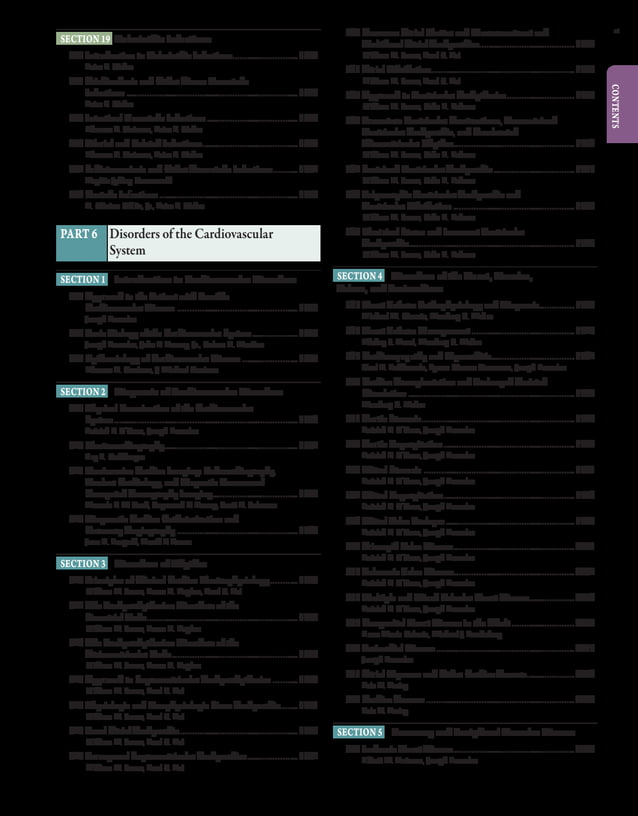
SECTION 19 HelminthicInfections
230 Introduction to Helminthic Infections...........................1768
Peter F. Weller
231 Trichinellosis and OtherTissue Nematode
Infections.....................................................................1770
Peter F. Weller
232 Intestinal Nematode Infections.....................................1773
Thomas B. Nutman, Peter F. Weller
233 Filarial and Related Infections.......................................1778
Thomas B. Nutman, Peter F. Weller
234 Schistosomiasis and OtherTrematode Infections...........1784
Birgitte Jyding Vennervald
235 Cestode Infections........................................................1790
A. Clinton White, Jr., Peter F. Weller
PART6 Disorders of the Cardiovascular
System
SECTION 1 Introduction to Cardiovascular Disorders
236 Approach to the Patient with Possible
Cardiovascular Disease.................................................1797
Joseph Loscalzo
237 Basic Biology of the Cardiovascular System...................1799
Joseph Loscalzo, John F. Keaney, Jr., Calum A. MacRae
238 Epidemiology of Cardiovascular Disease.......................1810
Thomas A. Gaziano, J. Michael Gaziano
SECTION 2 Diagnosis of Cardiovascular Disorders
239 Physical Examination of the Cardiovascular
System..........................................................................1815
Patrick T. O’Gara, Joseph Loscalzo
240 Electrocardiography......................................................1824
Ary L. Goldberger
241 Noninvasive Cardiac Imaging: Echocardiography,
Nuclear Cardiology, and Magnetic Resonance/
ComputedTomography Imaging...................................1832
Marcelo F. Di Carli, Raymond Y. Kwong, Scott D. Solomon
242 Diagnostic Cardiac Catheterization and
Coronary Angiography.................................................1859
Jane A. Leopold, David P. Faxon
SECTION 3 Disorders of Rhythm
243 Principles of Clinical Cardiac Electrophysiology............1866
William H. Sauer, Bruce A. Koplan, Paul C. Zei
244 The Bradyarrhythmias: Disorders of the
Sinoatrial Node.............................................................1873
William H. Sauer, Bruce A. Koplan
245 The Bradyarrhythmias: Disorders of the
Atrioventricular Node...................................................1880
William H. Sauer, Bruce A. Koplan
246 Approach to SupraventricularTachyarrhythmias...........1888
William H. Sauer, Paul C. Zei
247 Physiologic and Nonphysiologic SinusTachycardia........1891
William H. Sauer, Paul C. Zei
248 Focal AtrialTachycardia................................................1893
William H. Sauer, Paul C. Zei
249 Paroxysmal SupraventricularTachycardias.....................1894
William H. Sauer, Paul C. Zei
250 Common Atrial Flutter and Macroreentrant and
Multifocal AtrialTachycardias......................................1899
William H. Sauer, Paul C. Zei
251 Atrial Fibrillation.........................................................1903
William H. Sauer, Paul C. Zei
252 Approach to Ventricular Arrhythmias............................1910
William H. Sauer, Usha B. Tedrow
253 Premature Ventricular Contractions, Nonsustained
VentricularTachycardia, and Accelerated
Idioventricular Rhythm.................................................1915
William H. Sauer, Usha B. Tedrow
254 Sustained VentricularTachycardia.................................1919
William H. Sauer, Usha B. Tedrow
255 Polymorphic VentricularTachycardia and
Ventricular Fibrillation.................................................1923
William H. Sauer, Usha B. Tedrow
256 Electrical Storm and Incessant Ventricular
Tachycardia...................................................................1927
William H. Sauer, Usha B. Tedrow
SECTION 4 Disorders of the Heart, Muscles,
Valves, and Pericardium
257 Heart Failure: Pathophysiology and Diagnosis...............1930
Michael M. Givertz, Mandeep R. Mehra
258 Heart Failure: Management..........................................1940
Akshay S. Desai, Mandeep R. Mehra
259 Cardiomyopathy and Myocarditis..................................1954
Neal K. Lakdawala, Lynne Warner Stevenson, Joseph Loscalzo
260 CardiacTransplantation and Prolonged Assisted
Circulation...................................................................1973
Mandeep R. Mehra
261 Aortic Stenosis..............................................................1978
Patrick T. O’Gara, Joseph Loscalzo
262 Aortic Regurgitation.....................................................1986
Patrick T. O’Gara, Joseph Loscalzo
263 Mitral Stenosis.............................................................1991
Patrick T. O’Gara, Joseph Loscalzo
264 Mitral Regurgitation.....................................................1995
Patrick T. O’Gara, Joseph Loscalzo
265 Mitral Valve Prolapse....................................................1999
Patrick T. O’Gara, Joseph Loscalzo
266 Tricuspid Valve Disease.................................................2001
Patrick T. O’Gara, Joseph Loscalzo
267 Pulmonic Valve Disease................................................2004
Patrick T. O’Gara, Joseph Loscalzo
268 Multiple and Mixed Valvular Heart Disease..................2005
Patrick T. O’Gara, Joseph Loscalzo
269 Congenital Heart Disease in the Adult..........................2008
Anne Marie Valente, Michael J. Landzberg
270 Pericardial Disease........................................................2019
Joseph Loscalzo
271 Atrial Myxoma and Other CardiacTumors....................2025
Eric H. Awtry
272 CardiacTrauma............................................................2028
Eric H. Awtry
SECTION 5 Coronary and Peripheral Vascular Disease
273 Ischemic Heart Disease.................................................2030
Elliott M. Antman, Joseph Loscalzo
HPIM 21e_FM_VOL1_pi-pxl.indd 11 21/01/22 7:01 PM
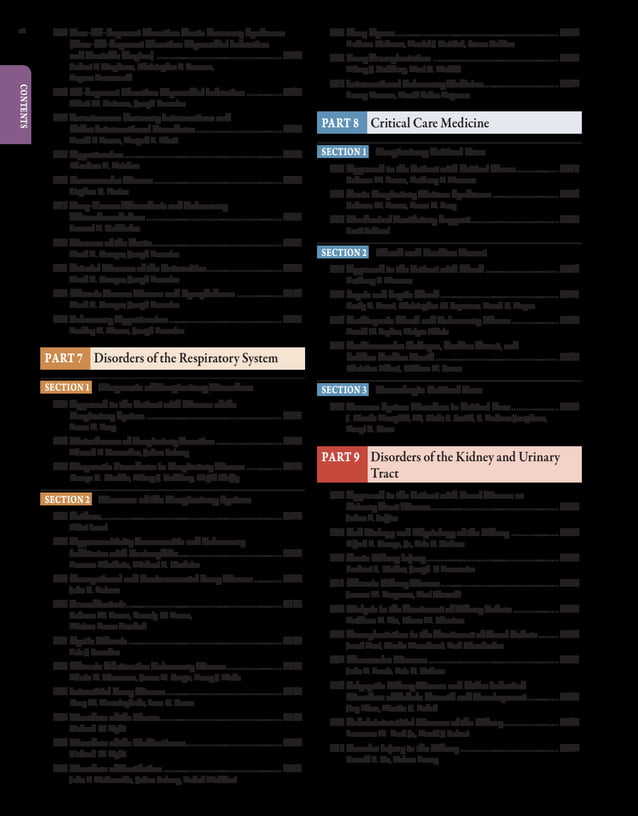
13.
CONTENTS
xii 274 Non-ST-SegmentElevation Acute Coronary Syndrome
(Non-ST-Segment Elevation Myocardial Infarction
and Unstable Angina)...................................................2046
Robert P. Giugliano, Christopher P. Cannon,
Eugene Braunwald
275 ST-Segment Elevation Myocardial Infarction...............2053
Elliott M. Antman, Joseph Loscalzo
276 Percutaneous Coronary Interventions and
Other Interventional Procedures...................................2066
David P. Faxon, Deepak L. Bhatt
277 Hypertension................................................................2072
Theodore A. Kotchen
278 Renovascular Disease....................................................2088
Stephen C. Textor
279 Deep-VenousThrombosis and Pulmonary
Thromboembolism.......................................................2091
Samuel Z. Goldhaber
280 Diseases of the Aorta....................................................2101
Mark A. Creager, Joseph Loscalzo
281 Arterial Diseases of the Extremities...............................2107
Mark A. Creager, Joseph Loscalzo
282 Chronic Venous Disease and Lymphedema...................2115
Mark A. Creager, Joseph Loscalzo
283 Pulmonary Hypertension..............................................2121
Bradley A. Maron, Joseph Loscalzo
PART 7 Disorders of the Respiratory System
SECTION 1 Diagnosis of Respiratory Disorders
284 Approach to the Patient with Disease of the
Respiratory System.......................................................2131
Bruce D. Levy
285 Disturbances of Respiratory Function...........................2133
Edward T. Naureckas, Julian Solway
286 Diagnostic Procedures in Respiratory Disease...............2140
George R. Washko, Hilary J. Goldberg, Majid Shafiq
SECTION 2 Diseases of the Respiratory System
287 Asthma.........................................................................2147
Elliot Israel
288 Hypersensitivity Pneumonitis and Pulmonary
Infiltrates with Eosinophilia..........................................2160
Praveen Akuthota, Michael E. Wechsler
289 Occupational and Environmental Lung Disease............2166
John R. Balmes
290 Bronchiectasis...............................................................2173
Rebecca M. Baron, Beverly W. Baron,
Miriam Baron Barshak
291 Cystic Fibrosis..............................................................2176
Eric J. Sorscher
292 Chronic Obstructive Pulmonary Disease.......................2180
Edwin K. Silverman, James D. Crapo, Barry J. Make
293 Interstitial Lung Disease...............................................2190
Gary M. Hunninghake, Ivan O. Rosas
294 Disorders of the Pleura..................................................2197
Richard W. Light
295 Disorders of the Mediastinum.......................................2200
Richard W. Light
296 Disorders of Ventilation................................................2201
John F. McConville, Julian Solway, Babak Mokhlesi
297 Sleep Apnea..................................................................2204
Andrew Wellman, Daniel J. Gottlieb, Susan Redline
298 LungTransplantation...................................................2209
Hilary J. Goldberg, Hari R. Mallidi
299 Interventional Pulmonary Medicine...............................2214
Lonny Yarmus, David Feller-Kopman
PART 8 Critical Care Medicine
SECTION 1 Respiratory Critical Care
300 Approach to the Patient with Critical Illness..................2217
Rebecca M. Baron, Anthony F. Massaro
301 Acute Respiratory Distress Syndrome...........................2225
Rebecca M. Baron, Bruce D. Levy
302 Mechanical Ventilatory Support....................................2230
Scott Schissel
SECTION 2 Shock and Cardiac Arrest
303 Approach to the Patient with Shock..............................2235
Anthony F. Massaro
304 Sepsis and Septic Shock................................................2241
Emily B. Brant, Christopher W. Seymour, Derek C. Angus
305 Cardiogenic Shock and Pulmonary Edema....................2250
David H. Ingbar, Holger Thiele
306 Cardiovascular Collapse, Cardiac Arrest, and
Sudden Cardiac Death..................................................2257
Christine Albert, William H. Sauer
SECTION 3 Neurologic Critical Care
307 Nervous System Disorders in Critical Care....................2267
J. Claude Hemphill, III, Wade S. Smith, S. Andrew Josephson,
Daryl R. Gress
PART 9 Disorders of the Kidney and Urinary
Tract
308 Approach to the Patient with Renal Disease or
UrinaryTract Disease....................................................2279
Julian L. Seifter
309 Cell Biology and Physiology of the Kidney....................2287
Alfred L. George, Jr., Eric G. Neilson
310 Acute Kidney Injury......................................................2296
Sushrut S. Waikar, Joseph V. Bonventre
311 Chronic Kidney Disease................................................2309
Joanne M. Bargman, Karl Skorecki
312 Dialysis in theTreatment of Kidney Failure...................2320
Kathleen D. Liu, Glenn M. Chertow
313 Transplantation in theTreatment of Renal Failure.........2325
Jamil Azzi, Naoka Murakami, Anil Chandraker
314 Glomerular Diseases.....................................................2331
Julia B. Lewis, Eric G. Neilson
315 Polycystic Kidney Disease and Other Inherited
Disorders ofTubule Growth and Development..............2350
Jing Zhou, Martin R. Pollak
316 Tubulointerstitial Diseases of the Kidney.......................2357
Laurence H. Beck Jr., David J. Salant
317 Vascular Injury to the Kidney........................................2364
Ronald S. Go, Nelson Leung
HPIM 21e_FM_VOL1_pi-pxl.indd 12 21/01/22 7:01 PM
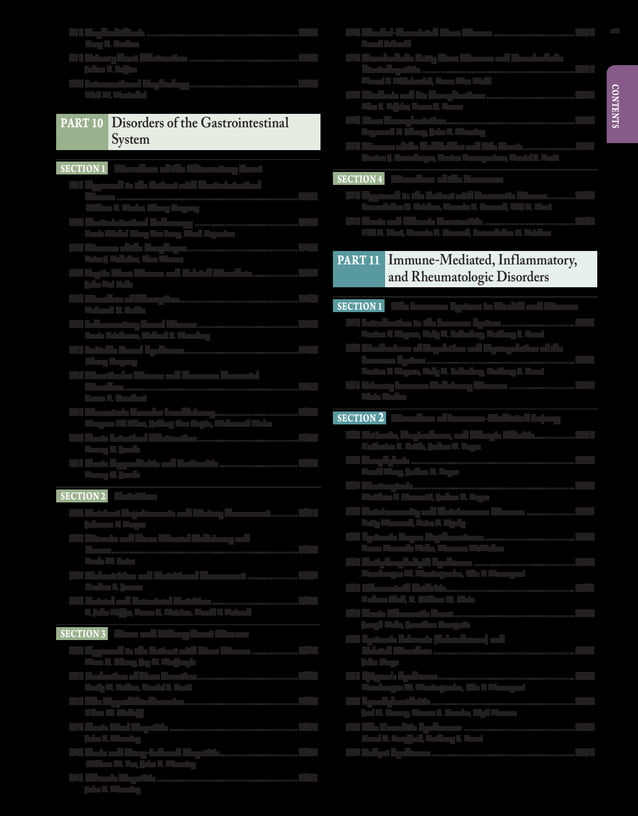
14.
CONTENTS
xiii
318 Nephrolithiasis.............................................................2368
Gary C.Curhan
319 UrinaryTract Obstruction............................................2373
Julian L. Seifter
320 Interventional Nephrology............................................2377
Dirk M. Hentschel
PART10 Disorders of the Gastrointestinal
System
SECTION 1 Disorders of the Alimentary Tract
321 Approach to the Patient with Gastrointestinal
Disease.........................................................................2381
William L. Hasler, Chung Owyang
322 Gastrointestinal Endoscopy..........................................2387
Louis Michel Wong Kee Song, Mark Topazian
323 Diseases of the Esophagus.............................................2423
Peter J. Kahrilas, Ikuo Hirano
324 Peptic Ulcer Disease and Related Disorders...................2434
John Del Valle
325 Disorders of Absorption................................................2458
Deborah C. Rubin
326 Inflammatory Bowel Disease.........................................2469
Sonia Friedman, Richard S. Blumberg
327 Irritable Bowel Syndrome..............................................2490
Chung Owyang
328 Diverticular Disease and Common Anorectal
Disorders......................................................................2497
Susan L. Gearhart
329 Mesenteric Vascular Insufficiency..................................2506
Maryam Ali Khan, Jaideep Das Gupta, Mahmoud Malas
330 Acute Intestinal Obstruction.........................................2508
Danny O. Jacobs
331 Acute Appendicitis and Peritonitis................................2513
Danny O. Jacobs
SECTION 2 Nutrition
332 Nutrient Requirements and Dietary Assessment............2517
Johanna T. Dwyer
333 Vitamin andTrace Mineral Deficiency and
Excess...........................................................................2523
Paolo M. Suter
334 Malnutrition and Nutritional Assessment.....................2534
Gordon L. Jensen
335 Enteral and Parenteral Nutrition...................................2539
L. John Hoffer, Bruce R. Bistrian, David F. Driscoll
SECTION 3 Liver and Biliary Tract Disease
336 Approach to the Patient with Liver Disease...................2546
Marc G. Ghany, Jay H. Hoofnagle
337 Evaluation of Liver Function.........................................2553
Emily D. Bethea, Daniel S. Pratt
338 The Hyperbilirubinemias..............................................2557
Allan W. Wolkoff
339 Acute Viral Hepatitis....................................................2562
Jules L. Dienstag
340 Toxic and Drug-Induced Hepatitis................................2584
William M. Lee, Jules L. Dienstag
341 Chronic Hepatitis.........................................................2591
Jules L. Dienstag
342 Alcohol-Associated Liver Disease.................................2617
Bernd Schnabl
343 Nonalcoholic Fatty Liver Diseases and Nonalcoholic
Steatohepatitis..............................................................2619
Manal F. Abdelmalek, Anna Mae Diehl
344 Cirrhosis and Its Complications....................................2624
Alex S. Befeler, Bruce R. Bacon
345 LiverTransplantation....................................................2633
Raymond T. Chung, Jules L. Dienstag
346 Diseases of the Gallbladder and Bile Ducts......................2641
Norton J. Greenberger, Gustav Paumgartner, Daniel S. Pratt
SECTION 4 Disorders of the Pancreas
347 Approach to the Patient with Pancreatic Disease............2652
Somashekar G. Krishna, Darwin L. Conwell, Phil A. Hart
348 Acute and Chronic Pancreatitis.....................................2657
Phil A. Hart, Darwin L. Conwell, Somashekar G. Krishna
PART 11 Immune-Mediated, Inflammatory,
and Rheumatologic Disorders
SECTION 1 The Immune System in Health and Disease
349 Introduction to the Immune System..............................2671
Barton F. Haynes, Kelly A. Soderberg, Anthony S. Fauci
350 Mechanisms of Regulation and Dysregulation of the
Immune System............................................................2701
Barton F. Haynes, Kelly A. Soderberg, Anthony S. Fauci
351 Primary Immune Deficiency Diseases...........................2709
Alain Fischer
SECTION 2 Disorders of Immune-Mediated Injury
352 Urticaria, Angioedema, and Allergic Rhinitis.................2719
Katherine L. Tuttle, Joshua A. Boyce
353 Anaphylaxis..................................................................2727
David Hong, Joshua A. Boyce
354 Mastocytosis.................................................................2729
Matthew P. Giannetti, Joshua A. Boyce
355 Autoimmunity and Autoimmune Diseases....................2731
Betty Diamond, Peter E. Lipsky
356 Systemic Lupus Erythematosus.....................................2736
Bevra Hannahs Hahn, Maureen McMahon
357 Antiphospholipid Syndrome.........................................2749
Haralampos M. Moutsopoulos, Clio P. Mavragani
358 Rheumatoid Arthritis....................................................2751
Ankoor Shah, E. William St. Clair
359 Acute Rheumatic Fever.................................................2766
Joseph Kado, Jonathan Carapetis
360 Systemic Sclerosis (Scleroderma) and
Related Disorders.........................................................2771
John Varga
361 Sjögren’s Syndrome.......................................................2787
Haralampos M. Moutsopoulos, Clio P. Mavragani
362 Spondyloarthritis..........................................................2790
Joel D. Taurog, Lianne S. Gensler, Nigil Haroon
363 The Vasculitis Syndromes.............................................2802
Carol A. Langford, Anthony S. Fauci
364 Behçet Syndrome..........................................................2817
HPIM 21e_FM_VOL1_pi-pxl.indd 13 21/01/22 7:01 PM
15.
CONTENTS
xiv Yusuf Yazici
365Inflammatory Myopathies.............................................2819
Steven A. Greenberg, Anthony A. Amato
366 Relapsing Polychondritis...............................................2826
Carol A. Langford
367 Sarcoidosis....................................................................2829
Robert P. Baughman, Elyse E. Lower
368 IgG4-Related Disease...................................................2837
John H. Stone
369 Familial Mediterranean Fever and Other
Hereditary Autoinflammatory Diseases.........................2840
Daniel L. Kastner
SECTION 3 Disorders of the Joints and Adjacent
Tissues
370 Approach to Articular and Musculoskeletal
Disorders......................................................................2844
John J. Cush
371 Osteoarthritis...............................................................2854
David T. Felson, Tuhina Neogi
372 Gout and Other Crystal-Associated Arthropathies........2862
Hyon K. Choi
373 Fibromyalgia.................................................................2868
Leslie J. Crofford
374 Arthritis Associated with Systemic Disease,
and Other Arthritides...................................................2871
Carol A. Langford, Brian F. Mandell
375 Periarticular Disorders of the Extremities......................2878
Carol A. Langford
PART12 Endocrinology and Metabolism
SECTION 1 Endocrinology
376 Approach to the Patient with Endocrine Disorders........2881
J. Larry Jameson
377 Mechanisms of Hormone Action..................................2884
J. Larry Jameson
378 Physiology of Anterior Pituitary Hormones..................2891
Shlomo Melmed, J. Larry Jameson
379 Hypopituitarism...........................................................2896
Shlomo Melmed, J. Larry Jameson
380 PituitaryTumor Syndromes..........................................2902
Shlomo Melmed, J. Larry Jameson
381 Disorders of the Neurohypophysis.................................2918
Gary L. Robertson, Daniel G. Bichet
382 Thyroid Gland Physiology andTesting..........................2926
J. Larry Jameson, Susan J. Mandel, Anthony P. Weetman
383 Hypothyroidism............................................................2933
J. Larry Jameson, Susan J. Mandel, Anthony P. Weetman
384 Hyperthyroidism and Other Causes of
Thyrotoxicosis..............................................................2938
J. Larry Jameson, Susan J. Mandel, Anthony P. Weetman
385 Thyroid Nodular Disease andThyroid Cancer...............2946
J. Larry Jameson, Susan J. Mandel, Anthony P. Weetman
386 Disorders of the Adrenal Cortex....................................2955
Wiebke Arlt
387 Pheochromocytoma......................................................2976
Hartmut P. H. Neumann
388 Multiple Endocrine Neoplasia Syndromes.....................2983
R. V. Thakker
389 Autoimmune Polyendocrine Syndromes........................2992
Peter A. Gottlieb, Aaron W. Michels
SECTION 2 Sex- and Gender-Based Medicine
390 Sex Development..........................................................2997
Courtney Finlayson, J. Larry Jameson, John C. Achermann
391 Disorders of theTestes and Male Reproductive
System..........................................................................3006
Shalender Bhasin, J. Larry Jameson
392 Disorders of the Female Reproductive System...............3027
Janet E. Hall, Anuja Dokras
393 Menstrual Disorders and Pelvic Pain.............................3033
Janet E. Hall, Anuja Dokras
394 Hirsutism.....................................................................3039
David A. Ehrmann
395 Menopause and Postmenopausal Hormone
Therapy........................................................................3043
JoAnn E. Manson, Shari S. Bassuk
396 Infertility and Contraception........................................3050
Anuja Dokras, Janet E. Hall
397 Sexual Dysfunction.......................................................3055
Kevin T. McVary
398 Women’s Health............................................................3063
Emily Nosova, Andrea Dunaif
399 Men’s Health................................................................3069
Shalender Bhasin
400 Lesbian, Gay, Bisexual, andTransgender
(LGBT) Health............................................................3078
Baligh R. Yehia, Zachary B. R. McClain
SECTION 3 Obesity, Diabetes Mellitus,
and Metabolic Syndrome
401 Pathobiology of Obesity................................................3080
Stephen O’Rahilly, I. Sadaf Farooqi
402 Evaluation and Management of Obesity........................3087
Robert F. Kushner
403 Diabetes Mellitus: Diagnosis, Classification,
and Pathophysiology.....................................................3094
Alvin C. Powers, Kevin D. Niswender, Carmella Evans-Molina
404 Diabetes Mellitus: Management andTherapies...............3104
Alvin C. Powers, Michael J. Fowler, Michael R. Rickels
405 Diabetes Mellitus: Complications.................................3120
Alvin C. Powers, John M. Stafford, Michael R. Rickels
406 Hypoglycemia...............................................................3129
Stephen N. Davis, Philip E. Cryer
407 Disorders of Lipoprotein Metabolism...........................3135
Daniel J. Rader
408 The Metabolic Syndrome..............................................3150
Robert H. Eckel
SECTION 4 Disorders of Bone and Mineral Metabolism
409 Bone and Mineral Metabolism in Health
and Disease...................................................................3157
F. Richard Bringhurst, Henry M. Kronenberg, Eva S. Liu
410 Disorders of the Parathyroid Gland and Calcium
Homeostasis.................................................................3169
John T. Potts, Jr., Harald Jüppner
411 Osteoporosis.................................................................3191
HPIM 21e_FM_VOL1_pi-pxl.indd 14 21/01/22 7:01 PM
16.
CONTENTS
xv
Robert Lindsay, BlossomSamuels
412 Paget’s Disease and Other Dysplasias of Bone...............3209
Rajesh K. Jain, Tamara J. Vokes
SECTION 5 Disorders of Intermediary Metabolism
413 Heritable Disorders of ConnectiveTissue......................3217
Joan C. Marini, Fransiska Malfait
414 Hemochromatosis.........................................................3230
Lawrie W. Powell, David M. Frazer
415 Wilson’s Disease...........................................................3235
Stephen G. Kaler
416 The Porphyrias.............................................................3237
Robert J. Desnick, Manisha Balwani
417 Disorders of Purine and Pyrimidine Metabolism...........3248
John N. Mecchella, Christopher M. Burns
418 Lysosomal Storage Diseases..........................................3254
Robert J. Hopkin, Gregory A. Grabowski
419 Glycogen Storage Diseases and Other Inherited
Disorders of Carbohydrate Metabolism.........................3261
Priya S. Kishnani
420 Inherited Disorders of Amino Acid Metabolism
in Adults.......................................................................3268
Nicola Longo
421 Inherited Defects of MembraneTransport....................3274
Nicola Longo
PART13 Neurologic Disorders
SECTION 1 Diagnosis of Neurologic Disorders
422 Approach to the Patient with Neurologic Disease..........3277
Daniel H. Lowenstein, S. Andrew Josephson, Stephen L. Hauser
423 Neuroimaging in Neurologic Disorders.........................3282
William P. Dillon
424 Pathobiology of Neurologic Diseases.............................3293
Stephen L. Hauser, Arnold R. Kriegstein, Stanley B. Prusiner
SECTION 2 Diseases of the Central Nervous System
425 Seizures and Epilepsy....................................................3305
Vikram R. Rao, Daniel H. Lowenstein
426 Introduction to Cerebrovascular Diseases......................3324
Wade S. Smith, S. Claiborne Johnston, J. Claude Hemphill, III
427 Ischemic Stroke............................................................3335
Wade S. Smith, S. Claiborne Johnston, J. Claude Hemphill, III
428 Intracranial Hemorrhage...............................................3348
Wade S. Smith, J. Claude Hemphill, III, S. Claiborne Johnston
429 Subarachnoid Hemorrhage...........................................3353
J. Claude Hemphill, III,Wade S. Smith, Daryl R. Gress
430 Migraine and Other Primary Headache
Disorders......................................................................3357
Peter J. Goadsby
431 Alzheimer’s Disease......................................................3370
Gil D. Rabinovici, William W. Seeley, Bruce L. Miller
432 Frontotemporal Dementia............................................3378
William W. Seeley, Bruce L. Miller
433 Vascular Dementia........................................................3381
Steven M. Greenberg, William W. Seeley
434 Dementia with Lewy Bodies..........................................3385
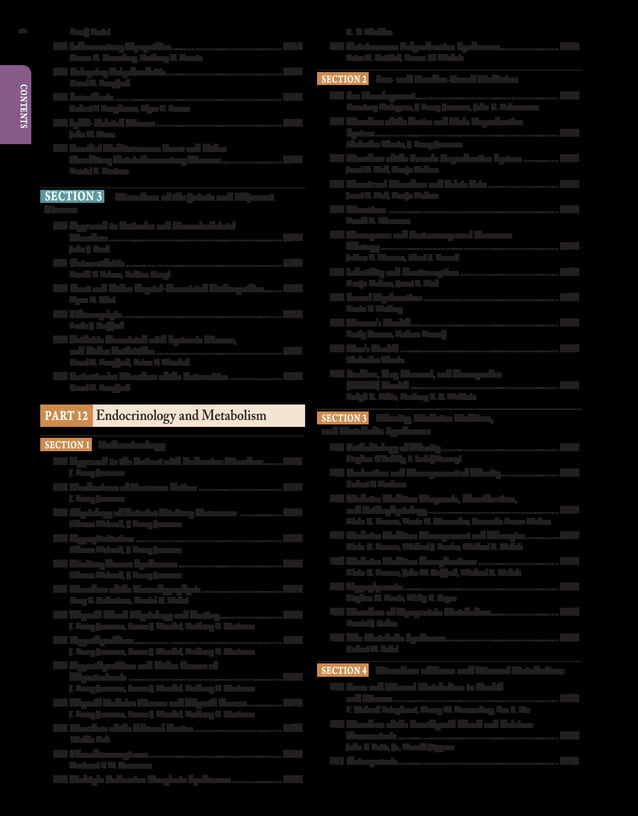
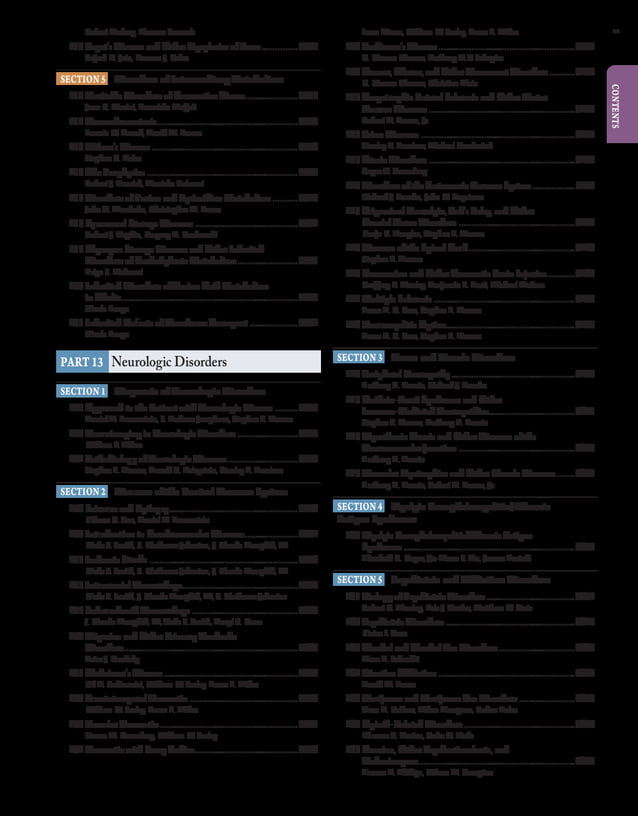
Irene Litvan, William W. Seeley, Bruce L. Miller
435 Parkinson’s Disease.......................................................3386
C. Warren Olanow, Anthony H.V. Schapira
436 Tremor,Chorea,and Other Movement Disorders...........3400
C. Warren Olanow, Christine Klein
437 Amyotrophic Lateral Sclerosis and Other Motor
Neuron Diseases...........................................................3410
Robert H. Brown, Jr.
438 Prion Diseases..............................................................3416
Stanley B. Prusiner, Michael Geschwind
439 Ataxic Disorders...........................................................3422
Roger N. Rosenberg
440 Disorders of the Autonomic Nervous System...................3427
Richard J. Barohn, John W. Engstrom
441 Trigeminal Neuralgia, Bell’s Palsy, and Other
Cranial Nerve Disorders...............................................3436
Vanja C. Douglas, Stephen L. Hauser
442 Diseases of the Spinal Cord...........................................3445
Stephen L. Hauser
443 Concussion and OtherTraumatic Brain Injuries............3456
Geoffrey T. Manley, Benjamin L. Brett, Michael McCrea
444 Multiple Sclerosis.........................................................3462
Bruce A. C. Cree, Stephen L. Hauser
445 Neuromyelitis Optica....................................................3477
Bruce A. C. Cree, Stephen L. Hauser
SECTION 3 Nerve and Muscle Disorders
446 Peripheral Neuropathy..................................................3480
Anthony A. Amato, Richard J. Barohn
447 Guillain-Barré Syndrome and Other
Immune-Mediated Neuropathies...................................3501
Stephen L. Hauser, Anthony A. Amato
448 Myasthenia Gravis and Other Diseases of the
Neuromuscular Junction...............................................3509
Anthony A. Amato
449 Muscular Dystrophies and Other Muscle Diseases........3516
Anthony A. Amato, Robert H. Brown, Jr.
SECTION 4 Myalgic Encephalomyelitis/Chronic
Fatigue Syndrome
450 Myalgic Encephalomyelitis/Chronic Fatigue
Syndrome.....................................................................3532
Elizabeth R. Unger, Jin-Mann S. Lin, Jeanne Bertolli
SECTION 5 Psychiatric and Addiction Disorders
451 Biology of Psychiatric Disorders....................................3534
Robert O. Messing, Eric J. Nestler, Matthew W. State
452 Psychiatric Disorders....................................................3540
Victor I. Reus
453 Alcohol and Alcohol Use Disorders...............................3556
Marc A. Schuckit
454 Nicotine Addiction.......................................................3563
David M. Burns
455 Marijuana and Marijuana Use Disorders.......................3567
Nora D. Volkow, Aidan Hampson, Ruben Baler
456 Opioid-Related Disorders.............................................3569
Thomas R. Kosten, Colin N. Haile
457 Cocaine, Other Psychostimulants, and
Hallucinogens...............................................................3573
Karran A. Phillips, Wilson M. Compton
HPIM 21e_FM_VOL1_pi-pxl.indd 15 21/01/22 7:01 PM
17.
CONTENTS
xvi
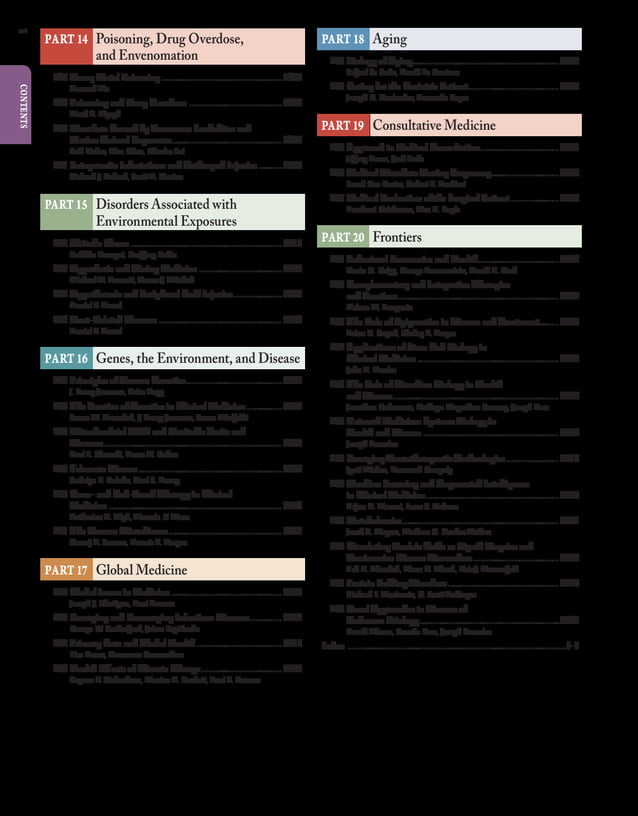
PART 14 Poisoning,Drug Overdose,
and Envenomation
458 Heavy Metal Poisoning.................................................3579
Howard Hu
459 Poisoning and Drug Overdose......................................3582
Mark B. Mycyk
460 Disorders Caused by Venomous Snakebites and
Marine Animal Exposures.............................................3596
Erik Fisher, Alex Chen, Charles Lei
461 Ectoparasite Infestations and Arthropod Injuries..........3608
Richard J. Pollack, Scott A. Norton
PART15 Disorders Associated with
Environmental Exposures
462 Altitude Illness.............................................................3617
Buddha Basnyat, Geoffrey Tabin
463 Hyperbaric and Diving Medicine..................................3623
Michael H. Bennett, Simon J. Mitchell
464 Hypothermia and Peripheral Cold Injuries....................3630
Daniel F. Danzl
465 Heat-Related Illnesses..................................................3635
Daniel F. Danzl
PART16 Genes, the Environment, and Disease
466 Principles of Human Genetics.......................................3639
J. Larry Jameson, Peter Kopp
467 The Practice of Genetics in Clinical Medicine...............3662
Susan M. Domchek, J. Larry Jameson, Susan Miesfeldt
468 Mitochondrial DNA and HeritableTraits and
Diseases........................................................................3668
Karl L. Skorecki, Bruce H. Cohen
469 Telomere Disease..........................................................3680
Rodrigo T. Calado, Neal S. Young
470 Gene- and Cell-BasedTherapy in Clinical
Medicine......................................................................3685
Katherine A. High, Marcela V. Maus
471 The Human Microbiome..............................................3690
Neeraj K. Surana, Dennis L. Kasper
PART17 Global Medicine
472 Global Issues in Medicine.............................................3703
Joseph J. Rhatigan, Paul Farmer
473 Emerging and Reemerging Infectious Diseases..............3713
George W. Rutherford, Jaime Sepúlveda
474 Primary Care and Global Health...................................3718
Tim Evans, Kumanan Rasanathan
475 Health Effects of Climate Change.................................3726
Eugene T. Richardson, Maxine A. Burkett, Paul E. Farmer
PART 18 Aging
476 Biology of Aging...........................................................3733
Rafael de Cabo, David Le Couteur
477 Caring for the Geriatric Patient.....................................3739
Joseph G. Ouslander, Bernardo Reyes
PART19 Consultative Medicine
478 Approach to Medical Consultation................................3761
Jeffrey Berns, Jack Ende
479 Medical Disorders During Pregnancy............................3762
Sarah Rae Easter, Robert L. Barbieri
480 Medical Evaluation of the Surgical Patient....................3769
Prashant Vaishnava, Kim A. Eagle
PART20 Frontiers
481 Behavioral Economics and Health.................................3775
Kevin G. Volpp, George Loewenstein, David A. Asch
482 Complementary and IntegrativeTherapies
and Practices.................................................................3784
Helene M. Langevin
483 The Role of Epigenetics in Disease andTreatment........3790
Brian C. Capell, Shelley L. Berger
484 Applications of Stem Cell Biology in
Clinical Medicine.........................................................3796
John A. Kessler
485 The Role of Circadian Biology in Health
and Disease...................................................................3800
Jonathan Cedernaes, Kathryn Moynihan Ramsey, Joseph Bass
486 Network Medicine: Systems Biology in
Health and Disease.......................................................3812
Joseph Loscalzo
487 Emerging NeurotherapeuticTechnologies......................3819
Jyoti Mishra, Karunesh Ganguly
488 Machine Learning and Augmented Intelligence
in Clinical Medicine......................................................3826
Arjun K. Manrai, Isaac S. Kohane
489 Metabolomics...............................................................3831
Jared R. Mayers, Mathew G. Vander Heiden
490 Circulating Nucleic Acids as Liquid Biopsies and
Noninvasive Disease Biomarkers...................................3836
Ash A. Alizadeh, Kiran K. Khush, Yair J. Blumenfeld
491 Protein Folding Disorders.............................................3846
Richard I. Morimoto, G. Scott Budinger
492 Novel Approaches to Diseasesof
Unknown Etiology...........................................................3851
David Adams, Camilo Toro, Joseph Loscalzo
Index ........................................................................................I-1
HPIM 21e_FM_VOL1_pi-pxl.indd 16 21/01/22 7:01 PM
18.
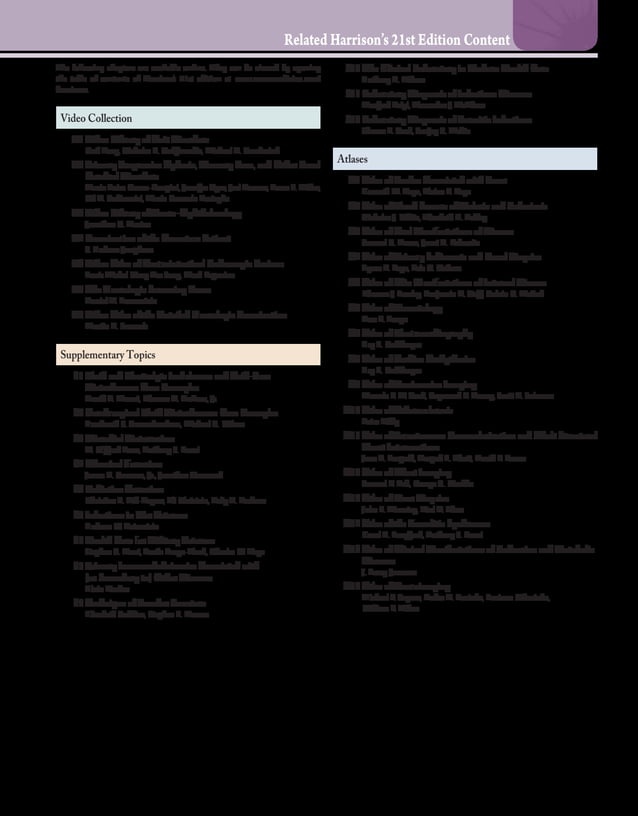
RelatedHarrison’s21stEditionContent
The following chaptersare available online. They can be viewed by opening
the table of contents of Harrison’s 21st edition at www.accessmedicine.com/
harrisons.
Video Collection
V1 Video Library of Gait Disorders
Gail Kang, Nicholas B. Galifianakis, Michael D. Geschwind
V2 Primary Progressive Aphasia, Memory Loss, and Other Focal
Cerebral Disorders
Maria Luisa Gorno-Tempini, Jennifer Ogar, Joel Kramer, Bruce L. Miller,
Gil D. Rabinovici, Maria Carmela Tartaglia
V3 Video Library of Neuro-Ophthalmology
Jonathan C. Horton
V4 Examination of the Comatose Patient
S. Andrew Josephson
V5 Video Atlas of Gastrointestinal Endoscopic Lesions
Louis Michel Wong Kee Song, Mark Topazian
V6 The Neurologic Screening Exam
Daniel H. Lowenstein
V7 Video Atlas of the Detailed Neurologic Examination
Martin A. Samuels
Supplementary Topics
S1 Fluid and Electrolyte Imbalances and Acid-Base
Disturbances: Case Examples
David B. Mount, Thomas D. DuBose, Jr.
S2 Cerebrospinal Fluid Disturbances: Case Examples
Prashanth S. Ramachandran, Michael R. Wilson
S3 Microbial Bioterrorism
H. Clifford Lane, Anthony S. Fauci
S4 ChemicalTerrorism
James A. Romano, Jr., Jonathan Newmark
S5 RadiationTerrorism
Christine E. Hill-Kayser, Eli Glatstein, Zelig A. Tochner
S6 Infections in War Veterans
Andrew W. Artenstein
S7 Health Care for Military Veterans
Stephen C. Hunt, Lucile Burgo-Black, Charles W. Hoge
S8 Primary Immunodeficiencies Associated with
(or Secondary to) Other Diseases
Alain Fischer
S9 Technique of Lumbar Puncture
Elizabeth Robbins, Stephen L. Hauser
S10 The Clinical Laboratory in Modern Health Care
Anthony A. Killeen
S11 Laboratory Diagnosis of Infectious Diseases
Manfred Brigl, Alexander J. McAdam
S12 Laboratory Diagnosis of Parasitic Infections
Sharon L. Reed, Sanjay R. Mehta
Atlases
A1 Atlas of Rashes Associated with Fever
Kenneth M. Kaye, Elaine T. Kaye
A2 Atlas of Blood Smears of Malaria and Babesiosis
Nicholas J. White, Elizabeth A. Ashley
A3 Atlas of Oral Manifestations of Disease
Samuel C. Durso, Janet A. Yellowitz
A4 Atlas of Urinary Sediments and Renal Biopsies
Agnes B. Fogo, Eric G. Neilson
A5 Atlas of Skin Manifestations of Internal Disease
Thomas J. Lawley, Benjamin K. Stoff, Calvin O. McCall
A6 Atlas of Hematology
Dan L. Longo
A7 Atlas of Electrocardiography
Ary L. Goldberger
A8 Atlas of Cardiac Arrhythmias
Ary L. Goldberger
A9 Atlas of Noninvasive Imaging
Marcelo F. Di Carli, Raymond Y. Kwong, Scott D. Solomon
A10 Atlas of Atherosclerosis
Peter Libby
A11 Atlas of Percutaneous Revascularization and Adult Structural
Heart Interventions
Jane A. Leopold, Deepak L. Bhatt, David P. Faxon
A12 Atlas of Chest Imaging
Samuel Y. Ash, George R. Washko
A13 Atlas of Liver Biopsies
Jules L. Dienstag, Atul K. Bhan
A14 Atlas of the Vasculitic Syndromes
Carol A. Langford, Anthony S. Fauci
A15 Atlas of Clinical Manifestations of Endocrine and Metabolic
Diseases
J. Larry Jameson
A16 Atlas of Neuroimaging
Michael F. Regner, Andre D. Furtado, Luciano Villarinho,
William P. Dillon
HPIM 21e_FM_VOL1_pi-pxl.indd 17 21/01/22 7:01 PM
19.
Contributors
James L. Abbruzzese,MD, FACP, FASCO, DSc (hon)
Professor, Division of Medical Oncology, Duke Cancer Institute, Durham,
North Carolina [92]
Manal F. Abdelmalek, MD, MPH
Professor of Medicine, Division of Gastroenterology and Hepatology,
Duke University, Durham, North Carolina [343]
John C. Achermann, MD, PhD
Wellcome Trust Senior Research Fellow in Clinical Science, Genetics
Genomic Medicine, UCL GOS Institute of Child Health, University College
London, London, United Kingdom [390]
David Adams, MD, PhD
Deputy Director of Clinical Genomics, Office of the Clinical Director/
NHGRI and Undiagnosed Diseases Program, National Institutes of Health,
Bethesda, Maryland [492]
John W. Adamson, MD
Clinical Professor, Division of Hematology/Oncology, Department of
Medicine, University of California at San Diego, San Diego, California
[63, 97]
Praveen Akuthota, MD
Associate Clinical Professor, Division of Pulmonary, Critical Care Sleep
Medicine, University of California, San Diego, San Diego, California [288]
Christine Albert, MD, MPH
Chair, Department of Cardiology; Lee and Harold Kapelovitz Endowed Chair
in Research Cardiology, Smidt Heart Institute, Cedars-Sinai Medical Center,
Los Angeles, California [306]
Ash A. Alizadeh, MD, PhD
Professor of Medicine (Oncology), Stanford University School of Medicine,
Stanford, California [490]
Anthony A. Amato, MD
Professor of Neurology, Harvard Medical School; Distinguished Chair of
Neurology and Chief, Neuromuscular Division, Brigham and Women’s
Hospital, Boston, Massachusetts [365, 446–449]
Rachel L. Amdur, MD
Assistant Professor of Medicine, Division of General Internal Medicine and
Geriatrics, Northwestern University Feinberg School of Medicine, Chicago,
Illinois [35]
Neil M. Ampel, MD
Professor Emeritus of Medicine and Immunobiology, University of Arizona,
Tucson, Arizona [213]
Kenneth C. Anderson, MD
Kraft Family Professor of Medicine, Harvard Medical School; Chief, Jerome
Lipper Multiple Myeloma Center, Dana-Farber Cancer Institute, Boston,
Massachusetts [111]
Rosa M. Andrade, MD
Assistant Professor of Medicine, University of California, Irvine School of
Medicine, Irvine, California [223]
Derek C. Angus, MD, MPH
Distinguished Professor and Mitchell P. Fink Endowed Chair, Department
of Critical Care Medicine; University of Pittsburgh School of Medicine,
Pittsburgh, Pennsylvania [304]
Elliott M. Antman, MD
Professor of Medicine; Harvard Medical School; Senior Physician; Senior
Investigator, TIMI Study Trial, Brigham and Women’s Hospital, Boston,
Massachusetts [273, 275]
Frederick R. Appelbaum, MD
Deputy Director, Fred Hutchinson Cancer Research Center, Seattle,
Washington [114]
Cesar A. Arias, MD, PhD, MSc, FIDSA
Chief, Division of Infectious Diseases, Houston Methodist Hospital;
Professor and John F. III and Ann H. Bookout Distinguished Chair;
Co-Director Center for Infectious Diseases Research, Houston Methodist
Research Institute and Weill Cornell Medical College, Houston, Texas [149]
Wiebke Arlt, MD, DSc, FRCP, FMedSci
William Withering Chair of Medicine, Institute of Metabolism and Systems
Research, University of Birmingham; Consultant Endocrinologist, Queen
Elizabeth Hospital Birmingham, Birmingham, United Kingdom [386]
Katrina A. Armstrong, MD
Physician in Chief, Massachusetts General Hospital, Boston, Massachusetts [6]
Andrew W. Artenstein, MD
Chief Physician Executive and Chief Academic Officer, Baystate Health;
Regional Executive Dean and Professor of Medicine, University of
Massachusetts Chan Medical School-Baystate, Springfield, Massachusetts [S6]
David A. Asch, MD, MBA
Executive Director, Penn Medicine Center for Health Care Innovation;
John Morgan Professor, Perelman School of Medicine and the Wharton
School, University of Pennsylvania, Philadelphia, Pennsylvania [481]
Samuel Y. Ash, MD, MPH
Assistant Professor of Medicine, Harvard Medical School; Division of
Pulmonary and Critical Care Medicine, Department of Medicine,
Brigham and Women’s Hospital, Boston, Massachusetts [A12]
Elizabeth A. Ashley, MB, BS, MRCP, FRCPath
Professor of Tropical Medicine, Oxford University; Director,
Lao-Oxford-Mahosot Hospital-Wellcome Trust Research Unit, Vientiane,
Lao PDR [224, A2]
John C. Atherton, MD, FRCP
Professor of Gastroenterology and Dean of the Faculty of Medicine and
Health Sciences, University of Nottingham, Nottingham, United Kingdom
[163]
Eric H. Awtry, MD
Associate Professor of Medicine, Boston University School of Medicine;
Associate Chair for Clinical Affairs, Section of Cardiology, Boston Medical
Center, Boston, Massachusetts [271, 272]
Jamil Azzi, MD
Associate Physician, Renal Division, Brigham and Women’s Hospital;
Director, Renal Transplant Fellowship; Assistant Professor of Medicine,
Harvard Medical School, Boston, Massachusetts [313]
Bruce R. Bacon, MD
Emeritus Professor of Internal Medicine, Saint Louis University School of
Medicine, St. Louis, Missouri [344]
Jessica M. Baker, MD
Assistant Professor, Department of Neurology, University of Wisconsin
School of Medicine and Public Health, Madison, Wisconsin [26]
Zoica Bakirtzief, PhD
Guest Professor of Psychology, Vocational Teacher Certification Program,
Federal University of Santa Maria, Santa Maria, Rio Grande do Sul,
Brazil [179]
Ruben Baler, PhD
Health Scientist, Office of Science Policy and Communications, National
Institute on Drug Abuse, National Institutes of Health, Bethesda, Maryland
[455]
John R. Balmes, MD
Professor of Medicine, University of California San Francisco School of
Medicine, San Francisco, California [289]
Manisha Balwani, MD, MS
Professor, Department of Genetics and Genomic Sciences and Medicine,
Icahn School of Medicine at Mount Sinai, New York, New York [416]
HPIM 21e_FM_VOL1_pi-pxl.indd 18 21/01/22 7:01 PM
20.
CONTRIBUTORS
xix
Robert L. Barbieri,MD
Kate Macy Ladd Distinguished Professor of Obstetrics, Gynecology and
Reproductive Biology, Harvard Medical School; Chief of Obstetrics,
Department of Obstetrics and Gynecology, Brigham and Women’s Hospital,
Boston, Massachusetts [479]
Alan G. Barbour, MD
Distinguished Professor of Medicine and Microbiology and Molecular
Genetics, University of California, Irvine, Irvine, California [185]
Joanne M. Bargman, MD, FRCPC
Professor of Medicine, University of Toronto; Staff Nephrologist, University
Health Network; Clinician Investigator, Toronto General Hospital Research
Institute; Director, Peritoneal Dialysis Program, Co-Director, Renal-
Rheumatology Lupus Clinic, University Health Network [311]
Tamar F. Barlam, MD, MSc
Professor of Medicine, Boston University School of Medicine; Chief,
Section of Infectious Diseases, Boston Medical Center, Boston, Massachusetts
[122, 158]
Richard J. Barohn, MD
Executive Vice Chancellor for Health Affairs; Executive Director, NextGen
Precision Health, University of Missouri, Columbia, Missouri [440, 446]
Beverly W. Baron, MD
Professor of Pathology, Retired, University of Chicago, Chicago,
Illinois [127, 290]
Rebecca M. Baron, MD
Associate Professor of Medicine, Harvard Medical School; Associate
Physician, Brigham and Women’s Hospital, Pulmonary Division and Critical
Care, Boston, Massachusetts [37, 127, 290, 300, 301]
Miriam Baron Barshak, MD
Assistant Professor of Medicine, Harvard Medical School; Physician,
Massachusetts General Hospital, Boston, Massachusetts [127, 132, 290]
Buddha Basnyat, MSc, MD, FACP, FRCP(Edinburgh)
Director, Oxford University Clinical Research Unit—Nepal, Patan Hospital,
Kathmandu, Nepal [462]
Joseph Bass, MD, PhD
Division of Endocrinology, Metabolism and Molecular Medicine,
Department of Medicine, Feinberg School of Medicine, Department of
Neurobiology, Northwestern University, Chicago, Illinois [485]
Shari S. Bassuk, ScD
Epidemiologist, Division of Preventive Medicine, Brigham and Women’s
Hospital, Boston, Massachusetts [395]
David W. Bates, MD, MSc
Professor of Medicine, Harvard Medical School; Chief, Division of General
Internal Medicine and Primary Care, Brigham and Women’s Hospital, Phyllis
Jen Center for Primary Care, Boston, Massachusetts [8]
Robert P. Baughman, MD
Department of Internal Medicine, University of Cincinnati Medical Center,
Cincinnati, Ohio [367]
Laurence H. Beck, Jr., MD, PhD
Associate Professor of Medicine, Boston University School of Medicine,
Boston, Massachusetts [316]
Nicholas J. Beeching, FRCP, FRACP, FFTM RCPS(Glasg),
FESCMID, FISTM, DTMH, DCH
Consultant in Tropical and Infectious Diseases, Tropical and Infectious
Disease Unit, Royal Liverpool University Hospitals Foundation NHS Trust;
Emeritus Professor of Tropical and Infectious Diseases, Clinical Sciences,
Liverpool School of Tropical Medicine, Liverpool, United Kingdom [169]
Alex S. Befeler, MD
Medical Director Liver Transplant, Professor of Internal Medicine, Division
of Gastroenterology and Hepatology, Saint Louis University, St. Louis,
Missouri [344]
Michael H. Bennett, MD, MBBS, MM (Clin Epi)
Conjoint Professor in Anesthesia and Hyperbaric Medicine; Faculty of
Medicine, University of New South Wales; Academic Head of Department,
Wales Anaesthesia, Prince of Wales Hospital, Sydney, Australia [463]
Shelley L. Berger, PhD
Daniel S. Och University Professor, Departments of Cell and Developmental
Biology; Biology; Genetics; Director, Penn Epigenetics Institute, University of
Pennsylvania Perelman School of Medicine, Philadelphia, Pennsylvania [483]
Jean Bergounioux, MD, PhD
Professor of Medicine, Versailles Saint Quentin University - Paris Saclay,
UFR Simone Veil - Motigney le Bretonneux, France; Director, Department of
Pediatric Neurology and Intensive Care Medicine, Assistance Publique des
Hôpitaux de Paris, Garches, France [166]
John L. Berk, MD
Professor of Medicine, Boston University School of Medicine, Assistant
Director, Amyloidosis Center, Boston Medical Center, Boston,
Massachusetts [112]
Jeffrey Berns, MD
Professor of Medicine and Pediatrics; Associate Chief, Renal Electrolyte and
Hypertension Division; Vice-President and Associate Dean for Graduate
Medical Education, Perelman School of Medicine of the University of
Pennsylvania, Philadelphia, Pennsylvania [478]
Aaron S. Bernstein, MD, MPH
Assistant Professor of Pediatrics, Harvard Medical School; Hospitalist,
Division of General Pediatrics, Boston Children’s Hospital; Interim Director,
Center for Climate, Health and the Global Environment, Harvard T.H. Chan
School of Public Health, Boston, Massachusetts [125]
Jeanne Bertolli, PhD
Division of High-Consequence Pathogens and Pathology, National Center for
Zoonotic and Emerging Infectious Diseases, Centers for Disease Control and
Prevention, Atlanta, Georgia [450]
Joseph R. Betancourt, MD, MPH
Associate Professor of Medicine, Massachusetts General Hospital;
Harvard Medical School, Boston, Massachusetts [10]
Emily D. Bethea, MD
Instructor in Medicine, Harvard Medical School; Associate Clinical Director
of Liver Transplantation, Gastroenterology and Hepatology Division,
Massachusetts General Hospital, Boston, Massachusetts [337]
Julie A. Bettinger, MPH, PhD
Professor, Department of Pediatrics, Vaccine Evaluation Center, BC
Children’s Hospital, University of British Columbia, Vancouver,
British Columbia, Canada [3]
Atul K. Bhan, MBBS, MD
Professor of Pathology, Harvard Medical School, Associate Director,
Center for the Study of Inflammatory Bowel Disease, Massachusetts General
Hospital, Boston, Massachusetts [A13]
Shalender Bhasin, MB, BS
Professor of Medicine, Harvard Medical School; Director, Research Program
in Men’s Health: Aging and Metabolism; Director, Boston Claude D. Pepper
Older Americans Independence Center; Brigham and Women’s Hospital,
Boston, Massachusetts [391, 399]
Deepak L. Bhatt, MD, MPH, FACC, FAHA, FSCAI, FESC
Professor of Medicine, Harvard Medical School; Executive Director of
Interventional Cardiovascular Programs, Brigham and Women’s Hospital
Heart Vascular Center, Boston, Massachusetts [276, A11]
Roby P. Bhattacharyya, MD, PhD
Assistant Professor of Medicine, Harvard Medical School and Massachusetts
General Hospital; Associate Member, Broad Institute of MIT and Harvard,
Boston, Massachusetts [121]
Daniel G. Bichet, MD
Professor of Medicine, Pharmacology and Physiology, University of
Montreal; Staff Nephrologist, Hôpital du Sacré-Cœur de Montréal, Montréal,
Quebec, Canada [381]
HPIM 21e_FM_VOL1_pi-pxl.indd 19 21/01/22 7:01 PM
21.
CONTRIBUTORS
xx David R.Bickers, MD
Carl Truman Nelson Professor and Chair, Department of Dermatology,
Columbia University Irving Medical Center, New York, New York [61]
William R. Bishai, MD, PhD
Professor of Medicine, Division of Infectious Diseases, Johns Hopkins School
of Medicine, Baltimore, Maryland [150]
Bruce R. Bistrian, MD, PhD, MPH
Professor of Medicine, Harvard Medical School; Chief, Clinical Nutrition,
Beth Israel Deaconess Medical Center, Boston, Massachusetts [335]
Lucas S. Blanton, MD
Assistant Professor, Division of Infectious Diseases, Department of Internal
Medicine University of Texas Medical Branch, Galveston, Texas [187]
Martin J. Blaser, MD
Henry Rutgers Chair of the Human Microbiome; Director, Center for
Advanced Biotechnology and Medicine, Rutgers University, Piscataway,
New Jersey [163, 167]
Chantal P. Bleeker-Rovers, MD, PhD
Department of Internal Medicine, Radboud University Medical Center,
Nijmegen, The Netherlands [20, 187]
William Blum, MD
Director, Acute Leukemia Program; Professor, Department of Hematology
and Oncology, Winship Cancer Institute and Emory University, Atlanta,
Georgia [104]
Richard S. Blumberg, MD
Vice-Chair for Research in Department of Medicine, Brigham and
Women’s Hospital, Professor of Medicine, Harvard Medical School, Boston,
Massachusetts [326]
Yair J. Blumenfeld, MD
Associate Professor of Obstetrics and Gynecology (Maternal Fetal Medicine),
Stanford University School of Medicine, Stanford, California [490]
Jean L. Bolognia, MD
Professor, Department of Dermatology, Yale University School of Medicine,
New Haven, Connecticut [58]
Joseph V. Bonventre, MD, PhD
Chief, Renal Division and Engineering in Department of Medicine, Brigham
and Women’s Hospital, Boston, Massachusetts [310]
Joshua A. Boyce, MD
Professor of Medicine and Pediatrics; Albert L. Sheffer Professor of Medicine,
Harvard Medical School; Director, Inflammation and Allergic Disease
Research Section, Brigham and Women’s Hospital, Boston, Massachusetts
[352–354]
Emily B. Brant, MD, MS
Assistant Professor, Department of Critical Care Medicine, University of
Pittsburgh School of Medicine, Pittsburgh, Pennsylvania [304]
Eugene Braunwald, MD
Distinguished Hersey Professor of the Theory and Practice of Medicine,
Harvard Medical School; Brigham and Women’s Hospital, BWH/Founding
Chair, TIMI Group, Boston, Massachusetts [274]
Irwin M. Braverman, MD
Professor Emeritus; Senior Research Scientist, Department of Dermatology,
Yale University School of Medicine, New Haven, Connecticut [58]
Otis W. Brawley, MD, MACP, FRCP(L), FASCO, FACE
Bloomberg Distinguished Professor, Johns Hopkins School of Medicine and
Johns Hopkins Bloomberg School of Public Health, Baltimore, Maryland [70]
Benjamin L. Brett, PhD
Medical College of Wisconsin, Assistant Professor, Departments of
Neurosurgery and Neurology (Division Neuropsychology), Milwaukee,
Wisconsin [443]
Manfred Brigl, MD
Assistant Professor of Pathology, Harvard Medical School, Boston,
Massachusetts [S11]
F. Richard Bringhurst, MD
Associate Professor of Medicine, Massachusetts General Hospital and
Harvard Medical School, Boston, Massachusetts [409]
Steven M. Bromley, MD
Director, South Jersey MS Center, Bromley Neurology PC, Audubon,
New Jersey [33]
Darron R. Brown, MD
Professor of Medicine, Microbiology, and Immunology, Division of Infectious
Diseases, Indiana University School of Medicine, Indianapolis, Indiana [198]
Kevin E. Brown, MD, MRCP, FRCPath
Consultant Medical Virologist, Immunisation and Vaccine Preventable
Diseases Division, UK Health Security Agency, London, United Kingdom
[197]
Robert H. Brown, Jr., MD, PhD
Chairman, Department of Neurology, University of Massachusetts Medical
School, Worcester, Massachusetts [437, 449]
Amy E. Bryant, PhD
Research Professor, Department of Biomedical and Pharmaceutical Sciences
College of Pharmacy, Idaho State University, Meridian, Idaho [129, 154]
G. Scott Budinger, MD
Ernest S. Bazley Professor of Airway Diseases; Chief, Pulmonary and Critical
Care Medicine, Department of Medicine, Northwestern University Feinberg
School of Medicine, Chicago, Illinois [491]
Fred Bunz, MD, PhD
Associate Professor, Johns Hopkins University School of Medicine, Baltimore,
Maryland [71]
Lucile Burgo-Black, MD, FACP
National Co-Director, VA Post-Deployment Integrated Care Initiative,
Assistant Clinical Professor of Medicine, Department of General Internal
Medicine, Yale University School of Medicine, New Haven, Connecticut [S7]
Maxine A. Burkett, JD
Professor of Law, William S. Richardson School of Law, University of Hawaii
at Mānoa, Honolulu, Hawaii [475]
Christopher M. Burns, MD
Associate Professor of Medicine, Geisel School of Medicine at Dartmouth,
Dartmouth-Hitchcock Medical Center, Lebanon, New Hampshire [417]
David M. Burns, MD
Professor Emeritus, University of California, San Diego School of Medicine
Del Mar, California [454]
John C. Byrd, MD
D. Warren Brown Chair of Leukemia Research; Distinguished University
Professor of Medicine, Medicinal Chemistry, and Veterinary Biosciences;
Director, Division of Hematology, Department of Medicine, The Ohio State
University, Columbus, Ohio [107]
Rodrigo T. Calado, MD, PhD
Associate Professor of Medicine, Ribeirão Preto Medical School,
University of São Paulo, Ribeirão Preto, Brazil [469]
Michael Camilleri, MD
Atherton and Winifred W. Bean Professor; Professor of Medicine,
Pharmacology, and Physiology, Mayo Clinic School of Medicine, Rochester,
Minnesota [46]
Christopher P. Cannon, MD
Professor of Medicine, Harvard Medical School; Education Director,
Cardiovascular Innovation, Preventive Cardiology Section, Brigham and
Women’s Hospital, Boston, Massachusetts [274]
Brian C. Capell, MD, PhD
Assistant Professor of Dermatology and Genetics, Departments of
Dermatology and Genetics, Penn Epigenetics Institute, Abramson
Cancer Center, University of Pennsylvania Perelman School of Medicine,
Philadelphia, Pennsylvania [483]
Jonathan Carapetis, MBBS, FRACP, FAFPHM, PhD
Executive Director, Telethon Kids Institute, Perth Children’s Hospital,
Nedlands, Western Australia [359]
HPIM 21e_FM_VOL1_pi-pxl.indd 20 21/01/22 7:01 PM
22.
CONTRIBUTORS
xxi
Arturo Casadevall, MD,PhD
Professor and Chair, Bloomberg School of Public Health, Johns Hopkins
University, Baltimore, Maryland [215]
Jonathan Cedernaes, MD, PhD
Visiting Postdoctoral Fellow, Division of Endocrinology, Metabolism and
Molecular Medicine, Department of Medicine, Feinberg School of Medicine,
Northwestern University, Chicago, Illinois [485]
Anil K. Chandraker, MB, ChB
Associate Professor of Medicine, Harvard Medical School; Medical Director,
Kidney and Pancreas Transplantation, Brigham and Women’s Hospital;
Boston, Massachusetts [313]
François Chappuis, MD, MCTM, PhD
Head of Division, Division of Tropical and Humanitarian Medicine,
Geneva University Hospitals, Geneva, Switzerland [227]
Richelle C. Charles, MD, FIDSA
Associate Professor of Medicine, Harvard Medical School, Massachusetts
General Hospital; Associate Professor of Immunology and Infectious
Diseases, Harvard T.H. Chan School of Public Health, Boston, Massachusetts
[133]
Justin T. Cheeley, MD, FAAD
Assistant Professor, Divisions of Dermatology and Internal Medicine and
Geriatrics, Emory University School of Medicine, Atlanta, Georgia [57]
Alex Chen, MD
Associate Physician, Department of Emergency Medicine, Kaiser
Permanente, South Sacramento Campus, Sacramento, California [460]
Glenn M. Chertow, MD, MPH
Professor of Medicine, Division of Nephrology, Stanford University School of
Medicine, Palo Alto, California [312]
Jacques Chiaroni, MD, PhD
Professor, Aix Marseille Univ, CNRS, EFS, ADES, UMR 7268; Etablissement
Francais du Sang Provence Alpes Côté d’Azur et Corse, Marseille, France [113]
Hyon K. Choi, MD, DrPH
Professor of Medicine, Harvard Medical School; Director, Gout and Crystal
Arthropathy Center; Director, Clinical Epidemiology and Health Outcomes,
Division of Rheumatology, Allergy, and Immunology, Department of
Medicine, Massachusetts General Hospital, Boston, Massachusetts [372]
Benjamin F. Chong, MD, MSCS
Associate Professor, Department of Dermatology, University of Texas
Southwestern Medical Center, Dallas, Texas [59]
Raymond T. Chung, MD
Professor of Medicine, Harvard Medical School; Director of Hepatology
and Liver Center; Vice Chief, Gastroenterology Division; Kevin and Polly
Maroni MGH Research Scholar, Massachusetts General Hospital, Boston,
Massachusetts [345]
Jeffrey W. Clark, MD
Associate Professor of Medicine, Harvard Medical School; Medical Director,
Clinical Trials Core, Dana-Farber Harvard Cancer Center; Massachusetts
General Hospital, Boston, Massachusetts [72]
Bruce H. Cohen, MD, FAAN
Professor of Pediatrics, Northeast Ohio Medical University; Professor of
Integrative Medical Sciences, Northeast Ohio Medical University; Considine
Family Endowed Chair in Research – Akron Children’s Hospital; Director;
NeuroDevelopmental Science Center, Akron Children’s Hospital; Divisions
of Neurology, Neurosurgery, NeuroBehavioral Health, Physiatry and
Developmental Pediatrics; Interim Vice President and Medical Director,
Rebecca D. Considine Research Institute, Akron Children’s Hospital, Akron,
Ohio [468]
Jeffrey I. Cohen, MD
Chief, Laboratory of Infectious Diseases, National Institute of Allergy and
Infectious Diseases, National Institutes of Health, Bethesda, Maryland [191,
194, 204]
Amanda Cohn, MD
Chief Medical Officer, National Center for Immunization and Respiratory
Diseases (NCIRD), Atlanta, Georgia [123]
Jennifer P. Collins, MD, MSc
Enteric Diseases Epidemiology Branch, Division of Foodborne, Waterborne,
and Environmental Diseases, National Center for Emerging and Zoonotic
Infectious Diseases, Centers for Disease Control and Prevention, Atlanta,
Georgia [151]
Wilson M. Compton, MD, MPE
Deputy Director, National Institute on Drug Abuse, National Institutes of
Health, U.S. Department of Health and Human Services, Bethesda, Maryland
[457]
Jean M. Connors, MD
Hematology Division, Brigham and Women’s Hospital; Harvard Medical
School, Boston, Massachusetts [116]
Darwin L. Conwell, MD, MS
Professor of Medicine, The Ohio State University College of Medicine;
Director, Division of Gastroenterology, Hepatology and Nutrition; The Ohio
State University Wexner Medical Center, Columbus, Ohio [347, 348]
Lawrence Corey, MD
Professor of Medicine and Laboratory Medicine and Pathology, University
of Washington; Past President Director, Fred Hutchinson Cancer Research
Center; Professor, Vaccine and Infectious Disease Division,
Fred Hutchinson Cancer Research Center, Seattle, Washington [192]
Jorge Cortes, MD
Jane and John Justin Distinguished Chair in Leukemia Research; Deputy
Chairman; Section Chief of AML and CML, The University of Texas MD
Anderson Cancer Center, Houston, Texas [105]
Sara E. Cosgrove, MD, MS
Professor of Medicine, Division of Infectious Diseases, Johns Hopkins
University School of Medicine, Baltimore, Maryland [128]
James D. Crapo, MD
Professor of Medicine, Department of Medicine; Division of Pulmonary and
Critical Care Sleep Medicine, National Jewish Health, Denver, Colorado
[292]
Mark A. Creager, MD
Professor of Medicine, Professor of Surgery, Geisel School of Medicine at
Dartmouth; Director, Heart and Vascular Center, Dartmouth-Hitchcock
Medical Center, Lebanon, New Hampshire [280–282]
Bruce A. C. Cree, MD, PhD, MAS
George A. Zimmermann Endowed Professor in Multiple Sclerosis; Professor
of Clinical Neurology; Clinical Research Director, UCSF Weill Institute
for Neurosciences, Department of Neurology, University of California San
Francisco, San Francisco, California [444, 445]
Leslie J. Crofford, MD
Professor, Departments of Medicine and Pathology, Microbiology and
Immunology, Vanderbilt University; Chief, Division of Rheumatology and
Immunology, Vanderbilt University Medical Center, Nashville, Tennessee [373]
Jennifer M. Croswell, MD, MPH
Senior Program Officer, Office of the Chief Science Officer, Patient-Centered
Outcomes Research Institute (PCORI), Washington, DC [70]
James E. Crowe, Jr., MD
Director, Vanderbilt Vaccine Center; Ann Scott Carell Chair and Professor,
Departments of Pediatrics, Pathology, Microbiology and Immunology,
Vanderbilt University Medical Center, Nashville, Tennessee [199]
Ian Crozier, MD
NIH/NIAID/DCR Integrated Research Facility at Fort Detrick, Clinical
Monitoring Research Program Directorate, Frederick National Laboratory for
Cancer Research, Frederick, Maryland [209, 210]
Philip E. Cryer, MD
Professor Emeritus of Medicine, Division of Endocrinology, Metabolism
Lipid Research, Washington University School of Medicine in St. Louis,
St. Louis, Missouri [406]
Gary C. Curhan, MD
Professor of Medicine, Harvard Medical School; Professor of Epidemiology,
Harvard School of Public Health; Channing Division of Network Medicine/
Renal Division, Brigham and Women’s Hospital, Boston, Massachusetts [318]
HPIM 21e_FM_VOL1_pi-pxl.indd 21 21/01/22 7:01 PM
23.
CONTRIBUTORS
xxii Brendan D.Curti, MD
Director, Cytokine and Adoptive Immunotherapy; Director, Genitourinary
Oncology Research and Director, Melanoma Program; Robert W. Franz
Endowed Chair for Clinical Research, Earle A. Chiles Research Institute, a
Division of the Providence Cancer Institute, Portland, Oregon [76]
John J. Cush, MD
Executive Editor, RheumNow.com; Professor of Internal Medicine, University
of Texas Southwestern Medical School, Dallas, Texas [370]
Charles A. Czeisler, MD, PhD
Frank Baldino, Jr., PhD Professor of Sleep Medicine, Professor of Medicine
and Director, Division of Sleep Medicine, Harvard Medical School; Chief,
Division of Sleep and Circadian Disorders, Departments of Medicine and
Neurology, Brigham and Women’s Hospital, Boston, Massachusetts [31]
Carolyn M. D’Ambrosio, MS, MD
Associate Professor of Medicine, Harvard Medical School; Brigham and
Women’s Hospital, Boston, Massachusetts [39]
Josep Dalmau, MD, PhD
ICREA Professor, Institut d’Investigacions Biomèdiques August Pi i Sunyer,
Hospital Clínic, University of Barcelona, Barcelona, Spain; Adjunct Professor,
University of Pennsylvania, Philadelphia, Pennsylvania [94]
Inger K. Damon, MD, PhD
Director, Division of High-Consequence Pathogens and Pathology (DHCPP),
Centers for Disease Control and Prevention, Atlanta, Georgia [196]
Daniel F. Danzl, MD
Professor and Emeritus Chair, Department of Emergency Medicine,
University of Louisville, Louisville, Kentucky [464, 465]
Robert B. Daroff, MD
Professor and Chair Emeritus, Department of Neurology, Case Western
Reserve University School of Medicine; University Hospitals–Cleveland
Medical Center, Cleveland, Ohio [22]
Jaideep Das Gupta, MD
Vascular Surgery Fellow, Vascular Surgery Division, University of California,
San Diego, La Jolla, California [329]
Stephen N. Davis, MBBS, FRCP, FACE, MACP
Theodore E. Woodward Professor of Medicine; Professor of Physiology;
Chairman, Department of Medicine, University of Maryland School of
Medicine; Director, Institute for Clinical and Translational Research;
Vice President of Clinical Translational Science
University of Maryland, Baltimore; Physician-in-Chief, University of
Maryland Medical Center, Baltimore, Maryland [406]
Lisa M. DeAngelis, MD
Professor of Neurology, Weill Cornell Medical College; Physician-in-Chief
and Chief Medical Officer, Memorial Sloan Kettering Cancer Center,
New York, New York [90]
Rafael de Cabo, PhD
Chief, Translational Gerontology Branch, National Institute on Aging,
National Institutes of Health, Baltimore, Maryland [476]
Lucia De Franceschi, MD
Department of Medicine, University of Verona and AOUI Verona, Verona,
Italy [100]
John Del Valle, MD
Professor and Vice Chair of Medicine, Department of Internal Medicine,
University of Michigan School of Medicine, Ann Arbor, Michigan [324]
David W. Denning, MBBS, FRCP, FRCPath, FMedSci
Professor of Infectious Diseases in Global Health, The University of
Manchester, Manchester, United Kingdom [217]
Akshay S. Desai, MD, MPH
Associated Professor of Medicine, Harvard Medical School; Director,
Cardiomyopathy and Heart Failure, Advanced Heart Disease Section,
Cardiovascular Division, Brigham and Women’s Hospital, Boston,
Massachusetts [258]
Robert J. Desnick, PhD, MD
Dean for Genetic and Genomic Medicine Emeritus; Professor and Chairman
Emeritus, Department of Genetics and Genomic Sciences, Icahn School of
Medicine at Mount Sinai, Mount Sinai Health System, New York, New York
[416]
Betty Diamond, MD
The Feinstein Institutes for Medical Research, Northwell Health System;
Center for Autoimmunity and Musculoskeletal Diseases, Manhasset,
New York [355]
Marcelo F. Di Carli, MD
Professor, Department of Radiology and Medicine, Harvard Medical School;
Chief, Division of Nuclear Medicine and Molecular Imaging; Executive
Director, Noninvasive Cardiovascular Imaging Program, Brigham and
Women’s Hospital, Boston, Massachusetts [241, A9]
Anna Mae Diehl, MD
Florence McAlister Professor of Medicine; Director, Duke Liver Center,
Duke University, Durham, North Carolina [343]
Jules L. Dienstag, MD
Carl W. Walter Professor of Medicine, Harvard Medical School; Physician,
Gastrointestinal Unit, Department of Medicine, Massachusetts General
Hospital, Boston, Massachusetts [339–341, 345, A13]
William P. Dillon, MD
Professor and Executive Vice-Chair, Department of Radiology and
Biomedical Imaging, University of California, San Francisco, San Francisco,
California [423, A16]
Charles A. Dinarello, MD
Distinguished Professor of Medicine, University of Colorado School of
Medicine, Aurora, Colorado [18]
R. Christopher Doiron, MD, FRCS(C)
Assistant Professor, Queens University at Kingston Canada; Staff Urologist,
Department of Urology, Kingston Health Sciences Centre, Kingston, Ontario,
Canada [51]
Anuja Dokras, MD, PhD
Professor of Obstetrics and Gynecology, Perelman School of Medicine,
University of Pennsylvania, Philadelphia, Pennsylvania [392, 393, 396]
Susan M. Domchek, MD
Basser Professor of Oncology, Abramson Cancer Center, Perelman School of
Medicine, University of Pennsylvania, Philadelphia, Pennsylvania [467]
Richard L. Doty, PhD
Professor, Department of Otorhinolaryngology: Head and Neck Surgery;
Director, Smell and Taste Center, Perelman School of Medicine, University of
Pennsylvania, Philadelphia, Pennsylvania [33]
Vanja C. Douglas, MD
Professor of Neurology and Sara and Evan Williams Foundation Endowed
Neurohospitalist Chair, University of California, San Francisco, San
Francisco, California [23, 441]
David F. Driscoll, PhD
Associate Professor of Medicine, University of Massachusetts Medical School,
Worcester, Massachusetts [335]
Thomas D. DuBose, Jr., MD, MACP
Emeritus Professor of Medicine, Wake Forest School of Medicine,
Winston Salem, North Carolina [55, S1]
J. Stephen Dumler, MD
Professor and Chairman, Department of Pathology, Uniformed Services
University of the Health Sciences, Walter Reed National Military Medical
Center, Joint Pathology Center, Bethesda, Maryland [187]
Andrea Dunaif, MD
Lillian and Henry M. Stratton Professor of Molecular Medicine, System
Chief, Hilda and J. Lester Gabrilove Division of Endocrinology, Diabetes and
Bone Disease, Icahn School of Medicine and Mount Sinai Health System,
New York, New York [398]
HPIM 21e_FM_VOL1_pi-pxl.indd 22 21/01/22 7:01 PM
24.
CONTRIBUTORS
xxiii
Samuel C. Durso,MD, MBA
Mason F. Lord Professor of Medicine; Executive Vice Chair, Johns Hopkins
University Department of Medicine; Director, Department of Medicine,
Johns Hopkins Bayview Medical Center, Baltimore, Maryland [36, A3]
Janice P. Dutcher, MD
Associate Director, Cancer Research Foundation of New York, Chappaqua,
New York; Former Professor of Medicine, New York Medical College,
Valhalla, New York [75]
Johanna T. Dwyer, DSc, RD
Professor of Medicine and Community Health, Tufts Medical School;
Senior Nutrition Scientist (Contractor), Office of Dietary Supplements,
National Institutes of Health, Boston, Massachusetts [332]
Kim A. Eagle, MD
Albion Walter Hewett Professor of Internal Medicine; Professor of Health
Management Policy, School of Public Health; Director, Samuel and Jean
Frankel Cardiovascular Center, University of Michigan, Ann Arbor,
Michigan [480]
Sarah Rae Easter, MD
Assistant Professor of Obstetrics, Gynecology and Reproductive Biology,
Harvard Medical School; Director of Obstetric Critical Care, Brigham and
Women’s Hospital, Boston, Massachusetts [479]
James A. Eastham, MD
Chief, Urology Service; Peter T. Scardino Chair in Oncology, Department of
Surgery, Sidney Kimmel Center for Prostate and Urologic Cancers, Memorial
Sloan Kettering Cancer Center, New York, New York [87]
Robert H. Eckel, MD
Professor of Medicine, Emeritus; University of Colorado School of Medicine,
Aurora, Colorado [408]
John E. Edwards, Jr., MD
Distinguished Professor of Medicine Emeritus, David Geffen School of
Medicine, University of California, Los Angeles; Senior Investigator, The
Lundquist Institute and Emeritus Chief, Division of Infectious Disease at
Harbor-UCLA Medical Center, Torrance, California [211, 216]
David A. Ehrmann, MD
Professor of Medicine, Section of Endocrinology; Director, University of
Chicago Center for PCOS, University of Chicago, Chicago, Illinois [394]
Ramy H. Elshaboury, PharmD
Clinical Pharmacy Manager; Director, PGY2 Infectious Diseases Pharmacy
Residency, Massachusetts General Hospital, Boston, Massachusetts [144]
Ezekiel J. Emanuel, MD, PhD
Chair, Department of Medical Ethics and Health Policy, Levy University
Professor, Perelman School of Medicine and Wharton School, University of
Pennsylvania, Philadelphia, Pennsylvania [12]
Jack Ende, MD
The Schaeffer Professor of Medicine; Assistant Vice President, University of
Pennsylvania Health System; Assistant Dean for Advanced Medical Practice,
Perelman School of Medicine of the University of Pennsylvania, Philadelphia,
Pennsylvania [478]
John W. Engstrom, MD
Betty Anker Fife Distinguished Professor and Vice-Chairman; Neurology
Residency Program Director, University of California, San Francisco, San
Francisco, California [17, 440]
Moshe Ephros, MD
Clinical Associate Professor of Pediatrics, Faculty of Medicine, Technion–
Israel Institute of Technology, Haifa, Israel [172]
Aaron C. Ermel, MD
Assistant Professor of Clinical Medicine, Department of Internal Medicine,
Division of Infectious Diseases, Indiana University School of Medicine,
Indianapolis, Indiana [198]
Tim Evans, DPhil, MD
Associate Dean and Director, School of Population and Global Health,
McGill University, Montreal, Quebec, Canada [474]
Carmella Evans-Molina, MD, PhD
Eli Lilly Professor of Pediatric Diabetes; Professor, Departments of Pediatrics
and Medicine; Director of the Center for Diabetes and Metabolic Diseases;
Director of Diabetes Research, Herman B. Wells Center for Pediatric
Research; Indiana University School of Medicine; Staff Physician, Richard L.
Roudebush VA Medical Center, Indianapolis, Indiana [403]
Christopher H. Fanta, MD
Professor of Medicine, Harvard Medical School; Member, Pulmonary and
Critical Care Medicine Division, Brigham and Women’s Hospital; Director,
Partners Asthma Center, Boston, Massachusetts [38]
Paul E. Farmer, MD, PhD
Kolokotrones University Professor, Harvard University; Chair, Department of
Global Health and Social Medicine, Harvard Medical School; Chief, Division
of Global Health Equity, Brigham and Women’s Hospital; Chief Strategist,
Co-Founder, Partners In Health, Boston, Massachusetts [472, 475]
I. Sadaf Farooqi, PhD, FRCP, FMedSci, FRS
Professor of Metabolism and Medicine, Wellcome-MRC Institute of
Metabolic Science, University of Cambridge, Cambridge, United Kingdom
[401]
Anthony S. Fauci, MD
Chief, Laboratory of Immunoregulation; Director, National Institute of
Allergy and Infectious Diseases, National Institutes of Health, Bethesda,
Maryland [1, 5, 201, 202, 349, 350, 363, A14, S3]
David P. Faxon, MD
Senior Lecturer, Harvard Medical School; Associate Chief, Cardiovascular
Medicine, Department of Medicine; Brigham and Women’s Hospital, Boston,
Massachusetts [242, 276, A11]
David Feller-Kopman, MD
Professor of Medicine, Dartmouth Geisel School of Medicine; Section Chief,
Pulmonary and Critical Care Medicine, Dartmouth Hitchcock Medical
Center, Lebanon, New Hampshire [299]
David T. Felson, MD, MPH
Professor of Medicine and Epidemiology, Boston University School of
Medicine, Boston, Massachusetts [371]
Howard L. Fields, MD, PhD
Professor, Department of Neurology, University of California, San Francisco,
San Francisco, California [13]
Gregory A. Filice, MD
Staff Physician, Veterans Affairs Medical Center, Professor of Medicine and
Adjunct Professor of Public Health, University of Minnesota, Minneapolis,
Minnesota [174]
Robert W. Finberg, MD‡
Richard M. Haidack Distinguished Professor of Medicine; Professor,
Microbiology and Physiological Systems; Chair, Department of Medicine,
University of Massachusetts Chan Medical School, Worcester, Massachusetts
[74, 143]
Courtney Finlayson, MD
Associate Professor, Division of Endocrinology, Department of Pediatrics,
Ann Robert H. Lurie Children’s Hospital of Chicago, Northwestern
University Feinberg School of Medicine, Chicago, Illinois [390]
Alain Fischer, MD, PhD
Imagine Institute; Professor at College de France, Paris, France [351, S8]
Erik Fisher, MD
Clinical Assistant Professor of Emergency Medicine, University of South
Carolina School of Medicine Greenville; Director, Medical Toxicology,
Department of Emergency Medicine, Prisma Health-Update, Greenville,
South Carolina [460]
Agnes B. Fogo, MD
John L. Shapiro Endowed Chair in Pathology; Professor of Pathology,
Medicine and Pediatrics; Director, Renal Pathology/Electron Microscopy
Laboratory, Vanderbilt University Medical Center, Nashville, Tennessee [A4]
‡
Deceased
HPIM 21e_FM_VOL1_pi-pxl.indd 23 21/01/22 7:01 PM
25.
CONTRIBUTORS
xxiv Gregory K.Folkers, MS, MPH
Chief of Staff, Office of the Director, National Institute of Allergy and
Infectious Diseases, National Institutes of Health, Bethesda, Maryland [202]
Michael J. Fowler, MD
Associate Professor of Medicine, Division of Diabetes, Endocrinology and
Metabolism, Department of Medicine; Course Director, Physical Diagnosis;
Medical Director, Glucose Management Service; Director of Clinical Skills
Development in Undergraduate Medical Education, Vanderbilt University
School of Medicine, Nashville, Tennessee [404]
David M. Frazer, PhD
Associate Professor, Molecular Nutrition Laboratory, QIMR Berghofer
Medical Research Institute, Brisbane, Queensland, Australia [414]
Jane E. Freedman, MD
Director, Division of Cardiology, Physician-in-Chief, Vanderbilt Medical
Center, Nashville, Tennessee [117]
Roy Freeman, MD
Professor of Neurology, Harvard Medical School; Director, Center for
Autonomic and Peripheral Nerve Disorders, Beth Israel Deaconess Medical
Center, Boston, Massachusetts [21]
Lawrence S. Friedman, MD
Professor of Medicine, Harvard Medical School; Professor of Medicine, Tufts
University School of Medicine; The Anton R. Fried, MD Chair, Department
of Medicine, Newton-Wellesley Hospital, Newton, Massachusetts; Assistant
Chief of Medicine, Massachusetts General Hospital, Boston, Massachusetts
[50]
Sonia Friedman, MD
Associate Professor of Medicine, Harvard Medical School; Associate
Physician, Brigham and Women’s Hospital, Boston, Massachusetts [326]
Andre D. Furtado, MD
Assistant Professor, Department of Radiology, School of Medicine, University
of Pittsburgh, Pittsburgh, Pennsylvania [A16]
Nicholas B. Galifianakis, MD, MPH
Associate Professor of Neurology, Movement Disorder and Neuromodulation
Center Weill Institute for Neurosciences, Department of Neurology,
University of California, San Francisco, San Francisco, California [V1]
John I. Gallin, MD
Associate Director for Clinical Research; Chief Scientific Officer,
Clinical Center, National Institutes of Health, Bethesda, Maryland [64]
Karunesh Ganguly, MD, PhD
Department of Neurology, University of California, San Francisco; Neurology
Rehabilitation Service, San Francisco VA Medical Center, San Francisco,
California [487]
Olivier Garraud, MD, PhD
Professor, INSERM 1059, University of Lyon, Faculty of Medicine of
Saint-Etienne, Saint-Etienne, France [113]
Gregory M. Gauthier, MD
Associate Professor, Department of Medicine, Division of Infectious Disease,
School of Medicine and Public Health, University of Wisconsin, Madison,
Madison, Wisconsin [214]
Charlotte A. Gaydos, MS, MPH, DrPH
Professor of Medicine, Division of Infectious Diseases, Johns Hopkins
University, Baltimore, Maryland [189]
J. Michael Gaziano, MD, MPH
Professor of Medicine, Harvard Medical School; Physician, Brigham
and Women’s Hospital and the VA Boston Healthcare System, Boston,
Massachusetts [238]
Thomas A. Gaziano, MD, MSc
Associate Professor of Medicine, Harvard Medical School; Associate
Professor, Health Policy and Management, Center for Health Decision
Sciences, Harvard School of Public Health; Director, Global Cardiovascular
Health Policy and Prevention Unit, Cardiovascular Medicine, Department of
Medicine, Brigham and Women’s Hospital, Boston, Massachusetts [238]
Susan L. Gearhart, MD
Associate Professor, Surgery, Johns Hopkins Medical Institutions, Baltimore,
Maryland [328]
Jeffrey A. Gelfand, MD
Professor of Medicine (Part-Time), Harvard Medical School; Attending
Physician, Infectious Diseases Division, Massachusetts General Hospital,
Boston, Massachusetts [225]
Jeffrey M. Gelfand, MD, MAS, FAAN
Associate Professor of Neurology, Department of Neurology, University of
California, San Francisco, San Francisco, California [23]
Lianne S. Gensler, MD
Professor of Medicine; Rheumatology Fellowship Program Director; Director,
Spondyloarthritis Research Program and Clinic, University of California,
San Francisco, San Francisco, California [362]
Alfred L. George, Jr., MD
Magerstadt Professor and Chair, Department of Pharmacology, Northwestern
University Feinberg School of Medicine, Chicago, Illinois [309]
Dale N. Gerding, MD
Research Physician, Edward Hines Jr. VA Hospital, Hines, Illinois; Professor
of Medicine (Retired), Loyola University Chicago Stritch School of Medicine,
Maywood, Illinois [134]
Michael D. Geschwind, MD, PhD
Professor of Neurology; Michael J. Homer Chair in Neurology, Memory
and Aging Center, University of California, San Francisco, San Francisco,
California [438, V1]
Marc G. Ghany, MD, MHSc
Tenure-Track Investigator, Liver Diseases Branch, National Institute of
Diabetes and Digestive and Kidney Diseases, National Institutes of Health,
Bethesda, Maryland [336]
Lorenzo Giacani, PhD
Associate Professor of Medicine, Department of Medicine, Division
of Allergy Infectious Diseases, University of Washington, Seattle,
Washington [183]
Matthew P. Giannetti, MD
Division of Allergy and Clinical Immunology, Brigham and Women’s
Hospital; Harvard Medical School, Boston, Massachusetts [354]
Michael Giladi, MD, MSc
Associate Professor of Medicine, Sackler Faculty of Medicine,
Tel Aviv University; Senior Physician, The Infectious Disease Unit; Director,
The Bernard Pridan Laboratory for Molecular Biology of Infectious Diseases,
Tel Aviv Sourasky Medical Center, Tel Aviv, Israel [172]
Robert P. Giugliano, MD, SM, FACC, FAHA
Professor of Medicine, Harvard Medical School; Senior Investigator, TIMI
Study Group, Cardiovascular Medicine, Brigham and Women’s Hospital,
Boston, Massachusetts [274]
Michael M. Givertz, MD
Professor of Medicine, Harvard Medical School; Medical Director, Heart
Transplant and Mechanical Circulatory Support, Brigham and Women’s
Hospital, Boston, Massachusetts [257]
Roger I. Glass, MD, PhD
Director, Fogarty International Center; Associate Director for International
Research National Institutes of Health, Bethesda, Maryland [203]
Seth R. Glassman, MD
Assistant Clinical Professor of Medicine, Division of Infectious Diseases,
University at Buffalo Jacobs School of Medicine and the Biomedical Sciences,
Buffalo, New York [176]
Eli Glatstein, MD‡
Professor Emeritus, Department of Radiation Oncology, Hospital of the
University of Pennsylvania, Philadelphia, Pennsylvania [S5]
Ronald S. Go, MD
Chair, Core/Consultative Hematology, Division of Hematology, Mayo Clinic
Rochester, Rochester, Minnesota [317]
‡
Deceased
HPIM 21e_FM_VOL1_pi-pxl.indd 24 21/01/22 7:01 PM
26.
CONTRIBUTORS
xxv
Peter J. Goadsby,MD, PhD, DSc, FRACP, FRCP, FMedSci
Professor, NIHR-Wellcome Trust King’s Clinical Research Facility, King’s
College London, United Kingdom; Professor, Department of Neurology,
University of California, Los Angeles, Los Angeles, California [16, 430]
Hilary J. Goldberg, MD, MPH
Assistant Professor of Medicine, Harvard Medical School; Medical Director,
Lung Transplant Program; Clinical Director, Division of Pulmonary
and Critical Care Medicine, Brigham and Women’s Hospital, Boston,
Massachusetts [286, 298]
Marcia B. Goldberg, MD
Professor of Medicine and Microbiology, Harvard Medical School,
Massachusetts General Hospital, Boston, Massachusetts [120]
Ary L. Goldberger, MD
Professor of Medicine, Harvard Medical School Wyss Institute for
Biotechnology Inspired Engineering at Harvard University; Director, Margret
and H.A. Rey Institute for Nonlinear Dynamics in Medicine; Associate
Chief, Division of Interdisciplinary Medicine and Biotechnology, Beth Israel
Deaconess Medical Center, Boston, Massachusetts [240, A7, A8]
David Goldblatt, MB, ChB, PhD
Professor of Vaccinology and Immunology, University College London
Institute of Child Health, London, United Kingdom [146]
Samuel Z. Goldhaber, MD
Professor of Medicine, Harvard Medical School; Associate Chief and Clinical
Director, Division of Cardiovascular Medicine; Director, Thrombosis
Research Group, Brigham and Women’s Hospital, Boston,
Massachusetts [279]
Andrea Gori, MD
Full Professor of Infectious Diseases, School of Medicine and Surgery,
Department of Pathophysiology and Transplantation; Co-Director, Centre
for Multidisciplinary Research in Health Science (MACH), University of
Milan; Director, Infectious Diseases Unit, Department of Internal Medicine,
Fondazione IRCCS Ca’ Granda, Ospedale Maggiore Policlinico, Milan, Italy
[178]
Marga G.A. Goris, PhD, MSC
Head OIE and National Collaborating Centre for Reference and Research on
Leptospirosis, Department of Medical Microbiology, Amsterdam University
Medical Centers, Amsterdam, The Netherlands [184]
Maria Luisa Gorno-Tempini, MD, PhD
Professor, Department of Neurology; Language Neurobiology Lab, Memory
and Aging Center; Dyslexia Center, University of California, San Francisco,
San Francisco, California [V2]
Daniel J. Gottlieb, MD, MPH
Associate Professor of Medicine, Harvard Medical School; Director, Sleep
Disorders Center, VA Boston Healthcare System, Sleep Medicine Division,
Brigham and Women’s Hospital, Boston, Massachusetts [297]
Peter A. Gottlieb, MD
Professor of Pediatrics and Medicine, Barbara Davis Center for Childhood
Diabetes, University of Colorado School of Medicine, Aurora, Colorado [389]
Gregory A. Grabowski, MD
Professor Emeritus, University of Cincinnati College of Medicine;
Departments of Pediatrics, and Molecular Genetics, Biochemistry and
Microbiology, Division of Human Genetics, Cincinnati Children’s Hospital
Medical Center, Cincinnati, Ohio [418]
Yonatan H. Grad, MD, PhD
Associate Professor of Immunology and Infectious Diseases, Harvard T.H.
Chan School of Public Health, Boston, Massachusetts [121]
Christine Grady, RN, PhD
Chief, Department of Bioethics, National Institutes of Health Clinical Center,
Bethesda, Maryland [11]
Francesc Graus, MD, PhD
Neuroimmunology Program, Institut d’Investigacions Biomèdiques August
Pi i Sunyer (IDIBAPS), Hospital Clínic, Barcelona, Spain [94]
Steven A. Greenberg, MD
Professor of Neurology, Harvard Medical School; Associate Neurologist,
Brigham and Women’s Hospital, Boston, Massachusetts [365]
Steven M. Greenberg, MD, PhD
Professor of Neurology, Harvard Medical School; Vice Chair of Neurology,
Massachusetts General Hospital, MGH Stroke Research Center, Boston,
Massachusetts [433]
Norton J. Greenberger, MD‡
Clinical Professor of Medicine, Harvard Medical School; Senior Physician,
Division of Gastroenterology, Brigham and Women’s Hospital, Boston,
Massachusetts [346]
Daryl R. Gress, MD
Professor of Neurological Sciences; Director of Neurocritical Care, University
of Nebraska Medical Center, Omaha, Nebraska [307, 429]
Patricia M. Griffin, MD
Chief, Enteric Diseases Epidemiology Branch, Division of Foodborne,
Waterborne, and Environmental Diseases, National Center for Emerging and
Zoonotic Infectious Diseases, Centers for Disease Control and Prevention,
Atlanta, Georgia [151]
Rasim Gucalp, MD, FACP
Professor of Medicine, Albert Einstein College of Medicine; Associate
Chairman for Educational Programs, Department of Oncology; Director,
Hematology/Oncology Fellowship, Montefiore Medical Center, Bronx,
New York [75]
Kalpana Gupta, MD, MPH
Associate Chief of Staff and Chief, Infectious Diseases, Veterans Affairs
Boston Healthcare System, West Roxbury, Massachusetts; Professor of
Medicine, Boston University School of Medicine, Boston, Massachusetts
[135]
Chadi A. Hage, MD
Associate Professor of Clinical Medicine, Indiana University School of
Medicine, Pulmonary Critical Care Medicine, Indianapolis, Indiana [212]
Bevra Hannahs Hahn, MD
Distinguished Professor of Medicine (Emeritus), University of California,
Los Angeles, Los Angeles, California [356]
Noah M. Hahn, MD
Associate Professor of Oncology and Urology, Johns Hopkins University
School of Medicine; Johns Hopkins University Greenberg Bladder Cancer
Institute, Baltimore, Maryland [86]
Colin N. Haile, MD, PhD
Assistant Professor, Menninger Department of Psychiatry and Behavioral
Sciences, Baylor College of Medicine; Michael E. DeBakey VA Medical
Center, Houston, Texas [456]
Janet E. Hall, MD
Clinical Director and Senior Investigator, Division of Intramural Research,
NIH/NIEHS, Research Triangle Park, North Carolina [392, 393, 396]
Scott A. Halperin, MD
Professor of Pediatrics and Microbiology Immunology, Dalhousie
University, Halifax, Nova Scotia, Canada [160]
Aidan Hampson, PhD
Program and Scientific Officer, Special Content Expert on Cannabis, Clinical
Research Grants Branch, Division of Therapeutics Medical Consequences,
National Institute on Drug Abuse, National Institutes of Health, Rockville,
Maryland [455]
R. Doug Hardy, MD
ID Specialists, Dallas, Texas [188]
Nigil Haroon, MD, PhD, DM, FRCPC
Associate Professor of Medicine and Rheumatology, University of Toronto;
Clinician Scientist and Attending Physician, University Health Network
and Mount Sinai Hospital; Scientist, Krembil Research Institute, Toronto,
Ontario, Canada [362]
‡
Deceased
HPIM 21e_FM_VOL1_pi-pxl.indd 25 21/01/22 7:01 PM
27.
CONTRIBUTORS
xxvi Phil A.Hart, MD
Associate Professor of Medicine; Director, Section of Pancreatic Disorders,
Division of Gastroenterology, Hepatology, and Nutrition, The Ohio State
University Wexner Medical Center, Columbus, Ohio [347, 348]
William L. Hasler, MD
Professor, Division of Gastroenterology and Hepatology, University of
Michigan Health System, Ann Arbor, Michigan [45, 321]
Stephen L. Hauser, MD
Robert A. Fishman Distinguished Professor, Department of Neurology,
University of California, San Francisco; Director, UCSF Weill Institute for
Neurosciences, San Francisco, California [1, 5, 24, 25, 28, 422, 424, 441, 442,
444, 445, 447, S9]
Thomas R. Hawn, MD, PhD
Professor, Department of Medicine, Division of Allergy Infectious
Diseases, University of Washington, Seattle, Washington [159]
Daniel F. Hayes, MD, FASCO, FACP
Stuart B. Padnos Professor of Breast Cancer Research, University of Michigan
Rogel Cancer Center, Ann Arbor, Michigan [79]
Barton F. Haynes, MD
Director, Duke Human Vaccine Institute; Frederic M. Hanes Professor
of Medicine; Professor of Immunology, Departments of Medicine and
Immunology, Duke University Medical Center, Durham, North Carolina
[349, 350]
J. Claude Hemphill, III, MD, MAS
Professor of Neurology and Neurological Surgery, University of California,
San Francisco; Chief, Neurology Service, Zuckerberg San Francisco General
Hospital, San Francisco, California [307, 426–429]
Dirk M. Hentschel, MD
Assistant Professor of Medicine, Harvard Medical School; Director of
Interventional Nephrology, Brigham Health; Associate Physician,
Brigham and Women’s Hospital, Boston, Massachusetts [320]
Katherine A. High, MD
Professor Emerita, Perelman School of Medicine of the University of
Pennsylvania; President, Therapeutics, Asklepios BioPharmaceuticals,
Philadelphia, Pennsylvania [470]
Christine E. Hill-Kayser, MD
Assistant Professor of Radiation Oncology, Perelman School of Medicine,
University of Pennsylvania, Philadelphia, Pennsylvania [S5]
Ikuo Hirano, MD
Professor of Medicine, Division of Gastroenterology, Northwestern
University Feinberg School of Medicine, Chicago, Illinois [44, 323]
Martin S. Hirsch, MD
Professor of Medicine, Harvard Medical School; Senior Physician,
Massachusetts General Hospital, Boston, Massachusetts [195]
Dieter Hoelzer, PhD, MD
Emeritus Director of Internal Medicine, University of Frankfurt, Frankfurt,
Germany [106]
A. Victor Hoffbrand, DM
Emeritus Professor of Haematology, University College, London,
United Kingdom [99]
L. John Hoffer, MD, PhD
Professor, Faculty of Medicine, McGill University; Senior Physician,
Divisions of Internal Medicine and Endocrinology, Lady Davis Institute for
Medical Research, Jewish General Hospital, Montreal, Quebec,
Canada [335]
Charles W. Hoge, MD
Senior Scientist, Center for Psychiatry and Neuroscience, Walter Reed Army
Institute of Research, Silver Spring, Maryland [S7]
Steven M. Holland, MD
Scientific Director, National Institute of Allergy and Infectious Diseases;
Distinguished NIH Investigator, National Institutes of Health, Bethesda,
Maryland [64, 180]
King K. Holmes, MD, PhD
Professor Emeritus, Global Health; Professor Emeritus, Medicine – Allergy
and Infectious Diseases; Director, Research and Faculty Development,
Department of Global Health; Co-Director, Center for AIDS Research,
University of Washington – Fred Hutchinson Cancer Research Center;
PI, International Training and Education Center for Health (I-TECH),
University of Washington – University of California San Francisco; Director,
Center for AIDS and STD, University of Washington; Infectious Disease
Section Head, Harborview Medical Center; Member, National Institutes
of Health (NIH) Fogarty International Center Council; Member, National
Institutes of Health (NIH) Council or Councils, Seattle, Washington [136]
David Hong, MD
Assistant Professor of Medicine, Harvard Medical School; Division of Allergy
Immunology, Brigham and Women’s Hospital, Boston, Massachusetts [353]
Jay H. Hoofnagle, MD
Director, Liver Diseases Research Branch, Division of Digestive Diseases and
Nutrition, National Institute of Diabetes and Digestive and Kidney Diseases,
National Institutes of Health, Bethesda, Maryland [336]
David C. Hooper, MD
Professor of Medicine, Harvard Medical School; Chief, Infection Control
Unit, and Associate Chief, Division of Infectious Diseases, Massachusetts
General Hospital, Boston, Massachusetts [144, 145]
Robert J. Hopkin, MD
Associate Professor of Clinical Pediatrics,
Cincinnati Children’s Hospital Medical Center
Division of Human Genetics, Cincinnati, Ohio [418]
Leora Horn, MD, MSc
Associate Professor, Division of Hematology and Medical Oncology,
Vanderbilt University School of Medicine, Nashville, Tennessee [78]
Jonathan C. Horton, MD, PhD
William F. Hoyt Professor of Neuro-ophthalmology, Professor of
Ophthalmology, Neurology and Physiology, University of California,
San Francisco School of Medicine, San Francisco, California [32, V3]
Howard Hu, MD, MPH, ScD
Professor Flora L. Thornton Chair, Department of Population and Public
Health Sciences, Keck School of Medicine, University of Southern California,
Los Angeles, California [458]
Deborah T. Hung, MD, PhD
Professor of Genetics, Harvard Medical School, Brigham and Women’s
Hospital and Massachusetts General Hospital, Boston, Massachusetts;
Co-Director, Infectious Disease and Microbiome Program, Broad Institute of
MIT and Harvard, Cambridge, Massachusetts [121]
Gary M. Hunninghake, MD, MPH
Associate Professor of Medicine, Harvard Medical School; Division of
Pulmonary Critical Care Medicine, Brigham and Women’s Hospital,
Boston, Massachusetts [293]
Stephen C. Hunt, MD, MPH
National Director, VA Post-Deployment Integrated Care Initiative; Clinical
Professor of Medicine, Department of Medicine, Division of General Internal
Medicine, Occupational and Environmental Medicine Program, University of
Washington, Seattle, Washington [S7]
Wade T. Iams, MD, MSCI
Department of Medicine, Division of Hematology/Oncology, Vanderbilt
University Medical Center, Nashville, Tennessee [78]
Ashraf S. Ibrahim, PhD
Professor of Medicine, Division of Infectious Diseases, David Geffen
School of Medicine at the University of California, Los Angeles; Senior
Investigator and Vice Chair, Board of Directors, Director of the Graduate
Studies Program, The Lindquist Institute at Harbor–UCLA Medical Center,
Torrance, California [216, 218]
HPIM 21e_FM_VOL1_pi-pxl.indd 26 21/01/22 7:01 PM
28.
CONTRIBUTORS
xxvii
David H. Ingbar,MD
Professor, Medicine, Pediatrics and Integrative Biology and Physiology;
Director, Pulmonary, Allergy, Critical Care and Sleep Division; CTSI
Associate Director, Education, Career Development and Training; Executive
Director, Center for Lung Science and Health, University of Minnesota,
Minneapolis, Minnesota [305]
Elliot Israel, MD
Professor of Medicine, Harvard Medical School; Gloria M. and Anthony
C. Simboli Distinguished Chair in Asthma Research; Director of Clinical
Research, Pulmonary and Critical Care Division, Allergy and Immunology
Division, Brigham and Women’s Hospital, Boston, Massachusetts [287]
Elias Jabbour, MD
Professor, Section Chief, Acute Lymphocytic Leukemia, Department of
Leukemia, Division of Cancer Medicine, MD Anderson Cancer Center,
Houston, Texas [105]
Alan C. Jackson, MD
Professor of Medicine (Neurology), University of Manitoba, Winnipeg,
Manitoba, Canada [208]
Yves Jackson, MD, PhD
Assistant Professor, Division of Primary Care Medicine, Geneva University
Hospitals, Geneva, Switzerland [227]
Danny O. Jacobs, MD, MPH, FACS
President, Oregon Health and Science University, Portland, Oregon
[15, 330, 331]
Caron A. Jacobson, MD
Assistant Professor of Medicine, Harvard Medical School; Dana-Farber
Cancer Institute, Boston, Massachusetts [108, 109]
Rajesh K. Jain, MD
Assistant Professor, Department of Medicine, Section of Endocrinology,
University of Chicago, Chicago, Illinois [412]
J. Larry Jameson, MD, PhD
Robert G. Dunlop Professor of Medicine; Dean, Raymond and Ruth
Perelman School of Medicine; Executive Vice President, University of
Pennsylvania for the Health System, Philadelphia, Pennsylvania [1, 5, 47, 93,
376–380, 382–385, 390, 391, 466, 467, A15]
Gordon L. Jensen, MD, PhD
Senior Associate Dean for Research; Professor of Medicine and Nutrition,
University of Vermont Larner College of Medicine, Burlington,
Vermont [334]
Savio John, MD
Chief of Gastroenterology, State University of New York Upstate Medical
University, Syracuse, New York [49]
James R. Johnson, MD
Professor of Medicine, Division of Infectious Diseases and International
Medicine, University of Minnesota, Minneapolis, Minnesota [161]
Stuart Johnson, MD
Professor of Medicine, Loyola University Chicago Stritch School of Medicine,
Maywood, Illinois; Staff Physician, Edward Hines Jr. VA Hospital, Hines,
Illinois [134]
S. Claiborne Johnston, MD, PhD
Professor of Neurology, Dell Medical School, University of Texas at Austin,
Austin, Texas [426–428]
S. Andrew Josephson, MD
Professor and Chairman, Department of Neurology, University of California,
San Francisco, San Francisco, California [27, 28, 307, 422, V4]
Sandeep S. Jubbal, MD
Assistant Professor of Medicine, Division of Infectious Diseases and
Immunology, University of Massachusetts Chan Medical School, Worcester,
Massachusetts [141]
Harald Jüppner, MD
Professor of Pediatrics, Endocrine Unit and Pediatric Nephrology Unit,
Harvard Medical School; Massachusetts General Hospital, Boston,
Massachusetts [410]
Joseph Kado, MBBS, DCH, MMed
University of Western Australia, Crawley, Western Australia; Clinical
Research Officer, Telethon Kids Institute, Nedlands, Western Australia [359]
Peter J. Kahrilas, MD
Gilbert H. Marquardt Professor of Medicine, Feinberg School of Medicine,
Northwestern University, Chicago, Illinois [44, 323]
Stephen G. Kaler, MD
CAPT, US Public Health Service (Ret); Professor of Pediatrics and Genetics,
The Ohio State University College of Medicine; Principal Investigator, Center
for Gene Therapy, Abigail Wexner Research Institute, Nationwide Children’s
Hospital, Columbus, Ohio [415]
Gail Kang, MD
Private Practice, Berkeley, California [V1]
Hagop Kantarjian, MD
Chairman, Leukemia Department; Professor of Leukemia, The University of
Texas MD Anderson Cancer Center, Houston, Texas [105]
Hemanta K. Kar, MBBS, MD, MAMS
Professor and Head, Department of Dermatology, STD and Leprosy, Kalinga
Institute of Medical Sciences, Bhubaneswar, Odisha, India [179]
Adolf W. Karchmer, MD
Professor of Medicine, Harvard Medical School; Emeritus Chief, Division
of Infectious Diseases, Beth Israel Deaconess Medical Center, Boston,
Massachusetts [128]
Dennis L. Kasper, MD
William Ellery Channing Professor of Medicine and Professor of
Immunology, Department of Immunology, Harvard Medical School;
Division of Infectious Diseases, Brigham and Women’s Hospital, Boston,
Massachusetts [1, 5, 119, 132, 177, 471]
Daniel L. Kastner, MD, PhD
Scientific Director, National Human Genome Research Institute, National
Institutes of Health, Bethesda, Maryland [369]
Carol A. Kauffman, MD
Chief, Infectious Diseases Section, VA Ann Arbor Healthcare System;
Professor of Internal Medicine, University of Michigan Medical School, Ann
Arbor, Michigan [219]
Elaine T. Kaye, MD
Assistant Professor of Dermatology, Harvard Medical School, Boston
Children’s Hospital, Boston, Massachusetts [19, A1]
Kenneth M. Kaye, MD
Professor of Medicine, Harvard Medical School; Senior Physician, Division of
Infectious Diseases, Brigham and Women’s Hospital, Boston, Massachusetts
[19, A1]
John F. Keaney, Jr., MD
Professor of Medicine, Harvard Medical School; Chief, Division of
Cardiovascular Medicine; Co-Executive Director, Heart and Vascular Center,
Brigham and Women’s Hospital, Boston, Massachusetts [237]
David Kelsen, MD
Professor of Medicine, Weill Cornell Medical College; Edward S. Gordon
Chair in Medical Oncology, Memorial Sloan Kettering Cancer Center,
New York, New York [80]
John A. Kessler, MD
Davee Professor of Stem Cell Biology, Davee Department of Neurology;
Director, Northwestern University Stem Cell Institute, Feinberg School of
Medicine, Northwestern University, Chicago, Illinois [484]
Maryam Ali Khan, MD
Research Scholar, Division of Vascular and Endovascular Surgery,
University of California, San Diego, San Diego, California [329]
Sundeep Khosla, MD
Dr. Francis Chucker and Nathan Landow Research Professor; Mayo
Foundation Distinguished Investigator, Mayo Clinic College of Medicine,
Rochester, Minnesota [54]
Kiran K. Khush, MD, MAS
Professor of Medicine (Cardiovascular Medicine), Stanford University School
of Medicine, Stanford, California [490]
HPIM 21e_FM_VOL1_pi-pxl.indd 27 21/01/22 7:01 PM
29.
CONTRIBUTORS
xxviii Anthony A.Killeen, MD, PhD
Professor, Department of Laboratory Medicine and Pathology, University of
Minnesota, Minneapolis, Minnesota [S10]
Kami Kim, MD
Andor Szentivanyi Professor of Medicine; Director, Division of Infectious
Diseases and International Medicine, Morsani College of Medicine,
University of South Florida, Tampa, Florida [228]
Priya S. Kishnani, MD
C.L. and Su Chen Professor of Pediatrics; Medical Director, YT and Alice
Chen Pediatrics Genetics and Genomics Center; Division Chief, Medical
Genetics; Professor of Molecular Genetics and Microbiology,
Duke University Medical Center, Durham, North Carolina [419]
Bruce S. Klein, MD
Gerard B. Odell Professor and Shirley S. Matchette Professor; Chief, Division
of Pediatric Infectious Disease, Departments of Pediatrics, Medicine and
Medical Microbiology and Immunology, University of Wisconsin, Madison,
Madison, Wisconsin [214]
Christine Klein, MD
Professor of Neurology and Neurogenetics, Institute of Neurogenetics and
Department of Neurology, University of Lübeck and University Hospital
Schleswig-Holstein, Lübeck, Germany [436]
David M. Knipe, PhD
Higgins Professor of Microbiology and Molecular Genetics; Head,
Program in Virology, Department of Microbiology, Blavatnik Institute,
Harvard Medical School, Boston, Massachusetts [190]
Isaac S. Kohane, MD, PhD
Marion V. Nelson Professor and Chair, Biomedical Informatics; Harvard
Medical School; Faculty Member, Informatics Program, Boston Children’s
Hospital, Boston, Massachusetts [488]
Barbara A. Konkle, MD
Professor of Medicine/Hematology, University of Washington; Scientific
Director, Washington Center for Bleeding Disorders, Seattle, Washington
[65, 115]
Bruce A. Koplan, MD, MPH
Assistant Professor of Medicine, Harvard Medical School; Director,
Electrophysiology Laboratory, Brigham and Women’s Hospital, Boston,
Massachusetts [243–245]
Peter Kopp, MD
Professor of Medicine/Médecin Chef, Division of Endocrinology,
Diabetology and Metabolism, University of Lausanne, Lausanne, Switzerland;
Adjunct Professor, Division of Endocrinology, Metabolism and Molecular
Medicine, Feinberg School of Medicine, Northwestern University, Chicago,
Illinois [466]
Walter J. Koroshetz, MD
National Institute of Neurological Disorders and Stroke, National Institutes of
Health, Bethesda, Maryland [139]
Thomas R. Kosten, MD
J. H. Waggoner Professor of Psychiatry, Pharmacology, Immunology,
Neuroscience, Baylor College of Medicine, Houston, Texas [456]
Theodore A. Kotchen, MD‡
Professor Emeritus, Associate Dean for Clinical Research, Medical College of
Wisconsin, Milwaukee, Wisconsin [277]
Camille Nelson Kotton, MD, FIDSA, FAST
Clinical Director, Transplant and Immunocompromised Host Infectious
Diseases, Infectious Diseases Division, Massachusetts General Hospital,
Boston, Massachusetts [195]
Barnett S. Kramer, MD, MPH, FACP
Director, Division of Cancer Prevention, National Cancer Institute, Bethesda,
Maryland [70]
Joel Kramer, PsyD
John Douglas French Alzheimer’s Foundation Endowed Professor of
Neuropsychology in Neurology; Director of Neuropsychology, Memory
and Aging Center, University of California, San Francisco, San Francisco,
California [V2]
Arnold R. Kriegstein, MD, PhD
Professor of Neurology, University of California, San Francisco,
San Francisco, California [424]
Somashekar G. Krishna, MD, MPH
Professor of Medicine, Division of Gastroenterology, Hepatology,
Nutrition, The Ohio State University Wexner Medical Center, Columbus,
Ohio [347, 348]
Henry M. Kronenberg, MD
Professor of Medicine, Massachusetts General Hospital and Harvard Medical
School, Boston, Massachusetts [409]
Jens H. Kuhn, MD, PhD, MS
Principal Scientist and Director of Virology, NIH/NIAID/DCR/Integrated
Research Facility at Fort Detrick, Frederick, Maryland [209, 210]
Matthew H. Kulke, MD
Zoltan Kohn Professor of Medicine, Boston University School of Medicine;
Chief, Section of Hematology and Medical Oncology, Boston Medical Center;
Co-Director, Boston University–Boston Medical Cancer Center, Boston,
Massachusetts [84]
Sebastian G. Kurz, MD
Associate Professor of Medicine, Division of Pulmonary, Critical Care and
Sleep Medicine, The Mount Sinai Hospital, New York, New York [181]
Robert F. Kushner, MD
Professor of Medicine and Medical Education, Northwestern University
Feinberg School of Medicine, Chicago, Illinois [402]
Raymond Y. Kwong, MD, MPH, FACC
Professor of Medicine, Harvard Medical School; Director of Cardiac
Magnetic Resonance Imaging, Cardiovascular Division, Department of
Medicine, Brigham and Women’s Hospital, Boston, Massachusetts [241, A9]
Loren Laine, MD
Professor of Medicine; Chief, Section of Digestive Diseases, Yale School of
Medicine, New Haven, Connecticut; VA Connecticut Healthcare System,
West Haven, Connecticut [48]
Neal K. Lakdawala, MD, MSc
Assistant Professor of Medicine, Harvard Medical School; Associate
Physician, Brigham and Women’s Hospital, Boston, Massachusetts [259]
Anil K. Lalwani, MD
Associate Dean for Student Research, Columbia University Vagelos College of
Physicians and Surgeons; Professor and Vice Chair for Research; Co-Director,
Columbia Cochlear Implant Center, Columbia University Vagelos College of
Physicians and Surgeons; Medical Director of Perioperative Services,
New York Presbyterian–Columbia University Irving Medical Center,
New York, New York [34]
Michael J. Landzberg, MD
Associate Professor of Medicine, Harvard Medical School; Boston Adult
Congenital Heart Disease and Pulmonary Hypertension Program,
Boston Children’s Hospital, Brigham and Women’s Hospital, Boston,
Massachusetts [269]
H. Clifford Lane, MD
Clinical Director, National Institute of Allergy and Infectious Diseases,
National Institutes of Health, Bethesda, Maryland [202, S3]
Helene M. Langevin, MD
Director, National Center for Complementary and Integrative Health,
National Institutes of Health, Bethesda, Maryland [482]
Carol A. Langford, MD, MHS
Harold C. Schott Endowed Chair; Director, Center for Vasculitis Care and
Research, Department of Rheumatic and Immunologic Diseases, Cleveland
Clinic, Cleveland, Ohio [363, 366, 374, 375, A14]
‡
Deceased
HPIM 21e_FM_VOL1_pi-pxl.indd 28 21/01/22 7:01 PM
30.
CONTRIBUTORS
xxix
Regina C. LaRocque,MD, MPH
Associate Professor of Medicine, Harvard Medical School, Massachusetts
General Hospital, Boston, Massachusetts [133]
Leslie P. Lawley, MD
Associate Professor, Department of Dermatology, School of Medicine,
Emory University, Atlanta, Georgia [57]
Thomas J. Lawley, MD
William Patterson Timmie Professor of Dermatology, Former Dean,
Emory University School of Medicine, Atlanta, Georgia [56, 59, A5]
David G. Le Couteur, MD, PhD
Professor of Geriatric Medicine, University of Sydney; Senior Staff
Geriatrician, Concord Hospital, Sydney, Australia [476]
Sancy A. Leachman, MD, PhD
John D. Gray Endowed Chair in Melanoma Research; Professor Chair,
Department of Dermatology, Oregon Health Science University, Center for
Health Healing, Portland, Oregon [76]
William M. Lee, MD
Professor of Internal Medicine; Meredith Mosle Chair in Liver Diseases,
University of Texas Southwestern Medical Center at Dallas, Dallas,
Texas [340]
Charles Lei, MD
Assistant Professor, Department of Emergency Medicine, Vanderbilt
University Medical Center, Nashville, Tennessee [460]
Jane A. Leopold, MD
Associate Professor of Medicine, Harvard Medical School; Director, Women’s
Interventional Cardiology Health Initiative, Brigham and Women’s Hospital,
Boston, Massachusetts [242, A11]
Jessica Leung, MPH
Epidemiologist, Viral Vaccine Preventable Diseases Branch, Division of
Viral Diseases, National Center for Immunization and Respiratory Diseases,
Centers for Disease Control and Prevention, Atlanta, Georgia [207]
Nelson Leung, MD
Professor of Medicine, Division of Nephrology and Hypertension, Division of
Hematology, Mayo Clinic Rochester, Rochester, Minnesota [317]
Jonathan S. Leventhal, MD
Assistant Professor of Dermatology, Yale University School of Medicine,
New Haven, Connecticut [58]
Bruce D. Levy, MD
Professor of Medicine, Harvard Medical School; Pulmonary and Critical Care
Medicine, Brigham and Women’s Hospital, Boston, Massachusetts [284, 301]
Julia B. Lewis, MD
Professor of Medicine, Division of Nephrology and Hypertension, Vanderbilt
University Medical Center, Nashville, Tennessee [314]
Peter Libby, MD
Mallinckrodt Professor of Medicine, Harvard Medical School; Brigham and
Women’s Hospital, Boston, Massachusetts [A10]
Richard W. Light, MD, FCCP‡
Professor of Medicine, Division of Allergy, Pulmonary, and Critical Care
Medicine, Vanderbilt University Medical Center, Nashville, Tennessee
[294, 295]
Jin-Mann S. Lin, PhD
Division of High-Consequence Pathogens and Pathology, National Center for
Zoonotic and Emerging Infectious Diseases, Centers for Disease Control and
Prevention, Atlanta, Georgia [450]
Jeffrey A. Linder, MD, MPH, FACP
Michael A. Gertz Professor of Medicine and Chief, Division of General
Internal Medicine and Geriatrics, Department of Medicine, Northwestern
University Feinberg School of Medicine, Chicago, Illinois [35]
Robert Lindsay, MD, PhD
Professor of Medicine, College of Physicians and Surgeons, Columbia
University, New York, New York; Chief, Internal Medicine; Attending
Physician, Helen Hayes Hospital, West Haverstraw, New York [411]
Michail S. Lionakis, MD, ScD
Chief, Fungal Pathogenesis Section, Laboratory of Clinical Immunology
Microbiology, National Institute of Allergy and Infectious Diseases,
National Institutes of Health, Bethesda, Maryland [211, 216]
Marc E. Lippman, MD, MACP, FRCP
Professor of Oncology and Internal Medicine, Georgetown University,
Washington, DC [79]
Peter E. Lipsky, MD
Charlottesville, Virginia [355]
Irene Litvan, MD, MSc, FAAN, FANA
Tasch Endowed Professor in Parkinson Disease Research; Director of the
Parkinson and Other Movement Disorders Center,
University of California, San Diego, La Jolla, California [434]
Eva S. Liu, MD
Assistant Professor of Medicine, Brigham and Women’s Hospital, Harvard
Medical School, Boston, Massachusetts [409]
Kathleen D. Liu, MD, PhD, MAS
Professor, Division of Nephrology, Department of Medicine, Division
of Critical Care Medicine, Department of Anesthesiology, University of
California, San Francisco, San Francisco, California [312]
Josep M. Llovet, MD, PhD
Liver Cancer Program, Division of Liver Diseases, Tisch Cancer Institute,
Department of Medicine, Icahn School of Medicine at Mount Sinai,
New York; Liver Cancer Translational Research Laboratory, Barcelona
Clínic Liver Cancer Group (BCLC), Liver Unit, IDIBAPS-Hospital Clínic,
CIBERehd, University of Barcelona, Catalonia, Spain; Institució Catalana de
Recerca i Estudis Avançats (ICREA), Barcelona, Catalonia, Spain [82]
Donald M. Lloyd-Jones, MD, ScM, FACC, FAHA
Eileen M. Foell Professor of Heart Research; Professor of Preventive
Medicine, Medicine, and Pediatrics; Chair, Department of Preventive
Medicine, Northwestern University Feinberg School of Medicine; President,
American Heart Association 2021–22, Chicago, Illinois [2]
Bernard Lo, MD
Professor of Medicine Emeritus and Director Emeritus of the Program
in Medical Ethics, University of California, San Francisco, San Francisco,
California; President Emeritus, The Greenwall Foundation, New York,
New York [11]
George Loewenstein, PhD
Herbert A. Simon Professor of Economics and Psychology, Carnegie Mellon
University, Pittsburgh, Pennsylvania [481]
Dan L. Longo, MD
Professor of Medicine, Harvard Medical School; Senior Physician, Brigham
and Women’s Hospital; Deputy Editor, New England Journal of Medicine,
Boston, Massachusetts [1, 5, 62, 63, 66, 69, 72, 73, 93, 95, 96, 101, 108–111,
201, A6]
Nicola Longo, MD, PhD
Professor and Chief, Division of Medical Genetics, Departments of
Pediatrics, Pathology, Nutrition, and Integrated Physiology; Medical
Co-Director, Biochemical Genetics Laboratory, ARUP Laboratories,
University of Utah, Salt Lake City, Utah [420, 421]
Lenny López, MD, MPH, MDiv
Professor of Medicine, University of California San Francisco; San Francisco
VA Medical Center, San Francisco, California [10]
Joseph Loscalzo, MD, PhD
Hersey Professor of the Theory and Practice of Medicine, Harvard Medical
School; Chairman, Department of Medicine, Soma Weiss MD Distinguished
Chair in Medicine, Physician-in-Chief, Brigham and Women’s Hospital,
Boston, Massachusetts [1, 5, 40–43, 117, 236, 237, 239, 259, 261–268, 270,
273, 275, 280–283, 486, 492]
‡
Deceased
HPIM 21e_FM_VOL1_pi-pxl.indd 29 21/01/22 7:01 PM
31.
CONTRIBUTORS
xxx Daniel H.Lowenstein, MD
Dr. Robert B. and Mrs. Ellinor Aird Professor of Neurology; Executive Vice
Chancellor and Provost, University of California, San Francisco,
San Francisco, California [422, 425, V6]
Elyse E. Lower, MD
Department of Internal Medicine, Division of Hematology-Oncology,
University of Cincinnati, Cincinnati, Ohio [367]
Franklin D. Lowy, MD
Clyde ’56 and Helen Wu Professor Emeritus of Medicine and Professor
Emeritus of Pathology and Cell Biology (in Epidemiology), Columbia
University College of Physicians and Surgeons, New York, New York [147]
Sheila A. Lukehart, PhD
Professor of Medicine, Division of Allergy Infectious Diseases and Global
Health, University of Washington, Seattle, Washington [182, 183]
Carolina Lúquez, PhD
Team Lead, National Botulism and Enteric Toxins Team, Enteric Diseases
Laboratory Branch, Division of Foodborne, Waterborne, and Environmental
Diseases, National Center for Emerging and Zoonotic Infectious Diseases,
Centers for Disease Control and Prevention, Atlanta, Georgia [153]
Lucio Luzzatto, MD, FRCP, FRCPath
Professor of Haematology, Muhimbili University of Health and Allied
Sciences, Dar-es-Salaam, Tanzania; Honorary Professor of Hematology,
University of Florence, Firenze, Italy [100]
Calum A. MacRae, MD, PhD
Professor of Medicine, Harvard Medical School; Vice Chair for Scientific
Innovation, Department of Medicine, Brigham and Women’s Hospital,
Boston, Massachusetts [237]
Lawrence C. Madoff, MD
Professor of Medicine, University of Massachusetts Chan Medical School,
Worcester, Massachusetts; Medical Director, Bureau of Infectious Disease and
Laboratory Sciences, Massachusetts Department of Public Health, Hinton
State Laboratory Institute, Jamaica Plain, Massachusetts [130, 141]
Barry J. Make, MD
Co-Director, COPD Program; Professor, Department of Medicine, Division
of Pulmonary, Critical Care and Sleep Medicine, National Jewish Health,
University of Colorado Denver School of Medicine, Denver, Colorado [292]
Mahmoud Malas, MD, MHS, RPVI, FACS
Professor in Residence; Vice Chair of Surgery for Clinical Research;
Chief Division Vascular and Endovascular Surgery, University of California,
San Diego, Health System, La Jolla, California [329]
Fransiska Malfait, MD, PhD
Associate Professor, Center for Medical Genetics, Ghent University Hospital
and Department for Biomolecular Medicine, Ghent University, Ghent,
Belgium [413]
Hari R. Mallidi, MD
Associate Professor of Surgery, Harvard Medical School; Brigham and
Women’s Hospital, Boston, Massachusetts [298]
Susan J. Mandel, MD, MPH
Professor of Medicine; Chief, Division of Endocrinology, Diabetes and
Metabolism, Perelman School of Medicine, University of Pennsylvania,
Philadelphia, Pennsylvania [382–385]
Brian F. Mandell, MD, PhD
Professor and Chairman of Medicine, Cleveland Clinic Lerner College of
Medicine, Department of Rheumatic and Immunologic Disease, Cleveland
Clinic, Cleveland, Ohio [374]
Lionel A. Mandell, MD, FRCPC
Professor Emeritus of Medicine, McMaster University, Hamilton, Ontario,
Canada [126]
Geoffrey T. Manley, MD, PhD
Professor and Vice Chairman of Neurological Surgery, University of
California, San Francisco; Chief of Neurosurgery, Zuckerberg San Francisco
General Hospital and Trauma Center; Co-Director, Brain and Spinal Injury
Center, University of California, San Francisco, San Francisco,
California [443]
Arjun K. Manrai, PhD
Assistant Professor, Harvard Medical School; Computational Health
Informatics Program, Boston Children’s Hospital, Boston,
Massachusetts [488]
JoAnn E. Manson, MD, DrPH
Professor of Medicine and the Michael and Lee Bell Professor of Women’s
Health, Harvard Medical School; Chief, Division of Preventive Medicine,
Brigham and Women’s Hospital, Boston, Massachusetts [395]
Joan C. Marini, MD, PhD
Senior Investigator; Head, Section on Heritable Disorders of Bone and
Extracellular Matrix, National Institute of Child Health and Human
Development (NICHD), National Institutes of Health, Bethesda,
Maryland [413]
Daniel B. Mark, MD, MPH
Professor of Medicine, Duke University Medical Center; Director, Outcomes
Research, Duke Clinical Research Institute, Durham, North Carolina [4]
Mariel Marlow, PhD, MPH
Mumps Program Lead, Viral Vaccine Preventable Diseases Branch, Division
of Viral Diseases, National Center for Immunization and Respiratory
Diseases, Centers for Disease Control and Prevention, Atlanta, Georgia [207]
Alexander G. Marneros, MD, PhD
Associate Professor, Department of Dermatology, Harvard Medical School;
Cutaneous Biology Research Center, Massachusetts General Hospital,
Boston, Massachusetts [61]
Bradley A. Maron, MD
Associate Professor of Medicine, Harvard Medical School; Associate
Physician, Brigham and Women’s Hospital, Boston, Massachusetts [283]
Jeanne M. Marrazzo, MD, MPH
Professor of Medicine; Director, Division of Infectious Diseases, University of
Alabama at Birmingham, Birmingham, Alabama [136]
Gary J. Martin, MD
Raymond J. Langenbach, MD Professor of Medicine; Senior Vice Chairman,
Department of Medicine, Northwestern University Medical School, Chicago,
Illinois [6]
Anthony F. Massaro, MD
Instructor, Harvard Medical School; Director, Medical Intensive Care Unit,
Division of Pulmonary and Critical Care, Brigham and Women’s Hospital,
Boston, Massachusetts [300, 303]
Henry Masur, MD
Chief, Critical Care Medicine Department, National Institutes of Health
Clinical Center, Bethesda, Maryland [220]
Max Maurin, MD, PhD
Professor of Bacteriology, Université Grenoble Alpes; Centre Hospitalier
Universitaire, Institut de Biologie et Pathologie, Grenoble, France [170]
Marcela V. Maus, MD, PhD
Director, Cell Therapy Program; Paula O’Keefe Endowed Chair,
Massachusetts General Hospital Cancer Center; Associate Professor of
Medicine, Harvard Medical School; Attending Physician, Hematopoietic
Cell Transplant Cell Therapy Program, Massachusetts General Hospital;
Associate Member, Broad Institute of MIT and Harvard; Associate Member,
Ragon Institute of MGH, MIT, and Harvard, Charlestown,
Massachusetts [470]
Clio P. Mavragani, MD
Rheumatologist, Associate Professor, Department of Physiology, National
and Kapodistrian University of Athens, Athens, Greece [357, 361]
Robert J. Mayer, MD
Faculty Vice President for Academic Affairs, Dana-Farber Cancer Institute;
Stephen B. Kay Family Professor of Medicine, Harvard Medical School,
Boston, Massachusetts [81]
Jared R. Mayers, MD, PhD
Research Fellow in Medicine, Harvard Medical School; Brigham and
Women’s Hospital, Boston, Massachusetts [489]
HPIM 21e_FM_VOL1_pi-pxl.indd 30 21/01/22 7:01 PM
32.
CONTRIBUTORS
xxxi
Sarah Mbaeyi, MD,MPH
Medical Officer, National Center for Immunization and Respiratory Diseases,
Centers for Disease Control and Prevention, Atlanta, Georgia [123]
Alexander J. McAdam, MD, PhD
Associate Professor of Pathology, Harvard Medical School; Medical Director,
Infectious Diseases Diagnostic Laboratory, Boston Children’s Hospital,
Boston, Massachusetts [S11]
Calvin O. McCall, MD
Dermatology Section, Hunter Holmes McGuire Veterans Affairs Medical
Center, Richmond, Virginia [A5]
Zachary B. R. McClain, MD
Attending Physician, Gender and Sexuality Development Clinic; Medical
Director, Young Men’s Clinic, Children’s Hospital of Philadelphia,
Philadelphia, Pennsylvania [400]
John F. McConville, MD
Associate Professor of Medicine; Director, Internal Medicine Residency
Program, Vice Chair for Education, University of Chicago, Chicago,
Illinois [296]
Michael McCrea, PhD, ABPP
Professor and Eminent Scholar; Vice Chair of Research; Co-Director, Center
for Neurotrauma Research (CNTR), Department of Neurosurgery, Medical
College of Wisconsin, Milwaukee, Wisconsin [443]
Kathleen M. McKibbin, MD
Staff Physician, Northwestern University Health Services, Evanston,
Illinois [2]
Maureen McMahon, MD, MCR
Associate Chief; Associate Professor, Division of Rheumatology,
David Geffen School of Medicine, University of California, Los Angeles,
Los Angeles, California [356]
Kevin T. McVary, MD, FACS
Director of the Center for Male Health; Professor of Urology, Department
of Urology, Stritch School of Medicine, Loyola University Medical Center,
Maywood, Illinois [397]
John N. Mecchella, DO, MPH
Assistant Professor of Medicine, Geisel School of Medicine at Dartmouth,
Dartmouth-Hitchcock Medical Center, Lebanon, New Hampshire [417]
Mandeep R. Mehra, MD, MSc, FRCP (London)
Professor of Medicine, Harvard Medical School; The William Harvey
Distinguished Chair in Advanced Cardiovascular Medicine; Executive
Director, Center for Advanced Heart Disease, Brigham and Women’s
Hospital, Boston, Massachusetts [257, 258, 260]
Sanjay R. Mehta, MD, DTMH, D(ABMM)
Associate Professor of Medicine and Pathology, University of California,
San Diego School of Medicine, San Diego, California [S12]
Shlomo Melmed, MBChB, MACP, FRCP
Executive Vice President and Dean of the Medical Faculty; Professor of
Medicine, Cedars-Sinai Medical Center, Los Angeles, California [378–380]
Robert O. Messing, MD
Professor and Chair of Neuroscience; Professor of Neurology; Director,
Waggoner Center for Alcohol and Addiction Research, University of Texas at
Austin, Austin, Texas [451]
Nancy Messonnier, MD
Executive Director for Pandemic Prevention and Health Systems, Skoll
Foundation, Palo Alto, California [123]
M.-Marsel Mesulam, MD
Ruth Dunbar Davee Professor of Neuroscience and Neurology, Mesulam
Center for Cognitive Neurology and Alzheimer’s Disease, Northwestern
University Feinberg School of Medicine, Chicago, Illinois [30]
Robert G. Micheletti, MD
Associate Professor of Dermatology and Medicine, Perelman School of
Medicine, University of Pennsylvania, Philadelphia, Pennsylvania [60]
Aaron W. Michels, MD
Associate Professor of Pediatrics, Medicine, and Immunology, Barbara Davis
Center for Childhood Diabetes, University of Colorado School of Medicine,
Aurora, Colorado [389]
Susan Miesfeldt, MD
Associate Professor of Medicine, Tufts University School of Medicine;
Medical Oncology, Medical Director, Cancer Risk and Prevention Program,
Maine Medical Center Cancer Institute, Scarborough, Maine [467]
Bruce L. Miller, MD
A. W. and Mary Margaret Clausen Distinguished Professor of Neurology,
Memory and Aging Center, Global Brain Health Institute, University of
California, San Francisco School of Medicine, San Francisco, California
[27, 29, 431, 432, 434, V2]
Samuel I. Miller, MD
Professor of Medicine, Microbiology and Genome Sciences, University of
Washington, Seattle, Washington [165]
William R. Miller, MD
Assistant Professor of Medicine, Division of Infectious Diseases, Houston
Methodist Hospital, Center for Infectious Diseases Research, Houston
Methodist Research Institute, Houston, Texas [149]
Jyoti Mishra, PhD
Department of Psychiatry, University of California, San Diego, La Jolla,
California [487]
Hana Mitchell, MD, MSC
Clinical Assistant Professor, Division of Pediatric Infectious Diseases,
Department of Pediatrics, The University of British Columbia, BC Children’s
Hospital, Vancouver, British Columbia, Canada [3]
Simon J. Mitchell, MBChB, PhD, FUHM, FANZCA
Professor, Department of Anaesthesiology, University of Auckland and
Auckland City Hospital, Auckland, New Zealand [463]
Babak Mokhlesi, MD, MSc
The J. Bailey Carter, MD Professor of Medicine; Chief, Division of
Pulmonary, Critical Care, and Sleep Medicine; Co-Director, Rush Lung
Center, Rush University Medical Center, Chicago, Illinois [296]
Thomas A. Moore, MD, FACP, FIDSA
Clinical Professor of Medicine, University of Kansas School of Medicine-
Wichita Campus, Wichita, Kansas [222]
Richard I. Morimoto, PhD
Bill and Gayle Cook Professor of Biology, Department of Molecular
Biosciences, Rice Institute for Biomedical Research, Northwestern University,
Evanston, Illinois [491]
Alison Morris, MD, MS
Chief, Pulmonary, Allergy and Critical Care Medicine; Professor of Medicine;
UPMC Chair of Translational Pulmonary and Critical Care Medicine;
Director, University of Pittsburgh Center for Medicine and the Microbiome,
University of Pittsburgh School of Medicine, Pittsburgh, Pennsylvania [220]
David A. Morrow, MD, MPH
Professor of Medicine, Harvard Medical School; Director, Samuel A. Levine
Cardiac Intensive Care Unit, Cardiovascular Division, Brigham and Women’s
Hospital, Boston, Massachusetts [14]
William J. Moss, MD, MPH
Professor, Departments of Epidemiology, International Health, and
Molecular Microbiology and Immunology, Bloomberg School of Public
Health, Johns Hopkins University, Baltimore, Maryland [205]
Robert J. Motzer, MD
Jack and Dorothy Byrne Chair in Clinical Oncology, Kidney Cancer Section
Head; Attending Physician, Department of Medicine, Memorial Sloan
Kettering Cancer Center, New York, New York [85]
David B. Mount, MD, FRCPC
Assistant Professor of Medicine, Harvard Medical School; Clinical Chief and
Director, Dialysis Services Renal Divisions, Brigham and Women’s Hospital
and VA Boston Healthcare System; Boston, Massachusetts [52, 53, S1]
HPIM 21e_FM_VOL1_pi-pxl.indd 31 21/01/22 7:01 PM
33.
CONTRIBUTORS
xxxii Haralampos M.Moutsopoulos, MD, FACP, FRCP(hc), Master ACR
Professor, Chair Medical Sciences-Immunology, Academy of Athens, Athens,
Greece [357, 361]
Catharina M. Mulders-Manders, MD, PhD
Department of Internal Medicine, Radboud University Medical Center,
Nijmegen, The Netherlands [20]
L. Silvia Munoz-Price, MD, PhD
Chief Quality and Safety Officer, Virginia Commonwealth University Health
System, Richmond, Virginia [162]
Nikhil C. Munshi, MD
Professor of Medicine, Harvard Medical School; Boston VA Healthcare
System; Director of Basic and Correlative Sciences; Associate Director,
Jerome Lipper Myeloma Center, Dana-Farber Cancer Institute, Boston,
Massachusetts [111]
Naoka Murakami, MD, PhD
Instructor in Medicine, Harvard Medical School; Associate Physician,
Brigham and Women’s Hospital, Boston, Massachusetts [313]
John R. Murphy, PhD
Professor of Medicine, Division of Infectious Diseases, Johns Hopkins School
of Medicine, Baltimore, Maryland [150]
Timothy F. Murphy, MD
SUNY Distinguished Professor; Director, UB Clinical and Translational
Science Institute; Senior Associate Dean for Clinical and Translational
Research, Jacobs School of Medicine and Biomedical Sciences, University at
Buffalo, The State University of New York, Buffalo, New York [157]
Barbara E. Murray, MD
J. Ralph Meadows Professor of Medicine, Division of Infectious Diseases;
Professor, Microbiology and Molecular Genetics, University of Texas Medical
School, Houston, Texas [149]
Joseph A. Murray, MD
Professor of Medicine, Departments of Internal Medicine and Immunology,
Mayo Clinic School of Medicine, Rochester, Minnesota [46]
Mark B. Mycyk, MD
Associate Professor, Department of Emergency Medicine, Northwestern
University Feinberg School of Medicine; Chair of Research, Department of
Emergency Medicine, Cook County Health, Chicago, Illinois [459]
Avindra Nath, MD
Chief, Section of Infections of the Nervous System; Clinical Director,
National Institute of Neurological Disorders and Stroke (NINDS),
National Institutes of Health, Bethesda, Maryland [139]
Edward T. Naureckas, MD
Professor of Medicine, Section of Pulmonary and Critical Care Medicine,
University of Chicago, Chicago, Illinois [285]
Eric G. Neilson, MD
Vice President for Medical Affairs; Lewis Landsberg Dean Professor of
Medicine and Cell and Molecular Biology, Feinberg School of Medicine,
Northwestern University, Chicago, Illinois [309, 314, A4]
Tuhina Neogi, MD, PhD
Professor of Medicine and Chief of Rheumatology, Section of Rheumatology,
Department of Medicine; Professor of Epidemiology, Department of
Epidemiology, Boston University School of Public Health, Boston,
Massachusetts [371]
Eric J. Nestler, MD, PhD
Nash Family Professor, Department of Neuroscience; Director, Friedman
Brain Institute; Dean for Academic and Scientific Affairs, Ichan School of
Medicine at Mount Sinai, New York, New York [451]
Hartmut P. H. Neumann, MD
Unit for Preventive Medicine, Department of Nephrology and General
Medicine, Albert-Ludwigs University of Freiburg, Freiburg, Germany [387]
Kathleen M. Neuzil, MD, MPH
Director, Center for Vaccine Development Global Health, University of
Maryland School of Medicine, Baltimore, Maryland [200]
Jonathan Newmark, MD, MM
Colonel (Retired), Medical Corps, US Army; Adjunct Professor, Neurology,
F. Edward Hebert School of Medicine, Uniformed Services University of the
Health Sciences, Bethesda, Maryland; Clinical Assistant Professor, Neurology,
School of Medicine and Health Sciences, George Washington University,
Washington, DC; Department of Neurology, Washington DC Veterans’
Affairs Medical Center, Washington, DC; Senior Medical Advisor, Office of
Biodefense Research and Surety, National Institute of Allergy and Infectious
Diseases, National Institutes of Health, Rockville, Maryland [S4]
J. Curtis Nickel, MD, FRCS(C)
Professor, Department of Urology, Queen’s University at Kingston; Staff
Urologist, Kingston Health Sciences Centre, Kingston, Ontario, Canada [51]
Michael S. Niederman, MD
Professor of Clinical Medicine, Weill Cornell Medical College; Division of
Pulmonary and Critical Care Medicine, New York Presbyterian/Weill Cornell
Medical Center, New York, New York [126]
Kevin D. Niswender, MD, PhD
Associate Professor of Medicine, Vanderbilt University Medical Center,
Nashville, Tennessee [403]
Scott A. Norton, MD, MPH, MSc
Professor of Dermatology and Pediatrics, George Washington University
School of Medicine and Health Sciences; Chief of Dermatology, Division of
Dermatology, Children’s National Health System, Washington, DC [461]
Emily Nosova, MD
Assistant Professor of Medicine, Division of Endocrinology, Diabetes and
Bone Disease, Icahn School of Medicine and Mount Sinai Health System,
New York, New York [398]
Thomas B. Nutman, MD
Head, Helminth Immunology Section; Head, Clinical Parasitology Section;
Chief, Laboratory of Parasitic Diseases, National Institute of Allergy and
Infectious Diseases, National Institutes of Health, Bethesda, Maryland
[232, 233]
Katherine L. O’Brien, MD, MPH
Director, IVB, World Health Organization, Geneva, Switzerland [146]
Max R. O’Donnell, MD, MPH
Associate Professor of Medicine Epidemiology, Division of Pulmonary,
Allergy, and Critical Care Medicine Department of Epidemiology,
Columbia University Irving Medical Center, New York, New York [181]
Nigel O’Farrell, MD, FRCP
Pasteur Suite Ealing Hospital, London, United Kingdom [173]
Jennifer Ogar, MS, CCC-SLP
Speech-Language Pathologist, Memory and Aging Center, University of
California, San Francisco, San Francisco, California [V2]
Patrick T. O’Gara, MD
Professor of Medicine, Harvard Medical School; Watkins Family
Distinguished Chair in Cardiology, Brigham and Women’s Hospital, Boston,
Massachusetts [42, 239, 261–268]
C. Warren Olanow, MD, FRCPC, FRCP(hon)
Professor and Chairman Emeritus, Department of Neurology; Professor
Emeritus, Department of Neuroscience, Mount Sinai School of Medicine,
New York, New York; CEO, Clintrex, LLC [435, 436]
Stephen O’Rahilly, MD, FRS, FMedSci
Professor of Clinical Biochemistry and Medicine and Director of the MRC
Metabolic Disease Unit, University of Cambridge, Addenbrookes Hospital,
Cambridge, United Kingdom [401]
Joseph G. Ouslander, MD
Charles E. Schmidt College of Medicine, Florida Atlantic University,
Boca Raton, Florida [477]
Chung Owyang, MD
H. Marvin Pollard Professor of Internal Medicine; Professor of Molecular and
Integrative Physiology; Chief, Division of Gastroenterology and Hepatology;
Director, Pollard Institute for Medical Research; University of Michigan
Health System, Ann Arbor, Michigan [321, 327]
HPIM 21e_FM_VOL1_pi-pxl.indd 32 21/01/22 7:01 PM
34.
CONTRIBUTORS
xxxiii
Umesh D. Parashar,MBBS, MPH
Chief, Viral Gastroenteritis Branch, Division of Viral Diseases, National
Center for Immunization and Respiratory Diseases, Centers for Disease
Control and Prevention, Atlanta, Georgia [203]
Shreyaskumar R. Patel, MD
Robert R. Herring Distinguished Professor of Medicine; Center Medical
Director, Sarcoma Center, The University of Texas MD Anderson Cancer
Center, Houston, Texas [91]
Gustav Paumgartner, MD
Professor Emeritus of Medicine, University of Munich, Munich,
Germany [346]
David A. Pegues, MD
Professor of Medicine, Division of Infectious Diseases, Perelman School of
Medicine, University of Pennsylvania, Philadelphia, Pennsylvania [165]
Steven A. Pergam, MD, MPH
Associate Professor, Vaccine and Infectious Disease Division, Fred
Hutchinson Cancer Research Center; Associate Professor, Department
of Medicine, Division of Allery Infectious Diseases, University of
Washington; Medical Director, Infection Prevention, Seattle Cancer Care
Alliance, Seattle, Washington [159]
Karran A. Phillips, MD, MSc
Clinical Director, National Institute on Drug Abuse, National Institutes of
Health, Baltimore, Maryland [457]
Richard J. Pollack, PhD
Senior Environmental Public Health Officer, Department of Environmental
Health and Safety, Harvard University, Cambridge, Massachusetts [461]
Martin R. Pollak, MD
George C. Reisman Professor of Medicine, Harvard Medical School; Beth
Israel Deaconess Medical Center, Boston, Massachusetts [315]
Sir Andrew J. Pollard, BSc, MA, MBBS, MRCP(UK), FRCPCH,
PhD, DIC, FHEA, FIDSA, FMedSci
Professor of Paediatric Infection and Immunity, Department of Paediatrics,
University of Oxford; Children’s Hospital, Oxford, United Kingdom [155]
Nongnooch Poowanawittayakom, MD, MPH
Assistant Professor, Division of Infectious Diseases, Allergy, and
Immunology, St. Louis University, St. Louis, Missouri [130]
Reuven Porat, MD
Professor of Medicine, Department of Internal Medicine, Tel Aviv Souarsky
Medical Center; Sackler Faculty of Medicine, Tel Aviv University, Tel Aviv,
Israel [18]
John T. Potts, Jr., MD
Jackson Distinguished Professor of Clinical Medicine, Harvard Medical
School; Director of Research and Physician-in-Chief Emeritus, Massachusetts
General Hospital, Boston, Massachusetts [410]
Lawrie W. Powell, AC, MD, PhD
Professor Emeritus, The University of Queensland and the Royal Brisbane
and Women’s Hospital, Queensland, Australia [414]
Alvin C. Powers, MD
Joe C. Davis Chair in Biomedical Science; Professor of Medicine, Molecular
Physiology and Biophysics; Director, Vanderbilt Diabetes Center; Chief,
Division of Diabetes, Endocrinology, and Metabolism, Vanderbilt University
Medical Center, Nashville, Tennessee [403–405]
Daniel S. Pratt, MD
Assistant Professor of Medicine, Harvard Medical School; Clinical Director,
Liver Transplantation; Director, Autoimmune and Cholestatic Liver Center,
Massachusetts General Hospital, Boston, Massachusetts [49, 337, 346]
Michael B. Prentice, MBChB, PhD, FRCP(UK), FRCPath,
FFPRCPI
Professor of Medical Microbiology, School of Microbiology,
University College Cork, Cork, Ireland [171]
Stanley B. Prusiner, MD
Director, Institute for Neurodegenerative Diseases; Professor, Department of
Neurology, UCSF Weill Institute for Neurosciences, University of California,
San Francisco; Professor, Department of Biochemistry and Biophysics,
University of California, San Francisco, San Francisco, California [424, 438]
Thomas C. Quinn, MD, MSc
Professor of Medicine and Pathology, Johns Hopkins University School of
Medicine; Director, Johns Hopkins Center for Global Health, Baltimore,
Maryland [189]
Gil D. Rabinovici, MD
Ed Fein and Pearl Landrith Distinguished Professor, Memory and Aging
Center, Department of Neurology, Department of Radiology and Biomedical
Imaging, Weill Institute for Neurosciences, University of California,
San Francisco, San Francisco, California [29, 431, V2]
Daniel J. Rader, MD
Seymour Gray Professor of Molecular Medicine; Chair, Department of
Genetics; Chief, Division of Translational Medicine and Human Genetics,
Department of Medicine, Perelman School of Medicine at the University of
Pennsylvania, Philadelphia, Pennsylvania [407]
Kanwal Raghav, MBBS, MD
Associate Professor, GI Medical Oncology, The University of Texas MD
Anderson Cancer Center, Houston, Texas [92]
Kaitlin Rainwater-Lovett, PhD, MPH
Senior Staff Scientist, Asymmetric Operations Sector, Johns Hopkins Applied
Physics Laboratory, Laurel, Maryland [205]
Sanjay Ram, MBBS
Professor of Medicine, Division of Infectious Diseases Immunology,
University of Massachusetts Chan Medical School, Worcester, Massachusetts
[156]
Prashanth S. Ramachandran, MBBS
Weill Institute for Neurosciences, Department of Neurology, University of
California, San Francisco, San Francisco, California [S2]
Reuben Ramphal, MD
Courtesy Professor, Department of Medicine, University of Florida College of
Medicine, Gainesville, Florida [164]
Kathryn Moynihan Ramsey, PhD
Research Assistant Professor, Division of Endocrinology, Metabolism and
Molecular Medicine, Department of Medicine, Feinberg School of Medicine,
Northwestern University, Chicago, Illinois [485]
Vikram R. Rao, MD, PhD
Distinguished Professor in Neurology; Associate Professor of Clinical
Neurology; Chief, Epilepsy Division, Department of Neurology, University of
California, San Francisco, San Francisco, California [425]
Didier Raoult, MD, PhD
Emeritus Professor, IHU Méditerranée Infection, Marseille, France.
Aix-Marseille Université, Marseille, France [170]
Kumanan Rasanathan, MBChB, MPH, FAFPHM
Unit Head, Equity and Health (EQH), Department of Social Determinants of
Health (SDH), World Health Organization, Phnom Penh, Cambodia [474]
James P. Rathmell, MD
Leroy D. Vandam Professor of Anaesthesia, Harvard Medical School; Chair,
Department of Anesthesiology, Perioperative and Pain Medicine, Brigham
and Women’s Hospital, Boston, Massachusetts [13]
Mario C. Raviglione, MD, FRCP (UK), FERS, Hon RSP (RF)
Full Professor of Global Health; Co-Director, Centre for Multidisciplinary
Research in Health Science (MACH), University of Milan, Milan, Italy [178]
Divya Reddy, MBBS, MPH
Associate Professor of Medicine; Program Director, Pulmonary and Critical
Care Fellowship; Medical Director, Bronchiectasis and Nontuberculous
Mycobacterial (NTM) Disease Program, Montefiore Medical Center, Albert
Einstein College of Medicine, Bronx, New York [181]
HPIM 21e_FM_VOL1_pi-pxl.indd 33 21/01/22 7:01 PM
35.
CONTRIBUTORS
xxxiv Susan Redline,MD, MPH
Peter C. Farrell Professor of Sleep Medicine, Harvard Medical School;
Brigham and Women’s Hospital; Boston, Massachusetts [297]
Sharon L. Reed, MD, MScCTM
Professor of Pathology and Medicine, University of California, San Diego
School of Medicine, La Jolla, California [221, 223, S12]
Susan E. Reef, MD
Medical Epidemiologist, Centers for Disease Control and Prevention,
Atlanta, Georgia [206]
Michael Regner, MD
Neuroradiology Clinical Instructor, Department of Radiology Biomedical
Imaging, University of California, San Francisco, San Francisco,
California [A16]
Victor I. Reus, MD
Distinguished Professor Emeritus, Department of Psychiatry and Behavioral
Sciences, University of California, San Francisco School of Medicine; UCSF
Weill Institute for Neurosciences, San Francisco, California [452]
Bernardo Reyes, MD
Charles E. Schmidt College of Medicine, Florida Atlantic University, Boca
Raton, Florida [477]
Joseph J. Rhatigan, MD
Associate Chief, Division of Global Health Equity, Brigham and Women’s
Hospital; Associate Professor, Harvard Medical School and Harvard T.H.
Chan School of Public Health, Boston, Massachusetts [472]
Peter A. Rice, MD
Professor of Medicine, Division of Infectious Diseases Immunology,
University of Massachusetts Chan Medical School, Worcester, Massachusetts
[156]
Eugene T. Richardson, MD, PhD
Assistant Professor of Global Health and Social Medicine, Harvard Medical
School, Boston, Massachusetts [475]
Jan H. Richardus, MD, PhD
Professor of Infectious Diseases and Public Health, Department
of Public Health, Erasmus MC, University Medical Center Rotterdam,
Rotterdam, The Netherlands [179]
Michael R. Rickels, MD, MS
Willard and Rhoda Ware Professor in Diabetes and Metabolic Diseases,
Department of Medicine, Division of Endocrinology, Diabetes and
Metabolism, University of Pennsylvania Perelman School of Medicine,
Philadelphia, Pennsylvania [404, 405]
Elizabeth Robbins, MD
Clinical Professor, Pediatrics, Emeritus, University of California,
San Francisco, San Francisco, California [S9]
Gary L. Robertson, MD
Emeritus Professor of Medicine, Northwestern University School of
Medicine, Chicago, Illinois [381]
Dan M. Roden, MD
Professor of Medicine, Pharmacology, and Biomedical Informatics,
Vanderbilt University School of Medicine, Nashville, Tennessee [67, 68]
James A. Romano, Jr., PhD, DABT, ATS
Principal Senior Life Scientist Advisor, Tunnell Government Services, Inc.,
Rockville, Maryland [S4]
Karen L. Roos, MD
John and Nancy Nelson Professor of Neurology; Professor of Neurological
Surgery, Indiana University School of Medicine, Indianapolis, Indiana
[137, 138, 140]
Allan H. Ropper, MD, FRCP, FACP
Professor of Neurology, Harvard Medical School; Deputy Editor, New
England Journal of Medicine, Boston, Massachusetts [28]
Rossana Rosa, MD
Infectious Diseases Consultant, UnityPoint Clinic, Des Moines, Iowa [162]
Ivan O. Rosas, MD
Professor and Section Chief, Pulmonary, Critical Care, and Sleep Medicine,
Baylor College of Medicine, Houston, Texas [293]
Mark Roschewski, MD
Clinical Director, Lymphoid Malignancies Branch, Center for Cancer
Research, National Cancer Institute, National Institutes of Health, Bethesda,
Maryland [95]
Misha Rosenbach, MD
Associate Professor, Perelman School of Medicine at the University of
Pennsylvania, Departments of Dermatology and Internal Medicine, Hospital
of the University of Pennsylvania, Philadelphia, Pennsylvania [60]
Roger N. Rosenberg, MD
Zale Distinguished Chair and Professor of Neurology, Department of
Neurology, University of Texas Southwestern Medical Center, Dallas,
Texas [439]
Myrna R. Rosenfeld, MD, PhD
Institut d’Investigacions Biomèdiques August Pi i Sunyer, Fundació Clínic per
a la Recerca Biomèdica, Spain; Adjunct Professor, University of Pennsylvania,
Philadelphia, Pennsylvania [94]
Deborah C. Rubin, MD
Professor of Medicine and of Developmental Biology; Associate Chair for
Faculty Affairs and Director, Womens’ GI Committee, Washington University
School of Medicine, St. Louis, Missouri [325]
Thomas A. Russo, MD, CM
SUNY Distinguished Professor of Medicine and Microbiology
Immunology, Chief, Division of Infectious Diseases, Jacobs School of
Medicine and the Biomedical Sciences, University at Buffalo, State University
of New York, Buffalo, New York
[161, 175, 176]
George W. Rutherford, MD
Professor of Epidemiology, Preventive Medicine, Pediatrics and History, and
Head, Division of Infectious Disease and Global Epidemiology, Department
of Epidemiology and Biostatistics, University of California, San Francisco,
San Francisco, California [473]
Edward T. Ryan, MD
Professor of Medicine, Harvard Medical School; Professor of Immunology
and Infectious Diseases, Harvard T.H. Chan School of Public Health;
Director, Global Infectious Diseases, Massachusetts General Hospital,
Boston, Massachusetts [168]
Manish Sadarangani, MA, BM, BCh, DPhil
Associate Professor, Department of Pediatrics, University of British
Columbia; Director, Vaccine Evaluation Center, BC Children’s Hospital
Research Institute, Vancouver, British Columbia, Canada [155]
David J. Salant, MD
Professor of Medicine, Boston University School of Medicine; Chief, Renal
Section, Boston University Medical Center, Boston, Massachusetts [316]
Richard B. Saltman, PhD
Professor of Health Policy and Management, Rollins School of Public Health,
Emory University, Atlanta, Georgia [7]
Blossom Samuels, MD
Attending, Westchester Medical Center; Clinical Assistant Professor,
New York Medical College, Valhalla, New York [411]
Martin A. Samuels, MD, DSc (hon), FACP, FAAN, FRCP, FANA
Miriam Sydney Joseph Distinguished Professor of Neurology, Harvard
Medical School; Founding Chair Emeritus, Department of Neurology,
Brigham and Women’s Hospital, Boston, Massachusetts [V7]
Vaishali Sanchorawala, MD
Professor of Medicine; Director, Amyloidosis Center; Director, Autologous
Stem Cell Transplantation Program, Boston University School of Medicine
and Boston Medical Center, Boston, Massachusetts [112]
Philippe J. Sansonetti, MD
Professor, Collège de France; Emeritus Professor, Institut Pasteur, Paris,
France [166]
HPIM 21e_FM_VOL1_pi-pxl.indd 34 21/01/22 7:01 PM
36.
CONTRIBUTORS
xxxv
Clifford B. Saper,MD, PhD
James Jackson Putnam Professor of Neurology and Neuroscience,
Harvard Medical School; Department of Neurology, Beth Israel Deaconess
Medical Center, Boston, Massachusetts [31]
William H. Sauer, MD
Associate Professor of Medicine, Harvard Medical School; Section Chief,
Cardiac Arrhythmia Service, Brigham and Women’s Hospital, Boston,
Massachusetts [243–256, 306]
Edward A. Sausville, MD, PhD
National Cancer Institute, Bethesda, Maryland (Retired); Marlene Stewart
Greenebaum Comprehensive Cancer Center, University of Maryland,
Baltimore, Maryland [73]
David T. Scadden, MD
Gerald and Darlene Jordan Professor of Medicine; Chair Emeritus and
Professor, Department of Stem Cell and Regenerative Biology, Harvard
University; Director, Center for Regenerative Medicine; Massachusetts
General Hospital, Co-director, Harvard Stem Cell Institute, Cambridge,
Massachusetts [96]
Thomas E. Scammell, MD
Professor, Harvard Medical School; Beth Israel Deaconess Medical Center;
Boston Children’s Hospital, Boston, Massachusetts [31]
Anthony H. V. Schapira, MD, DSc, FRCP, FMedSci
Head and Professor, Department of Clinical and Movement Neurosciences,
UCL Queen Square Institute of Neurology; Director of UCL Royal Free
Campus; Vice-Dean UCL, London, United Kingdom [435]
Howard I. Scher, MD, FASCO
Professor of Medicine, Weill Cornell Medicine College; D. Wayne Calloway
Chair in Urologic Oncology; Head, Biomarker Development Program, Office
of the Physician in Chief; Member and Attending Physician, Genitourinary
Oncology Service, Department of Medicine, Memorial Sloan Kettering
Cancer Center, New York, New York [87]
Gordon Schiff, MD
Associate Professor of Medicine, Harvard Medical School; Associate Director,
Brigham and Women’s Hospital Center Patient Safety Research; Quality and
Safety Director, HMS Center for Primary Care, Boston, Massachusetts [9]
Scott Schissel, MD, PhD
Chief of Medicine, Department of Medicine, Brigham and Women’s Faulkner
Hospital, Jamaica Plain, Massachusetts [302]
Bernd Schnabl, MD
Professor of Medicine, Department of Medicine, Division of
Gastroenterology, University of California San Diego, La Jolla,
California [342]
Marc A. Schuckit, MD
Distinguished Professor of Psychiatry, University of California,
San Diego Medical School, La Jolla, California [453]
William W. Seeley, MD
Professor of Neurology and Pathology, UCSF Weill Institute for
Neurosciences, University of California, San Francisco, San Francisco,
California [29, 431–434]
Florencia Pereyra Segal, MD
Assistant Professor of Medicine, Brigham and Women’s Hospital, Boston,
Massachusetts [141]
Julian L. Seifter, MD
Associate Professor of Medicine, Harvard Medical School; Distinguished
Nephrologist, Brigham and Women’s Hospital, Boston, Massachusetts
[308, 319]
Jaime Sepúlveda, MD, MPH, MSc, DrSc
Haile T. Debas Distinguished Professor of Global Health; Executive Director,
Institute for Global Health Sciences, University of California, San Francisco,
San Francisco, California [473]
Christopher W. Seymour, MD, MSc
Associate Professor of Critical Care and Emergency Medicine, Department of
Critical Care and Emergency Medicine, The CRISMA Center, University of
Pittsburgh School of Medicine, Pittsburgh, Pennsylvania [304]
Majid Shafiq, MD, MPH
Medical Director, Interventional Pulmonology, Division of Pulmonary
and Critical Care Medicine, Brigham and Women’s Hospital, Boston,
Massachusetts [286]
Ankoor Shah, MD
Associate Professor, Department of Medicine, Division of Rheumatology and
Immunology, Duke University Medical Center, Durham,
North Carolina [358]
Erica S. Shenoy, MD, PhD
Associate Professor of Medicine, Harvard Medical School; Associate
Chief, Infection Control Unit, Massachusetts General Hospital, Boston,
Massachusetts [144]
Kanade Shinkai, MD, PhD
Professor, Department of Dermatology, University of California,
San Francisco, San Francisco, California [60]
Edwin K. Silverman, MD, PhD
Professor of Medicine, Harvard Medical School; Chief, Channing Division
of Network Medicine, Department of Medicine, Brigham and Women’s
Hospital, Boston, Massachusetts [292]
Shakti Singh, MSc, PhD
Research Scientist, The Lundquist Institute at Harbor-UCLA Medical Center,
Torrance, California [216]
Karl Skorecki, MD, FCRPC, FASN
Dean, Azrieli Faculty of Medicine, Bar-Ilan University, Safed, Israel
[311, 468]
Wade S. Smith, MD, PhD
Professor of Neurology, Department of Neurology, University of California,
San Francisco, San Francisco, California [307, 426–429]
Jeremy Sobel, MD, MPH
Associate Director for Epidemiologic Science, Division of Foodborne,
Waterborne, and Environmental Diseases, National Center for Emerging and
Zoonotic Infectious Diseases, Centers for Disease Control and Prevention,
Atlanta, Georgia [153]
Kelly A. Soderberg, PhD
Chief of Staff, Duke Human Vaccine Institute, Department of Medicine,
Duke University School of Medicine; Duke University Medical Center,
Durham, North Carolina [349, 350]
Scott D. Solomon, MD
The Edward D. Frohlich Distinguished Chair; Professor of Medicine,
Harvard Medical School; Senior Physician, Brigham and Women’s Hospital,
Boston, Massachusetts [241, A9]
Julian Solway, MD
Walter L. Palmer Distinguished Service Professor of Medicine and Pediatrics;
Dean for Translational Medicine, Biological Sciences Division; Vice Chair
for Research, Department of Medicine; Chair, Committee on Molecular
Medicine, University of Chicago, Chicago, Illinois [285, 296]
Eric J. Sorscher, MD
Hertz Endowed Professorship, Emory University School of Medicine,
Children’s Healthcare of Atlanta, Atlanta, Georgia [291]
Brad Spellberg, MD
Professor of Clinical Medicine, Division of Infectious Diseases, Keck School
of Medicine at the University of Southern California; Chief Medical Officer,
Los Angeles County + University of Southern California (LAC + USC)
Medical Center, Los Angeles, California [218]
Jerry L. Spivak, MD
Professor of Medicine and Oncology, Hematology Division, Johns Hopkins
University School of Medicine, Baltimore, Maryland [103]
David Spriggs, MD, FACP, FASCO
Faculty Member, Harvard Medical School; Program Director of Gynecologic
Oncology, Massachusetts General Hospital Cancer Center, Boston,
Massachusetts [89]
HPIM 21e_FM_VOL1_pi-pxl.indd 35 21/01/22 7:01 PM
37.
CONTRIBUTORS
xxxvi E. WilliamSt. Clair, MD
W. Lester Brooks, Jr. Professor of Medicine; Professor of Immunology,
Department of Medicine, Duke University Medical Center, Durham,
North Carolina [358]
John M. Stafford, MD, PhD
Associate Professor of Medicine, Diabetes and Endocrinology, Vanderbilt
University School of Medicine; Tennessee Valley Health System, Veterans
Affairs, Nashville, Tennessee [405]
Matthew W. State, MD, PhD
Oberndorf Family Distinguished Professor; Chair, Department of Psychiatry
and Behavioral Sciences; President, Langley Porter Psychiatric Hospital and
Clinics, Weill Institute for Neurosciences, University of California,
San Francisco, San Francisco, California [451]
Allen C. Steere, MD
Professor of Medicine, Harvard Medical School and Massachusetts General
Hospital, Boston, Massachusetts [186]
Martin H. Steinberg, MD
Professor of Medicine, Pediatrics, Pathology and Laboratory Medicine,
Boston University School of Medicine, Boston, Massachusetts [98]
Dennis L. Stevens, MD, PhD
Professor of Medicine, University of Washington School of Medicine,
Seattle, Washington; Director, Center of Biomedical Research Excellence in
Emerging/Reemerging Infectious Diseases, Boise Veterans Affairs Medical
Center, Boise, Idaho [129, 154]
Lynne Warner Stevenson, MD
Professor of Medicine; Program Director, Advanced Heart Failure Fellowship
Program, Vanderbilt University Medical Center, Nashville, Tennessee [259]
Benjamin K. Stoff, MD, MAB
Associate Professor of Dermatology, Emory University School of Medicine;
Senior Faculty Fellow, Emory Center for Ethics, Atlanta, Georgia [A5]
John H. Stone, MD, MPH
Professor of Medicine, Harvard Medical School; The Edward Fox Chair in
Medicine, Massachusetts General Hospital, Boston, Massachusetts [368]
Shyam Sundar, MD
Distinguished Professor, Department of Medicine, Institute of Medical
Sciences, Banaras Hindu University, Varanasi, India [226]
Neeraj K. Surana, MD, PhD
Assistant Professor of Pediatrics, Molecular Genetics and Microbiology,
and Immunology, Duke University, Durham, North Carolina
[18, 119, 177, 471]
Paolo M. Suter, MD, MS
Department of Endocrinology, Diabetology, and Clinical Nutrition,
University Hospital, Zurich, Switzerland [333]
Robert A. Swerlick, MD
Department of Dermatology, Emory University School of Medicine, Atlanta,
Georgia [57]
Geoffrey Tabin, MD
Director, Department of Ophthalmology, Stanford University, Stanford,
California [462]
Maria Carmela Tartaglia, MD
Associate Professor, Tanz Centre for Research in Neurodegenerative Diseases,
University of Toronto, Toronto, Ontario, Canada [V2]
Joel D. Taurog, MD
Professor of Internal Medicine (Retired), Rheumatic Diseases Division,
University of Texas Southwestern Medical Center, Dallas, Texas [362]
Usha B. Tedrow, MD, MSc
Associate Professor of Medicine, Harvard Medical School; Director,
Clinical Cardiac Electrophysiology Fellowship; Clinical Director,
Ventricular Arrhythmia Program, Brigham and Women’s Hospital, Boston,
Massachusetts [252–256]
Ayalew Tefferi, MD
Barbara Woodward Lips Professor of Medicine and Hematology,
Mayo Clinic, Rochester, Minnesota [110]
Stephen C. Textor, MD
Professor of Medicine, Division of Nephrology and Hypertension,
Mayo Clinic School of Medicine, Rochester, Minnesota [278]
R. V. Thakker, MD, ScD, FRCP, FRCPath, FRS, FMedSci
May Professor of Medicine, Academic Endocrine Unit, University of Oxford;
O.C.D.E.M., Churchill Hospital, Headington, Oxford, United Kingdom [388]
Holger Thiele, MD
Full Professor of Internal Medicine/Cardiology; Director, Heart Center,
Department of Internal Medicine/Cardiology, University of Leipzig, Leipzig,
Germany [305]
C. Louise Thwaites, MBBS, BSc, MD
Clinical Research Fellow, Oxford University Clinical Research Unit, Ho Chi
Minh City, Vietnam; Clinical Lecturer, Centre for Tropical Medicine and
Global Health, University of Oxford, Oxford, United Kingdom [152]
Pierre Tiberghien, MD, PhD
Professor of Medicine, Bourgogne Franche-Comté University, Besançon;
Senior Advisor, Etablissement Français du Sang, Paris, France [113]
Zelig A. Tochner, MD
Professor Emeritus of Radiation Oncology, University of Pennsylvania School
of Medicine, Philadelphia, Pennsylvania [S5]
Karina A. Top, MD, MSc
Associate Professor of Pediatrics and Community Health Epidemiology,
Dalhousie University, Halifax, Nova Scotia, Canada [160]
Mark Topazian, MD
Professor of Medicine, Mayo Clinic, Rochester, Minnesota [322, V5]
Camilo Toro, MD
Director, Adult NIH Undiagnosed Diseases Program, National Institutes of
Health, Bethesda, Maryland [492]
Barbara W. Trautner, MD, PhD
Professor, Section of Infectious Diseases, Department of Medicine, Baylor
College of Medicine; Investigator, Houston VA Center for Innovations in
Quality, Effectiveness and Safety (IQuESt), Houston, Texas [135]
Katherine L. Tuttle, MD
Assistant Professor, Department of Pediatrics, Pediatric Allergy/
Immunology; Assistant Professor, Department of Medicine, Allergy/
Immunology and Rheumatology (SMD), University of Rochester Medical
Center, Rochester, New York [352]
Kenneth L. Tyler, MD
Louise Baum Endowed Chair and Chairman of Neurology; Professor of
Medicine and Immunology-Microbiology, University of Colorado School
of Medicine, Aurora, Colorado; Neurologist, Rocky Mountain VA Medical
Center, Aurora, Colorado [137, 138, 140]
Elizabeth R. Unger, PhD, MD
Division of High-Consequence Pathogens and Pathology, National Center for
Zoonotic and Emerging Infectious Diseases, Centers for Disease Control and
Prevention, Atlanta, Georgia [450]
Prashant Vaishnava, MD
Assistant Professor of Medicine; Director of Quality Assurance and Inpatient
Services, Mount Sinai Heart, Mount Sinai Hospital, Icahn School of Medicine
at Mount Sinai, New York, New York [480]
Anne Marie Valente, MD
Associate Professor of Medicine and Pediatrics, Harvard Medical School;
Director, Boston Adult Congenital Heart Disease and Pulmonary
Hypertension Program, Boston Children’s Hospital, Brigham and Women’s
Hospital, Boston, Massachusetts [269]
Wim H. van Brakel, MD, MSc, PhD
Medical Director, NLR, Amsterdam, The Netherlands [179]
Jos W. M. van der Meer, MD, PhD
Emeritus Professor of Medicine, Department of Internal Medicine, Radboud
University Medical Center, Nijmegen, The Netherlands [20]
Mathew G. Vander Heiden, MD, PhD
Professor and Director, Koch Institute for Integrative Cancer Research,
Massachusetts Institute of Technology, Cambridge, Massachusetts [489]
HPIM 21e_FM_VOL1_pi-pxl.indd 36 21/01/22 7:01 PM
38.
CONTRIBUTORS
xxxvii
Edouard Vannier, PharmD,PhD
Assistant Professor of Medicine, Division of Geographic Medicine and
Infectious Diseases, Department of Medicine, Tufts Medical Center and Tufts
University School of Medicine, Boston, Massachusetts [225]
Gauri R. Varadhachary, MD
Professor, GI Medical Oncology, The University of Texas MD Anderson
Cancer Center, Houston, Texas [92]
John Varga, MD
Frederick Huetwell Professor; Chief, Division of Rheumatology, University of
Michigan, Ann Arbor, Michigan [360]
David J. Vaughn, MD
Genitourinary Medical Oncology Professor, Perelman School of Medicine
at the University of Pennsylvania, Perelman Center for Advanced Medicine,
Philadelphia, Pennsylvania [88]
Birgitte Jyding Vennervald, MD, MSA
Professor, Section for Parasitology and Aquatic Pathobiology, Faculty
of Health and Medical Sciences, University of Copenhagen, Frederiksberg,
Denmark [234]
John T. Vetto, MD, FACS
Professor of Surgery, Division of Surgical Oncology; Director, Cutaneous
Oncology Program, Department of Surgery, Oregon Health Science
University; Program Leader, Melanoma Disease Site Team, OHSU Knight
Cancer Institute, Portland, Oregon [76]
Luciano Villarinho, MD
Neuroradiologist, South County Hospital, Wakefield, Rhode Island [A16]
Bert Vogelstein, MD
Professor, Ludwig Center for Cancer Genetics and Therapeutics, Johns
Hopkins University School of Medicine; Investigator, Howard Hughes
Medical Institute, Baltimore, Maryland [71]
Everett E. Vokes, MD
John E. Ultmann Professor; Chairman, Department of Medicine; Physician-
in-Chief, University of Chicago Medicine and Biological Sciences, Chicago,
Illinois [77]
Tamara J. Vokes, MD
Professor, Department of Medicine, Section of Endocrinology, University of
Chicago, Chicago, Illinois [412]
Nora D. Volkow, MD
Director, National Institute on Drug Abuse (NIDA), National Institutes of
Health, Rockville, Maryland [455]
Kevin G. Volpp, MD, PhD
Director, Penn Center for Health Incentives and Behavioral Economics;
Founders Presidential Distinguished Professor, Perelman School of
Medicine and the Wharton School, University of Pennsylvania, Philadelphia,
Pennsylvania [481]
Daniel D. Von Hoff, MD, FACP, FASCO, FAACR
Distinguished Professor, Translational Genomics Research Institute (TGEN),
Phoenix, Arizona; Virginia G. Piper Distinguished Chair for Innovative
Cancer Research and Chief Scientific Officer, Honor Health Research
Institute; Senior Consultant-Clinical Investigations, City of Hope; Professor
of Medicine, Mayo Clinic, Scottsdale, Arizona [83]
Martin H. Voss, MD
Clinical Director, Genitourinary Oncology Service, Memorial Sloan
Kettering Cancer Center, New York, New York [85]
Jiři F. P. Wagenaar, MD, PhD
Internist and Infectious Disease Specialist, Northwest Clinics, Alkmaar,
The Netherlands [184]
Jesse Waggoner, MD
Assistant Professor, Department of Medicine, Division of Infectious Diseases,
Emory University, Atlanta, Georgia [124]
Sushrut S. Waikar, MD, MPH
Chief, Section of Nephrology; Norman G. Lewinsky Professor of Medicine,
Boston University School of Medicine, Boston, Massachusetts [310]
Matthew K. Waldor, MD, PhD
Edward H. Kass Professor of Medicine, Harvard Medical School,
Division of Infectious Diseases, Brigham and Women’s Hospital, Boston,
Massachusetts [168]
David H. Walker, MD
The Carmage and Martha Walls Distinguished University Chair in Tropical
Diseases; Professor, Department of Pathology; Executive Director, Center for
Biodefense and Emerging Infectious Diseases, University of Texas Medical
Branch, Galveston, Texas [187]
Mark F. Walker, MD
Associate Professor, Neurology, Case Western Reserve University; Director,
Daroff-Dell’Osso Ocular Motility Laboratory, VA Northeast Ohio Healthcare
System, Cleveland, Ohio [22]
George R. Washko, MD, MMSc
Associate Professor of Medicine, Harvard Medical School; Associate
Physician, Division of Pulmonary and Critical Care Medicine, Department of
Medicine, Brigham and Women’s Hospital, Boston, Massachusetts [286, A12]
Michael E. Wechsler, MD, MMSc
Professor of Medicine; Director, Asthma Program, Department of Medicine,
National Jewish Health, Denver, Colorado [288]
Anthony P. Weetman, MD, DSc
University of Sheffield, School of Medicine, Sheffield, United Kingdom
[382–385]
Robert A. Weinstein, MD
The C. Anderson Hedberg MD Professor of Internal Medicine, Rush
University Medical Center; Chairman of Medicine, Emeritus, Cook County
Health, Chicago, Illinois [142]
Jeffrey I. Weitz, MD, FRCP(C), FRSC, FACP
Professor of Medicine and Biochemistry and Biomedical Sciences, McMaster
University; Executive Director, Thrombosis and Atherosclerosis Research
Institute, Hamilton, Ontario, Canada [118]
Peter F. Weller, MD
William Bosworth Castle Professor of Medicine, Harvard Medical School;
Professor of Immunology and Infectious Diseases, Harvard T.H. Chan School
of Public Health; Chief Emeritus, Infectious Diseases Division and Vice Chair
of Research, Department of Medicine, Beth Israel Deaconess Medical Center,
Boston, Massachusetts [229–233, 235]
Andrew Wellman, MD, PhD
Associate Professor of Medicine, Harvard Medical School; Director,
Sleep Disordered Breathing Lab, Brigham and Women’s Hospital, Boston,
Massachusetts [297]
Patrick Y. Wen, MD
Professor of Neurology, Harvard Medical School; Director, Center for
Neuro-Oncology, Dana-Farber Cancer Institute; Director, Division of
Neuro-Oncology, Department of Neurology, Brigham and Women’s Hospital,
Boston, Massachusetts [90]
Michael R. Wessels, MD
John F. Enders Professor of Pediatrics and Professor of Medicine, Harvard
Medical School; Senior Physician, Division of Infectious Diseases, Boston
Children’s Hospital, Boston, Massachusetts [148]
L. Joseph Wheat, MD
Medical Director, MiraVista Diagnostics, Indianapolis, Indiana [212]
A. Clinton White, Jr., MD, FACP, FIDSA, FASTMH
Professor, Infectious Disease Division, Department of Internal Medicine,
University of Texas Medical Branch, Galveston, Texas [235]
Nicholas J. White, DSc, MD, FRCP, F Med Sci, FRS
Professor of Tropical Medicine, Mahidol and Oxford Universities, Bangkok,
Thailand [224, A2]
Richard J. Whitley, MD
Loeb Eminent Scholar in Pediatrics; Professor of Pediatrics, Microbiology
and Neurosurgery, The University of Alabama at Birmingham, Birmingham,
Alabama [193]
HPIM 21e_FM_VOL1_pi-pxl.indd 37 21/01/22 7:01 PM
39.
CONTRIBUTORS
xxxviii Eleanor Wilson,MD, MHS
Associate Professor of Medicine, Associate Director of Clinical Research,
Division of Clinical Care and Research, Institute of Human Virology,
University of Maryland School of Medicine, Baltimore, Maryland [191]
Michael R. Wilson, MD, MAS
Rachleff Family Distinguished Associate Professor in Neurology, University
of California San Francisco Weill Institute for Neurosciences; Staff Physician,
University of California San Francisco Medical Center and Zuckerberg San
Francisco General Hospital, San Francisco, California [137, 139, S2]
Bruce U. Wintroub, MD
Professor and Chair, Department of Dermatology, University of California,
San Francisco, San Francisco, California [60]
Allan W. Wolkoff, MD
The Herman Lopata Chair in Liver Disease Research; Professor of Medicine
and Anatomy and Structural Biology; Associate Chair of Medicine for
Research; Chief, Division of Hepatology; Director, Marion Bessin Liver
Research Center, Albert Einstein College of Medicine and Montefiore
Medical Center, Bronx, New York [338]
Louis Michel Wong Kee Song, MD
Professor of Medicine, Division of Gastroenterology and Hepatology,
Mayo Clinic College of Medicine, Rochester, Minnesota [322, V5]
John B. Wong, MD
Professor of Medicine, Tufts University School of Medicine; Interim Chief
Scientific Officer, Tufts Medical Center, Boston, Massachusetts [4]
Thomas E. Wood, PhD
Research Fellow, Department of Medicine, Division of Infectious Diseases,
Massachusetts General Hospital; Department of Microbiology, Harvard
Medical School, Boston, Massachusetts [120]
Jennifer A. Woyach, MD
Professor of Medicine, Division of Hematology, The Ohio State University,
Columbus, Ohio [107]
Peter F. Wright, MD
Professor of Pediatrics, Geisel School of Medicine, Dartmouth College,
Hanover, New Hampshire [200]
Henry M. Wu, MD, DTMH, FIDSA
Associate Professor of Medicine, Division of Infectious Diseases, Emory
University; Director, Emory TravelWell Center, Atlanta, Georgia [124]
Kim B. Yancey, MD
Professor and Chair, Department of Dermatology, University of Texas
Southwestern Medical Center in Dallas, Dallas, Texas [56, 59]
Lonny Yarmus, DO, MBA
Professor of Medicine, Division of Pulmonary and Critical Care Medicine,
Johns Hopkins University School of Medicine, Baltimore, Maryland [299]
Yusuf Yazici, MD
Clinical Associate Professor of Medicine, New York University Grossman
School of Medicine, New York, New York [364]
Baligh R. Yehia, MD, MPP, MSc
Ascension Health, St. Louis, Missouri [400]
Janet A. Yellowitz, DMD, MPH
Associate Professor; Director, Special Care and Geriatric Dentistry,
University of Maryland School of Dentistry, Baltimore, Maryland [A3]
Lam Minh Yen, MD
Senior Clinical Researcher, Oxford University Clinical Research Unit, Ho Chi
Minh City, Vietnam [152]
Neal S. Young, MD
Chief, Hematology Branch, National Heart, Lung, and Blood Institute,
National Institutes of Health, Bethesda, Maryland [102, 469]
Paul C. Zei, MD, PhD
Associate Professor of Medicine, Harvard Medical School; Director, Clinical
Atrial Fibrillation Program, Brigham and Women’s Hospital, Boston,
Massachusetts [243, 246–251]
Jing Zhou, MD, PhD, FASN
Professor of Medicine, Harvard Medical School; Director, Laboratory of
Molecular Genetics and Developmental Biology of Disease, Renal Division;
Director, Center for Polycystic Kidney Disease Research, Brigham and
Women’s Hospital; Boston, Massachusetts [315]
Werner Zimmerli, MD
Professor of Medicine, Basel University, Interdisciplinary Unit of
Orthopaedic Infections, Kantonsspital Baselland, Liestal, Switzerland [131]
Laura A. Zimmerman, MPH
Epidemiologist, Centers for Disease Control and Prevention, Atlanta,
Georgia [206]
HPIM 21e_FM_VOL1_pi-pxl.indd 38 21/01/22 7:01 PM
40.
Preface
The Editors arepleased to present the 21st edition of Harrison’s Principles of
Internal Medicine. This 21st edition is a true landmark in medicine, spanning
71 years and multiple generations of trainees and practicing clinicians. While
medicine and medical education have evolved, readers will appreciate how
this classic textbook has retained enduring features that have distinguished
it among medical texts—a sharp focus on the clinical presentation of disease,
expert in-depth summaries of pathophysiology and treatment, and highlights
of emerging frontiers of science and medicine. Indeed, Harrison’s retains its
conviction that, in the profession of medicine, we are all perpetual students
with lifelong learning as our common goal.
Harrison’s is intended for learners throughout their careers. For students,
Part 1, Chapter 1 begins with an overview of “The Practice of Medicine.” In
this introductory chapter, the editors continue the tradition of orienting cli-
nicians to the science and the art of medicine, emphasizing the values of our
profession while incorporating new advances in technology, science, and clin-
ical care. Part 2, “Cardinal Manifestations and Presentation of Diseases,” is a
signature feature of Harrison’s. These chapters eloquently describe how patients
present with common clinical conditions, such as headache, fever, cough, pal-
pitations, or anemia, and provide an overview of typical symptoms, physical
findings, and differential diagnosis. Mastery of these topics prepares students
for subsequent chapters on specific diseases they will encounter in courses on
pathophysiology and in clinical clerkships. For residents and fellows caring for
patients and preparing for board examinations, Harrison’s remains a definitive
source of trusted content written by internationally renowned experts. Trainees
will be reassured by the depth of content, comprehensive tables, and illumi-
nating figures and clinical algorithms. Many examination questions are based
on key testing points derived from Harrison’s chapters. A useful companion
book, Harrison’s Self-Assessment and Board Review, includes over 1000 ques-
tions, offers comprehensive explanations of the correct answer, and provides
links to the relevant chapters in the textbook. Practicing clinicians must keep
up with an ever-changing knowledge base and clinical guidelines as part of life-
long learning. Clinicians can trust that chapters are updated extensively with
each edition of Harrison’s. The text is an excellent point-of-care reference for
clinical questions, differential diagnosis, and patient management. In addition
to the expanded and detailed Treatment sections, Harrison’s continues its tradi-
tion of including “Approach to the Patient” sections, which provide an expert’s
overview of the practical management of common but often complex clinical
conditions.
This edition has been modified extensively in its structure as well as its con-
tent and offers a more consistently standardized format for each disease chapter.
Theauthorsandeditorshavecuratedrigorouslyandsynthesizedthevastamount
of information that comprises general internal medicine—and each of the major
specialties—into a highly readable and informative two-volume book. Readers
will appreciate the concise writing style and substantive quality that have always
characterized Harrison’s. This book has a sharp focus on essential information
with a goal of providing clear and definitive answers to clinical questions.
In the 21st edition, examples of new chapters include “Precision Medicine
and Clinical Care,” focusing on the ever-growing pool of “big data” used to pro-
vide individualized genotype-phenotype correlations; “Mechanisms of Regula-
tion and Dysregulation of the Immune System,” focusing on the extraordinary
advances made over the past 5 years in understanding the complex and subtle
mechanisms whereby the immune system is regulated and how perturbations
in this regulation lead to disease states as well as targets for therapeutic inter-
vention; new chapters on Alzheimer’s disease and related conditions, with a
special focus on vascular dementia, a common and treatable cause of cognitive
loss; and a new chapter on marijuana and marijuana use disorders, as well as
updated management guidelines for multiple sclerosis and the expanding array
of other autoimmune nervous system diseases that can now be identified and
treated.
Other new chapters include “Vaccine Opposition and Hesitancy,” “Precision
Medicine and Clinical Care,” “Diagnosis: Reducing Errors and Improving
Quality,” “Approach to the Patient with Renal or Urinary Tract Disease,” “Inter-
ventional Nephrology,” “Health Effects of Climate Change,” and “Circulating
Nucleic Acids as Liquid Biopsies and Noninvasive Disease Biomarkers.” In
addition, many chapters have new authors.
The chapter, “Vaccine Opposition and Hesitancy,” provides an overview of
the current antivaccination crisis, the issues involved, and specific strategies to
utilize within the clinical setting to address the lack of confidence that many
patients feel toward the health care system. The chapter, “Metabolomics,” out-
lines an emerging and important new and sensitive approach to measuring per-
turbations within a system or patient that will likely become a routine part of
the clinical armamentarium for diagnosing, monitoring, and treating disease.
In addition to these and other new topics, the 21st edition presents impor-
tant updates in the established chapters, such as the microbiology and clinical
management of SARS-CoV-2 infection, the use of gene editing for sickle cell
anemia and thalassemia, gene therapy for hemophilia, new immunothera-
pies for autoimmune diseases and cancers, and novel approaches to vaccine
development, among many others. Our focus on forwarding-looking issues
of emerging clinical importance continues with the series of chapters entitled
“Frontiers,” which foreshadows cutting-edge science that will change medical
practice in the near term. Examples of new Frontier chapters include “Machine
Learning and Augmented Intelligence,” “Metabolomics,” “Protein Folding Dis-
orders,” and “Novel Approaches to Disease of Unknown Etiology.”
Harrison’s content is available in a variety of print and digital formats,
including eBooks, apps, and a popular, widely used online platform available
at www.accessmedicine.com.
We have many people to thank for their efforts in producing this book. First,
the authors have done a superb job of producing authoritative chapters that
synthesize vast amounts of scientific and clinical data to create informative and
practical approaches to managing patients. In today’s information-rich, rapidly
evolving environment, they have ensured that this information is current. We
are most grateful to our colleagues who work closely with each editor to facili-
tate communication with the authors and help us keep Harrison’s content cur-
rent. In particular, we wish to acknowledge the expert support of Lauren Bauer,
Patricia Conrad, Patricia L. Duffey, Gregory K. Folkers, Julie B. McCoy, Eliza-
beth Robbins, Marie Scurti, and Stephanie C. Tribuna. Scott Grillo and James
Shanahan, our long-standing partners at McGraw Hill’s Professional Publish-
ing group, have inspired the creative and dynamic evolution of Harrison’s,
guiding the development of the book and its related products in new formats.
Kim Davis, as Managing Editor, has adeptly ensured that the complex pro-
duction of this multi-authored textbook proceeded smoothly and efficiently.
Priscilla Beer oversaw the production of our videos and animations; Jeffrey
Herzich, Elleanore Waka, and Rachel Norton, along with other members of the
McGraw Hill staff; and Revathi Viswanathan of KnowledgeWorks Global Ltd.,
shepherded the production of this new edition.
We are privileged to have compiled this 21st edition and are enthusiastic
about all that it offers our readers. We learned much in the process of editing
Harrison’s and hope that you will find this edition uniquely valuable as a clinical
and educational resource.
The Editors
HPIM 21e_FM_VOL1_pi-pxl.indd 39 21/01/22 7:01 PM
41.
RelatedHarrison’sResources
A complete collectionto meet your educational, clinical, and board prep needs.
Harrison’s Online
The online edition of Harrison’s is available at www.accessmedicine.com. It requires an institutional or individual subscription separate from the purchase of the
print book. The online edition of Harrison’s features all the chapters from the print edition, plus more than two dozen supplementary chapters in print, atlas, and
video formats. Harrison’s Online includes numerous monthly updates, from the editors of Harrison’s, on important new developments in medical research and
practice. Easily search across the entire Harrison’s content set, download images and tables for presentations and lectures, view step-by-step videos on common
clinical procedures, access the text of the Harrison’s Manual of Medicine, set up a personalized test exam for board prep, get access to chapters from new editions
of Harrison’s months before book publication, and more.
The Harrison’s Manual of Medicine
The Harrison’s Manual of Medicine provides high-yield, rapid-access clinical summaries of Harrison’s content, suitable for use at the bedside. Chapters in the Man-
ual reflect those likely to be encountered in both the inpatient and outpatient setting. The format is built for ease of use. The Manual is available in print, eBook,
and app. In addition, the full text of the Manual is available to subscribers at accessmedicine.com. This format provides flexibility of format to customers, who can
move back and forth between the full scope of Harrison’s Principles of Internal Medicine and the high-yield clinical essentials of the Manual.
The Manual includes more than 200 chapters in 17 sections and covers presenting signs and symptoms and major conditions seen in both inpatient and outpatient
settings. The full table of contents is available at www.accessmedicine.com.
The Harrison’s Self-Assessment and Board Review
This practical resource provides more than 1000 self-assessment questions, most in board-style clinical vignette format with multiple choice answers. The explana-
tions for the questions are comprehensive and provide detailed guidance on correct and incorrect answers. Question-and-answer sets include references to related
chapters in Harrison’s Principles of Internal Medicine for more comprehensive understanding. Use this very handy resource for primary and recertification exam
prep, for rotational shelf exams, and for general assessment of understanding of the principles of clinical medicine. This resource is available as a print book, an
eBook, an app, and on accessmedicine.com, where users can create personalized testing experiences and receive instant scores on practice tests.
Harrison’s Podclass
Our podcast presents bi-weekly episodes covering clinical vignettes across internal medicine, with two expert discussants reviewing common and challenging
patient presentations and a series of self-assessment QA choices tied to each case. The hosts work through correct and incorrect answer choices and summarize
cases with practical pearls that all students and clinicians will find helpful and interesting. Harrison’s Podclass is available in most of the common podcast outlets
and on www.accessmedicine.com.
HPIM 21e_FM_VOL1_pi-pxl.indd 40 21/01/22 7:01 PM
42.
TheProfessionofMedicine PART 1
ThePractice of Medicine
The Editors
1
ENDURING VALUES OF THE MEDICAL
PROFESSION
No greater opportunity, responsibility, or obligation can fall to the lot of a
human being than to become a physician. In the care of the suffering, [the
physician] needs technical skill, scientific knowledge, and human under-
standing. Tact, sympathy, and understanding are expected of the physician,
for the patient is no mere collection of symptoms, signs, disordered func-
tions, damaged organs, and disturbed emotions. [The patient] is human,
fearful, and hopeful, seeking relief, help, and reassurance.
—Harrison’s Principles of Internal Medicine, 1950
The practice of medicine has changed in significant ways since the first
edition of this book was published in 1950. The advent of molecular
genetics, sophisticated new imaging techniques, robotics, and advances in
bioinformatics and information technology have contributed to an explo-
sion of scientific information that has changed fundamentally the way
physicians define, diagnose, treat, and attempt to prevent disease. This
growth of scientific knowledge continues to evolve at an accelerated pace.
The widespread use of electronic medical records and the Internet
have altered the way physicians and other health care providers access
and exchange information as a routine part of medical education and
practice (Fig. 1-1). As today’s physicians strive to integrate an ever-
expanding body of scientific knowledge into everyday practice, it is
critically important to remember two key principles: first, the ultimate
goal of medicine is to prevent disease and, when it occurs, to diagnose
it early and provide effective treatment; and second, despite 70 years
of scientific advances since the first edition of this text, a trusting rela-
tionship between physician and patient still lies at the heart of effective
patient care.
■
■ THE SCIENCE AND ART OF MEDICINE
Deductive reasoning and applied technology form the foundation for
the approach and solution to many clinical problems. Extraordinary
advances in biochemistry, cell biology, immunology, and genomics,
coupled with newly developed imaging techniques, provide a window
into the most remote recesses of the body and allow access to the
innermost parts of the cell. Revelations about the nature of genes and
single cells have opened a portal for formulating a new molecular
basis for the physiology of systems. Researchers are deciphering the
complex mechanisms by which genes are regulated, and increasingly,
physicians are learning how subtle changes in many different genes,
acting in an integrative contextual way, can affect the function of cells
and organisms. Clinicians have developed a new appreciation of the
role of stem cells in normal tissue function, in the development of
cancer and other disorders, and in the treatment of certain diseases.
Entirely new areas of research, including studies of the human micro-
biome, epigenetics, and noncoding RNAs as regulatory features of
the genome, have become important for understanding both health
and disease. Information technology enables the interrogation of
medical records from millions of individuals, yielding new insights
into the etiology, characteristics, prognosis, and stratification of many
diseases. With the increasing availability of very large data sets (“big
data”) from omic analyses and the electronic medical record, there is
now a growing need for machine learning and artificial intelligence
for unbiased analyses that enhance clinical predictive accuracy. The
knowledge gleaned from the science of medicine continues to enhance
the understanding by physicians of complex pathologic processes
and to provide new approaches to disease prevention, diagnosis, and
treatment. With continued refinement of unique omic signatures
coupled with nuanced clinical pathophenotypes, the profession moves
ever closer to practical precision medicine. Yet, skill in the most
sophisticated applications of laboratory technology and in the use of
the latest therapeutic modality alone does not make a good physician.
Extraordinary advances in vaccine platform technology and the use
of cryo-electron microscopy for the structure-based design of vaccine
immunogens have transformed the field of vaccinology, resulting in
the unprecedented speed and success with which COVID-19 vaccines
were developed.
When a patient poses challenging clinical problems, an effective
physician must be able to identify the crucial elements in a complex
history and physical examination; order the appropriate laboratory,
imaging, and diagnostic tests; and extract the key results from densely
populated computer screens to determine whether to treat or to
“watch.” As the number of tests increases, so does the likelihood that
some incidental finding, completely unrelated to the clinical problem
at hand, will be uncovered. Deciding whether a clinical clue is worth
pursuing or should be dismissed as a “red herring” and weighing
whether a proposed test, preventive measure, or treatment entails a
greater risk than the disease itself are essential judgments that a skilled
clinician must make many times each day. This combination of med-
ical knowledge, intuition, experience, and judgment defines the art of
medicine, which is as necessary to the practice of medicine and the pre-
cision medicine of the future as is a sound scientific base, and as impor-
tant for contemporary medical practice as it has been in earlier eras.
■
■ CLINICAL SKILLS
History-Taking The recorded history of an illness should include
all the facts of medical significance in the life of the patient. Recent
events should be given the most attention. Patients should, at some
early point, have the opportunity to tell their own story of the illness
without frequent interruption and, when appropriate, should receive
expressions of interest, encouragement, and empathy from the phy-
sician. Any event related by a patient, however trivial or seemingly
irrelevant, may provide the key to solving the medical problem. A
methodical review of systems is important to elicit features of an
underlying disease that might not be mentioned in the patient’s nar-
rative. In general, patients who feel comfortable with the physician
will offer more complete information; thus, putting the patient at ease
contributes substantially to obtaining an adequate history.
FIGURE 1-1 The Doctor by Luke Fildes depicts the caring relationship between
this Victorian physician and a very ill child. Painted in 1891, the painting reflects
the death of the painter’s young son from typhoid fever and was intended to reflect
the compassionate care provided by the physician even when his tools were not
able to influence the course of disease. (Source: History and Art Collection/Alamy
Stock Photo.)
HPIM21e_Part1_p001-p090.indd 1 19/01/22 1:49 PM
43.
2
PART
1
The
Profession
of
Medicine
An informative historyis more than eliciting an orderly listing
of symptoms. By listening to patients and noting the ways in which
they describe their symptoms, physicians can gain valuable insight.
Inflections of voice, facial expression, gestures, and attitude (i.e., “body
language”) may offer important clues to patients’ perception of and
reaction to their symptoms. Because patients vary considerably in
their medical sophistication and ability to recall facts, the reported
medical history should be corroborated whenever possible. The social
history also can provide important insights into the types of diseases
that should be considered and can identify practical considerations for
subsequent management. The family history not only identifies rare
genetic disorders or common exposures, but often reveals risk factors
for common disorders, such as coronary heart disease, hypertension,
autoimmunity, and asthma. A thorough family history may require
input from multiple relatives to ensure completeness and accuracy.
An experienced clinician can usually formulate a relevant differential
diagnosis from the history alone, using the physical examination and
diagnostic tests to narrow the list or reveal unexpected findings that
lead to more focused inquiry.
The very act of eliciting the history provides the physician with an
opportunity to establish or enhance a unique bond that can form the
basis for a good patient–physician relationship. This process helps the
physician develop an appreciation of the patient’s view of the illness,
the patient’s expectations of the physician and the health care system,
and the financial and social implications of the illness for the patient.
Although current health care settings may impose time constraints
on patient visits, it is important not to rush the encounter. A hurried
approach may lead patients to believe that what they are relating is not
of importance to the physician, and, as a result, they may withhold
relevant information. The confidentiality of the patient–physician rela-
tionship cannot be overemphasized.
Physical Examination The purpose of the physical examination is
to identify physical signs of disease. The significance of these objective
indications of disease is enhanced when they confirm a functional or
structural change already suggested by the patient’s history. At times,
however, physical signs may be the only evidence of disease and may
not have been suggested by the history.
The physical examination should be methodical and thorough, with
consideration given to the patient’s comfort and modesty. Although
attention is often directed by the history to the diseased organ or part
of the body, the examination of a new patient must extend from head
to toe in an objective search for abnormalities. The results of the exami-
nation, like the details of the history, should be recorded at the time
they are elicited—not hours later, when they are subject to the distor-
tions of memory. Physical examination skills should be learned under
direct observation of experienced clinicians. Even highly experienced
clinicians can benefit from ongoing coaching and feedback. Simulation
laboratories and standardized patients play an increasingly important
role in the development of clinical skills. Although the skills of physical
diagnosis are acquired with experience, it is not merely technique that
determines success in identifying signs of disease. The detection of a
few scattered petechiae, a faint diastolic murmur, or a small mass in the
abdomen is not a question of keener eyes and ears or more sensitive
fingers, but of a mind alert to those findings. Because physical findings
can change with time, the physical examination should be repeated as
frequently as the clinical situation warrants.
Given the many highly sensitive diagnostic tests now available
(particularly imaging techniques), it may be tempting to place less
emphasis on the physical examination. Some are critical of physical
diagnosis based on perceived low levels of specificity and sensitivity.
Indeed, many patients are seen by consultants only after a series of
diagnostic tests have been performed and the results are known. This
fact should not deter the physician from performing a thorough phys-
ical examination since important clinical findings may have escaped
detection by diagnostic tests. Especially important, a thorough and
thoughtful physical examination may render a laboratory finding
unimportant (i.e., certain echocardiographic regurgitant lesions). The
act of a hands-on examination of the patient also offers an opportunity
for communication and may have reassuring effects that foster the
patient–physician relationship.
Diagnostic Studies Physicians rely increasingly on a wide array
of laboratory and imaging tests to make diagnoses and ultimately to
solve clinical problems; however, such information does not relieve the
physician from the responsibility of carefully observing and examining
the patient. It is also essential to appreciate the limitations of diagnos-
tic tests. By virtue of their apparent precision, these tests often gain
an aura of certainty regardless of the fallibility of the tests themselves,
the instruments used in the tests, and the individuals performing or
interpreting the tests. Physicians must weigh the expense involved in
laboratory procedures against the value of the information these pro-
cedures are likely to provide.
Single laboratory tests are rarely ordered. Instead, physicians gen-
erally request “batteries” of multiple tests, which often prove useful
and can be performed with a single specimen at relatively low cost.
For example, abnormalities of hepatic function may provide the clue
to nonspecific symptoms such as generalized weakness and increased
fatigability, suggesting a diagnosis of chronic liver disease. Sometimes
a single abnormality, such as an elevated serum calcium level, points to
a particular disease, such as hyperparathyroidism.
The thoughtful use of screening tests (e.g., measurement of low-
density lipoprotein cholesterol) may allow early intervention to prevent
disease (Chap. 6). Screening tests are most informative when they
are directed toward common diseases and when their results indicate
whether other potentially useful—but often costly—tests or inter-
ventions are needed. On the one hand, biochemical measurements,
together with simple laboratory determinations such as routine serum
chemistries, blood counts, and urinalysis, often provide a major clue to
the presence of a pathologic process. On the other hand, the physician
must learn to evaluate occasional screening-test abnormalities that do
not necessarily connote significant disease. An in-depth workup after
the report of an isolated laboratory abnormality in a person who is
otherwise well is often wasteful and unproductive. Because so many
tests are performed routinely for screening purposes, it is not unusual
for one or two values to be slightly abnormal. Nevertheless, even if
there is no reason to suspect an underlying illness, tests yielding abnor-
mal results ordinarily are repeated to rule out laboratory error. If an
abnormality is confirmed, it is important to consider its potential sig-
nificance in the context of the patient’s condition and other test results.
There is almost continual development of technically improved
imaging studies with greater sensitivity and specificity. These tests
provide remarkably detailed anatomic information that can be pivotal
in informing medical decision-making. MRI, CT, ultrasonography, a
variety of isotopic scans, and positron emission tomography (PET)
have supplanted older, more invasive approaches and opened new
diagnostic vistas. In light of their capabilities and the rapidity with
which they can lead to a diagnosis, it is tempting to order a battery of
imaging studies. All physicians have had experiences in which imaging
studies revealed findings that led to an unexpected diagnosis. None-
theless, patients must endure each of these tests, and the added cost
of unnecessary testing is substantial. Furthermore, investigation of an
unexpected abnormal finding may lead to an iatrogenic complication
or to the diagnosis of an irrelevant or incidental problem. A skilled
physician must learn to use these powerful diagnostic tools judiciously,
always considering whether the results will alter management and
benefit the patient.
■
■ MANAGEMENT OF PATIENT CARE
Team-Based Care Medical practice has long involved teams,
particularly physicians working with nurses and, more recently, with
physician assistants and nurse practitioners. Advances in medicine
have increased our ability to manage very complex clinical situations
(e.g., intensive care units [ICUs], bone marrow transplantation) and
have shifted the burden of disease toward chronic illnesses. Because an
individual patient may have multiple chronic diseases, he or she may
be cared for by several specialists as well as a primary care physician. In
the inpatient setting, care may involve multiple consultants along with
HPIM21e_Part1_p001-p090.indd 2 19/01/22 1:49 PM
44.
The
Practice
of
Medicine
3
CHAPTER
1
the primary admittingphysician. Communication through the medical
record is necessary but not sufficient, particularly when patients have
complex medical problems or when difficult decisions need to be made
about the optimal management plan. Physicians should optimally meet
face-to-face or by phone to ensure clear communication and thought-
ful planning. It is important to note that patients often receive or
perceive different messages from various care providers; thus, attempts
should be made to provide consistency among these messages to the
patient. Management plans and treatment options should be outlined
succinctly and clearly for the patient.
Another dimension of team-based care involves allied health profes-
sions. It is not unusual for a hospitalized patient to encounter physical
therapists, pharmacists, respiratory therapists, radiology technicians,
social workers, dieticians, and transport personnel (among others) in
addition to physicians and nurses. Each of these individuals contrib-
utes to clinical care as well as to the patient’s experience with the health
care system. In the outpatient setting, disease screening and chronic
disease management are often carried out by nurses, physician assis-
tants, or other allied health professionals.
The growth of team-based care has important implications for
medical culture, student and resident training, and the organization
of health care systems. Despite diversity in training, skills, and respon-
sibilities among health care professionals, common values need to be
espoused and reinforced. Many medical schools have incorporated
interprofessional teamwork into their curricula. Effective communica-
tion is inevitably the most challenging aspect of implementing team-
based care. While communication can be aided by electronic devices,
including medical records, apps, or text messages, it is vitally important
to balance efficiency with taking the necessary time to speak directly
with colleagues.
The Dichotomy of Inpatient and Outpatient Internal
Medicine The hospital environment has undergone sweeping
changes over the past few decades. Emergency departments and critical
care units have evolved to manage critically ill patients, allowing them
to survive formerly fatal conditions. In parallel, there is increasing pres-
sure to reduce the length of stay in the hospital and to manage complex
disorders in the outpatient setting. This transition has been driven
not only by efforts to reduce costs but also by the availability of new
outpatient technologies, such as imaging and percutaneous infusion
catheters for long-term antibiotics or nutrition, minimally invasive
surgical procedures, and evidence that outcomes often are improved
by reducing inpatient hospitalization.
In addition to traditional medical beds, hospitals now encompass
multiple distinct levels of care, such as the emergency department,
procedure rooms, overnight observation units, critical care units, and
palliative care units. A consequence of this differentiation has been
the emergence of new specialties (e.g., emergency medicine and end-
of-life care) and the provision of in-hospital care by hospitalists and
intensivists. Most hospitalists are board-certified internists who bear
primary responsibility for the care of hospitalized patients and whose
work is limited entirely to the hospital setting. The shortened length
of hospital stay means that most patients receive only acute care while
hospitalized; the increased complexities of inpatient medicine make
the presence of an internist with specific training, skills, and expe-
rience in the hospital environment extremely beneficial. Intensivists
are board-certified physicians who are further certified in critical
care medicine and who direct and provide care for very ill patients in
critical care units. Clearly, an important challenge in internal medicine
today is to ensure the continuity of communication and information
flow between a patient’s primary care physician and those who are
in charge of the patient’s hospital care. Maintaining these channels of
communication is frequently complicated by patient “handoffs”—i.e.,
transitions from the outpatient to the inpatient environment, from
the critical care unit to a general medicine floor, from a medical to a
surgical service and vice versa, from the hospital environment to the
recently developed “home hospital” setting (for select patients with
adequate home support), and from the hospital or home hospital to the
outpatient environment.
The involvement of many care providers in conjunction with
these transitions can threaten the traditional one-to-one relationship
between patient and primary care physician. Of course, patients can
benefit greatly from effective collaboration among a number of health
care professionals; however, it is the duty of the patient’s principal or pri-
mary physician to provide cohesive guidance through an illness. To meet
this challenge, primary care physicians must be familiar with the tech-
niques, skills, and objectives of specialist physicians and allied health
professionals who care for their patients in the hospital. In addition,
primary care physicians must ensure that their patients benefit from
scientific advances and the expertise of specialists, both in and out of
the hospital. Primary care physicians should explain the role of these
specialists to reassure patients that they are in the hands of physicians
best trained to manage their current illness. However, the primary
care physician should assure patients and their families that decisions
are being made in consultation with these specialists. The evolving
concept of the “medical home” incorporates team-based primary care
with subspecialty care in a cohesive environment that ensures smooth
transitions of care.
Mitigating the Stress of Acute Illness Few people are prepared
for a new diagnosis of cancer or anticipate the occurrence of a myocar-
dial infarction, stroke, or major accident. The care of a frightened or
distraught patient is confounded by these understandable responses to
life-threatening events. The physician and other health providers can
reduce the shock of life-changing events by providing information in a
clear, calm, consistent, and reassuring manner. Often, information and
reassurance need to be repeated. Caregivers should also recognize that,
for the typical patient, hospital emergency rooms, operating rooms,
ICUs, and general medical floors represent an intimidating environ-
ment. Hospitalized patients find themselves surrounded by air jets,
buttons, and glaring lights; invaded by tubes and wires; and beset by the
numerous members of the health care team—hospitalists, specialists,
nurses, nurses’ aides, physician assistants, social workers, technolo-
gists, physical therapists, medical students, house officers, attending
and consulting physicians, and many others. They may be transported
to special laboratories and imaging facilities replete with blinking
lights, strange sounds, and unfamiliar personnel; they may be left
unattended at times; and they may be obligated to share a room with
other patients who have their own health problems. It is little wonder
that patients may find this environment bewildering and stressful. The
additive effects of an acute illness, unfamiliar environment, multiple
medications, and sleep deprivation can lead to confusion or delirium,
especially in older hospitalized patients. Physicians who appreciate the
hospital experience from the patient’s perspective and who make an
effort to guide the patient through this experience may make a stress-
ful situation more tolerable and enhance the patient’s chances for an
optimal recovery.
Medical Decision-Making Medical decision-making is a fun-
damental responsibility of the physician and occurs at each stage of
the diagnostic and therapeutic process. The decision-making process
involves the ordering of additional tests, requests for consultations,
decisions about treatment, and predictions concerning prognosis. This
process requires an in-depth understanding of the pathophysiology
and natural history of disease. Formulating a differential diagnosis
requires not only a broad knowledge base but also the ability to assess
the relative probabilities of various diseases for a given patient. Appli-
cation of the scientific method, including hypothesis formulation and
data collection, is essential to the process of accepting or rejecting a
particular diagnosis. Analysis of the differential diagnosis is an itera-
tive process. As new information or test results are acquired, the group
of disease processes being considered can be contracted or expanded
appropriately. Whenever possible, decisions should be evidence-based,
taking advantage of rigorously designed clinical trials or objective com-
parisons of different diagnostic tests. Evidence-based medicine stands in
sharp contrast to anecdotal experience, which is often biased. Unless
attuned to the importance of using larger, objective studies for making
decisions, even the most experienced physicians can be influenced
HPIM21e_Part1_p001-p090.indd 3 19/01/22 1:49 PM
45.
4
PART
1
The
Profession
of
Medicine
to an undueextent by recent encounters with selected patients.
Evidence-based medicine has become an increasingly important part
of routine medical practice and has led to the publication of many
useful practice guidelines. It is important to remember, however, that
only a small fraction of the many decisions made in clinical practice
are based on rigorous clinical trial evidence; other guideline recom-
mendations are, therefore, predicated on expert consensus and weaker
evidentiary support.
Thus, the importance of evidence-based medicine notwithstanding,
much medical decision-making still relies on good clinical judgment,
an attribute that is difficult to quantify or even to assess qualitatively.
Physicians must use their knowledge and experience as a basis for
weighing known factors, along with the inevitable uncertainties, and
then making a sound judgment; this synthesis of information is partic-
ularly important when a relevant evidence base is not available. Several
quantitative tools may be invaluable in synthesizing the available infor-
mation, including diagnostic tests, Bayes’ theorem (the probability of
an event predicated on prior knowledge of conditions possibly related
to the event), and multivariate statistical models (Chap. 4). Diagnos-
tic tests serve to reduce uncertainty about an individual’s diagnosis
or prognosis and help the physician decide how best to manage that
individual’s condition. The battery of diagnostic tests complements the
history and physical examination. The accuracy of a particular test is
ascertained by determining its sensitivity (true-positive rate) and spec-
ificity (true-negative rate), as well as the predictive value of a positive
and a negative result. See Chap. 4 for a more thorough discussion of
decision-making in clinical medicine.
Practice Guidelines Many professional organizations and govern-
ment agencies have developed formal clinical-practice guidelines to aid
physicians and other caregivers in making diagnostic and therapeutic
decisions that are evidence-based, cost-effective, and most appropriate
to a particular patient and clinical situation. As the evidence base of
medicine increases, guidelines can provide a useful framework for
managing patients with particular diagnoses or symptoms. Clinical
guidelines can protect patients—particularly those with inadequate
health care benefits—from receiving substandard care. These guide-
lines also can protect conscientious caregivers from inappropriate
charges of malpractice and society from the excessive costs associated
with the overuse of medical resources. There are, however, caveats
associated with clinical-practice guidelines since they tend to oversim-
plify the complexities of medicine. Furthermore, groups with different
perspectives may develop divergent recommendations regarding issues
as basic as the need for screening of women by mammography or
of men with serum prostate-specific antigen (PSA) measurements.
Finally, guidelines, as the term implies, do not—and cannot be
expected to—account for the uniqueness of each individual and his or
her illness. The physician’s challenge is to integrate into clinical practice
the useful recommendations offered by experts without accepting them
blindly or being inappropriately constrained by them.
Precision Medicine The concept of precision or personalized
medicine reflects the growing recognition that diseases once lumped
together can be further stratified on the basis of genetic, biomarker,
phenotypic, and/or psychosocial characteristics that distinguish a given
patient from other patients with similar clinical presentations. Inherent
in this concept is the goal of targeting therapies in a more specific way
to improve clinical outcomes for the individual patient and minimize
unnecessary side effects for those less likely to respond to a partic-
ular treatment. In some respects, precision medicine represents the
evolution of clinical practice guidelines, which are usually developed
for populations of patients or a particular diagnosis (e.g., hyperten-
sion, thyroid nodule). As the pathobiology, prognosis, and treatment
responses of subgroups within these diagnoses become better under-
stood (i.e., through refined genomic analysis or enhanced deep pheno-
typing), the relevant clinical guidelines incorporate progressively more
refined recommendations for individuals within these subgroups.
The role of precision medicine is best illustrated for cancers in which
genetic testing is able to predict responses (or the lack thereof) to
targeted therapies (Chap. 73). One can anticipate similar applications
of precision medicine in pharmacogenomics, immunologic disorders,
and diseases in which biomarkers can predict treatment responses. See
Chap. 5 for a more thorough discussion of precision medicine.
Evaluation of Outcomes Clinicians generally use objective and
readily measurable parameters to judge the outcome of a therapeutic
intervention. These measures may oversimplify the complexity of a
clinical condition as patients often present with a major clinical prob-
lem in the context of multiple complicating background illnesses. For
example, a patient may present with chest pain and cardiac ischemia,
but with a background of chronic obstructive pulmonary disease and
renal insufficiency. For this reason, outcome measures, such as mor-
tality, length of hospital stay, or readmission rates, are typically risk-
adjusted. An important point to remember is that patients usually seek
medical attention for subjective reasons; they wish to obtain relief from
pain, to preserve or regain function, and to enjoy life. The components
of a patient’s health status or quality of life can include bodily comfort,
capacity for physical activity, personal and professional function, sex-
ual function, cognitive function, and overall perception of health. Each
of these important domains can be assessed through structured inter-
views or specially designed questionnaires. Such assessments provide
useful parameters by which a physician can judge patients’ subjective
views of their disabilities and responses to treatment, particularly in
chronic illness. The practice of medicine requires consideration and
integration of both objective and subjective outcomes.
Many health systems use survey and patient feedback data to assess
qualitative features such as patient satisfaction, access to care, and com-
munication with nurses and physicians. In the United States, HCAHPS
(Hospital Consumer Assessment of Healthcare Providers and Systems)
surveys are used by many systems and are publicly reported. Social
media is also being used to assess feedback in real time as well as to
share patient experiences with health care systems, potentially enrich-
ing the information available for use in medical decisions.
Errors in the Delivery of Health Care A series of reports from
the Institute of Medicine (now the National Academy of Medicine
[NAM]) called for an ambitious agenda to reduce medical error rates
and improve patient safety by designing and implementing fundamen-
tal changes in health care systems (Chap. 8). It is the responsibility of
hospitals and health care organizations to develop systems to reduce
risk and ensure patient safety. Medication errors can be reduced
through the use of ordering systems that rely on electronic processes
or, when electronic options are not available, that eliminate misreading
of handwriting. Whatever the clinical situation, it is the physician’s
responsibility to use powerful therapeutic measures wisely, with due
regard for their beneficial actions, potential dangers, and cost. Imple-
mentation of infection control systems, enforcement of hand-washing
protocols, and careful oversight of antibiotic use can minimize the
complications of nosocomial infections. Central-line infection rates
and catheter-associated urinary tract infections have been dramatically
reduced at many centers by careful adherence of trained personnel to
standardized protocols for introducing and maintaining central lines
and urinary catheters, respectively. Rates of surgical infection and
wrong-site surgery can likewise be reduced by the use of standardized
protocols and checklists. Falls by patients can be minimized by judi-
cious use of sedatives and appropriate assistance with bed-to-chair and
bed-to-bathroom transitions. Taken together, these and other measures
are saving thousands of lives each year.
Electronic Medical Records Both the growing reliance on
computers and the strength of information technology now play
central roles in medicine, including efforts to reduce medical errors.
Laboratory data are accessed almost universally through computers.
Many medical centers now have electronic medical records (EMRs),
computerized order entry, and bar-coded tracking of medications.
Some of these systems are interactive, sending reminders or warning
of potential medical errors.
EMRs offer rapid access to information that is invaluable in enhanc-
ing health care quality and patient safety, including relevant data,
HPIM21e_Part1_p001-p090.indd 4 19/01/22 1:49 PM
46.
The
Practice
of
Medicine
5
CHAPTER
1
historical and clinicalinformation, imaging studies, laboratory results,
and medication records. These data can be used to monitor and reduce
unnecessary variations in care and to provide real-time information
about processes of care and clinical outcomes. Ideally, patient records
are easily transferred across the health care system; however, techno-
logical limitations and concerns about privacy and cost continue to
limit broad-based use of EMRs in many clinical settings.
For all of the advantages of EMRs, they can create distance between
the physician and patient if care is not taken to preserve face-to-face
contact. EMRs also require training and time for data entry. Many
providers spend significant time entering information to generate
structured data and to meet billing requirements. They may feel pres-
sured to take short cuts, such as “cutting and pasting” parts of earlier
notes into the daily record, thereby increasing the risk of errors. EMRs
also structure information in a manner that disrupts the traditional
narrative flow across time and among providers. These features, which
may be frustrating for some providers, must be weighed against the
advantages of ready access to past medical history, imaging, laboratory
data, and consultant notes. Furthermore, the effort, time, and attention
needed to maintain and utilize the EMR have led to a growing sense of
dissatisfaction among physicians, lessening professional and personal
well-being as a result. Clearly, this is an area of daily practice that
requires improvement both for the delivery of safe and optimal care
and physician wellness.
It is important to emphasize that information technology is merely
a tool and can never replace the clinical decisions that are best made by
the physician. Clinical knowledge and an understanding of a patient’s
needs, supplemented by quantitative tools, still represent the best
approach to decision-making in the practice of medicine.
THE PATIENT–PHYSICIAN RELATIONSHIP
The significance of the intimate personal relationship between physician
and patient cannot be too strongly emphasized, for in an extraordinarily
large number of cases both the diagnosis and treatment are directly depen-
dent on it. One of the essential qualities of the clinician is interest in human-
ity, for the secret of the care of the patient is in caring for the patient.
—Francis W. Peabody, October 21, 1925,
Lecture at Harvard Medical School
Physicians must never forget that patients are individuals with prob-
lems that all too often transcend their physical complaints. They are
not “cases” or “admissions” or “diseases.” Patients do not fail treat-
ments; treatments fail to benefit patients. This point is particularly
important in this era of high technology in clinical medicine. Most
patients are anxious and fearful. Physicians should instill confidence
and offer reassurance, but they must never come across as arrogant,
patronizing, impatient, or hurried. A professional attitude, coupled
with warmth and openness, can do much to alleviate anxiety and to
encourage patients to share all aspects of their medical history. Empa-
thy and compassion are the essential features of a caring physician. The
physician needs to consider the setting in which an illness occurs—in
terms not only of patients themselves but also of their familial, social,
and cultural backgrounds. The ideal patient–physician relationship
is based on thorough knowledge of the patient, mutual trust, and the
ability to communicate.
Informed Consent The fundamental principles of medical ethics
require physicians to act in the patient’s best interest and to respect
the patient’s autonomy. Both principles are reflected in the process of
informed consent. Patients are required to sign consent forms for most
diagnostic or therapeutic procedures. Many patients possess limited
medical knowledge and must rely on their physicians for advice. Com-
municating in a clear and understandable manner, physicians must
fully discuss the alternatives for care and explain the risks, benefits, and
likely consequences of each alternative. The physician is responsible
for ensuring that the patient thoroughly understands these risks and
benefits; encouraging questions is an important part of this process. It
may be necessary to go over certain issues with the patient more than
once. This is the very definition of informed consent. Complete, clear
explanation and discussion of the proposed procedures and treatment
can greatly mitigate the fear of the unknown that commonly accom-
panies hospitalization. Often the patient’s understanding is enhanced
by repeatedly discussing the issues in an unthreatening and supportive
way, answering new questions that occur to the patient as they arise.
Continuing efforts to educate the patient are essential. Patients are
frequently inhibited from understanding by the fear of an uncertain
future and potential impact of the illness on themselves and their fam-
ilies. Clear communication can also help alleviate misunderstandings
in situations where complications of intervention occur. Special care
should also be taken to ensure that a physician seeking a patient’s
informed consent has no real or apparent conflict of interest.
Approach to Grave Prognoses and Death No circumstance is
more distressing than the diagnosis of an incurable disease, particularly
when premature death is inevitable. What should the patient and fam-
ily be told? What measures should be taken to maintain life? What can
be done to optimize quality of life?
Transparency of information, delivered in an appropriate manner,
is essential in the face of a terminal illness. Even patients who seem
unaware of their medical circumstances, or whose family members
have protected them from diagnoses or prognoses, often have keen
insights into their condition. They may also have misunderstandings
that can lead to additional anxiety. The patient must be given an
opportunity to speak with the physician and ask questions. A wise and
insightful physician uses such open communication as the basis for
assessing what the patient wants to know and when he or she wants
to know it. On the basis of the patient’s responses, the physician can
assess the most appropriate time and pace for sharing information.
Ultimately, the patient must understand the expected course of the
disease so that appropriate plans and preparations can be made. The
patient should participate in decision-making with an understanding
of the goal of treatment (palliation) and its likely effects. The patient’s
religious beliefs should be taken into consideration. Some patients may
find it easier to share their feelings about death with their physician,
nurses, or members of the clergy than with family members or friends.
The physician should provide or arrange for emotional, physical,
and spiritual support, and must be compassionate, unhurried, and
open. In many instances, there is much to be gained by the laying on
of hands. Pain should be controlled adequately, human dignity main-
tained, and isolation from family and close friends avoided. These
aspects of care tend to be overlooked in hospitals, where the intrusion
of life-sustaining equipment can detract from attention to the individ-
ual person and encourage concentration instead on the life-threatening
disease, against which the battle ultimately will be lost in any case. In
the face of terminal illness, the goal of medicine must shift from cure to
care in the broadest sense of the term. Primum succurrere, first to help,
is a guiding principle. In offering care to a dying patient, a physician
should be prepared to provide information to family members and deal
with their grief and sometimes their feelings of guilt or even anger.
It is important for the physician to assure the family that everything
reasonable is being done. A substantial challenge in these discussions
is that the physician often does not know exactly how to gauge the
prognosis. In addition, various members of the health care team may
offer different opinions. Good communication among providers is
essential so that consistent information is provided to patients. This is
especially important when the best path forward is uncertain. Advice
from experts in palliative and terminal care should be sought whenever
appropriate to ensure that clinicians are not providing patients with
unrealistic expectations. For a more complete discussion of end-of-
life care, see Chap. 12.
Maintaining Humanism and Professionalism Many trends
in the delivery of health care tend to make medical care impersonal.
These trends, some of which have been mentioned already, include (1)
vigorous efforts to reduce the escalating costs of health care; (2) the
growing number of managed-care programs, which are intended to
reduce costs but where the patient may have little choice in selecting
a physician; (3) increasing reliance on technological advances and
HPIM21e_Part1_p001-p090.indd 5 19/01/22 1:49 PM
47.
6
PART
1
The
Profession
of
Medicine
computerization; and (4)the need for numerous physicians and other
health professionals to be involved in the care of most patients who are
seriously ill.
In light of these changes in the medical care system, it is a major
challenge for physicians to maintain the humane aspects of medical
care. The American Board of Internal Medicine, working together with
the American College of Physicians–American Society of Internal Med-
icine and the European Federation of Internal Medicine, has published a
Charter on Medical Professionalism that underscores three main princi-
ples in physicians’ contract with society: (1) the primacy of patient wel-
fare, (2) patient autonomy, and (3) social justice. While medical schools
appropriately place substantial emphasis on professionalism, a physi-
cian’s personal attributes, including integrity, respect, and compassion,
also are extremely important. In the United States, the Gold Humanism
Society recognizes individuals who are exemplars of humanistic patient
care and serve as role models for medical education and training.
Availability to the patient, expression of sincere concern, willingness
to take the time to explain all aspects of the illness, and a nonjudg-
mental attitude when dealing with patients whose cultures, lifestyles,
attitudes, and values differ from those of the physician are just a few
of the characteristics of a humane physician. Every physician will,
at times, be challenged by patients who evoke strongly negative or
positive emotional responses. Physicians should be alert to their own
reactions to such situations and should consciously monitor and con-
trol their behavior so that the patient’s best interest remains the princi-
pal motivation for their actions at all times.
Another important aspect of patient care involves an appreciation
of the patient’s “quality of life,” a subjective assessment of what each
patient values most. This assessment requires detailed, sometimes
intimate knowledge of the patient, which usually can be obtained only
through deliberate, unhurried, and often repeated conversations. Time
pressures will always threaten these interactions, but they should not
diminish the importance of understanding and seeking to fulfill the
priorities of the patient.
■
■ EXPANDING FRONTIERS IN MEDICAL PRACTICE
The Era of “Omics” In the spring of 2003, announcement of
the complete sequencing of the human genome officially ushered in the
genomic era. However, even before that landmark accomplishment, the
practice of medicine had been evolving as a result of insights into both
the human genome and the genomes of a wide variety of microbes. The
clinical implications of these insights are illustrated by the complete
genome sequencing of H1N1 influenza virus in 2009 and even faster
sequencing of COVID-19 in early 2020, leading to the swift develop-
ment and dissemination of effective vaccines. Today, gene expression
profiles are being used to guide therapy and inform prognosis for a
number of diseases, and genotyping is providing a new means to assess
the risk of certain diseases as well as variations in response to a num-
ber of drugs. Despite these advances, the use of complex genomics in
the diagnosis, prevention, and treatment of disease is still in its early
stages. The task of physicians is complicated by the fact that pheno-
types generally are determined not by genes alone but by the complex
interactions among genes and gene products, and by the interplay of
genetic and environmental factors.
Rapid progress is also being made in other areas of molecular
medicine. Epigenetics is the study of alterations in chromatin and
histone proteins and methylation of DNA sequences that influence
gene expression (Chap. 483). Every cell of the body has identical DNA
sequences; the diverse phenotypes a person’s cells manifest are, in
part, the result of epigenetic regulation of gene expression. Epigenetic
alterations are associated with a number of cancers and other diseases.
Proteomics, the study of the entire library of proteins made in a cell
or organ and the complex relationship of these proteins to disease, is
enhancing the repertoire of the 23,000 genes in the human genome
through alternate splicing, posttranslational processing, and posttrans-
lational modifications that often have unique functional consequences.
The presence or absence of particular proteins in the circulation or
in cells is being explored for many diagnostic and disease-screening
applications. Microbiomics is the study of the resident microbes in
humans and other mammals, which together compose the microbiome.
The human haploid genome has ~23,000 genes, whereas the microbes
residing on and in the human body encompass more than 3–4 million
genes; these resident microbes are likely to be of great significance with
regard to health status. Ongoing research is demonstrating that the
microbes inhabiting human mucosal and skin surfaces play a critical
role in maturation of the immune system, in metabolic balance, in
brain function, and in disease susceptibility. A variety of environmental
factors, including the use and overuse of antibiotics, have been tied
experimentally to substantial increases in disorders such as obesity,
metabolic syndrome, atherosclerosis, and immune-mediated diseases
in both adults and children. Metagenomics, of which microbiomics
is a part, is the genomic study of environmental species that have the
potential to influence human biology directly or indirectly. An example
is the study of exposures to microorganisms in farm environments that
may be responsible for the lower incidence of asthma among children
raised on farms. Metabolomics is the study of the range of metabolites
in cells or organs and the ways they are altered in disease states. The
aging process itself may leave telltale metabolic footprints that allow
the prediction (and possibly the prevention) of organ dysfunction and
disease. It seems likely that disease-associated patterns will be found
in lipids, carbohydrates, membranes, mitochondria and mitochondrial
function, and other vital components of cells and tissues. Exposomics is
the study of the exposome—i.e., the environmental exposures such as
smoking, sunlight, diet, exercise, education, and violence that together
have an enormous impact on health. All of this new information rep-
resents a challenge to the traditional reductionist approach to medical
thinking. The variability of results in different patients, together with
the large number of variables that can be assessed, creates challenges
in identifying preclinical disease and defining disease states unequiv-
ocally. Accordingly, the tools of systems biology and network medicine
are being applied to the enormous body of information (“big data”)
now obtainable for every patient and may eventually provide new
approaches to classifying disease. For a more complete discussion of
a complex systems and network science approach to human disease,
see Chap. 486.
The rapidity of these advances may seem overwhelming to practic-
ing physicians; however, physicians have an important role to play in
ensuring that these powerful technologies and sources of new informa-
tion are applied judiciously to patient care. Since omics are evolving so
rapidly, physicians and other health care professionals must engage in
continuous learning so that they can apply this new knowledge to the
benefit of their patients’ health and well-being. Genetic testing requires
wise counsel based on an understanding of the value and limitations of
the tests as well as the implications of their results for specific individu-
als. For a more complete discussion of genetic testing, see Chap. 467.
The Globalization of Medicine Physicians should be cognizant
of diseases and health care services beyond local boundaries. Global
travel has critical implications for disease spread, and it is not uncom-
mon for diseases endemic to certain regions to be seen in other regions
after a patient has traveled to and returned from those regions. The
outbreak of Zika virus infections in the Americas is a cogent example
of this phenomenon. In addition, factors such as wars, the migration of
refugees, and increasing climate extremes are contributing to changing
disease profiles worldwide. Patients have broader access to unique
expertise or clinical trials at distant medical centers, even those in other
countries, and the cost of travel may be offset by the quality of care at
those distant locations. As much as any other factor influencing global
aspects of medicine, the Internet has transformed the transfer of med-
ical information throughout the world. This change has been accom-
panied by the transfer of technological skills through telemedicine and
international consultation—for example, interpretation of radiologic
images and pathologic specimens. For a complete discussion of global
issues, see Chap. 472.
Medicine on the Internet On the whole, the Internet has had a
positive effect on the practice of medicine; through personal computers,
a wide range of information is available to physicians and patients
HPIM21e_Part1_p001-p090.indd 6 19/01/22 1:49 PM
48.
The
Practice
of
Medicine
7
CHAPTER
1
almost instantaneously atany time and from anywhere in the world.
This medium holds enormous potential for the delivery of current
information, practice guidelines, state-of-the-art conferences, journal
content, textbooks (including this text), and direct communications
with other physicians and specialists, expanding the depth and breadth
of information available to the physician regarding the diagnosis and
care of patients. Medical journals are now accessible online, provid-
ing rapid sources of new information. By bringing them into direct
and timely contact with the latest developments in medical care, this
medium also serves to lessen the information gap that has hampered
physicians and health care providers in remote areas.
Patients, too, are turning to the Internet in increasing numbers to
acquire information about their illnesses and therapies and to join
Internet-based support groups. Patients often arrive at a clinic visit
with sophisticated information about their illnesses. In this regard,
physicians are challenged in a positive way to keep abreast of the latest
relevant information while serving as an “editor” as patients navigate
this seemingly endless source of information, the accuracy and validity
of which are not uniform.
A critically important caveat is that virtually anything can be pub-
lished on the Internet, with easy circumvention of the peer-review
process that is an essential feature of academic publications. Both
physicians and patients who search the Internet for medical informa-
tion must be aware of this danger. Notwithstanding this limitation,
appropriate use of the Internet is revolutionizing information access
for physicians and patients, and in this regard represents a remarkable
resource that was not available to practitioners a generation ago.
Public Expectations and Accountability The general public’s
level of knowledge and sophistication regarding health issues has
grown rapidly over the past few decades. As a result, expectations of
the health care system in general and of physicians in particular have
risen. Physicians are expected to master rapidly advancing fields (the
science of medicine) while considering their patients’ unique needs (the
art of medicine). Thus, physicians are held accountable not only for
the technical aspects of the care they provide but also for their patients’
satisfaction with the delivery and costs of care.
In many parts of the world, physicians increasingly are expected
to account for the way in which they practice medicine by meeting
certain standards prescribed by federal and local governments. The
hospitalization of patients whose health care costs are reimbursed
by the government and other third parties is subjected to utilization
review. Thus, a physician must defend the cause for and duration of a
patient’s hospitalization if it falls outside certain “average” standards.
Authorization for reimbursement increasingly is based on documenta-
tion of the nature and complexity of an illness, as reflected by recorded
elements of the history and physical examination. A growing “pay-
for-performance” movement seeks to link reimbursement to quality of
care. The goal of this movement is to improve standards of health care
and contain spiraling health care costs. In many parts of the United
States, managed (capitated) care contracts with insurers have replaced
traditional fee-for-service care, placing the onus of managing the cost
of all care directly on the providers and increasing the emphasis on pre-
ventive strategies. In addition, physicians are expected to give evidence
of their current competence through mandatory continuing education,
patient record audits, maintenance of certification, and relicensing.
Medical Ethics and New Technologies The rapid pace of tech-
nological advances has profound implications for medical applications
that go far beyond the traditional goals of disease prevention, treat-
ment, and cure. Cloning, genetic engineering, gene therapy, human–
computer interfaces, nanotechnology, and use of targeted therapies
have the potential to modify inherited predispositions to disease,
select desired characteristics in embryos, augment “normal” human
performance, replace failing tissues, and substantially prolong life span.
Given their unique training, physicians have a responsibility to help
shape the debate on the appropriate uses of and limits placed on these
new technologies and to consider carefully the ethical issues associated
with the implementation of such interventions. As medicine becomes
more complex, shared decision-making is increasingly important, not
only in areas such as genetic counseling and end-of-life care, but also
in diagnostic and treatment options.
Learning Medicine More than a century has passed since the
publication of the Flexner Report, a seminal study that transformed
medical education and emphasized the scientific foundations of medi-
cine as well as the acquisition of clinical skills. In an era of burgeoning
information and access to medical simulation and informatics, many
schools are implementing new curricula that emphasize lifelong learn-
ing and the acquisition of competencies in teamwork, communication
skills, system-based practice, and professionalism. The tools of medi-
cine also change continuously, necessitating formal training in the use
of EMRs, large datasets, ultrasound, robotics, and new imaging tech-
niques. These and other features of the medical school curriculum pro-
vide the foundation for many of the themes highlighted in this chapter
and are expected to allow physicians to progress, with experience and
learning over time, from competency to proficiency to mastery.
At a time when the amount of information that must be mastered
to practice medicine continues to expand, increasing pressures both
within and outside of medicine have led to the implementation of
restrictions on the amount of time a physician-in-training can spend
in the hospital and in clinics. Because the benefits associated with con-
tinuity of medical care and observation of a patient’s progress over time
were thought to be outstripped by the stresses imposed on trainees by
long hours and by fatigue-related errors, strict limits were set on the
number of patients that trainees could be responsible for at one time,
the number of new patients they could evaluate in a day on call, and the
number of hours they could spend in the hospital. In 1980, residents
in medicine worked in the hospital more than 90 hours per week on
average. In 1989, their hours were restricted to no more than 80 per
week. Resident physicians’ hours further decreased by ~10% between
1996 and 2008, and in 2010, the Accreditation Council for Graduate
Medical Education further restricted (i.e., to 16 hours per shift) consec-
utive in-hospital duty hours for first-year residents. The impact of these
changes is still being assessed, but the evidence that medical errors have
decreased as a consequence is sparse. An unavoidable by-product of
fewer hours at the bedside is an increase in the number of “handoffs”
of patient responsibility from one physician to another. These transfers
often involve a transition from a physician who knows the patient well,
having evaluated that individual on admission, to a physician who
knows the patient less well. It is imperative that these transitions of
responsibility be handled with care and thoroughness, with all relevant
information exchanged and acknowledged. These issues highlight the
challenge our profession has in establishing a reliable measure of phy-
sician effectiveness.
The Physician as Perpetual Student From the time physi-
cians graduate from medical school, it becomes all too apparent that
this milestone is symbolic and that they must embrace the role of a
“perpetual student.” This realization is at the same time exhilarating
and anxiety-provoking. It is exhilarating because physicians can apply
constantly expanding knowledge to the treatment of their patients; it is
anxiety-provoking because physicians realize that they will never know
as much as they want or need to know. Ideally, physicians will trans-
late the latter feeling into energy through which they can continue to
improve and reach their potential. It is the physician’s responsibility to
pursue new knowledge continually by reading, attending conferences
and courses, and consulting colleagues and the Internet. This is often a
difficult task for a busy practitioner; however, a commitment to contin-
ued learning is an integral part of being a physician and must be given
the highest priority.
The Physician as Citizen Being a physician is a privilege. The
capacity to apply one’s skills for the benefit of fellow human beings
is a noble calling. The physician–patient relationship is inherently
unbalanced in the distribution of power. In light of their influence,
physicians must always be aware of the potential impact of what they
do and say, and must always strive to strip away individual biases and
preferences to find what is best for their patients. To the extent possible,
physicians should also act within their communities to promote health
HPIM21e_Part1_p001-p090.indd 7 19/01/22 1:49 PM
49.
8
PART
1
The
Profession
of
Medicine
and alleviate suffering.Meeting these goals begins by setting a healthy
example and continues in taking action to deliver needed care even
when personal financial compensation may not be available.
Research, Teaching, and the Practice of Medicine The word
doctor is derived from the Latin docere, “to teach.” As teachers,
physicians should share information and medical knowledge with
colleagues, students of medicine and related professions, and their
patients. The practice of medicine is dependent on the sum total of
medical knowledge, which in turn is based on an unending chain of
scientific discovery, clinical observation, analysis, and interpretation.
Advances in medicine depend on the acquisition of new information
through research, and improved medical care requires the transmission
of that information. As part of their broader societal responsibilities,
physicians should encourage patients to participate in ethical and
properly approved clinical investigations if these studies do not impose
undue hazard, discomfort, or inconvenience. Physicians engaged in
clinical research must be alert to potential conflicts of interest between
their research goals and their obligations to individual patients. The
best interests of the patient must always take priority.
To wrest from nature the secrets which have perplexed philosophers in all
ages, to track to their sources the causes of disease, to correlate the vast
stores of knowledge, that they may be quickly available for the prevention
and cure of disease—these are our ambitions.
—William Osler, 1849–1919
■
■ FURTHER READING
Cheston CC et al: Social media use in medical education: A systematic
review. Acad Med 88:893, 2013.
Cooke M et al: American medical education 100 years after the Flex-
ner report. N Engl J Med 355:1339, 2006.
Excel JL et al: Vaccine development for emerging infectious diseases.
Nat Med 27:591, 2021
Institute of Medicine: Dying in America: Improving Quality and
Honoring Individual Preferences Near the End of Life. Washington,
DC, National Academies Press, 2015.
Institute of Medicine: Improving Diagnosis in Health Care.
Washington, DC, National Academies of Sciences, Engineering, and
Medicine, 2015.
Levine DM et al: Hospital-level care at home for acutely ill adults: A
qualitative evaluation of a randomized controlled trial. J Gen Intern
Med 36:1965, 2021.
Stern DT, Papadakis M: The developing physician—becoming a pro-
fessional. N Engl J Med 355:1794, 2006.
Vickrey BG et al: How neurologists think: A cognitive psychology
perspective on missed diagnoses. Ann Neurol 67:425, 2010.
West P et al: Intervention to promote physician well-being, job sat-
isfaction, and professionalism. A randomized clinical trial. JAMA
Intern Med 174:527, 2014.
■
■ GOALS AND APPROACHES TO PREVENTION
Prevention of acute and chronic diseases before their onset has been
recognized as one of the hallmarks of excellent medical practice for
centuries and is now used as a metric for highly functioning health
care systems. The ultimate goal of preventive strategies is to avoid
premature death. However, as longevity has increased dramatically
2 Promoting Good Health
Donald M. Lloyd-Jones,
Kathleen M. McKibbin
Normative aging
with gradual loss of
stock of health
Squaring the curve
with compression
of morbidity
Stock
of
health
0
0 20 40
Age
60 80 100
0.2
0.4
0.6
0.8
1
FIGURE 2-1 Loss of health with aging. Representation of normative aging with
loss of the full stock of health with which individuals are born (indicating gain of
morbidity), contrasted with a squared curve with greater longevity and fuller stock
of health (less morbidity) until shortly before death. The “squared curve” represents
the likely ideal situation for most patients.
worldwide over the last century (largely as a result of public health
practices), increasing emphasis is placed on prevention for the purpose
of preserving quality of life and extending the health span, not just the
life span. Given that all patients will eventually die, the goal of preven-
tion ultimately becomes compression of morbidity toward the end of
the life span; that is, reduction of the amount of burden and time spent
with disease prior to dying. As shown in Fig. 2-1, normative aging
tends to involve a steady decline in the stock of health, with acceler-
ating decline over time. Successful prevention offers the opportunity
both to extend life and to extend healthy life, thus “squaring the curve”
of health loss during aging.
Prevention strategies have been characterized as tertiary, secondary,
primary, and primordial. Tertiary prevention requires rapid action to
prevent imminent death in the setting of acute illness, such as through
percutaneous coronary intervention in the setting of ST-segment ele-
vation myocardial infarction. Secondary prevention strategies focus on
avoiding the recurrence of disease and death in an individual who is
already affected. For example, tamoxifen is recommended for women
with surgically treated early-stage, estrogen receptor–positive breast
cancer, because it reduces the risk of recurrent breast cancer (including
in the contralateral breast) and death. Primary prevention attempts to
reduce the risk of incident disease among individuals with one or more
risk factors. Treatment of elevated blood pressure in individuals who
have not yet experienced cardiovascular disease represents one exam-
ple of primary prevention that has proven effective in reducing the
incidence of stroke, heart failure, and coronary heart disease.
Primordial prevention is a more recent concept (first introduced in
1979) that focuses on prevention of the development of risk factors
for disease, not just prevention of disease. Primordial prevention
strategies emphasize upstream determinants of risk for chronic dis-
eases, such as eating patterns, physical activity, and environmental
and social determinants of health. It therefore encompasses medical
treatment strategies for some individuals as well as a strong reliance on
public health and social policy. It is increasingly clear that primordial
prevention represents the ultimate means for reducing the burden
of chronic diseases of aging. Once risk factors develop, it is difficult
to restore risk to the low level of someone who never developed the
risk factor. The time spent with adverse levels of the risk factor often
causes irreversible damage that precludes complete restoration of low
risk. For example, individuals with hypertension who are treated back
to optimal levels (120/80 mmHg) do have a lower risk compared
with untreated patients with hypertension, but they still have twice the
risk of cardiovascular events as those who maintained optimal blood
pressure without medications. Patients with elevated blood pressure
that is subsequently treated have greater left ventricular mass index,
worse renal function, and more evidence of atherosclerosis and other
target organ damage as a result of the time spent with elevated blood
pressure; such damage cannot be fully reversed despite efficacious ther-
apy with antihypertensive medications. Conversely, as described below
in greater detail, individuals who maintain optimal levels of all major
HPIM21e_Part1_p001-p090.indd 8 19/01/22 1:49 PM
50.
Promoting
Good
Health
9
CHAPTER
2
may improve adherence;ignoring them will likely lead to therapeutic
failure. Numerous studies demonstrate that, even in high-functioning
health systems, only ~50% of patients are taking recommended,
evidence-based secondary prevention medications, such as statins, by
1 year after a myocardial infarction.
In patients who are eligible for primary prevention strategies, it is
important to frame the discussion around the overall evidence base
as well as an individual patient’s likelihood of benefit from a given
preventive intervention. A first step is to understand the patient’s
estimated absolute risk for disease in the foreseeable future or during
their remaining life span. However, absolute risk estimation and pre-
sentation of those risks are generally insufficient to motivate behavior
change. It is critical to assess the patient’s understanding and tolerance
of the risk, their readiness to implement lifestyle changes or adhere
to drug therapy, and their overall preferences regarding use of drug
therapy to prevent an event (e.g., cancer, myocardial infarction, stroke).
The clinician can help the patient by informing them of the risks for
disease and potential for absolute benefits (and harms) from the avail-
able evidence-based choices. This may take more than one conversa-
tion, but given that diseases, such as cancer and cardiovascular disease,
are the leading causes of premature death and disability, the time is well
spent.
Partnering with the patient through motivational interviewing
may assist in the process of selecting initial approaches to prevention.
Selecting an area that the patient feels they are ready to change can lead
to better adherence and greater achievement of success in the short and
longer term. If the patient is uncertain what course to choose, prudence
would dictate focusing on control of risk factors that may lead to the
most rapid reduction in risk for acute events. For example, blood pres-
sure is both a chronic risk factor and an acute trigger for cardiovascular
events. Thus, if a patient has both significant elevations in blood pres-
sure and dyslipidemia, it would be appropriate to focus initial efforts
on blood pressure control. Likewise, a focus on smoking cessation can
lead to more rapid reductions in risk for acute events than some other
lifestyle interventions.
■
■ PREVENTION AND HEALTH PROMOTION ACROSS
THE LIFE COURSE
Periodic Health Evaluations The “routine annual physical” has
in many ways become an expected part of the patient-physician rela-
tionship in primary care practice. However, evidence for the efficacy
of the periodic health evaluation in asymptomatic adults unselected
for risk factors or disease is mixed and depends on the outcome.
Systematic reviews and meta-analyses of published trials have con-
sistently observed lack of benefit (and also lack of harm) in terms of
total mortality in association with periodic health evaluations. Data
are more heterogeneous but overall suggest no benefit for cancer- or
cardiovascular-specific mortality, with the potential for either benefit
or harm depending on number of evaluations and patient-level factors.
Well-designed studies on nonfatal clinical events and morbidity have
been sparsely reported, but there appear to be no large effects.
Periodic health evaluations do appear to lead to greater diagnosis of
certain conditions such as hypertension and dyslipidemia, as expected.
Likewise, periodic health examinations also improve the delivery of
recommended preventive services, such as gynecologic examinations
and Papanicolaou smears, fecal occult blood testing, and cholesterol
screening. The benefits and risks associated with screening tests are
discussed in detail in Chap. 6. Risks of routine evaluations include
inappropriate testing or overtesting or false-positive findings that
require follow-up and induce patients to worry. Periodic health exami-
nations appear to be associated with less patient worry. On balance,
given the lack of convincing evidence of harm and the potential for
better delivery of appropriate screening, counseling, and preventive
services, periodic health evaluations appear reasonable for general
populations at average risk for chronic conditions.
It is important to note that routine annual comprehensive physical
examinations of asymptomatic adult patients have very low yield and
may take an inordinate amount of time in a wellness visit. Such time
cardiovascular risk factors into middle age through primordial preven-
tion essentially abolish their lifetime risk of developing cardiovascular
disease while also living substantially longer and having a lower burden
and later onset of other comorbid illnesses (compression of morbidity).
Prevention strategies should be distinguished from disease screen-
ing strategies. Screening attempts to detect evidence of disease at its
earliest stages, when treatment is likely to be more efficacious than for
advanced disease (Chap. 6). Screening can be performed in service of
prevention, especially if it aids in identifying preclinical markers, such
as dyslipidemia or hyperglycemia, associated with elevated disease risk.
■
■ HEALTH PROMOTION
In recent decades, medical practice has increasingly focused on clinical
and public health approaches to promote health, and not just prevent
disease. Prevention of disease is a worthy individual and societal goal
in and of itself, but it does not necessarily guarantee health. Health is
a broader construct encompassing more than just absence of disease.
It includes biologic, physiologic, and psychological domains (among
others) in a continuum, rather than occurring as a dichotomous trait.
Health is therefore somewhat subjective, but attempts have been made
to use more objective criteria to define health in order to raise aware-
ness, prevent disease, and promote healthy longevity.
For example, in 2010, the American Heart Association (AHA)
defined a new construct of “cardiovascular health” based on evidence
of associations with longevity, disease avoidance, healthy longevity, and
quality of life. The definition of cardiovascular health is based on seven
health behaviors and health factors (eating pattern, physical activity,
smoking status, body mass index [BMI], and levels of blood pressure,
blood cholesterol, and blood glucose) and includes a spectrum from
poor to ideal. Individuals with optimal levels of all seven metrics
simultaneously are considered to have ideal cardiovascular health. The
state of cardiovascular health for an individual or a population can be
assessed with simple scoring by counting the number of ideal metrics
(out of seven) or applying 0 points for each poor metric, 1 point for
each intermediate metric, and 2 points for each ideal metric, thus
creating a composite cardiovascular health score ranging from 0 to
14 points. Higher cardiovascular health scores in younger and middle
ages have been associated with greater longevity, lower incidence of
cardiovascular disease, lower incidence of other chronic diseases of
aging (including dementia, cancer, and more), compression of morbid-
ity, greater quality of life, and lower health care costs, achieving both
individual and societal goals for healthy aging and further establishing
the critical importance of primordial prevention and cardiovascular
health promotion.
Focusing on health promotion, rather than just disease prevention,
may also provide greater motivation for patients to pursue lifestyle
changes or adhere to clinician recommendations. Extensive literature
suggests that providing patients solely with information regarding
disease risk, or risk reduction with treatment, is unlikely to motivate
desired behavior change. Empowering patients with strategies to
achieve positive health goals after discussing risks can provide more
effective adherence and better long-term outcomes. In the case of
smoking cessation, enumerating only the risks of smoking can lead
to patient inertia and therapeutic nihilism and has proven to be an
ineffective approach, whereas strategies that incorporate positive
health messaging, support, and feedback, with appropriate use of
evidence-based therapies, have proven far more effective.
■
■ PRIORITIZING PREVENTION STRATEGIES
In secondary prevention, the patient already has manifest clinical dis-
ease and is therefore at high risk for progression. The approach should
be to work with the patient to implement all evidence-based strategies
that will help to prevent recurrence or progression. This will typically
include drug therapy as well as therapeutic lifestyle changes to control
ongoing risk factors that may have caused disease in the first place.
Juggling priorities can be difficult, and barriers to implementation are
many, including costs, time, patient health literacy, and patient and
caregiver capacity to organize the regimen. Addressing these poten-
tial barriers with the patient can help to forge a therapeutic bond and
HPIM21e_Part1_p001-p090.indd 9 19/01/22 1:49 PM
51.
10
PART
1
The
Profession
of
Medicine
TABLE 2-1 Guidelinesand Key Recommendations from the DietaryGuidelinesforAmericans, 2020–2025
GUIDELINES KEY RECOMMENDATIONS
1. Follow a healthy dietary pattern at every life
stage. For the first 6 months of life, infants should
exclusively be fed human milk, or iron-fortified
formula if human milk is unavailable. From 6 to
12 months, infants should be introduced to a
variety of complementary nutrient-dense foods.
From 12 months to older adulthood, the dietary
pattern should meet nutrient needs, help achieve
a healthy body weight, and reduce the risk of
chronic disease.
2. Customize and enjoy nutrient-dense food and
beverage choices to reflect personal preferences,
cultural traditions, and budgetary considerations.
The Dietary Guidelines provide a framework of
several dietary patterns intended to be customized
to individual needs and preferences, as well as
the foodways of the diverse cultures in the United
States.
3. Focus on meeting food group needs with nutrient-
dense foods and beverages, and stay within
calorie limits. Nutrient-dense foods provide
vitamins, minerals, and other health-promoting
components and have no or little added sugars,
saturated fat, and sodium. A healthy dietary
pattern consists of nutrient-dense forms of
foods and beverages across all food groups, in
recommended amounts, and within calorie limits.
4. Limit foods and beverages higher in added sugars,
saturated fat, and sodium, and limit alcoholic
beverages. At every life stage, meeting food group
recommendations, even with nutrient-dense
choices, fulfills most of a person’s daily calorie
needs and sodium limits, with little room for extra
added sugars, saturated fat, or sodium, or for
alcoholic beverages.
The Dietary Guidelines’ Key Recommendations for healthy eating patterns should be applied in their
entirety, given the interconnected relationship that each dietary component can have with others. They are
also intended as a framework to accommodate personal preferences, cultural traditions, and budgetary
considerations.
Focus on meeting food group needs with nutrient-dense foods and beverages, and stay within calorie limits to
achieve a healthy weight and reduce the risk of chronic disease.
The core elements that make up a healthy dietary pattern include:
• Vegetables of all types—dark green; red and orange; beans, peas, and lentils; starchy; and other vegetables
• Fruits, especially whole fruit
• Grains, at least half of which are whole grain
• Dairy, including fat-free or low-fat milk, yogurt, and cheese, and/or lactose-free versions and fortified soy
beverages and yogurt as alternatives
• Protein foods, including lean meats, poultry, and eggs; seafood; beans, peas, and lentils; and nuts, seeds, and
soy products
• Oils, including vegetable oils and oils in food, such as seafood and nuts
A healthy eating pattern limits:
• Added sugars—Less than 10% of calories per day starting at age 2. Avoid foods and beverages with added
sugars for those younger than age 2.
• Saturated fat—Less than 10% of calories per day starting at age 2.
• Sodium—Less than 2300 mg per day—and even less for children younger than age 14.
• Alcoholic beverages—Adults of legal drinking age can choose not to drink or to drink in moderation by
limiting intake to 2 drinks or less in a day for men and 1 drink or less in a day for women, when alcohol is
consumed. Drinking less is better for health than drinking more. There are some adults who should not drink
alcohol, such as women who are pregnant.
Meet the U.S. Department of Health and Human Services’ Physical Activity Guidelines for Americans
In tandem with the recommendations above, Americans of all ages—children, adolescents, adults, and older
adults—should meet the Physical Activity Guidelines for Americans to help promote health and reduce the
risk of chronic disease. Americans should aim to achieve and maintain a healthy body weight. The relationship
between diet and physical activity contributes to calorie balance and managing body weight.
Source: Adapted from the Dietary Guidelines for Americans, 2020-2025. Washington, DC: U.S. Department of Agriculture and U.S. Department of Health and Human Services;
2020. Available at https://www.dietaryguidelines.gov/sites/default/files/2020-12/Dietary_Guidelines_for_Americans_2020-2025.pdf.
may be better spent on assessing and counseling the patient on other
aspects of their health, as discussed below. Evidence-based components
that should be included in periodic evaluations focused on health and
prevention include a number of age-appropriate screening tests for
chronic disease and risk factors, preventive interventions including
immunizations and chemoprevention for at-risk individuals, and pre-
ventive counseling. The U.S. Preventive Services Task Force publishes
its Guide to Clinical Preventive Services, which contains evidence-based
recommendations from the Task Force on preventive services for
which there is a high degree of certainty that the service provides at
least moderate net clinical benefit (i.e., benefits outweigh harms sig-
nificantly and to a reasonable magnitude).
Healthy Behaviors and Lifestyles Owing to the paucity of
evidence, the heterogeneity of study designs, and the diverse nature
of interventions studied, many clinicians are uncertain as to how to
deliver advice regarding healthy behaviors and lifestyles. Nevertheless,
adverse behaviors and lifestyles contribute to 75% of premature,
preventable deaths and disability. Estimates from the U.S. National
Health and Nutrition Examination Survey indicate that fewer than 1%
of Americans achieve an optimal heart-healthy eating pattern. Thus,
whereas there are many demands on time during a typical patient-
clinician encounter, few things may have more impact on longevity,
health, and quality of life for asymptomatic patients than an efficient
approach to assessing, documenting, and improving patients’ health
behaviors. Indeed, the mere act of assessing health behaviors has
been shown to affect patients’ health behaviors. Facility with tools for
assessment of lifestyle and with strategies for counseling are therefore
of paramount importance.
Healthy Eating Patterns (see Chap. 332) Despite the existence
of numerous “fad” diets and seemingly inconsistent recommendations
on dietary composition, there is remarkable agreement about what
should constitute a healthy eating pattern for the broad population to
avoid nutritional deficits (i.e., vitamin deficiency) and excesses (i.e.,
excessive caloric intake) and to maximize potential health (Table 2-1).
Optimal eating patterns consist of whole fruits and vegetables, whole
grains, lean proteins, and healthy oils, and allow for nonfat or low-fat
dairy intake. They tend to exclude frequent ingestion of foods high in
refined sugars and starches, saturated fat, and sodium. Since sodium
and refined sugars and starches are the hallmark of much of the
processed/packaged food supply, a simple rule of thumb is to provide
or cook the majority of one’s own meals starting from whole foods and
emphasizing fruits and vegetables. Likewise, foods prepared outside of
the home tend to have higher fat and sodium content, so special atten-
tion to menu choices focused on fruits, vegetables, lean proteins, and
whole grains, while minimizing sauces and dressings, can help most
individuals follow healthier eating patterns when eating food prepared
outside the home. In all cases, sugar-sweetened beverages and nonnu-
tritious snack foods should be minimized. If snacks are included, small
amounts of healthy nuts and seeds or more fruits and vegetables should
be encouraged.
Specific conditions and diseases, such as diabetes, other metabolic
disorders, allergies, and gastrointestinal disorders, may require tailored
approaches to diet. In counseling most patients, the general approach
should focus on whole foods, eating patterns, and appropriate calorie
balance, rather than on specific micronutrients such as electrolytes or
selected vitamins. It should be remembered that most patients have
difficulty understanding nutritional labels on packaged foods, with the
attendant demands on numeracy and health literacy.
Dietary guidelines are published by the U.S. Department of Agri-
culture (USDA) and U.S. Department of Health and Human Ser-
vices every 5 years, and these guidelines have undergone substantial
HPIM21e_Part1_p001-p090.indd 10 19/01/22 1:49 PM
52.
Promoting
Good
Health
11
CHAPTER
2
evolution over time.The current U.S. Dietary Guidelines and Key
Recommendations for 2020–2025 are summarized in Table 2-1 and
emphasize the importance of healthy eating patterns for every stage of
life, to avoid chronic diseases including obesity, diabetes, cancer, and
cardiovascular disease. The core elements include eating patterns with
nutrient-dense (rather than calorie-dense) whole foods and appropri-
ate caloric intake to achieve and maintain healthy weight. The USDA
guidelines focus on the concept of a healthy plate (rather than the prior
food pyramid) for ease of counseling and adoption. Fifty percent of
the plate should consist of vegetables and whole fruits, with remaining
portions for whole grains and lean protein foods. When using fat for
cooking, it should be done by sauteing in healthier oils (e.g., canola oil),
and addition of judicious amounts of healthy raw oils (e.g., olive oil,
nuts) to dishes is appropriate. Recommendations also focus on limita-
tion of foods and beverages higher in added sugars, saturated fat, and
sodium, and moderation or avoidance of alcohol intake.
The USDA guidelines focus on specific healthy eating patterns that
adhere to these broad recommendations and are appropriate for ~97%
of the general population. They identify a “Healthy U.S.-Style Dietary
Pattern” that adheres closely to the evidence-based Dietary Approaches
to Stop Hypertension (DASH) eating pattern but is customizable for dif-
ferent cultural or personal preferences. Alternative patterns, which vary
more in emphasis than in content, include a “Healthy Mediterranean-
Style Dietary Pattern” and a “Healthy Vegetarian Dietary Pattern.”
AGE- AND SEX-SPECIFIC RECOMMENDATIONS Current dietary frame-
work recommendations are generally similar for all life stages from
ages ≥12 months, but recommended levels of caloric intake (and hence
amounts of foods) differ by age, sex, and physical activity level. For
example, recommended caloric intake ranges from 1000 calories/d for
sedentary 2-year-old children to as high as 3200 calories/d for active
16- to 18-year-old young men. Recommended caloric intakes peak in
late adolescence or early adulthood for men and women and gradually
decrease over ensuing decades.
As with all lifestyle counseling aimed at behavior change, dietary
approaches that partner with the patient and utilize motivational inter-
viewing strategies and shared goals and commitments tend to work
best, as described below (see “Approach to the Patient”).
Physical Activity Similar to the approach to counseling regarding
healthy eating patterns, recommendations on participation in physical
activity emphasize the point that any physical activity is better than
none. A simple rule of thumb for patients is: “If you are doing nothing,
do something; and if you are doing something, do more, every day.”
The evidence base for physical activity indicates that the marginal ben-
efits from physical activity are greatest in advancing from no activity to
low levels of moderate activity. With increasing duration and intensity
of activity, there is a continued curvilinear increase in health benefits,
but the marginal gains for each additional minute of moderate-to-
vigorous activity slowly diminish. Thus, for adults, the recommended
amount of physical activity is 150 min of moderate-intensity or 75 min
of vigorous-intensity aerobic activity per week, performed in episodes
of at least 5 min, and preferably spread throughout the week, plus
participation in muscle-strengthening activity at least 2 days per week.
Additional health benefits can be realized by engaging in physical
activity beyond this amount.
In counseling patients regarding physical activity, it is important to
note that sedentary time (e.g., seated at work or at home in front of elec-
tronic screens) has adverse health consequences independent of the lack
of physical activity during these episodes. Therefore, even modest efforts
like standing at the desk and doing gentle stretching for periods during
the day may be beneficial. It is also important to emphasize that par-
ticipating in a variety of aerobic activities (biking, swimming, walking,
jogging, rowing, elliptical training, stair-climbing, etc.) can be beneficial
and may help to avoid overuse injuries and boredom with the exercise
regimen. If patients choose to participate in muscle-strengthening activ-
ities for health improvement, emphasis should be placed on weights
that allow more repetitions (e.g., 3 sets of 15–20 repetitions that can be
performed comfortably, with a rest period in between) and on avoiding
breath-holding and straining against a closed glottis.
SUDDEN CARDIAC DEATH RISK Patients may express concerns regard-
ing the risk of sudden cardiac death during exercise. Whereas the risk
of sudden death during exercise does increase directly with the amount
of time spent exercising, this association is substantially mitigated by
training effects. Thus, patients embarking on an exercise program
should be encouraged to increase the duration of aerobic exercise grad-
ually as tolerated, aiming for episodes of at least 30 min 5 times a week
as an ideal. Once a comfortable duration is reached, incorporating
interval training periods of more intensive activity interspersed during
the exercise can provide greater fitness gains.
EXTREME ENDURANCE ACTIVITIES As with other forms of exercise,
extreme endurance activities such as triathlons and marathons should
be undertaken only with appropriate and graded training. Such activi-
ties tend to take a greater toll on the musculoskeletal system over time
than less extreme activities, and they are also associated with mea-
surable damage to the myocardium and greater risks for other organ
damage. Athletes participating in endurance activities routinely have
elevations in cardiac troponin (a specific circulating marker of myocar-
dial cell damage and death) at the end of the race, although elevations
are lower in those who are well trained. Patients and clinicians should
consider the patient’s overall health, specific limitations, potential for
injury, and ability to train in decision-making regarding participation
in endurance events.
AGE-SPECIFIC RECOMMENDATIONS The U.S. Department of Health
and Human Services’ Physical Activity Guidelines for Americans, second
edition (2018) (Table 2-2), recommend that preschool-aged children
(aged 3–5 years) should be physically active throughout the day in a vari-
ety of activity types to enhance growth and development. Children and
adolescents aged 6–17 years should participate in ≥60 min of physical
activity daily, most of which should be moderate- or vigorous-intensity
aerobic activity, including vigorous, muscle-strengthening, and bone-
strengthening activities at least 3 days a week each. As noted above,
adults aged 18–64 years are recommended to pursue at least 150 min
of moderate-intensity or 75 min of vigorous-intensity aerobic activity
per week (or equivalent combinations), with at least 2 days of muscle-
strengthening activities. Adults aged ≥65 years should follow the adult
guidelines or be as active as possible as abilities and conditions allow.
For older adults, special emphasis is also placed on multicomponent
physical activity that includes balance training as well as aerobic and
muscle-strengthening activities.
Sleep Hygiene Sleeping between 7 and 9 h per night appears to be
optimal for health in adults aged ≥18 years. Sleeping 7 h is associated
with adverse outcomes, including obesity, diabetes, elevated blood
pressure, cardiovascular disease, depression, and all-cause mortality,
as well as physiologic disturbances such as impaired immune function,
increased pain sensitivity, and impaired cognitive performance. Con-
versely, achieving appropriate levels of sleep is associated with more
success in weight loss, better blood pressure control among patients
with hypertension, and improved mental health and performance.
Regular sleep more than 9 h per night is appropriate for children and
adolescents or individuals recovering from sleep deprivation or illness,
but for most individuals, the effects on health are uncertain.
Patients often express concerns about the quantity and quality of
their sleep. With aging, both aspects of sleep tend to decline, even with-
out overt sleep disorders. Documentation of sleep using a sleep log may
assist in understanding different types of insomnia and sleep disorders.
Encouraging daily activity to promote fatigue, avoidance of eating and
drinking alcohol too close to bedtime, and regular daily sleep habits
may help patients achieve better sleep. Regular use of sedative medi-
cations should generally be discouraged given the high potential for
dependence, addiction, and altered sleep quality.
DISORDERS OF SLEEP The prevalence of sleep-related breathing
disorders, including obstructive sleep apnea (OSA), is poorly docu-
mented. A recent systematic review suggested that that the prevalence
of clinically important OSA in the general adult population may be
between 9% and 38%, with higher rates in men versus women, older
versus younger adults, and those with higher versus lower BMI.
HPIM21e_Part1_p001-p090.indd 11 19/01/22 1:49 PM
53.
12
PART
1
The
Profession
of
Medicine
TABLE 2-2 Recommendationsfrom PhysicalActivityGuidelinesforAmericans
AGE RECOMMENDATIONS
3–5 years • Preschool-aged children (ages 3 through 5 years) should be physically active throughout the day to enhance growth and development.
• Adult caregivers of preschool-aged children should encourage active play that includes a variety of activity types.
6–17 years • It is important to provide young people opportunities and encouragement to participate in physical activities that are appropriate for their age,
that are enjoyable, and that offer variety.
• Children and adolescents ages 6 through 17 years should do 60 min (1 h) or more of moderate-to-vigorous physical activity daily:
• Aerobic: Most of the 60 min or more per day should be either moderate- or vigorous-intensity aerobic physical activity and should include
vigorous-intensity physical activity on at least 3 days a week.
• Muscle-strengthening: As part of their 60 min or more of daily physical activity, children and adolescents should include muscle-
strengthening physical activity on at least 3 days a week.
• Bone-strengthening: As part of their 60 min or more of daily physical activity, children and adolescents should include bone-strengthening
physical activity on at least 3 days a week.
18–64 years • Adults should move more and sit less throughout the day. Some physical activity is better than none. Adults who sit less and do any amount of
moderate-to-vigorous physical activity gain some health benefits.
• For substantial health benefits, adults should do at least 150 min (2 h and 30 min) to 300 min (5 hours) a week of moderate-intensity or 75 min
(1 h and 15 min) to 150 min (2 h and 30 min) a week of vigorous-intensity aerobic physical activity, or an equivalent combination of moderate-
and vigorous-intensity aerobic activity. Preferably, aerobic activity should be spread throughout the week.
• Additional health benefits are gained by engaging in physical activity beyond the equivalent of 300 min (5 h) of moderate-intensity physical
activity a week.
• Adults should also do muscle-strengthening activities of moderate or greater intensity and that involve all major muscle groups on 2 or more
days a week, as these activities provide additional health benefits.
≥65 years • The key guidelines for adults also apply to older adults. In addition, the following key guidelines are just for older adults:
• As part of their weekly physical activity, older adults should do multicomponent physical activity that includes balance training as well as
aerobic and muscle-strengthening activities.
• Older adults should determine their level of effort for physical activity relative to their level of fitness.
• Older adults with chronic conditions should understand whether and how their conditions affect their ability to do regular physical activity
safely.
• When older adults cannot do 150 min of moderate-intensity aerobic activity a week because of chronic conditions, they should be as
physically active as their abilities and conditions allow.
Moderate-intensity physical activity: Aerobic activity that increases a person’s heart rate and breathing to some extent. On a scale relative to a person’s capacity,
moderate-intensity activity is usually a 5 or 6 on a 0 to 10 scale. Brisk walking, dancing, swimming, or bicycling on a level terrain are examples. Vigorous-intensity physical
activity: Aerobic activity that greatly increases a person’s heart rate and breathing. On a scale relative to a person’s capacity, vigorous-intensity activity is usually a 7 or 8
on a 0 to 10 scale. Jogging, singles tennis, swimming continuous laps, or bicycling uphill are examples. Muscle-strengthening activity: Physical activity, including exercise
that increases skeletal muscle strength, power, endurance, and mass. It includes strength training, resistance training, and muscular strength and endurance exercises.
Bone-strengthening activity: Physical activity that produces an impact or tension force on bones, which promotes bone growth and strength. Running, jumping rope, and
lifting weights are examples.
Source: Adapted from U.S. Department of Health and Human Services. Physical Activity Guidelines for Americans, 2nd edition. Washington, DC: U.S. Department of Health
and Human Services; 2018. Available at https://health.gov/sites/default/files/2019-09/Physical_Activity_Guidelines_2nd_edition.pdf.
Patients with persistent complaints of poor sleep quality or excessive
daytime somnolence or with witnessed apneic spells may benefit from
screening for sleep disorders, prior to consideration of a formal sleep
study. A number of clinical tools have been developed to screen for
sleep apnea, including the Epworth Sleepiness Scale, the STOP (snoring,
tiredness, observed apnea, high blood pressure) Questionnaire, and the
STOP-Bang Questionnaire (STOP plus assessment of BMI, age, neck
circumference, and gender), among others. The U.S. Preventive Services
Task Force found that current evidence is insufficient to assess the bal-
ance of benefits and harms of screening for OSA in asymptomatic adults
owing to a lack of validation data in primary care settings. Nonetheless,
the high prevalence and significant health consequences of sleep apnea
suggest that clinicians should be alert for its potential presence, partic-
ularly in patients who are obese with symptoms of excessive daytime
somnolence or witnessed apnea episodes. Other sleep disorders, such as
restless leg syndrome, may be identified with simple history.
Weight Management Overweight and obesity are prevalent in
epidemic proportions in the United States and other industrialized
nations (Chaps. 401 and 402). Since 1985, the prevalence of obesity
in the United States has increased from ~10 to ~35%, and the prev-
alence of overweight is now ~40%. Overweight and obesity dispro-
portionately affect individuals in lower socioeconomic strata and in
many underserved minority populations, including black Americans,
Latino Americans, and American Indians. In all race/ethnic groups,
both overweight and obesity are associated with adverse health conse-
quences, including diabetes, certain cancers, cardiovascular diseases,
and degenerative joint disease. Eating disorders such as anorexia and
bulimia are much less common but pose major health consequences
for affected patients and should be suspected particularly in younger
women with history of rapid weight shifts or underweight status.
Weight loss is one of the most difficult preventive interventions to
achieve and sustain over time. However, several key factors can assist
the patient and clinician, and early referral to a dietician can be very
helpful. The first therapeutic goal is to aim for weight stabilization.
Many of the risks of overweight and obesity are driven more strongly
by continued weight gain, rather than overweight/obese status per se.
Working with the patient to find initial strategies for weight mainte-
nance can be a successful initial step with success for many patients.
For those who can progress to considering weight loss, it is critical
to help the patient understand that there is no standard solution.
Experimentation and documentation are key. Tools to assist patients
can include food and weight logs, activity logs, and smart phone apps.
Some patients respond best to structured approaches such as intermit-
tent fasting regimens or commercial dietary programs where meals are
provided. Any of these approaches can be tried with or without social
group supports.
The key construct for weight loss is, of course, negative calorie bal-
ance. This is achieved through a combination of reduced caloric intake
and increased physical activity. Patients may already understand, from
prior weight loss attempts, what combination works best for them to
achieve this. Some patients find that they cannot lose weight without
increasing their exercise. For many, reduction of caloric intake is most
efficient. Encouraging the patient to find what works for them is most
important. The same principle holds for dietary content. Well-done
feeding studies indicate that weight loss is dependent far more on the
reduction of caloric intake than on the relative composition of fat, pro-
tein, and carbohydrate in the diet. There may be other medical reasons
HPIM21e_Part1_p001-p090.indd 12 19/01/22 1:49 PM
54.
Vaccine
Opposition
and
Hesitancy
13
CHAPTER
3
to choose oneapproach over another, but if not, encouraging the
patient to pick one approach and document the results is an important
start. Once weight loss is achieved, increase in activity is often required
for its successful maintenance.
Tobacco Cessation (see Chap. 454) Escaping nicotine depen-
dence is another major, but critical, challenge to prevention and
wellness efforts. The addictive effects of nicotine have been well
documented, with effects that can last for years after successful ces-
sation. Assessing a patient’s past history of cessation attempts and
current readiness for change are key first steps in forging a successful
approach. Frequent follow-up and reinforcement, as well as use of
nicotine replacement therapy and other cessation-promoting medi-
cations, are additional critical elements. Recidivism is the rule, and
patients should expect to resume smoking and attempt again as they
journey to tobacco cessation. Electronic cigarettes have some evidence
for benefit in adult smoking cessation, but their potential for use by
adolescents and young adults who are not smokers represents a major
public health threat for a new generation of nicotine addiction, with
unknown health consequences as a result of the high doses of nico-
tine delivered to developing organs, including the brain. Vaping of
other substances, often in association with flavoring compounds, has
also been associated with pulmonary and cardiovascular damage and
should be actively discouraged.
■
■ VACCINATION (CHAP. 123)
One of the major advances in public health that has contributed to
increases in health and longevity worldwide is the development of safe
and effective vaccinations against endemic and epidemic infectious
diseases. Patients should be counseled regarding age-appropriate vac-
cinations for their children and for themselves. Some individuals may
be reluctant to receive a vaccination; in these cases, listening to the
patient’s concerns is important, followed by explanation of the benefits
to the individual, their family, and their community and review of the
low risk for potential harms. It is true to say that no current vaccines
are ever worse than the disease they prevent, although side effects may
occur rarely. Thorough knowledge of the data on side effect rates and
of efficacy will aid the clinician in helping the patient make a fully
informed decision.
■
■ MENTAL HEALTH AND ADDICTION
Assessment for depression and cognitive impairment is important
to address when patients exhibit symptoms or they or their family
members express concerns. Both of these common conditions play a
major role in reducing quality of life and are high on patients’ lists of
concerns, even if not clearly expressed. Screening tools for depression
are reviewed in Chap. 452. Cognitive function decline with aging or
comorbid illness, including depression, should be anticipated. Assess-
ment tools such as the General Practitioner Assessment of Cognition
or the Mini-CogTM
test are widely available and effective rapid assess-
ment tools.
Alcohol and Opioids (see Chaps. 453 and 456) Alcohol
dependence and abuse are common and underdiagnosed. Rapid
screening tools have proven efficacy for identifying patients with alco-
hol problems. In a systematic review, the CAGE (cut down, annoyed,
guilty, eye opener) questionnaire was most effective at identifying
alcohol abuse and dependence, with reasonable sensitivity and high
specificity. The present opioid epidemic in the United States presents
a new and substantial public health challenge given the high potential
for dependency and abuse of these drugs. Rapid screening tools are
available to assist clinicians in screening for opioid dependence.
■
■ ACCIDENTS AND SUICIDE
Regular assessment of patient safety through simple questions about
seat belt use, domestic violence, and gun safety in the home continues
to be an important part of health promotion and wellness. Long-
standing recommendations for assessment of suicidal ideation among
patients with depression or a history of suicide attempts also continue
to be relevant.
APPROACH TO THE PATIENT
In the context of a clinical visit focused on health assessment, health
promotion, and prevention, the basic skills of history-taking are
of paramount importance. Much of the evaluation, counseling,
and management that focus on health promotion and prevention
also require engagement and buy-in from the patient in order to
assist with recognition of contributing behaviors and to promote
adherence to therapeutic plans. Therefore, in addition to standard
history-taking, additional skills such as motivational interviewing
and eliciting patient commitments and contracting may prove of
significant value. The availability of additional tools to assist with
screening, monitoring, and chronic management, both online and
through wearable devices and mobile health technologies, is rap-
idly expanding, with uncertain implications for the future. Major
research gaps exist in our understanding of how best to employ these
newer technologies to improve health outcomes. Concepts of behav-
ioral economics are being explored to better understand the psy-
chology of decision-making and incentives as a means to improve
lifestyle choices and adherence to treatment plans (Chap. 481).
The limited time available to clinicians and patients during a
wellness visit or periodic health examination (not driven by spe-
cific patient issues) makes it important to prioritize assessment and
counseling for factors that affect longevity, health span, and quality
of life over approaches that may have low yield, such as the annual
comprehensive physical examination in an asymptomatic patient.
Setting clear expectations for the content of a wellness visit may be
a first step, and scheduling follow-up visits for findings or to con-
tinue indicated counseling are important steps to achieving better
health outcomes.
■
■ FURTHER READING
Boulware LE et al: Systematic review: The value of the periodic health
evaluation. Ann Intern Med 146:289, 2007.
Dietary Guidelines for Americans, 2020–2025. Washington, DC:
U.S. Department of Agriculture and U.S. Department of Health and
HumanServices;2020.Availableathttps://www.dietaryguidelines.gov/sites/
default/files/2020-12/Dietary_Guidelines_for_Americans_2020-2025.pdf.
Irish LA et al: The role of sleep hygiene in promoting public health: A
review of empirical evidence. Sleep Med Rev 22:23, 2015.
Krogsboll LT et al: General health checks in adults for reducing mor-
bidity and mortality from disease: Cochrane systematic review and
meta-analysis. BMJ 345:e7191, 2012.
U.S. Department of Health and Human Services: Physical Activity
Guidelines for Americans, 2nd ed. Washington, DC: U.S. Department of
Health and Human Services; 2018. Available at https://health.gov/sites/
default/files/2019-09/Physical_Activity_Guidelines_2nd_edition.pdf.
U.S. Preventive Services Task Force webpage. Available at https://
www.uspreventiveservicestaskforce.org/uspstf/.
Vaccines have been recognized as one of the top public health achieve-
ments of the twentieth century. Dramatic declines in the morbidity and
mortality of vaccine-preventable diseases have been observed, and the
contribution of vaccines to the elimination, control, and prevention of
infectious disease cannot be overstated. However, opposition and hes-
itancy to vaccines exist and are not new. Vaccine hesitancy has existed
3 Vaccine Opposition and
Hesitancy
Julie A. Bettinger, Hana Mitchell
HPIM21e_Part1_p001-p090.indd 13 19/01/22 1:49 PM
55.
14
PART
1
The
Profession
of
Medicine
crisis of confidencemany patients feel toward HCPs and the health care
system. Studies demonstrate that an unambiguous, strong recommen-
dation by trusted HCPs is most often the reason that patients, includ-
ing those who are vaccine hesitant, choose to vaccinate. Strategies
for counseling vaccine-hesitant and vaccine-resistant patients will be
presented and examples of strong vaccine recommendations provided.
Presenting strategies to increase vaccine demand at a system and policy
level is beyond the scope of this chapter. While some physicians may
have roles that allow them to act at this level, all physicians can act and
influence their individual patients. Strategies to create active vaccine
demand at the individual level alone will not solve vaccine hesitancy,
but vaccine hesitancy cannot be addressed without these efforts. For
further discussion of immunization principles and vaccine use, see
Chap. 123.
■
■ VACCINE COVERAGE AND OUTBREAKS
The epidemiologic data from measles outbreaks over the past 10 years
provide an interesting illustration of the effects of vaccine opposition
and hesitancy. For further discussion of measles, see Chap. 205.
North America Herd immunity occurs when enough individuals
in a population become immune to an infectious disease, usually
through vaccination, that transmission of the infection stops. The level
of immunity (or level of vaccine coverage) required to confer herd
immunity varies with the specific infectious disease. Because measles is
a highly contagious virus, a coverage rate of 93–95% must be achieved
for vaccination to confer herd immunity and interrupt measles trans-
mission. National coverage estimates place one-dose measles vaccine
coverage rates in 2-year-old children at 92% in the United States and
88% in Canada. In spite of these relatively high levels of coverage in
young children, numerous measles outbreaks have occurred in both
countries since 2010 (Table 3-1).
The vast majority (80%) of measles cases described in Table 3-1
occurred in under- or completely unvaccinated individuals. Of note,
many of these outbreaks highlight pockets of significantly under- or
unvaccinated individuals that are not apparent in national vaccine cov-
erage statistics. Moreover, many of the outbreaks listed in Table 3-1 were
ignited by unvaccinated returned travelers from areas with existing
TABLE 3-1 Measles Outbreaks in North America
YEAR/PLACE NO. OF CASES REASON
2010/Canada 70 An infected traveler to the 2010 Winter Olympics transmitted infection to an under- and unvaccinated local population
in British Columbia.
2011/Canada 776 Disease was imported from France by an unvaccinated returned traveler to Quebec. The outbreak spread in a
nonvaccinating religious community and outside that community. A majority of cases occurred in under- and
unvaccinated persons.
2011/United States 118 Of 118 cases, 46 were in returned travelers from Europe and Asia/Pacific regions; 105 cases (89%) occurred in
unvaccinated persons.
2013/United States 58 Disease was imported by a returned unvaccinated traveler from Europe. The outbreak spread in a nonvaccinating
religious community in New York.
2014/Canada 433 Disease was imported from the Netherlands. The outbreak spread in a nonvaccinating religious community in British
Columbia.
2014/United States 383 The outbreak occurred in nonvaccinating religious communities in Ohio.
2015/United States 147 A multistate/multicountry outbreak was linked to Disneyland amusement park. More than 80% of cases occurred in
unvaccinated persons.
2015/Canada 159 Disease was imported from the United States (part of the Disneyland outbreak) by an unvaccinated traveler. The
outbreak spread in a nonvaccinating religious community in Quebec.
2017/United States 75 The outbreak occurred in an under-vaccinated community in Minnesota; 95% of patients were unvaccinated.
2018/United States 375 Disease was imported by returned unvaccinated travelers from Israel. The outbreak spread in nonvaccinating religious
communities in New York and New Jersey.
2019/Canada 31 Disease was imported from Vietnam by a returned traveler to British Columbia. The outbreak spread throughout
local area schools in under- and unvaccinated persons and resulted in a province-wide measles mass immunization
campaign for schoolchildren.
2019/United States 1282 Outbreaks occurred in 10 states; 73% of cases (~935) were linked to outbreaks in nonvaccinating religious communities
in New York.
Source: Centers for Disease Control and Prevention and Public Health Agency of Canada.
since Edward Jenner introduced the first vaccine against smallpox in
the eighteenth century. So why did the World Health Organization
rank these attitudes as one of the ten greatest threats to public health in
2019? Are current opposition and hesitancy any different from what has
been seen before? Many sociologists, public health experts, and health
care providers (HCPs) argue yes. Recent social and cultural trends,
combined with new communication formats, have converged to create
a particularly potent form of hesitancy and what some have labeled a
crisis of confidence. This crisis manifests as a lack of trust in specific
vaccines, vaccine programs, researchers, HCPs, the health care system,
pharmaceutical companies, academics, policymakers, governments,
and authority in general. (See “Focus: COVID-19 Vaccine Hesitancy,”
below.)
The roots of modern vaccine hesitancy and opposition—defined as
delay or rejection of vaccines in spite of availability—vary depending
on the place and the population. For some individuals and communi-
ties, pseudoscience and false claims about the safety of existing vaccines
(e.g., an unsupported link between measles vaccine and autism) have
driven fears, increased hesitancy, and decreased acceptance. For others,
real safety events, such as the association of narcolepsy with a specific
pandemic influenza vaccine (Pandemrix), have justified concerns. In a
few locations (e.g., Ukraine, Pakistan), vaccine hesitancy is the result
of failed health systems or even state failures. Finally, for some groups,
including some fundamentalist religious groups and alternative-
culture communities, vaccine hesitancy and opposition reflect exclu-
sion from and rejection of mainstream society and allopathic health
care and manifest as a deep distrust of these institutions and their
HCPs. Although the genesis of modern vaccine hesitancy is multifac-
torial, its outcomes are uniform: a decrease in vaccine demand and
uptake, a decrease in coverage by childhood and adult vaccines, and
an increase in vaccine-preventable diseases, outbreaks, and epidemics
of disease. Addressing this crisis and moving people from vaccine
hesitancy and refusal to acceptance and active demand require inter-
vention at multiple levels: the individual, the health system (including
public health), and the state.
This chapter will define vaccine hesitancy and briefly describe its
determinants and effects in North America (the United States and
Canada). Physicians and other HCPs are well positioned to address the
HPIM21e_Part1_p001-p090.indd 14 19/01/22 1:49 PM
56.
Vaccine
Opposition
and
Hesitancy
15
CHAPTER
3
outbreaks or epidemics,who spread disease into an unvaccinated or
under-vaccinated community. Many of the outbreaks were contained
within the nonvaccinating community, but several spread to other
under-vaccinated communities geographically contiguous with the
outbreak community. More concerning still are the cases and outbreaks
originating in communities that had not previously been identified as
nonvaccinating. These cases likely highlight pockets of unvaccinated
individuals who object for cultural rather than religious reasons. In the
past, these nonvaccinating individuals did not exist in large enough
clusters to sustain the spread of measles. Of further concern is the
number of individuals included in outbreak statistics who have had one
or sometimes even two doses of vaccine and who were thought to be
protected but who still end up with the disease. The assumption is that
one or two doses provide full disease immunity, but this is not always
true. Often, individual level characteristics (age, immune compromise,
etc.) affect the individual’s response to the vaccine and their level of
protection. In other instances, vaccine protection can wane over time,
thus leaving fully immunized individuals susceptible to infection. In
fact, when herd immunity breaks (i.e., the level of immunity in a com-
munity becomes too low to prevent transmission of disease), the occur-
rence of cases even in fully immunized persons is seen, as reflected in
outbreak statistics. As a result of decreased vaccination rates and the
resulting disruption of herd immunity, these individuals may become
more identifiable as non-immune.
Outside North America Although overall coverage rates may still
be high in North America, they are lower in other parts of the world. In
Samoa, for example, measles–mumps–rubella (MMR) vaccine coverage
before a recent outbreak was 31%; in the Philippines, it was 67%. Twenty
years ago, vaccine coverage was sufficiently high in some parts of the
world, including Europe, that an unvaccinated traveler from a nonvac-
cinating community to most regions would have been protected by herd
immunity at their destinations. Today that is not the case: such travelers
are likely to become infected in a country with active measles transmis-
sion and return home to spread the infection into their communities
and possibly beyond. Thus active measles transmission, whether at
home or abroad, places individuals who rely on herd immunity (e.g.,
immunocompromised persons and young infants) at increased risk.
■
■ FACTORS IN VACCINE HESITANCY
Vaccination coverage rates provide an estimate of the proportion of
children or adults in the population who have been vaccinated, but
they do not indicate the proportion of individuals who are vaccine
hesitant. An individual may be fully vaccinated but still be hesitant
about the safety and effectiveness of vaccines, or an individual may
be unvaccinated as a result of access issues but may not be hesitant.
Therefore, in attempts to understand a patient’s lack of vaccination, it is
important to distinguish persons who are hesitant and refuse vaccines
from those who need assistance to access the health care system and
successfully complete vaccination. To this end, an understanding of
vaccine hesitancy and its determinants is needed.
Vaccine hesitancy and opposition are defined by the World Health
Organization’s SAGE Working Group on Vaccine Hesitancy as a “delay
in acceptance or refusal of vaccines despite availability of vaccination
services.” The SAGE group describes vaccine hesitancy as “complex
and context specific, varying across time, place, and vaccines.”
It is useful to frame vaccine acceptance as a continuum pyramid,
with active demand for all vaccines representing the largest group at
the bottom of the pyramid and outright refusal of all vaccines depicted
in the smallest group at the top. In the middle lies vaccine hesitancy,
in which the degree of vaccine demand and acceptance varies. For-
tunately, for disease control efforts, most individuals fall within the
active-demand category or, if they are hesitant, still accept all vaccines.
Hesitancy can be influenced by complacency, convenience, and confi-
dence (Fig. 3-1).
Complacency is self-satisfaction when accompanied by a lack of
awareness for real dangers or deficiencies. Complacency exists in
communities and individuals when the perceived risks of vaccine-
preventable diseases are low and vaccination is not deemed a necessary
preventive action. This attitude can apply to vaccination in general or
to specific vaccines, such as influenza vaccines. Actual or perceived
vaccine efficacy and effectiveness contribute to complacency. Patients
who are complacent about vaccine-preventable diseases prioritize
other lifestyle or health factors over vaccination. These individuals can
be influenced toward vaccination by a strong recommendation from
a trusted HCP or a local influenza outbreak. They can be influenced
away from vaccination by a vaccine scare or misinformation on social
• Strong distrust of health system/pharmaceutical industry/government
• Strong-willed and committed against vaccines
• Negative or traumatic experiences with HCPs and health system
• May use natural approach to health/alternative HCPs
• May have strong religious/moral considerations for refusal
• May cluster in communities (geographic and online)
• Vaccination is very unlikely; alternative strategies to protect individual and community must be discussed.
Refuses
• Questions safety and necessity of vaccines
• Actively seeks information from many sources
• Has conflicting feelings on whom to trust
• Social norm is not vaccinating.
• May have had negative or traumatic experience with health system
• Vaccination may not occur; a strong trust relationship with HCP and many visits and conversations are
required.
Late and
selective
• Focused on vaccine risks
• Conversation with trusted HCP strongly influential
• Trusts HCPs
• Actively seeking information and wants to verify it
• Wants advice specific for their child
• Confused by conflicting information
• Social norm is vaccinating, but individual may feel conflicted by this norm.
• Vaccination requires longer conversation and may require multiple visits.
• Focused toward vaccine risk
• Complacency: low perceived benefits of vaccination
• Can move up or down continuum as a result of various influences (HCP
recommendation, vaccine scare, outbreak)
• Trusts HCPs and health system
• Convenience: need few barriers to vaccination
• Vaccination requires longer conversation but likely can be performed at same
visit; potential exists to move to active demand.
Hesitant – minor doubts
and concerns
• Confidence
• Considers vaccines important
• Considers vaccines safe
• Trusts HCP/vaccines/health system
• Social norm is vaccinating
• Very short conversation with HCP about vaccination, in which HCP
should address any questions to maintain active-demand status
Active demand – no doubts or
concerns
Accepts
vaccines
Rejects
vaccines
Characteristics
Presumptive
Communication
Approach
Hesitant – many
doubts and
concerns
Participatory
Communication
Approach
FIGURE 3-1 Vaccine acceptance continuum. HCPs, health care providers. (Adapted from J Leask et al: BMC Pediatrics 12:154, 2012; AL Benin et al: Pediatrics 117:1532, 2006;
and E Dubé, NE MacDonald: The Vaccine Book, 2016, pp. 507-528.)
HPIM21e_Part1_p001-p090.indd 15 19/01/22 1:49 PM
57.
16
PART
1
The
Profession
of
Medicine
media. Finally, thereal or perceived ability of patients to take the action
required for vaccination (i.e., self-efficacy) influences the role compla-
cency plays in hesitancy and willingness to seek vaccination.
Convenience is determined by the degree to which conversations
about vaccination and other services can be provided in culturally
safe contexts that are convenient and comfortable for the individual.
Clearly, convenience varies by community, health clinic, and even
patient. Persons who are criticized or scolded for not vaccinating
themselves or their children may not feel comfortable or safe accessing
health services. Factors such as affordability, geographic accessibility,
language, and health literacy are important considerations when eval-
uating the convenience of existing clinical care. Any of these factors
can affect vaccine acceptance and can push a patient who has some
hesitancy toward vaccinating or not vaccinating.
Confidence is based on trust in the safety and efficacy of vaccines,
in the health care system that delivers vaccines (including HCPs), and
in the policymakers or governments who decide which vaccines are
needed and used. A continual erosion of confidence around vaccina-
tion, health systems, and governments drives today’s hesitancy and
has been amplified by larger social and cultural trends in medicine,
parenting, and information availability.
■
■ SOCIAL AND CULTURAL TRENDS
Individualized Health Care Over the past 30 years, the focus of
medicine and health care has shifted to patient-oriented, individual-
ized care, with an increasing emphasis on treatment and prevention
options tailored to the individual patient. In vaccination programs,
this shift has manifested as requests for individualized vaccine recom-
mendations and customized immunization schedules. The increasing
personalization of medicine, while positive overall, has forced public
health away from a focus on the community and its common good and
has created tension between individual rights and community health.
Parenting Trends The desire for an individualized approach to
medicine and vaccination reflects broader cultural trends concerning
individual risk management: accordingly, the individual is to blame
for bad outcomes, and public institutions cannot be trusted to manage
technological (i.e., vaccine-related) risks. This viewpoint is directly
linked with cultural shifts in parenting and social norms defining
what it means to be a “good parent.” The image of a good parent has
been reframed to refer to someone whom several investigators have
described as “a critical consumer of health services and products,
accounting for their own individual situation as they see it with little
regard for the implications of their decision on other children.” The
archetypical good parent no longer unquestioningly trusts HCPs and
other authorities and experts. According to this social norm, “good
parents” should seek individual medical advice that is tailored for their
child and specific to that child’s needs. While in essence not a bad
thing, this norm can conflict directly with public health vaccine rec-
ommendations and schedules that are organized to maximize commu-
nity health and to facilitate efficient provision of care at a community
level.
Traditional Media Newspapers, radio, and television have been
criticized for their coverage of vaccines and in particular their coverage
of the alleged link between MMR vaccine and autism. By offering equal
coverage throughout the early to mid-2000s for both the scientific
evidence and unproven claims of MMR vaccine harms, traditional
media outlets provided a forum and a megaphone for the spread of
pseudoscience. Equal coverage leads to false equivalencies. Celebrity
advocates further amplified the message via this channel. The boost
that traditional media provided to active vaccine resistance and, less
directly, to vaccine hesitancy has not been adequately measured but
must be considered in any discussion of vaccine hesitancy. After
headlines about multiple outbreaks of measles and other vaccine-
preventable diseases and continued direct criticism of the equal-
coverage approach, some traditional media now reject and attempt to
discredit pseudoscience. The effect this stance will have on increasing
vaccine confidence is unknown.
The Internet and Social Media Approximately 90% of Americans
and 91% of Canadians use the Internet, and 80% of Americans and
60% of Canadians have a social network profile. Widespread access
to social media can be empowering, but it is also problematic. The
Internet and social media require users to select their information
sources, creating an environment described as an “echo chamber” in
which individuals choose information sources harboring beliefs or
opinions similar to their own and thereby reinforcing their existing
views. This situation has created a new platform for further spread of
vaccine misinformation (inaccuracies due to error) and disinformation
(deliberate lies) and has provided a forum for vaccine-resistant individ-
uals, including celebrities, to organize and raise funds to support their
efforts. The harmful effects of Internet and social media use on vaccine
hesitancy have been well documented. Vaccine hesitancy increases for
parents who seek their information from the Internet. Unfortunately,
public health and health care institutions have been slow to adapt to
this new communication medium and to recognize its influence and
impact. In this medium, personal stories and anecdotes are now viewed
as data and disproportionately influence vaccine decision-making,
while traditional, more authoritative, fact-based information sources
are deemphasized. Centralized monitoring by jurisdiction of vaccine
misinformation and disinformation, with summaries of the relevant
discourses and rebuttals provided to HCPs, has been proposed as a
potential way to counter the influence of social media on vaccine hes-
itancy. While such strategies have been applied in single jurisdictions
and appear to have had some success, their applicability to a broader
context is unknown. Moreover, the resources for such a coordinated
response have not been made available, and individual HCPs have been
left to counter popular, shifting, viral communications on their own,
patient by patient.
As with traditional media, the social media landscape appears to
be shifting. In 2019, the proliferation of anti-vaccination information
combined with measles outbreaks in North America and increasing
pressure from health leaders led large social media companies (Face-
book, Instagram, Pinterest) to deemphasize anti-vaccination informa-
tion by removing relevant advertisements and recommendations and
decreasing their prominence in search results. While it is too soon to
determine the effects of these measures, critics are skeptical that they
will have the intended result of reducing vaccine misinformation and
disinformation. Early evidence shows that misleading content is still
widely available, with anti-vaccine advertisements now using the term
“vaccine choice” to avoid censorship. More disturbingly, public health
advertisements in support of vaccination have been included in social
bans and removed from social media sites.
In a more grassroots effort, providers and vaccine supporters have
united on social media to provide online support and evidence-based
facts to providers and others who support vaccines when they are
attacked digitally by anti-vaccine supporters. For example, Shots Heard
Round the World (www.shotsheard.com) is an effort led by two U.S.
pediatricians to provide advice and support for HCPs who speak out
about the importance of vaccines. Such efforts harness the power of
social media in ways similar to those used by vaccine opponents and
may prove successful in combating vaccine hesitancy.
Given these social and cultural trends, no one should be surprised
when individuals now question vaccination, express confusion about
conflicting information and information sources, and feel unsure
whom to trust. Their broader social context is telling them they should
question everything and trust no one. This message is reinforced via
misinformation and disinformation on social media. Recent vaccine-
preventable disease outbreaks illustrate that effective engagement
with individuals cannot be accomplished through one-way, top-down
information provision (which still is often the de facto choice for health
system communication), but rather requires a dialogue that takes into
account the social processes surrounding individual vaccination deci-
sions. It is at the interface between the individual and the health system
in which conversations between HCPs and their patients can have the
greatest impact. It is critical for all HCPs to discuss vaccines and pro-
vide strong vaccine recommendations—including HCPs who do not
administer vaccines but who have established trust with their patients.
HPIM21e_Part1_p001-p090.indd 16 19/01/22 1:49 PM
58.
Vaccine
Opposition
and
Hesitancy
17
CHAPTER
3
APPROACH TO THEPATIENT
An ideal vaccine-hesitancy intervention would result in full com-
pliance with vaccination, the patient’s satisfaction with the health
care encounter, and sustained trust in the HCP’s recommenda-
tions. On a programmatic level, vaccine-hesitancy interventions
should be multicomponent, dialogue based, and tailored to specific
under-vaccinated populations.
Communicating with vaccine-hesitant individuals can be chal-
lenging and time-consuming. HCPs may feel that vaccine-hesitant
patients cast doubt on their personal and professional integrity,
their authority as medical experts, and their competence as com-
municators. Some HCPs may be reluctant to initiate conversations
about vaccination because of concerns that discussing a sensitive
topic may compromise their clinical rapport with their patients.
Other HCPs may believe that they have not received sufficient
training to confidently recommend vaccines and answer questions.
Discussing vaccines with hesitant patients, while not always easy,
provides an opportunity to honor the principles of patient-centered
care by demonstrating an interest in patients’ opinions, engaging
in dialogue, and ideally increasing patients’ confidence in vaccine
recommendations.
FACTORS IN EFFECTIVE VACCINE RECOMMENDATIONS
Vaccine recommendations ideally should be made within an estab-
lished, trusting patient–provider relationship in which patients are
comfortable asking questions and voicing concerns, even if their
views on vaccines contradict the HCP’s recommendations. Rec-
ommending vaccines requires both provision of information and
effective communication. There is no single “best practice” for
how providers should approach recommending vaccines to vaccine-
hesitant individuals. In general, all vaccine recommendations
should be (1) strong, making it clear that the provider supports and
recommends vaccination; (2) tailored, acknowledging the vaccine
attitudes and potential concerns of individual patients; (3) trans-
parent and accurate, highlighting the benefits of vaccines while also
communicating the risks; (4) supported by trustworthy informa-
tion resources that patients can access and review after the clinical
encounter; and (5) revisited, with repetition and reinforcement
during follow-up health care encounters.
Strength of the Recommendation HCPs should make it explicit
(in the absence of medical contraindications) that vaccination
based on the recommended schedule is the best option. While
HCPs should take time to elicit patients’ questions and address
concerns, the recommendation for vaccination should be made in
clear and unambiguous terms.
Tailored Communication Vaccine hesitancy occurs on a contin-
uum (Fig. 3-1). Therefore, it is helpful for HCPs to have some under-
standing of their patients’ attitudes toward vaccination at the start of
the health care appointment. Unfortunately, vaccine-hesitancy sur-
veys for use as part of vaccine consultation visits have not been val-
idated on a large scale. However, the following are some examples
of questions that can be asked, depending on the setting. (1) Did
you have a chance to review the vaccine leaflet we provided? Did
you have any questions about it? (2) Have you ever been reluctant
or hesitant about getting a vaccination for yourself or your child? If
so, what were the reasons? (3) Are there other pressures in your life
that prevent you from getting yourself or your child immunized on
time? (4) Whom/what resources do you trust the most for informa-
tion about vaccines? Whom/what resources do you trust the least?
Communication style and content for patients in the active-
demand category for vaccination will be different from those for
individuals who are hesitant, late and selective, or strongly inclined
to refuse vaccines. Two communication styles have been proposed
for vaccine recommendations. Evidence shows that a presumptive/
directive approach (“Your child is due for MMR vaccination.”)
results in higher rates of vaccine uptake than a participatory/guiding
approach (“What are your thoughts about the MMR vaccine?”).
However, adopting a strictly presumptive/directive approach may
alienate some patients, especially those who are higher up on the
hesitancy pyramid and who may feel that they are being pres-
sured into vaccination before their concerns have been heard
and addressed. Adopting a participatory/guiding approach and
clarifying receptivity to vaccines may be more suitable for hesitant
individuals with many doubts and concerns, persons with a late
or selective attitude, and those who are strongly inclined to refuse
vaccines. In addition, a participatory/guiding approach provides
an opportunity for ongoing clinical rapport and dialogue between
unvaccinated or under-vaccinated patients and their HCPs, even
when it does not result in immediate vaccine uptake. Regardless of
which approach is used, a strong vaccine recommendation should
be made at each encounter.
Transparency and Accuracy Vaccine recommendations should
be transparent, should include accurate information about both
the benefits and the risks of the vaccine, and should emphasize
why the benefits outweigh the risks. For example, when evidence
supports an association between a vaccine and an adverse event,
the occurrence of the adverse event is often very rare and the event
quickly resolves (Chap. 123). U.S. Federal law (under the National
Childhood Vaccine Injury Act) requires HCPs to provide a copy of
the current Vaccine Information Statement from the Centers for
Disease Control and Prevention (CDC), which describes both ben-
efits and risks of vaccines to an adult patient or to a child’s parent/
legal representative before vaccination.
CDC Vaccine Information Statements should not replace a dis-
cussion with the HCP. Depending on the provider and the patient,
a description of benefits and risks may include words and numbers,
graphics, and personal anecdotes (e.g., why the provider vaccinates
his or her own children). Personal anecdotes are powerful, and
many hesitant patients seek and are influenced by them.
A discussion of benefits and risks provides an opportunity to
address specific misconceptions about a particular vaccine or about
vaccines overall. For example, patients may be concerned about
adverse events following vaccination that are not supported by evi-
dence, such as autism following MMR vaccination or myocardial
infarction following influenza vaccination in the elderly.
Most adults—even those whose children are fully immunized—
still have questions, misconceptions, or concerns about vaccines
that should be addressed. A risk/benefit discussion allows HCPs
to describe the vaccine safety monitoring systems in place. Pro-
viders should emphasize that vaccines are developed and approved
through a highly regulated process that includes prelicensure clini-
cal trials, review and approval by designated regulatory authorities
(e.g., the U.S. Food and Drug Administration, Health Canada),
strict manufacturing regulations, and ongoing postmarketing safety
surveillance.
Support from Accessible Information Sources All vaccine recom-
mendations should be supported by additional information sources
patients can assess after the health care encounter. HCPs play an
important role as information intermediaries for their patients.
They can navigate information (and misinformation) about vac-
cines and direct patients toward reliable, appropriate resources.
HCPs should consider what resources will be suitable for a patient
or patient population. Vaccine information resources are available
in different media formats and use a combination of images and
text to communicate the information to various audiences. See
“Further Reading,” below, for suggestions or refer to resources pro-
vided by local health authorities.
Revisiting and Reinforcement of Vaccine Recommendations All
health care encounters offer an opportunity to revisit and reinforce
vaccine recommendations. Vaccine-hesitant individuals who do
not accept vaccines but are willing to review information should
be offered a follow-up appointment to reinforce previously made
recommendations and address further questions. Vaccine-hesitant
HPIM21e_Part1_p001-p090.indd 17 19/01/22 1:49 PM
59.
18
PART
1
The
Profession
of
Medicine
TABLE 3-2 SampleVaccine Conversations
STRONG VACCINE RECOMMENDATION
“We are headed into the flu season. Getting flu vaccine not only protects you, but it helps protect other people around you who can get very sick from flu. I strongly
recommend you get your flu shot. Do you know where to get it?”
“You will be turning 50 next year. This means you will be eligible for a vaccine that prevents shingles, and I strongly recommend you receive it. Have you heard about
this vaccine before? Can I answer your questions about it?”
“I know you are not comfortable getting vaccinated today. I do want to make it clear that I recommend vaccines because I am convinced they are the best way to
protect you from some serious diseases. Is there something that would lead you to think about getting vaccinated in the future?”
TAILORED COMMUNICATION
“I recommend that children and adults stay up to date on recommended vaccines. I see from your vaccine record that you’ve had your childhood vaccines, but
you haven’t gotten any adult vaccines. I wanted to clarify whether this is because you decided not to get vaccines or something else prevented you from getting
vaccinated.”
“I understand that you are here for your pneumococcal vaccine. This is the best way to protect yourself and those around you from pneumonia. Do you have any
questions before I give you the vaccine?”
“I understand you have some concerns about vaccines. What are you most concerned about? Would you like me to explain why I recommend giving your child these
vaccines?”
TRANSPARENCY AND ACCURACY
“Serious side effects can develop after MMR vaccination but are very rare. On average, 3 out of 10,000 children who get MMR vaccine will have a febrile seizure/
convulsion in the days after vaccination. Febrile seizures can be frightening, but nearly all children who have a febrile seizure recover very quickly and without any
long-term consequences. On the other hand, 1 out of 1000 children who get measles will develop encephalitis (brain inflammation) that not only causes seizures but can
also lead to permanent damage.”
“About 10 out of every 10,000 Americans who do not get vaccinated against flu die because of influenza every year, and many more are hospitalized. While flu vaccine
does not prevent all cases of influenza, it is the most effective vaccine we have. By getting the vaccine, you also help protect people around you from getting sick.”
“You are correct, aluminum is used in some vaccines to help the body’s immune system respond. However, aluminum is also present in food and drinking water. In fact,
the amount of aluminum present in vaccines is similar to or less than what is present in breast milk or infant formulas.”
SUPPORT FROM ACCESSIBLE INFORMATION SOURCES
“Your child and other boys and girls his age will be eligible for the human papillomavirus vaccine this coming school year. Have you heard about this vaccine before?
What questions do you have about it? Here’s a list of websites for parents and teenagers that explain what it is about.”
“There’s a lot of information about vaccines on the internet, and a lot of that information is not based on facts. Here is a list of websites that have been reviewed by
health care professionals and accurately describe benefits and risks of each vaccine. The information is written in lay language and includes helpful illustrations.”
REVISITING AND REINFORCEMENT OF THE RECOMMENDATION
“During our last visit, we talked about MMR vaccine for your son and some of the concerns you had about potential side effects. Have you had a chance to look at the
take-home information I gave you? Was there anything else you would like to ask about? I recommend that we vaccinate your child today.”
“During our last visit, we talked about receiving a pertussis booster during pregnancy and where you can get vaccinated. Have you had a chance to get your pertussis
vaccine?”
“I see that you got your vaccines at the public health clinic last week. How did it go? Did you have any questions?”
“It’s possible that the symptoms you experienced after receiving the vaccine were an adverse reaction to the vaccine. I will report this to the health authority. Let’s
discuss what we can do next time to prevent symptoms from occurring again.”
Note: Specific vaccine recommendations, vaccine eligibility guidelines, and statistics used to communicate benefits and risks will vary with the health jurisdiction
and the country. Several sample statements here are adapted from the Australian National Centre for Immunisation Research and Surveillance website (www.
talkingaboutimmunisation.org.au). For patient vaccine information resources, see also the Immunization Action Coalition website for the public developed in partnership
with the CDC (vaccineinformation.org).
patients who accept vaccines should be seen at a follow-up appoint-
ment to confirm and document vaccine receipt (if vaccine is not
given at the point of care), ascertain whether the vaccine was
well tolerated, and reinforce the message about vaccine safety and
effectiveness. Patients who actively demand vaccines usually do
not require much follow-up other than to confirm and document
the receipt of vaccine (if it is not given at the point of care) and to
address additional questions or concerns arising subsequent to vac-
cination. Often this follow-up can be covered without an office visit.
WHAT TO SAY TO VACCINE-HESITANT PATIENTS
Engaging vaccine-hesitant individuals requires confidence, knowl-
edge, skills, time, and creativity to tailor the approach to each
individual patient. Examples for each part of the vaccine recom-
mendation are listed in Table 3-2.
■
■ OTHER CONSIDERATIONS DURING CLINICAL
ENCOUNTERS
Missed Opportunities The World Health Organization defines
a missed opportunity for vaccination as “any contact with health
services by an individual (child or person of any age) who is eligible
for vaccination (e.g., unvaccinated or partially vaccinated and free of
contraindications to vaccination), which does not result in the person
receivingoneormoreofthevaccinedosesforwhichheorsheiseligible.”
HCPs who do not offer point-of-care vaccination frequently miss the
opportunity to recommend vaccines to their patients. Missed opportu-
nities for recommending and providing vaccines during routine health
care encounters contribute to under-vaccination. Studies show that up
to 45% of under-vaccinated children could be up to date with all age-
appropriate vaccines and up to 90% of female adolescents could be up
to date with human papillomavirus (HPV) vaccination if all opportu-
nities to vaccinate were taken.
Vaccine counseling and vaccination should be incorporated into
clinical care for individuals of all ages, not just young children. Because
many adolescents and adults do not have regular health care follow-up,
providers need to take advantage of every health care encounter to
recommend and provide vaccines. For example, a visit to an emergency
department, a routine follow-up visit at a diabetes clinic, or a visit
planning for elective orthopedic surgery offer opportunities to inquire
about the patient’s vaccination status and to recommend vaccines.
HCPs should make preemptive vaccine recommendations (e.g., ini-
tiating discussions about infant vaccines during pregnancy, inform-
ing parents about HPV vaccine before their child becomes eligible).
Such advance discussions may be especially helpful in identifying
HPIM21e_Part1_p001-p090.indd 18 19/01/22 1:49 PM
60.
Vaccine
Opposition
and
Hesitancy
19
CHAPTER
3
vaccine-hesitant patients andensuring that they have enough time to
ask questions and make decisions before vaccines are due.
HCPs should ensure that a vaccine recommendation is followed by
vaccination. Providers who recommend vaccines but do not vaccinate
at the point of care should inform patients where they can be vacci-
nated. This discussion may include information about public health
clinics, travel clinics, and pharmacies or a referral to another provider.
HCPs should follow up with their patients at subsequent appointments
to confirm that they were vaccinated.
Adverse Events Following Vaccination Although rare, adverse
events (Chap. 123) may influence vaccine acceptance and willingness
to be vaccinated in the future. It is important for providers to iden-
tify and follow up with all patients who experience an adverse event,
regardless of the patients’ vaccine attitudes prior to the event. Adverse
events following vaccination should be reported to the relevant vaccine
monitoring system: the U.S. Vaccine Adverse Event Reporting System
or the Canadian Adverse Event Following Immunization Surveillance
System.
Addressing Inequities In Vaccine Access Discrepancies in
access to health care services create inequitable access to vaccines
for children and adults and contribute to under-vaccination. A U.S.
study found that socially disadvantaged individuals were more likely
than other persons to be under-vaccinated, in part because of a lack
of access to health care services. HCPs must recognize that socially
disadvantaged individuals and populations are often at greater risk of
vaccine-preventable diseases (e.g., as a result of crowded living condi-
tions, limited access to sanitation, poor nutrition, or substance abuse)
and also at greater risk of being under-vaccinated because they have
limited access to health care services. In addition, specific vaccines may
be recommended for some socially disadvantaged populations or com-
munities. For example, in the wake of several outbreaks of hepatitis A
among the U.S. homeless population, the CDC now recommends that
everyone 1 year of age experiencing homelessness receive hepatitis A
vaccine.
Depending on the setting and the patient, some recommended vac-
cines may not be covered through public funding or private insurance
coverage. HCPs should be aware of alternative funding models, such
as the Vaccines for Children Program, which provides free vaccines
for U.S. children (19 years of age) with financial barriers to vaccine
access. When vaccines are not publicly funded or covered by private
insurance and patients perceive that they cannot afford a vaccine,
HCPs should not withhold a vaccine recommendation. The risks and
benefits of vaccination still need to be communicated, with a strong
recommendation, and the patient should be provided the opportunity
to decide whether they can afford the vaccine.
Further Communication With Patients Who Refuse Vaccines
Fortunately, the proportion of people who completely refuse all vac-
cines and are not willing to talk to their HCP is small. Nevertheless, in
some cases, attempts to initiate discussion and address vaccine refusal
may be futile. When possible, HCPs should focus on the common
goals of care and preserve the therapeutic relationship. Vaccine refusal
should be well documented in the patient’s chart. The HCP should con-
tinue with tailored communication and be open to future discussions.
Vaccine demand and vaccine refusal are rarely static over time. (See
“Focus: COVID-19 Vaccine Hesitancy,” below.)
■
■ CONCLUSION
In summary, vaccine hesitancy is complex and context specific. It
varies with time, place, patient, and vaccine. HCPs are well positioned
to address vaccine hesitancy and should develop the skills, knowledge,
and confidence to make strong vaccine recommendations to their
patients.
■
■ FOCUS: COVID-19 VACCINE HESITANCY
As COVID-19 vaccines are used to control SARS-CoV-2, some indi-
viduals will have concerns about these vaccines and a proportion of
the population will reject them. While worrisome, hesitancy about
COVID-19 vaccines is not unexpected; it mirrors public concerns
expressed about past pandemic influenza vaccines and other newly
introduced vaccines. It has been established that the newness of
any vaccine, be it a pandemic influenza vaccine or a COVID-19
vaccine, raises concern in a large percentage of the population. Polit-
icization of COVID-19 vaccines raises additional issues for some
patients.
Past Experience with New Vaccines Past experience with new
vaccines, including the H1N1 pandemic influenza vaccine in 2009 and
the human papillomavirus vaccine in the early 2000s, provides a guide
to topics that need to be addressed with regard to COVID-19 vaccines.
While resistance is often framed as uncertainty about a vaccine’s “new-
ness,” further discussion translates this uncertainty into concern about
the new vaccine’s safety. This concern encompasses both short- and
long-term side effects. Frequent, acute adverse effects can be captured
in clinical trial data, whereas worries about rare and long-term side
effects can be addressed only by direct evidence after the initiation of
a new vaccination program. In addition to queries about the overall
safety of the vaccine, HCPs can expect specific questions regarding the
safety of individual ingredients included in the vaccine, whether or not
these ingredients are new and whether or not relevant safety data are
available. Information on the incidence of common or expected health
events in an unvaccinated population (i.e., background rates) over a
4-week period is helpful in distinguishing what is normal and expected
from a point of concern. Studies that have examined this issue with
regard to other vaccines can be used as a basis for presenting back-
ground rates of expected events in the context of COVID-19 vaccines
for some groups; however, it is important to ensure that more specific
background-rate information is available to HCPs with regard to the
individual groups being vaccinated. HCPs, public health programs,
and vaccine manufacturers can anticipate these questions and should
develop answers and information to respond to them.
Specific Concerns about COVID-19 Vaccines While some
concerns can be anticipated on the basis of past experience with new
vaccines, several characteristics of COVID-19 vaccines require new
approaches to adequately address individual concerns, and HCPs need
to educate themselves in several specific areas. First, an overwhelm-
ing amount of attention has been paid to the speed of development
of COVID-19 vaccines, with some jurisdictions even skipping the
usual clinical-trial steps in an effort to provide vaccine more rapidly
to their populations. This situation directly increases concerns about
the “newness” of the vaccine and its safety and, unfortunately, raises
questions about the entire vaccine development process. Education is
required to explain how a process that normally requires 5–10 years
was condensed to this degree. (See Lurie et al [2020] for an excel-
lent explanation of the COVID-19 vaccine development process.) In
addition, transparency with regard to clinical trial data is required to
enable scientists, HCPs, and consumers to read and understand the
development and evaluation processes. The usually shrouded, propri-
etary development process is unsuitable if the final vaccine product is
to garner public trust. Education on existing vaccine-safety monitoring
systems also needs to be provided. HCPs must familiarize themselves
with the vaccine development process and safety monitoring systems if
they are to present this information to their patients.
Second, several newer vaccine platforms that are being used for
COVID-19 vaccines (e.g., nucleic acid–based vaccines, viral vector)
have not been used in the past. This novelty exacerbates public con-
cern about the unfamiliarity of new vaccines and further heightens
misgivings about vaccine safety and the potential for long-term adverse
effects. Again, HCPs need to familiarize themselves with the new tech-
nology and develop effective messaging for their patients. Public health
officials have developed resources to address this issue (see www.cdc.
gov/vaccines/covid-19/vaccinate-with-confidence.html), but, even in the
absence of such resources, HCPs can anticipate questions about the
new technology involved and become comfortable explaining it.
HPIM21e_Part1_p001-p090.indd 19 19/01/22 1:49 PM
61.
20
PART
1
The
Profession
of
Medicine
1
The Tuskegee SyphilisStudy is the most infamous example of medical exper-
imentation in Black communities in the United States. (See Brandt [1978]
for details.) Numerous examples of medical experimentation on Indigenous
peoples are available. For example, a 12-year trial of an experimental bacille
Calmette-Guérin vaccine for tuberculosis was conducted on Cree and Nakoda
Oyadebi infants in Saskatchewan during the 1930s. (See Lux [2016] for details.)
Third, clinical trial safety and efficacy data were lacking for all
groups initially prioritized to receive the vaccine. For example, long-
term-care residents were prioritized for vaccine receipt, but clinical
trial data were not available for the range of chronic health conditions
that exist in older adults. While observational studies have filled some
of these gaps, HCPs need to extrapolate on the basis of available evi-
dence in considering individual patients and must make a recommen-
dation without knowing all the answers.
Fourth, some minority and marginalized communities who have
been disproportionately affected by COVID-19 express hesitancy or
reject COVID-19 vaccines. For some Black, Indigenous, Latinx, and
other communities, COVID-19 hesitancy stems directly from sys-
tematic discrimination, racism, and mistreatment in the health care
system. Black and Indigenous communities also share a horrific legacy
of unethical medical experimentation,1
which, when combined with
current discrimination and overt racism, creates a powerful climate of
mistrust in HCPs, the medical system, and science.
Social and Cultural Trends The social and cultural trends
already discussed in this chapter—in particular, traditional media,
the Internet, and social media—are exerting influence and pressure
that did not affect the introduction of older vaccines, even the H1N1
pandemic vaccines. The media attention given to the development of
transverse myelitis in one clinical-trial participant following receipt of
COVID-19 vaccine is but one example of the intense media scrutiny
of the vaccine development process. Unfortunately, in the United
States, efforts to control COVID-19, including vaccine development,
have become highly politicized. This degree of politicization has not
occurred with past vaccines, so HCPs are in uncharted territory in
terms of how to address it or even to understand its potential influence
on vaccine acceptance. Again, individual HCPs need to navigate com-
plex conversations with their patients and possibly their communities.
Below are some suggestions that may prove helpful in formulating
these conversations.
Tips for Discussion of COVID-19 Vaccines • ADDRESS
CONCERNS ABOUT “NEWNESS” HCPs need to understand and be
able to explain the newer vaccine platforms (mRNA, DNA, and viral
vector vaccines) and to provide examples of other, older vaccines that
have been developed by similar techniques. This information makes
COVID-19 vaccines more familiar.
ADDRESS CONCERNS ABOUT VACCINE SAFETY HCPs need to under-
stand and explain how vaccines are evaluated before being approved
for use and how vaccine safety is monitored after vaccines are used in
the population. It is important to be honest and state that potential rare
and long-term effects are not yet known, but then to speak to what is
from the animal and clinical trial data and to comment on background
rates for rare events. Placing potential vaccine risks in the context of
known COVID-19 disease risks is helpful for some patients.
Depending on the context, explain why specific high-risk groups
may have been prioritized to receive the vaccine. Patients who have
been prioritized may still need a strong recommendation from an HCP
to accept the vaccine. An HCP recommendation is as important here
as it is for acceptance of routine vaccines. As with other vaccines, many
patients’ decision to accept a COVID-19 vaccine rests upon whether
their HCP recommends it.
Address implicit or overt racism and systemic discrimination in the
medical system and create culturally safe health care spaces. HCPs
need to be aware of the legacy of discrimination, racism, and medi-
cal experimentation and the distrust it fosters in some communities.
While SARS-CoV-2 has critically highlighted fractures in our health
care system for minority and marginalized communities, addressing
these underlying issues goes beyond addressing vaccine hesitancy and
is clearly needed for all types of medical care in these communities.
EMPHASIZE THE IMPORTANCE OF KEEPING UP TO DATE WITH OTHER
ROUTINE VACCINES DURING THE COVID-19 PANDEMIC These vac-
cines include but are not limited to seasonal influenza vaccine and the
childhood primary vaccination series.
■
■ FURTHER READING
Vaccine Hesitancy
American Academy of Pediatrics: Vaccine hesitant parents.
Available at www.aap.org/en-us/advocacy-and-policy/aap-health-
initiatives/immunizations/Pages/vaccine-hesitant-parents.aspx.
Accessed October 23, 2020.
DeStefano F et al: Principal controversies in vaccine safety in the
United States. Clin Infect Dis 69:726, 2019.
Dudley MZ et al: The state of vaccine safety science: Systematic
reviews of the evidence. Lancet Infect Dis 20:e80, 2020.
Immunization Action Coalition: For healthcare professionals.
Available at www.immunize.org. Accessed October 23, 2020.
Immunization Action Coalition: For the public: Vaccine informa-
tion you need. Available at vaccineinformation.org. Accessed October
23, 2020.
Jamison AM et al: Vaccine-related advertising in the Facebook Ad
Archive. Vaccine 38:512, 2020.
Leask J et al: Communicating with parents about vaccination: A
framework for health professionals. BMC Pediatr 12:154, 2012.
MacDonald N et al: Vaccine hesitancy: Definition, scope and deter-
minants. Vaccine 33:4161, 2015.
World Health Organization: Vaccine hesitancy survey ques-
tions related to SAGE vaccine hesitancy. Available at www.who.int/
immunization/programmes_systems/Survey_Questions_Hesitancy.pdf.
Accessed October 23, 2020.
World Health Organization: Improving vaccination demand
and addressing hesitancy. Available at www.who.int/immunization/
programmes_systems/vaccine_hesitancy/en/. Accessed October 23,
2020.
World Health Organization: Missed opportunities for vacci-
nation (MOV) strategy. Available at www.who.int/immunization/
programmes_systems/policies_strategies/MOV/en/. Accessed October
23, 2020.
COVID-19 Vaccine Hesitancy
Brandt AM: Racism and research: The case of the Tuskegee Syphilis
Study. Hastings Cent Rep 8:21, 1978.
Centers for Disease Control and Prevention: Vaccinate with
confidence: Strategy to reinforce confidence in Covid-19 vac-
cines. Available at www.cdc.gov/vaccines/covid-19/vaccinate-with-
confidence.html. Accessed April 5, 2021.
Lurie N et al: Developing Covid-19 vaccines at pandemic speed.
N Engl J Med 382:21, 2020.
Lux MK: Separate beds: A history of Indian hospitals in Canada,
1920s–1980s. Toronto, University of Toronto Press, 2016.
Mosby I et al: Medical experimentation and the roots of COVID-19
vaccine hesitancy among Indigenous Peoples in Canada. CMAJ
193:E381, 2021.
HPIM21e_Part1_p001-p090.indd 20 19/01/22 1:49 PM
62.
Decision-Making
in
Clinical
Medicine
21
CHAPTER
4
Practicing medicine atits core requires making decisions. What makes
medical practice so difficult is not only the specialized technical
knowledge required but also the intrinsic uncertainty that surrounds
each decision. Mastering the technical aspects of medicine alone,
unfortunately, does not ensure a mastery of the practice of medicine.
Sir William Osler’s familiar quote “Medicine is a science of uncertainty
and an art of probability” captures well this complex duality. Although
the science of medicine is often taught as if the mechanisms of the
human body operate with Newtonian predictability, every aspect of
medical practice is infused with an element of irreducible uncertainty
that the clinician ignores at her peril. Although deeply rooted in
science, more than 100 years after the practice of medicine took its
modern form, it remains at its core a craft, to which individual doctors
bring varying levels of skill and understanding. With the exponential
growth in medical literature and other technical information and an
ever-increasing number of testing and treatment options, twenty-first
century physicians who seek excellence in their craft must master a
more diverse and complex set of skills than any of the generations that
preceded them. This chapter provides an introduction to three of the
pillars upon which the craft of modern medicine rests: (1) expertise in
clinical reasoning (what it is and how it can be developed); (2) rational
diagnostic test use and interpretation; and (3) integration of the best
available research evidence with clinical judgment in the care of indi-
vidual patients (evidence-based medicine [EBM]).
■
■ BRIEF INTRODUCTION TO CLINICAL REASONING
Clinical Expertise Defining “clinical expertise” remains surpris-
ingly difficult. Chess has an objective ranking system based on skill
and performance criteria. Athletics, similarly, have ranking systems
to distinguish novices from Olympians. But in medicine, after phy-
sicians complete training and pass the boards (or get recertified), no
tests or benchmarks are used to identify those who have attained the
highest levels of clinical performance. At each institution, there are
often a few “elite” clinicians who are known for their “special problem-
solving prowess” when particularly difficult or obscure cases have baf-
fled everyone else. Yet despite their skill, even such master clinicians
typically cannot explain their exact processes and methods, thereby
limiting the acquisition and dissemination of the expertise used
to achieve their impressive results. Furthermore, clinical virtuosity
appears not to be generalizable, e.g., an expert on hypertrophic cardio-
myopathy may be no better (and possibly worse) than a first-year med-
ical resident at diagnosing and managing a patient with neutropenia,
fever, and hypotension.
Broadly construed, clinical expertise encompasses not only cogni-
tive dimensions involving the integration of disease knowledge with
verbal and visual cues and test interpretation but also potentially the
complex fine-motor skills necessary for invasive procedures and tests.
In addition, “the complete package” of expertise in medicine requires
effective communication and care coordination with patients and
members of the medical team. Research on medical expertise remains
sparse overall and mostly centered on diagnostic reasoning, so in
this chapter, we focus primarily on the cognitive elements of clinical
reasoning.
Because clinical reasoning occurs in the heads of clinicians, objec-
tive study of the process is difficult. One research method used for
this area asks clinicians to “think out loud” as they receive increments
of clinical information in a manner meant to simulate a clinical
encounter. Another research approach focuses on how doctors should
reason diagnostically, to identify remediable “errors,” rather than on
how they actually do reason. Much of what is known about clinical
4 Decision-Making in
Clinical Medicine
Daniel B. Mark, John B. Wong
reasoning comes from empirical studies of nonmedical problem-
solving behavior. Because of the diverse perspectives contributing to
this area, with important contributions from cognitive psychology,
medical education, behavioral economics, sociology, informatics, and
decision sciences, no single integrated model of clinical reasoning
exists, and not infrequently, different terms and reasoning models
describe similar phenomena.
Intuitive Versus Analytic Reasoning A useful contemporary
model of reasoning, the dual-process theory distinguishes two general
conceptual modes of thinking as fast or slow. Intuition (System 1)
provides rapid effortless judgments from memorized associations
using pattern recognition and other simplifying “rules of thumb” (i.e.,
heuristics). For example, a very simple pattern that could be useful
in certain situations is “black woman plus hilar adenopathy equals
sarcoid.” Because no effort is involved in recalling the pattern, the
clinician is often unable to say how those judgments were formulated.
In contrast, Analysis (System 2), the other form of reasoning in the
dual-process model, is slow, methodical, deliberative, and effortful. A
student might read about causes of hilar adenopathy and from that list
(e.g., Chap. 66), identify diseases more common in black women or
examine the patient for skin or eye findings that occur with sarcoid.
These dual processes, of course, represent two exemplars taken from
the cognitive continuum. They provide helpful descriptive insights but
very little guidance in how to develop expertise in clinical reasoning.
How these idealized systems interact in different decision problems,
how experts use them differently from novices, and when their use can
lead to errors in judgment remain the subject of study and considerable
debate.
Pattern recognition, an important part of System 1 reasoning, is
a complex cognitive process that appears largely effortless. One can
recognize people’s faces, the breed of a dog, an automobile model, or
a piece of music from just a few notes within milliseconds without
necessarily being able to articulate the specific features that prompted
the recognition. Analogously, experienced clinicians often recognize
familiar diagnostic patterns very quickly. The key here is having a large
library of stored patterns that can be rapidly accessed. In the absence
of an extensive stored repertoire of diagnostic patterns, students (as
well as experienced clinicians operating outside their area of expertise
and familiarity) often must use the more laborious System 2 analytic
approach along with more intensive and comprehensive data collection
to reach the diagnosis.
The following brief patient scenarios illustrate three distinct pat-
terns associated with hemoptysis that experienced clinicians recognize
without effort:
• A 46-year-old man presents to his internist with a chief complaint
of hemoptysis. An otherwise healthy, nonsmoker, he is recovering
from an apparent viral bronchitis. This presentation pattern suggests
that the small amount of blood-streaked sputum is due to acute
bronchitis, so that a chest x-ray provides sufficient reassurance that
a more serious disorder is absent.
• In the second scenario, a 46-year-old patient who has the same chief
complaint but with a 100-pack-year smoking history, a productive
morning cough with blood-streaked sputum, and weight loss fits
the pattern of carcinoma of the lung. Consequently, along with the
chest x-ray, the clinician obtains a sputum cytology examination and
refers this patient for a chest CT scan.
• In the third scenario, the clinician hears a soft diastolic rumbling
murmur at the apex on cardiac auscultation in a 46-year-old patient
with hemoptysis who immigrated from a developing country and
orders an echocardiogram as well, because of possible pulmonary
hypertension from suspected rheumatic mitral stenosis.
Pattern recognition by itself is not, however, sufficient for secure
diagnosis. Without deliberative systematic reflection, undisciplined
pattern recognition can result in premature closure: mistakenly jump-
ing to the conclusion that one has the correct diagnosis before all the
relevant data are in. A critical second step, therefore, even when the
diagnosis seems obvious, is diagnostic verification: considering whether
HPIM21e_Part1_p001-p090.indd 21 19/01/22 1:49 PM
63.
22
PART
1
The
Profession
of
Medicine
the diagnosis adequatelyaccounts for the presenting symptoms and
signs and can explain all the ancillary findings. The following case
based on a real clinical encounter provides an example of premature
closure. A 45-year-old man presents with a 3-week history of a “flulike”
upper respiratory infection (URI) including dyspnea and a productive
cough. The emergency department (ED) clinician pulled out a “URI
assessment form,” which defines and standardizes the information
gathered. After quickly acquiring the requisite structured examination
components and noting in particular the absence of fever and a clear
chest examination, the physician prescribed a cough suppressant for
acute bronchitis and reassured the patient that his illness was not seri-
ous. Following a sleepless night at home with significant dyspnea, the
patient developed nausea and vomiting and collapsed. He was brought
back to the ED in cardiac arrest and was unable to be resuscitated.
His autopsy showed a posterior wall myocardial infarction (MI) and
a fresh thrombus in an atherosclerotic right coronary artery. What
went wrong? Presumably, the ED clinician felt that the patient was
basically healthy (one can be misled by the way the patient appears on
examination—a patient that does not appear “sick” may be incorrectly
assumed to have an innocuous illness). So, in this case, the physician,
upon hearing the overview of the patient from the triage nurse, elected
to use the URI assessment protocol even before starting the history,
closing consideration of the broader range of possibilities and associ-
ated tests required to confirm or refute these possibilities. In particular,
by concentrating on the abbreviated and focused URI protocol, the
clinician failed to elicit the full dyspnea history, which was precipitated
by exertion and accompanied by chest heaviness and relieved by rest,
suggesting a far more serious disorder.
Heuristics or rules of thumb are a part of the intuitive system.
These cognitive shortcuts provide a quick and easy path to reaching
conclusions and making choices, but when used improperly, they can
lead to errors. Two major research programs have studied heuristics
in a mostly nonmedical context and have reached very different con-
clusions about the value of these cognitive tools. The “heuristics and
biases” program focuses on how these mental shortcuts can lead to
incorrect judgments. So far, however, little evidence exists that educat-
ing physicians and other decision makers to watch for the 100 cogni-
tive biases identified to date has had any effect on the rate of diagnostic
errors. In contrast, the “fast and frugal heuristics” research program
explores how and when relying on simple heuristics can produce good
decisions. Although many heuristics have relevance to clinical reason-
ing, only four will be mentioned here.
When diagnosing patients, clinicians usually develop diagnostic
hypotheses based on the similarity of that patient’s symptoms, signs,
and other data to their mental representations (memorized patterns)
of the disease possibilities. In other words, clinicians pattern match
to identify the diagnoses that share the most similar findings to the
patient at hand. This cognitive shortcut is called the representative-
ness heuristic. Consider a patient with hypertension who has head-
ache, palpitations, and diaphoresis. Based on the representativeness
heuristic, clinicians might judge pheochromocytoma to be quite
likely given this classic presenting symptom triad suggesting pheo-
chromocytoma. Doing so, however, would be incorrect given that
other causes of hypertension are much more common than pheo-
chromocytoma and this triad of symptoms can occur in patients who
do not have it. Thus, clinicians using the representativeness heuristic
may overestimate the likelihood of a particular disease based on the
presence of representative symptoms and signs, failing to account for
its low underlying prevalence (i.e., the prior, or pretest, probabilities).
Conversely, atypical presentations of common diseases may lead to
underestimating the likelihood of a particular disease. Thus, inexpe-
rience with a specific disease and with the breadth of its presentations
may also lead to diagnostic delays or errors, e.g., diseases that affect
multiple organ systems, such as sarcoid or tuberculosis, may be partic-
ularly challenging to diagnose because of the many different patterns
they may manifest.
A second commonly used cognitive shortcut, the availability heu-
ristic, involves judgments based on how easily prior similar cases or
outcomes can be brought to mind. For example, a clinician may recall
a case from a morbidity and mortality conference in which an elderly
patient presented with painless dyspnea of acute onset and was eval-
uated for a pulmonary cause but was eventually found to have acute
MI, with the diagnostic delay likely contributing to the development of
ischemic cardiomyopathy. If the case was associated with a malpractice
accusation, such examples may be even more memorable. Errors with
the availability heuristic arise from several sources of recall bias. Rare
catastrophic outcomes become memorable cases with a clarity and
force disproportionate to their likelihood for future diagnosis—for
example, a patient with a sore throat eventually found to have leuke-
mia or a young athlete with leg pain subsequently found to have an
osteosarcoma—and those publicized in the media or recently experi-
enced are, of course, easier to recall and therefore more influential on
clinical judgments.
The third commonly used cognitive shortcut, the anchoring heu-
ristic (also called conservatism or stickiness), involves insufficiently
adjusting the initial probability of disease up (or down) following a
positive (or negative test) when compared with Bayes’ theorem, i.e.,
sticking to the initial diagnosis. For example, a clinician may still judge
the probability of coronary artery disease (CAD) to be high despite a
negative exercise perfusion test and go on to cardiac catheterization
(see “Measures of Disease Probability and Bayes’ Rule,” below).
The fourth heuristic states that clinicians should use the simplest
explanation possible that will adequately account for the patient’s
symptoms and findings (Occam’s razor or, alternatively, the simplicity
heuristic). Although this is an attractive and often used principle, it
is important to remember that no biologic basis for it exists. Errors
from the simplicity heuristic include premature closure leading to the
neglect of unexplained significant symptoms or findings.
For complex or unfamiliar diagnostic problems, clinicians typically
resort to analytic reasoning processes (System 2) and proceed method-
ically using the hypothetico-deductive model of reasoning. Based on
the patient’s stated reasons for seeking medical attention, clinicians
develop an initial list of diagnostic possibilities in hypothesis generation.
During the history of the present illness, the initial hypotheses evolve
in diagnostic refinement as emerging information is tested against
the mental models of the diseases being considered with diagnoses
increasing and decreasing in likelihood or even being dropped from
consideration as the working hypotheses of the moment. These mental
models often generate additional questions that distinguish the diag-
nostic possibilities from one another. The focused physical examina-
tion contributes to further distinguishing the working hypotheses. Is
the spleen enlarged? How big is the liver? Is it tender? Are there any
palpable masses or nodules? Diagnostic verification involves testing the
adequacy (whether the diagnosis accounts for all symptoms and signs)
and coherency (whether the signs and symptoms are consistent with
the underlying pathophysiologic causal mechanism) of the working
diagnosis. For example, if the enlarged and quite tender liver felt on
physical examination is due to acute hepatitis (the hypothesis), then
certain specific liver function tests will be markedly elevated (the pre-
diction). Should the tests come back normal, the hypothesis may have
to be discarded and others reconsidered.
Although often neglected, negative findings are as important as
positive ones because they reduce the likelihood of the diagnostic
hypotheses under consideration. Chest discomfort that is not provoked
or worsened by exertion and not relieved by rest in an active patient
lowers the likelihood that chronic ischemic heart disease is the under-
lying cause. The absence of a resting tachycardia and thyroid gland
enlargement reduces the likelihood of hyperthyroidism in a patient
with paroxysmal atrial fibrillation.
The acuity of a patient’s illness may override considerations of prev-
alence and the other issues described above. “Diagnostic imperatives”
recognize the significance of relatively rare but potentially catastrophic
conditions if undiagnosed and untreated. For example, clinicians should
consider aortic dissection routinely as a possible cause of acute severe
chest discomfort. Although the typical presenting symptoms of dissec-
tion differ from those of MI, dissection may mimic MI, and because
it is far less prevalent and potentially fatal if mistreated, diagnosing
dissection remains a challenging diagnostic imperative (Chap. 280).
HPIM21e_Part1_p001-p090.indd 22 19/01/22 1:49 PM
64.
Decision-Making
in
Clinical
Medicine
23
CHAPTER
4
Clinicians taking careof acute, severe chest pain patients should
explicitly and routinely inquire about symptoms suggestive of dis-
section, measure blood pressures in both arms for discrepancies, and
examine for pulse deficits. When these are all negative, clinicians
may feel sufficiently reassured to discard the aortic dissection hypothe-
sis. If, however, the chest x-ray shows a possible widened mediastinum,
the hypothesis should be reinstated and an appropriate imaging test
ordered (e.g., thoracic computed tomography [CT] scan or transesoph-
ageal echocardiogram). In nonacute situations, the prevalence of
potential alternative diagnoses should play a much more prominent
role in diagnostic hypothesis generation.
Cognitive scientists studying the thought processes of expert clini-
cians have observed that clinicians group data into packets, or “chunks,”
that are stored in short-term or “working memory” and manipulated to
generate diagnostic hypotheses. Because short-term memory is limited
(classically humans can accurately repeat a list of 7 ± 2 numbers read
to them), the number of diagnoses that can be actively considered in
hypothesis-generating activities is similarly limited. For this reason, the
cognitive shortcuts discussed above play a key role in the generation
of diagnostic hypotheses, many of which are discarded as rapidly as
they are formed, thereby demonstrating that the distinction between
analytic and intuitive reasoning is an arbitrary and simplistic, but
nonetheless useful, representation of cognition.
Research into the hypothetico-deductive model of reasoning has had
difficulty identifying the elements of the reasoning process that distin-
guish experts from novices. This has led to a shift from examining the
problem-solving process of experts to analyzing the organization of their
knowledge for pattern matching as exemplars, prototypes, and illness
scripts. For example, diagnosis may be based on the resemblance of a new
case to patients seen previously (exemplars). As abstract mental models
of disease, prototypes incorporate the likelihood of various disease fea-
tures. Illness scripts include risk factors, pathophysiology, and symptoms
and signs. Experts have a much larger store of exemplar and prototype
cases, an example of which is the visual long-term memory of experi-
enced radiologists. However, clinicians do not simply rely on literal recall
of specific cases but have constructed elaborate conceptual networks of
memorized information or models of disease to aid in arriving at their
conclusions (illness scripts). That is, expertise involves an enhanced
ability to connect symptoms, signs, and risk factors to one another in
meaningful ways; relate those findings to possible diagnoses; and identify
the additional information necessary to confirm the diagnosis.
No single theory accounts for all the key features of expertise in
medical diagnosis. Experts have more knowledge about presenting
symptoms of diseases and a larger repertoire of cognitive tools to
employ in problem solving than nonexperts. One definition of exper-
tise highlights the ability to make powerful distinctions. In this sense,
expertise involves a working knowledge of the diagnostic possibilities
and those features that distinguish one disease from another. Memo-
rization alone is insufficient, e.g., photographic memory of a medical
textbook would not make one an expert. But having access to detailed
case-specific relevant information is critically important. In the past,
clinicians primarily acquired clinical knowledge through their patient
experiences, but now clinicians have access to a plethora of information
sources. Clinicians of the future will be able to leverage the experiences
of large numbers of other clinicians using electronic tools, but, as
with the memorized textbook, the data alone will be insufficient for
becoming an expert. Nonetheless, availability of these data removes
one barrier for acquiring experience with connecting symptoms, signs,
and risk factors to the possible diagnoses and identifying the additional
distinguishing information necessary to confirm the diagnosis, thereby
potentially facilitating the development of the working knowledge nec-
essary for becoming an expert.
Despite all of the research seeking to understand expertise in med-
icine and other disciplines, it remains uncertain whether any didactic
program can actually accelerate the progression from novice to expert
or from experienced clinician to master clinician. Deliberate effortful
practice (over an extended period of time, sometimes said to be 10 years
or 10,000 practice hours) and personal coaching are two strategies
often used outside medicine (e.g., music, athletics, chess) to cultivate
expertise. Their use in developing medical expertise and maintaining
or enhancing it has not yet been adequately explored. Some studies
in medicine suggest that the most beneficial approach to education
exposes students to both the signs and symptoms of specific diseases
(disease pattern recognition) and, in addition, the lists of diseases that
can present with specific symptoms and signs (differential diagnosis).
Active learning opportunities useful for those in training include
developing a personal learning system, e.g., systematically reflecting
on diagnostic processes used (metacognition) and following-up to
identify diagnoses and treatments for patients in their care.
■
■ DIAGNOSTIC VERSUS THERAPEUTIC
DECISION-MAKING
The modern ideal of medical therapeutic decision-making is to “per-
sonalize” treatment recommendations. In the abstract, personalizing
treatment involves combining the best available evidence about what
works with an individual patient’s unique features (e.g., risk factors,
genomics, and comorbidities) and his or her preferences and health
goals to craft an optimal treatment recommendation with the patient.
Operationally, two different and complementary levels of personaliza-
tion are possible: individualizing the risk of harm and benefit for the
options being considered based on the specific patient characteristics
(precision medicine), and personalizing the therapeutic decision
process by incorporating the patient’s preferences and values for the
possible health outcomes. This latter process is sometimes referred
to as shared decision-making and typically involves clinicians sharing
their knowledge about the options and the associated consequences
and trade-offs and patients sharing their health goals (e.g., avoiding a
short-term risk of dying from coronary artery bypass grafting to see
their grandchild get married in a few months).
Individualizing the evidence about therapy does not mean relying
on physician impressions of benefit and harm from their personal
experience. Because of small sample sizes and rare events, the chance
of drawing erroneous causal inferences from one’s own clinical experi-
ence is very high. For most chronic diseases, therapeutic effectiveness
is only demonstrable statistically in large patient populations. It would
be incorrect to infer with any certainty, for example, that treating
a hypertensive patient with angiotensin-converting enzyme (ACE)
inhibitors necessarily prevented a stroke from occurring during treat-
ment, or that an untreated patient would definitely have avoided their
stroke had they been treated. For many chronic diseases, a majority
of patients will remain event free regardless of treatment choices;
some will have events regardless of which treatment is selected; and
those who avoided having an event through treatment cannot be
individually identified. Blood pressure lowering, a readily observable
surrogate endpoint, does not have a tightly coupled relationship with
strokes prevented. Consequently, in most situations, demonstrating
therapeutic effectiveness cannot rely simply on observing the outcome
of an individual patient but should instead be based on large groups of
patients carefully studied and properly analyzed.
Therapeutic decision-making, therefore, should be based on the best
available evidence from clinical trials and well-done outcome studies.
Trustworthy clinical practice guidelines that synthesize such evidence
offer normative guidance for many testing and treatment decisions.
However, all guidelines recognize that “one size fits all” recommen-
dations may not apply to individual patients. Increased research into
the heterogeneity of treatment effects seeks to understand how best to
adjust group-level clinical evidence of treatment harms and benefits to
account for the absolute level of risks faced by subgroups and even by
individual patients, using, for example, validated clinical risk scores.
■
■ NONCLINICAL INFLUENCES ON CLINICAL
DECISION-MAKING
More than three decades of research on variations in clinician practice
patterns has identified important nonclinical forces that shape clin-
ical decisions. These factors can be grouped conceptually into three
overlapping categories: (1) factors related to an individual physician’s
practice, (2) factors related to practice setting, and (3) factors related
to payment systems.
HPIM21e_Part1_p001-p090.indd 23 19/01/22 1:49 PM
65.
24
PART
1
The
Profession
of
Medicine
Factors Related toPractice Style To ensure that necessary care
is provided at a high level of quality, physicians fulfill a key role in
medical care by serving as the patient’s advocate. Factors that influence
performance in this role include the physician’s knowledge, training,
and experience. Clearly, physicians cannot practice EBM if they are
unfamiliar with the evidence. As would be expected, specialists gener-
ally know the evidence in their field better than do generalists. Beyond
published evidence and practice guidelines, a major set of influences
on physician practice can be subsumed under the general concept of
“practice style.” The practice style serves to define norms of clinical
behavior. Differing practice styles may be based on training, personal
experience, and medical evidence. Beliefs about effectiveness of differ-
ent therapies and preferred patterns of diagnostic test use are examples
of different facets of a practice style. For example, cardiologists eval-
uating patients with lower risk chest pain symptoms often conceptu-
alize their primary diagnostic objective as maximizing the detection
of ischemia. For this reason, they may strongly favor stress imaging.
Internists caring for the same patients may be more comfortable with
initial use of exercise ECG testing without imaging. This latter practice
style focuses less on ischemia detection and more on following guide-
line recommendations that indicate no outcome advantage for stress
imaging in this context. Cardiologist may also favor a more liberal use
of coronary angiography and revascularization in patients with stable
ischemic symptoms relative to general internists.
Beyond the patient’s welfare, physician perceptions about the risk of
a malpractice suit resulting from either an erroneous decision or a bad
outcome may drive clinical decisions and create a practice referred to
as defensive medicine. This practice involves ordering tests and ther-
apies with very small marginal benefits, ostensibly to preclude future
criticism should an adverse outcome occur. With conscious or uncon-
scious awareness of a connection to the risk of litigation or to payment,
however, over time, such patterns of care may become accepted as part
of the practice norm, thereby perpetuating their overuse, e.g., annual
cardiac exercise testing in asymptomatic patients.
Practice Setting Factors Factors in this category relate to work
systems including tasks and workflow (interruptions, inefficiencies,
workload), technology (poor design or implementation, errors in use,
failure, misuse), organizational characteristics (e.g., culture, leader-
ship, staffing, scheduling), and the physical environment (e.g., noise,
lighting, layout). Physician-induced demand is a term that refers to
the repeated observation that once medical facilities and technologies
become available to physicians, they will find ways to use them. Other
environmental factors that can influence decision-making include the
local availability of specialists for consultations and procedures; “high-
tech” advanced imaging or procedure facilities such as MRI machines
and proton beam therapy centers; and fragmentation of care.
Payment Systems Economic incentives are closely related to the
other two categories of practice-modifying factors. Financial issues can
exert both stimulatory and inhibitory influences on clinical practice.
Historically, physicians are paid on a fee-for-service, capitation, or
salary basis. In fee-for-service, physicians who do more get paid more,
thereby encouraging overuse, consciously or unconsciously. When fees
are reduced (discounted reimbursement), clinicians tend to increase
the number of services provided to maintain revenue. Capitation, in
contrast, provides a fixed payment per patient per year to encourage
physicians to consider a global population budget in managing indi-
vidual patients and ideally reducing the use of interventions with small
marginal benefit. To discourage volume-based excessive utilization,
fixed salary compensation plans pay physicians the same regardless of
the clinical effort expended but may provide an (unintended) incen-
tive to see fewer patients. In recognition of the nonsustainability of
continued growth in medical expenditures and the opportunity costs
associated with that (funds that might be more beneficially applied
to education, energy, social welfare, or defense), current efforts seek
to transition to a value-based payment system to reduce overuse and to
reflect benefit. Work to define how to actually tie payment to value has
mostly focused so far on “pay for performance” models. High-quality
clinical trial evidence for the effectiveness of these models is still
mostly lacking.
■
■ INTERPRETATION OF DIAGNOSTIC TESTS
Despite impressive technological advances in medicine over the past
century, uncertainty still abounds and challenges all aspects of medical
decision-making. Compounding this challenge, massive information
overload characterizes modern medicine. Clinicians on average sub-
scribe to seven journals, presenting them with 2500 new articles each
year, and need access to 2 million pieces of information to practice
medicine. Of course, to be useful, this information must be sifted for
quality and examined for applicability for integration into patient-
specific care. Although computers appear to offer an obvious solution
both for information management and for quantification of medical
care uncertainties, many practical problems remain to be solved before
computerized decision support can be routinely incorporated into the
clinical reasoning process in a way that demonstrably improves the
quality of care. For the present, understanding the nature of diagnostic
test information can help clinicians become more efficient users of
such data. The next section reviews select concepts related to diagnos-
tic testing.
■
■ DIAGNOSTIC TESTING: MEASURES OF TEST
ACCURACY
The purpose of performing a test on a patient is to reduce uncer-
tainty about the patient’s diagnosis or prognosis in order to facilitate
appropriate management. Although diagnostic tests commonly refer
to laboratory (e.g., blood count) or imaging tests or procedures (e.g.,
colonoscopyorbronchoscopy),anyinformationthatchangesaprovider’s
understanding of the patient’s problem qualifies as a diagnostic test.
Thus, even the history and physical examination can be considered
as diagnostic tests. In clinical medicine, it is common to reduce the
results of a test to a dichotomous outcome, such as positive or negative,
normal or abnormal. Although this simplification often suppresses
useful information (such as the degree of abnormality), it facilitates
illustrating some important principles of test interpretation that are
described below.
The accuracy of any diagnostic test is assessed relative to a “gold
standard,” where a positive gold standard test defines the patients who
have disease and a negative test securely rules out disease (Table 4-1).
Characterizing the diagnostic performance of a new test requires
identifying an appropriate population (ideally, patients representative
of those in whom the new test would be used) and applying both the
new and the gold standard tests to all subjects. Biased estimates of
test performance occur when diagnostic accuracy is defined using an
inappropriate population or one in which gold standard determina-
tion of disease status is incomplete. The accuracy of the new test in
distinguishing disease from health is determined relative to the gold
standard results and summarized in four estimates. The sensitivity or
true-positive rate reflects how well the new test identifies patients with
disease. It is the proportion of patients with disease (defined by the
gold standard) who have a positive test. The proportion of patients with
disease who have a negative test is the false-negative rate, calculated as
1 – sensitivity. The specificity, or true-negative rate, reflects how well
TABLE 4-1 Measures of Diagnostic Test Accuracy
DISEASE STATUS
TEST RESULT PRESENT ABSENT
Positive True positives (TP) False positives (FP)
Negative False negatives (FN) True negatives (TN)
Test Characteristics in Patients with Disease
True-positive rate (sensitivity) = TP/(TP + FN)
False-negative rate = FN/(TP + FN) = 1 – true-positive rate
Test Characteristics in Patients without Disease
True-negative rate (specificity) = TN/(TN + FP)
False-positive rate = FP/(TN + FP) = 1 – true-negative rate
HPIM21e_Part1_p001-p090.indd 24 19/01/22 1:49 PM
66.
Decision-Making
in
Clinical
Medicine
25
CHAPTER
4
the new testcorrectly identifies patients without disease. It is the pro-
portion of patients without disease (defined by the gold standard) who
have a negative test. The proportion of patients without disease who
have positive test is the false-positive rate, calculated as 1 – specificity.
In theory, a perfect test would be one with a sensitivity of 100% and
a specificity of 100% and would completely distinguish patients with
disease from those without it. A useful mnemonic to help remember
the somewhat paradoxical relationship between what the test is best at
technically versus what it is most useful for clinically is: a test with a
very high sensitivity (Sn) when negative (N) helps rule out (out) disease
(SnNout), and a test with a very high specificity (Sp) when positive (P)
helps rule in (in) disease (SpPin).
Calculating sensitivity and specificity requires selection of a thresh-
old value or cut point above which the test is considered “positive.”
Making the cut point “stricter” (e.g., raising it) lowers sensitivity but
improves specificity, while making it “laxer” (e.g., lowering it) raises
sensitivity but lowers specificity. This dynamic trade-off between more
accurate identification of subjects with disease versus those without
disease is often displayed graphically as a receiver operating charac-
teristic (ROC) curve (Fig. 4-1) by plotting sensitivity (y axis) versus
1 – specificity (x axis). Each point on the curve represents a potential
cut point with an associated sensitivity and specificity value. The area
under the ROC curve often is used as a quantitative measure of the
information content of a test. Values range from 0.5 (no diagnostic
information from testing at all; the test is equivalent to flipping a coin)
to 1.0 (perfect test). The choice of cut point should in theory reflect
the relative harms and benefits of treatment for those without versus
those with disease. For example, if treatment was safe with substantial
benefit, then choosing a high-sensitivity cut point (upper right of the
ROC curve) for a low-risk test may be appropriate (e.g., phenylketon-
uria in newborns), but if treatment had substantial risk for harm, then
choosing a high-specificity cut point (lower left of the ROC curve) may
be appropriate (e.g., chemotherapy for cancer). The choice of cut point
may also depend on the prevalence of disease, with low prevalence
placing a greater emphasis on the harms of false-positive tests (e.g.,
HIV testing in marriage applicants) or the harms of false-negative tests
(e.g., HIV testing in blood donors).
■
■ MEASURES OF DISEASE PROBABILITY AND
BAYES’ RULE
In the absence of perfect tests, the true disease state of the patient
remains uncertain after every test. Bayes’ rule provides a way to quan-
tify the revised uncertainty using simple probability mathematics (and
thereby avoid anchoring bias). It calculates the posttest probability,
or likelihood of disease after a test result, from three parameters: the
pretest probability of disease, the test sensitivity, and the test specificity.
The pretest probability is a quantitative estimate of the likelihood of the
diagnosis before the test is performed and is usually estimated from
the prevalence of the disease in the underlying population (if known)
or clinical context (e.g., age, sex, and type of chest pain). For some
common conditions, such as CAD, existing nomograms and statistical
models generate estimates of pretest probability that account for his-
tory, physical examination, and test findings. The posttest probability
(also called the predictive value of the test, see below) is a recalibrated
statement of the probability of the diagnosis, accounting for both pre-
test probability and test results. For the probability of disease following
a positive test (i.e., positive predictive value), Bayes’ rule is calculated
as:
=
×
× +
×
Posttest probability
Pretest probability test sensitivity
Pretest probability test sensitivity
(1–Pretest probability)
(false-positive test rate)
For example, consider a 64-year-old woman with atypical chest pain
who has a pretest probability of 0.50 and a “positive” diagnostic test
result (assuming test sensitivity = 0.90 and specificity = 0.90).
=
+
=
Posttest probability
(0.50)(0.90)
(0.50)(0.90) (0.50)(0.10)
0.90
The term predictive value has often been used as a synonym for the
posttest probability. Unfortunately, clinicians commonly misinterpret
reported predictive values as intrinsic measures of test accuracy rather
than calculated probabilities. Studies of diagnostic test performance
compound the confusion by calculating predictive values from the
same sample used to measure sensitivity and specificity. Such calcula-
tions are misleading unless the test is applied subsequently to popula-
tions with exactly the same disease prevalence. For these reasons, the
term predictive value is best avoided in favor of the more descriptive
posttest probability following a positive or a negative test result.
The nomogram version of Bayes’ rule (Fig. 4-2) helps us to under-
stand at a conceptual level how it estimates the posttest probability of
disease. In this nomogram, the impact of the diagnostic test result is
summarized by the likelihood ratio, which is defined as the ratio of
the probability of a given test result (e.g., “positive” or “negative”) in a
patient with disease to the probability of that result in a patient without
disease, thereby providing a measure of how well the test distinguishes
those with from those without disease.
The likelihood ratio for a positive test is calculated as the ratio of the
true-positive rate to the false-positive rate (or sensitivity/[1 – specificity]).
For example, a test with a sensitivity of 0.90 and a specificity of 0.90
has a likelihood ratio of 0.90/(1 – 0.90), or 9. Thus, for this hypothet-
ical test, a “positive” result is 9 times more likely in a patient with the
disease than in a patient without it. Most tests in medicine have like-
lihood ratios for a positive result between 1.5 and 20. Higher values
are associated with tests that more substantially increase the posttest
likelihood of disease. A very high likelihood ratio positive (10) usually
implies high specificity, so a positive high specificity test helps “rule
in” disease (the “SpPin” mnemonic introduced earlier). If sensitivity is
excellent but specificity is less so, the likelihood ratio positive will be
reduced substantially (e.g., with a 90% sensitivity but a 55% specificity,
the likelihood ratio positive is 2.0).
The corresponding likelihood ratio for a negative test is the ratio of the
false-negative rate to the true-negative rate (or [1 – sensitivity]/specificity).
Good
Fair
No predictive value
1
0.9
0.8
0.7
0.6
0.5
0.4
0.3
0.2
0.1
0
True-positive
rate
0 0.1 0.2 0.3 0.4
False-positive rate
0.5 0.6 0.7 0.8 0.9 1
FIGURE 4-1 Each receiver operating characteristic (ROC curve) illustrates a trade-
off that occurs between improved test sensitivity (accurate detection of patients
with disease) and improved test specificity (accurate detection of patients without
disease), as the test value defining when the test turns from “negative” to “positive”
is varied. A 45° line would indicate a test with no predictive value (sensitivity =
specificity at every test value). The area under each ROC curve is a measure of
the information content of the test. Thus, a larger ROC area signifies increased
diagnostic accuracy.
HPIM21e_Part1_p001-p090.indd 25 19/01/22 1:49 PM
67.
26
PART
1
The
Profession
of
Medicine
99
1
2
5
0.01
0.1
0.2
0.5
1
2
5
10
20
30
40
50
60
70
80
90
95
98
99
0.02
0.05
0.1
0.2
0.5
10
99
98
95
90
80
70
60
50
40
30
20
10
1
2
5
10
20
50
0.01
0.1
0.2
0.5
1
2
5
10
20
30
40
50
60
70
80
90
95
98
99
0.02
0.05
0.1
0.2
0.5
5
2
1
0.5
0.2
0.1
20
50
98
95
90
80
70
60
50
40
30
20
10
5
2
1
0.5
0.5
0.1
Pretest
Probability, %
Posttest
Probability, %
Likelihood
Ratio
Pretest
Probability,%
Posttest
Probability, %
Likelihood
Ratio
FIGURE 4-2 Nomogram version of Bayes’ theorem used to predict the posttest probability of disease (right-hand scale)
using the pretest probability of disease (left-hand scale) and the likelihood ratio for a positive or a negative test (middle
scale). See text for information on calculation of likelihood ratios. To use, place a straightedge connecting the pretest
probability and the likelihood ratio and read off the posttest probability. The right-hand part of the figure illustrates the
value of a positive exercise treadmill test (likelihood ratio 4, green line) and a positive exercise thallium single-photon
emission CT perfusion study (likelihood ratio 9, broken yellow line) in a patient with a pretest probability of coronary
artery disease of 50%. (Adapted from Centre for Evidence-Based Medicine: Likelihood ratios. Available at http://www.
cebm.net/likelihood-ratios/.)
Lower likelihood ratio negative values more substantially lower the
posttest likelihood of disease. A very low likelihood ratio negative
(falling below 0.10) usually implies high sensitivity, so a negative
high sensitivity test helps “rule out” disease (the SnNout mnemonic).
The hypothetical test considered above with a sensitivity of 0.9 and a
specificity of 0.9 would have a likelihood ratio for a negative test result
of (1 – 0.9)/0.9, or 0.11, meaning that a negative result is about one-
tenth as likely in patients with disease than in those without disease
(or about 10 times more likely in those without disease than in those
with disease).
■
■ APPLICATIONS TO DIAGNOSTIC TESTING IN CAD
Consider two tests commonly used in the diagnosis of CAD: an exer-
cise treadmill and an exercise single-photon emission CT (SPECT)
myocardial perfusion imaging test (Chap. 241). A positive treadmill
ST-segment response has an average sensitivity of ~60% and an average
specificity of ~75%, yielding a likelihood ratio positive of 2.4 (0.60/
[1 – 0.75]) (consistent with modest discriminatory ability because it
falls between 2 and 5). For a 41-year-old man with nonanginal pain and
a 10% pretest probability of CAD, the posttest probability of disease
after a positive result rises to only ~30%. For a 60-year-old woman with
typical angina and a pretest probability of CAD of 80%, a positive test
result raises the posttest probability of disease to ~95%.
In contrast, exercise SPECT myocardial perfusion test is more accu-
rate for diagnosis of CAD. For simplicity, assume that the finding of a
reversible exercise-induced perfusion defect has both a sensitivity and
a specificity of 90% (a bit higher than
reported), yielding a likelihood ratio for
a positive test of 9.0 (0.90/[1 – 0.90])
(consistent with intermediate discrim-
inatory ability because it falls between
5 and 10). For the same 10% pretest
probability patient, a positive test raises
the probability of CAD to 50% (Fig.
4-2). However, despite the differences in
posttest probabilities between these two
tests (30 vs 50%), the more accurate test
may not improve diagnostic likelihood
enough to change patient management
(e.g., decision to refer to cardiac cath-
eterization) because the more accurate
test has only moved the physician from
being fairly certain that the patient
did not have CAD to a 50:50 chance
of disease. In a patient with a pretest
probability of 80%, exercise SPECT test
raises the posttest probability to 97%
(compared with 95% for the exercise
treadmill). Again, the more accurate test
does not provide enough improvement
in posttest confidence to alter manage-
ment, and neither test has improved
much on what was known from clinical
data alone.
In general, positive results with an
accurate test (e.g., likelihood ratio for
a positive test of 10) when the pretest
probability is low (e.g., 20%) do not
move the posttest probability to a range
high enough to rule in disease (e.g.,
80%). In screening situations, pretest
probabilities are often particularly low
because patients are asymptomatic. In
such cases, specificity becomes espe-
cially important. For example, in screen-
ing first-time female blood donors
without risk factors for HIV, a positive
test raised the likelihood of HIV to only
67% despite a specificity of 99.995%
because the prevalence was 0.01%. Conversely, with a high pretest
probability, a negative test may not rule out disease adequately if it is
not sufficiently sensitive. Thus, the largest change in diagnostic likeli-
hood following a test result occurs when the clinician is most uncertain
(i.e., pretest probability between 30 and 70%). For example, in patients
with a pretest probability for CAD of 50%, a positive exercise tread-
mill test moves the posttest probability to 80% and a positive exercise
SPECT perfusion test moves it to 90% (Fig. 4-2).
As presented above, Bayes’ rule employs a number of important
simplifications that should be considered. First, few tests provide only
“positive” or “negative” results. Many tests have multidimensional out-
comes (e.g., extent of ST-segment depression, exercise duration, and
exercise-induced symptoms with exercise testing). Although Bayes’
theorem can be adapted to this more detailed test result format, it
is computationally more complex to do so. Similarly, when multiple
sequential tests are performed, the posttest probability may be used
as the pretest probability to interpret the second test. However, this
simplification assumes conditional independence—that is, that the
results of the first test do not affect the likelihood of the second test
result—and this is often not true.
Finally, many texts assert that sensitivity and specificity are
prevalence-independent parameters of test accuracy. This statistically
useful assumption, however, is often incorrect. A treadmill exercise
test, for example, has a sensitivity of ~30% in a population of patients
with one-vessel CAD, whereas its sensitivity in patients with severe
three-vessel CAD approaches 80%. Thus, the best estimate of sensitivity
HPIM21e_Part1_p001-p090.indd 26 19/01/22 1:49 PM
68.
Decision-Making
in
Clinical
Medicine
27
CHAPTER
4
to use ina particular decision may vary, depending on the severity of
disease in the local population. A hospitalized, symptomatic, or referral
population typically has a higher prevalence of disease and, in particu-
lar, a higher prevalence of more advanced disease than does an outpa-
tient population. Consequently, test sensitivity will likely be higher in
hospitalized patients and test specificity higher in outpatients.
■
■ STATISTICAL PREDICTION MODELS
Bayes’ rule, when used as presented above, is useful in studying diag-
nostic testing concepts, but predictions based on multivariable statisti-
cal models can more accurately address these more complex problems
by simultaneously accounting for additional relevant patient character-
istics. In particular, these models explicitly account for multiple, even
possibly overlapping, pieces of patient-specific information and assign
a relative weight to each on the basis of its unique independent contri-
bution to the prediction in question. For example, a logistic regression
model to predict the probability of CAD ideally considers all the rele-
vant independent factors from the clinical examination and diagnostic
testing and their relative importance instead of the limited data that
clinicians can manage in their heads or with Bayes’ rule. However,
despite this strength, prediction models are usually too complex com-
putationally to use without a calculator or computer. Guideline-driven
treatment recommendations based on statistical prediction models
available online, e.g., the American College of Cardiology/American
Heart Association risk calculator for primary prevention with statins
and the CHA2
DS2
-VASC calculator for anticoagulation for atrial fibril-
lation, have generated more widespread usage. When electronic health
records (EHRs) will provide sufficient platform support to allow for
routine use of predictive models in clinical practice and increase their
impact on clinical encounters and outcomes remains uncertain.
One reason for limited clinical use is that, to date, only a handful
of prediction models have been validated sufficiently (for example,
Wells criteria for pulmonary embolism; Table 4-2). The importance
of independent validation in a population separate from the one used
to develop the model cannot be overstated. An unvalidated prediction
model should be viewed with the skepticism appropriate for any new
drug or medical device that has not had rigorous clinical trial testing.
When statistical survival models in cancer and heart disease have
been compared directly with clinicians’ predictions, the survival mod-
els have been found to be more consistent, as would be expected, but
not always more accurate. On the other hand, comparison of clinicians
with websites and apps that generate lists of possible diagnoses to
help patients with self-diagnosis found that physicians outperformed
the currently available programs. For students and less-experienced
clinicians, the biggest value of diagnostic decision support may be in
extending diagnostic possibilities and triggering “rational override,”
but their impact on knowledge, information-seeking, and problem-
solving needs additional research.
FORMAL DECISION SUPPORT TOOLS
■
■ DECISION SUPPORT SYSTEMS
Over the past 50 years, many attempts have been made to develop
computer systems to aid clinical decision-making and patient man-
agement. Conceptually, computers offer several levels of potentially
useful support for clinicians. At the most basic level, they provide
ready access to vast reservoirs of information, which may, however, be
quite difficult to sort through to find what is needed. At higher levels,
computers can support care management decisions by making accurate
predictions of outcome, or can simulate the whole decision process,
and provide algorithmic guidance. Computer-based predictions using
Bayesian or statistical regression models inform a clinical decision but
do not actually reach a “conclusion” or “recommendation.” Machine
learning methods are being applied to pattern recognition tasks such
as the examination of skin lesions and the interpretation of x-rays.
Artificial intelligence (AI) systems attempt to simulate or replace
human reasoning with a computer-based analogue. Natural language
processing allows the system to access and process large amounts of
data, both from the EHR and from the medical literature. To date, such
approaches have achieved only limited success. The most prominent
example, IBM’s Watson program, introduced publicly in 2011, has
yet to produce persuasive evidence of clinical decision support utility.
Reminder or protocol-directed systems do not make predictions but
use existing algorithms, such as guidelines or appropriate utiliza-
tion criteria, to direct clinical practice. In general, however, decision
support systems have so far had little impact on practice. Reminder
systems built into EHRs have shown the most promise, particularly in
correcting drug dosing and promoting adherence to guidelines. Check-
lists may also help avoid or reduce errors.
■
■ DECISION ANALYSIS
Compared with the decision support methods discussed earlier,
decision analysis represents a normative prescriptive approach to
decision-making in the face of uncertainty. Its principal application
is in complex decisions. For example, public health policy decisions
often involve trade-offs in length versus quality of life, benefits versus
resource use, population versus individual health, and uncertainty
regarding efficacy, effectiveness, and adverse events as well as values or
preferences regarding mortality and morbidity outcomes.
One recent analysis using this approach involved the optimal
screening strategy for breast cancer, which has remained controversial,
in part because a randomized controlled trial to determine when to
begin screening and how often to repeat screening mammography is
impractical. In 2016, the National Cancer Institute–sponsored Cancer
Intervention and Surveillance Network (CISNET) examined eight
strategies differing by whether to initiate mammography screening at
age 40, 45, or 50 years and whether to screen annually, biennially, or
annually for women in their forties and biennially thereafter (hybrid).
The six simulation models found biennial strategies to be the most
efficient for average-risk women. Biennial screening for 1000 women
from age 50–74 years versus no screening avoided seven breast cancer
deaths. Screening annually from age 40–74 years avoided three addi-
tional deaths but required 20,000 additional mammograms and yielded
1988 more false-positive results. Factors that influenced the results
included patients with a 2–4-fold higher risk for developing breast
cancer in whom annual screening from age 40–74 years yielded similar
benefits as biennial screening from age 50–74. For average-risk patients
with moderate or severe comorbidities, screening could be stopped
earlier, at age 66–68 years.
This analysis involved six models that reproduced epidemiologic
trends and a screening trial result, accounted for digital technology and
treatments advances, and considered quality of life, risk factors, breast
density, and comorbidity. It provided novel insights into a public health
problem in the absence of a randomized clinical trial and helped weigh
the pros and cons of such a health policy recommendation. Although
such models have been developed for selected clinical problems, their
benefit and application to individual real-time clinical management
has yet to be demonstrated.
TABLE 4-2 Wells Clinical Prediction Rule for Pulmonary
Embolism (PE)
CLINICAL FEATURE POINTS
Clinical signs of deep-vein thrombosis 3
Alternative diagnosis is less likely than PE 3
Heart rate 100 beats/min 1.5
Immobilization ≥3 days or surgery in previous
4 weeks
1.5
History of deep-vein thrombosis or pulmonary
embolism
1.5
Hemoptysis 1
Malignancy (with treatment within 6 months)
or palliative
1
INTERPRETATION
Score 6.0 High
Score 2.0–6.0 Intermediate
Score 2.0 Low
HPIM21e_Part1_p001-p090.indd 27 19/01/22 1:49 PM
69.
28
PART
1
The
Profession
of
Medicine
DIAGNOSIS AS ANELEMENT OF QUALITY
OF CARE
High-quality medical care begins with accurate diagnosis. The inci-
dence of diagnostic errors has been estimated by a variety of methods
including postmortem examinations, medical record reviews, and
medical malpractice claims, with each yielding complementary but
different estimates of this quality of care patient-safety problem. In the
past, diagnostic errors tended to be viewed as a failure of individual
clinicians. The modern view is that they are mostly a system of care
deficiencies. Current estimates suggest that nearly everyone will expe-
rience at least one diagnostic error in their lifetime, leading to mor-
tality, morbidity, unnecessary tests and procedures, costs, and anxiety.
Solutions to the “diagnostic errors as a system of care” problem
have focused on system-level approaches, such as decision support
and other tools integrated into EHRs. The use of checklists has been
proposed as a means of reducing some of the cognitive errors discussed
earlier in the chapter, such as premature closure. While checklists have
been shown to be useful in certain medical contexts, such as operating
rooms and intensive care units, their value in preventing diagnostic
errors that lead to patient adverse events remains to be shown.
EVIDENCE-BASED MEDICINE
Clinical medicine is defined traditionally as a practice combining med-
ical knowledge (including scientific evidence), intuition, and judgment
in the care of patients (Chap. 1). Evidence-based medicine (EBM)
updates this construct by placing much greater emphasis on the pro-
cesses by which clinicians gain knowledge of the most up-to-date and
relevant clinical research to determine for themselves whether medical
interventions alter the disease course and improve the length or quality
of life. The phrase “evidence-based medicine” is now used so often and
in so many different contexts that many practitioners are unaware of
its original meaning. The intention of the EBM program, as described
in the early 1990s by its founding proponents at McMaster University,
becomes clearer through an examination of its four key steps:
1. Formulating the management question to be answered
2. Searching the literature and online databases for applicable research
data
3. Appraising the evidence gathered with regard to its validity and
relevance
4. Integrating this appraisal with knowledge about the unique aspects
of the patient (including the patient’s preferences about the possible
outcomes)
The process of searching the world’s research literature and apprais-
ing the quality and relevance of studies can be time-consuming and
requires skills and training that most clinicians do not possess. In a
busy clinical practice, the work required is also logistically not feasible.
This has led to a focus on finding recent systematic overviews of the
problem in question as a useful shortcut in the EBM process. System-
atic reviews are regarded by some as the highest level of evidence in the
EBM hierarchy because they are intended to comprehensively summa-
rize the available evidence on a particular topic. To avoid the potential
biases found in narrative review articles, predefined reproducible
explicit search strategies and inclusion and exclusion criteria seek to
find all of the relevant scientific research and grade its quality. The pro-
totype for this kind of resource is the Cochrane Database of Systematic
Reviews. When appropriate, a meta-analysis is used to quantitatively
summarize the systematic review findings (discussed further below).
Unfortunately, systematic reviews are not uniformly the acme of
the EBM process they were initially envisioned to be. In select cir-
cumstances, they can provide a much clearer picture of the state of
the evidence than is available from any individual clinical report, but
their value is less clear when only a few trials are available, when trials
and observational studies are mixed, or when the evidence base is only
observational. They cannot compensate for deficiencies in the under-
lying research available, and many are created without the requisite
clinical insights. The medical literature is now flooded with systematic
reviews of varying quality and clinical utility. The peer review system
has, unfortunately, not proved to be an effective arbiter of quality of
these papers. Therefore, systematic reviews should be used with cir-
cumspection in conjunction with selective reading of some of the best
empirical studies.
■
■ SOURCES OF EVIDENCE: CLINICAL TRIALS AND
REGISTRIES
The notion of learning from observation of patients is as old as med-
icine itself. Over the past 50 years, physicians’ understanding of how
best to turn raw observation into useful evidence has evolved consid-
erably. Medicine has received a hard refresher lesson in this process
from COVID-19 pandemic. Starting in the spring of 2020, case reports,
personal and institutional anecdotal experience, and small single-
center case series started appearing in the peer-reviewed literature
and within months turned into a flood of confusing and often contra-
dictory evidence. Observational reports of treatments for COVID-19
fueled the confusion. Despite 40,000 publications appearing in the
first 7 months of the pandemic, an enormous amount of uncertainty
around prevention, diagnosis, treatment, and prognosis of the dis-
ease remained. Many of the early 2020 publications were either small
observational series or reviews of published series, neither of which
can resolve the key uncertainties clinicians need to address in caring
for these patients. These small observational studies often have sub-
stantial limitations in validity and generalizability, and although they
may generate important hypotheses or be the first reports of adverse
events or therapeutic benefit, they have no role in formulating modern
standards of practice. The major tools used to develop reliable evidence
consist of randomized clinical trials supplemented strategically by large
(high-quality) observational registries. A registry or database typically
is focused on a disease or syndrome (e.g., different types of cancer,
acute or chronic CAD, pacemaker capture, or chronic heart failure), a
clinical procedure (e.g., bone marrow transplantation, coronary revas-
cularization), or an administrative process (e.g., claims data used for
billing and reimbursement).
By definition, in observational data, the investigator does not con-
trol patient care. Carefully collected prospective observational data,
however, can at times achieve a level of evidence quality approaching
that of major clinical trial data. At the other end of the spectrum, data
collected retrospectively (e.g., chart review) are limited in form and
content to what previous observers recorded and may not include the
specific research data being sought (e.g., claims data). Advantages of
observational data include the inclusion of a broader population as
encountered in practice than is typically represented in clinical trials
because of their restrictive inclusion and exclusion criteria. In addition,
observational data provide primary evidence for research questions
when a randomized trial cannot be performed. For example, it would
be difficult to randomize patients to test diagnostic or therapeutic
strategies that are unproven but widely accepted in practice, and it
would be unethical to randomize based on sex, racial/ethnic group,
socioeconomic status, or country of residence or to randomize patients
to a potentially harmful intervention, such as smoking or deliberately
overeating to develop obesity.
A well-done prospective observational study of a particular manage-
ment strategy differs from a well-done randomized clinical trial most
importantly by its lack of protection from treatment selection bias.
The use of observational data to compare diagnostic or therapeutic
strategies assumes that sufficient uncertainty and heterogeneity exists
in clinical practice to ensure that similar patients will be managed
differently by diverse physicians. In short, the analysis assumes that a
sufficient element of randomness (in the sense of disorder rather than
in the formal statistical sense) exists in clinical management. In such
cases, statistical models attempt to adjust for important imbalances
to “level the playing field” so that a fair comparison among treatment
options can be made. When management is clearly not random (e.g.,
all eligible left main CAD patients are referred for coronary bypass
surgery), the problem may be too confounded (biased) for statistical
correction, and observational data may not provide reliable evidence.
HPIM21e_Part1_p001-p090.indd 28 19/01/22 1:49 PM
70.
Decision-Making
in
Clinical
Medicine
29
CHAPTER
4
In general, theuse of concurrent controls is vastly preferable to that
of historical controls. For example, comparison of current surgical
management of left main CAD with medically treated patients with left
main CAD during the 1970s (the last time these patients were routinely
treated with medicine alone) would be extremely misleading because
“medical therapy” has substantially improved in the interim.
Randomized controlled clinical trials include the careful prospective
design features of the best observational data studies but also include
the use of random allocation of treatment. This design provides the
best protection against measured and unmeasured confounding due to
treatment selection bias (a major aspect of internal validity). However,
the randomized trial may not have good external validity (generaliz-
ability) if the process of recruitment into the trial resulted in the exclu-
sion of many potentially eligible subjects or if the nominal eligibility for
the trial describes a very heterogeneous population.
Consumers of medical evidence need to be aware that randomized
trials vary widely in their quality and applicability to practice. The
process of designing such a trial often involves many compromises.
For example, trials designed to gain U.S. Food and Drug Administra-
tion (FDA) approval for an investigational drug or device must fulfill
regulatory requirements (such as the use of a placebo control) that may
result in a trial population and design that differ substantially from
what practicing clinicians would find most useful.
■
■ META-ANALYSIS
The Greek prefix meta signifies something at a later or higher stage of
development. Meta-analysis is research that combines and summarizes
the available evidence quantitatively. Although it is used to examine
nonrandomized studies, meta-analysis is most useful for summarizing
all available randomized trials examining a particular therapy used in
a specific clinical context. Ideally, unpublished trials should be iden-
tified and included to avoid publication bias (i.e., missing “negative”
trials that may not be published). Furthermore, the best meta-analyses
obtain and analyze individual patient-level data from all trials rather
than using only the summary data from published reports. Nonethe-
less, not all published meta-analyses yield reliable evidence for a par-
ticular problem, so their methodology should be scrutinized carefully
to ensure proper study design and analysis. The results of a well-done
meta-analysis are likely to be most persuasive if they include at least
several large-scale, properly performed randomized trials. Meta-
analysis can especially help detect benefits when individual trials are
inadequately powered (e.g., the benefits of streptokinase thrombolytic
therapy in acute MI demonstrated by ISIS-2 in 1988 were evident by
the early 1970s through meta-analysis). However, in cases in which the
available trials are small or poorly done, meta-analysis should not be
viewed as a remedy for deficiencies in primary trial data or trial design.
Meta-analyses typically focus on summary measures of relative
treatment benefit, such as odds ratios or relative risks. Clinicians should
also examine what absolute risk reduction (ARR) can be expected from
the therapy. A metric of absolute treatment benefit that is frequently
reported is the number needed to treat (NNT) to prevent one adverse
outcome event (e.g., death, stroke). NNT should not be interpreted
literally as a causal statement. NNT is simply 1/ARR. For example, if
a hypothetical therapy reduced mortality rates over a 5-year follow-up
by 33% (the relative treatment benefit) from 12% (control arm) to 8%
(treatment arm), the ARR would be 12% – 8% = 4% and the NNT would
be 1/.04, or 25. This does not mean literally that 1 patient benefits and
24 do not. However, it can be conceptualized as an informal measure
of treatment efficiency. If the hypothetical treatment was applied to a
lower-risk population, say, with a 6% 5-year mortality, the 33% relative
treatment benefit would reduce absolute mortality by 2% (from 6%
to 4%), and the NNT for the same therapy in this lower-risk group of
patients would be 50. Although not always made explicit, comparisons
of NNT estimates from different studies should account for the duration
of follow-up used to create each estimate. In addition, the NNT con-
cept assumes a homogeneity in response to treatment that may not be
accurate. The NNT is simply another way of summarizing the absolute
treatment difference and does not provide any unique information.
■
■ CLINICAL PRACTICE GUIDELINES
Per the 1990 Institute of Medicine definition, clinical practice guide-
lines are “systematically developed statements to assist practitioner
and patient decisions about appropriate health care for specific clinical
circumstances.” This definition emphasizes several crucial features of
modern guideline development. First, guidelines are created by using
the tools of EBM. In particular, the core of the development process is
a systematic literature search followed by a review of the relevant peer-
reviewed literature. Second, guidelines usually are focused on a clinical
disorder (e.g., diabetes mellitus, stable angina pectoris) or a health care
intervention (e.g., cancer screening). Third, the primary objective of
guidelines is to improve the quality of medical care by identifying care
practices that should be routinely implemented, based on high-quality
evidence and high benefit-to-harm ratios for the interventions. Guide-
lines are intended to “assist” decision-making, not to define explicitly
what decisions should be made in a particular situation, in part because
guideline-level evidence alone is never sufficient for clinical decision-
making (e.g., deciding whether to intubate and administer antibiotics
for pneumonia in a terminally ill individual, in an individual with
dementia, or in an otherwise healthy 30-year-old mother).
Guidelines are narrative documents constructed by expert panels
whose composition often is determined by interested professional
organizations. These panels vary in expertise and in the degree to
which they represent all relevant stakeholders. The guideline docu-
ments consist of a series of specific management recommendations, a
summary indication of the quantity and quality of evidence supporting
each recommendation, an assessment of the benefit-to-harm ratio for
the recommendation, and a narrative discussion of the recommenda-
tions. Many recommendations simply reflect the expert consensus of
the guideline panel because literature-based evidence is insufficient
or absent. A recent examination of this issue in cardiovascular guide-
lines showed that 15% of guideline recommendations were based
on the highest level of clinical trial evidence, and this proportion had
not improved in 10 years despite a substantial number of trials being
conducted and published. The final step in guideline construction is
peer review, followed by a final revision in response to the critiques
provided.
Guidelines are closely tied to the process of quality improvement in
medicine through their identification of evidence-based best practices.
Such practices can be used as quality indicators. Examples include the
proportion of acute MI patients who receive aspirin upon admission to
a hospital and the proportion of heart failure patients with a depressed
ejection fraction treated with an ACE inhibitor.
CONCLUSIONS
Thirty years after the introduction of the EBM movement, it is tempt-
ing to think that all the difficult decisions practitioners face have been
or soon will be solved and digested into practice guidelines and com-
puterized reminders. However, EBM provides practitioners with an
ideal rather than a finished set of tools with which to manage patients.
Moreover, even with such evidence, it is always worth remembering
that the response to therapy of the “average” patient represented by
the summary clinical trial outcomes may not be what can be expected
for the specific patient sitting in front of a provider in the clinic or
hospital. In addition, meta-analyses cannot generate evidence when
there are no adequate randomized trials, and most of what clinicians
confront in practice will never be thoroughly tested in a randomized
trial. For the foreseeable future, excellent clinical reasoning skills and
experience supplemented by well-designed quantitative tools and a
keen appreciation for the role of individual patient preferences in their
health care will continue to be of paramount importance in the practice
of clinical medicine.
■
■ FURTHER READING
Croskerry P: A universal model of diagnostic reasoning. Acad Med
84:1022, 2009.
Dhaliwal G, Detsky AS: The evolution of the master diagnostician.
JAMA 310:579, 2013.
HPIM21e_Part1_p001-p090.indd 29 19/01/22 1:49 PM
71.
30
PART
1
The
Profession
of
Medicine
■
■ DISEASE NOSOLOGYAND PRECISION MEDICINE
Modern disease nosology arose in the late nineteenth century and
represented a clear departure from the holistic, limited descriptions
of disease dating to Galen. In this rubric, the definition of any disease
is largely based on clinicopathologic observation. As the correlation
between clinical signs and symptoms with pathoanatomy required
autopsy material, diseases tended to be characterized by the end organ
in which the primary syndrome was manifest and by late-stage presen-
tations. Morgagni institutionalized this framework with the publication
of De Sedibus et Causis Morborum per Anatomen Indagatis in 1761, in
which he correlated the clinical features of patients with more than 600
autopsies at the University of Padua, demonstrating an anatomic basis
for disease pathophysiology. Clinicopathologic observation served as
the basis for inductive generalization coupled with the application of
Occam’s razor in which disease complexity was reduced to its simplest
possible form. While this approach to defining human disease has held
sway for over a century and facilitated the conquest of many diseases
previously considered incurable, overly inclusive and simplified Osle-
rian diagnostics suffer from significant shortcomings. These include,
but are not limited to, failure to distinguish the underlying etiology of
different diseases with common pathophenotypes. For example, many
different diseases can cause end-stage kidney disease or heart failure.
Over time, the classification of neurodegenerative disorders or lym-
phomas, as well as many other diseases, is becoming more refined and
precise as the underlying etiologies are identified. These distinctions
are important for providing predictable prognostic information for
individual patients with even highly prevalent diseases. Additionally,
therapies may be ineffective owing to a lack of understanding of the
often subtle molecular complexities of specific disease drivers.
5 Precision Medicine and
Clinical Care
The Editors
Fanaroff AC et al: Levels of evidence supporting American College
of Cardiology/American Heart Association and European Society of
Cardiology Guidelines, 2008-2018. JAMA 321:1069, 2019.
Hunink MGM et al: Decision Making in Health and Medicine: Integrat-
ing Evidence and Values, 2nd ed. Cambridge, Cambridge University
Press, 2014.
Kahneman D: Thinking Fast and Slow. New York, Farrar, Straus and
Giroux, 2013.
Kassirer JP et al: Learning Clinical Reasoning, 2nd ed. Baltimore,
Lippincott Williams Wilkins, 2009.
Mandelblatt JS et al: Collaborative modeling of the benefits and
harms of associated with different U.S. breast cancer screening strat-
egies. Ann Intern Med 164:215, 2016.
Monteior S et al: The 3 faces of clinical reasoning: Epistemological
explorations of disparate error reduction strategies. J Eval Clin Pract
24:666, 2018.
Murthy VK et al: An inquiry into the early careers of master clini-
cians. J Grad Med Educ 10:500, 2018.
Richards JB et al: Teaching clinical reasoning and critical thinking:
From cognitive theory to practical application. Chest 158:1617, 2020.
Royce CS et al: Teaching critical thinking: A case for instruction in
cognitive biases to reduce diagnostic errors and improve patient
safety. Acad Med 94:187, 2019.
Saposnik G et al: Cognitive biases associated with medical decisions: A
systematic review. BMC Med Inform Decis Mak 16:138, 2016.
Schuwirth LWT et al: Assessment of clinical reasoning: three evolu-
tions of thought. Diagnosis (Berl) 7:191, 2020.
Beginning in the mid-twentieth century, the era of molecular med-
icine offered the idealized possibility of identifying the underlying
molecular basis of every disease. Using a conventional reductionist
paradigm, physician-scientists explored disease mechanism at ever-
increasing molecular depth, seeking the single (or limited number of)
molecular cause(s) of many human diseases. Yet, as effective as this
now conventional scientific approach was at uncovering many disease
mechanisms, the clinical manifestations of very few diseases could be
explained on the basis of a single molecular mechanism. Even knowl-
edge of the globin β chain mutation that causes sickle cell disease does
not predict the many different manifestations of the disease (stroke syn-
drome, painful crises, and hemolytic crisis, among others). Clearly, the
profession had expected too much from oversimplified reductionism
and failed to take into consideration the extraordinary biologic variety
and its accompanying molecular and genetic complexity that under-
pin both normal and pathologic diversity. The promise of the Human
Genome Project provided new tools and approaches and unleashed
efforts to identify a monogenic, oligogenic, or polygenic cause for every
disease (allowing for environmental modulation). Yet, once again,
disappointment reigned as the pool of genomes expanded without the
expected revelations (aside from rare variants). The arc of progressive
reductionism (as illustrated for tuberculosis in Fig. 5-1) in refining and
explaining disease reached a humbling plateau, revealing the need for
new approaches to understand better the etiology, manifestations, and
progression of most diseases. The stage was set for a return to holism.
However, in contrast to the holism of ancient physicians, we adopted one
that is integrative, taking genomic context into account in all dimensions.
In the course of elaborating this complex pathobiologic landscape,
disease definition must become more precise and progressively more
individualized, setting the stage for what we term precision medicine.
Oversimplification of phenotype is a natural outgrowth of the obser-
vational scientific method. Categorizing individuals as falling into
groups or clusters that are reasonably similar simplifies the task of the
diagnostician and also facilitates the application of “specific” therapies
more broadly. Biomedicine has been viewed as less quantitative and
precise than other scientific disciplines, with biologic and pathobio-
logic diversity (biologic “noise”) viewed as the norm. Thus, distilling
such observational complexity to a fundamental group of symptoms
or signs that are reasonably invariant across a group of sick individuals
has served as the basis for the approach to disease and its treatment
since the earliest days of medicine. This approach to diagnosis and
therapy has remained in place into the twenty-first century, serving
as the basis for the development of standard diagnostic tests and of
broadly applied drug therapies. Targeting larger groups of patients
is efficient when applied to large populations. As successful as this
approach has been in advancing medical care, it is important to point
out its limitations, which include significant predictive inaccuracies
and sizeable segments of the disease population who do not respond to
the most “effective” drugs (upward of 60% by some estimates). Clearly,
a more nuanced approach to diagnosis and therapy is required to
achieve better prognostic and therapeutic outcomes.
Turning first to phenotype, astute clinicians know full well the sub-
tle and vivid differences in presentation that are often manifest among
individuals with the same disease. In some cases, these differences in
pathophenotype lead to new subclassifications of the disease, such as heart
failure with preserved ejection fraction versus heart failure with reduced
ejection fraction. Often, these relatively crude efforts at making diagnoses
more precise are driven by new technologies or new ways of applying
established technologies. In other cases, differences in pathophenotype
are more subtle, not necessarily clinically apparent, and often driven by
measures of endophenotype, such as distinctions among vasculitides facil-
itated by refinements in serologies or immunophenotyping. The impetus
to create these subclasses of disease is largely determined by the need to
improve prognosis and apply more precise and effective therapies. Based
on these guiding principles, many experienced clinicians will argue—and
rightly so—that they have been practicing personalized, precision med-
icine throughout their careers: they characterize each patient’s illness in
greatdetail,andchoosetherapiesthatrespectandareguidedbythoseindi-
vidualized clinical and laboratory features, limited though they may be.
HPIM21e_Part1_p001-p090.indd 30 19/01/22 1:49 PM
32
PART
1
The
Profession
of
Medicine
– Mutations in11 sarcomeric proteins
(1400 variants)
– Hypertensive heart disease
– Aortic stenosis
– Fabry’s disease
– Pompe’s disease
– TTP
– HUS
– Malignant hypertension
– Scleroderma renal crisis
– Preeclampsia/eclampsia
– HELLP
– Antiphospholipid syndrome
A
–Syncope
–Heart failure
–Angina pectoris
–Venous thromboembolism
–Thrombotic stroke
–Mesenteric thrombosis
–Coronary thrombosis
–Livedo reticularis
Hypertrophic cardiomyopathy
Thrombotic microangiopathy
Aortic stenosis
Antiphospholipid syndrome
B
FIGURE 5-2 Convergent and divergent phenotypes. Examples of the former (A) include
hypertrophic cardiomyopathy and thrombotic microangiopathy, and examples of the latter, and
(B) include aortic stenosis and antiphospholipid syndrome, each of which can have several distinct
clinical presentations. HELLP, hemolysis, elevated liver enzymes, and a low platelet count; HUS,
hemolytic-uremic syndrome; TTP, thrombotic thrombocytopenic purpura.
Environmental exposures
Epigenomic modifications
Single-cell
analyses
Integration: Network of Networks
Post-translational modifications
Microbiome interactions
Genomic
network
Transcriptomic
network
Proteomic
network
Metabolomic
network
Psychosocial
network
Clinical
phenotypes
Improved
understanding of
(patho)biology
Complex disease
reclassification
Disease prevention
Network-targeted
therapies
Precision
medicine
HO
O
O
OH
FIGURE 5-3 Universe of precision medicine. The totality of precision medicine incorporates multidimensional biologic networks, the integration of which leads to a
network of networks whose components interact with each other and with environmental exposures to yield a distinctive phenotype or pathophenotype. (Reproduced with
permission from LY-H Lee, J Loscalzo: Network medicine in pathobiology. Am J Pathol 189:1311, 2019.)
detailed history, including family history and environmen-
tal exposures, as well as relevant (physiologic) functional
studies and imaging, including molecular imaging where
appropriate. Biochemical, immunologic, and molecular
tests of body fluids provide additional detail to the overall
phenotype. Importantly, these objective laboratory tests
together with functional studies compose an assessment of
the endophenotype (or endotype) of an individual, refin-
ing the overall discriminant power of the evaluation. One
additional concept that has gained traction in recent years
is the notion of orthogonal phenotyping, i.e., assessing clin-
ical, molecular, imaging, or functional (endo)phenotypes
seemingly unrelated to the clinical presentation. These
features further enhance the ability to distinguish (sub)
phenotypes and derive from the fact that diseases can be
subtly (subclinically) manifest in organ systems different
from that in which the primary symptoms or signs are
expressed. While some diseases are well known to affect
multiple organ systems (e.g., systemic lupus erythematosus)
and in many cases involvement of those many systems is
assessed at initial diagnosis, such is not the case for most
other diseases. As we begin to understand the differ-
ences in the organ-specific expression of genomic variants
that drive or modify disease, it is becoming increasingly
apparent that orthogonal—or more appropriately, unbiased
comprehensive—phenotyping should become the norm.
Genomic profiling must next be coupled to detailed
phenotyping. The complex levels of genomic assess-
ment continue to mature and include DNA sequencing
(exomic, whole genome), gene expression (mRNA and
protein expression), and metabolomics. In addition, the
epigenome, the posttranslationally modified proteome,
and the metagenome (the personal microbiome of an
individual) are gaining traction as additional elements
of comprehensive genomics (Chap. 483). Not all of these
genomic features are yet available for clinical laboratory
testing, and those that are available are largely confined
to blood testing. While DNA sequencing using whole
blood would generally apply to any organ-based disease,
HPIM21e_Part1_p001-p090.indd 32 19/01/22 1:49 PM
74.
Precision
Medicine
and
Clinical
Care
33
CHAPTER
5
gene expression, metabolomics,and epigenetics are often tissue spe-
cific. As tissue specimens cannot always or easily be obtained from the
organ of interest, attempts at correlating whole-blood mRNA, protein,
or metabolite profiles with those of the involved organ are critical for
precise prognostics and therapeutic choices. In many cases, systemic
consequences to an organ-specific disease (e.g., systemic inflammatory
responses in individuals with atherosclerosis) can be ascertained and
may provide useful prognostic information or therapeutic strategies.
These biomarker signatures are the subject of ongoing discovery and
have provided useful guidance toward improved diagnostic precision
in many diseases. However, in many diseases, the correlations between
these plasma or blood markers and organ-based diseases are weak,
indicating a need to analyze each condition and each resulting signa-
ture before applying it to clinical decision-making. It is important to
note that one of the key determinants of the functional consequences
of a genetic variant believed to drive a disease phenotype is not simply
its expression in a tissue of interest but, more importantly, the coex-
pression of protein binding partners in that same tissue comprising
specific (dys)functional pathways that govern phenotype (Fig. 5-4). An
alternative strategy currently under investigation is the conversion of
induced pluripotent stem cells from a patient into a cell type of interest
for gene expression or metabolomics study. As rational as this approach
seems from first principles, it is important to note that gene expression
patterns in these induced, differentiated cell types are not completely
consonant with their native counterparts, offering often limited addi-
tional information at potentially great additional expense.
While phenotype features of many chronic diseases are assessed over
time, genomic features tend to be limited to single time point sampling.
Time trajectories are extremely informative in precision genotyping and
phenotyping, with gene expression patterns and phenotypes changing
over time in different ways among different patients with the same
overarching phenotype. Cost, feasible sampling frequency, predictive
power, and therapeutic choices will all drive the optimal strategy for the
acquisition of timed samples in any given patient; however, with con-
tinued cost reduction in genomics technologies, this limitation may be
progressively mitigated and clinical application may become a reality.
One important class of diseases that does not have most of these
limitations in genomic profiling is cancer. Cancers can be (and are)
sampled (biopsied) frequently to monitor temporal changes in the
somatically mutating oncogenome and its consequences for the lim-
ited number of well-defined oncogenic driver pathways (Chap. 68).
A unique limitation of cancer in this regard, however, is that the
frequency of somatic mutations over time (and, especially, with treat-
ment) is great and the functional consequences of many of these muta-
tions unknown. Equally important, assessment of single-cell mRNA
sequencing patterns demonstrates great variability between apparently
similar cells, challenging functional interpretation. Lastly, in solid
tumors, stromal cells interact in a variety of ways (e.g., metabolically)
with the associated malignant cells, and their gene expression signa-
tures are also modified by the changing somatic mutational landscape
of the primary malignancy. Thus, while much more information can be
obtained over time in most cancer patients, the interpretation of these
rich data sets continues to remain largely semi-empirical.
The possibility of identifying specific therapeutic targets remains a
major goal of precision medicine. Doing so requires more than sim-
ple DNA sequencing and must include analysis of some level of gene
expression, ideally in the involved organ(s). In addition to demonstrat-
ing the expression of a variant protein in the organ, one must ideally
also demonstrate its functional consequences, which requires ascer-
taining the expression of binding partner proteins and the functional
pathways they comprise. To achieve this goal, a variety of approaches
have been tried, one of the most successful of which is the construction
of the protein-protein interactome (the interactome), which is a com-
prehensive network map of the protein-protein interactions in a cell or
organ of interest (Chap. 486). This template provides information on
the subnetworks that govern a disease phenotype (disease modules),
which can be further individualized by incorporating individual vari-
ants and differentially expressed proteins that are patient specific. This
type of analysis leads to the creation of an individual “reticulome” or
reticulotype, which links the genotype to the phenotype of an individual
(Fig. 5-5). Using this approach, one can identify potential drug targets
in a rational way or can even repurpose existing drugs by demonstrat-
ing the proximity of a known drug target to a disease module of interest
(Fig. 5-6). For example, in multicentric Castleman’s disease, a disorder
of unclear etiology, recognition that the PI3K/Akt/mTOR pathway is
highly activated led to trials with an existing, approved drug, sirolimus.
Precision medicine offers additional opportunities for optimizing the
utilization of a drug by assessing the individualized pharmacogenom-
ics of its disposition and metabolism, as demonstrated for the adverse
consequences of variants in TPMT on azathioprine metabolism and in
CYP2C19 on clopidogrel metabolism (Chap. 68).
■
■ EXAMPLES OF PRECISION MEDICINE
APPLICATIONS
The field of precision medicine did not appear abruptly in medical
history but, rather, evolved gradually as clinicians became more aware
of differences among patients with the same disease. With the advent
of modern genomics, in the ideal situation, these phenotype differences
can now be mapped to genotype differences. Thus, we can consider
precision medicine from the perspective of the pregenomic era and the
postgenomic era. Pregenomic precision medicine was applied to many
diseases as therapeutic classes expanded for those disorders. A prime
example of this approach is in the field of heart failure, where diuretics,
digoxin, beta blockers, afterload-reducing agents, venodilators, renin-
angiotensin-aldosterone inhibitors, and brain natriuretic peptide
(nesiritide) are commonly used in some combination for most patients.
The choice of agents is governed by the evidence basis for their use,
but tailored to the primary pathophysiologic phenotypes manifest in a
patient, such as congestion, hypertension, and impaired contractility.
These treatments were developed in the latter half of the last century
based on empiric observation, reductionist experiments of specific
pathways believed to be involved in the pathophysiology, and clinical
response in prospective trials. As phenotyping became more refined
(e.g., echocardiographic assessments of ventricular function and tissue
Doppler characterization of ventricular relaxation), the syndrome was
subclassified into heart failure with reduced ejection fraction and heart
failure with preserved ejection fraction, the latter of which does not
respond well to any of the classes of therapeutic agents currently avail-
able. In the postgenomic era, ever more refined and detailed methods
are under investigation to characterize pathophenotypes as well as
genotypes, which may then be matched to the idealized combination
of therapeutic classes of agents.
Pulmonary arterial hypertension is another disease for which defin-
itive therapies straddle the pre- and postgenomic eras of precision
medicine. Prior to the 1990s, there were no effective therapies for this
highly morbid and lethal condition. With the advent of molecular and
biochemical characterization of vascular abnormalities in individuals
with established disease, however, therapies with agents that restored
normal vascular function improved morbidity and mortality. These
included calcium channel blockers, prostacyclin congeners, and endo-
thelin receptor antagonists. As genomic characterization of the disease
has progressed over the past two decades, there is increasing recognition
of distinct genotypes that yield unique phenotypes (Chap. 283), such as
the demonstration of a primarily fibrotic endophenotype governed by
the (oxidized) scaffold protein NEDD-9 and its aldosterone-dependent,
TGF-β-independent enhancement of collagen III expression. This
approach will continue to evolve as therapies become more effective
(e.g., for perivascular fibrosis) and therapeutic choices better targeted
to individual patients.
Precision genomics has also led to a new classification of the demen-
tias, conditions previously thought to have a single cause with varied
clinical expression. These disorders can now be categorized based on
the genes and pathways involved and the site where aggregated proteins
first form and then spread in the nervous system. For example, the
varied clinical presentations of frontotemporal dementia, including
progressive aphasia, behavioral disturbances, and dementia with amy-
otrophic lateral sclerosis, can now be linked to specific genotypes and
susceptible cells (Chap. 432). In prion diseases, the clinical phenotype
HPIM21e_Part1_p001-p090.indd 33 19/01/22 1:49 PM
75.
34
PART
1
The
Profession
of
Medicine
FIGURE 5-4 Geneexpression and phenotype. A. The human protein-protein interactome is constructed, and a specific disease module is identified (I); gene expression
within this module is ascertained (II); and the tissue specificity of gene expression is determined (III). This analysis leads to a reduction of the total number of disease
module genes that govern phenotype in a specific organ, which is a reflection of the specific pathway (or pathways) that is (or are) expressed in their functional entirety in
that tissue. B. A disease-tissue bipartite network is constructed wherein specific tissues are placed within the circle and linked to diseases shown on the circumference.
Nodes are colored according to tissue classification, the sizes of nodes are proportional to the total number of genes expressed in them, and the widths (shades) of the
lines or edges correspond to the significance of the associations with specific diseases. (From M Kitsak et al: Tissue Specificity of Human Disease Module. Sci Rep 6: 35241,
2016, Figure 4.)
Non-disease genes DATA:
13,460 Proteins
141,296 Interactions
70 Diseases
64 Tissues
I. Human Interactome:
colored nodes are disease genes
II. Expression Data
Node size = expression level
III. Tissue-specific Interactome
Subgraph of significantly expressed genes
Genes of disease A
Genes of disease B
Genes of disease C
A
Significance
threshold
lowest
highest
Gene
expression
Multiple
Total genes expressed in a tissue:
Cardiomyopathy, hypertrophic
Aneurysm
Crohn disease
Adrenal gland diseases
Anemia, aplastic
Blood coagulation disorders
Blood platelet disorders
Blood protein disorders
Anemia, hemolytic
Lupus erythematosus,
systemic
Psoriasis
Arthritis, rheumatoid
Nutritional and metabolic diseases
Muscular dystrophies
Lipid metabolism disorders
Multiple sclerosis
Tauopathies
Macular degeneration
Disease-Tissue Network
Basal ganglia diseases
Cerebrovascular disorders
Alzheimer disease
Charcot-Marie-Tooth
disease
Peroxisomal disorders
Glomerulonephritis
Lung diseases, obstructive
Asthma
Mycobacterium infections
Sarcoma
Carbohydrate metabolism,
inborn errors
Amino acid metabolism,
inborn errors
Leukemia, myeloid, acute
Breast neoplasms
Appendix
Bonemarrow
Cingulate cortex
Medulla oblongata
Lysosomal storage diseases
Colorectal neoplasms
Adrenal cortex
Pancreatic islet
Cardiomyopathies
Association significance:
Bronchial epithelial cells
Skeletal muscle
Whole blood
z = 18.2
z = 1.6
Cardiovascular
Digestive
Endocrine
Immune
Integumentary
Musculoskeletal
Nervous
Reproductive
Respiratory
Classification
CD4 Tcells
Tongue
Prostate
CD105 Endothelial
Cardiac myocytes
CD34
Heart
CD8 Tcells
CD56 NKCells
Lung
Thyroid
Placenta
Smooth muscle
Liver
CD14 Monocytes
Tonsil Lymphnode
Pituitary
Spinalcord
Hypothalamus
Prefrontal cortex
X721 B lymphoblasts
BDCA4 Dentritic cells
Thalamus
Amygdala
Whole brain
B
HPIM21e_Part1_p001-p090.indd 34 19/01/22 1:49 PM
76.
Precision
Medicine
and
Clinical
Care
35
CHAPTER
5
Individual 1
Multi-omic
molecular
analysis
“Reticulotyping”
Individualized
targeted
therapeutics
Interrogation of
patient-specific
molecular
perturbations
inindividualized
network contexts
Individual 2 Individual 3
Reticulotype
Genotype Phenotype Genotype Phenotype Genotype Phenotype
Reticulotype
Reticulotype
DNA
RNAs
Proteins
Metabolites
Microbiome
Clinical/exposures
DNA
RNAs
Proteins
Metabolites
Microbiome
Clinical/exposures
DNA
RNAs
Proteins
Metabolites
Microbiome
Clinical/exposures
FIGURE 5-5 Reticulotype. Patient-specific genotype-phenotype relationships by multiomic network structures are depicted for three individuals. Each individual’s unique
molecular perturbations (genetic variants, differentially expressed genes) are examined within the context of the subject’s unique integrative biologic network or reticulome
derived from these multiomic analyses. These unique reticulotypes then serve as the basis for patient-specific, precision therapies. (Reproduced with permission from LYH
Lee, J Loscalzo: Network Medicine in Pathobiology. Am J Pathol 189:1311, 2019.)
Disease module
Disease gene
S1
S2
S3
t1 t2
Drug target
Shortest path to the
closest disease gene
Disease
module
Network-Based Drug Target ID Network-Based Drug Repurposing:
The Proximity Hypothesis
Drug target
FIGURE 5-6 Network-based precision drug repurposing. (Adapted from F Cheng et al: A genome-wide positioning
systems network algorithm for in silico drug repurposing. Nat Commun 10:3476, 2019.)
is determined by specific germline mutations present in the prion
protein (Chap. 438). Discovery of autoantibodies against aquaporin-4
(AQP-4) and myelin oligodendrocyte glycoprotein (MOG) has allowed
neuromyelitis optica, previously considered a multiple sclerosis–like
disorder, to be classified as a separate entity requiring different treat-
ment (Chap. 445). Similarly, in myasthenia gravis, the identification
of novel autoantibodies now permits stratification and a more finely
tuned precision approach to therapy (Chap. 448).
Precision medicine approaches to cancers have, of course, become the
prime example of the opportunity that this strategy offers. In the prege-
nomic era, chemotherapy was widely used with variable success despite
continued efforts to characterize the molecular features of the specific
tumors and their semi-empiric responses to specific chemotherapeutic
agents. As cancer genome sequencing evolved, however, it became appar-
ent that there are a limited number of oncogenic pathways (20) that are
represented in the great majority of malignancies, without regard for the
organ in which the disease was primarily manifest. These genomic signa-
tures served as a template for precisely targeted
therapies that have led to dramatic changes in
response to treatment, including, for example,
imatinib (and congeners) for Bcr-Abl tyrosine
kinase activity in chronic myelogenous leu-
kemia, erlotinib for EGFR-mutant non-small
cell lung cancers, and ibrutinib for Bruton
tyrosine kinase in chronic lymphocytic leuke-
mia, among many others.
As exciting as these approaches have been,
there are at least three primary challenges
associated with precision therapeutics that
are unique to cancer: (1) the mutational land-
scape continues to evolve as the disease pro-
gresses, and therapy often (if not invariably)
leads to selection for resistant clones; (2) the
likelihood that any cancer can be definitively
cured by any single agent, no matter its exqui-
site precision, is quite limited, necessitating
HPIM21e_Part1_p001-p090.indd 35 19/01/22 1:52 PM
77.
36
PART
1
The
Profession
of
Medicine
Health system data
‘Omic’data
Exposome/social
determinants
Microbiome
Study-participant-
generated data
Motivations
and behaviours
Precision participant
descriptor
B C Electronic health-care
system of the future
Dynamic phenotype Data curation and
user-friendly display
A
FIGURE 5-7 Big data in precision medicine. A. Six dimensions by which individuals
may be characterized in the precision medicine era are described. B. The precision
participant descriptor integrates the data from these six dimensions and varies over
time. C. The electronic medical record increasingly must evolve to provide curated
precision data in a user-friendly way. (Reproduced with permission from EM Antman,
J Loscalzo: Precision medicine in cardiology. Nat Rev Cardiol 13:591, 2016.)
Disease
Sample
Decreased
heterogeneity
Prognostic
enrichment
Predictive
enrichment
Enrichment strategies
FIGURE 5-8 The basis for precision medicine. The notion of precision medicine
evolved, in part, from clinical trial design. From the entire population of patients
with the disease of interest, a sample cohort of individuals is enrolled in the trial that
ideally is representative of the entire distribution. Enrichment strategies developed
to decrease heterogeneity or increase the representation of individuals with a high
risk of observed outcomes (prognostic enrichment) facilitate trial conduct but do
not necessarily improve precision in defining treatment response. The predictive
enrichment strategy utilizes both trial participant characteristics and data from
experiments conducted before or during (adaptive design) the trial to improve the
prediction of who is likely to have a more pronounced response to the treatment
under study. (Reproduced with permission from EM Antman, J Loscalzo: Precision
medicine in cardiology. Nat Rev Cardiol 13:591, 2016.)
the development of rational polypharmaceutical approaches that take
into account alternative pathways that achieve the same oncogenic
goals as the primary targeted pathway, complicating drug development;
and (3) there is marked genomic heterogeneity in many malignancies
arguing that targeting a specific pathway—even with multiple drugs—
may not ultimately succeed over the long term owing to the continued
and heterogeneous evolution of the genomic landscape within a tumor
within a patient. Despite these serious shortcomings, the application of
progressively more refined and precisely targeted therapies used alone
and in combination, such as with immune modulators, continues to
offer great promise for the treatment of these diseases. In some ways,
these approaches in cancer mirror earlier strategies in the treatment of
infectious diseases in which the identification of the causative organism
and its sensitivity to potential antimicrobials allows precision approaches
to treatment. Combinatorial antimicrobial treatments represent an
effective strategy to address acquired resistance. These diagnostic and
therapeutic strategies can be applied without detailed knowledge of
personalized responses to the infection or treatment (aside from serious
adverse effects) with good outcomes in most cases. Yet, individuals do
respond differently to specific infections and their treatments, possi-
bly driven by different endophenotypes (e.g., different inflammatory
responses), suggesting that more precise knowledge of these precise
mechanistic differences may yield improved prognosis and therapeu-
tic approaches. As with cancer, immune modulation, particularly for
immune exhaustion in chronic infections, represents a new frontier,
again amenable to the personalized, precise analyses described above.
■
■ THE FUTURE OF PRECISION MEDICINE
Precision medicine clearly holds great promise for the future of the prac-
ticeofmedicine.Forprecisionmedicinetocontinuetoevolvesuccessfully,
however, several requirements will need to be met. First, both deeply
refined personal phenotypic data and genomic data are essential as the
information with which precision analysis is performed. These data sets
are quite large and require sufficient storage for analysis, especially for
individuals in whom time trajectories are acquired (as should be the case
for every person). Equally important, the analytical methods required to
extract useful information from these data sets are evolving and them-
selves quite complex. While great progress has been made in genomics
and biochemical testing, our ability to capture meaningful immunologic
endophenotypes and environmental exposures is limited by comparison.
Machine learning and artificial (auxiliary) intelligence methods will be
essential for extracting optimal information from these data sets, which
include not only pathways that can be uniquely targeted therapeutically
but also individualized genomic or phenotypic signatures that are highly
predictive of outcome, with or without therapy. Gathering sufficient infor-
mation on the “normal” segments of the population is also required to
ensure appropriate comparison data sets for optimal prediction.
Second, phenotyping must continue to expand and become dimen-
sionally richer. The phenotypic features included in this data gathering
must incorporate not only data relevant to the clinical presentation
but also orthogonal phenotypic data that may yield useful information
on disease trajectory or preclinical disease markers. Personal device
data, environmental exposure history, social network interactions, and
health system data will all be incorporated increasingly in defining
phenotype and will require great efforts on the part of the medical
informatics community to harmonize data sets, standardize data col-
lection, and optimize/standardize data analysis (Fig. 5-7).
Third, perhaps the greatest challenge to making precision medicine
the standard approach to illness will be to determine the minimal data
set required to predict outcome and response to therapy. Gathering data
is comparatively simple; however, analyzing it to eliminate redundant
information in these overdetermined biologic systems, weighting the
determinants of an outcome, and using the data as phenomic/genomic
signatures that are easier to collect than comprehensive, unbiased data
sets are the ideal goals—a major challenge, but not insurmountable.
Rapidly evolving machine learning and artificial intelligence strategies
will also be essential for maximal success.
To return to the question of how precise precision medicine needs to
be in order to be useful, please refer to Fig. 5-8 where the approaches
HPIM21e_Part1_p001-p090.indd 36 19/01/22 1:52 PM
78.
Screening
and
Prevention
of
Disease
37
CHAPTER
6
to clinical trialdesign meant to improve therapeutic signal are illus-
trated. Decreasing heterogeneity and enriching the study population will
enhance the effect size, but these strategies are based on analyses of prior
data sets that define those individuals who are more likely than not to
respond to a therapy. By contrast, the notion of predictive enrichment
follows from the information provided by a detailed, big data–driven
analysis of individuals that explores phenotypic and genomic features
used to predict response. These features need not be precisely met by each
patient; however, they can be collated or clustered to define a reasonably
sized cohort predicted to respond in a particular way within certain con-
fidence bounds. In this way, the boundaries to the practice of precision
medicine are imprecise strictly speaking, but sufficiently predictive to
be practical from the perspectives of clinical care and cost-effectiveness.
■
■ FURTHER READING
Antman EM, Loscalzo J: Precision medicine in cardiology. Nat Rev
Cardiol 13:591, 2016.
Cheng F et al: Comprehensive characterization of protein-protein
interactions perturbed by disease mutations. Nat Genet 53:342, 2021.
Cheng F et al: A genome-wide positioning systems network algorithm
for in silico drug repurposing. Nat Commun 10:3476, 2019.
Greene JA, Loscalzo J: Putting the patient back together—Social
medicine, network medicine, and the limits of reductionism. N Engl
J Med 377:2493, 2017.
Kitsak M et al: Tissue specificity of human disease module. Sci Rep
6:35241, 2016.
Lee LY, Loscalzo J: Network medicine in pathobiology. Am J Pathol
189:1311, 2019.
Leopold JA et al: The application of big data to cardiovascular disease:
Paths to precision medicine. J Clin Invest 130:29, 2020.
Loscalzo J et al: Human disease classification in the postgenomic era:
A complex systems approach to human pathobiology. Mol Syst Biol
3:124, 2007.
Maron BA et al: Individualized interactomes for network-based preci-
sion medicine in hypertrophic cardiomyopathy with implications for
other clinical pathophenotypes. Nat Commun 12:873, 2021.
Menche J et al: Disease networks. Uncovering disease-disease relation-
ships through the incomplete interactome. Science 347:1257601, 2015.
Samokhin AO et al: NEDD9 targets COL3A1 to promote endothe-
lial fibrosis and pulmonary arterial hypertension. Sci Transl Med
10:eaap7294, 2018.
A primary goal of health care is to prevent disease or detect it early
enough that intervention will be more effective. Tremendous progress
has been made toward this goal over the past 50 years. Screening tests
are available for many common diseases and encompass biochemical
(e.g., cholesterol, glucose), physiologic (e.g., blood pressure, growth
curves), radiologic (e.g., mammogram, bone densitometry), and cyto-
logic (e.g., Pap smear) approaches. Effective preventive interventions
have resulted in dramatic declines in mortality from many diseases,
particularly infections. Preventive interventions include counseling
about risk behaviors, vaccinations, medications, and, in some relatively
uncommon settings, surgery. Preventive services (including screening
tests, preventive interventions, and counseling) are different than other
medical interventions because they are proactively administered to
healthy individuals instead of in response to a symptom, sign, or diag-
nosis. Thus, the decision to recommend a screening test or preventive
6 Screening and Prevention
of Disease
Katrina A. Armstrong, Gary J. Martin
intervention requires a particularly high bar of evidence that testing
and intervention are both practical and effective.
Because population-based screening and prevention strategies
must be extremely low risk to have an acceptable benefit-to-harm
ratio, the ability to target individuals who are more likely to
develop disease could enable the application of a wider set of potential
approaches and increase efficiency. Currently, there are many types of
data that can predict disease incidence in an asymptomatic individual.
Germline genomic data have received the most attention to date, at least
in part because mutations in high-penetrance genes have clear implica-
tions for preventive care (Chap. 467). Women with mutations in either
BRCA1 or BRCA2, the two major breast cancer susceptibility genes
identified to date, have a markedly increased risk (five- to twentyfold) of
breast and ovarian cancer. Screening and prevention recommendations
include prophylactic oophorectomy and breast magnetic resonance
imaging (MRI), both of which are considered to incur too much harm
for women at average cancer risk. Some women with BRCA mutations
opt for prophylactic mastectomy to dramatically reduce their breast
cancer risk. Although the proportion of common disease explained by
high-penetrance genes appears to be relatively small (5–10% of most
diseases), mutations in rare, moderate-penetrance genes, and variants
in low-penetrance genes, also contribute to the prediction of disease
risk. Most recently, polygenic risk scores combining information about
variants across hundreds of genes are being evaluated for identifying
individuals at high risk of coronary heart disease and other conditions.
The advent of affordable whole exome/whole genome sequencing is
likely to speed the dissemination of these tests into clinical practice and
may transform the delivery of preventive care.
Other forms of “omic” data also have the potential to provide impor-
tant predictive information. Proteomics and metabolomics can provide
insight into gene function, but it has proven challenging to develop
reliable, predictive measures using these platforms. More recently, it has
become possible to measure the presence of mutations in DNA circulat-
ing in the bloodstream and in stool, with early promising evidence that
these assays can be used to detect cancer before existing screening tests.
In addition to “omic” data, imaging data are increasingly being
integrated into risk-stratified prevention approaches as evidence grows
about the predictive ability of these data. For example, coronary com-
puted tomography (CT) scans are used in many preventive cardiology
programs to inform decisions about beginning statin therapy when
there is conflicting or uncertain information from other risk assess-
ment approaches. Of course, these data may also be helpful in predict-
ing the risk of harms from screening or prevention, such as the risk of
a false-positive mammogram.
In addition to advances in risk prediction, there are several other
reasons that screening and prevention are likely to gain importance
in medical care in the near term. New imaging modalities are being
developed that promise to detect changes at the cellular and subcellular
levels, greatly increasing the probability that early detection improves
outcomes. The rapidly growing understanding of the biologic pathways
underlying initiation and progression of many common diseases has
the potential to transform the development of preventive interventions,
including chemoprevention. Furthermore, screening and prevention
offer the promise of both improving health and sparing the costs of dis-
ease treatment, an issue that will continue to gain importance as long
as health care costs in the United States remain a concern to patients,
government agencies, and insurers.
This chapter will review the basic principles of screening and pre-
vention in the primary care setting. Recommendations for specific
disorders such as cardiovascular disease, diabetes, and cancer are pro-
vided in the chapters dedicated to those topics.
■
■ BASIC PRINCIPLES OF SCREENING
The basic principles of screening populations for disease were pub-
lished by the World Health Organization in 1968 (Table 6-1).
In general, screening is most effective when applied to relatively
common disorders that carry a large disease burden (Table 6-2). The
five leading causes of mortality in the United States are heart dis-
eases, malignant neoplasms, chronic obstructive pulmonary disease,
HPIM21e_Part1_p001-p090.indd 37 19/01/22 1:52 PM
79.
38
PART
1
The
Profession
of
Medicine
accidents, and cerebrovasculardiseases. Thus, many screening strate-
gies are targeted at these conditions. From a global health perspective,
these conditions are priorities, but malaria, malnutrition, AIDS, tuber-
culosis, and violence also carry a heavy disease burden (Chap. 472).
Having an effective treatment for early disease has proven challeng-
ing for some common diseases. For example, although Alzheimer’s
disease is the sixth leading cause of death in the United States, there are
no curative treatments and no evidence that early treatment improves
outcomes. Lack of facilities for diagnosis and treatment is a particular
challenge for developing countries and may change screening strate-
gies, including the development of “see and treat” approaches such as
those currently used for cervical cancer screening in some countries.
A long latent or preclinical phase where early treatment increases the
chance of cure is a hallmark of many cancers; for example, polypectomy
prevents progression to colon cancer. Similarly, early identification of
hypertension or hyperlipidemia allows therapeutic interventions that
reduce the long-term risk of cardiovascular or cerebrovascular events.
In contrast, lung cancer screening has historically proven more chal-
lenging because most tumors are not curable by the time they can be
detected on a chest x-ray. However, the length of the preclinical phase
also depends on the level of resolution of the screening test, and this
situation changed with the development of chest CT. Low-dose chest
CT scanning can detect tumors earlier and has been demonstrated to
reduce lung cancer mortality by 20% in individuals who had at least a
30-pack-year history of smoking. The short interval between the ability
to detect disease on a screening test and the development of incurable
disease also contributes to the limited effectiveness of mammography
screening in reducing deaths from some forms of breast cancer. At the
other end of the spectrum, the early detection of prostate cancer may
not lead to a difference in the mortality rate because the disease is often
indolent and competing morbidities, such as coronary artery disease,
may ultimately cause mortality (Chap. 70). This uncertainty about the
natural history is also reflected in the controversy about treatment of
prostate cancer, further contributing to the challenge of screening in
this disease. Finally, screening programs can incur significant eco-
nomic costs that must be considered in the context of the available
resources and alternative strategies for improving health outcomes.
■
■ METHODS OF MEASURING HEALTH BENEFITS
Because screening and preventive interventions are recommended
to asymptomatic individuals, they are held to a high standard for
demonstrating a favorable risk-benefit ratio before implementation.
In general, the principles of evidence-based medicine apply to demon-
strating the efficacy of screening tests and preventive interventions,
where randomized controlled trials (RCTs) with mortality outcomes
are the gold standard. However, because RCTs are often not feasible,
TABLE 6-1 Principles of Screening
The condition should be an important health problem.
There should be a treatment for the condition.
Facilities for diagnosis and treatment should be available.
There should be a latent stage of the disease.
There should be a test or examination for the condition.
The test should be acceptable to the population.
The natural history of the disease should be adequately understood.
There should be an agreed policy on whom to treat.
The cost of finding a case should be balanced in relation to overall medical
expenditure.
TABLE 6-2 Lifetime Cumulative Risk
Breast cancer for women 10%
Colon cancer 6%
Cervical cancer for womena
2%
Domestic violence for women Up to 15%
Hip fracture for white women 16%
a
Assuming an unscreened population.
TABLE 6-3 Estimated Average Increase in Life Expectancy for a
Population
SCREENING OR PREVENTIVE INTERVENTION AVERAGE INCREASE
Mammography:
Women, 40–50 years 0–5 days
Women, 50–70 years 1 month
Pap smears, age 18–65 2–3 months
Getting a 35-year-old smoker to quit 3–5 years
Beginning regular exercise for a 40-year-old man
(30 min, 3 times a week)
9 months–2 years
observational studies, such as case-control designs, have been used to
assess the effectiveness of some interventions such as colonoscopy for
colorectal cancer screening. For some strategies, such as Pap smear
screening for cervical cancer, the only data available are ecologic data
demonstrating dramatic declines in mortality.
Irrespective of the study design used to assess the effectiveness of
screening, it is critical that disease incidence or mortality is the pri-
mary endpoint rather than length of disease survival. This is important
because lead time bias and length time bias can create the appearance
of an improvement in disease survival from a screening test when there
is no actual effect. Lead time bias occurs because screening identifies
a case before it would have presented clinically, thereby creating the
perception that a patient lived longer after diagnosis simply by moving
the date of diagnosis earlier rather than the date of death later. Length
time bias occurs because screening is more likely to identify slowly pro-
gressive disease than rapidly progressive disease. Thus, within a fixed
period of time, a screened population will have a greater proportion
of these slowly progressive cases and will appear to have better disease
survival than an unscreened population.
A variety of endpoints are used to assess the potential gain from
screening and preventive interventions.
1. The absolute and relative impact of screening on disease incidence or
mortality. The absolute difference in disease incidence or mortality
between a screened and nonscreened group allows the comparison
of size of the benefit across preventive services. A meta-analysis
of Swedish mammography trials (ages 40–70) found that ~1.2
fewer women per 1000 would die from breast cancer if they were
screened over a 12-year period. By comparison, at least ~3 lives
per 1000 would be saved from colon cancer in a population (aged
50–75) screened with annual fecal occult blood testing (FOBT) over
a 13-year period, and an estimated 20–24 lives per 1000 would be
saved over the entire 25-year period. Based on this analysis, colon
cancer screening may actually save more women’s lives than does
mammography. However, the relative impact of FOBT (30% reduc-
tion in colon cancer death) is similar to the relative impact of mam-
mography (14–32% reduction in breast cancer death), emphasizing
the importance of both relative and absolute comparisons.
2. The number of subjects screened to prevent disease or death in one
individual. The inverse of the absolute difference in mortality is
the number of subjects who would need to be screened or receive
a preventive intervention to prevent one death. For example, 731
women aged 65–69 would need to be screened by dual-energy x-ray
absorptiometry (DEXA) (and treated appropriately) to prevent one
hip fracture from osteoporosis.
3. Increase in average life expectancy for a population. Predicted
increases in life expectancy for various screening and preventive
interventions are listed in Table 6-3. It should be noted, however, that
the increase in life expectancy is an average that applies to a popula-
tion, not to an individual. In reality, the vast majority of the popula-
tion does not derive any benefit from a screening test. A small subset
of patients, however, will benefit greatly. For example, Pap smears do
not benefit the 98% of women who never develop cancer of the cer-
vix. However, for the 2% who would have developed cervical cancer,
Pap smears may add as much as 25 years to their lives. Some studies
suggest that a 1-month gain of life expectancy is a reasonable goal for
a population-based screening or prevention strategy.
HPIM21e_Part1_p001-p090.indd 38 19/01/22 1:52 PM
80.
Screening
and
Prevention
of
Disease
39
CHAPTER
6
■
■ ASSESSING THEHARMS OF SCREENING
AND PREVENTION
Just as with most aspects of medical care, screening and preventive
interventions also incur the possibility of adverse outcomes. These
adverse outcomes include side effects from preventive medications and
vaccinations, false-positive screening tests, overdiagnosis of disease
from screening tests, anxiety, radiation exposure from some screening
tests, and discomfort from some interventions and screening tests. The
risk of side effects from preventive medications is analogous to the use
of medications in therapeutic settings and is considered in the U.S.
Food and Drug Administration (FDA) approval process. Side effects
from currently recommended vaccinations are primarily limited to
discomfort and minor immune reactions. However, the concern about
associations between vaccinations and serious adverse outcomes con-
tinues to limit the acceptance of many vaccinations despite the lack of
data supporting the causal nature of these associations.
The possibility of a false-positive test occurs with nearly all screen-
ing tests, although the definition of what constitutes a false-positive
result often varies across settings. For some tests such as screening
mammography and screening chest CT, a false-positive result occurs
when an abnormality is identified that is not malignant, requiring
either a biopsy diagnosis or short-term follow-up. For other tests such
as Pap smears, a false-positive result occurs because the test identifies a
wide range of potentially premalignant states, only a small percentage
of which would ever progress to an invasive cancer. This risk is closely
tied to the risk of overdiagnosis in which the screening test identifies
disease that would not have presented clinically in the patient’s life-
time. Assessing the degree of overdiagnosis from a screening test is
very difficult given the need for long-term follow-up of an unscreened
population to determine the true incidence of disease over time. Recent
estimates suggest that as much as 15–40% of breast cancers identified
by mammography screening and 15–37% of prostate cancers identified
by prostate-specific antigen testing may never have presented clinically.
Screening tests also have the potential to create unwarranted anxiety,
particularly in conjunction with false-positive findings. Although
multiple studies have documented increased anxiety through the
screening process, there are few data suggesting this anxiety has long-
term adverse consequences, including subsequent screening behavior.
Screening tests that involve radiation (e.g., mammography, chest CT)
add to the cumulative radiation exposure for the screened individual.
The absolute amount of radiation is very small from any of these tests,
but the overall impact of repeated exposure from multiple sources is
still being determined. Some preventive interventions (e.g., vaccina-
tions) and screening tests (e.g., mammography) may lead to discomfort
at the time of administration, but again, there is little evidence of long-
term adverse consequences.
■
■ WEIGHING THE BENEFITS AND HARMS
The decision to implement a population-based screening and preven-
tion strategy requires weighing the benefits and harms, including the
economic impact of the strategy. The costs include not only the expense
of the intervention but also time away from work, downstream costs
from false-positive results, “incidentalomas” or adverse events, and other
potential harms. Cost-effectiveness is typically assessed by calculating
the cost per year of life saved, with adjustment for the quality of life
impact of different interventions and disease states (i.e., quality-adjusted
life-year). Typically, strategies that cost $50,000–100,000 per quality-
adjusted year of life saved are considered “cost-effective” (Chap. 4).
The U.S. Preventive Services Task Force (USPSTF) is an indepen-
dent panel of experts in preventive care that provides evidence-based
recommendations for screening and preventive strategies based on an
assessment of the benefit-to-harm ratio (Tables 6-4 and 6-5). Because
TABLE 6-4 Screening Tests Recommended by the U.S. Preventive Services Task Force for Average-Risk Adults
DISEASE TEST POPULATION FREQUENCY CHAPTER
Abdominal aortic aneurysm Ultrasound Men 65–75 who have ever smoked Once
Alcohol misuse Alcohol Use Disorders Identification Test All adults Unknown 453
Breast cancer Mammography with or without clinical breast
examination
Women 50–75 Every 2 years
Cervical cancer Pap smear Women 21–65 Every 3 years 70
Pap smear and/or HPV testing Women 30–65 Every 5 years if HPV negative
Chlamydia/gonorrhea Nucleic acid amplification test on urine or
cervical swab
Sexually active women 25 Unknown 189
Colorectal cancer Fecal occult blood testing 45–75 Every year 70, 81
Fecal immunochemical-DNA 45–75 Every 1–3 years
Sigmoidoscopy 45–75 Every 5 years
Colonoscopy (or occult blood testing
combined with sigmoidoscopy)
45–75 Every 10 years
Depression Screening questions All adults Periodically
Diabetes Fasting blood glucose or HgbA1c Adults overweight, obese, or with
hypertension
Every 3 years 403
Hepatitis C Anti-HCV antibody followed by confirmatory
PCR
18–79 Once
HIV Reactive immunoassay or rapid HIV followed by
confirmatory test
15–65 At least once
Hyperlipidemia Cholesterol 40–75 Unknown 407
Hypertension Blood pressure All adults Periodically 277
Intimate partner violence Screening questions Women of childbearing age Unknown
Lung cancer Low-dose computed tomography Adults 50 to 80 years who have a
20 pack-year smoking history and
currently smoke or have quit within
the past 15 years
Yearly
Obesity Body mass index All adults Unknown
Osteoporosis DEXA Women 65 or 60 with risk factors Unknown 411
Abbreviations: DEXA, dual-energy x-ray absorptiometry; HCV, hepatitis C virus; HPV, human papillomavirus; PCR, polymerase chain reaction.
Source: Adapted from the U.S. Preventive Services Task Force 2017. www.uspreventiveservicestaskforce.org/Page/Name/uspstf-a-and-b-recommendations/.
HPIM21e_Part1_p001-p090.indd 39 19/01/22 1:52 PM
81.
40
PART
1
The
Profession
of
Medicine
there are multipleadvisory organizations providing recommendations
for preventive services, the agreement among the organizations varies
across the different services. For example, all advisory groups support
screening for hyperlipidemia and colorectal cancer, whereas consensus
is lower for breast cancer screening among women in their forties and
for prostate cancer screening. Because the guidelines are only updated
periodically, differences across advisory organizations may also reflect
the data that were available when the guideline was issued.
For many screening tests and preventive interventions, the balance
of benefits and harms may be uncertain for the average-risk population
but more favorable for individuals at higher risk for disease. Although
age is the most commonly used risk factor for determining screening
and prevention recommendations, the USPSTF also recommends
some screening tests in populations based upon the presence of other
risk factors for the disease. In addition, being at increased risk for the
disease often supports initiating screening at an earlier age than that
recommended for the average-risk population. For example, when
there is a significant family history of colon cancer, it is prudent to
initiate screening 10 years before the age at which the youngest family
member was diagnosed with cancer.
Although informed consent is important for all aspects of medical
care, shared decision-making may be a particularly important approach
to decisions about preventive services when the benefit-to-harm ratio is
uncertain for a specific population. For example, many expert groups,
including the American Cancer Society, recommend an individual-
ized discussion about prostate cancer screening, because the decision-
making process is complex and relies heavily on personal issues. Some
men may decline screening, whereas others may be more willing to
accept the risks of an early detection strategy. Recent analysis suggests
that many men may be better off not screening for prostate cancer
because watchful waiting was the preferred strategy when quality-
adjusted life-years were considered. Another example of shared decision-
making involves the choice of techniques for colon cancer screening
(Chap. 70). In controlled studies, the use of annual FOBT reduces colon
cancer deaths by 15–30%. Flexible sigmoidoscopy reduces colon cancer
deaths by ~40–60%. Colonoscopy appears to offer a greater benefit
than flexible sigmoidoscopy with a reduction in risk of ~70%, but its
use incurs additional costs and risks. These screening procedures have
not been compared directly in the same population, but models suggest
that appropriate frequencies of each technique may be associated with
similar numbers of lives saved and cost to society per life saved ($10,000–
25,000). Thus, although one patient may prefer the ease of preparation,
less time disruption, and the lower risk of flexible sigmoidoscopy, others
may prefer the sedation, thoroughness, and time interval of colonoscopy.
■
■ COUNSELING ON HEALTHY BEHAVIORS
In considering the impact of preventive services, it is important to
recognize that tobacco and alcohol use, diet, and exercise constitute the
vast majority of factors that influence preventable deaths in developed
countries. Perhaps the single greatest preventive health care measure
is to help patients quit smoking (Chap. 454). However, efforts in these
areas frequently require behavior changes (e.g., weight loss, exercise)
or the management of addictive conditions (e.g., tobacco and alcohol
use) that are often recalcitrant to intervention. Although these are chal-
lenging problems, evidence strongly supports the role of counseling by
health care providers (Table 6-6) in effecting health behavior change.
Educational campaigns, public policy changes, and community-based
interventions have also proven to be important parts of a strategy for
addressing these factors in some settings. Although the USPSTF found
that the evidence was conclusive to recommend a relatively small set
of counseling activities, counseling in areas such as physical activity
and injury prevention (including seat belts and bicycle and motorcycle
helmets) has become a routine part of primary care practice.
■
■ IMPLEMENTING DISEASE PREVENTION AND
SCREENING
The implementation of disease prevention and screening strategies
in practice is challenging. A number of techniques can assist physi-
cians with the delivery of these services. An appropriately configured
electronic health record can provide reminder systems that make it
easier for physicians to track and meet guidelines. Some systems give
patients secure access to their medical records, providing an additional
means to enhance adherence to routine screening. Systems that provide
nurses and other staff with standing orders are effective for immuni-
zations. The USPSTF has developed flow sheets and electronic tools to
assist clinicians (https://www.uspreventiveservicestaskforce.org/uspstf/
information-health-professionals). Many of these tools use age catego-
ries to help guide implementation. Age-specific recommendations for
screening and counseling are summarized in Table 6-7.
Many patients see a physician for ongoing care of chronic ill-
nesses, and this visit provides an opportunity to include a “measure
of prevention” for other health problems. For example, a patient seen
for management of hypertension or diabetes can have breast cancer
TABLE 6-5 Preventive Interventions Recommended for Average-Risk Adults
INTERVENTION DISEASE POPULATION FREQUENCY CHAPTER
Adult immunization 123, 124
Tetanus-diphtheria 18 Every 10 years
Varicella Susceptibles only, 18 Two doses
Measles-mumps-rubella Women, childbearing age One dose
Pneumococcal 64 13 followed by 23 valent
Influenza 18 Yearly
Human papillomavirus Up to age 27 If not done prior
Zoster 60 Once
Chemoprevention
Aspirin Cardiovascular disease Aged 50–59 years with a ≥10% 10-year
cardiovascular disease risk (bleeding risk
may = benefit for some groups)
Folic acid Neural tube defects in baby Women planning or capable of pregnancy
Tamoxifen/raloxifene Breast cancer Women at high risk for breast cancer
Vitamin D Fracture/falls 64 at increased risk for falls
TABLE 6-6 Preventive Counseling Recommended by the
U.S. Preventive Services Task Force (USPSTF)
TOPIC CHAPTER REFERENCE
Alcohol and drug use 453, 456, 457
Genetic counseling for BRCA1/2 testing among
women at increased risk for deleterious mutations
79, 467
Nutrition and diet 332, 333
Sexually transmitted infections 136, 202
Sun exposure 61
Tobacco use 454
HPIM21e_Part1_p001-p090.indd 40 19/01/22 1:52 PM
82.
Screening
and
Prevention
of
Disease
41
CHAPTER
6
TABLE 6-7 Age-SpecificCauses of Mortality and Corresponding Preventive Options
AGE GROUP
LEADING CAUSES OF
AGE-SPECIFIC MORTALITY SCREENING PREVENTION INTERVENTIONS TO CONSIDER FOR EACH SPECIFIC POPULATION
15–24 1. Accident
2. Homicide
3. Suicide
4. Malignancy
5. Heart disease
• Counseling on routine seat belt use, bicycle/motorcycle/ATV helmets (1)
• Counseling on diet and exercise (5)
• Discuss dangers of alcohol use while driving, swimming, boating (1)
• Assess and update vaccination status (tetanus, diphtheria, hepatitis B, MMR, rubella, varicella, meningitis, HPV)
• Ask about gun use and/or gun possession (2,3)
• Assess for substance abuse history including alcohol (2,3)
• Screen for domestic violence (2,3)
• Screen for depression and/or suicidal/homicidal ideation (2,3)
• Pap smear for cervical cancer screening after age 21 (4)
• Discuss skin, breast awareness, and testicular self-examinations (4)
• Recommend UV light avoidance and regular sunscreen use (4)
• Measurement of blood pressure, height, weight, and body mass index (5)
• Discuss health risks of tobacco use, consider emphasis on cosmetic and economic issues to improve quit rates
for younger smokers (4,5)
• Chlamydia and gonorrhea screening and contraceptive counseling for sexually active females, discuss STD
prevention
• Hepatitis B, and syphilis testing if there is high-risk sexual behavior(s) or any prior history of sexually transmitted
disease
• Hepatitis C screening starting at age 18 to 79
• HIV testing
• Continue annual influenza vaccination
25–44 1. Accident
2. Malignancy
3. Heart disease
4. Suicide
5. Homicide
6. HIV
As above plus consider the following:
• Readdress smoking status, encourage cessation at every visit (2,3)
• Obtain detailed family history of malignancies and begin early screening/prevention program if patient is at
significant increased risk (2)
• Assess all cardiac risk factors (including screening for diabetes and hyperlipidemia) and consider primary
prevention with aspirin for patients at 3% 5-year risk of a vascular event (3) and statin therapy for higher risk
patients
• Assess for chronic alcohol abuse, risk factors for viral hepatitis, or other risks for development of chronic liver
disease
• Consider individualized breast cancer screening with mammography at age 40 (2)
45–64 1. Malignancy
2. Heart disease
3. Accident
4. Diabetes mellitus
5. Cerebrovascular disease
6. Chronic lower respiratory
disease
7. Chronic liver disease and
cirrhosis
8. Suicide
• Consider prostate cancer screen with annual PSA and digital rectal examination at age 50 (or possibly earlier in
African Americans or patients with family history) (1)
• Begin colorectal cancer screening at age 45 or 50 with fecal occult blood testing, flexible sigmoidoscopy, or
colonoscopy (1)
• Reassess and update vaccination status at age 50 and vaccinate all smokers against Streptococcus pneumoniae
at age 50 (6)
• Consider screening for coronary disease in higher-risk patients (2,5)
• Zoster vaccination at age 60
• Begin mammography screening by age 50
• Lung cancer screening at age 50 to 80 years if a 20 pack-year smoking history and currently smoke or have quit
within the past 15 years, yearly.
≥65 1. Heart disease
2. Malignancy
3. Cerebrovascular disease
4. Chronic lower respiratory
disease
5. Alzheimer’s disease
6. Influenza and pneumonia
7. Diabetes mellitus
8. Kidney disease
9. Accidents
10. Septicemia
As above plus consider the following:
• Readdress smoking status, encourage cessation at every visit (1,2,3,4)
• One-time ultrasound for AAA in men 65–75 who have ever smoked
• Consider pulmonary function testing for all long-term smokers to assess for development of chronic obstructive
pulmonary disease (4,6)
• Screen all postmenopausal women (and all men with risk factors) for osteoporosis
• Continue annual influenza vaccination and vaccinate against S. pneumoniae at age 65 (4,6)
• Screen for visual and hearing problems, home safety issues, and elder abuse (9)
• Consider fall prevention exercise intervention if at higher risk (9)
Note: The numbers in parentheses refer to areas of risk in the mortality column affected by the specified intervention.
Abbreviations: AAA, abdominal aortic aneurysm; ATV, all-terrain vehicle; HPV, human papillomavirus; MMR, measles-mumps-rubella; PSA, prostate-specific antigen;
STD, sexually transmitted disease; UV, ultraviolet.
screening incorporated into one visit and a discussion about colon
cancer screening at the next visit. Other patients may respond more
favorably to a clearly defined visit that addresses all relevant screening
and prevention interventions. Because of age or comorbidities, it may
be appropriate with some patients to abandon certain screening and
prevention activities, although there are fewer data about when to
“sunset” these services. For many screening tests, the benefit of screen-
ing does not accrue until 5–10 years of follow-up, and there are gen-
erally few data to support continuing screening for most diseases past
age 75. In addition, for patients with advanced diseases and limited life
HPIM21e_Part1_p001-p090.indd 41 19/01/22 1:52 PM
83.
42
PART
1
The
Profession
of
Medicine
expectancy, there isconsiderable benefit from shifting the focus from
screening procedures to the conditions and interventions more likely
to affect quality and length of life.
■
■ FURTHER READING
Bretthauer M et al: America, we are confused: The updated U.S.
Preventive Services Task Force recommendation on colorectal cancer
screening. Ann Intern Med 166:139, 2017.
Hayes JH et al: Observation versus initial treatment for men with
localized, low-risk prostate cancer: A cost-effectiveness analysis. Ann
Intern Med 158:853, 2013.
Hugosson J et al: Mortality results from the Goteborg random-
ized population-based prostate-cancer screening trial. Lancet Oncol
11:725, 2010.
Oeffinger KC et al: Breast cancer screening for women at average risk
2015. Guideline update from the American Cancer Society. JAMA
314:1599, 2015.
US Preventive Services Task Force: Screening for colorectal
cancer. US Preventive Services Task Force recommendation state-
ment. JAMA 315:2564, 2016.
Health care systems are highly complex organizations, with many inter-
dependent components. In developed countries, health systems have
traditionally been classified by their type of financing—i.e., either pre-
dominantly tax-funded (such as the National Health Service in England
and publicly operated regional care systems in the four European
Nordic countries) or predominantly statutory social health insurance
(SHI)-funded (such as in Germany, the Netherlands, and France). Over
the past several decades, however, there has been structural conver-
gence in the technical characteristics of both funding arrangements
and in the associated delivery systems, making analytic observations
about differences across national systems more difficult.
A second confounding factor has been that former Soviet Bloc coun-
tries in Central and Eastern Europe, including the Russian Federation,
have, since 1991, replaced their former Soviet-style Semashko models (a
top-down, national government–controlled funding and delivery struc-
ture with a parallel Communist Party administrative apparatus) with
various hybrid arrangements built on national government–run SHI
financing. Distinctions across developed country health systems, espe-
cially in Europe, have been further compressed by inadequate resources
in many publicly funded systems in an era of rapid clinical and techno-
logical change, triggering increased private sector funding and provision.
In middle-income developing countries, institutional structures in
the health sector typically reflect the country’s preindependence admin-
istrative framework. Mexico, for example, has a Spanish-derived config-
uration with health insurance as part of social insurance for formally
employed workers (via Instituto Mexicano del Seguro Social), supple-
mented by tax-funded health services (Seguro Popular) provided for
those with informal employment and all other citizens, as well as a sep-
arate program (Instituto de Seguridad y Servicios Sociales de los Traba-
jadores del Estado) for public employees. Countries such as India and
Egypt, reflecting British influence, have predominantly tax-funded and
publicly operated health systems. China is an exception, with an inter-
nally generated system that is publicly funded and operated, although
recent Communist Party policy has been to introduce SHI-based
7 Global Diversity of Health
System Financing and
Delivery
Richard B. Saltman
insurance with individual medical savings accounts (patterned after
Singapore), promote private insurance, and expand private hospitals.
In lower-income developing countries, health services are typically
provided by tax-funded public institutions, often with considerable
inadequacies and sometimes with substantial copayments. It is impor-
tant to note that governmentally organized systems in nearly all devel-
oping countries, as well as in former Soviet bloc countries and, to a
lesser degree, in tax-funded developed countries, are supplemented to
varying extents by a mix of private and/or employer-paid insurers and
providers.
This chapter focuses on the individual patient care system: on the
financing and delivery of individual clinical and preventive services.
The individual patient care system is composed of the financing and
delivery of necessary services to prevent death or serious harm (“rule
of rescue”); to maintain quality of life; and to manage, reduce, and/or
prevent the burden of illness on individual patients. While the techni-
cal dimensions of most clinical services are similar across countries,
their organizational, social, and economic characteristics range widely.
Health systems in both developed and developing countries exhibit
substantial differences, for example, in access to care; in the design and
reliance on quality assurance and provider payment mechanisms; in
the relationship of primary care to hospital services; in the coordina-
tion of health care with home care and nursing home services; in the
design and use of provider management strategies; in the way phy-
sicians work and are paid; in the decision-making roles of politically
elected officials and of national, regional, and municipal governments;
and in participation of both citizens and patients. These wide-ranging
institutional and organizational characteristics reflect differing country
contexts (geographical, social, economic, and political), differences
in national culture (consisting of prioritized norms and values), and
substantial variation in how health sector institutions are structured.
■
■ FINANCING INDIVIDUAL PATIENT CARE
SERVICES IN DEVELOPED COUNTRIES
Funding for individual care services in developed countries comes
from the particular national mix among four possible sources of
revenue: national, regional, and/or municipal taxes; mandatory SHI;
private health insurance (including employer-paid insurances); and
out-of-pocket payments. Most countries have one preponderant payer,
which then defines its funding arrangements and serves to frame the
structure of its delivery system as well.
Total Health Expenditures The Organization for Economic
Co-operation and Development (OECD) data from 2017 (adjusted for
purchasing power parities) show that total health care expenditures in
developed countries vary across a considerable range, tied to health
system structure as well as national history and culture (Table 7-1).
Per capita health expenditure figures provide a different, specific
measurement of available funds in a country’s health sector (Table 7-2).
Tax-Funded Systems In the United Kingdom, 79% of all health
care funding was furnished through general tax revenues allocated by
the national government in its annual budget process (all figures from
OECD for 2017). In Sweden, all public taxes combined raised 83.7% of
total health care spending. Sweden’s 21 regional-level elected govern-
ments provide approximately 70% of that 83.7%, with the remaining
13.7% of total health spending raised by national and municipal taxes.
In Canada, 71% of total health spending was raised by tax revenues,
with 66% of that 71% coming from provincial or territorial taxes, while
5% came from national and local government taxes.
In most tax-funded countries, a segment of the population also has
individual-, company-, or union-purchased private complementary
and/or supplemental insurance coverage. In Sweden, 2019 estimates
are that about 600,000 individuals have private complementary policies
in a total population of 9 million. In Denmark, 50% of the population
purchase supplemental insurance, while 30% have complementary
insurance (often purchased by employers) that pays for private sector
services enabling them to bypass public sector queues. In Finland,
many middle-class families purchase separate private health insur-
ance for their children to enable them to bypass long waiting times
HPIM21e_Part1_p001-p090.indd 42 19/01/22 1:52 PM
84.
Global
Diversity
of
Health
System
Financing
and
Delivery
43
CHAPTER
7
TABLE 7-1 DevelopedCountry Total Health Expenditure (% GDP)
TAX FUNDED IN WESTERN
EUROPE
SHI FUNDED IN WESTERN
EUROPE CENTRAL EUROPEAN DEVELOPED ASIAN
DEVELOPED NORTH
AMERICAN
Ireland 7.2% Belgium 10.3% Latvia 6.0% Singapore 4.5% Canada 10.7%
Spain 8.9% Netherlands 10.1% Poland 6.5% South Korea 7.6% United States 17.1%
UK 9.6% Germany 11.2% Czech Republic 7.2% Japan 10.9%
Finland 9.6% Switzerland 12.3% Slovenia 8.2%
Denmark 10.1%
Sweden 11.0%
Abbreviations: GDP, gross domestic product; SHI, social health insurance; UK, United Kingdom.
Source: The Organization for Economic Co-operation and Development (OECD) data.
for primary and secondary pediatric health care services. More than
400,000 Finnish children (in a total population of 5 million) have pri-
vately purchased policies. In England in 2015, individual-, employer-,
and union-purchased private complementary insurance covered an
estimated 10.5% of the population, or about 6 million people. In
Canada, individuals are not allowed by law to purchase private com-
plementary insurance (except for Supreme Court–ordered insurance
for three backlogged surgical procedures in Quebec Province—2005
Chaoulli decision); however, approximately 65% of the population
have employer-, union-, or private group–purchased supplemental
insurance for non–publicly covered services such as outpatient phar-
maceutical prescriptions and home care.
Social Insurance–Funded Systems In Western Europe, SHI
funds have traditionally been organized on a private not-for-profit
basis, but with statutory responsibilities under national law. When
former Soviet Bloc countries in Eastern Europe regained their inde-
pendence in 1991, they returned to pre–World War II SHI models, but
because there was no remaining organizational infrastructure, these
post-1991 arrangements typically became a single SHI fund, run as
an arm of the national government. In the United States, the Medicare
social insurance system for citizens over age 65, enacted in 1965, is
organized as a single fund tied to the national Social Security (public
pension) Administration, an independent agency within the national
government, with reimbursement arrangements supervised by the Cen-
ters for Medicare and Medicaid Services (CMS) inside the Department
of Health and Human Services. Medicare covers inpatient hospital care
plus limited post-hospital nursing home services (Medicare Part A).
Supplemental private insurance policies are bought by covered individ-
uals to help pay for outpatient physician visits (Medicare Part B) and
for outpatient pharmaceuticals (Medicare Part D).
In Germany, 85% of the population is enrolled in one of 120 not-for-
profit, monthly premium–based private SHI funds. This figure includes
all individuals with annual incomes below 54,500 euros, who are required
by law to join an SHI fund, as well as those with higher incomes who
choose to enroll or remain. Eleven percent of the population—all hav-
ing annual incomes above the mandatory SHI enrollment ceiling of
54,500 euros—have opted out of the SHI system to voluntarily enroll
in claims-based private health insurance, whereas 4% of the citizenry
is enrolled in sector-specific public programs such as the military.
Since 2009, all SHI members pay a flat tax on gross monthly income
as a contribution (8.2% in 2018, up to an upper income limit of 49,500
euros), which is transferred by their SHI fund to a national pool,
TABLE 7-2 Developed Country Per Capita Health Expenditures
TAX FUNDED IN WESTERN
EUROPE
SHI FUNDED IN WESTERN
EUROPE CENTRAL EUROPEAN DEVELOPED ASIAN
DEVELOPED NORTH
AMERICAN
Spain $2738 Belgium $4149 Latvia $874 South Korea $2043 Canada $4458
Italy $2738 Germany $4714 Poland $809 Singapore $4083 United States $9869
UK $3958 Netherlands $4742 Czech Republic $1321 Japan $4233
Denmark $5565 Switzerland $9835 Slovenia $1834
Sweden $5710
Abbreviations: SHI, social health insurance; UK, United Kingdom.
and then redistributed back to their chosen fund on an individual
risk-adjusted basis. Employers send 7.3% of each employee’s salary to
the same national pool. Special arrangements exist for payments from
self-employed, retired, and unemployed workers. Since 1995, there has
been a separate mandatory social insurance fund for long-term care
(LTC), with an annual premium of 1.95% of each adult’s gross monthly
income, split 50%–50% with their employer. Pensioners since 2004
are required to pay the full 1.95% from their pensions. Childless SHI
enrollees pay a surcharge of 0.25% of monthly gross income. Overall,
78% of all health care expenditures in Germany were paid from public
and/or mandatory private SHI sources.
In the Netherlands since 2006, all adult citizens pay a fixed pre-
mium (about 1453 euros in 2019) to their choice among 35 pri-
vate health insurers (not-for-profit and for-profit), with four large
insurance groups having over 1 million members each. In addition,
employers pay 6.95% of salary below 51,400 euros for each employee
into a national health insurance fund. Self-employed individuals pay
4.85% into the national fund for taxable income up to the same limit.
Retired and unemployed individuals also make payments. In addition
to the individual premiums paid to their choice of private insurance
fund, payments from the national health insurance fund, adjusted by
individual age, sex, and health characteristics, also are made to the
individual’s chosen insurer. The Netherlands has a separate mandatory
social insurance fund for LTC (the ABWZ, since 2015 the WLZ, and
now only for residential nursing home care) to which each employee
pays 9.5% of taxable income beneath 33,600 euros every year. Self-
employed, unemployed, and retired individuals also are required to pay
premiums to the WLZ. Overall, including SHI revenues, public spend-
ing provided 87% of total health expenditures in 2014.
In Estonia, a former Soviet Republic that re-established an SHI
system in 1991 upon regaining its independence, there is one national
SHI fund that is an arm of the national government. This fund collects
mandatory payments of 13% from salaried workers and 20% from
self-employed individuals, covering both health care and retirement
pensions. Overall, including SHI revenues, public spending accounted
for 74.5% of total health expenditures in 2017.
Singapore, Japan, South Korea, and Taiwan have predominantly SHI
systems of funding for individual care services. In these Asian coun-
tries (except Japan), there is one SHI fund that typically is operated as
an arm of the national government.
In Singapore, starting in 1983, all employees up to age 50 have been
required to place 20% of their income (employers add 16% more) into
a personal health savings account to pay for direct health care costs,
HPIM21e_Part1_p001-p090.indd 43 19/01/22 1:52 PM
85.
44
PART
1
The
Profession
of
Medicine
managed in theirname by the Singapore government, called a Medisave
account. Medisave accounts have a maximum amount, are tax-exempt,
and receive interest payments (currently set at 4%). Consistent with
a Confucian emphasis on family, the funds that accumulate in the
Medisave account can be spent on health care for family members as
well. If the accumulated funds are not spent on health care during the
insured’s life, they become part of the individual’s personal estate and
are distributed as a tax-free inheritance to his or her designated heirs.
In addition, Singaporean citizens are also automatically enrolled into
a second government-run health insurance plan called MediShield
that pays for supplemental catastrophic, chronic, and long-term care.
While citizens can opt out, 90% of citizens remain in the program.
The Singapore government also operates a third, wholly tax-funded
payer called Medifund that, with approval of a local neighborhood
committee, will pay hospital costs for 3–4% of the population who are
recognized as indigent. In part reflecting the high level of mandatory
individual saving, public funding provided only 54.5% of total health
expenditures in 2016.
In South Korea, a state-run SHI system was established in 1977,
which in 1990 covered 30.9% of total health care costs. This percent-
age paid by the SHI system rose to 40.5% of total costs in 2017, with
national tax revenue covering 16.9%, leaving out-of-pocket expenses at
a relatively high 34.4% of total costs. Although there are legal ceilings
on total out-of-pocket copayments for each 6-month period, over 70%
of Korean adults purchase an additional private Voluntary Health
Insurance policy to cover these additional direct expenditures. In 2000,
three types of public SHI funds were merged into a single national
state-run fund. As of 2018, 6% of an employee’s salary must be paid
as a social insurance contribution into this fund, with employees and
employers each paying 50% of that amount. In 2008, an additional SHI
fund was introduced to pay for LTC, operated by the main state-run
SHI fund to reduce administrative costs. Contributions to the LTC
fund are set at 6.55% of the individual’s regular SHI contribution, cou-
pled with 20% copayments for institutional care and 15% copayments
for home care services.
The United States There is no single preponderant source of
health care spending in the United States. The federal government’s
CMS reported that, for 2017, private health insurance covered 34% of
total health expenditures, Medicare (mandatory SHI program for all
citizens over 65) covered 20%, Medicaid (a joint federal-state welfare
program for low-income citizens) covered 17%, and out-of-pocket paid
10%. Sources of funds for these programs were 28% from the federal
government, 17% from state and local governments, 28% from private
households, and 20% from private business (e.g., employers). The
World Bank set public funding in the United States at 50.2% of total
health expenditures in 2017.
In 2010, the passage of the Affordable Care Act (ACA) extended
privately provided but heavily regulated and federally subsidized health
insurance to many low- and middle-income uninsured individuals and
families. Since the same act reduced the availability of existing indi-
vidually purchased private health insurance, the total increase in the
number of newly covered individuals was less than expected. Insurance
premium increases for 2017 rose from 20% to over 100%, depending
on the particular state, with additional increases in up-front deductible
requirements, raising questions about the long-term sustainability of
the ACA initiative. The recent Republican administration sought to
repeal major financial and tax elements of the ACA and to replace
existing subsidy arrangements with a system of refundable tax credits
toward the establishment of individual health savings accounts and/or
purchase of private health insurance on open cross-state markets (cur-
rently, private health insurance in the United States remains controlled
at the separate 50-state level of government).
■
■ DELIVERING INDIVIDUAL PATIENT CARE
SERVICES IN DEVELOPED COUNTRIES
Hospital Services In Europe, hospitals in both tax-funded and
SHI-funded health systems are mostly publicly owned and operated
by regional or municipal governments. In tax-funded health systems,
most hospital-based physicians are civil servants, employed on a nego-
tiated salary basis (often by a physician labor union), and subject to
most of the usual advantages and disadvantages of being a public sector
employee. There are somewhat more private hospitals in SHI-funded
health systems. However, most larger hospitals are public institutions
operated by local governments, and most hospital physicians (with the
notable exception of the Netherlands, where they are private contrac-
tors organized in private group practices) are, like those in tax-funded
systems, public sector employees. In most tax-funded European coun-
tries (but not continental SHI-funded countries), few specialist phy-
sicians have office-based practices, and in both tax- and SHI-funded
systems, office-based specialists do not have admitting privileges to
publicly operated hospitals.
Most public hospitals in both tax-funded and SHI-funded health
systems are single free-standing institutions that can be classified into
three broad categories by complexity of patients admitted and number
of specialties available: (1) district hospitals (four specialties: internal
medicine, general surgery, obstetrics, and psychiatry); (2) regional
hospitals (20 specialties); and (3) university hospitals (40 specialties).
In addition, many countries have a number of small, 15- to 20-bed,
freestanding, private (typically for-profit) clinics. Recently, some tax-
funded countries have begun to merge district and regional hospitals
in an effort to improve the quality of care and create financial effi-
ciencies (for example, Norway; planned for Denmark, also for Ireland;
however, failed Parliamentary passage and brought down the coalition
government, in Finland in 2019). Institutional mergers can be difficult
to negotiate among publicly operated hospitals, due to the role that
these large institutions play as important care providers and as large
employers in smaller cities and towns, especially given political and
union concerns about maintaining current employment levels. In the
United States, financial and reimbursement pressures triggered by the
implementation of the 2010 ACA have generated a number of private
sector hospital mergers into larger hospital groups.
In tax-funded health systems, publicly funded patients who are
admitted for an elective procedure cannot choose their specialist phy-
sician (except private-pay patients in “pay beds” in National Health
Service [NHS] hospitals in England). Specialists are assigned by the
clinic to a patient based on availability, with both junior and senior
doctors placed in rotation.
Capital costs (buildings, large medical equipment) are publicly
funded in all tax-funded systems and in most traditional SHI systems.
For example, in Germany, capital costs for public hospitals are paid for
by the regional governments. As a result, new capital investment is often
allocated politically, according to location and political priorities. In
Finland, local politicians in the 1980s would say that it “takes 10 years
to build a hospital,” meaning that it took that long to become a political
priority for the regional government that controlled capital expendi-
tures. Local politicians would therefore regularly overbuild when they
got their one opportunity to obtain new capital.
Recently, efforts have been made to make public hospitals more
responsible for their use of capital. In the Netherlands, public hospitals
were shifted into private not-for-profit entities that are expected either
to fund new capital from operating surplus or to borrow the funds from
a bank based on a viable business plan. In England, more than 100 hos-
pitals have been built using the Public Finance Initiative (PFI) program,
in which private developers build turn-key facilities (thus taking capital
costs off the public borrowing limit), and then rent these facilities back
to the NHS and/or the relevant NHS Foundation Trust. In Sweden and
Finland, while capital equipment is now a cost on hospital operating
budgets, large new capital equipment and major building renovations
remain politically driven processes often with extensive delays. In
Stockholm County, the New Karolinska University Hospital opened in
2018 was built and is managed by a separate nonprofit public-private
company.
In Singapore and South Korea, both of which are SHI funded, larger
hospitals are publicly operated. However, there are a substantial num-
ber of smaller private clinics typically owned by specialist physicians.
In the United States, the passage of the 2010 ACA has triggered the
selling of many private specialist group practices to hospital groups,
HPIM21e_Part1_p001-p090.indd 44 19/01/22 1:52 PM
86.
Global
Diversity
of
Health
System
Financing
and
Delivery
45
CHAPTER
7
transforming previously independentpracticing physicians into hos-
pital employees.
Primary Care Services Most primary health care in SHI-funded
health systems, and also in an increasing number of tax-funded health
systems (except in low-income areas of some large cities), is delivered by
independent private general practitioners (GPs), working either indi-
vidually or in small privately owned group practices. Recent changes
in tax-funded health systems include Norway, where most primary
care moved from municipally employed physicians to private-practice
GPs in 2003, and Sweden, where, following a 2010 change in national
reimbursement requirements, new privately owned not-for-profit and
for-profit GP practices were established and now deliver 50% of all
primary care visits.
In England, most primary care physicians are private GPs who are
contractors to the NHS, working either independently or in small
group practices. These private GPs own their own practices, which they
can sell when they retire. However, as part of the original agreement to
convince physicians to support the establishment of the NHS in 1948
(which most physicians strongly opposed), private GPs also receive a
national government pension upon retirement. In the inner cities in
England, there are some larger primary health clinics.
In 2001, England’s private primary care doctors were organized into
geographically based Primary Care Trusts (PCTs). These PCTs were
allocated 80% of the total NHS budget to contract for elective hospital
services required by their patients with both NHS hospital trusts as
well as private hospitals. In 2013, PCTs were restructured into Clinical
Commissioning Groups with similar contracting responsibilities.
In 2004, the Quality Outcomes Framework (QOF) was introduced as
a quality of care–tied approach to providing additional income for NHS
GPs. This regulatory mechanism in 2010 set 134 different standards for
best practice primary care in four main domains: 86 clinical, 36 organi-
zational, 4 preventive service, and 3 patient experience. GP income grew
on average by 25% through the introduction of the QOF, with general
practices averaging 96% of possible QOF points. Total spending on QOF
in 2014 in England consumed 15% of all primary care expenditures.
In April 2019, a slightly revised QOF contract was implemented,
which retired 28 low-value indicators, introduced 15 new more clini-
cally appropriate indicators, added two Quality Improvement modules,
and added a new personalized care adjustment option. Funding was
only changed marginally.
Access for individuals to primary care services is considered good
in SHI-funded systems such as those in Germany and the Netherlands.
One often-cited reason is that private office-based physicians (both
GPs and specialists) in these countries are paid on a modified fee-for-
service basis. In Germany, office-based physicians are paid on a quar-
terly basis by the Sickness funds, acting jointly at the Länder (regional)
level through a point-based system. A national agreement between
the physician association and the association of sick funds establishes
points for each clinical act. Similarly, the association of sick funds (led
in each of Germany’s 16 Länder by the fund with the most subscribers
in that region) establishes a fixed budget for all office-based physician
services for all sick fund patients each 3-month period. Retrospectively
at the end of each period, the total number of points is divided into the
sick funds’ fixed allocation for office-based physicians for that Länder
for that quarter, establishing the value of a point for that quarter. Sub-
sequently, each office-based physician’s point total is multiplied by that
quarterly point value, resulting in that physician’s total payment from
the statutory sick funds.
In contrast to SHI systems, seeing a primary care doctor in a number
of tax-funded health systems has become increasingly difficult over
the past decade. In Sweden, in 2005, a “care guarantee” was introduced
that required its predominantly publicly operated health centers to see
a patient within 7 days after calling for an appointment. In Finland,
where public primary health care centers used to provide most primary
care visits, delays in getting public health center appointments have
pushed up to 40% of all visits into a parallel occupational health sys-
tem, as well as to publicly employed primary care physicians working
privately in the afternoons.
In England in 2019, access to GP services has been labeled a “crisis,”
aggravated by a 6% fall in the number of practicing GPs, leading to
delays of up to 30 days for an appointment in urban areas like London.
A 2019 report by the King’s Fund found that only 1 in 20 trainee GPs
planned to work full time. Also in 2019, the Nuffield Trust published
a report suggesting that future planning for primary care services in
England should assume a permanent shortage of GPs, requiring large
numbers of new nurse practitioners and other auxiliary personnel. In
Central European countries that were formerly within the Soviet Bloc,
primary care provision had to be newly established after independence
was regained in 1991, since first-line care in the former Semashko
model was provided in specialist polyclinics. Primary care doctors
rapidly emerged as almost entirely private for-profit GPs, working
on contract from the national SHI fund (Estonia, Hungary, North
Macedonia), from state-regulated private insurance companies (Czech
Republic), or from regional/municipal public payers (Poland). Private
GPs in most Central European countries now are paid on a per-visit-
tied basis. This arrangement was heavily influenced by the structure
of primary care in Germany, where private office-based GPs are paid
according to a point-system-tied framework.
In Asian countries such as Singapore, South Korea, and Japan, most
primary care is provided by private for-profit GPs working indepen-
dently or in small group practices. Private GPs are reimbursed at a set
per-service fee by the national SHI fund(s). Access to primary care
physicians is considered good.
Developed countries have varying policies regarding access to indi-
vidual preventive services. Health systems in most countries provide
vaccinations and mammography as part of funded health care services.
In the United States, most insured individuals—and in Canada, most
covered residents—automatically receive an annual physical exam
including full blood profiles. In Norway and Denmark, adult physical
exams are provided only upon special request by the individual, and in
Sweden, adult physical exams are provided only to pregnant women. In
Sweden, adults who wish to know their cholesterol or prostate-specific
antigen (PSA) levels have begun to purchase blood tests out-of-pocket
from private laboratories. In England in 2019, the NHS announced it
would stop providing PSA screening tests for prostate cancer, even to
men who requested one, similarly forcing concerned patients to pur-
chase private laboratory testing.
Patients must make copayments to see a primary care doctor in
some tax-funded health systems and in most SHI countries. In tax-
funded systems, for example, Swedish patients are required to make
a county-council-set copayment for each primary care visit up to a
national-government-set annual ceiling, after which ambulatory visits
(both primary and outpatient specialist) are not charged. Finland has
a fixed copay for public health center visits, while Denmark’s private
GP visits do not have a copayment. In England, there is no copayment
for GP visits.
In SHI health care systems in Europe and in Asia, patients usually
are responsible for a copayment for both primary and office-based
specialist care. To defray these charges (and to pay for other nonfunded
services), a high percentage of citizens typically purchase additional
supplemental health insurance. In France, where 95% of patients in
2015 purchased private supplemental insurance, patients paid directly
the full fee for 65% of outpatient primary and specialist services, reim-
bursed subsequently by both their SHI fund and their supplemental
insurance carrier for all payments (after deductibles), while for 35%
of services (for low-income individuals and certain high-cost proce-
dures), full agreed prices were paid directly to providers by SHI.
Access to Elective Specialist Care Approximately half of all
European health care systems have a gatekeeping system that requires
referrals from primary care physicians in order to book hospital spe-
cialist visits (for publicly paid visits). In most tax-funded health systems
(although not in most SHI systems), there are substantial waiting times,
typically several months or more, for elective specialist appointments
as well as for high-tech diagnostic and treatment procedures. Waiting
times can be particularly long for cancer and other elective surgical
or high-demand services. In Sweden, government figures from the
HPIM21e_Part1_p001-p090.indd 45 19/01/22 1:52 PM
87.
46
PART
1
The
Profession
of
Medicine
summer of 2017showed that, nationally, only 5–10% of prostate cancer
operations were performed within 60 days after diagnosis.
In the English NHS, waiting lists for elective surgery in 2019 were
often 6 months or longer. In August 2017, there were over 4,000,000
patients on NHS waiting lists. In January 2018, what administrators
termed “a severe flu season,” during which hospital emergency rooms
were overwhelmed with elderly patients requiring admission, led to
a national-level NHS decision to cancel all elective operating room
procedures in all hospitals in England (50,000 procedures in 1200
hospitals) for the entire month of January, further lengthening waiting
lists. Regarding quality of care, again in England, a March 2018 report
from the national Office of Health Economics found that, in 2016 and
2017, up to three-quarters of patients who could have undergone key-
hole procedures were forced to undergo open surgery, resulting in an
estimated 1 million procedures each year that were more invasive than
clinically necessary.
Delays in some tax-funded systems also are procedural. In England,
for example, a patient who requires a further consultation with a sec-
ond specialist typically has to return to their primary care physician for
a second referral and then has to wait in the regular patient queue for
that second appointment.
There is also substantial waiting time for radiologic imaging services
in most tax-funded systems. In Malta, the tax-funded health system’s
recent efforts to prioritize elective MRI investigations have succeeded
in reducing waiting times from 18 months to 4 months. In both the
Alberta and British Columbia Provinces in Canada, waiting times for a
publicly funded nonemergency MRI can extend up to several months,
whereas privately paid MRIs were available in both provinces within
1 week.
This issue of waiting times for specialist services in tax-funded
health systems reflects a combination of growing demand (increasing/
aging populations and changing clinical indications), financial con-
straints, and insufficient capacity, including inadequate physician
working hours. For example, in the 1980s, when several surgical
procedures for the elderly became more routine practice (e.g., hip
replacement, coronary artery bypass graft, corneal lens implantation),
the waiting list problem worsened. It had been mitigated somewhat
through increased service capacity by the early 2000s, only to return
as a growing policy challenge once public sector financial resources
became constrained again after the 2008 global financial crisis. Timely
cancer diagnosis and care continue to be a particularly sensitive issue,
with tax-funded systems often taking several months for a patient to
see an oncologist and then months more to begin treatment. In 2013
in Sweden, a newspaper journalist set off a political storm when he
described women patients in one large county council (Malmo) who
had to wait more than 40 days to receive the results from their breast
cancer biopsy. In September 2019 in England, only 76.9% of patients
with suspected cancer began treatment within 2 months of an urgent
referral from a GP.
In response to pressure from national patient associations, a number
of tax-funded health care systems introduced maximum waiting times
for elective hospital procedures in the early 2000s. (Most Western
European SHI systems do not have long waiting times or treatment
guarantees for hospital care.) These maximum waiting times typically
include initial primary care visits as well as specialist evaluations and
treatment. In Denmark, a patient has the right to go to a different
Danish public hospital for care after waiting 30 days without treatment.
In Sweden, under the 2005 “waiting time guarantee,” an untreated
patient’s local county council is required to pay for care in another
county’s hospital after 180 days. In a parallel process at the European
Union (EU) level, beginning in 1997, the EU Court of Justice steadily
expanded the right of all EU citizens to travel to another EU country in
order to receive “timely” care, with their home country health system
required to pay for that care.
In private not-for-profit SHI-funded health systems such as in
Germany and Switzerland, waiting times for specialist visits and
hospital procedures are typically a few weeks to 1 month. In the SHI
system in France, which is more centrally organized and funded (part
of the Napoleonic tradition of public administration), ongoing disputes
about insufficient central government funding for public hospitals and
staff salaries led in March 2019 to 9 months of hospital staff strikes,
particularly in accident and emergency departments. In November
2019, the national government announced that it would take over
10 billion euros in public hospital debt as part of an effort to reverse
staff cutbacks, bed and operating theater closures, and personnel flight
to the private sector.
Long-Term Care Services LTC (consisting of residential and
home-based services) consumes a relatively small but increasing pro-
portion of gross domestic product (GDP) in developed countries. In
2016, Norway (2.95% GDP), Sweden (2.87% GDP), and the Netherlands
(2.64% GDP) all spent more than one-fourth of their total health expen-
ditures on LTC (Eurostat and OECD figures). More than one-fifth of all
health care expenditures went to LTC in Belgium (2.16% GDP), Ireland
(1.55% GDP), and Denmark (2.5% GDP). Lower-spending countries
included the United Kingdom (18% of health expenditures; 1.75%
GDP), Germany (12% of expenditures; 1.33% GDP), and Spain (9%
of expenditures; 0.81% GDP). In the United States, official figures put
total LTC expenditures in 2016 at 4.9% of total health expenditures, or
0.9% of total GDP. (Note that these figures do not include emergency,
inpatient, or outpatient hospital costs generated by elderly patients.)
Since nursing home care is more expensive than home care (nursing
home care requires the provision of housing, food, and around-the-
clock care providers), government policymakers seek to keep the
elderly and the chronically ill out of nursing homes for as long as fea-
sible. Moreover, in developed countries like Sweden, Norway, and the
United States, some 70% of all home care services come from informal
caregivers: spouses, children (typically daughters), neighbors, and
nonprofit community groups. While some SHI systems (e.g., Germany)
have separate public LTC insurance (funded by mandatory premiums
paid by all adults) that make available cash payments for LTC that can
be used to compensate informal caregivers, most policymakers work
hard to not monetize what is a large amount of essentially free care.
Indeed, policymakers actively seek to encourage those providing these
services to continue to do so as long as possible, trying to postpone
caregiver burnout by providing support services such as free respite
care, special call-in lines for caregiving advice, pension points toward
retirement for the informal caregiver (Nordic countries), and free day-
care center services.
In most tax-funded and SHI-funded European countries, home care
services are organized at the municipal government level. In tax-funded
systems, these services are also delivered mostly by municipal employees,
working according to union-negotiated protocols. In some European
SHI systems, and recently in tax-funded Sweden and Finland, private
companies also provide home care services on contract to municipal
governments. In combination with national legislation, these munic-
ipal systems also provide important support for informal caregivers,
since the financial costs of caring for adults in their own home are
substantially less than providing housing, food, and caregiver support
in publicly funded homes for the aged or in nursing homes.
A high proportion of nursing homes in European tax-funded and
SHI-funded health systems are publicly owned facilities operated by
municipal governments; in some instances, in SHI-funded systems
(Israel, the Netherlands), they are operated by private not-for-profit
organizations. Recently, in some tax-funded systems (e.g., Sweden),
private for-profit chains have begun to open nursing homes that are
funded on a contract basis with local municipal governments. Costs
for nursing home care can be expensive: in Norway, the cost per patient
is often over $100,000 per year in a publicly funded home, with the
patient responsible for paying up to 80% depending on the family’s
economic status. In Sweden, patients living in publicly funded nursing
homes in Stockholm County pay a relatively small official fee, but they
also pay room rent and up to 2706 Swedish krona (SEK) per month
(about $270 U.S. dollars [USD]) for food out of their monthly public
pension payments.
In 2012, in an effort to reduce demand for expensive hospital and
nursing home services, Norway and Denmark began elderly care
reforms that shifted service delivery as well as funding responsibilities
HPIM21e_Part1_p001-p090.indd 46 19/01/22 1:52 PM
88.
Global
Diversity
of
Health
System
Financing
and
Delivery
47
CHAPTER
7
to municipal governments.Among innovations in Norway, municipal-
ities are required to establish a municipal acute bed unit (MAU) to treat
stable elderly patients and provide observation beds for evaluation.
Partial funding for these units is provided by the four public regional
health care administrations. Some municipalities have also embedded
primary care units inside their regional hospital to arrange discharge
and to coordinate care for the chronically ill elderly. Norwegian munic-
ipalities are also responsible through their contracted (mostly private)
primary care physicians to implement the National Pathways Program,
which established treatment protocols for cross-sector conditions such
as diabetes and cardiovascular conditions.
A differently configured structural innovation to better integrate
LTC for the chronically ill elderly with clinical individual health
services has been to consolidate both social and health care services
within the same public administrative organization. In 2019, as part of
health reforms in Ireland and Denmark and a proposed (unenacted)
reform in Finland, as well as a pilot decentralization program in
England for 2.8 million people in Greater Manchester, social and health
care programs are to be administered by a single responsible agency.
In the SHI-funded system in the Netherlands, almost 7% of the
population live in a residential home. National government legislation
revised the structure of nursing home funding and care in 2015. Three
acts restructured the separate public LTC SHI fund, which requires
mandatory payments by 100% of Dutch adults, and introduced
delivery-related reforms that reduced the number and overall cost of
nursing home patients paid for by the fund. Determination of eligibility
for public payment for nursing home care is now made by an inde-
pendent national assessment body (the Centre for Needs Assessment).
Moreover, municipal governments now play a stronger role in funding
and delivering home care services. The reforms created social care
teams that hold “kitchen table talks” to steer the elderly first toward
seeking care from family, neighbors, churches, and other local commu-
nity organizations before they qualify for publicly paid in-home care.
In 2012, some 1.5 million people (12% of total population) provided
informal care to ill or disabled persons, averaging 22 hours per week
of care per person.
Home care recipients in the Netherlands can choose to set up a “per-
sonal budget,” using their public funding allocation to select their pre-
ferred individual care personnel (either publicly employed or publicly
approved private providers). This arrangement also enables these home
care recipients to determine the particular mix of services they want,
as well as to augment the allocated public funds with personal funds. A
number of innovative not-for-profit nursing homes have been created
to provide additional services to elderly living in their neighborhood
(primary care home visits), as well as terminal hospice care (e.g., the
Saffier De Residentie Groep residences in The Haag).
In the United States, nursing home and home care are funded and
delivered in a variety of different ways. For individuals who have minimal
financial assets, nursing home costs are paid by a joint federal-regional
(state) welfare program called Medicaid. Most state government Medic-
aid programs pay out more than 40% of their total budget for nursing
home care. In the past, Medicaid did not pay for home care services.
However, some states have programs with private for-profit and not-for-
profit providers that provide home care as a way to forestall the need for
the more expensive nursing home care.
Many private individuals take out private LTC insurance, typically
from commercial insurance companies. These policies require indi-
viduals to make premium payments for years in advance (often 20 or
more) before the individual learns whether they will, in fact, require
home or nursing home care. Some private insurers have also raised
premiums after individuals have paid in for many years and canceled
policies if the new higher rate is not affordable. The 2010 ACA con-
tained a new public LTC insurance program. However, the program
was designed to be voluntary, and U.S. Department of Health and
Human Services administrators decided in 2013 not to implement that
portion of the law.
In addition to the tax-funded Medicaid program and privately pur-
chased LTC insurance, many middle-class families pay for care from
savings, by selling the elderly person’s home, or by direct contribution
from children and other family members. Expenses can reach between
$60,000 and $100,000 per year depending on the location of a facility
and who operates it.
Nursing home care in the United States is provided by a wide mix
of private not-for-profit and for-profit providers, ranging from church-
owned single-site homes to large stock market–listed companies. Many
of these homes are purpose-built as assisted-living or memory-care
facilities. Home care services are delivered by a mix of private not-for-
profit and for-profit providers.
In Japan, a national LTC insurance fund was introduced in
2000. Although the new fund applies uniformly across the country,
the program is administered by municipal governments and the pre-
mium level differs across municipalities, with an average monthly
premium of 3000 yen (about $30 USD). In South Korea, an SHI fund
for LTC is funded by mandatory contributions of 4.78% of a person’s
regular national health insurance contribution, with an additional 20%
of total LTC expenditures provided by national government funds. The
client copayment for home care is set at 15% of expenses and at 20%
for residential care.
■
■ PHARMACEUTICALS
Pharmaceutical expenditures in developed countries (inpatient and
outpatient combined) vary widely across different health system types,
as well as between different countries within each institutional type.
OECD figures for 2018 show drug expenditures in tax-funded coun-
tries in Western Europe ranging from 6.3% of total health expenditures
(THE) in Denmark to 11.9% of THE in the United Kingdom and 18.6%
of THE in Spain. In SHI-funded Western European systems, pharma-
ceuticals absorbed 7.5% of THE in the Netherlands, while in Germany,
that figure was 14.1%. In the hybrid tax-funded SHI systems of Central
Europe, the pharmaceutical percentage of THE is higher: 18.2% of
THE in Estonia to 27.9% of THE in Hungary. Similarly, in Asian SHI
systems, pharmaceuticals consumed 20.7% of THE in South Korea and
18.6% of THE in Japan. The OECD’s 2018 figures for pharmaceutical
spending in North America are 12.0% of THE in the United States and
16.7% in Canada.
Contributing factors to this wide-ranging variation are (1) differ-
ences in national practice and prescription patterns reflecting differing
cultural expectations; (2) the ratio problem (relatively fixed level of
pharmaceutical costs due to international prices—the numerator—
divided by a greatly varying per capita health expenditure cost in
different developed country health systems); (3) the range and type of
pharmaceutical price controls in each country; and (4) the degree of
limitation placed on pharmaceutical supply, tied to formularies and/or
explicit forms of drug rationing.
Most European health systems have tight national controls on the
cost and, in some tax-based countries, on the availability of pharma-
ceuticals. Most European countries also use a number of different regu-
latory measures to limit prices and/or availability of both inpatient and
outpatient drugs, including mandatory generic prescribing, reference
pricing, patient copays (sometimes with an annual ceiling, after which
copayments are no longer required), and (particularly in tax-funded
systems) national formularies tied to clinical effectiveness. Norway,
for example, allows only about 2300 different preparations—including
dosage, delivery method, and box size—to be stocked by pharmacies.
Prices for drugs can vary considerably across different European
countries, tied to economic development and domestic pricing pat-
terns. One consequence of these differential national pricing controls
has been the development of a parallel import market, in which drug
wholesalers and pharmacists in the more expensive countries purchase
supplies from a cheaper market elsewhere in Europe.
Access to expensive drugs has also been intentionally limited in
some tax-funded health systems in Europe. One basis for rationing has
been rationing tied to quality-adjusted life-years (QALYs). Rationing
also reflects a clash between strained public drug budgets and public
pressure. For example, in the case of cancer drugs in England, the
recommendation of the National Institute for Health and Care Excel-
lence (NICE) against funding the breast cancer drug trastuzumab
(Herceptin) was subsequently overturned by the Minister of Health.
HPIM21e_Part1_p001-p090.indd 47 19/01/22 1:52 PM
89.
48
PART
1
The
Profession
of
Medicine
Expensive cancer drugscontinue to be rationed in England where the
NHS Cancer Drug Fund, established in 2011 to provide access to non-
NHS-provided drugs on a case-by-case basis, ran out of funds in 2015,
forcing it to drop 25 of 83 covered drugs and close down for 3 months
to restructure its operations.
As part of earlier medical patterns in Asian countries, office-based
physicians traditionally filled prescriptions as well as prescribing drugs
to patients. These sales also served to supplement their income in a
setting of relatively low per-visit payments from state-run SHI funds.
Concerned about cost and overuse, both Taiwan (in 1997, except for
emergency cases or rural regions) and South Korea (for the whole
country in 2003) implemented “separation reforms,” which ended these
physician sales. In Japan, a series of fee and reimbursement reforms
have trimmed the percentage of all prescriptions dispensed in 2016 by
physicians to 26% of prescriptions filled.
■
■ GOVERNANCE AND REGULATION
Health care services in developed countries are steered, constrained,
monitored, and (to varying degrees) assessed by governments and
governmentally established and/or empowered bodies. Although these
measures apply particularly to the financial efficiency of government-
funded services, they also seek to promote patient and community
safety, equity of access, and high-quality clinical outcomes. This over-
sight is often strongly focused on privately operated and contracted
providers and insurers, although in principle, it applies to publicly
operated organizations as well.
Governance consists of macro national-level policy, meso
institutional-level management, and micro clinic-level care decisions.
This complex mix of governance decisions is often shared among
different national, regional, and local governments, depending on the
degree of centralization, decentralization, or, recently, recentralization
(e.g., Norway and Denmark). While most systems officially prioritize
“good governance,” governance activities frequently comingle with
political objectives as core policy concepts are developed and trans-
formed into concrete organizational targets.
In Sweden, health system governance is shared among national,
regional (county), and local municipal governments. The national gov-
ernment has responsibility to pass “frame” legislation, which establishes
the basic structure of the system. To cite one example, until recently, the
national government had limited an adult patient’s total copayments
for outpatient physician care (specialist and primary care) and pharma-
ceuticals to 2800 SEK (about $280 USD) for a 12-month period. The
20 regional governments, in turn, made policy decisions within that
legislation, deciding how to apportion the specific copayments for each
primary care and specialist outpatient visit. Since Swedes can self-refer
to specialists, some counties double the copayment to hospital-based
doctors to discourage unnecessary appointments. Similarly, fiscal pol-
icy normally is shared between the regional government, which raises
about 70% of total health expenditures through its own county-set flat
income tax, and the national government, which provides additional
purpose-tied funds for national objectives such as consolidating open-
heart surgery across county lines as well as supplementing lower tax
receipts in rural counties with smaller working populations. However,
this normal funding relationship across governments can change. In
the early 1990s, the national government placed a “stop” on raising
county taxes prior to Sweden’s admission in 1995 to the EU. In 2016,
each of the 20 counties could set their own ceilings, which were almost
all at 3300 SEK (about $330 USD).
In Spain’s tax-funded health system (71.1% publicly funded in 2015),
17 regional “autonomous communities” were given full managerial
responsibility for the provision of health services in a 1990s decentral-
ization process, along with ownership of all publicly operated hospitals.
The national government generates a substantial proportion of health
care resources, which are included in the broad block grants it allocates
to the regional governments, which then add regional tax revenue to
make up the full public sector budget. In a mechanism to steer regional
government operating policies in this decentralized environment, the
national Spanish government established a joint federal-regional coun-
cil to review quality and performance data (through the 2003 Health
System Cohesion and Quality Act). Italy’s tax-funded health system
(75.8% publicly funded in 2014) similarly shares governance responsi-
bilities between national and regional governments. Health services are
provided by local health authorities (Azienda Sanitaria Locale) super-
vised by 20 regional governments within a nationally established gover-
nance framework, financed through a complicated mix of national and
nationally stipulated but regionally collected taxes. Again, like Spain,
the national government established a federal-regional government
council, seeking to better coordinate care standards and information
among the regions and with national government agencies. In 2006, the
national government imposed strict financial plans on 10 regions that
were systematically in deficit.
In Germany, where funding for its SHI-based health system is
predominantly the responsibility of 120 private not-for-profit sick-
ness funds, governance decisions are shared among these private
sector sickness funds and public sector national, regional, and munic-
ipal governments. The sickness funds receive a risk-adjusted pre-
mium payment for each enrolled individual, according to a national
government–determined formula, and from a national government–
run health insurance pool. Most hospitals are owned and operated by
municipal governments, while investment capital for structural renova-
tions and new building comes from the 16 regional Länder taken from
their tax revenues. Payment frameworks and amounts for public hos-
pitals are negotiated between associations of these municipally owned
hospitals and associations of the private sickness funds, without formal
government participation.
Regulation is an essential element of an effective health care system
and a key component of overall health system governance. Regulation
incorporates both broad standard requirements that affect all organi-
zations that operate in a country (e.g., hiring, firing, and wage deci-
sions) as well as specific health sector–related regulations (e.g., proper
handling, use, and disposal of low-grade nuclear waste from radiation
treatments). Recent examples of health sector regulation in England,
for example, include the following:
1. Requiring all cancer drugs adopted for use in the NHS to cost no
more than $41,268/QALY;
2. Requiring in their employment contract that junior doctors in hos-
pitals work a specific number of Sundays; and
3. Requiring that all emergency department patients receive care
within 4 h of their arrival.
A powerful tool that has the force of law, regulation can have sub-
stantial negative as well as positive effects. A well-known political
science corollary of regulatory power is that “the right to regulate is
also the right to destroy.” For example, in the United States, the federal
Environmental Protection Agency, as part of its pursuit of cleaner air,
issued wide-ranging regulatory orders setting performance standards
that resulted in the closing of many West Virginia coal mines, with the
loss of tens of millions of dollars of productive capacity and thousands
of high-paying jobs, and likely contributing to social conditions that
helped spawn that state’s high rates of opioid abuse among unem-
ployed males. Similarly, in some tax-funded European systems, such
as those in Sweden and England, there is growing pressure from public
health advocates for national regulations to prohibit the making of a
profit from publicly paid funds. In Sweden, the national government’s
Reepalu report in 2016 honored a pledge made by the Social Demo-
cratic government to its Left (socialist) Party ally by calling for a legis-
lated ban on profit-making in the provision of publicly funded health
care services. The report’s publication triggered substantial divestment
of existing investor-owned primary care, nursing home, and home care
companies.
■
■ FUTURE CHALLENGES
Health systems in developed countries face continued challenges in
the coming years. These include financial, organizational, and policy
dilemmas for which institutionally viable, financially sustainable, and
politically supportable solutions will be complicated to develop and
difficult to implement. On the delivery side, a key question is whether
HPIM21e_Part1_p001-p090.indd 48 19/01/22 1:52 PM
90.
Global
Diversity
of
Health
System
Financing
and
Delivery
49
CHAPTER
7
privately structured GP-basedprimary care is more efficient and effec-
tive than various clinic-based forms of primary care services. Recent
movement in Northern and Central Europe toward more private GPs,
along with continued private office–based primary care in much of
Canada, the United States, and economically developed countries in
Asia, raises complex policy issues for international organizations like
the World Health Organization (WHO), as well as national policymak-
ers. In the hospital sector, existing levels of clinical quality and patient
responsiveness in publicly operated command-and-control institutions
will increasingly have to compete with those of semi-autonomous pub-
lic hospitals, as well as various types of private, sometimes very inno-
vative providers. In the financing arena, continued pressure on publicly
raised health system revenues is likely to erode longtime commitments
in some tax-funded health systems to minimal patient copayments and
low out-of-pocket funding.
An additional set of challenges will arise from recent commitments
by international organizations like WHO to restructure health systems
in developed countries to better address the social determinants of
health. This new, incomplete strategy calls for a dramatic expansion of
health sector responsibility to include a wide range of existing institu-
tional arrangements in housing, education, work-life, and social and
political decision-making. The influential 2010 Strategic Review of
Health Inequalities in England entitled “Fair Society, Healthy Lives,”
led by Sir Michael Marmot, a British epidemiologist, called for the
elimination of all “inequities in power, money, and resources.” Separate
from the political dimensions of this proposed new paradigm, how
such fundamental societal change will be funded and implemented has
yet to be addressed.
Looking forward, among the most essential challenges to national
decision-makers in the coming period will be four specific health sys-
tem imperatives:
1. Finding a more sustainable balance between ethics and funding.
Policymakers in publicly funded health systems face a growing
gap between patient expectations of high-quality clinical care, staff
expectations of better compensation, and the economic imperative
of no new taxes. Recent research has suggested that SHI-funded
health systems, faced with increasing aging and thus proportionally
fewer employed, face a similar gap. While the present solidaristic
foundation for raising collective revenues is insufficient, available
nonsolidaristic tools (copayments, supplemental insurance, private
pay) inevitably contribute to overall inequality. But what then are the
realistic policy alternatives? The minimalist new policy goal neces-
sarily will have to become one of raising new revenues while doing
the least economic and social harm.
2. Developing better strategies to steer provider diversity.
Health systems in developed countries are becoming more diverse
with more and different types of public owners: hospital trusts, state
enterprises, and mixed public-private hospital owners/managers.
There also are more and different types of private providers: not-for-
profit community groups, foundations, and cooperatives, as well as
for-profit small local entrepreneurs, large international companies,
and risk capital funds (venture capital). Furthermore, new innova-
tive delivery models are reorganizing traditional service boundaries:
not-for-profit private nursing homes in the Netherlands also provide
outpatient primary care to neighborhood elderly patients, as well
as hospice care; Israeli technology companies combine high-tech
home-based patient monitoring with standard medical and cus-
todial home care services. Public pressure from citizens for more
choice and better outcomes will pressure policymakers toward new,
more accommodative health system arrangements. A 2019 national
government report in Sweden on the hospital sector recommended
a new emphasis on better access to out-of-office hours and out-of-
hospital acute care by private as well as public providers.
3. Ensuring better coordination between social and health services.
Tax-funded and SHI-funded systems alike are under intense policy
pressure to develop better strategies to integrate services for the
chronically ill elderly, as a way to improve the quality of services
that these patients receive and to keep them at home healthier and
longer, reducing expensive acute visits to hospitals and emergency
departments. The clear delivery system goal will increasingly be to
keep the elderly out of nursing homes and acute care facilities for as
long as possible.
4. Building labor unions into provider innovation.
In many developed countries, health sector staff, including hospital
physicians, are members of labor unions. Effective policymaking
will require finding mechanisms to build these personnel unions
into accelerated health system restructuring processes. This process
will necessarily involve integrating unions into more innovative,
flexible, fiscally sustainable organizational arrangements with con-
tracts that reward active participation in organizational change,
contracts that pay incentives to more productive employees, quicker
reassignment and redundancy procedures (firing health sector
workers can take a year or longer in some European health systems),
and establishing profit-sharing payments to teams/unions, also in
public sector organizations.
While the structure and complexity of resolving these specific orga-
nizational challenges will vary depending on a country’s cultural and
institutional context, the commonality of these problems suggests that
health systems in the developed world require a new, broader range of
targeted policy strategies and solutions.
■
■ FINANCING AND PROVIDING HEALTH SERVICES
IN DEVELOPING COUNTRIES (See also Chap. 474)
Health systems in developing countries reflect a complex combination
of the same core elements found in developed country systems (hospi-
tals, primary care facilities, medical staff, pharmaceuticals) adapted to
different, widely varying organizational, social, political, and economic
contexts and conditions. System structure and provider institutions
typically vary by differing national characteristics including historical
relationships (Anglophone/Francophone/Hispanic/Soviet Semashko/
American institutional and educational links); GDP and per capita
annual national income (low- or middle-income developing countries);
political norms and values; and ethnic and/or cultural mix. Predomi-
nantly public sector funding, particularly in lower-income countries,
typically generates substantially lower levels of resources per capita
than in developed countries and tends to be less reliable, particularly
in countries where the economy is dependent on commodity exports.
Service delivery arrangements in developing countries, in turn,
typically have higher provider-to-population ratios as well as, in
public sector institutions, more mixed quality of care. In a number of
middle-income developing countries, migration of trained medical
staff to practice in higher-paying developed country health systems
(often going to countries with historical relationships and/or where
they received advanced training) further depletes available medical
resources. In nearly all developing countries, private sector provid-
ers play an important supplemental role, with some middle-income
developing countries like China currently encouraging their further
development.
Most middle- and lower-income developing countries struggle to
fund high-quality individual health services. Recent emphasis on uni-
versal health coverage has intensified that struggle. In middle-income
developing countries (Table 7-3), World Bank data from 2016 show
TABLE 7-3 Middle-Income Developing Countries: Total Health
Expenditure (% of gross domestic product)
Middle-Income Developing Countries
Kazakhstan 3.53%
Thailand 3.71%
Malaysia 3.80%
Turkey 4.31%
China 4.98%
Botswana 5.46%
Mexico 5.47%
Colombia 5.91%
HPIM21e_Part1_p001-p090.indd 49 19/01/22 1:52 PM
91.
50
PART
1
The
Profession
of
Medicine
TABLE 7-4 Low-IncomeDeveloping Countries: Total Health
Expenditure (% of gross domestic product)
Low-Income Developing Countries
Nigeria 3.65%
India 3.66%
Ethiopia 3.97%
Nepal 6.29%
Honduras 8.40%
TABLE 7-5 Middle-Income Developing Countries: Per Capita Health
Expenditures
Middle-Income Developing Countries
Thailand $221
Kazakhstan $262
Colombia $340
Malaysia $361
Botswana $379
China $398
Mexico $461
Turkey $468
TABLE 7-6 Low-Income Developing Countries: Per Capital Health
Expenditures
Low-Income Developing Countries
Ethiopia $27
Nepal $45
India $62
Nigeria $79
Honduras $199
a range of health expenditure rates as a percentage of GDP, including
Kazakhstan at 3.53% of GDP, Thailand at 3.71%, Malaysia at 3.80%,
Turkey at 4.31%, China at 4.98%, Botswana at 5.46%, Mexico at 5.47%,
and Colombia at 5.91%. Total health spending in low-income develop-
ing countries (Table 7-4) ranges from 3.65% of GDP for Nigeria, 3.66%
for India, 3.97% for Ethiopia, 6.29% for Nepal, to 8.40% for Honduras.
Given lower aggregate GDP levels, per capita annual expenditures
are considerably less than those found in developed countries. In
middle-income developing countries (Table 7-5), Thailand spent (2016
data in adjusted USD) $221 annually per person, Kazakhstan spent
$262, Colombia spent $340, Malaysia spent $361, Botswana spent $379,
China spent $398, Mexico spent $461, and Turkey spent $468. Among
low-income developing countries (Table 7-6), Ethiopia spent $27 per
person annually, Nepal spent $45, India spent $62, and Nigeria spent
$79, whereas Honduras spent $199.
China provides an interesting example of financing and service
delivery development in middle-income developing countries. Financ-
ing reforms replaced fully publicly funded services with three new
arrangements tied to work status and residence: (1) Urban Employee
Basic Medical Insurance in 1998 (incorporating privately funded med-
ical savings accounts—a concept pioneered in Singapore); (2) Urban
Resident Basic Medical Insurance in 2007; and (3) New Rural Coop-
erative Medical Scheme in 2007. The urban employee program is an
SHI model reflecting the rapid rate of economic growth and increasing
incomes for urban workers. Starting in 2013, the Chinese government
increasingly emphasized the development of new private hospitals and
promotion of private insurance in urban areas. These and other health
sector reforms became possible as continued strong economic growth
over 30 years raised an estimated 300 million Chinese into the middle
class, generating the requisite private as well as public revenues to
underpin major structural health sector change.
Service delivery in developing countries varies widely in access,
quality, and outcomes across and also within many developing coun-
tries. Medical services and tertiary institutions in urban areas of China,
for example, operate at a substantially higher standard of service than
those typically available in poorer rural regions. Similar disparities
exist in wealthier parts of India such as Rajasthan, whereas in poorer
states such as Bihar, primary care is mostly delivered by community
“volunteers” with basic medical training, supervised by a GP.
Two critical challenges for all developing country health systems
are contingent on generating adequate future funding flows. First, the
current push from United Nations agencies to achieve universal health
coverage will require additional public and private sector funding to
pay for the necessary new providers and services. Second, available
funding will need to be more effectively targeted on needed and appro-
priate services, with minimized managerial inefficiencies and substan-
tially less political corruption.
Both forms of expanded funding will be dependent on strong
national and global economic growth, which in turn will require con-
tinued country-level economic and political reforms. Achieving both
funding-related objectives will require considerable international as
well as national effort.
■
■ FURTHER READING
Barber SL et al: Price Setting and Price Regulation in Health Care:
Lessons for Advancing Universal Health Coverage. Geneva, World
Health Organization, Organization for Economic Co-operation
and Development, 2019. https://apps.who.int/iris/bitstream/han
dle/10665/325547/9789241515924-eng.pdf.
Figueras J, McKee M (eds): Health Systems, Health, Wealth, and
Societal Well-Being: Assessing the Case for Investing in Health Systems.
Maidenhead, Open University Press/McGraw-Hill Education, 2011.
www.euro.who.int/__data/assets/pdf_file/0007/164383/e96159.pdf.
Haseltine W: Affordable Excellence: The Singapore Health Story.
Washington, Brookings Institution Press, 2013. www.brookings.edu/
wp-www.brookings.edu/wp-content/uploads/2016/07/AffordableExcel-
lencePDF.pdf.
Kuhlmann E et al (eds): The Palgrave International Handbook on
Healthcare Policy and Governance. London, Palgrave MacMillan,
2015.
Rice T et al: United States of America: Health System Review. Health in
Transition (HiT) Series 15 (3). Brussels, European Observatory on
Health Systems and Policies, 2013. www.euro.who.int/__data/assets/
pdf_file/0019/215155/HiT-United-States-of-America.pdf.
Safety and quality are two of the central dimensions of health care. In
recent years, it has become easier to measure safety and quality, and
it is increasingly clear that performance in both dimensions could be
much better. The public is—with good justification—demanding mea-
surement and accountability, and payment for services will increasingly
be based on performance in these areas. Thus, physicians must learn
about these two domains, how they can be improved, and the relative
strengths and limitations of the current ability to measure them.
Safety and quality are closely related but do not completely overlap.
The Institute of Medicine has suggested in a seminal series of reports
that safety is the first part of quality and that the health care system
must first and foremost guarantee that it will deliver safe care, although
quality is also pivotal. In the end, it is likely that more net clinical
8 The Safety and Quality of
Health Care
David W. Bates
HPIM21e_Part1_p001-p090.indd 50 19/01/22 1:52 PM
92.
The
Safety
and
Quality
of
Health
Care
51
CHAPTER
8
action when oneis interrupted partway through it by a page, for exam-
ple. Approaches that may be helpful in this area include minimizing
interruptions and setting up tools that help define the urgency of an
interruption.
Complexity represents a key issue that contributes to errors. Pro-
viders are confronted by streams of data (e.g., laboratory tests and vital
signs), many of which provide little useful information but some of
which are important and require action or suggest a specific diagnosis.
Tools that emphasize specific abnormalities or combinations of abnor-
malities may be helpful in this area.
Transitions between providers and settings are also common in
health care, especially with the advent of the 80-h workweek, and gen-
erally represent points of vulnerability. Tools that provide structure in
exchanging information—for example, when transferring care between
providers—may be helpful.
The Frequency of Adverse Events in Health Care Most large
studies focusing on the frequency and consequences of adverse events
have been performed in the inpatient setting; some data are available
for nursing homes, but much less information is available about the
outpatient setting. The Harvard Medical Practice Study, one of the
largest studies to address this issue, was performed with hospitalized
patients in New York. The primary outcome was the adverse event:
an injury caused by medical management rather than by the patient’s
underlying disease. In this study, an event either resulted in death or
disability at discharge or prolonged the length of hospital stay by at
least 2 days. Key findings were that the adverse event rate was 3.7% and
that 58% of the adverse events were considered preventable. Although
New York is not representative of the United States as a whole, the
study was replicated later in Colorado and Utah, where the rates were
essentially similar. Since then, other studies using analogous method-
ologies have been performed in various developed nations, and the
rates of adverse events in these countries appear to be ~10%. Rates of
safety issues appear to be even higher in developing and transitional
countries; thus, this is clearly an issue of global proportions.
In the Harvard Medical Practice Study, adverse drug events (ADEs)
were most common, accounting for 19% of all adverse events, and were
followed in frequency by wound infections (14%) and technical com-
plications (13%). Almost half of adverse events were associated with a
surgical procedure. Among nonoperative events, 37% were ADEs, 15%
were diagnostic mishaps, 14% were therapeutic mishaps, 13% were
procedure-related mishaps, and 5% were falls.
ADEs have been studied more than any other error category. Studies
focusing specifically on ADEs have found that they appear to be much
more common than was suggested by the Harvard Medical Practice
Study, although most other studies use more inclusive criteria. Detec-
tion approaches in the research setting include chart review and the
use of a computerized ADE monitor, a tool that explores the database
and identifies signals that suggest an ADE may have occurred. Studies
that use multiple approaches find more ADEs than does any individual
approach, and this discrepancy suggests that the true underlying rate in
the population is higher than would be identified by a single approach.
About 6–10% of patients admitted to U.S. hospitals experience an ADE.
Injuries caused by drugs are also common in the outpatient setting.
One study found a rate of 21 ADEs per every 100 patients per year
when patients were called to assess whether they had had a problem
with one of their medications. The severity level was lower than in
the inpatient setting, but approximately one-third of these ADEs were
preventable.
The period immediately after a patient is discharged from the hospi-
tal appears to be very risky. A recent study of patients hospitalized on a
medical service found an adverse event rate of 19%; about one-third of
those events were preventable, and another one-third were ameliorable
(i.e., they could have been made less severe). ADEs were the single
leading error category.
Prevention Strategies Most work on strategies to prevent adverse
events has targeted specific types of events in the inpatient setting, with
nosocomial infections and ADEs having received the most attention.
Nosocomial infection rates have been reduced greatly in intensive care
Successive layers of defenses, barriers, and safeguards
Other holes due to
latent conditions
(resident “pathogens”)
Some holes due
to active failures
Hazards
Losses
FIGURE 8-1 “Swiss cheese” diagram. Reason argues that most accidents occur
when a series of “latent failures” are present in a system and happen to line up in
a given instance, resulting in an accident. Examples of latent failures in the case
of a fall might be that the unit is unusually busy and the floor happens to be wet.
(Adapted from J Reason: BMJ 320:768, 2000.)
benefit will be derived from improving quality than from improving
safety, though both are important and safety is in many ways more tan-
gible to the public. The first section of this chapter will address issues
relating to the safety of care and the second will cover quality of care.
■
■ SAFETY IN HEALTH CARE
Safety Theory and Systems Theory Safety theory clearly points
out that individuals make errors all the time. Think of driving home
from the hospital: you intend to stop and pick up a quart of milk on the
way home but find yourself entering your driveway without realizing
how you got there. Everybody uses low-level, semiautomatic behavior
for many activities in daily life; this kind of error is called a slip. Slips
occur often during care delivery—e.g., when people intend to write
an order but forget because they must complete another action first.
Mistakes, by contrast, are errors of a higher level; they occur in new or
nonstereotypic situations in which conscious decisions are being made.
An example would be dosing of a medication with which a physician
is not familiar. The strategies used to prevent slips and mistakes are
often different.
Systems theory suggests that most accidents occur as the result of a
series of small failures that happen to line up in an individual instance
so that an accident can occur (Fig. 8-1). It also suggests that most
individuals in an industry such as health care are trying to do the right
thing (e.g., deliver safe care) and that most accidents thus result from
defects in systems. Systems should be designed both to make errors less
likely and to identify those that do inevitably occur.
Factors That Increase the Likelihood of Errors Many factors
ubiquitous in health care systems can increase the likelihood of errors,
including fatigue, stress, interruptions, complexity, and transitions. The
effects of fatigue in other industries are clear, but its effects in health
care have been more controversial until recently. For example, the acci-
dent rate among truck drivers increases dramatically if they work over
a certain number of hours in a week, especially with prolonged shifts.
A recent study of house officers in the intensive care unit demon-
strated that they were about one-third more likely to make errors
when they were on a 24-h shift than when they were on a schedule that
allowed them to sleep 8 h the previous night. The American College of
Graduate Medical Education has moved to address this issue by putting
in place the 80-h workweek. Although this stipulation is a step forward,
it does not address the most important cause of fatigue-related errors:
extended-duty shifts. High levels of stress and heavy workloads also
can increase error rates. Thus, in extremely high-pressure situations,
such as cardiac arrests, errors are more likely to occur. Strategies such
as using protocols in these settings can be helpful, as can simple recog-
nition that the situation is stressful.
Interruptions also increase the likelihood of error and occur fre-
quently in health care delivery. It is common to forget to complete an
HPIM21e_Part1_p001-p090.indd 51 19/01/22 1:52 PM
93.
52
PART
1
The
Profession
of
Medicine
settings, especially byusing checklists. For ADEs, several strategies
have been found to reduce the medication error rate, although it has
been harder to demonstrate that they reduce the ADE rate overall, and
no studies with adequate power to show a clinically meaningful reduc-
tion have been published.
Implementation of checklists to ensure that specific actions are car-
ried out has had a major impact on rates of catheter-associated blood-
stream infection and ventilator-associated pneumonia, two of the most
serious complications occurring in intensive care units. The checklist
concept is based on the premise that several specific actions can reduce
the frequency of these issues; when these actions are all taken for every
patient, the result has been an extreme reduction in the frequency of
the associated complication. These practices have been disseminated
across wide areas in the state of Michigan.
Computerized physician order entry (CPOE) linked with clinical
decision support reduces the rate of serious medication errors, defined
as those that harm someone or have the potential to do so. In one
study, CPOE, even with limited decision support, decreased the serious
medication error rate by 55%. CPOE can prevent medication errors by
suggesting a default dose, ensuring that all orders are complete (e.g.,
that they include dose, route, and frequency), and checking orders for
allergies, drug–drug interactions, and drug–laboratory issues. In addi-
tion, clinical decision support can suggest the right dose for a patient,
tailoring it to the level of renal function and age. In one study, patients
with renal insufficiency received the appropriate dose only one-third
of the time without decision support, whereas that fraction increased
to approximately two-thirds with decision support; moreover, with
such support, patients with renal insufficiency were discharged from
the hospital half a day earlier. As of 2019, over 95% of U.S. hospitals
had implemented CPOE, although the decision support often is still
limited.
Another technology that can improve medication safety is bar
coding linked with an electronic medication administration record.
Bar coding can help ensure that the right patient gets the right medi-
cation at the right time. Electronic medication administration records
can make it much easier to determine what medications a patient has
received. Studies to assess the impact of bar coding on medication
safety are under way, and the early results are promising. Another tech-
nology to improve medication safety is “smart pumps.” These pumps
can be set according to which medication is being given and at what
dose; the health care professional will receive a warning if too high a
dose is about to be administered.
The National Safety Picture Several organizations, including
the National Quality Forum and The Joint Commission, have made
recommendations for improving safety. The National Quality Forum
has released recommendations to U.S. hospitals about what practices
will most improve the safety of care, and all hospitals are expected
to implement these recommendations. Many of these practices arise
frequently in routine care. One example is “readback,” the practice
of recording all verbal orders and immediately reading them back to
the physician to verify the accuracy of what was heard. Another is the
consistent use of standard abbreviations and dose designations; some
abbreviations and dose designations are particularly prone to error
(e.g., 7U may be read as 70).
Measurement of Safety Measuring the safety of care is difficult
and expensive, since adverse events are, fortunately, rare. Most hos-
pitals rely on spontaneous reporting to identify errors and adverse
events, but the sensitivity of this approach is very low, with only ~1 in
20 ADEs reported. Promising research techniques involve searching
the electronic record for signals suggesting that an adverse event has
occurred. These methods are not yet in wide use but will probably be
used routinely in the future. Claims data have been used to identify
the frequency of adverse events; this approach works much better for
surgical care than for medical care and requires additional validation.
The net result is that, except for a few specific types of events (e.g., falls
and nosocomial infections), hospitals have little idea about the true
frequency of safety issues.
Nonetheless, all providers have the responsibility to report prob-
lems with safety as they are identified. All hospitals have spontaneous
reporting systems, and if providers report events as they occur, those
events can serve as lessons for subsequent improvement.
Conclusions about Safety It is abundantly clear that the safety of
health care can be improved substantially. As more areas are studied
closely, more problems are identified. Much more is known about
the epidemiology of safety in the inpatient setting than in outpatient
settings. A number of effective strategies for improving inpatient safety
have been identified and are increasingly being applied. Some effec-
tive strategies are also available for the outpatient setting. Transitions
appear to be especially risky. The solutions to improving care often
entail the consistent use of systematic techniques such as checklists
and often involve leveraging of information technology. Nevertheless,
solutions will also include many other domains, such human factors
techniques, team training, and a culture of safety.
■
■ QUALITY IN HEALTH CARE
Assessment of quality of care has remained somewhat elusive, although
the tools for this purpose have increasingly improved. Selection of
health care and measurement of its quality are components of a com-
plex process.
Quality Theory Donabedian has suggested that quality of care can
be categorized by type of measurement into structure, process, and out-
come. Structure refers to whether a particular characteristic is applica-
ble in a particular setting—e.g., whether a hospital has a catheterization
laboratory or whether a clinic uses an electronic health record. Process
refers to the way care is delivered; examples of process measures are
whether a Pap smear was performed at the recommended interval or
whether an aspirin was given to a patient with a suspected myocardial
infarction. Outcome refers to what happens—e.g., the mortality rate in
myocardial infarction. It is important to note that good structure and
process do not always result in a good outcome. For instance, a patient
may present with a suspected myocardial infarction to an institution
with a catheterization laboratory and receive recommended care,
including aspirin, but still die because of the infarction.
Quality theory also suggests that overall quality will be improved
more in the aggregate if the performance level of all providers is raised
rather than if a few poor performers are identified and punished. This
view suggests that systems changes are especially likely to be helpful in
improving quality, since large numbers of providers may be affected
simultaneously.
The theory of continuous quality improvement suggests that organi-
zations should be evaluating the care they deliver on an ongoing basis
and continually making small changes to improve their individual
processes. This approach can be very powerful if embraced over time.
Several specific tools have been developed to help improve process
performance. One of the most important is the Plan-Do-Check-Act
cycle (Fig. 8-2). This approach can be used for “rapid cycle” improve-
ment of a process—e.g., the time that elapses between a diagnosis of
pneumonia and administration of antibiotics to the patient. Some
statistical tools, such as control charts, are often used in conjunction
to determine whether progress is being made. Because most medical
care includes one or many processes, this tool is especially important
for improvement.
Factors Relating to Quality Many factors can decrease the level
of quality, including stress to providers, high or low levels of produc-
tion pressure, and poor systems. Stress can have an adverse effect on
quality because it can lead providers to omit important steps, as can a
high level of production pressure. Low levels of production pressure
sometimes can result in worse quality, as providers may be bored or
have little experience with a specific problem. Poor systems can have a
tremendous impact on quality, and even extremely dedicated providers
typically cannot achieve high levels of performance if they are operat-
ing within a poor system.
Data about the Current State of Quality A study published by
the RAND Corporation in 2006 provided the most complete picture of
HPIM21e_Part1_p001-p090.indd 52 19/01/22 1:52 PM
94.
The
Safety
and
Quality
of
Health
Care
53
CHAPTER
8
quality of caredelivered in the United States to date. The results were
sobering. The authors found that, across a wide range of quality param-
eters, patients in the United States received only 55% of recommended
care overall; there was little variation by subtype, with scores of 54%
for preventive care, 54% for acute care, and 56% for care of chronic
conditions. The authors concluded that, in broad terms, the chances
of getting high-quality care in the United States were little better than
those of winning a coin flip.
Work from the Dartmouth Atlas of Health Care evaluating geo-
graphic variation in use and quality of care demonstrates that, despite
large variations in utilization, there is no positive correlation between
the two variables at the regional level. An array of data demonstrate,
however, that providers with larger volumes for specific conditions,
especially for surgical conditions, do have better outcomes.
Strategies for Improving Quality and Performance Many
specific strategies can be used to improve quality at the individual level,
including rationing, education, feedback, incentives, and penalties.
Rationing has been effective in some specific areas, such as persuading
physicians to prescribe within a formulary, but it generally has been
resisted. Education is effective in the short run and is necessary for
changing opinions, but its effect decays fairly rapidly with time. Feed-
back on performance can be given at either the group or the individual
level. Feedback is most effective if it is individualized and is given in
close temporal proximity to the original events. Incentives can be effec-
tive, and many believe that they will prove to be a key to improving
quality, especially if pay-for-performance with sufficient incentives is
broadly implemented (see below). Penalties produce provider resent-
ment and are rarely used in health care.
Another set of strategies for improving quality involves changing
the systems of care. An example would be introducing reminders
about which specific actions need to be taken at a visit for a specific
patient—a strategy that has been demonstrated to improve perfor-
mance in certain situations, such as the delivery of preventive services.
Another approach that has been effective is the development of “bun-
dles” or groups of quality measures that can be implemented together
with a high degree of fidelity. Many hospitals have implemented a
bundle for ventilator-associated pneumonia in the intensive care unit
that includes five measures (e.g., ensuring that the head of the bed
is elevated). These hospitals have been able to improve performance
substantially. Another technique is SCAMPs, or Standardized Clinical
Assessment and Management Plans. These are care guidelines devel-
oped by clinicians who identify key steps in workflow and decisions to
help improve the process outcomes.
Perhaps the most pressing need is to improve the quality of care
for chronic diseases. The Chronic Care Model has been developed by
Wagner and colleagues (Fig. 8-3); it suggests that a combination of
strategies is necessary (including self-management support, changes
in delivery system design, decision support, and information systems)
and that these strategies must be delivered by a practice team com-
posed of several providers, not just a physician.
Available evidence about the relative efficacy of strategies in reduc-
ing hemoglobin A1c
(HbA1c
) in outpatient diabetes care supports this
general premise. It is especially notable that the outcome was the
HbA1c
level, as it has generally been much more difficult to improve
outcome measures than process measures (such as whether HbA1c
was
measured). In this meta-analysis, a variety of strategies were effective,
but the most effective ones were the use of team changes and the use
of a case manager. When cost-effectiveness is considered in addition, it
appears likely that an amalgam of strategies will be needed. However,
the more expensive strategies, such as the use of case managers, proba-
bly will be implemented widely only if pay-for-performance takes hold.
The evidence linking better performance on quality metrics assess-
ing process and outcomes varies greatly by condition. For example,
there is strong evidence that performing Pap smears results in better
outcomes in patients who develop cervical cancer, but the evidence for
many other conditions is far more tenuous.
National State of Quality Measurement In the inpatient set-
ting, quality measurement is now being performed by a very large
proportion of hospitals for several conditions, including myocardial
infarction, congestive heart failure, pneumonia, and surgical infection
prevention; 20 measures are included in all. This is the result of the
Hospital Quality Initiative, which represents a collaboration among
many entities, including the Hospital Quality Alliance, The Joint Com-
mission, the National Quality Forum, and the Agency for Healthcare
Research and Quality. The data are housed at the Centers for Medicare
and Medicaid Services, which publicly releases performance data on
the measures on a website called Hospital Compare (www.cms.gov/
Medicare/Quality-Initiatives-Patient-Assessment-Instruments/Hospital-
QualityInits/HospitalCompare.html). These data are reported voluntar-
ily and are available for a very high proportion of the nation’s hospitals.
Analyses demonstrate substantial regional variation in quality and
important differences among hospitals. Analyses by The Joint Com-
mission for similar indicators reveal that performance on measures by
hospitals has improved over time and that, as might be hoped, lower
performers have improved more than higher performers.
Public Reporting Overall, public reporting of quality data is
becoming increasingly common. There are now commercial websites
that have quality-related data for most regions of the United States, and
Act Plan
D
o
Check
Adopt or abandon
strategies based
on results
Identify potential
improvement
strategies
Try out
strategies
Measure
effectiveness
of strategies
FIGURE 8-2 Plan-Do-Check-Act cycle. This approach can be used to improve
a specific process rapidly. First, planning is undertaken, and several potential
improvement strategies are identified. Next, these strategies are evaluated in
small “tests of change.” “Checking” entails measuring whether the strategies have
appeared to make a difference, and “acting” refers to acting on the results.
Productive
interactions
Informed,
activated
patient
Prepared,
proactive
practice team
Improved Outcomes
Self-
management
Support
Delivery
system
design
Decision
support
Clinical
information
systems
Community
Resources and policies
Health System
Organization of health care
FIGURE 8-3 The Chronic Care Model, which focuses on improving care for
chronic diseases, suggests that (1) delivery of high-quality care requires a range
of strategies that must closely involve and engage the patient and (2) team care is
essential. (From EH Wagner et al: Eff Clin Pract 1:2, 1998.)
HPIM21e_Part1_p001-p090.indd 53 19/01/22 1:52 PM
95.
54
PART
1
The
Profession
of
Medicine
Diagnosing patients’ illnessesis the essence of medicine. Patients
present to doctors seeking an answer to the question, “What is wrong
with me?” Ideally, no clinician would want to treat a patient without
knowing the diagnosis or, worse yet, erroneously treat a misdiagnosed
illness. From the earliest moments of medical school, the defining
quest toward becoming a knowledgeable and proficient physician
is learning how to put a diagnostic label on patients’ symptoms and
physical findings, and clinicians pride themselves on being “good
diagnosticians.” Yet the centuries-old paradigm of mastering a long
list of diseases, understanding their pathophysiology, and knowing the
cardinal ways they manifest themselves in signs and symptoms, while
still of fundamental importance, is being challenged by new insights
illuminated by the glaring spotlight of diagnostic errors. Basic internal
medicine diseases, such as asthma, pulmonary embolism, conges-
tive heart failure, seizures, strokes, ruptured aneurysms, depression,
and cancer, are misdiagnosed at shockingly high rates, often with
20–50% of patients either being mislabeled as having these conditions
(false-positive diagnoses) or having their diagnosis missed or delayed
(false negatives). How and why do physicians so often get it wrong,
and what can we do to both diagnose and treat the problem of delayed
diagnosis or misdiagnosis?
Diagnosis is both an ancient art and a modern science. The current
science of diagnosis, however, goes far beyond what typically comes to
clinicians’ and patients’ minds when they conjure up images of state-
of-the-art molecular, genetic, or imaging technologies. Improvements
in diagnosis are just as likely to come from other areas, many with
origins outside of medicine, as they are from advanced diagnostic
testing modalities. These diverse sciences that the field of diagnostic
safety has, and must, draw from include systems and human factors
9 Diagnosis: Reducing
Errors and Improving
Quality
Gordon Schiff
these data can be accessed for a fee. Similarly, national data for hospi-
tals are available. The evidence to date indicates that patients have not
made much use of such data, but that the data have had an important
effect on provider and organization behavior. Instead, patients have
relied on provider reputation to make choices, partly because little
information was available until very recently and the information that
was available was not necessarily presented in ways that were easy for
patients to access. Problems still exist with quality metrics; many can be
“gamed,” and even though providers are now nearly universally using
electronic health records (EHRs), most metrics come from claims that
include many inaccuracies. More metrics that leverage EHRs are sorely
needed. However, many authorities think that, as more information
about quality becomes available, it will become increasingly central to
patients’ choices about where to access care.
Pay-for-Performance Currently, providers in the United States
get paid the same amount for a specific service, regardless of the qual-
ity of care delivered. The pay-for-performance theory suggests that, if
providers are paid more for higher-quality care, they will invest in strat-
egies that enable them to deliver that care. The current key issues in the
pay-for-performance debate relate to (1) how effective it is, (2) what
levels of incentives are needed, and (3) what perverse consequences
are produced. The evidence on effectiveness is limited, although a
number of studies are ongoing. With respect to incentive levels, most
quality-based performance incentives have accounted for merely 1–2%
of total payment in the United States to date. In the United Kingdom,
however, 40% of general practitioners’ salaries have been placed at
risk according to performance across a wide array of parameters;
this approach has been associated with substantial improvements in
reported quality performance, although it is still unclear to what extent
this change represents better performance versus better reporting. The
potential for perverse consequences exists with any incentive scheme.
One problem is that, if incentives are tied to outcomes, there may be a
tendency to transfer the sickest patients to other providers and systems.
Another concern is that providers will pay too much attention to qual-
ity measures with incentives and ignore the rest of the quality picture.
The validity of these concerns remains to be determined. Nonetheless,
it appears likely that, under health care reform, the use of various pay-
for-performance schemes is likely to increase.
■
■ CONCLUSIONS
The safety and quality of care in the United States could be improved
substantially. A number of available interventions have been shown
to improve the safety of care and should be used more widely; others
are undergoing evaluation or soon will be. Quality also could be dra-
matically better, and the science of quality improvement continues to
mature. Implementation of value-based approaches such as accountable
care that include pay-for-performance related to safety and quality
should make it much easier for organizations to justify investments in
improving safety and quality parameters, including health information
technology. However, many improvements will also require changing
the structure of care—e.g., moving to a more team-oriented approach
and ensuring that patients are more involved in their own care. Payment
reform focusing on value seems very likely to progress and will likely
include both positive incentives and penalties related to safety and
quality performance. Measures of safety are still relatively immature
and could be made much more robust; it would be particularly useful
if organizations had measures they could use in routine operations to
assess safety at a reasonable cost, and substantial research is addressing
this. Although the quality measures available are more robust than
those for safety, they still cover a relatively small proportion of the entire
domain of quality, and more measures need to be developed. The public
and payers are demanding better information about safety and quality
as well as better performance in these areas. The clear implication is that
these domains will have to be addressed directly by providers.
■
■ FURTHER READING
Bates DW et al: Effect of computerized physician order entry and a
team intervention on prevention of serious medication errors. JAMA
280:1311, 1998.
Bates DW et al: Two decades since to err is human: An assessment
of progress and emerging priorities in patient safety. Health Aff
(Millwood) 37:1736, 2018.
Berwick DM: Era 3 for medicine and health care. JAMA 315:1329,
2016.
Brennan TA et al: Incidence of adverse events and negligence in hos-
pitalized patients. Results of the Harvard Medical Practice Study I. N
Engl J Med 324:370, 1991.
Chertow GM et al: Guided medication dosing for inpatients with
renal insufficiency. JAMA 286:2839, 2001.
Institute of Medicine. Report: To err is human: Building a safer
health system. 1999. https://www.nap.edu/resource/9728/To-Err-is-
Human-1999--report-brief.pdf.
Institute of Medicine. Crossing the quality chasm: A new health
system for the 21st century. 2001. https://www.nap.edu/catalog/10027/
crossing-the-quality-chasm-a-new-health-system-for-the.
Landrigan C et al: Effect of reducing interns’ work hours on serious
medical errors in intensive care units. N Engl J Med 351:1838, 2004.
McGlynn EA et al: The quality of health care delivered to adults in the
United States. N Engl J Med 348:2635, 2003.
Pronovost P et al: An intervention to decrease catheter-related blood-
stream infections in the ICU. N Engl J Med 355:2725, 2006. Erratum
in: N Engl J Med 356:2660, 2007.
Starmer AJ et al: Rates of medical errors and preventable adverse
events among hospitalized children following implementation of a
resident handoff bundle. JAMA 310:2262, 2013.
HPIM21e_Part1_p001-p090.indd 54 19/01/22 1:52 PM
96.
Diagnosis:
Reducing
Errors
and
Improving
Quality
55
CHAPTER
9
can also leadto biases and errors. Table 9-2 lists some of the common
cognitive biases that can lead diagnosis astray (this topic is discussed
further in Chap. 4).
However, clinicians will also benefit from having a better under-
standing of diagnosis as a “system” rather than just what takes place in
clinicians’ minds. Classic teaching exhorting trainees and practicing
physicians to have a broad differential and “high index of suspicion”
for various diseases is challenged not only by these unconscious biases
but also by limitations of human memory, information shortfalls,
constrained encounter time, system process failures, and the myriad
nonspecific symptoms that patients bring to clinicians. Many symp-
toms are self-limited, defy a precise diagnosis or etiology, and do not
portend harmful outcomes. Insights from safety and cognitive sciences
call for rethinking traditional approaches to diagnosis and suggest new
approaches to overcome current limitations (Table 9-3).
■
■ UNCERTAINTY IN DIAGNOSIS
Given variations and overlap in ways patients present, illnesses evolve,
and tests perform, it is often not possible or practical to “make” a
definitive diagnosis, particularly in the primary care setting early
in the course of a patient’s illness. Clinicians need to harness these
uncertainties to both engineer situational awareness of where things
Diagnostic
Process
Failures
Delayed,
Missed,
or Wrong
Diagnosis
Adverse
Outcomes
FIGURE 9-1 What is a diagnosis error? (Adapted from GD Schiff et al: Diagnosing
diagnosis errors: Lessons from a multi-institutional collaborative project, in
Advances in Patient Safety: from Research to Implementation. Vol. 2 Concepts and
Methodology, Rockville, MD, 2005, pp. 255-278, and GD Schiff, L Leape: Acad Med
87:135, 2012.)
TABLE 9-1 National Academy of Medicine Recommendations for
Improving Diagnosis in Health Care
1. Facilitate more effective teamwork in the diagnostic process among health
care professionals, patients, and their families.
2. Enhance professional education and training in the diagnostic process in
areas such as clinical reasoning; teamwork; communication with patients,
families, and other health care professionals; and appropriate use of
diagnostic tests.
3. Ensure that health information technologies support patients and health care
professionals in the diagnostic process.
4. Develop and deploy approaches to identify, learn from, and reduce diagnostic
errors and near misses in clinical practice including providing systematic
feedback on diagnostic performance.
5. Establish a work system and culture that supports the diagnostic process and
improvements in diagnostic performance.
6. Develop a reporting environment and medical liability system that facilitates
improved diagnosis by learning from diagnostic errors and near misses.
7. Design a payment and care delivery environment that supports the diagnostic
process.
8. Provide dedicated funding for research on the diagnostic process and
diagnostic errors.
engineering, reliability science, cognitive psychology, decision sciences,
forensic science, clinical epidemiology, health services research, deci-
sion analysis, network medicine, learning health systems theory, medi-
cal sociology, team dynamics and communication, risk assessment and
communication, information and knowledge management, and health
information technology, especially artificial intelligence and clinical
decision support. A clinician reading this chapter is likely to find this
list of overlapping and intersecting domains quite daunting. However,
rather than feeling overwhelmed, we urge readers to view them as the
basic science supports that will ultimately make their lives easier and
diagnosis more accurate and timely. Rather than feeling intimidated,
clinicians should feel a sense of relief and assurance in understanding
that good diagnosis does not rest entirely on their shoulders. Instead,
it is a systems property, where an infrastructure and a team, one that
especially includes the patient, can in a coordinated way work together
to achieve more reliable and optimal diagnosis.
■
■ EMERGENCE OF DIAGNOSIS ERROR AS AN
IMPORTANT PATIENT SAFETY ISSUE
Over the past decade, a series of studies culminating in a landmark
report from the U.S. National Academy of Medicine (NAM), Improving
Diagnosis in Health Care, have shone a spotlight on diagnostic errors.
Reports from patient surveys, malpractice claims, and safety organi-
zations, such as the ECRI and the National Patient Safety Foundation
(now part of Institute for Healthcare Improvement), have found that
diagnostic errors are the leading type of medical error. Although errors
in diagnosis are defined in various ways, the NAM Committee defined
diagnostic error as “the failure to (a) establish an accurate and timely
explanation of the patient’s health problem(s) or (b) communicate that
explanation to the patient.” One way to visualize diagnostic errors is
through a Venn diagram (Fig. 9-1), which illustrates the fact that many
things can go wrong in the diagnostic process (e.g., failure to ask an
important history question, physical examination sign overlooked, labo-
ratory specimen erroneously switched between two patients, x-ray not
followed up), but this usually does not result in a wrong diagnosis or
patient harm. Similarly, a patient can be misdiagnosed but unharmed,
without any identifiable error in the care received. Our greatest con-
cern is where these three circles intersect, with conservative estimates
suggesting that 40,000–80,000 patients die each year in U.S. hospitals
alone from diagnostic errors. The NAM report outlined eight recom-
mendations that are the foundation for this chapter (Table 9-1).
■
■ NEW WAYS TO THINK ABOUT DIAGNOSIS AND
DIAGNOSTIC ERRORS
Medical textbooks have historically given attention to “clinician
reasoning” and associated cognitive heuristics and biases. Errors
in clinical reasoning can be summarized in three broad groups: (1)
hasty judgments, (2) biased judgments, and (3) inaccurate probability
estimates. Research from cognitive psychology has identified scores
of common mental shortcuts or “heuristics” humans are prone to use
in everyday life, many of which are useful for efficient diagnosis but
TABLE 9-2 Selected Cognitive Biases Contributing to Diagnostic
Errors
1. Premature closure: accepting a diagnosis before it has been fully verified
2. Anchoring: tendency to fixate on a specific symptom or piece of information
early in the diagnostic process with subsequent failure to appropriately
adjust
3. Confirmation bias: tendency to look for confirming evidence to support one’s
diagnostic hypothesis, rather than disconfirming evidence to refute it
4. Search satisficing: tendency to call off a search, satisfied once a piece of
data or presumed explanation is found, and not considering/searching for
additional findings or diagnoses
5. Availability bias: tendency to give too much weight to diagnoses that come
more readily to mind (e.g., recent dramatic case)
6. Base-rate neglect: failing to adequately take into account prevalence of a
particular disease (e.g., erroneously interpreting a positive test as indicating
disease in a low-prevalence population using a test with 5% false-positive
rate)
7. Knowledge deficit (on part of provider, with accompanying lack of
awareness)
8. Framing bias: Judgement overly influenced by the way the problem was
presented (how it was framed in words, settings, situations)
9. Social/demographic/stereotype bias: biases from personal or cultural beliefs
about women, minorities, or other patient groups for whom prejudices may
distort diagnostic assessment
HPIM21e_Part1_p001-p090.indd 55 19/01/22 1:52 PM
97.
56
PART
1
The
Profession
of
Medicine
TABLE 9-3 NewModels for Conceptualizing Diagnosis and Diagnosis Improvement
TRADITIONAL WAYS OF THINKING ABOUT DIAGNOSIS
AND DIAGNOSTIC ERROR NEW PARADIGMS/BETTER WAYS TO THINK ABOUT DIAGNOSIS AND IMPROVING DIAGNOSIS
General
A good diagnostician gets it right the first time, almost all
of the time
Diagnosis is an inexact science with inherent uncertainties
Goal is to minimize errors and delays via more reliable systems and follow-up
Lore of masterful/skillful academic expert diagnostician
who knows/recalls everything; need to look to them if
seeking diagnostic excellence
Less reliance on (fallible) human memory
Quality diagnosis is based on well-coordinated distributed network/team of people and reliable processes
All patients entitled to receive quality diagnosis, regardless of where and from whom they receive care
Diagnosis is the doctor’s job Co-production of diagnosis among clinicians (including lab, radiology, specialists, nurses, social workers)
and, especially, the patient and family
Patients often viewed as overly anxious, exaggerating,
time-consuming, questioning, with sometimes
unreasonable demands and expectations
Patients are key allies in diagnosis; hold key information
Need to address understandable/legitimate fears, desires for explanations
Leveraging patient questions and questioning of diagnosis to stimulate rethinking the diagnosis where
needed
Diagnosis and treatment as separate stages in patient care
(i.e., make a diagnosis, then treat)
Prioritizing diagnostic efforts to target treatable conditions
More integrated strategies and timing for testing and treatment depending on urgency for treatment
Clinical practices
Order lots of tests to avoid missing diagnoses Judicious ordering: targeted, well-organized data and testing
Appreciation of test limitations (false positive or negative, incidental findings, overdiagnosis, test risks)
and resulting harms
More referrals to avoid missing rarer/specialized
diagnoses; concomitant utilization barriers (copays, prior
authorization) to minimize overuse
“Pull systems” to lower barriers and make it easier to pose questions, obtain real-time virtual consults
Co-management approaches to enable collaborative watch-and-wait conservative strategies where
appropriate
Frequent empirical drug trials when uncertain of diagnosis Conservative use of drugs to avoid confusing clinical picture or labeling patients with diseases they may
not have
Physician attention/efforts to ensure disease screening Automating, delegating clerical functions; teamwork to free up physician cognitive time
Diagnosis errors and challenges
Diagnostic error viewed as a personal failing
Errors classified as either “system” or “cognitive”
Many errors/delays rooted in processes and system design/failures
Errors multifactorial with interwoven, interacting, and inseparable cognitive and system factors
Errors are infrequent; hit-and-miss ways to learn about
errors
Errors are common; systematic proactive follow-up is needed to recognize potential for errors
Surveilling of high-risk situations and one’s own diagnostic performance and outcomes
Clinicians’ reactions: denial, defensive, others to blame,
pointing to others also making similar errors
Culture of actively and nondefensively seeking to uncover, dig deep to learn from, and share errors and
lessons
Dreading complex, frustrating diagnostic dilemmas Welcoming/enjoying intellectual/professional challenges
Adequate support (time, help, consultations) for more complex patients
Diagnoses as distinct labels, events Diagnoses can be indistinct, interacting comorbidities, socially constructed, multifactorial, evolving over
time, or have overlapping genotype-phenotype expressions
Documentation/communication
Viewed as time-consuming, mindless, primarily to
document for billing code and/or bulwark against
malpractice claims
Documentation as useful tool for reflecting, crafting, sharing assessments, differential diagnosis,
reflecting about unanswered questions
Opportunities for decision support interacting with computer
Notes open for patients to read to help understand and critique diagnosis
Say and write as little as possible about uncertainties, lest
it be used against you in malpractice allegation
Share uncertainties to maximize communication and engagement with other caregivers, patients
Don’t let patient know about errors so they don’t become
angry, mistrustful, or sue
Patients have right to honest disclosure; often find out about errors anyway (e.g., cancer evolves);
anticipate, engage their concerns
Patients advised to call if not better; no news is good news
(test results: “We’ll call if anything is abnormal.”)
Systematic proactive follow-up to close loop on tests and symptoms, to check how patient is doing,
monitor outcomes
Global remedies
Knowing/memorizing more medical knowledge Knowing more about the patient (including psychosocial, past history, environmental contexts)
Attention to the “objective” data (physical exam, tests) to
reliably make diagnoses
Renewed emphasis on history, history-taking, listening
Acknowledgement of ubiquitous subjective cognitive biases; efforts to anticipate, recognize, counteract
Exhortations to have “high index of suspicion” of various
diagnoses
Less reliance on memory recall of lectures/reading; more just-in-time info look-up
Affordances, alerts to red flags engineered into workflow
Delineation of “don’t miss” diagnoses with design of context-relevant decision support reminders
Ensuring physician is copied on everything, thorough/
voluminous notes, widespread reminders/alerts
Biggest problem is no longer lack of access to information, but rather information overload; strategies to
organize, minimize
Continuing medical education (CME) courses to expand
medical knowledge
Real-time, context-aware reminders of pitfalls, critical differential diagnoses, and key differentiating
features.
Ready access to medical references, second opinions
(Continued)
HPIM21e_Part1_p001-p090.indd 56 19/01/22 1:52 PM
98.
Diagnosis:
Reducing
Errors
and
Improving
Quality
57
CHAPTER
9
TABLE 9-3 NewModels for Conceptualizing Diagnosis and Diagnosis Improvement
TRADITIONAL WAYS OF THINKING ABOUT DIAGNOSIS
AND DIAGNOSTIC ERROR NEW PARADIGMS/BETTER WAYS TO THINK ABOUT DIAGNOSIS AND IMPROVING DIAGNOSIS
Redundancies, double-checks Recognition that single, highly reliable systems are often better than multiple halfway solutions.
Clear delineation of responsibilities for follow-up tasks
Fear of malpractice suits to motivate physicians to be more
careful and practice defensive medicine
Drive out fear, making it safe to learn from and share errors
Shared situational awareness of where pitfalls lurk
More accountability, financial incentives, and penalties tied
to performance metrics
Clinician engagement in improvement based on trust, collaboration, professionalism, financial neutrality
Metric modesty, recognizing many best practices yet to be defined/proven
More rules, requirements; target outliers for better
compliance
Standardization with flexibility; learning from deviations
More time with patients Better time spent with patients: offloading distractions, more efficient history collection/organization,
longitudinal continuity, and, where needed, additional time to talk/think/explain during, before, or after
visits
Easier access for patients to reach or be seen by clinicians when experiencing symptoms
Reflex changes in response to errors Avoiding “tampering,” which entails understanding/diagnosing difference between “special cause”
versus “common cause” (random) variation
Source: Modified from GD Schiff: Quality and Safety in Health Care 2013.
can go wrong and create safety nets to protect patients against harms
from delayed diagnosis and misdiagnosis. Terms such as preliminary
diagnosis, working diagnosis, differential diagnosis, deferred diagnosis,
undiagnosed illness, diagnoses with uncertain or multifactorial etiolo-
gies, intermittent diagnoses, multiple/dual diagnoses, self-diagnosis, or at
times contested diagnosis need to be part of our vocabulary, thinking,
and communications with patients to convey that diagnosis is often
imprecise. Anxious patients worried about a condition, for example,
cancer, COVID-19 infection, or a diagnosis to which a relative or a
friend has recently succumbed, come seeking reassurance and may not
welcome an uncertain answer. Thus, we have to work with patients,
listen to and respect their concerns, and take their symptoms seriously
yet modestly acknowledge our limitations. We need to tailor this
approach to patients’ differing levels of health literacy, trust in our
clinical advice, and experiences with the health system.
■
■ DON’T MISS DIAGNOSES AND RED FLAGS
Uncertainty should not be a license for complacency. Particularly for
diseases that (1) progress rapidly, (2) require specific treatments that
depend on making the correct diagnosis, or (3) have public health
or contagion implications, clinicians need to be poised, and systems
designed, to consider and, where appropriate, pursue critical “don’t
miss” diagnoses. While clinicians are generally aware of more com-
mon “don’t miss” diagnoses (e.g., acute myocardial infarction, sepsis),
Table 9-4 illustrates examples of less common diagnoses that warrant
similar consideration. Throughout this textbook, readers should orient
themselves to recognize such critical diagnoses and think about pre-
sentations and syndromes where they may be lurking.
An important related concept is so-called “red flags” or “alarm
symptoms.” This construct has its origins in guidelines for back pain
but has increasingly been applied to many other problems, such as
headache, red eye, swollen joint, or even abdominal pain and chest
pain. Examples of widely cited red flags for back pain that should
trigger consideration of more serious etiologies include fever, weight
loss, history of malignancy or intravenous drug use, or neurologic
signs and symptoms. In theory, many presenting syndromes could
benefit from identification of such clues to more serious diagnoses.
Evidence-based medicine calls for better data on the sensitivity, spec-
ificity, yield, and discriminatory ability of various clinical “red flag”
clues; yet, few have been rigorously evaluated. Nonetheless, clinicians
find them useful as simple ways to reassure themselves and their
patients that a common symptom such as back pain or headache is, or
is not, likely an indicator of more urgent or serious pathology.
Interwoven with the challenges of not missing critical diagnoses is
the problem of overtesting and overdiagnosis—performing unneces-
sary and even potentially harmful tests whose benefit does not justify
the risks or costs or that may lead to diagnoses that would have never
caused any symptoms or problems. Thoughtful diagnosticians need to
weigh carefully this “other side of the coin” of missed diagnosis to avoid
such harms and expenses.
■
■ DIAGNOSTIC PITFALLS
One of the important ways of learning in medicine is learning from the
missteps of those who have walked the path ahead of us. By learning
about commonly missed diagnoses and the ways accurate, timely diag-
nosis went astray, we can avoid making similar mistakes. Anticipating
the potential for similar types of errors can both create situational
awareness of traps to avoid and contribute to learning from our own
personal and collective patterns of mistakes. Several studies have
examined common or recurring pitfalls in diagnosis. An example of a
common disease-specific diagnostic pitfall in breast cancer diagnosis is
ordering a mammogram for a woman with a palpable breast lump and,
when the mammogram returns as normal, reassuring her that cancer
has been “ruled out” by the negative test. Any mass or lesion palpable
(Continued)
TABLE 9-4 Examples of “Don’t Miss” Diagnoses
INFECTIONS/
INFLAMMATION
CARDIAC/ISCHEMIC/
BLEEDING
METABOLIC/
HEMATOLOGIC/
ENVIRONMENTAL
Spinal epidural abscess Aortic dissection
Leaking/ruptured
abdominal aortic
aneurysm
Diabetes ketoacidosis
Hyperosmolar
hyperglycemia
Necrotizing fasciitis Pericardial tamponade Myxedema/
thyrotoxicosis
Meningitis Wolff-Parkinson-White
Prolonged QT
Addison’s disease
Endocarditis Pulmonary embolism B12
deficiency anemia
Peritonsillar abscess Tension pneumothorax von Willebrand’s disease
Tuberculosis-active
pulmonary, other
Acute mesenteric
ischemia
Sigmoid volvulus
Hemochromatosis
COVID-19 infection Esophageal, bowel
perforation
Celiac sprue
Guillain-Barré syndrome Cerebellar hemorrhage Carbon monoxide
poisoning
Ebola infection Spinal cord compression Food poisoning
Temporal arteritis Testicular, ovarian torsion Malignant hyperthermia
Rhabdomyolysis Ectopic pregnancy Alcohol, benzodiazepine,
barbiturate withdrawal
Angioedema Retroperitoneal
hemorrhage
Tumor lysis syndrome
Hypo-/hypercalcemia
HPIM21e_Part1_p001-p090.indd 57 19/01/22 1:52 PM
99.
58
PART
1
The
Profession
of
Medicine
on physical examinationprobably needs more careful assessment pro-
ceeding all the way to invasive biopsy, if necessary. Diagnostic pitfalls
can be classified into a number of generic scenarios (Table 9-5). We
now have large databases that have the potential to track “diagnoses
outcomes”—i.e., whether a new diagnosis emerges that suggests an
initial diagnosis was incorrect or a diagnosis of a patient’s symptoms
was suboptimally delayed. This should, in the future, allow us to more
rigorously focus on these cases, to identify contributing factors and
recurring patterns, and to help point the way for systemwide improve-
ment strategies.
■
■ DIAGNOSIS SAFETY CULTURE
Just as diagnosing bacterial infections relies on a proper culture
medium to grow and identify etiologic organisms, good diagnosis also
requires a healthy safety culture that will allow it to grow and flourish.
While clinicians may be inclined to view “safety culture” as something
too subjective to be important in their quest to make a definitive
diagnosis, this view is misguided. Multiple studies have demonstrated
adverse consequences resulting from organizational cultures that
inhibit openness, learning, and sharing and create a climate where staff
and patients are afraid to speak up when they observe problems or have
questions. Most importantly, patients need to be encouraged to ques-
tion diagnoses and be heard, particularly when they are not responding
to treatment as expected or developing symptoms that are either not
consistent with the diagnosis or represent possible red flags for other
diagnoses or complications.
Studies examining “high-reliability organizations” outside of med-
icine and “learning health care organizations” have distilled a series
of fundamental properties that are correlated with more reliable
and safer outcomes. Just as a thermometer or recording of a pulse
can suggest how ill a patient is, we now have instruments that can
measure safety culture. These safety measurement tools typically are
validated staff surveys that assess (1) communication about errors
with staff willingness to report mistakes because they do not feel these
mistakes are held against them; (2) openness and encouragement to
talk about hospital/office problems; (3) existence of a learning culture
that seeks to learn from errors and improve based on lessons learned;
(4) leadership commitment to safety, prioritizing safety over produc-
tion speed and the “bottom line” by providing adequate staffing and
resources to operate safely; and (5) accountability and transparency for
following up safety events and concerns. Each of these generic culture
attributes translates into specific implications for diagnostic safety.
These include the following:
• Making it “safe” for clinicians to admit and share diagnostic errors
• Proactive identification, ownership, and accountability regarding
error-prone diagnostic workflow processes (particularly around test
results, referrals, and patient follow-up)
• Leadership making diagnosis improvement a top priority based on
recognition that patients and malpractice insurers report that diag-
nostic errors are the leading patient safety problem
• Mutual trust and respect for challenges that clinicians often face in
making diagnoses and caution in applying the lens of hindsight bias
in judging what in retrospect might seem like an “obvious” diagnosis
that a clinician initially missed
■
■ HEALTH INFORMATION TECHNOLOGY AND THE
FUTURE OF DIAGNOSIS
Clinicians now spend more time interacting with computers than they
do interacting with patients. This is especially true for diagnosis and
will likely be even more so in the future. Interactions with patients,
consultants, and other staff are increasingly mediated through the
computer. Key activities, such as collecting patients’ history (past and
current), interpreting data to make a diagnosis, conveying diagnostic
assessments (to others on the team and, increasingly, to the patient via
open notes), and tracking diagnostic trajectories as they evolve over
time, are now computer based. With the rise of telemedicine, even
elements of the physical examination have been rerouted to electronic
encounters.
While many complain the computer has “gotten in the way” of good
diagnosis, distracting clinicians from quality time listening to patients
and miring doctors in reading and writing notes filled with copied/
pasted/templated information of questionable currency and accuracy,
medicine needs to harness the computer’s capabilities to improve diag-
nosis (Table 9-6). Although these basic diagnosis-supporting capa-
bilities should be the foundation of the design of health information
technology and everyday workflow, electronic medical records have
historically been largely designed around other needs, such as ordering
medications and billing and malpractice documentation. They need to
be radically redesigned to better support diagnostic processes, as well
as save, rather than squander, clinicians’ time.
■
■ DIAGNOSIS OF DIAGNOSIS ERRORS AND SAFETY:
PRACTICAL CONCLUSIONS
In practice, there are frequent and meaningful opportunities for
improving diagnosis in each of the three NAM-defined areas to make
it a) more reliable, b) timely, and c) to improve diagnosis-related
communication with patients. Clinicians in training, practicing physi-
cians, nurses, and others should develop the habit of regularly asking
TABLE 9-5 Generic Types of Diagnostic Pitfalls
PITFALL EXAMPLES
Disease A mistaken for disease B
Diseases often mistaken/misdiagnosed
with each other
• Aortic dissection misdiagnosed as
acute myocardial infarction
• Bipolar disorder misdiagnosed as
depression
Misinterpretation of test result(s)
False-positive or false-negative results
with failure to recognize test limitations
• Breast lump dismissed after
negative mammogram
• Negative COVID-19 test early or late
in course
Failure to recognize atypical
presentation, signs, and symptoms
• Apathetic hyperthyroidism
• Sepsis in elderly patient who is
afebrile or hypothermic
Failure to assess appropriately the
urgency of diagnosis
Urgency of the clinical situation was
not appreciated and/or delays critical
diagnoses
• Compartment syndrome
• Pericardial tamponade
• Tension pneumothorax
Perils of intermittent symptoms or
misleading evolution
Intermittent symptoms dismissed
due to normal findings (exam, lab,
electrocardiogram) when initially seen
• “Lucid interval” in traumatic
epidural hematoma
• Paroxysmal arrhythmias
• Intermittent hydrocephalus (Bruns’
syndrome)
Confusion arising from response/
masking by empiric treatment
• Empiric treatment with steroids,
proton pump inhibitors, antibiotics,
pain medication erroneously
masking serious diagnosis
Chronic disease or comorbidity
presumed to account for new
symptoms
Especially in medically complex
patients
• Septic joint signs misattributed to
chronic rheumatoid arthritis
• Mental status change due to
infection or medication misattributed
to underlying dementia
Rare diagnosis: failure to consider or
know
• Many; fortunately, by definition,
rare, but still warrant consideration
especially if urgent or treatable
Drug or environmental factor not
considered/overlooked
Underlying etiology causing/
contributing to symptoms, or disease
progression not sought, uncovered
• Ventricular arrhythmia related to
QT-prolonging drug
• Achilles tendon rupture related to
quinolone drugs
Failure to appreciate risk factors for
particular disease
• Family history of breast, colorectal
cancer not solicited and/or weighed
in diagnostic evaluation or screening
Failure to appreciate limitations of
physical exam
Now with ↑ telemedicine, missing
physical exam entirely
• Overweighing absence of
tenderness, swelling in deep vein
thrombosis
• Missing pill-rolling tremor during
telemedicine visit
HPIM21e_Part1_p001-p090.indd 58 19/01/22 1:52 PM
100.
Racial
and
Ethnic
Disparities
in
Health
Care
59
CHAPTER
10
TABLE 9-6 AreasWhere Health Information Technology Has Potential
to Help Improve Diagnosis and Reduce Errors
FUNCTION EXAMPLES
Facilitate collection/
gathering of information
• Quickly access past history from prior care at
same and outside institutions
• Electronic collection of history of present illness,
review of systems, and social determinant risks
in advance of visits
Enhanced information
entry, organization, and
display
• Visually enhanced flowsheets showing trends,
relationships to treatment
• Reorganized notes to facilitate summarization
and simplification and prevent items from
getting lost
Generating differential
diagnosis
• Automated creation of lists of diagnoses
to consider based on patient’s symptoms,
demographics, risks
Weighing diagnoses
likelihoods
• Tools to assist in calculation of posttest
(Bayesian) probabilities
Aids for formulating
diagnostic plan, intelligent
test ordering
• Entering a diagnostic consideration (e.g., celiac
disease, pheochromocytoma) and computer
suggests most appropriate diagnostic test(s)
and how to order
Access to diagnostic
reference information
• Info-buttons instantly linking symptom or
diagnosis relevant questions to Harrison’s,
Up-to-Date chapters, references
Ensuring more reliable
follow-up
• Hardwiring “closed loops” to ensure abnormal
labs, missed referrals, worrisome symptoms are
tracked and followed up
Support screening for early
detection
• Collaborative tools that patients, clinicians,
and offices can use to know when due, order
and track screening based on individualized
demographics, risk factors, prior tests
Collaborative diagnosis;
access to specialist
• Real-time posing/answering of questions
• Electronic consults; virtual co-management
Facilitating feedback on
diagnoses
• Feeding back new diagnoses (from downstream
providers, patients) that emerge suggesting
potential misdiagnosis/errors to clinicians, ERs
who saw patient previously
Abbreviation: ERs, emergency rooms.
Source: Modified from G Schiff, DW Bates: N Engl J Med 362:1066, 2010, and
R El-Karah et al: BMJ Qual Saf Suppl 2:ii40, 2013.
including the American Board of Internal Medicine (ABIM), the
American College of Physicians (ACP), and the Society of Hospital
Medicine (SHM), committed to increasing awareness and action. Ulti-
mately, collectively tackling the challenges of improving the quality of
diagnosis will transform the way clinicians and patients work together
to co-produce better diagnoses.
■
■ FURTHER READING
Gandhi TK, Singh H: Reducing the risk of diagnostic error in the
COVID-19 era. J Hosp Med 15:363, 2020.
Graber ML et al: The impact of electronic health records on diagnosis.
Diagnosis (Berl) 4:211, 2017.
NationalAcademiesofSciences,Engineering,andMedicine.2015.
Improving Diagnosis in Health Care. https://doi.org/10.17226/21794.
Adapted and reproduced with permission from the National Academy
ofSciences,CourtesyoftheNationalAcademiesPress,Washington,DC.
Newman-Toker DE et al: Serious misdiagnosis-related harms in
malpractice claims: The “big three”—Vascular events, infections, and
cancers. Diagnosis (Berl) 6:227, 2019.
Schiff GD et al: Diagnosing diagnosis errors: Lessons from a
multi-institutional collaborative project, in Advances in Patient Safety:
From Research to Implementation. Vol 2: Concepts and Methodology.
Rockville, MD, Agency for Healthcare Research and Quality, 2005.
Schiff GD et al: Ten principles for more conservative, care-full diag-
nosis. Ann Intern Med 169:643, 2018.
themselves three questions about individual patients in their care, and
another three questions regarding the systems in which they work. For
each patient being assessed, clinicians should ask:
1. What else might this be? (forcing a differential diagnosis to be made)
2. What doesn’t fit? (making sure unexplained abnormal findings are
not dismissed)
3. What critical diagnoses are important not to miss? (injecting con-
sideration of “don’t miss” diagnoses, red flags, and known pitfalls)
and to diagnose safely, each practitioner must recognize that he or she
is working within a larger system. Questions to be asking continually,
ensuring we are maximizing reliability and timeliness and minimizing
potential for errors, include:
1. Do we have reliable “closed loop” systems to provide reliable, ideally
automated tracking and following up of patients’ symptoms, abnormal
laboratory or imaging findings, and critical referrals that we order?
2. What is the culture-of-safety climate in our organization, office, or
clinic?
3. How does the electronic (or even paper) medical record as currently
implemented help versus impair efficient, timely, accurate, and fail-
safe diagnosis, and how can it be improved?
To take these questions to the next stage, an international move-
ment dedicated to studying and improving diagnosis has emerged.
These efforts include annual conferences of clinicians, researchers,
and patients; the formation of the Society for Improving Diagnosis in
Medicine (SIDM); and convening of a broad coalition of organizations,
Over the course of its history, the United States has experienced
dramatic improvements in overall health and life expectancy, largely
as a result of initiatives in public health, health promotion, disease
prevention, and chronic care management. Our ability to prevent,
detect, and treat diseases in their early stages has allowed us to target
and reduce rates of morbidity and mortality. Despite interventions that
have improved the overall health of the majority of Americans, racial
and ethnic minorities (blacks, Hispanics/Latinos, Native Americans/
Alaskan Natives, Asian/Pacific Islanders) have benefited less from
these advances than whites and have suffered poorer health outcomes
from many major diseases, including cardiovascular disease, cancer,
and diabetes. These disparities highlight the importance of recogniz-
ing and addressing the multiple factors that impact health outcomes,
including structural racism, social determinants of health (SDOH),
access to care, and health care quality. On this last point, research has
revealed that minorities may receive less care and lower-quality care
than whites, even when confounders such as stage of presentation,
comorbidities, and health insurance are controlled. These differences
in quality are called racial and ethnic disparities in health care. These
health care disparities have taken on greater importance with the sig-
nificant transformation of the U.S. health care system and value-based
purchasing. The shift toward creating financial incentives and disin-
centives to achieve quality goals makes focusing on those who receive
lower-quality care more important than ever before. This chapter will
provide an overview of racial and ethnic disparities in health and
health care, identify root causes, and provide key recommendations to
address these disparities at both the clinical and health system levels.
■
■ NATURE AND EXTENT OF DISPARITIES
Life expectancy at birth is an important measure of the health of
a nation’s population. Although the overall life expectancy in the
United States has been increasing since 1900, differences due to
10 Racial and Ethnic
Disparities in Health Care
Lenny López, Joseph R. Betancourt
HPIM21e_Part1_p001-p090.indd 59 19/01/22 1:52 PM