Ir para o conteúdo principal
Conditional Sentences Structure : A conditional sentence is composed of  2 parts  : If-clause  + Main Clause Example : If it rains tomorrow, we will not come. If-clause Main Clause
Conditional Sentences Types : There are  4 types  of conditional sentences.  They are classified according to their  specific  implications. Each type of conditional sentences  uses  different tenses  to show the difference in  their implications.
Conditional Sentences Type 0 : Use : Talk about universal truth. Tense : Present tense  in both clauses Example : If you  heat  water to 100 °C, it  boils . Present Tense Present Tense If you  pour  oil into water, it  floats .
Conditional Sentences Type 1 Use : Talk about a present or future  probable  case. Tense : If-clause ~  Present Tense Main Clause ~  Future Tense Example : If I  feel  sick, I  will not go  to school. Present Tense Future Tense If it  rains  tomorrow, the match  will be cancelled .
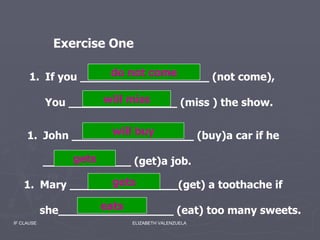
Exercise One If you ___________________ (not come), You ________________ (miss ) the show. do not come will miss John __________________ (buy)a car if he  _____________ (get)a job. will buy gets Mary ________________(get) a toothache if  she_________________ (eat) too many sweets. gets eats
Conditional Sentences Type 2 (Present Subjunctive) Use : Talk about a present or future  improbable  case.  (A case that is  unlikely to happen ) Tense : If-clause ~  Past Tense Main Clause ~  would + an infinitive Example : If he  were  a bird, he  would fly  across the harbour. Past Tense Would + infinitive If I  had  $200,000 now, I  would buy  a car.
Conditional Sentences Type 3 (Past Subjunctive) Use : Talk about a  past, impossible  case  Tense : If-clause ~  Past Perfect Tense Main Clause ~  Would + Present Perfect Form Example : If I  had had  enough money, I  would have bought  the camera yesterday. Past Perfect Tense Would + Present Perfect Form If I  had come  home earlier, I  would not have   missed  the programme.
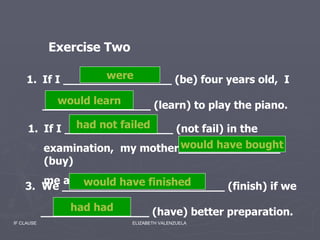
Exercise Two If I ________________ (be) four years old,  I  ________________ (learn) to play the piano.  were would learn If I ________________ (not fail) in the  examination,  my mother_______________  (buy)  me a new computer. had not failed would have bought 3.  We ________________________ (finish) if we  ________________ (have) better preparation. would have finished had had
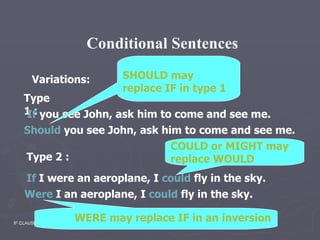
Conditional Sentences Variations: Type 1 : If  you see John, ask him to come and see me. Should  you see John, ask him to come and see me. SHOULD may replace IF in type 1 Type 2 : If  I were an aeroplane, I  could  fly in the sky. Were  I an aeroplane, I  could  fly in the sky. COULD or MIGHT may replace WOULD WERE may replace IF in an inversion
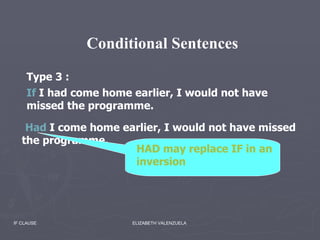
Conditional Sentences Type 3 : If  I had come home earlier, I would not have missed the programme. Had  I come home earlier, I would not have missed  the programme. HAD may replace IF in an inversion
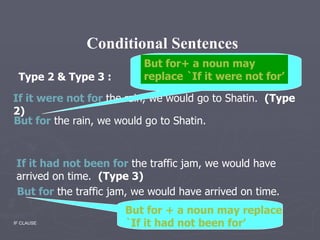
Conditional Sentences Type 2 & Type 3 : If it were not for  the rain, we would go to Shatin.  (Type 2) But for  the rain, we would go to Shatin.  But for+ a noun may replace `If it were not for’ If it had not been for  the traffic jam, we would have arrived on time.  (Type 3) But for  the traffic jam, we would have arrived on time. But for + a noun may replace `If it had not been for’
The Subjunctive Mood Other sentences than the conditional may bear the subjunctive mood. a.  Wish (v) I  wish  I  were  a king.  (But I am not!) I  wish  she  had left  last night. (But she didn’t!) Type 2 Type 3 * Non-subjunctive use of wish I  wish to travel  to Europe next year We wish you a happy birthday.
The Subjunctive Mood b.  If only If only  I  were  you! If only  he  were  born in the USA! (He was  not  born in USA) If only  she  had left  last night! (She did  not  leave last night) Type 2 Type 2 Type 3
The Subjunctive Mood b.  Would rather I  would rather  you  came  earlier. (But you come late.)  Type 2 I  would rather  he  had told  me the secret. (But he didn’t.) Type 3 * Non-subjunctive use of would rather A : Do you want to go fishing today? B : I  would rather stay  at home and  take  some rest. (B prefers staying at home to going fishing)
The Subjunctive Mood d.  Lest (Conjunction) He put the money in the safe  lest  someone  should / might steal  it. e.  It is (high) time It is (high) time  you  studied  hard. (You  have not studied  hard.  Now the examination is near, so you have to study very hard.) Past Tense It is time   for you  to leave (non-subjunctive)
END