Ir para o conteúdo principal
INTRODUCTION
OFHUMAN
ANATOMY&
PHYSIOLOGY
Pawan Kumar Sahu
Lecturer at Rudauli College of
Pharmacy
Introduction to
the Human
Body
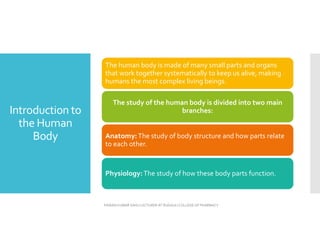
The human body is made of many small parts and organs
that work together systematically to keep us alive, making
humans the most complex living beings.
The study of the human body is divided into two main
branches:
Anatomy:The study of body structure and how parts relate
to each other.
Physiology:The study of how these body parts function.
PAWAN KUMAR SAHU LECTURER AT RUDAULI COLLEGE OF PHARMACY
Levels of
Structural
Organization
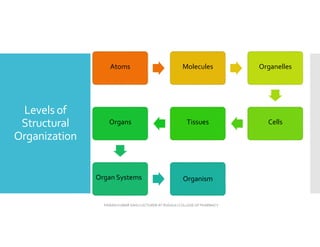
Atoms Molecules Organelles
Cells
Tissues
Organs
Organ Systems Organism
PAWAN KUMAR SAHU LECTURER AT RUDAULI COLLEGE OF PHARMACY
The body is
organized in
increasing
levels of
complexity:
Examples
Description
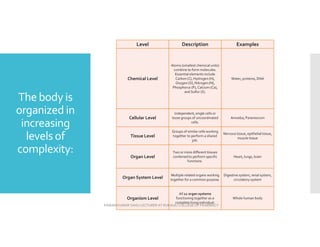
Level
Water, proteins, DNA
Atoms (smallest chemical units)
combine to form molecules.
Essential elements include
Carbon (C), Hydrogen (H),
Oxygen (O), Nitrogen (N),
Phosphorus (P), Calcium (Ca),
and Sulfur (S).
Chemical Level
Amoeba, Paramecium
Independent, single cells or
loose groups of uncoordinated
cells.
Cellular Level
Nervous tissue, epithelial tissue,
muscle tissue
Groups of similar cells working
together to perform a shared
job.
Tissue Level
Heart, lungs, brain
Two or more different tissues
combined to perform specific
functions.
Organ Level
Digestive system, renal system,
circulatory system
Multiple related organs working
together for a common purpose.
Organ System Level
Whole human body
All 11 organ systems
functioning together as a
complete living individual.
Organism Level
PAWAN KUMAR SAHU LECTURER AT RUDAULI COLLEGE OF PHARMACY
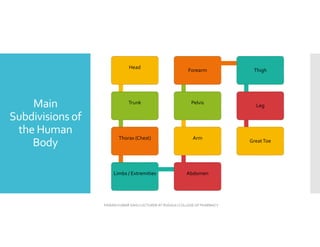
Main
Subdivisions of
the Human
Body
PAWAN KUMAR SAHU LECTURER AT RUDAULI COLLEGE OF PHARMACY
Head
Trunk
Thorax (Chest)
Limbs / Extremities Abdomen
Arm
Pelvis
Forearm Thigh
Leg
GreatToe
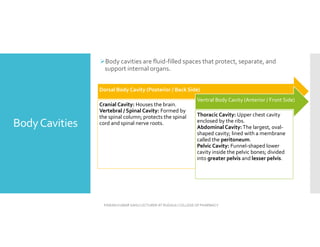
BodyCavities
Body cavities are fluid-filled spaces that protect, separate, and
support internal organs.
Dorsal Body Cavity (Posterior / Back Side)
Cranial Cavity: Houses the brain.
Vertebral / Spinal Cavity: Formed by
the spinal column; protects the spinal
cord and spinal nerve roots.
Ventral Body Cavity (Anterior / Front Side)
Thoracic Cavity: Upper chest cavity
enclosed by the ribs.
Abdominal Cavity:The largest, oval-
shaped cavity; lined with a membrane
called the peritoneum.
Pelvic Cavity: Funnel-shaped lower
cavity inside the pelvic bones; divided
into greater pelvis and lesser pelvis.
PAWAN KUMAR SAHU LECTURER AT RUDAULI COLLEGE OF PHARMACY
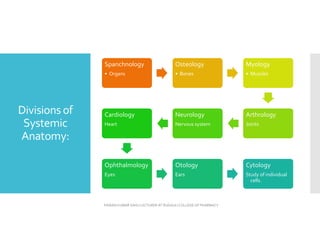
Divisions of
Systemic
Anatomy:
Spanchnology
• Organs
Osteology
• Bones
Myology
• Muscles
Arthrology
Joints
Neurology
Nervous system
Cardiology
Heart
Ophthalmology
Eyes
Otology
Ears
Cytology
Study of individual
cells.
PAWAN KUMAR SAHU LECTURER AT RUDAULI COLLEGE OF PHARMACY
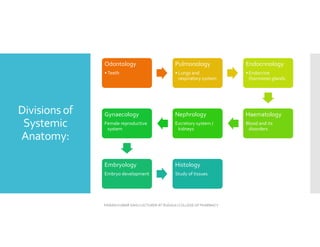
Divisions of
Systemic
Anatomy:
Odontology
• Teeth
Pulmonology
• Lungs and
respiratory system
Endocrinology
• Endocrine
(hormone) glands
Haematology
Blood and its
disorders
Nephrology
Excretory system /
kidneys
Gynaecology
Female reproductive
system
Embryology
Embryo development
Histology
Study of tissues
PAWAN KUMAR SAHU LECTURER AT RUDAULI COLLEGE OF PHARMACY
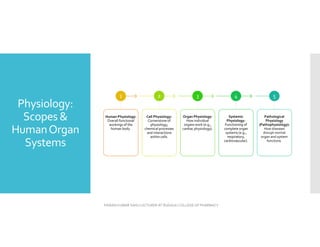
Physiology:
Scopes &
HumanOrgan
Systems
Human Physiology:
Overall functional
workings of the
human body.
1
Human Physiology:
Overall functional
workings of the
human body.
Cell Physiology:
Cornerstone of
physiology;
chemical processes
and interactions
within cells.
2
Cell Physiology:
Cornerstone of
physiology;
chemical processes
and interactions
within cells.
Organ Physiology:
How individual
organs work (e.g.,
cardiac physiology).
3
Organ Physiology:
How individual
organs work (e.g.,
cardiac physiology).
Systemic
Physiology:
Functioning of
complete organ
systems (e.g.,
respiratory,
cardiovascular).
4
Systemic
Physiology:
Functioning of
complete organ
systems (e.g.,
respiratory,
cardiovascular).
5
Pathological
Physiology
(Pathophysiology):
How diseases
disrupt normal
organ and system
functions.
PAWAN KUMAR SAHU LECTURER AT RUDAULI COLLEGE OF PHARMACY
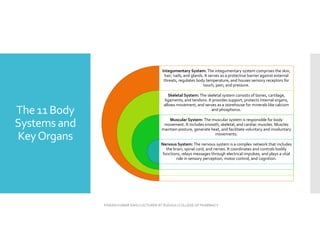
The 11 Body
Systems and
KeyOrgans
Integumentary System:The integumentary system comprises the skin,
hair, nails, and glands. It serves as a protective barrier against external
threats, regulates body temperature, and houses sensory receptors for
touch, pain, and pressure.
Skeletal System:The skeletal system consists of bones, cartilage,
ligaments, and tendons. It provides support, protects internal organs,
allows movement, and serves as a storehouse for minerals like calcium
and phosphorus.
Muscular System: The muscular system is responsible for body
movement. It includes smooth, skeletal, and cardiac muscles. Muscles
maintain posture, generate heat, and facilitate voluntary and involuntary
movements.
Nervous System:The nervous system is a complex network that includes
the brain, spinal cord, and nerves. It coordinates and controls bodily
functions, relays messages through electrical impulses, and plays a vital
role in sensory perception, motor control, and cognition.
PAWAN KUMAR SAHU LECTURER AT RUDAULI COLLEGE OF PHARMACY
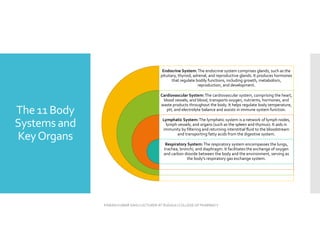
The 11 Body
Systems and
KeyOrgans
Endocrine System:The endocrine system comprises glands, such as the
pituitary, thyroid, adrenal, and reproductive glands. It produces hormones
that regulate bodily functions, including growth, metabolism,
reproduction, and development.
Cardiovascular System:The cardiovascular system, comprising the heart,
blood vessels, and blood, transports oxygen, nutrients, hormones, and
waste products throughout the body. It helps regulate body temperature,
pH, and electrolyte balance and assists in immune system function.
Lymphatic System:The lymphatic system is a network of lymph nodes,
lymph vessels, and organs (such as the spleen and thymus). It aids in
immunity by filtering and returning interstitial fluid to the bloodstream
and transporting fatty acids from the digestive system.
Respiratory System:The respiratory system encompasses the lungs,
trachea, bronchi, and diaphragm. It facilitates the exchange of oxygen
and carbon dioxide between the body and the environment, serving as
the body's respiratory gas exchange system.
PAWAN KUMAR SAHU LECTURER AT RUDAULI COLLEGE OF PHARMACY
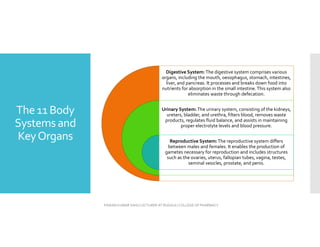
The 11 Body
Systems and
KeyOrgans
Digestive System:The digestive system comprises various
organs, including the mouth, oesophagus, stomach, intestines,
liver, and pancreas. It processes and breaks down food into
nutrients for absorption in the small intestine.This system also
eliminates waste through defecation.
Urinary System:The urinary system, consisting of the kidneys,
ureters, bladder, and urethra, filters blood, removes waste
products, regulates fluid balance, and assists in maintaining
proper electrolyte levels and blood pressure.
Reproductive System:The reproductive system differs
between males and females. It enables the production of
gametes necessary for reproduction and includes structures
such as the ovaries, uterus, fallopian tubes, vagina, testes,
seminal vesicles, prostate, and penis.
PAWAN KUMAR SAHU LECTURER AT RUDAULI COLLEGE OF PHARMACY
THANK
YOU
PAWAN KUMAR SAHU LECTURER AT RUDAULI COLLEGE OF PHARMACY