Comprehensive Overview of Glucose Transport Systems and Homeostasis Regulation
Detailed exploration of GLUT and SGLT transporters, insulin signaling, hormonal regulation, and clinical implications in glucose metabolism and homeostasis.
Comprehensive Overview of Glucose Transport Systems and Homeostasis Regulation
1.
B I OC H E M I S T R Y | C A R B O H Y D R AT E M E TA B O L I S M
Glucose Transport System &
Glucose Homeostasis
GLUT & SGLT transporters, insulin signaling, hormonal regulation, and clinical correlations
1
Glucose Transport & Homeostasis
Amit Kumar Singh
Assistant Professor
Department of Medical Laboratory Science
Chandigarh University
2.
GLUCOSE TRANSPORT
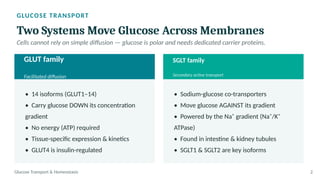
Two SystemsMove Glucose Across Membranes
Cells cannot rely on simple diffusion — glucose is polar and needs dedicated carrier proteins.
GLUT family
Facilitated diffusion
• 14 isoforms (GLUT1–14)
• Carry glucose DOWN its concentration
gradient
• No energy (ATP) required
• Tissue-specific expression & kinetics
• GLUT4 is insulin-regulated
SGLT family
Secondary active transport
• Sodium-glucose co-transporters
• Move glucose AGAINST its gradient
• Powered by the Na⁺ gradient (Na⁺/K⁺
ATPase)
• Found in intestine & kidney tubules
• SGLT1 & SGLT2 are key isoforms
2
Glucose Transport & Homeostasis
3.
G LU COSE TR ANS PO RT
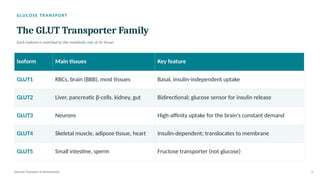
The GLUT Transporter Family
Each isoform is matched to the metabolic role of its tissue.
Isoform Main tissues Key feature
GLUT1 RBCs, brain (BBB), most tissues Basal, insulin-independent uptake
GLUT2 Liver, pancreatic β-cells, kidney, gut Bidirectional; glucose sensor for insulin release
GLUT3 Neurons High-affinity uptake for the brain's constant demand
GLUT4 Skeletal muscle, adipose tissue, heart Insulin-dependent; translocates to membrane
GLUT5 Small intestine, sperm Fructose transporter (not glucose)
3
Glucose Transport & Homeostasis
4.
GLUCOSE TRANSPORT
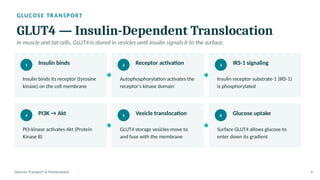
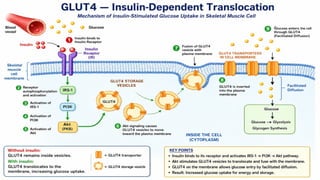
GLUT4 —Insulin-Dependent Translocation
In muscle and fat cells, GLUT4 is stored in vesicles until insulin signals it to the surface.
1 Insulin binds
Insulin binds its receptor (tyrosine
kinase) on the cell membrane
2 Receptor activation
Autophosphorylation activates the
receptor's kinase domain
3 IRS-1 signaling
Insulin receptor substrate-1 (IRS-1)
is phosphorylated
4 PI3K → Akt
PI3-kinase activates Akt (Protein
Kinase B)
5 Vesicle translocation
GLUT4 storage vesicles move to
and fuse with the membrane
6 Glucose uptake
Surface GLUT4 allows glucose to
enter down its gradient
4
Glucose Transport & Homeostasis
6.
G LU COSE TR ANS PO RT
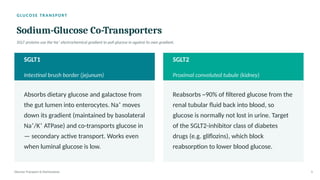
Sodium-Glucose Co-Transporters
SGLT proteins use the Na⁺ electrochemical gradient to pull glucose in against its own gradient.
SGLT1
Intestinal brush border (jejunum)
Absorbs dietary glucose and galactose from
the gut lumen into enterocytes. Na⁺ moves
down its gradient (maintained by basolateral
Na⁺/K⁺ ATPase) and co-transports glucose in
— secondary active transport. Works even
when luminal glucose is low.
SGLT2
Proximal convoluted tubule (kidney)
Reabsorbs ~90% of filtered glucose from the
renal tubular fluid back into blood, so
glucose is normally not lost in urine. Target
of the SGLT2-inhibitor class of diabetes
drugs (e.g. gliflozins), which block
reabsorption to lower blood glucose.
5
Glucose Transport & Homeostasis
7.
G LU COSE TR ANS PO RT
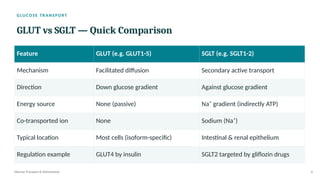
GLUT vs SGLT — Quick Comparison
Feature GLUT (e.g. GLUT1-5) SGLT (e.g. SGLT1-2)
Mechanism Facilitated diffusion Secondary active transport
Direction Down glucose gradient Against glucose gradient
Energy source None (passive) Na⁺ gradient (indirectly ATP)
Co-transported ion None Sodium (Na⁺)
Typical location Most cells (isoform-specific) Intestinal & renal epithelium
Regulation example GLUT4 by insulin SGLT2 targeted by gliflozin drugs
6
Glucose Transport & Homeostasis
8.
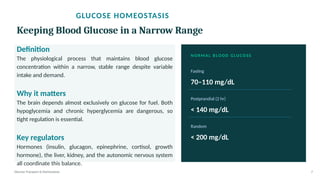
GLUCOSE HOMEOSTASIS
Keeping BloodGlucose in a Narrow Range
Definition
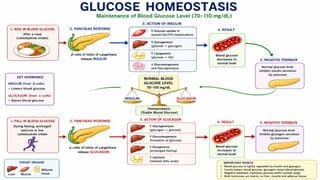
The physiological process that maintains blood glucose
concentration within a narrow, stable range despite variable
intake and demand.
Why it matters
The brain depends almost exclusively on glucose for fuel. Both
hypoglycemia and chronic hyperglycemia are dangerous, so
tight regulation is essential.
Key regulators
Hormones (insulin, glucagon, epinephrine, cortisol, growth
hormone), the liver, kidney, and the autonomic nervous system
all coordinate this balance.
NO R MAL B LO OD G LU CO SE
Fasting
70–110 mg/dL
Postprandial (2 hr)
< 140 mg/dL
Random
< 200 mg/dL
7
Glucose Transport & Homeostasis
10.
G LU CO S E H O M E O S TA S I S
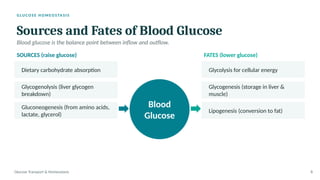
Sources and Fates of Blood Glucose
Blood glucose is the balance point between inflow and outflow.
Blood
Glucose
SOURCES (raise glucose)
Dietary carbohydrate absorption
Glycogenolysis (liver glycogen
breakdown)
Gluconeogenesis (from amino acids,
lactate, glycerol)
FATES (lower glucose)
Glycolysis for cellular energy
Glycogenesis (storage in liver &
muscle)
Lipogenesis (conversion to fat)
8
Glucose Transport & Homeostasis
11.
GLUCOSE HOMEO STASIS
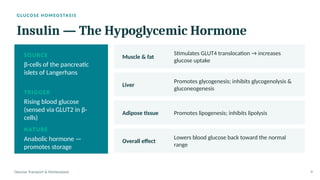
Insulin — The Hypoglycemic Hormone
SOURCE
β-cells of the pancreatic
islets of Langerhans
TRIGGER
Rising blood glucose
(sensed via GLUT2 in β-
cells)
NATURE
Anabolic hormone —
promotes storage
Muscle & fat
Stimulates GLUT4 translocation → increases
glucose uptake
Liver
Promotes glycogenesis; inhibits glycogenolysis &
gluconeogenesis
Adipose tissue Promotes lipogenesis; inhibits lipolysis
Overall effect
Lowers blood glucose back toward the normal
range
9
Glucose Transport & Homeostasis
12.
G LU CO S E H O M E O S TA S I S
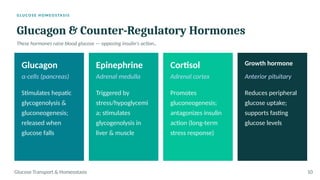
Glucagon & Counter-Regulatory Hormones
These hormones raise blood glucose — opposing insulin's action.
Glucagon
α-cells (pancreas)
Stimulates hepatic
glycogenolysis &
gluconeogenesis;
released when
glucose falls
Epinephrine
Adrenal medulla
Triggered by
stress/hypoglycemi
a; stimulates
glycogenolysis in
liver & muscle
Cortisol
Adrenal cortex
Promotes
gluconeogenesis;
antagonizes insulin
action (long-term
stress response)
Growth hormone
Anterior pituitary
Reduces peripheral
glucose uptake;
supports fasting
glucose levels
10
Glucose Transport & Homeostasis
13.
G LU COSE H OMEO STASI S
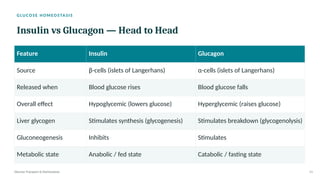
Insulin vs Glucagon — Head to Head
Feature Insulin Glucagon
Source β-cells (islets of Langerhans) α-cells (islets of Langerhans)
Released when Blood glucose rises Blood glucose falls
Overall effect Hypoglycemic (lowers glucose) Hyperglycemic (raises glucose)
Liver glycogen Stimulates synthesis (glycogenesis) Stimulates breakdown (glycogenolysis)
Gluconeogenesis Inhibits Stimulates
Metabolic state Anabolic / fed state Catabolic / fasting state
11
Glucose Transport & Homeostasis
14.
GLUCOSE HOMEOSTASIS
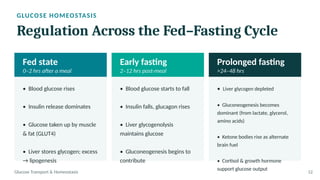
Regulation Acrossthe Fed–Fasting Cycle
Fed state
0–2 hrs after a meal
• Blood glucose rises
• Insulin release dominates
• Glucose taken up by muscle
& fat (GLUT4)
• Liver stores glycogen; excess
→ lipogenesis
Early fasting
2–12 hrs post-meal
• Blood glucose starts to fall
• Insulin falls, glucagon rises
• Liver glycogenolysis
maintains glucose
• Gluconeogenesis begins to
contribute
Prolonged fasting
>24–48 hrs
• Liver glycogen depleted
• Gluconeogenesis becomes
dominant (from lactate, glycerol,
amino acids)
• Ketone bodies rise as alternate
brain fuel
• Cortisol & growth hormone
support glucose output
12
Glucose Transport & Homeostasis
15.
G LU COSE H OMEO STASI S
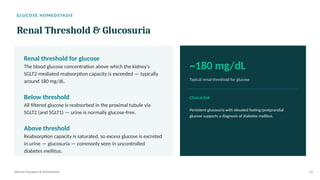
Renal Threshold & Glucosuria
Renal threshold for glucose
The blood glucose concentration above which the kidney's
SGLT2-mediated reabsorption capacity is exceeded — typically
around 180 mg/dL.
Below threshold
All filtered glucose is reabsorbed in the proximal tubule via
SGLT2 (and SGLT1) — urine is normally glucose-free.
Above threshold
Reabsorption capacity is saturated, so excess glucose is excreted
in urine — glucosuria — commonly seen in uncontrolled
diabetes mellitus.
~180 mg/dL
Typical renal threshold for glucose
Clinical link
Persistent glucosuria with elevated fasting/postprandial
glucose supports a diagnosis of diabetes mellitus.
13
Glucose Transport & Homeostasis
16.
G LU COSE H OMEO STASI S
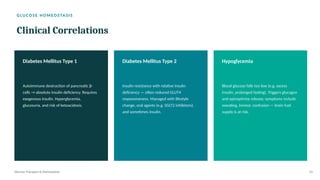
Clinical Correlations
Diabetes Mellitus Type 1
Autoimmune destruction of pancreatic β-
cells → absolute insulin deficiency. Requires
exogenous insulin. Hyperglycemia,
glucosuria, and risk of ketoacidosis.
Diabetes Mellitus Type 2
Insulin resistance with relative insulin
deficiency — often reduced GLUT4
responsiveness. Managed with lifestyle
change, oral agents (e.g. SGLT2 inhibitors),
and sometimes insulin.
Hypoglycemia
Blood glucose falls too low (e.g. excess
insulin, prolonged fasting). Triggers glucagon
and epinephrine release; symptoms include
sweating, tremor, confusion — brain fuel
supply is at risk.
14
Glucose Transport & Homeostasis