Comprehensive Overview of Drugs Used in Shock Therapy and Management
Detailed insights into types, causes, symptoms, and pharmacological treatments of shock including hypovolemic, cardiogenic, anaphylactic, septic, and neurogenic shock.
Comprehensive Overview of Drugs Used in Shock Therapy and Management
2.
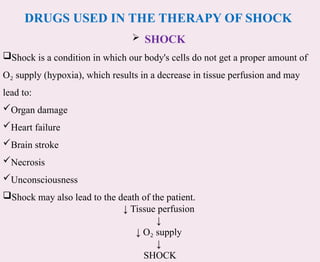
DRUGS USED INTHE THERAPY OF SHOCK
SHOCK
Shock is a condition in which our body's cells do not get a proper amount of
O supply (hypoxia), which results in a decrease in tissue perfusion and may
₂
lead to:
Organ damage
Heart failure
Brain stroke
Necrosis
Unconsciousness
Shock may also lead to the death of the patient.
↓ Tissue perfusion
↓
↓ O supply
₂
↓
SHOCK
3.
CAUSES OF SHOCK
1.Decrease in blood volume (blood supply)
This may occur due to:
Excessive loss of body fluids
Haemorrhage – escape of blood due to rupture of blood vessels
Severe burns
Dehydration
Allergic reactions
Diarrhoea
Poisoning, etc.
SIGNS AND SYMPTOMS OF SHOCK
Nausea and vomiting
Pale skin due to lack of blood supply
Shortness of breathing
Cold hands and feet
4.
TYPES OFSHOCK
1. Hypovolemic shock
2. Cardiogenic shock
3. Anaphylactic shock
4. Septic shock
5. Neurogenic shock
1. HYPOVOLEMIC SHOCK
Hypo = Low & Volemic = Volume
Therefore: Hypovolemic = Low volume of blood
It is a type of shock caused due to a low volume of blood.
Causes
Blood loss
Electrolyte loss
Trauma
Diarrhoea
Haemorrhage
Vomiting, etc.
5.
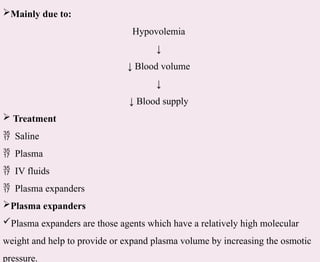
Mainly due to:
Hypovolemia
↓
↓Blood volume
↓
↓ Blood supply
Treatment
Saline
Plasma
IV fluids
Plasma expanders
Plasma expanders
Plasma expanders are those agents which have a relatively high molecular
weight and help to provide or expand plasma volume by increasing the osmotic
pressure.
6.
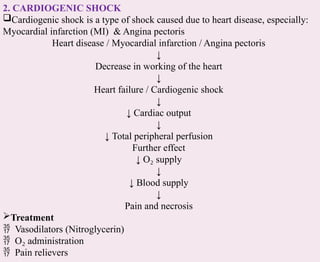
2. CARDIOGENIC SHOCK
Cardiogenicshock is a type of shock caused due to heart disease, especially:
Myocardial infarction (MI) & Angina pectoris
Heart disease / Myocardial infarction / Angina pectoris
↓
Decrease in working of the heart
↓
Heart failure / Cardiogenic shock
↓
↓ Cardiac output
↓
↓ Total peripheral perfusion
Further effect
↓ O supply
₂
↓
↓ Blood supply
↓
Pain and necrosis
Treatment
Vasodilators (Nitroglycerin)
O administration
₂
Pain relievers
7.
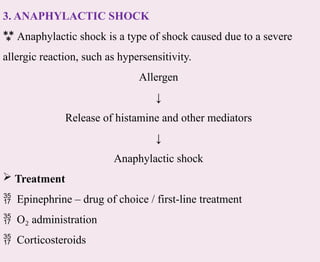
3. ANAPHYLACTIC SHOCK
Anaphylactic shock is a type of shock caused due to a severe
allergic reaction, such as hypersensitivity.
Allergen
↓
Release of histamine and other mediators
↓
Anaphylactic shock
Treatment
Epinephrine – drug of choice / first-line treatment
O administration
₂
Corticosteroids
8.
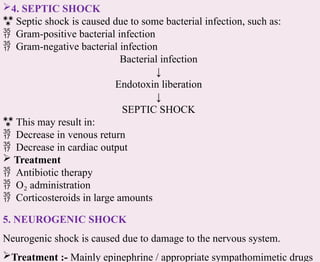
4. SEPTIC SHOCK
Septic shock is caused due to some bacterial infection, such as:
Gram-positive bacterial infection
Gram-negative bacterial infection
Bacterial infection
↓
Endotoxin liberation
↓
SEPTIC SHOCK
This may result in:
Decrease in venous return
Decrease in cardiac output
Treatment
Antibiotic therapy
O administration
₂
Corticosteroids in large amounts
5. NEUROGENIC SHOCK
Neurogenic shock is caused due to damage to the nervous system.
Treatment :- Mainly epinephrine / appropriate sympathomimetic drugs
9.
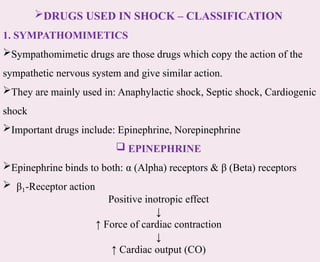
DRUGS USED INSHOCK – CLASSIFICATION
1. SYMPATHOMIMETICS
Sympathomimetic drugs are those drugs which copy the action of the
sympathetic nervous system and give similar action.
They are mainly used in: Anaphylactic shock, Septic shock, Cardiogenic
shock
Important drugs include: Epinephrine, Norepinephrine
EPINEPHRINE
Epinephrine binds to both: α (Alpha) receptors & β (Beta) receptors
β -
₁ Receptor action
Positive inotropic effect
↓
↑ Force of cardiac contraction
↓
↑ Cardiac output (CO)
10.
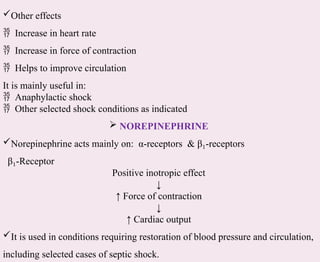
Other effects
Increasein heart rate
Increase in force of contraction
Helps to improve circulation
It is mainly useful in:
Anaphylactic shock
Other selected shock conditions as indicated
NOREPINEPHRINE
Norepinephrine acts mainly on: α-receptors & β -
₁ receptors
β -
₁ Receptor
Positive inotropic effect
↓
↑ Force of contraction
↓
↑ Cardiac output
It is used in conditions requiring restoration of blood pressure and circulation,
including selected cases of septic shock.
11.
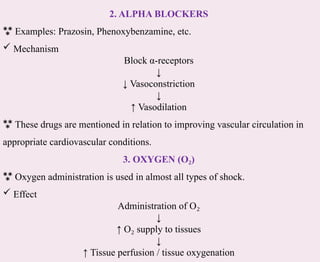
2. ALPHA BLOCKERS
Examples: Prazosin, Phenoxybenzamine, etc.
Mechanism
Block α-receptors
↓
↓ Vasoconstriction
↓
↑ Vasodilation
These drugs are mentioned in relation to improving vascular circulation in
appropriate cardiovascular conditions.
3. OXYGEN (O )
₂
Oxygen administration is used in almost all types of shock.
Effect
Administration of O₂
↓
↑ O supply to tissues
₂
↓
↑ Tissue perfusion / tissue oxygenation
12.
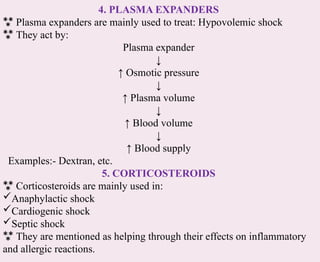
4. PLASMA EXPANDERS
Plasma expanders are mainly used to treat: Hypovolemic shock
They act by:
Plasma expander
↓
↑ Osmotic pressure
↓
↑ Plasma volume
↓
↑ Blood volume
↓
↑ Blood supply
Examples:- Dextran, etc.
5. CORTICOSTEROIDS
Corticosteroids are mainly used in:
Anaphylactic shock
Cardiogenic shock
Septic shock
They are mentioned as helping through their effects on inflammatory
and allergic reactions.