Celebrating World Heritage Day: India's UNESCO Treasures & Conservation
Explore India's 44 UNESCO World Heritage Sites, focusing on Rajasthan's forts, Jaipur's urban planning, and Keoladeo National Park. Learn heritage significance, conservation challenges, and how to become a heritage guardian.
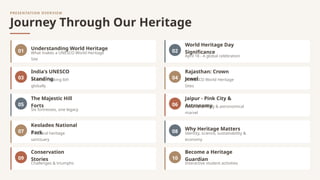
PRESENTATION OVERVIEW
Journey ThroughOur Heritage
01
Understanding World Heritage
What makes a UNESCO World Heritage
Site
02
World Heritage Day
Significance
April 18 - A global celebration
03
India's UNESCO
Standing
44 sites, ranking 6th
globally
04
Rajasthan: Crown
Jewel
9 UNESCO World Heritage
Sites
05
The Majestic Hill
Forts
Six fortresses, one legacy
06
Jaipur - Pink City &
Astronomy
Urban planning & astronomical
marvel
07
Keoladeo National
Park
A natural heritage
sanctuary
08
Why Heritage Matters
Identity, science, sustainability &
economy
09
Conservation
Stories
Challenges & triumphs
10
Become a Heritage
Guardian
Interactive student activities
3.
FOUNDATION
What is aUNESCO
World Heritage Site?
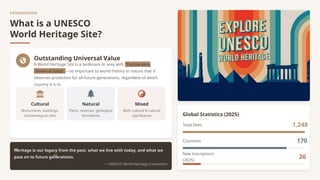
Outstanding Universal Value
A World Heritage Site is a landmark or area with "Outstanding
Universal Value" —so important to world history or nature that it
deserves protection for all future generations, regardless of which
country it is in.
Cultural
Monuments, buildings,
archaeological sites
Natural
Parks, reserves, geological
formations
Mixed
Both cultural & natural
significance
Heritage is our legacy from the past, what we live with today, and what we
pass on to future generations.
— UNESCO World Heritage Convention
Global Statistics (2025)
Total Sites 1,248
Countries 170
New Inscriptions
(2025)
26
4.
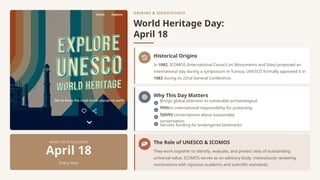
MARK YOUR CALENDAR
April18
Every Year
ORIGINS & SIGNIFICANCE
World Heritage Day:
April 18
Historical Origins
In 1982, ICOMOS (International Council on Monuments and Sites) proposed an
international day during a symposium in Tunisia. UNESCO formally approved it in
1983 during its 22nd General Conference.
Why This Day Matters
Brings global attention to vulnerable archaeological
sites
Fosters international responsibility for protecting
history
Sparks conversations about sustainable
conservation
Secures funding for endangered landmarks
The Role of UNESCO & ICOMOS
They work together to identify, evaluate, and protect sites of outstanding
universal value. ICOMOS serves as an advisory body, meticulously reviewing
nominations with rigorous academic and scientific standards.
5.
GLOBAL RECOGNITION
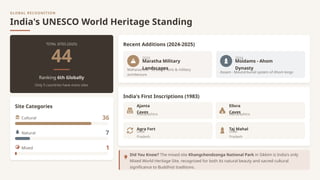
India's UNESCOWorld Heritage Standing
TOTAL SITES (2025)
44
Ranking 6th Globally
Only 5 countries have more sites
Site Categories
Cultural 36
Natural 7
Mixed 1
Recent Additions (2024-2025)
2025
Maratha Military
Landscapes
Maharashtra - Strategic forts & military
architecture
2024
Moidams - Ahom
Dynasty
Assam - Mound-burial system of Ahom kings
India's First Inscriptions (1983)
Ajanta
Caves
Maharashtra
Ellora
Caves
Maharashtra
Agra Fort
Uttar
Pradesh
Taj Mahal
Uttar
Pradesh
Did You Know? The mixed site Khangchendzonga National Park in Sikkim is India's only
Mixed World Heritage Site, recognized for both its natural beauty and sacred cultural
significance to Buddhist traditions.
6.
THE LAND OFKINGS
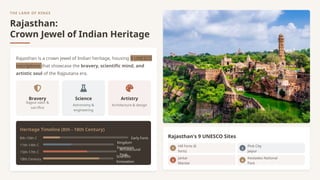
Rajasthan:
Crown Jewel of Indian Heritage
Rajasthan is a crown jewel of Indian heritage, housing 9 UNESCO
inscriptions that showcase the bravery, scientific mind, and
artistic soul of the Rajputana era.
Bravery
Rajput valor &
sacrifice
Science
Astronomy &
engineering
Artistry
Architecture & design
Heritage Timeline (8th - 18th Century)
8th-10th C Early Forts
11th-14th C
Kingdom
Expansion
15th-17th C
Architectural
Peak
18th Century
Scientific
Innovation
Rajasthan's 9 UNESCO Sites
1
Hill Forts (6
forts)
2
Pink City
Jaipur
3
Jantar
Mantar
4
Keoladeo National
Park
7.
SERIAL WORLD HERITAGESITE • INSCRIBED 2013
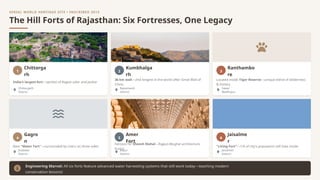
The Hill Forts of Rajasthan: Six Fortresses, One Legacy
1
Chittorga
rh
India's largest fort—symbol of Rajput valor and Jauhar
Chittorgarh
District
2
Kumbhalga
rh
36 km wall—2nd longest in the world after Great Wall of
China
Rajsamand
District
3
Ranthambo
re
Located inside Tiger Reserve—unique blend of wilderness
& history
Sawai
Madhopur
4
Gagro
n
Rare "Water Fort"—surrounded by rivers on three sides
Jhalawar
District
5
Amer
Fort
Famous for Sheesh Mahal—Rajput-Mughal architecture
fusion
Jaipur
District
6
Jaisalme
r
"Living Fort"—1/4 of city's population still lives inside
Jaisalmer
District
Engineering Marvel: All six forts feature advanced water harvesting systems that still work today—teaching modern
conservation lessons!
8.
TWO UNESCO SITESIN ONE CITY
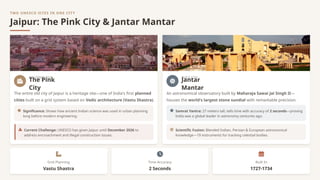
Jaipur: The Pink City & Jantar Mantar
INSCRIBED 2019
The Pink
City
The entire old city of Jaipur is a heritage site—one of India's first planned
cities built on a grid system based on Vedic architecture (Vastu Shastra).
Significance: Shows how ancient Indian science was used in urban planning
long before modern engineering.
Current Challenge: UNESCO has given Jaipur until December 2026 to
address encroachment and illegal construction issues.
BUILT 1734
Jantar
Mantar
An astronomical observatory built by Maharaja Sawai Jai Singh II—
houses the world's largest stone sundial with remarkable precision.
Samrat Yantra: 27 meters tall, tells time with accuracy of 2 seconds—proving
India was a global leader in astronomy centuries ago.
Scientific Fusion: Blended Indian, Persian & European astronomical
knowledge—19 instruments for tracking celestial bodies.
Grid Planning
Vastu Shastra
Time Accuracy
2 Seconds
Built In
1727-1734
9.
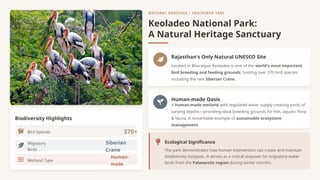
Biodiversity Highlights
Bird Species370+
Migratory
Birds
Siberian
Crane
Wetland Type
Human-
made
NATURAL HERITAGE • INSCRIBED 1985
Keoladeo National Park:
A Natural Heritage Sanctuary
Rajasthan's Only Natural UNESCO Site
Located in Bharatpur, Keoladeo is one of the world's most important
bird breeding and feeding grounds, hosting over 370 bird species
including the rare Siberian Crane.
Human-made Oasis
A human-made wetland with regulated water supply creating pools of
varying depths—providing ideal breeding grounds for fish, aquatic flora
& fauna. A remarkable example of sustainable ecosystem
management.
Ecological Significance
The park demonstrates how human intervention can create and maintain
biodiversity hotspots. It serves as a critical stopover for migratory water
birds from the Palaearctic region during winter months.
10.
BEYOND OLD BUILDINGS
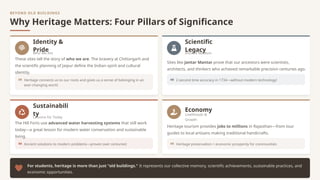
WhyHeritage Matters: Four Pillars of Significance
Identity &
Pride
Who We Are
These sites tell the story of who we are. The bravery at Chittorgarh and
the scientific planning of Jaipur define the Indian spirit and cultural
identity.
Heritage connects us to our roots and gives us a sense of belonging in an
ever-changing world.
Scientific
Legacy
Ancient Wisdom
Sites like Jantar Mantar prove that our ancestors were scientists,
architects, and thinkers who achieved remarkable precision centuries ago.
2-second time accuracy in 1734—without modern technology!
Sustainabili
ty
Lessons for Today
The Hill Forts use advanced water harvesting systems that still work
today—a great lesson for modern water conservation and sustainable
living.
Ancient solutions to modern problems—proven over centuries!
Economy
Livelihoods &
Growth
Heritage tourism provides jobs to millions in Rajasthan—from tour
guides to local artisans making traditional handicrafts.
Heritage preservation = economic prosperity for communities
For students, heritage is more than just "old buildings." It represents our collective memory, scientific achievements, sustainable practices, and
economic opportunities.
11.
THE REALITY OFPRESERVATION
Conservation: Challenges & Success Stories
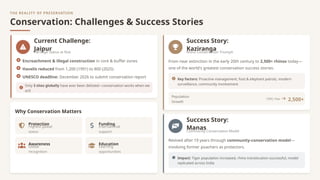
Current Challenge:
Jaipur
Heritage Status at Risk
Encroachment & illegal construction in core & buffer zones
Havelis reduced from 1,200 (1991) to 800 (2025)
UNESCO deadline: December 2026 to submit conservation report
Only 3 sites globally have ever been delisted—conservation works when we
act!
Why Conservation Matters
Protection
Highest global
status
Funding
International
support
Awareness
Global
recognition
Education
Learning
opportunities
Success Story:
Kaziranga
Rhino Conservation Triumph
From near extinction in the early 20th century to 2,500+ rhinos today—
one of the world's greatest conservation success stories.
Key factors: Proactive management, foot & elephant patrols, modern
surveillance, community involvement
Population
Growth
1905: Few 2,500+
Success Story:
Manas
Community Conservation Model
Revived after 19 years through community-conservation model—
involving former poachers as protectors.
Impact: Tiger population increased, rhino translocation successful, model
replicated across India
12.
TAKE ACTION
Become aHeritage Guardian
Heritage preservation starts with you! Engage with these interactive
activities.
The Wall Challenge
Kumbhalgarh's wall is 36 km long.
Calculate how many times you'd run
around your school playground to
match it!
Math + Heritage = Fun!
Sustainability Detective
Research how Jaisalmer Fort stays
cool in 45°C desert heat without air
conditioning.
Hint: Stone carving & ventilation
Conservation Poster
Design a "Save Our Heritage" poster
focused on preventing littering at
historical monuments.
Art + Awareness = Impact!
FUN FACT
Jaisalmer Fort is called "Sonar Quilla" (Golden Fort) because its yellow
sandstone walls turn a brilliant honey-gold at sunset!
Every visit, every photo, every share helps preserve our heritage for
future generations!