Assessing ICT Students' Knowledge on Computer Devices: A Tech Check Study
This study evaluates ICT students' understanding of computer devices, focusing on identification, functions, and practical use to improve ICT education at Commissioner Luis R. Asis National High School.
Assessing ICT Students' Knowledge on Computer Devices: A Tech Check Study
1.
TECH CHECK LEVELOF KNOWLEDGE ON
COMPUTER DEVICES AMONG ICT
STUDENTS
Presented by: Group 2
1
2.
Abstract
This study, "TechCheck: Level Of Knowledge Of ICT Students On
Computer Devices" aims to assess how well ICT students at
Commissioner Luis R. Asis National High School know computer
devices for S.Y. 2026–2027. Using a survey, it will check their
demographic profile and their level of knowledge on identification,
functions, and basic use of computer devices. Anchored on
Constructivist Learning Theory, the study wants to identify gaps so
that practical ICT skills and instruction can be improved.
CHAPTER 1
3.
Background of theStudy
ICT students are expected to understand computer hardware
and software, operating systems, networking, cybersecurity,
repairs, upgrades, and other technologies.
In reality, some ICT students have limited knowledge of
computer devices and struggle to identify components and
understand their functions.
This can make troubleshooting, maintenance, laboratory tasks,
and practical activities more difficult.
The study determines the students’ level of knowledge of
computer devices and identifies strengths and weaknesses that
may help improve practical skills. 3
4.
Statement of theProblem
Main purpose: determine the level of knowledge of students on
computer devices, including their functions, uses, and
importance.
1. What is the demographic profile of the respondents in terms
of age, gender, and grade level?
2. What is the level of knowledge of ICT students on computer
devices in terms of identification, functions, and basic use?
3. What is the overall knowledge of computer devices among ICT
students?
4
5.
Scope and Limitationof the Study
Focus: the level of knowledge of ICT students on computer
devices.
Locale: Commissioner Luis R. Asis National High School.
School Year: 2026–2027.
Design: descriptive quantitative research.
Data were gathered through a researcher-made survey
questionnaire and analyzed using frequency, percentage, mean,
and mean of means with a rating scale.
6
6.
Framework of theStudy
The study is anchored on Constructivist Learning Theory, as
discussed by Schunk (2020).
The theory states that students learn more effectively through
active, meaningful, and hands-on learning experiences.
For ICT students, identifying components, assembling systems,
and troubleshooting problems connect theoretical concepts with
real-world applications.
Therefore, the theory provides a foundation for assessing ICT
students’ hardware and device knowledge.
5
7.
Definition of Terms
Computerdevices — physical hardware that works together to
accept input, process data, store information, or deliver output.
ICT students — learners enrolled in Information and
Communications Technology programs who develop knowledge
and skills in computer systems, software, networking, and
hardware.
Level of knowledge — the degree of students’ understanding,
familiarity, and ability to identify, explain, and apply concepts
related to computer devices.
Functions of computer devices — the roles of hardware
components such as input, output, storage, processing, and
communication.
Uses of computer devices — how physical hardware is used to 7
8.
Review of RelatedLiterature
Local
Perlas, Ea, Rex Flejoles, and Rocel Marie Gelera (2025) studied ICT
competency and computer attitudes among Computer Studies
students at Iloilo Science and Technology University — Miagao
Campus.
The study examined practical ICT skills across factors such as
age, gender, computer experience, class section, and computer
access.
It also considered students’ confidence and attitudes toward ICT
learning.
The findings may help improve ICT instruction and support 8
9.
Review of RelatedLiterature
International
Valverde-Berrocoso, Acevedo-Borrega, and Gerezo Pizarro (2022)
conducted a systematic review on educational technology and
learning environments.
The review examined how digital tools affect academic
performance, technical competence, and learning outcomes.
It considered online platforms, interactive tools, and AI
applications, as well as challenges such as accessibility, training,
and engagement.
The findings provide insights for educators and policymakers on
using technology to improve education. 9
10.
Synthesis
Both studies highlightthe importance of educational technology
and digital literacy in modern learning.
International literature shows that integrating digital tools can
affect student learning outcomes.
Local literature shows that ICT competency and attitudes can be
shaped by access, experience, and demographic factors.
Together, the literature supports assessing students’ current
technology knowledge and skill levels, especially in relation to
practical access and familiarity.
10
Research Design
The studyuses a descriptive quantitative research design.
It collects and analyzes numerical data to describe the current
level of ICT students’ knowledge of computer hardware and
devices.
No variables are manipulated because the study focuses on
describing the existing level of knowledge.
12
13.
Respondents of theStudy
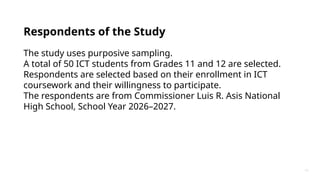
The study uses purposive sampling.
A total of 50 ICT students from Grades 11 and 12 are selected.
Respondents are selected based on their enrollment in ICT
coursework and their willingness to participate.
The respondents are from Commissioner Luis R. Asis National
High School, School Year 2026–2027.
13
14.
Sampling Size
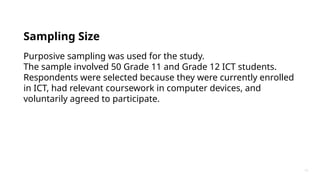
Purposive samplingwas used for the study.
The sample involved 50 Grade 11 and Grade 12 ICT students.
Respondents were selected because they were currently enrolled
in ICT, had relevant coursework in computer devices, and
voluntarily agreed to participate.
15
15.
Research Instrument
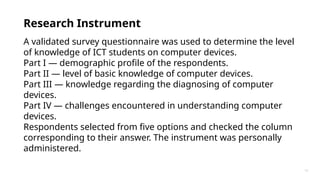
A validatedsurvey questionnaire was used to determine the level
of knowledge of ICT students on computer devices.
Part I — demographic profile of the respondents.
Part II — level of basic knowledge of computer devices.
Part III — knowledge regarding the diagnosing of computer
devices.
Part IV — challenges encountered in understanding computer
devices.
Respondents selected from five options and checked the column
corresponding to their answer. The instrument was personally
administered.
16
16.
Data Analysis Procedure
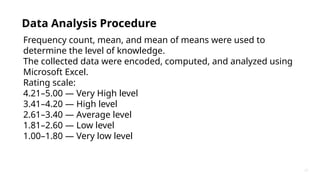
Frequencycount, mean, and mean of means were used to
determine the level of knowledge.
The collected data were encoded, computed, and analyzed using
Microsoft Excel.
Rating scale:
4.21–5.00 — Very High level
3.41–4.20 — High level
2.61–3.40 — Average level
1.81–2.60 — Low level
1.00–1.80 — Very low level
17